Te Ao Maori Concepts: Treaty of Waitangi and Midwifery Initiatives
VerifiedAdded on 2022/10/15
|11
|2713
|89
Essay
AI Summary
This essay delves into the core concepts of Te Ao Maori, including Tikanga, manaakitanga, kaitiakitanga, and kotahitanga, illustrating their importance in Maori culture. It examines the profound impacts of colonization, urbanization, and legislation on Maori identity, Hauora Maori, and traditional birthing practices. Furthermore, the essay discusses the significance of the Treaty of Waitangi articles in the context of healthcare provision to Maori, emphasizing the incorporation of culturally sensitive initiatives and guidelines in midwifery practices to support Wahine Maori and Whanau, ultimately aiming to reshape Maori identity and reclaim Tino Rangatiratanga. Desklib offers a range of similar solved assignments and study resources for students.
Running head: TE AO MAORI CONCEPTS
Te Ao Maori Concepts
Name of the Student
Name of the University
Author Note
Te Ao Maori Concepts
Name of the Student
Name of the University
Author Note

Paraphrase This Document
Need a fresh take? Get an instant paraphrase of this document with our AI Paraphraser
1
TE AO MAORI CONCEPTS
Table of Contents
Concepts of Te Ao Maori...........................................................................................................2
Discussion of various impacts on Maori identity.......................................................................3
Description of the significance of te Tiriti o Waitangi articles..................................................5
Discussion of incorporation of initiatives in the midwifery practices.......................................6
References..................................................................................................................................8
TE AO MAORI CONCEPTS
Table of Contents
Concepts of Te Ao Maori...........................................................................................................2
Discussion of various impacts on Maori identity.......................................................................3
Description of the significance of te Tiriti o Waitangi articles..................................................5
Discussion of incorporation of initiatives in the midwifery practices.......................................6
References..................................................................................................................................8
2
TE AO MAORI CONCEPTS
Concepts of Te Ao Maori
The people of Maori possess a very special method of linking with the world that exists
around them. The traditional rules, laws or customs for overseeing of the life in the form of
Maori is dictated by a concept which is referred to as Tikanga. The word Tika derives the
word Tikanga that can also be interpreted in the form of truth, fairness or even correctness
(Eketone et al., 2016). There are various kinds of concepts of Te Ao Maori that is lived by the
Maori people and which holds some meaning to it.
The first concept is known as manaakitanga whose meaning is extending of aroha and
aroha means compassion and love to everybody. It is discovered in various acts like the
helping of the people who are loved, encouragement of each other or providing of support as
well as assistance to a stranger who is not at all known. Manaakitanga stands as one of the
most important concepts of Te Ao M aori or to the people of Maori as it is helpful in securing
the strength of all the whanau as well as the communities and the meaning of whanau
indicates towards families (Harmsworth et al., 2016). Manaakitanga can be extended by the
process of sending of the messages to the loved people. It can also be extended by cooking a
special meal for somebody. It can also be extended by the method of taking over the job or
chore of someone.
The next concept of Te Ao Maori is kaitiakitanga. In terms of the language of Maori or Te
Reo Maori, the kaitiakitanga depicts towards a guardian. The method of offering of
kaitiakitanga is equivalent to that of offering to the sea, land as well as sky. The earth is
believed by the people of Maori to be a taonga or a gift from their ancentors which in turn
should always be protected. The kaitiakitanga can be extended by the process of conserving
as well as respecting the earth along with being mindful regarding the behaviours of the
individuals. It can also be extended by giving back to their land in any of the method (Henry
TE AO MAORI CONCEPTS
Concepts of Te Ao Maori
The people of Maori possess a very special method of linking with the world that exists
around them. The traditional rules, laws or customs for overseeing of the life in the form of
Maori is dictated by a concept which is referred to as Tikanga. The word Tika derives the
word Tikanga that can also be interpreted in the form of truth, fairness or even correctness
(Eketone et al., 2016). There are various kinds of concepts of Te Ao Maori that is lived by the
Maori people and which holds some meaning to it.
The first concept is known as manaakitanga whose meaning is extending of aroha and
aroha means compassion and love to everybody. It is discovered in various acts like the
helping of the people who are loved, encouragement of each other or providing of support as
well as assistance to a stranger who is not at all known. Manaakitanga stands as one of the
most important concepts of Te Ao M aori or to the people of Maori as it is helpful in securing
the strength of all the whanau as well as the communities and the meaning of whanau
indicates towards families (Harmsworth et al., 2016). Manaakitanga can be extended by the
process of sending of the messages to the loved people. It can also be extended by cooking a
special meal for somebody. It can also be extended by the method of taking over the job or
chore of someone.
The next concept of Te Ao Maori is kaitiakitanga. In terms of the language of Maori or Te
Reo Maori, the kaitiakitanga depicts towards a guardian. The method of offering of
kaitiakitanga is equivalent to that of offering to the sea, land as well as sky. The earth is
believed by the people of Maori to be a taonga or a gift from their ancentors which in turn
should always be protected. The kaitiakitanga can be extended by the process of conserving
as well as respecting the earth along with being mindful regarding the behaviours of the
individuals. It can also be extended by giving back to their land in any of the method (Henry
⊘ This is a preview!⊘
Do you want full access?
Subscribe today to unlock all pages.

Trusted by 1+ million students worldwide
3
TE AO MAORI CONCEPTS
et al., 2018). It can also be extended by the process of reducing, recycling as well as reusing
and also by planting trees. It can also be extended by taking a walk to reach the work place or
riding a bike to work.
The next concept of Te Ao Maori is Kotahitanga which involves the concept of
togetherness among eachother. Maori are very small but at the same time is a unified race as
lifting up of each other is very important, The concept of kotahitanga involves the process of
identification as one in the context of sharing of the earth, extension of ahima which is also
known as support to each and everybody and receiving the same kind of support back. This
concept is very important for the people of Maori as the company of the people of Maori is
termed as whakatauki which means a proverb and the proverb is Kia Kotahi Tatou which
indicated towards everybody as one. This particular proverb is just inclusive of the various
kinds of people staying at the village of Maori (Langer et al., 2017). The concept of
kotahitanga can be extended by the process of joining a team of that plays local sports. It can
also be extended by the process of donation of charities and by saying hello as well as
greeting a stranger.
Discussion of various impacts on Maori identity
Impacts of colonisation
The term colonisation indicates towards a sovereignty loss by a group to the other group.
The impacts of colonisation have is linked with lower levels of numeracy as well as literacy
on the basis of its effects on all the colonised along with the enduring legacy of its own
(Theodore et al., 2016). The expectancies of life of Maori was impacted directly because of
the occurrence of colonisation. The life expectancies got affected due to warfare as well as
various diseases brought in by the settlers which were very common in Europe which
TE AO MAORI CONCEPTS
et al., 2018). It can also be extended by the process of reducing, recycling as well as reusing
and also by planting trees. It can also be extended by taking a walk to reach the work place or
riding a bike to work.
The next concept of Te Ao Maori is Kotahitanga which involves the concept of
togetherness among eachother. Maori are very small but at the same time is a unified race as
lifting up of each other is very important, The concept of kotahitanga involves the process of
identification as one in the context of sharing of the earth, extension of ahima which is also
known as support to each and everybody and receiving the same kind of support back. This
concept is very important for the people of Maori as the company of the people of Maori is
termed as whakatauki which means a proverb and the proverb is Kia Kotahi Tatou which
indicated towards everybody as one. This particular proverb is just inclusive of the various
kinds of people staying at the village of Maori (Langer et al., 2017). The concept of
kotahitanga can be extended by the process of joining a team of that plays local sports. It can
also be extended by the process of donation of charities and by saying hello as well as
greeting a stranger.
Discussion of various impacts on Maori identity
Impacts of colonisation
The term colonisation indicates towards a sovereignty loss by a group to the other group.
The impacts of colonisation have is linked with lower levels of numeracy as well as literacy
on the basis of its effects on all the colonised along with the enduring legacy of its own
(Theodore et al., 2016). The expectancies of life of Maori was impacted directly because of
the occurrence of colonisation. The life expectancies got affected due to warfare as well as
various diseases brought in by the settlers which were very common in Europe which
Paraphrase This Document
Need a fresh take? Get an instant paraphrase of this document with our AI Paraphraser
4
TE AO MAORI CONCEPTS
involved various disease like whooping cough, mumps and measles along with various
diseases related to respiration like tuberculosis as well as bronchitis.
These diseases affected both adults as well as children of Europe. Wars caused the loss of
lands of Maori which lead to displacements of several number of lands of Maori. Loss of land
led to reduction of tribes towards poverty along with the living conditions of the people of
Maori being unhygienic as well as overcrowded. The accessibility to the sources of
traditional food also got lost due to the loosing of the lands which in turn led to the poor
levels of diet and led to the spreading of various kinds of diseases (Lawrenson et al., 2016).
Maori was disadvantaged both economically and socially and led to more poor nutrition and
housing to the people of Maori. Various losses were faced by the people of Maori like power,
land, identity, language, status and culture.
Impacts of urbanisation
After the urbanisation, most of the population of Maori became urban dwellers. It
affected the structure of grouping and identity of Maori. New organizations of Maori were
developed in the urban areas leading to the creation of the new sense of connectedness as
well as community providing the identification of Maori in terms of a pan-tribal context.
Advanced structures that were not related to tribes helped in providing of support for
transforming as well as establishing dislocated Maori inside an urban environment. Fund
raisers were set with various concert parties (Santamaria et al., 2016). There were certain
conflicts that were faced by urban Maori regarding the establishment of the new tribes in the
place of their residence irrespective of the regional area of that particular tribe
Impacts of legislation
In simple words, the term legislation indicates towards the method of making as well as
enacting the various laws. There were various laws that were incorporated in the customs of
TE AO MAORI CONCEPTS
involved various disease like whooping cough, mumps and measles along with various
diseases related to respiration like tuberculosis as well as bronchitis.
These diseases affected both adults as well as children of Europe. Wars caused the loss of
lands of Maori which lead to displacements of several number of lands of Maori. Loss of land
led to reduction of tribes towards poverty along with the living conditions of the people of
Maori being unhygienic as well as overcrowded. The accessibility to the sources of
traditional food also got lost due to the loosing of the lands which in turn led to the poor
levels of diet and led to the spreading of various kinds of diseases (Lawrenson et al., 2016).
Maori was disadvantaged both economically and socially and led to more poor nutrition and
housing to the people of Maori. Various losses were faced by the people of Maori like power,
land, identity, language, status and culture.
Impacts of urbanisation
After the urbanisation, most of the population of Maori became urban dwellers. It
affected the structure of grouping and identity of Maori. New organizations of Maori were
developed in the urban areas leading to the creation of the new sense of connectedness as
well as community providing the identification of Maori in terms of a pan-tribal context.
Advanced structures that were not related to tribes helped in providing of support for
transforming as well as establishing dislocated Maori inside an urban environment. Fund
raisers were set with various concert parties (Santamaria et al., 2016). There were certain
conflicts that were faced by urban Maori regarding the establishment of the new tribes in the
place of their residence irrespective of the regional area of that particular tribe
Impacts of legislation
In simple words, the term legislation indicates towards the method of making as well as
enacting the various laws. There were various laws that were incorporated in the customs of
5
TE AO MAORI CONCEPTS
Maori where it was convicted of a theft for paying a victim a huge money in the form of
compensation. There were several kinds of laws that affected the Maori lands. Due to this
kinds of laws, many individual groups were abandoned and was claimed weakened. On the
other hand, claim would be based by iwi on the land which in turn will be supported by the
occupation (Ringham et al., 2016). This involved take kite or the land which has been
discovered, take raupatu which indicates towards the land which is taken by conquest, take
tukua which means ther land which is gifted and last but not the least is the take tipuna which
refers to any ancestral right that is validated by the recitation of whakapapa.
Description of the significance of te Tiriti o Waitangi articles
The te Tiriti o Waitangi articles are very significant because this is the foundation
document of the country New Zealand. This particular treaty was passed by the British
Crown representatives along with the chiefs of Maori who also represented by all their sub-
tribes as well. Maori along with all its historical ties as well as common narratives are
indigenous to New Zealand and is extended to Polynesia (Love, 2017). The Tikaka best
practice guidelines consists of taking care of the people in a safe way who belong to various
kinds of cultural groups are the members of those groups who needs to be shown some
tolerance, understanding as well as patience and the people should always been guided by
their own values.
Hiranga or excellence should always be shown to the members of the various cultural
groups. Atawhi or care should also be shown to the members of the various cultural groups
(Rangihau, 2017). Whakaute or respect along with kotahitanga or collaboration should also
be shown towards the members of various cultural groups. The best practices are the
guidelines instead of rules that needs to be applied during any kind of circumstances and the
needs of the patients along with their family must also be considered.
TE AO MAORI CONCEPTS
Maori where it was convicted of a theft for paying a victim a huge money in the form of
compensation. There were several kinds of laws that affected the Maori lands. Due to this
kinds of laws, many individual groups were abandoned and was claimed weakened. On the
other hand, claim would be based by iwi on the land which in turn will be supported by the
occupation (Ringham et al., 2016). This involved take kite or the land which has been
discovered, take raupatu which indicates towards the land which is taken by conquest, take
tukua which means ther land which is gifted and last but not the least is the take tipuna which
refers to any ancestral right that is validated by the recitation of whakapapa.
Description of the significance of te Tiriti o Waitangi articles
The te Tiriti o Waitangi articles are very significant because this is the foundation
document of the country New Zealand. This particular treaty was passed by the British
Crown representatives along with the chiefs of Maori who also represented by all their sub-
tribes as well. Maori along with all its historical ties as well as common narratives are
indigenous to New Zealand and is extended to Polynesia (Love, 2017). The Tikaka best
practice guidelines consists of taking care of the people in a safe way who belong to various
kinds of cultural groups are the members of those groups who needs to be shown some
tolerance, understanding as well as patience and the people should always been guided by
their own values.
Hiranga or excellence should always be shown to the members of the various cultural
groups. Atawhi or care should also be shown to the members of the various cultural groups
(Rangihau, 2017). Whakaute or respect along with kotahitanga or collaboration should also
be shown towards the members of various cultural groups. The best practices are the
guidelines instead of rules that needs to be applied during any kind of circumstances and the
needs of the patients along with their family must also be considered.
⊘ This is a preview!⊘
Do you want full access?
Subscribe today to unlock all pages.
Trusted by 1+ million students worldwide
6
TE AO MAORI CONCEPTS
For the identification of the best response, the circumstances needs to be checked and
behaviour should be shown in goods patient’s interests. The guidelines includes information
and support under which the healthcare will be provided in an environment that is culturally
sensitive. The patients and their family should have knowledge regarding what is taking
place. The next is whanau or the support of the family which is fundamentally very important
to the people of Maori that extends beyond the biological family (Mariott et al., 2015). The
patient along with their family must be supported and encouraged by the staffs regarding
decision making aspects.
Next is the karakia which is also known as prayers or blessings which plays an essential
role in the protection of physical, emotional, spiritual and mental health. The opportunity of
having a blessing as a portion of care of patients must be verbally offered by the staffs. Next
is the food, bedpans and linen under which the restricted things should always be separated
from all the unrestricted things (Nicolson, 2017). The staffs should learn restricted and
unrestricted principles like no utilization of the covers of pillows for any other purpose. Next
is the valuables or taoka under which pious objects are more valuable than sentimental value.
Next is the body parts, substances and tissues under which clear explanation should be
present regarding the options of the tissue (Pugsley, 2015). This also includes pending and
following death which involve the sending the information the family of the patients
regarding the occurrence of patient’s death.
Discussion of incorporation of initiatives in the midwifery practices
The practice of midwifery is underpinned by all the values which is helpful in guiding the
method in which care is provided by the midwives. The role of the appropriate providers of
care is played by the midwives mostly (McCarthy et al., 2016). Women are attended by the
midwives at the time of labour, pregnancy, birth along with the post-natal period and for
TE AO MAORI CONCEPTS
For the identification of the best response, the circumstances needs to be checked and
behaviour should be shown in goods patient’s interests. The guidelines includes information
and support under which the healthcare will be provided in an environment that is culturally
sensitive. The patients and their family should have knowledge regarding what is taking
place. The next is whanau or the support of the family which is fundamentally very important
to the people of Maori that extends beyond the biological family (Mariott et al., 2015). The
patient along with their family must be supported and encouraged by the staffs regarding
decision making aspects.
Next is the karakia which is also known as prayers or blessings which plays an essential
role in the protection of physical, emotional, spiritual and mental health. The opportunity of
having a blessing as a portion of care of patients must be verbally offered by the staffs. Next
is the food, bedpans and linen under which the restricted things should always be separated
from all the unrestricted things (Nicolson, 2017). The staffs should learn restricted and
unrestricted principles like no utilization of the covers of pillows for any other purpose. Next
is the valuables or taoka under which pious objects are more valuable than sentimental value.
Next is the body parts, substances and tissues under which clear explanation should be
present regarding the options of the tissue (Pugsley, 2015). This also includes pending and
following death which involve the sending the information the family of the patients
regarding the occurrence of patient’s death.
Discussion of incorporation of initiatives in the midwifery practices
The practice of midwifery is underpinned by all the values which is helpful in guiding the
method in which care is provided by the midwives. The role of the appropriate providers of
care is played by the midwives mostly (McCarthy et al., 2016). Women are attended by the
midwives at the time of labour, pregnancy, birth along with the post-natal period and for
Paraphrase This Document
Need a fresh take? Get an instant paraphrase of this document with our AI Paraphraser
7
TE AO MAORI CONCEPTS
performing all these activities the midwives collaborate with the professional of health care
whenever required.
One of the guidelines that can be incorporated into the midwifery practices while
supporting the people of Maori along with the support of the family for reaching their
potentials would be the information and support. The main aim of this guideline is providing
of health care in a n environment that is culturally very sensitive and aims in supporting the
total health of the patients. This is appropriate for the people of Maori along with the family
support which is provided to all the patients irrespective of whatever their culture.
The spiritual needs of each and every patients are attended. It is made sure that the patients
along with the families of the patients have knowledge regarding all sorts of activities taking
place along with the availability of support as well as resources like the services related to
translation and the pastoral care along with the availability of support through the services of
disability and health advocacy (Mead, 2016).
Correct pronunciation of names should be ensured along with all the clearly available
information that in turn could be understood by the patient and support should be provided by
the family of the patients (Walker, 2016). Broad interpretation for the understanding of the
offerings along with ensuring the awareness of the patients and their support of family
regarding various services of accommodation before the admission of the patients. The
cultural policy of the hospital is also ensured.
TE AO MAORI CONCEPTS
performing all these activities the midwives collaborate with the professional of health care
whenever required.
One of the guidelines that can be incorporated into the midwifery practices while
supporting the people of Maori along with the support of the family for reaching their
potentials would be the information and support. The main aim of this guideline is providing
of health care in a n environment that is culturally very sensitive and aims in supporting the
total health of the patients. This is appropriate for the people of Maori along with the family
support which is provided to all the patients irrespective of whatever their culture.
The spiritual needs of each and every patients are attended. It is made sure that the patients
along with the families of the patients have knowledge regarding all sorts of activities taking
place along with the availability of support as well as resources like the services related to
translation and the pastoral care along with the availability of support through the services of
disability and health advocacy (Mead, 2016).
Correct pronunciation of names should be ensured along with all the clearly available
information that in turn could be understood by the patient and support should be provided by
the family of the patients (Walker, 2016). Broad interpretation for the understanding of the
offerings along with ensuring the awareness of the patients and their support of family
regarding various services of accommodation before the admission of the patients. The
cultural policy of the hospital is also ensured.

8
TE AO MAORI CONCEPTS
TE AO MAORI CONCEPTS
⊘ This is a preview!⊘
Do you want full access?
Subscribe today to unlock all pages.
Trusted by 1+ million students worldwide
9
TE AO MAORI CONCEPTS
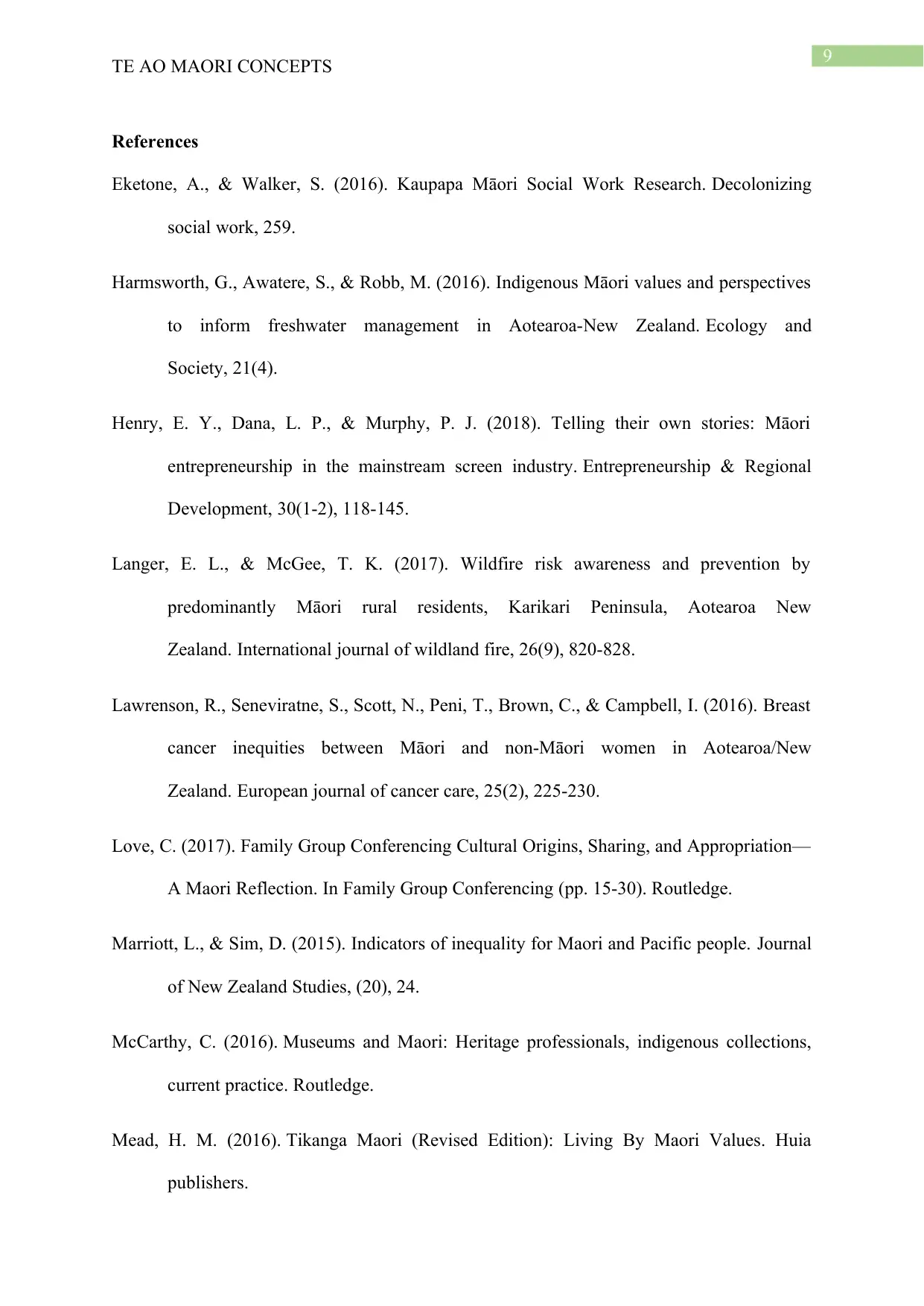
References
Eketone, A., & Walker, S. (2016). Kaupapa Māori Social Work Research. Decolonizing
social work, 259.
Harmsworth, G., Awatere, S., & Robb, M. (2016). Indigenous Māori values and perspectives
to inform freshwater management in Aotearoa-New Zealand. Ecology and
Society, 21(4).
Henry, E. Y., Dana, L. P., & Murphy, P. J. (2018). Telling their own stories: Māori
entrepreneurship in the mainstream screen industry. Entrepreneurship & Regional
Development, 30(1-2), 118-145.
Langer, E. L., & McGee, T. K. (2017). Wildfire risk awareness and prevention by
predominantly Māori rural residents, Karikari Peninsula, Aotearoa New
Zealand. International journal of wildland fire, 26(9), 820-828.
Lawrenson, R., Seneviratne, S., Scott, N., Peni, T., Brown, C., & Campbell, I. (2016). Breast
cancer inequities between Māori and non‐Māori women in Aotearoa/New
Zealand. European journal of cancer care, 25(2), 225-230.
Love, C. (2017). Family Group Conferencing Cultural Origins, Sharing, and Appropriation—
A Maori Reflection. In Family Group Conferencing (pp. 15-30). Routledge.
Marriott, L., & Sim, D. (2015). Indicators of inequality for Maori and Pacific people. Journal
of New Zealand Studies, (20), 24.
McCarthy, C. (2016). Museums and Maori: Heritage professionals, indigenous collections,
current practice. Routledge.
Mead, H. M. (2016). Tikanga Maori (Revised Edition): Living By Maori Values. Huia
publishers.
TE AO MAORI CONCEPTS
References
Eketone, A., & Walker, S. (2016). Kaupapa Māori Social Work Research. Decolonizing
social work, 259.
Harmsworth, G., Awatere, S., & Robb, M. (2016). Indigenous Māori values and perspectives
to inform freshwater management in Aotearoa-New Zealand. Ecology and
Society, 21(4).
Henry, E. Y., Dana, L. P., & Murphy, P. J. (2018). Telling their own stories: Māori
entrepreneurship in the mainstream screen industry. Entrepreneurship & Regional
Development, 30(1-2), 118-145.
Langer, E. L., & McGee, T. K. (2017). Wildfire risk awareness and prevention by
predominantly Māori rural residents, Karikari Peninsula, Aotearoa New
Zealand. International journal of wildland fire, 26(9), 820-828.
Lawrenson, R., Seneviratne, S., Scott, N., Peni, T., Brown, C., & Campbell, I. (2016). Breast
cancer inequities between Māori and non‐Māori women in Aotearoa/New
Zealand. European journal of cancer care, 25(2), 225-230.
Love, C. (2017). Family Group Conferencing Cultural Origins, Sharing, and Appropriation—
A Maori Reflection. In Family Group Conferencing (pp. 15-30). Routledge.
Marriott, L., & Sim, D. (2015). Indicators of inequality for Maori and Pacific people. Journal
of New Zealand Studies, (20), 24.
McCarthy, C. (2016). Museums and Maori: Heritage professionals, indigenous collections,
current practice. Routledge.
Mead, H. M. (2016). Tikanga Maori (Revised Edition): Living By Maori Values. Huia
publishers.
Paraphrase This Document
Need a fresh take? Get an instant paraphrase of this document with our AI Paraphraser
10
TE AO MAORI CONCEPTS
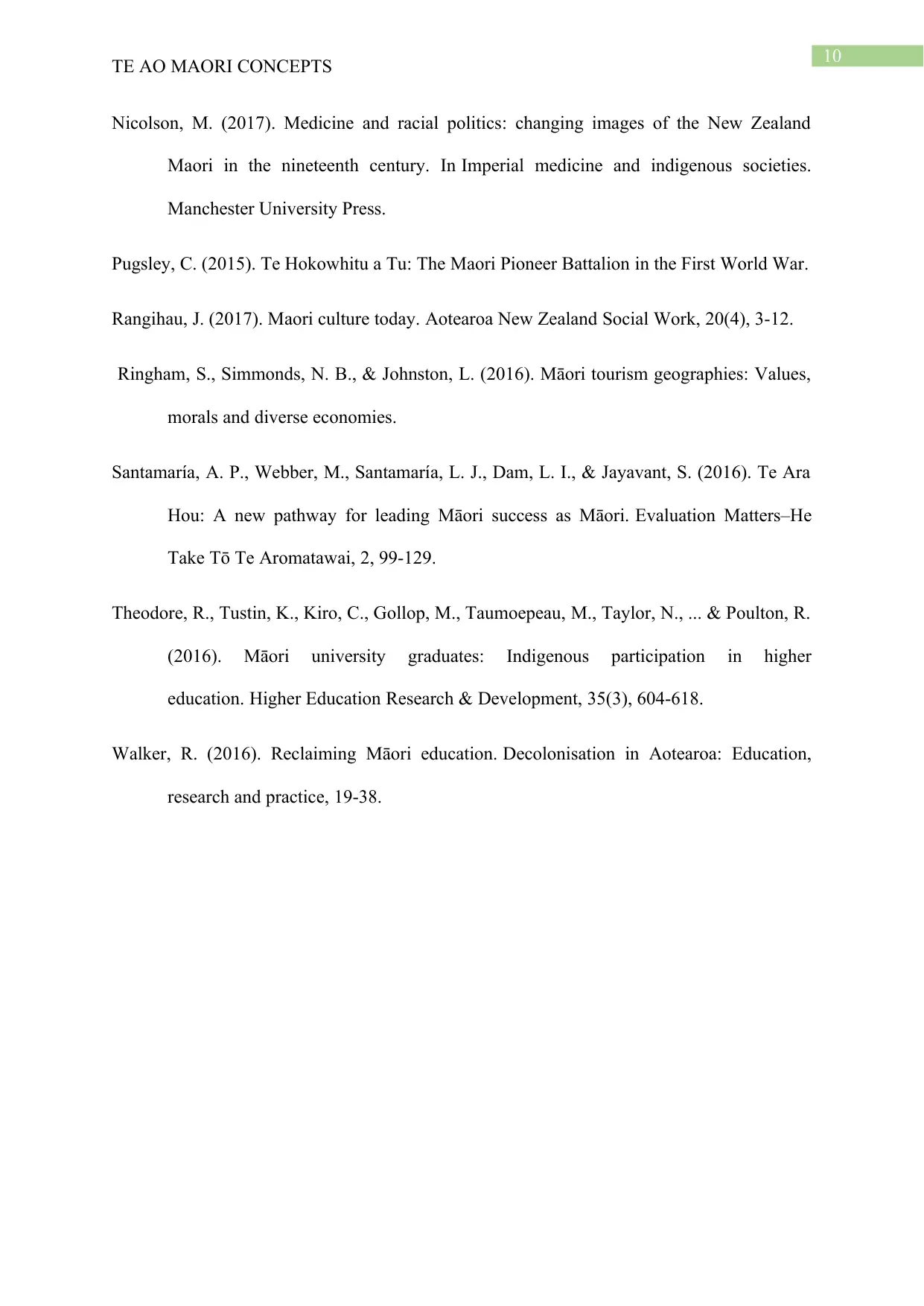
Nicolson, M. (2017). Medicine and racial politics: changing images of the New Zealand
Maori in the nineteenth century. In Imperial medicine and indigenous societies.
Manchester University Press.
Pugsley, C. (2015). Te Hokowhitu a Tu: The Maori Pioneer Battalion in the First World War.
Rangihau, J. (2017). Maori culture today. Aotearoa New Zealand Social Work, 20(4), 3-12.
Ringham, S., Simmonds, N. B., & Johnston, L. (2016). Māori tourism geographies: Values,
morals and diverse economies.
Santamaría, A. P., Webber, M., Santamaría, L. J., Dam, L. I., & Jayavant, S. (2016). Te Ara
Hou: A new pathway for leading Māori success as Māori. Evaluation Matters–He
Take Tō Te Aromatawai, 2, 99-129.
Theodore, R., Tustin, K., Kiro, C., Gollop, M., Taumoepeau, M., Taylor, N., ... & Poulton, R.
(2016). Māori university graduates: Indigenous participation in higher
education. Higher Education Research & Development, 35(3), 604-618.
Walker, R. (2016). Reclaiming Māori education. Decolonisation in Aotearoa: Education,
research and practice, 19-38.
TE AO MAORI CONCEPTS
Nicolson, M. (2017). Medicine and racial politics: changing images of the New Zealand
Maori in the nineteenth century. In Imperial medicine and indigenous societies.
Manchester University Press.
Pugsley, C. (2015). Te Hokowhitu a Tu: The Maori Pioneer Battalion in the First World War.
Rangihau, J. (2017). Maori culture today. Aotearoa New Zealand Social Work, 20(4), 3-12.
Ringham, S., Simmonds, N. B., & Johnston, L. (2016). Māori tourism geographies: Values,
morals and diverse economies.
Santamaría, A. P., Webber, M., Santamaría, L. J., Dam, L. I., & Jayavant, S. (2016). Te Ara
Hou: A new pathway for leading Māori success as Māori. Evaluation Matters–He
Take Tō Te Aromatawai, 2, 99-129.
Theodore, R., Tustin, K., Kiro, C., Gollop, M., Taumoepeau, M., Taylor, N., ... & Poulton, R.
(2016). Māori university graduates: Indigenous participation in higher
education. Higher Education Research & Development, 35(3), 604-618.
Walker, R. (2016). Reclaiming Māori education. Decolonisation in Aotearoa: Education,
research and practice, 19-38.

1 out of 11


Related Documents


Your All-in-One AI-Powered Toolkit for Academic Success.
+13062052269
info@desklib.com
Available 24*7 on WhatsApp / Email
![[object Object]](/_next/static/media/star-bottom.7253800d.svg)
Unlock your academic potential
Copyright © 2020–2026 A2Z Services. All Rights Reserved. Developed and managed by ZUCOL.