Biomedical Engineering Homework Solution with Answers

Verified

Added on  2020/04/01

|9
|1097
|39
Homework Assignment
AI Summary
This document provides a comprehensive solution to a biomedical engineering assignment. It begins with the calculation of Nernst potential using the Nernst equation, detailing the formula and applying it to Na+, K+, and Cl- ions. The assignment then explores anatomical relationships, such as the connections between the mouth, ear, elbow, hand, thoracic cavity, and abdominal cavity. The solution further includes calculations related to alveolar ventilation rate and total ventilation rate, using given tidal volume, dead space, and respiratory rate values, along with the alveolar gas equation. Finally, the assignment delves into genetics, demonstrating Punnett squares to determine the probability of offspring eye color based on parental genotypes. The document also provides references to support the answers provided.
Document Page
Running head: BIOMEDICAL ENGINEERING
Biomedical Engineering
Name of the Student
Name of the University
Author Note
tabler-icon-diamond-filled.svg

Paraphrase This Document

Need a fresh take? Get an instant paraphrase of this document with our AI Paraphraser
Document Page
1
BIOMEDICAL ENGINEERING
Table of Contents
Answer 1....................................................................................................................................2
Answer 1(a)............................................................................................................................2
Answer 1(b)............................................................................................................................2
Answer 2....................................................................................................................................4
2a............................................................................................................................................4
2b............................................................................................................................................4
2c............................................................................................................................................4
Answer 3....................................................................................................................................5
Answer 3(a)............................................................................................................................5
Answer 3(b)............................................................................................................................5
Answer 4....................................................................................................................................6
Answer 4(a)................................................................................................................................6
Answer 4(b)................................................................................................................................7
References..................................................................................................................................8
Document Page
2
BIOMEDICAL ENGINEERING
Answer 1
Formulae of Nernst potential:
E(ion) = RT/ZF ln([X(outside)/X(inside)]) 1
Or, E(ion) = 2.303 RT/ZF log10([X(outside)/X(inside)])
Here,
E(ion)= Nernst potential
R= Universal gas constant = 1.987 cal/(degree _ mol) or 8.28 joules/(degree _ mol)
T= absolute temperature in degrees Kelvin (310.15 K at 37 ºC)
Z = valency of the ionic species ( Z is +1 for Na+, +1 for K+, +2 for Ca2+, -1 for Cl-)
F = F (the Faraday constant) 23,062 cal/(mol _ V), or 96,000 coulombs/(mol _ V)
Answer 1(a)
Therefore,
Nernst potential of Na+ ions = 0.0586 mv
Nernst potential of K+ ions = -0.085 mv
Nernst potential of Cl- ions = -0.068 mv
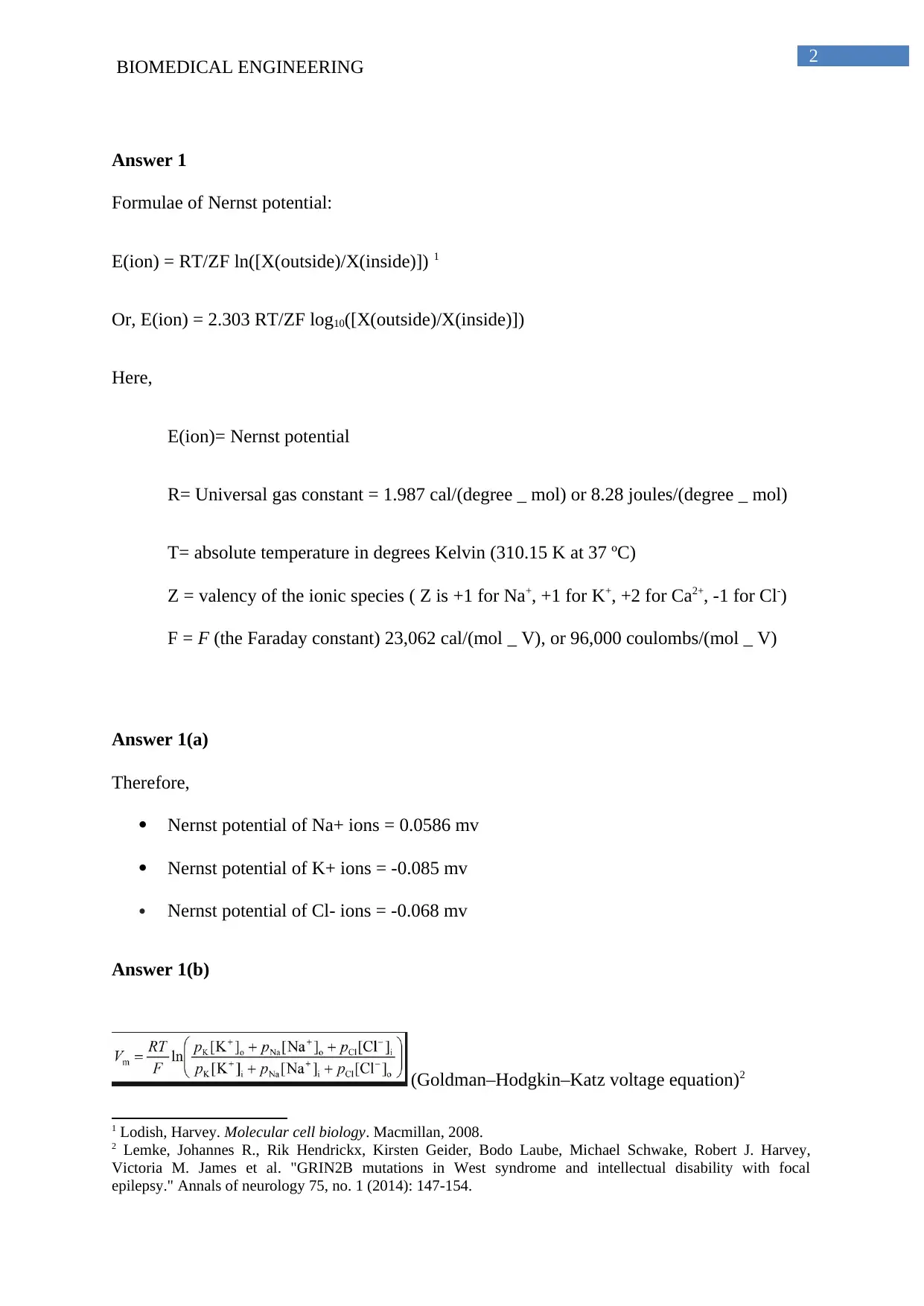
Answer 1(b)
(Goldman–Hodgkin–Katz voltage equation)2
1 Lodish, Harvey. Molecular cell biology. Macmillan, 2008.
2 Lemke, Johannes R., Rik Hendrickx, Kirsten Geider, Bodo Laube, Michael Schwake, Robert J. Harvey,
Victoria M. James et al. "GRIN2B mutations in West syndrome and intellectual disability with focal
epilepsy." Annals of neurology 75, no. 1 (2014): 147-154.
Document Page
3
BIOMEDICAL ENGINEERING
Therefore the overall trans membrane potential is -0.0198 mv
tabler-icon-diamond-filled.svg

Paraphrase This Document

Need a fresh take? Get an instant paraphrase of this document with our AI Paraphraser
Document Page
4
BIOMEDICAL ENGINEERING
Answer 2
2a.
Mouth and left ear
Four pair of air filled cavities; sinuses connect the nose to the pair of ear and throat.
The Eustachian tube provides connection between the middle of the ear to the throat. The
Eustachian tube equalizes the pressure between the outer and the middle portion of the ear
and this helps in proper transmission of the sound waves. Any infection in the mouth gets
transmitted via the Eustachian tube into the ear and vice versa3.
2b.
Right elbow and right hand
The connection between the right elbow and right hand is the elbow joint. The elbow
joint is the complex hinge joint that is present in between the proximal ends of the radius in
the forearm and ulna. It is also situated in the distal side of the humerus in the upper arm. The
elbow is responsible for the extension of the arm (forearm). The distal end of the humerus is
round and is sub-divided into 2 different joint namely trochlea and capitulum. This allows the
radius of the hand movement4.
2c.
Thoracic Cavity and Abdominal Cavity
The anatomical relation between the thoracic cavity and the abdominal cavity is
diaphragm. Diaphragm is a dome-shaped muscle sheet, which has a collection of tendons. It
serves as the main muscle for the process of respiration and plays an important role in the
3 Mandpe, Aditi H. "Eustachian tube device and method." U.S. Patent 8,197,552, issued June 12, 2012.
4 Apfelberg, David B., and Sanford J. Larson. "Dynamic anatomy of the ulnar nerve at the elbow." Plastic and
reconstructive surgery 51, no. 1 (1973): 76-81.
Document Page
5
BIOMEDICAL ENGINEERING
inhalation and exhalation process. At times, it is commonly referred as thoracic diaphragm
and serves a vital anatomic role. It is one of the sole anatomical landmark that separated the
chest or the thorax from the overall abdomen. Diaphragm originates from the lumbar vertebra
of the spinal cord. Inferior border of the ribs and sternum is also associated with the
origination of the diaphragm. The systematic opening of the diaphragm enables the phrenic,
vagus nerves, esophagus, descending aorta, and inferior vena cava to pass in between the
thoracic and abdominal cavity5.
Answer 3
Answer 3(a)
Alveolar Ventilation Rate (AVR) = (Tidal Volume – Dead Space) x respiratory rate6
Here,
Tidal volume = 660 ml (given)
Dead Space = 150 ml (standard rate)
Respiratory rate = 11breaths per minute
Therefore, AVR is 5610 per minute
Total Ventilation Rate = Tidal volume x Respiratory Rate = 660 x 11 = 7.26 liter/minute
Answer 3(b)
a) Given,
Tidal Volume (TV) = 660 ml
Breathing rate (BR) = 11 breaths per minute
5 DiMarco, A. F., A. F. Connors, and K. E. Kowalski. "Gas exchange during separate diaphragm and intercostal
muscle breathing." Journal of applied physiology 96, no. 6 (2004): 2120-2124.
6 Lumb, Andrew B. Nunn's Applied Respiratory Physiology eBook. Elsevier Health Sciences, 2016.
Document Page
6
BIOMEDICAL ENGINEERING
Therefore,
Total ventilation rate = TV × BR
= (660×11) ml/min
= 7260 ml/min
Alveolar ventilation rate = (TV-Physiological Dead Space Volume) × BR
= (660-150) × 11 ml/min
= 5610 ml/min
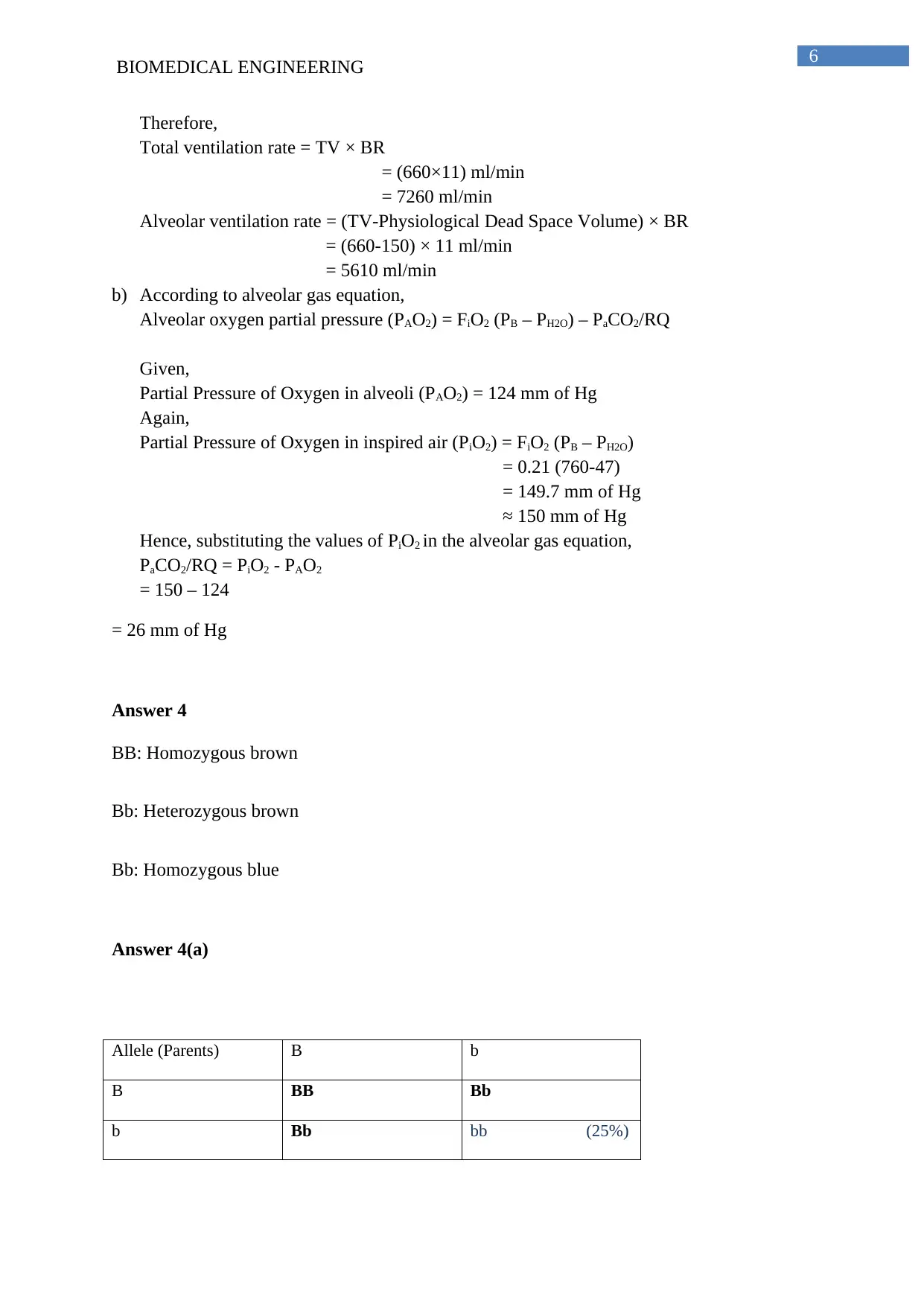
b) According to alveolar gas equation,
Alveolar oxygen partial pressure (PAO2) = FiO2 (PB – PH2O) – PaCO2/RQ
Given,
Partial Pressure of Oxygen in alveoli (PAO2) = 124 mm of Hg
Again,
Partial Pressure of Oxygen in inspired air (PiO2) = FiO2 (PB – PH2O)
= 0.21 (760-47)
= 149.7 mm of Hg
≈ 150 mm of Hg
Hence, substituting the values of PiO2 in the alveolar gas equation,
PaCO2/RQ = PiO2 - PAO2
= 150 – 124
= 26 mm of Hg
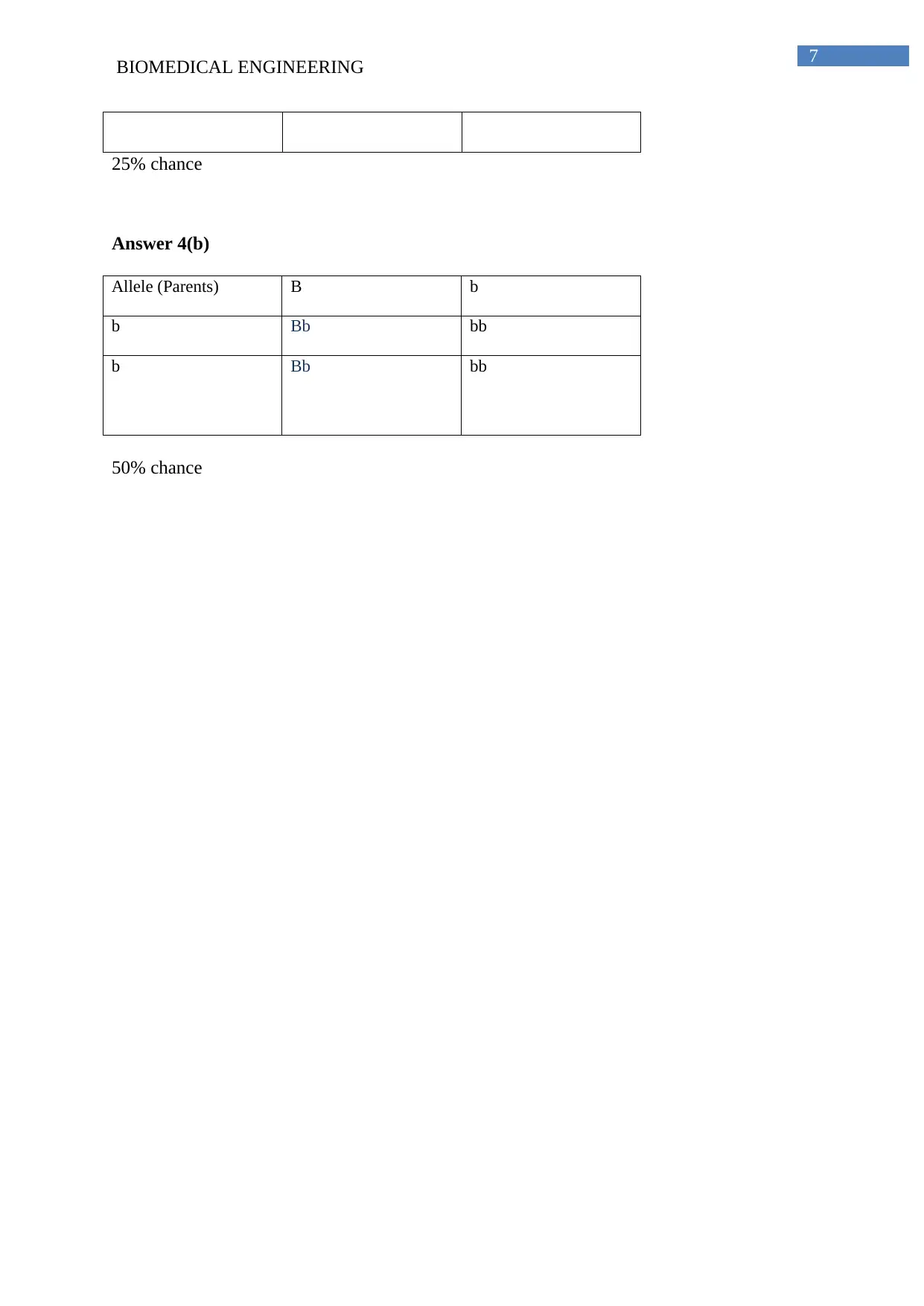
Answer 4
BB: Homozygous brown
Bb: Heterozygous brown
Bb: Homozygous blue
Answer 4(a)
Allele (Parents) B b
B BB Bb
b Bb bb (25%)
tabler-icon-diamond-filled.svg

Paraphrase This Document

Need a fresh take? Get an instant paraphrase of this document with our AI Paraphraser
Document Page
7
BIOMEDICAL ENGINEERING
25% chance
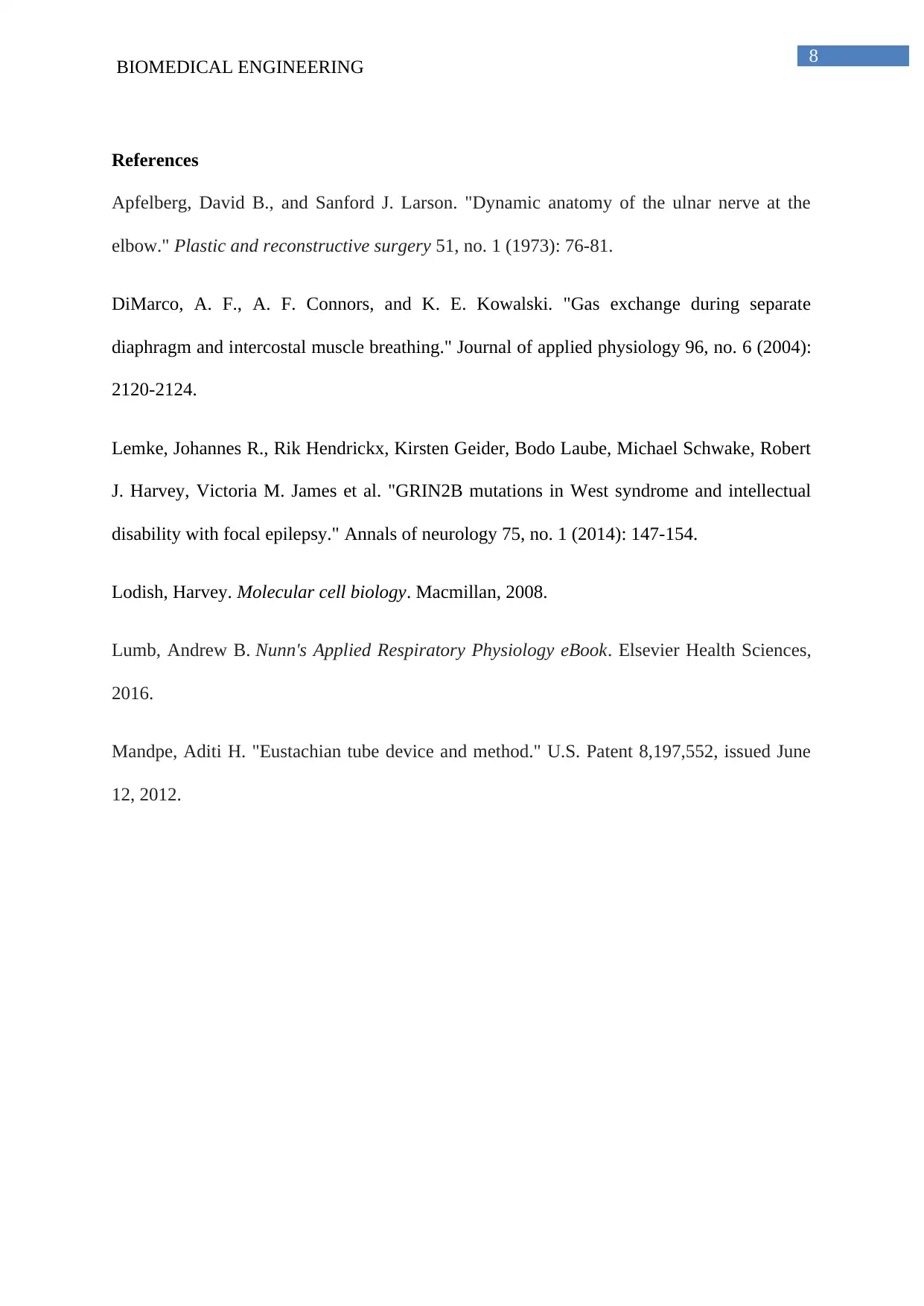
Answer 4(b)
50% chance
Allele (Parents) B b
b Bb bb
b Bb bb
Document Page
8
BIOMEDICAL ENGINEERING
References
Apfelberg, David B., and Sanford J. Larson. "Dynamic anatomy of the ulnar nerve at the
elbow." Plastic and reconstructive surgery 51, no. 1 (1973): 76-81.
DiMarco, A. F., A. F. Connors, and K. E. Kowalski. "Gas exchange during separate
diaphragm and intercostal muscle breathing." Journal of applied physiology 96, no. 6 (2004):
2120-2124.
Lemke, Johannes R., Rik Hendrickx, Kirsten Geider, Bodo Laube, Michael Schwake, Robert
J. Harvey, Victoria M. James et al. "GRIN2B mutations in West syndrome and intellectual
disability with focal epilepsy." Annals of neurology 75, no. 1 (2014): 147-154.
Lodish, Harvey. Molecular cell biology. Macmillan, 2008.
Lumb, Andrew B. Nunn's Applied Respiratory Physiology eBook. Elsevier Health Sciences,
2016.
Mandpe, Aditi H. "Eustachian tube device and method." U.S. Patent 8,197,552, issued June
12, 2012.
chevron_up_icon
1 out of 9
circle_padding
hide_on_mobile
zoom_out_icon
[object Object]