Automated User Testing Using Machine Learning: A Thesis Paper

Verified

Added on Ā 2019/10/01

|10
|1412
|38
Thesis and Dissertation
AI Summary
This thesis paper explores the application of machine learning in automated user testing, contrasting it with traditional manual testing procedures. The paper begins with an abstract outlining the evolution of testing methodologies, from manual test cases to automated tools and the integration of fuzzy logic. It emphasizes the need for dynamic test procedures that adapt to changing software environments. The core of the thesis involves a comparative analysis of manual versus automated testing using machine learning algorithms. A specific case study is presented, involving the determination of an isosceles triangle using black box testing. The manual test procedure, a step-by-step flowchart, is contrasted with an automated, dynamic logic based on simple query techniques. The results section highlights the superior performance of machine learning-driven tests, which achieve better scores in fewer iterations compared to manual methods. Capability and performance statistics are used to demonstrate the effectiveness of the automated approach. The conclusion underscores the adaptability, reliability, and efficiency of machine learning test cases, saving manual effort and enhancing the precision of black box testing. The paper recommends understanding the complexities of machine learning deployment while acknowledging the necessity of manual intervention, even in highly logical domains. The thesis includes acknowledgements, a bibliography, and figures illustrating the testing methodologies.

Document Page
11/27/2018
Automated User Testing Using Machine Learning
Thesis Paper
tabler-icon-diamond-filled.svg

Paraphrase This Document

Need a fresh take? Get an instant paraphrase of this document with our AI Paraphraser
Document Page
ABSTRACT
The procedures of manual testing have evolved over time. Earlier, all the test cases
were written manually, executed sequentially and there was a limitation to the scope of
modification, if the program to be tested changed. Then came the innovative
mechanisms of tools and procedures that enabled developers to test their programs
efficiently and in a more precise way. The tools that were used, use to record
procedures, catch test cases and results, maintain logs and summaries and all the
points of failure and exit.
With the advancements in software programs world-wide, the introduction of
fuzzy logic in the day to day operations, the increased complexities with critical
programs came the need of identification of dynamic test procedures which were to
adjust to the changing procedures and would adapt to the new logic. These test cases
were later programmed effectively once this need of dynamic changes was felt. The
terminology of machine learning, in the automated test case scenario, gives an edge to
highly innovative technology products to be tested in the most effective manner,
reducing floor time.
The methodology used here are simple cases, that adjusts and understand the
dynamics of changing programming environment, by manual test case adaptation
versus automated user tests. The results indicate the functionality of adaptive test cases
to be exceptionally accurate and helpful in reducing the multi scenario and modifying
parameters of software programming and its variables. The adaptive functionality of
machine learning is a boon in today’s software development scenario.
2 | P a g e
Document Page
TABLE OF CONTENTS
ABSTRACT...................................................................................................................... 2
INTROUCTION................................................................................................................ 4
PROCEDURE.................................................................................................................. 4
RESULTS.........................................................................................................................4
DISCUSSION...................................................................................................................4
CONCLUSION................................................................................................................. 4
RECOMMENDATION......................................................................................................4
ACKNOWLEDGEMENTS................................................................................................5
BIBLIOGRAPHY.............................................................................................................. 6
3 | P a g e
Document Page
INTROUCTION
The purpose of the thesis written here is to test the adaptability of machine learning
algorithms that claim flexibility in test cases while performing user testing in the complex
software scenarios. The performance of hard bound, inflexible and brittle manual test
cases are very poor. The manual cost of writing and modifying the test cases are very
high. These manual testing scenarios are limited to the scope, where the software code
alterations to achieve a functionality does not need dynamic input, which in turn may not
be form specific.
Mostly, the user test cases are drawn and are brittle. If something goes wrong, in a test
procedural framework, a tool or manual test case, it needs to drop the remaining
segment of the test or skip certain testing steps that ultimately leaves the accuracy of
testing questionable. Since there is no mechanism with manual testing to check if the
test is performing effectively, unless it is executed completely, the procedures of
intermittent results is not achievable by manual test procedures.
The introduction of machine learning and artificial intelligence systems into testing with
automated procedures has given a breakthrough by making adaptable, dynamically
changing, fuzzy logic driven algorithmic approaches. The case tests the effectiveness of
automated Machine Learning driven algorithms against manually driven test
procedures. The criteria of acceptance is the intermittent log based modifications by
algorithms adjusting to case test, if the required input parameters does not match
exactly.
PROCEDURE
The problem is a simple one. To find out whether the three sides given as input form an
isosceles triangle or not, can be done through the black box test mechanism, where the
internal content of the coding is not known to the user.
4 | P a g e
tabler-icon-diamond-filled.svg

Paraphrase This Document

Need a fresh take? Get an instant paraphrase of this document with our AI Paraphraser
Document Page
Manual Test Procedure:
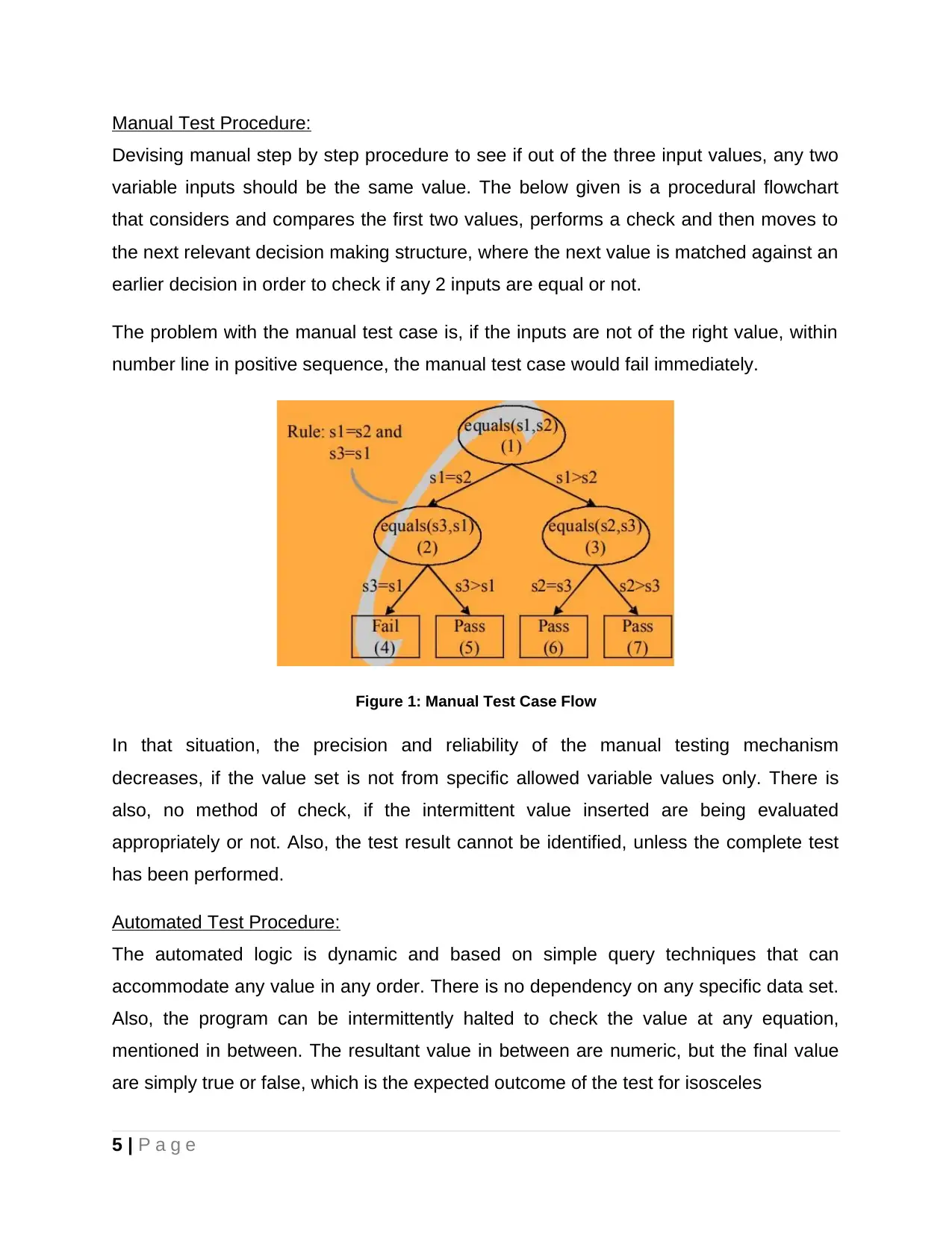
Devising manual step by step procedure to see if out of the three input values, any two
variable inputs should be the same value. The below given is a procedural flowchart
that considers and compares the first two values, performs a check and then moves to
the next relevant decision making structure, where the next value is matched against an
earlier decision in order to check if any 2 inputs are equal or not.
The problem with the manual test case is, if the inputs are not of the right value, within
number line in positive sequence, the manual test case would fail immediately.
Figure 1: Manual Test Case Flow
In that situation, the precision and reliability of the manual testing mechanism
decreases, if the value set is not from specific allowed variable values only. There is
also, no method of check, if the intermittent value inserted are being evaluated
appropriately or not. Also, the test result cannot be identified, unless the complete test
has been performed.
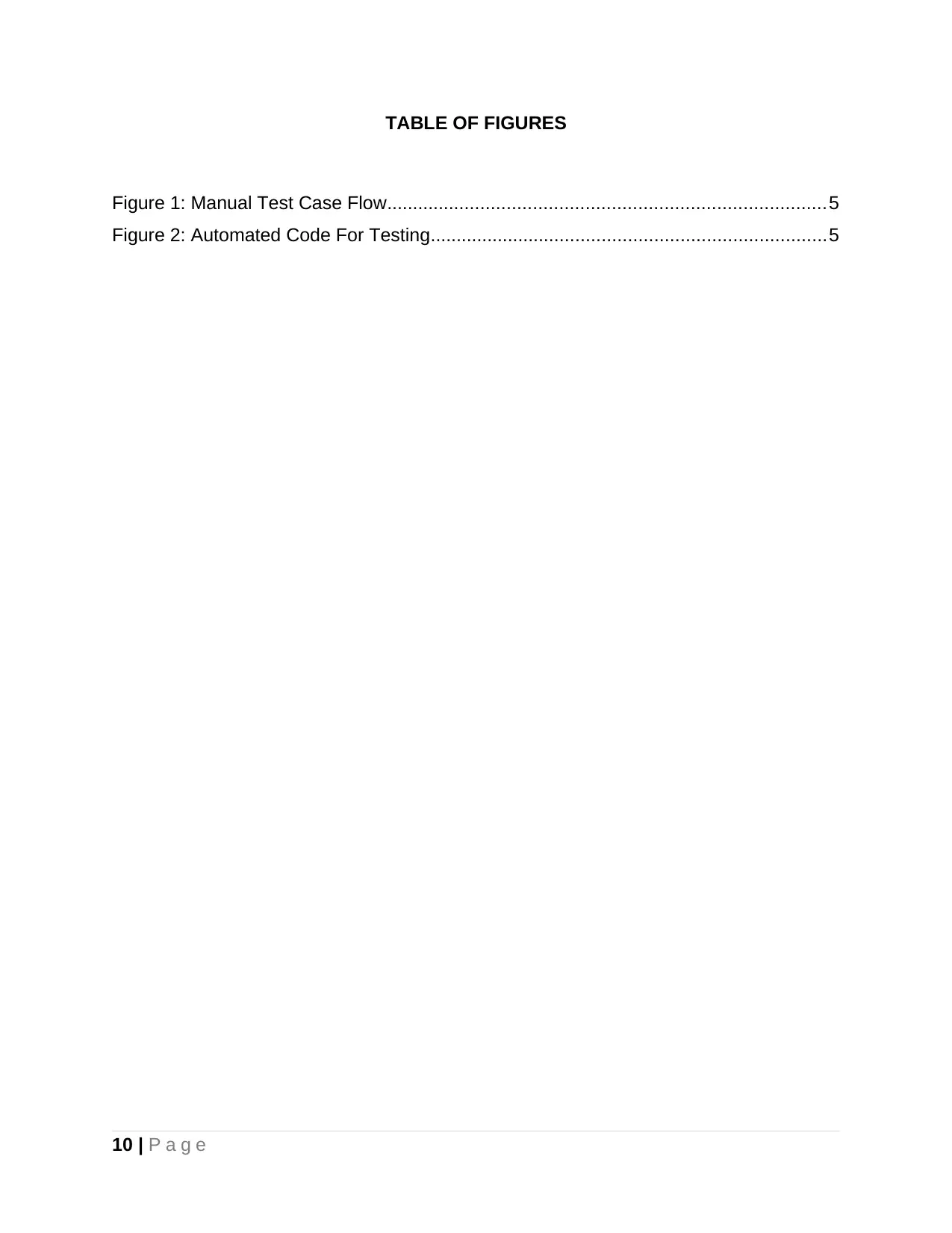
Automated Test Procedure:
The automated logic is dynamic and based on simple query techniques that can
accommodate any value in any order. There is no dependency on any specific data set.
Also, the program can be intermittently halted to check the value at any equation,
mentioned in between. The resultant value in between are numeric, but the final value
are simply true or false, which is the expected outcome of the test for isosceles
5 | P a g e
Document Page
Figure 2: Automated Code For Testing
RESULTS
The results obtained from analysis of input values and output responses are compared
and analyzed. The outcomes states that are obtained as the capability statistics and
performance statistics for executing automated test driven by machine learning are far
better and achieves the scores gained by manual testing procedures in just one or two
iterations. The quality of the outcome is significantly better in Machine Learning driven
tests than the manual test case procedures.
DISCUSSION
Capability statistics is a measure of potential of a procedure to achieve a desired set or
goal in order to meet the requisites behind the specifications mentioned. Another
attribute of Performance capability helps in demonstrating the overall performance of
execution of one singular run in testing, either manually or automated. The CP and PP
of the results give away the closeness with logic and deviation from the expected
outcome.
CONCLUSION
The results indicate a clear indication that machine driven test cases are adaptable and
reliable and saves manual effort of changes in test procedures. Dynamic test cases
6 | P a g e
Document Page
created out of modified fuzzy logic helps in performing with precision and accuracy of
black box testing.
RECOMMENDATION
It is important to understand the logic and complexities involved in order to deploy a
Machine Learning concept. These machine learning technological upgrades come with
certain costs, yet they make significant impact at performing standardized tests with
mere resemblance nearing hit to be found on specific program. They are independent of
input value sets and enable better understanding. Yet manual intervention is a basic
necessity even in these highly logical domains.
7 | P a g e
tabler-icon-diamond-filled.svg

Paraphrase This Document

Need a fresh take? Get an instant paraphrase of this document with our AI Paraphraser
Document Page
ACKNOWLEDGEMENTS
8 | P a g e
Document Page
BIBLIOGRAPHY
Chang, R., Sankaranarayanan, S., Jiang, G., & Ivancic, F. (2014). U.S. Patent No. 8,924,938.
Washington, DC: U.S. Patent and Trademark Office.
Feurer, M., Klein, A., Eggensperger, K., Springenberg, J., Blum, M., & Hutter, F. (2015). Efficient and
robust automated machine learning. In Advances in Neural Information Processing Systems (pp. 2962-
2970).
Jonsson, L., Borg, M., Broman, D., Sandahl, K., Eldh, S., & Runeson, P. (2016). Automated bug
assignment: Ensemble-based machine learning in large scale industrial contexts. Empirical Software
Engineering, 21(4), 1533-1578.
LemaƮtre, G., Nogueira, F., & Aridas, C. K. (2017). Imbalanced-learn: A python toolbox to tackle the curse
of imbalanced datasets in machine learning. The Journal of Machine Learning Research, 18(1), 559-563.
Malhotra, R. (2015). A systematic review of machine learning techniques for software fault
prediction. Applied Soft Computing, 27, 504-518.
9 | P a g e
Document Page
TABLE OF FIGURES
Figure 1: Manual Test Case Flow....................................................................................5
Figure 2: Automated Code For Testing............................................................................5
10 | P a g e
chevron_up_icon
1 out of 10
circle_padding
hide_on_mobile
zoom_out_icon
[object Object]