A Historical Analysis of Fashion Trends in India during the 1970s

Verified

Added on  2020/02/14

|6
|935
|65
Essay
AI Summary
This essay provides a comprehensive overview of the fashion trends in India during the 1970s, emphasizing the significant impact of Bollywood on the evolving style landscape. It explores key trends such as bellbottoms, polka dots, and various hairstyles, as well as the emergence of disco and retro styles. The essay also examines how Bollywood served as a major source of inspiration, influencing both men's and women's fashion choices, and leading to the adoption of new styles like synthetic sarees and three-piece suits. Furthermore, it discusses the cultural context of the time, including the rise of kurtis and fashionable sunglasses, and how fashion reflected the changing status and desires of the Indian population. The analysis extends to the 1990s, highlighting the continued evolution of fashion, and the role of Bollywood in shaping trends. The essay references key sources to support its claims, offering a detailed insight into the historical significance of fashion in India.

Document Page
1990’S FASHION
tabler-icon-diamond-filled.svg

Paraphrase This Document

Need a fresh take? Get an instant paraphrase of this document with our AI Paraphraser
Document Page
1970S FASHION
Status within any country reflects through their culture as well as traditions. With the
changing time period fashion sense of people are also changing and they are becoming more
demanding as well. Differences in status are clearly reflected through the dress of people of
different country such as: The traditional Chinese clothes have two basic styles i.e. a top-bottom
clothes style and a one-piece clothes style. On the other hand, Indian people usually wear
traditional clothing in the 1990s (Pani and Sharma, 2012). However, with the changing time their
fashion status has also been changed. The major influence of this changing fashion status is
changing culture of country. People are becoming so modern day by day and their desires and
needs are also changing according to time. In the past years poverty in India was one of the
major factor due to which people usually do not change their fashion status. As per the changing
time and economic conditions of country, majority of people likes to purchase different cloths
and started changing their fashion status rapidly.
Dress makes all the difference and it also reflects the character of individual as well as
their culture and tradition. For determining particular changes within the fashion, India has been
selected. A historic period of 1970s is being taken into consideration. From the past data has
been founded that the 70s was the most influential and it is considered a turning point for both
female empowerment and clothing (Boroian and De Poix, 2009). In India, Bollywood has been
major inspiration for ever-changing fashion industry in India. The flared, oversized bellbottom
trousers were a range during 70s. Bellbottoms were popular among both men and women and it
was their top choice. However, there are several changes which took place within the changing
time. In this regards, the men has selected to pair them with suit jackets while women preferred
to tuck them with the trendy and flowy tops.
1
Document Page
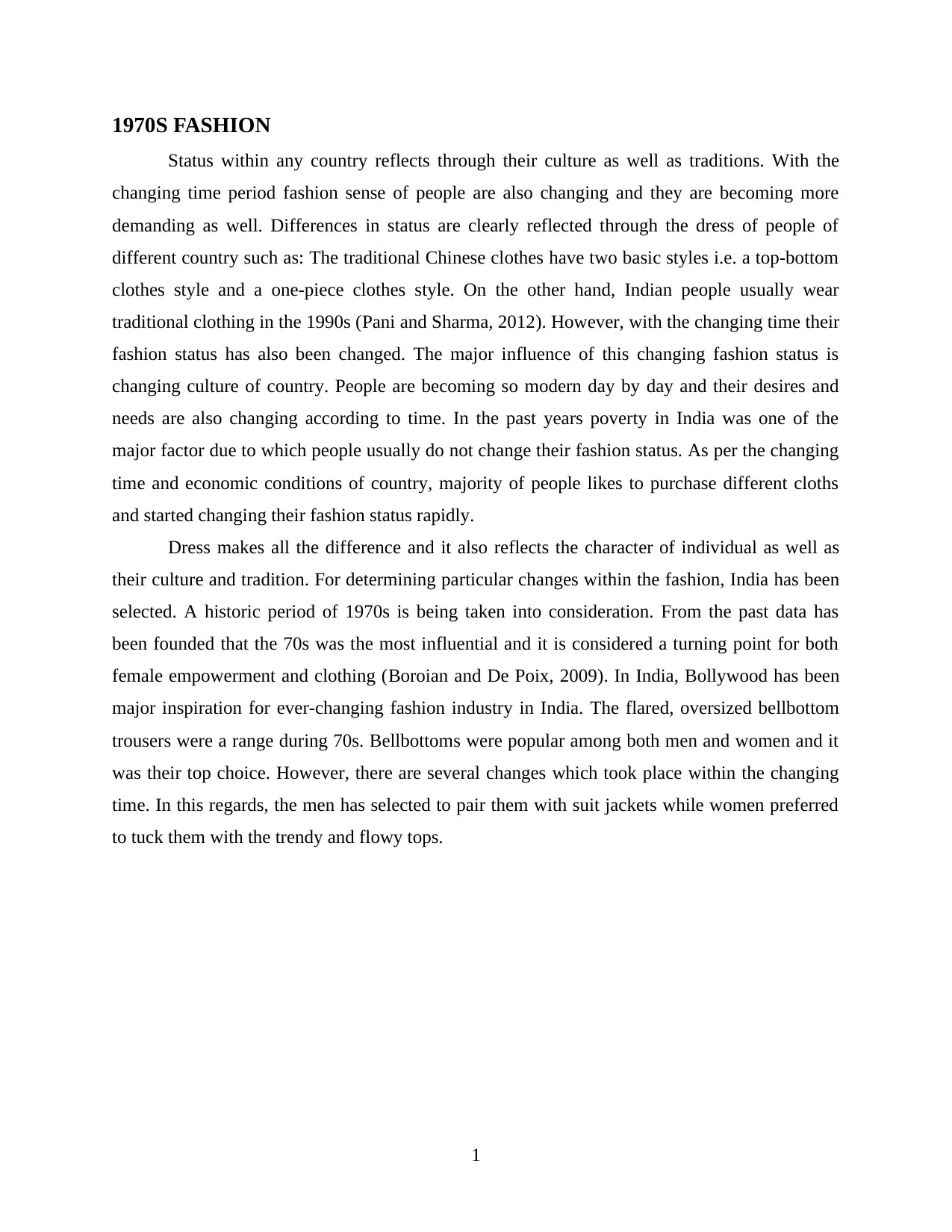
Polka dots were one of the major fashions trends and most of the women’s prefer to wear
this print and it is a massive hit among women. Within this historic period of 1970s, status
differentials clearly presented by the changing time. An array of hairdos was a common and
highly preferable due to the Bollywood film during 1970s. Some of the most favourite styles
were puffed up high hair, exaggerated buns and varied sized bangs. In addition to this, big glares
or sunglasses have been in vogue since the 70s.
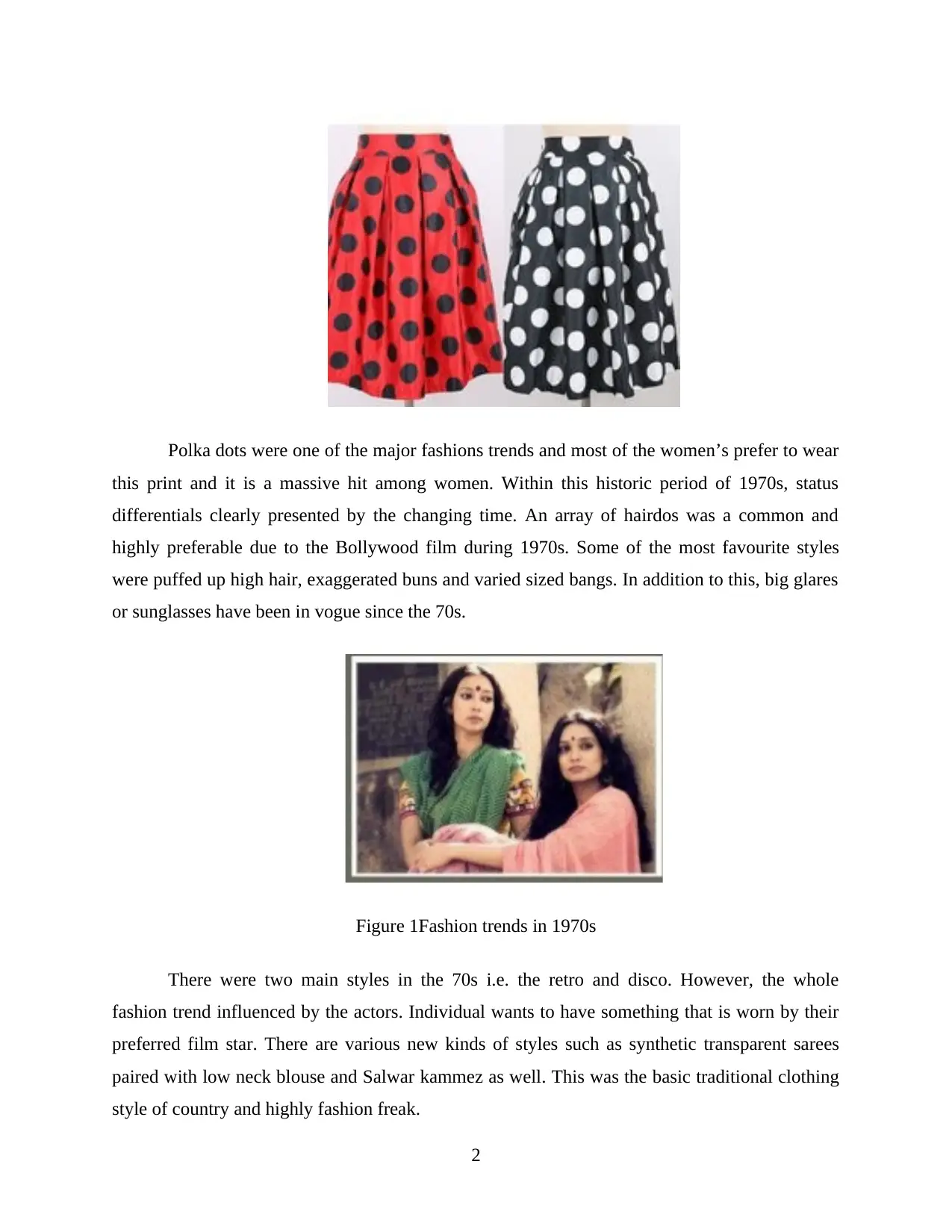
Figure 1Fashion trends in 1970s
There were two main styles in the 70s i.e. the retro and disco. However, the whole
fashion trend influenced by the actors. Individual wants to have something that is worn by their
preferred film star. There are various new kinds of styles such as synthetic transparent sarees
paired with low neck blouse and Salwar kammez as well. This was the basic traditional clothing
style of country and highly fashion freak.
2
Document Page
On the other hand, male style in 1970s was disco and retro wear as well and 3 pieces suits
started becoming more popular. It is being identified that one such revolution in fashion was seen
in India in the 70s. It is also considered by so many countries and also gave the great makeover
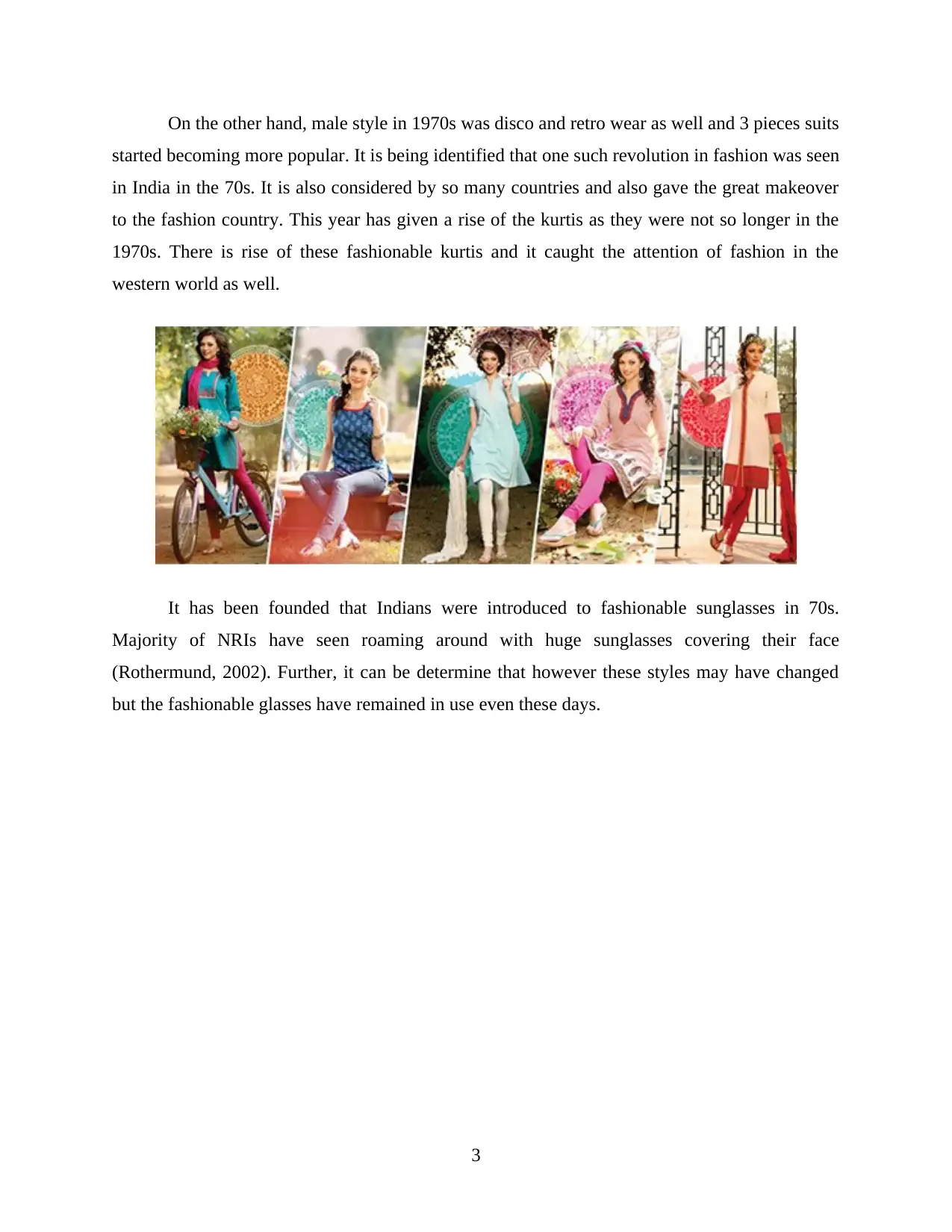
to the fashion country. This year has given a rise of the kurtis as they were not so longer in the
1970s. There is rise of these fashionable kurtis and it caught the attention of fashion in the
western world as well.
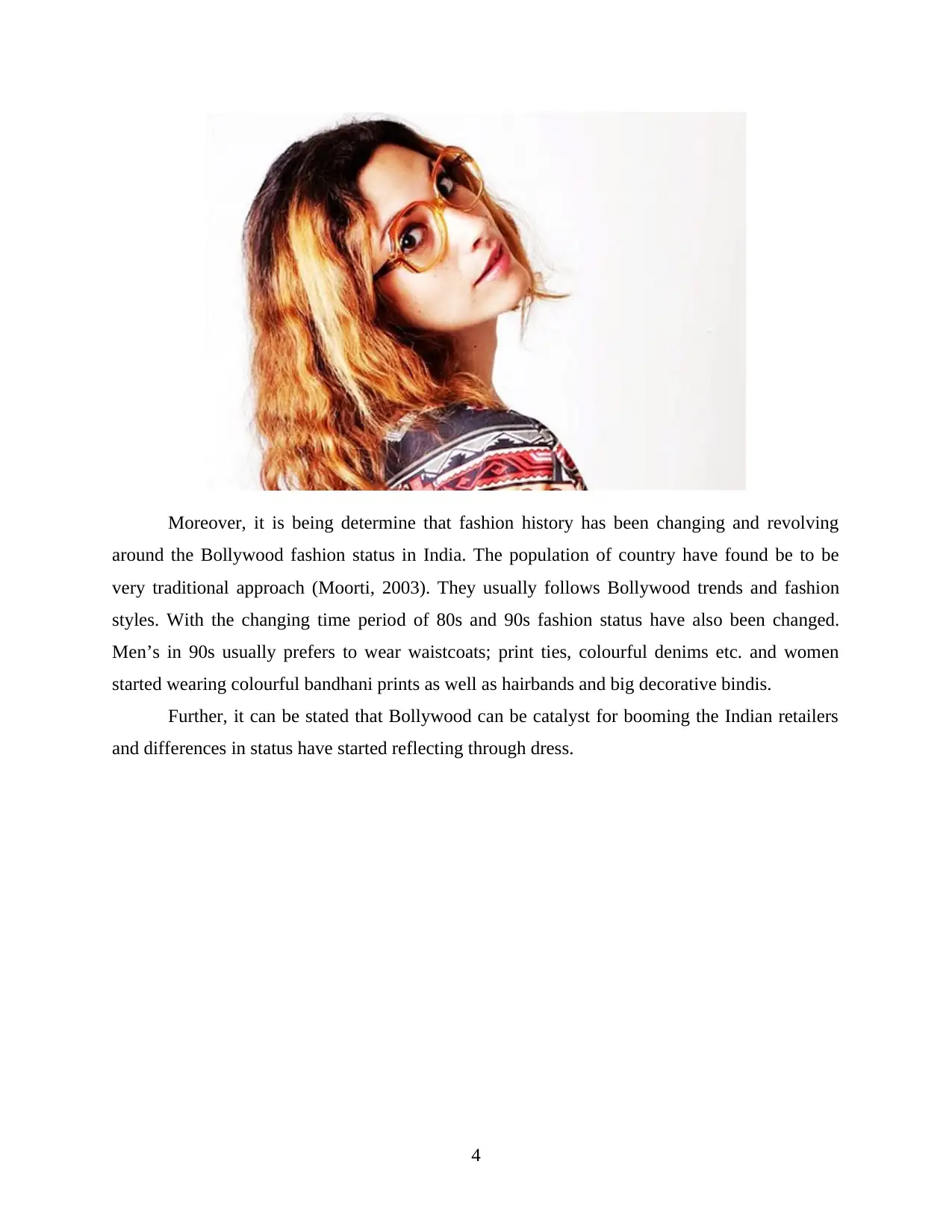
It has been founded that Indians were introduced to fashionable sunglasses in 70s.
Majority of NRIs have seen roaming around with huge sunglasses covering their face
(Rothermund, 2002). Further, it can be determine that however these styles may have changed
but the fashionable glasses have remained in use even these days.
3
tabler-icon-diamond-filled.svg

Paraphrase This Document

Need a fresh take? Get an instant paraphrase of this document with our AI Paraphraser
Document Page
Moreover, it is being determine that fashion history has been changing and revolving
around the Bollywood fashion status in India. The population of country have found be to be
very traditional approach (Moorti, 2003). They usually follows Bollywood trends and fashion
styles. With the changing time period of 80s and 90s fashion status have also been changed.
Men’s in 90s usually prefers to wear waistcoats; print ties, colourful denims etc. and women
started wearing colourful bandhani prints as well as hairbands and big decorative bindis.
Further, it can be stated that Bollywood can be catalyst for booming the Indian retailers
and differences in status have started reflecting through dress.
4
Document Page
REFERENCES
Boroian, M. and De Poix, A., 2009. India by design: The pursuit of luxury and fashion. John
Wiley and Sons.
Moorti, S., 2003. Out of India: fashion culture and the marketing of ethnic style. Blackwell
Publishing Ltd.
Pani, A. and Sharma, M., 2012. Emerging trends in fashion marketing: a case study of apparel
retailing in India. International Journal of Business and Management Tomorrow. 2(10).
pp.1-8.
Rothermund, D., 2002. An fashion history of India. Routledge.
5
chevron_up_icon
1 out of 6
circle_padding
hide_on_mobile
zoom_out_icon
[object Object]