Studebaker v. Nettie's Flower Garden Case

Verified

Added on  2019/09/16

|4
|458
|442
Case Study
AI Summary
This document presents a case study solution for Studebaker v. Nettie's Flower Garden, Inc. The case involves an automobile accident caused by Ferry, an employee of Nettie's, and a subsequent lawsuit filed by Ms. Judith using the theory of respondent superior. The analysis explores whether Nettie's had control over Ferry's actions, concluding that they did. It also discusses the ethical implications of classifying employees as contractors to avoid providing benefits. The document includes references to relevant legal texts.
Document Page
1
Case Study: Studebaker v. Nettie's Flower Garden, Inc.
tabler-icon-diamond-filled.svg

Paraphrase This Document

Need a fresh take? Get an instant paraphrase of this document with our AI Paraphraser
Document Page
2
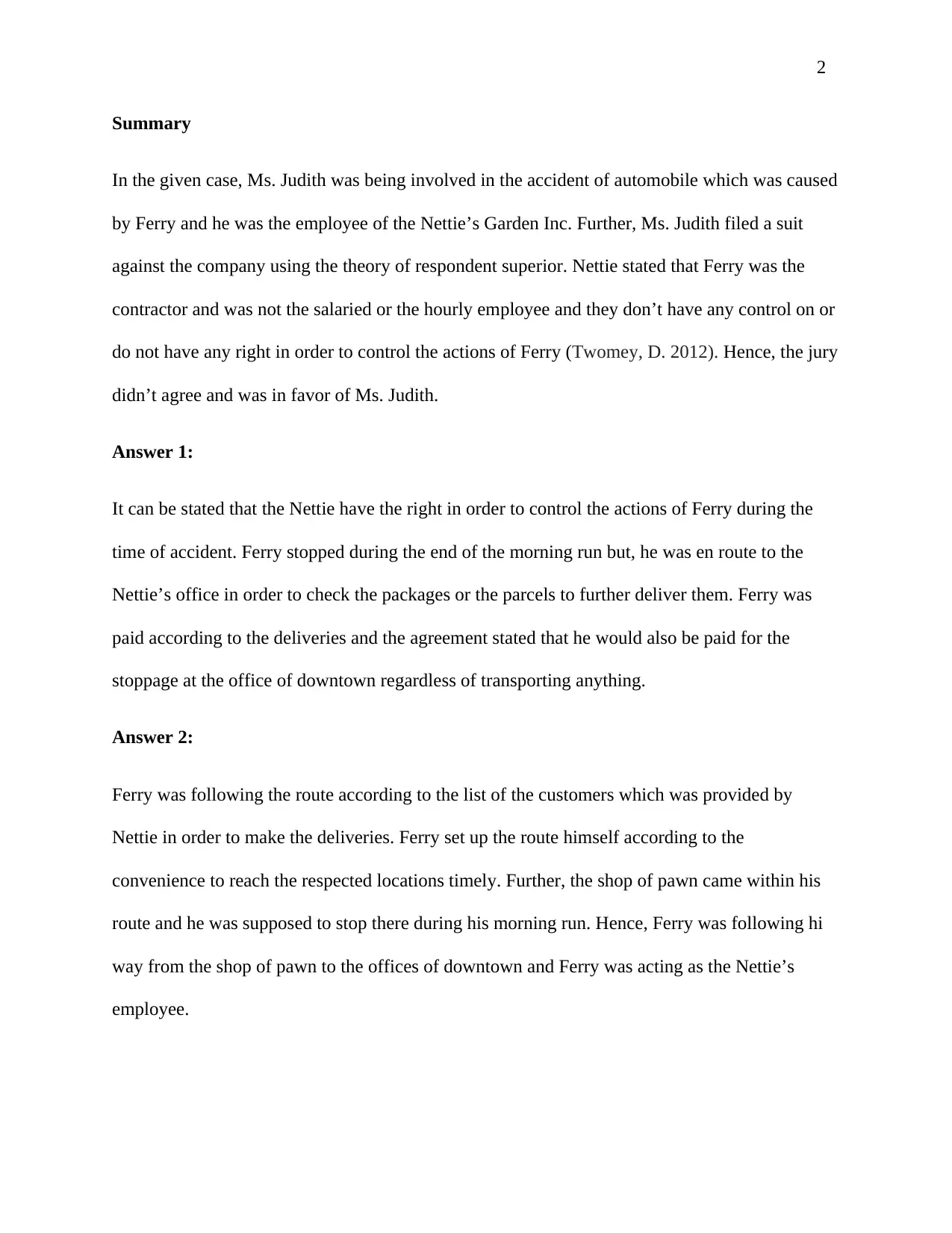
Summary
In the given case, Ms. Judith was being involved in the accident of automobile which was caused
by Ferry and he was the employee of the Nettie’s Garden Inc. Further, Ms. Judith filed a suit
against the company using the theory of respondent superior. Nettie stated that Ferry was the
contractor and was not the salaried or the hourly employee and they don’t have any control on or
do not have any right in order to control the actions of Ferry (Twomey, D. 2012). Hence, the jury
didn’t agree and was in favor of Ms. Judith.
Answer 1:
It can be stated that the Nettie have the right in order to control the actions of Ferry during the
time of accident. Ferry stopped during the end of the morning run but, he was en route to the
Nettie’s office in order to check the packages or the parcels to further deliver them. Ferry was
paid according to the deliveries and the agreement stated that he would also be paid for the
stoppage at the office of downtown regardless of transporting anything.
Answer 2:
Ferry was following the route according to the list of the customers which was provided by
Nettie in order to make the deliveries. Ferry set up the route himself according to the
convenience to reach the respected locations timely. Further, the shop of pawn came within his
route and he was supposed to stop there during his morning run. Hence, Ferry was following hi
way from the shop of pawn to the offices of downtown and Ferry was acting as the Nettie’s
employee.
Document Page
3
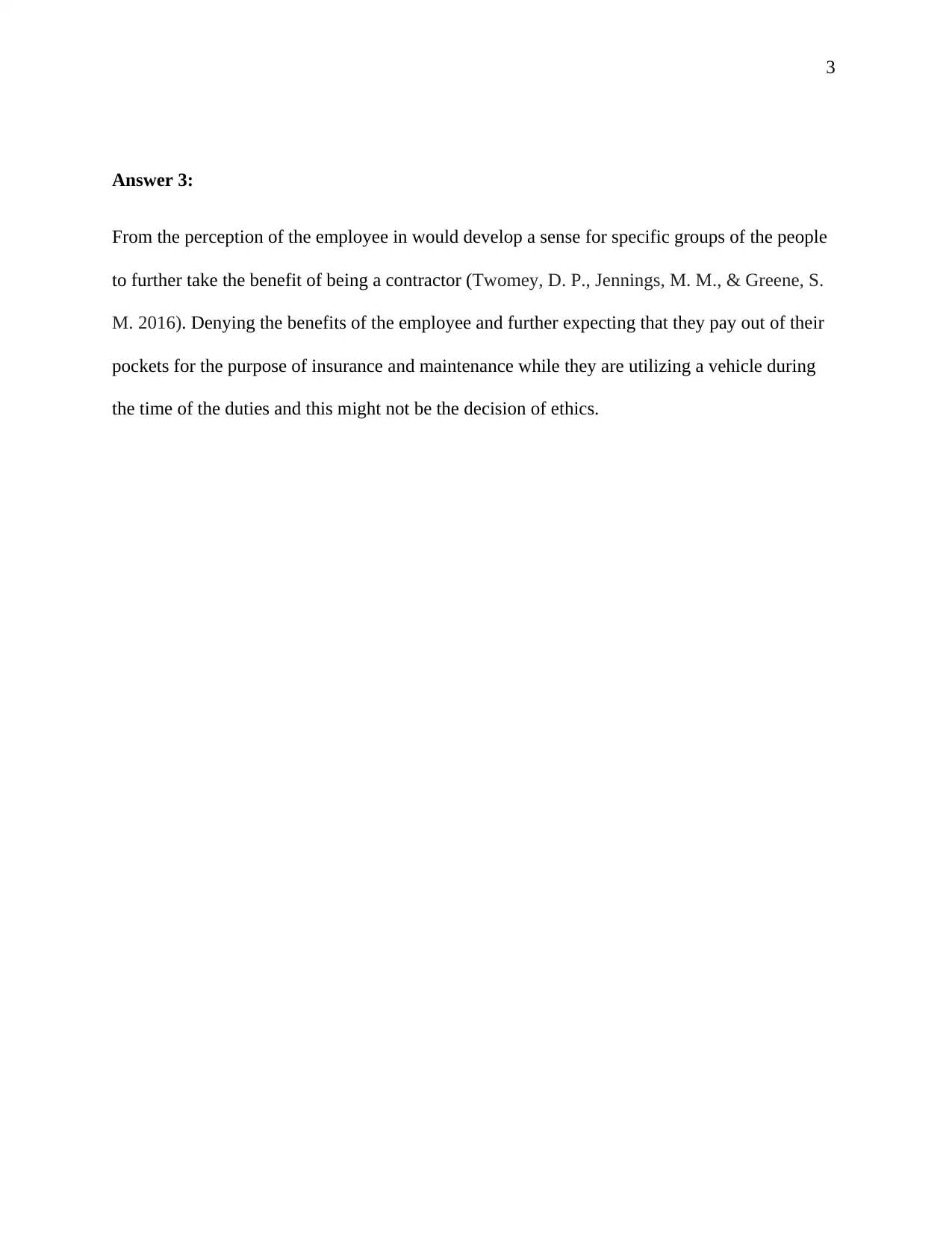
Answer 3:
From the perception of the employee in would develop a sense for specific groups of the people
to further take the benefit of being a contractor (Twomey, D. P., Jennings, M. M., & Greene, S.
M. 2016). Denying the benefits of the employee and further expecting that they pay out of their
pockets for the purpose of insurance and maintenance while they are utilizing a vehicle during
the time of the duties and this might not be the decision of ethics.
Document Page
4
REFERENCES
Twomey, D. (2012). Labor and Employment Law: Text & Cases. Cengage Learning.
Twomey, D. P., Jennings, M. M., & Greene, S. M. (2016). Anderson's Business Law and the
Legal Environment, Comprehensive Volume. Nelson Education.
chevron_up_icon
1 out of 4
circle_padding
hide_on_mobile
zoom_out_icon
[object Object]