Strategic Analysis of Guajilote Cooperativo Forestal Case Study
VerifiedAdded on 2022/11/29
|7
|1266
|442
Case Study
AI Summary
This case study examines Guajilote Cooperativo Forestal, a forestry cooperative in Honduras, established with USAID support to address deforestation concerns. The analysis encompasses the cooperative's strengths, such as strong member relationships and government authorization for mahogany utilization, and weaknesses, including the leader's lack of formal education and a lack of succession planning. Opportunities include local market sales, eco-friendly furniture production, and direct mahogany sales. Threats include political instability, illegal logging, and the non-renewable nature of mahogany. Strategic factors involve preserving Honduran forestry by utilizing fallen mahogany, resource pooling, market advantage, and value addition. Core competencies are centered around mahogany production, while the distinctive competency lies in the cooperative's exclusive right to use this resource. The paper concludes by emphasizing the significance of government authorization and the challenges posed by the leader's education level, market opportunities, and the need for sustainable resource management.
0
Strategic management of
Gujaliote Cooperativo Forestal
Strategic management of
Gujaliote Cooperativo Forestal
Paraphrase This Document
Need a fresh take? Get an instant paraphrase of this document with our AI Paraphraser

1
Table of Contents
Introduction................................................................................................................................2
1. Strengths and weaknesses of Guajilote..................................................................................2
2. Opportunities and threats facing Guajilote............................................................................2
3. Strategic factors facing Guajilote...........................................................................................3
4. Core competencies of Guajilote.............................................................................................3
5. Distinctive competency of Guajilote......................................................................................3
Conclusion..................................................................................................................................4
References..................................................................................................................................5
Table of Contents
Introduction................................................................................................................................2
1. Strengths and weaknesses of Guajilote..................................................................................2
2. Opportunities and threats facing Guajilote............................................................................2
3. Strategic factors facing Guajilote...........................................................................................3
4. Core competencies of Guajilote.............................................................................................3
5. Distinctive competency of Guajilote......................................................................................3
Conclusion..................................................................................................................................4
References..................................................................................................................................5

2
Introduction
Gujailote Cooperativo Forestal was started in 1991 because of the growing distress over the
desertion of forests in Honduras, with the help of USAID. The paper deals with the strengths,
weaknesses, opportunities, and threats of the organization (Ramos et.al. 2018, pp. 439-452).
The paper also discusses the strategic factors and points out the core as well as the distinctive
competency of the organization.
1. Strengths and weaknesses of Guajilote
Strengths – the determination of the business was great and the employees as well as the
members of the organization were determined. Relationship between the members of the
society was strong as well. Guajilote Cooperativo Forestal was the only cooperative in the
country of Honduras, which consisted of its distinctive rights. The maintenance of the
equipment required a limited outlay of the capital. The permission provided to Guajilote and
the authorization by the government for the removal of the trees which were fallen and used
them for their development needs was a definite strength.
Weaknesses – the leader of the cooperative was not educated, which can be considered as the
primary weakness of the cooperative(Famiyeh et.al. 2018, pp 588-607). There was a need for
more education as well as the training for the staffs. There was no plan for the succession of
leadership. The advancement of Munguia becoming a genuine leader in such a short period
was also considered as a weakness.
2. Opportunities and threats facing Guajilote
Opportunities – there was a distinct possibility of selling the cooperative to the carpenters of
the local community. The competition within the local market was not present, which can be
considered as a huge opportunity. The likely addition of the division of transportation on their
own in order to sell the mahogany directly to the market and without the need of a distributor
can also be considered an opportunity. Since the issues of ecology have been increased
globally; therefore, the production of eco-friendly furniture will create value for the
cooperative.
Threats – the nature of the politics within the small country of Honduras could not assure the
guarantee that the Guajilote will not have any problem if they continue to sell mahogany(Rao
Introduction
Gujailote Cooperativo Forestal was started in 1991 because of the growing distress over the
desertion of forests in Honduras, with the help of USAID. The paper deals with the strengths,
weaknesses, opportunities, and threats of the organization (Ramos et.al. 2018, pp. 439-452).
The paper also discusses the strategic factors and points out the core as well as the distinctive
competency of the organization.
1. Strengths and weaknesses of Guajilote
Strengths – the determination of the business was great and the employees as well as the
members of the organization were determined. Relationship between the members of the
society was strong as well. Guajilote Cooperativo Forestal was the only cooperative in the
country of Honduras, which consisted of its distinctive rights. The maintenance of the
equipment required a limited outlay of the capital. The permission provided to Guajilote and
the authorization by the government for the removal of the trees which were fallen and used
them for their development needs was a definite strength.
Weaknesses – the leader of the cooperative was not educated, which can be considered as the
primary weakness of the cooperative(Famiyeh et.al. 2018, pp 588-607). There was a need for
more education as well as the training for the staffs. There was no plan for the succession of
leadership. The advancement of Munguia becoming a genuine leader in such a short period
was also considered as a weakness.
2. Opportunities and threats facing Guajilote
Opportunities – there was a distinct possibility of selling the cooperative to the carpenters of
the local community. The competition within the local market was not present, which can be
considered as a huge opportunity. The likely addition of the division of transportation on their
own in order to sell the mahogany directly to the market and without the need of a distributor
can also be considered an opportunity. Since the issues of ecology have been increased
globally; therefore, the production of eco-friendly furniture will create value for the
cooperative.
Threats – the nature of the politics within the small country of Honduras could not assure the
guarantee that the Guajilote will not have any problem if they continue to sell mahogany(Rao
⊘ This is a preview!⊘
Do you want full access?
Subscribe today to unlock all pages.

Trusted by 1+ million students worldwide

3
et.al. 2018). The illegal logging of mahogany and mixing the illegally obtained mahogany
into the products purchased from Guajilote will eventually lead to a decrease in the value of
the product. Mahogany is a non-renewable resource and faces a threat of extinction with the
overuse of the product.
3. Strategic factors facing Guajilote
The strategies created by the cooperative to maximize the advantage of competition and
achieve the aims and objectives include:
The cooperative’s statement of mission, in the language of the permit, states that the
forestry of Honduras must be preserved by producing mahogany from the trees which
have fallen as a result of natural causes (Santana & Gil, 2018, pp. 315-336).
The main goal of the cooperative was to pool the resources as much as possible for
the product to reach the market with no apprehension of future development.
The cooperative also tried to gain market advantage of being the the only authorised
player in the market
The organisation also tried to add value to the customers by providing an option for
eco-friendly furniture.
The organisation also utilised the authorisation of utilizing the main resource which
was mahogany.
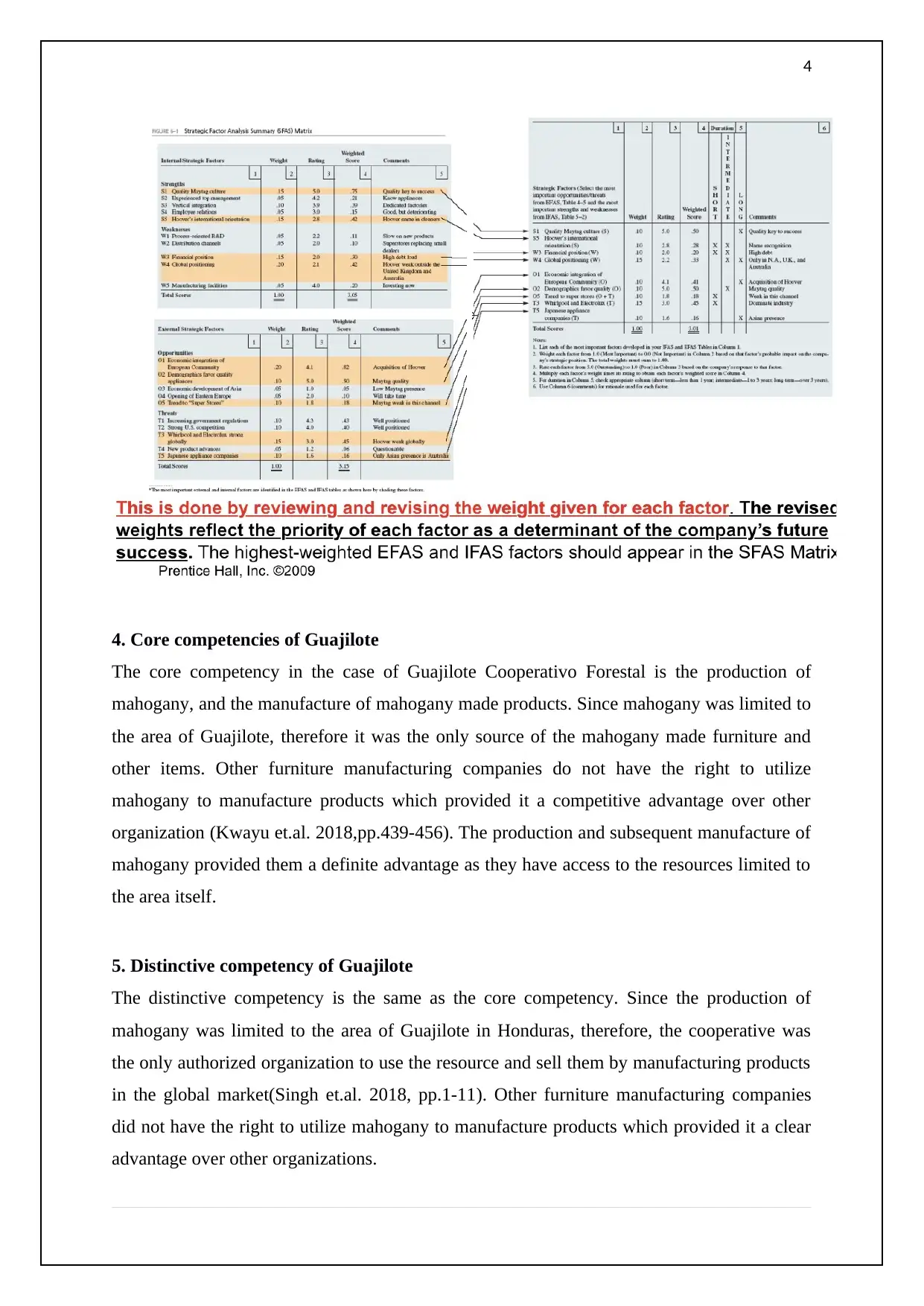
The factors can be understood in more details through the following figure:
et.al. 2018). The illegal logging of mahogany and mixing the illegally obtained mahogany
into the products purchased from Guajilote will eventually lead to a decrease in the value of
the product. Mahogany is a non-renewable resource and faces a threat of extinction with the
overuse of the product.
3. Strategic factors facing Guajilote
The strategies created by the cooperative to maximize the advantage of competition and
achieve the aims and objectives include:
The cooperative’s statement of mission, in the language of the permit, states that the
forestry of Honduras must be preserved by producing mahogany from the trees which
have fallen as a result of natural causes (Santana & Gil, 2018, pp. 315-336).
The main goal of the cooperative was to pool the resources as much as possible for
the product to reach the market with no apprehension of future development.
The cooperative also tried to gain market advantage of being the the only authorised
player in the market
The organisation also tried to add value to the customers by providing an option for
eco-friendly furniture.
The organisation also utilised the authorisation of utilizing the main resource which
was mahogany.
The factors can be understood in more details through the following figure:
Paraphrase This Document
Need a fresh take? Get an instant paraphrase of this document with our AI Paraphraser

4
4. Core competencies of Guajilote
The core competency in the case of Guajilote Cooperativo Forestal is the production of
mahogany, and the manufacture of mahogany made products. Since mahogany was limited to
the area of Guajilote, therefore it was the only source of the mahogany made furniture and
other items. Other furniture manufacturing companies do not have the right to utilize
mahogany to manufacture products which provided it a competitive advantage over other
organization (Kwayu et.al. 2018,pp.439-456). The production and subsequent manufacture of
mahogany provided them a definite advantage as they have access to the resources limited to
the area itself.
5. Distinctive competency of Guajilote
The distinctive competency is the same as the core competency. Since the production of
mahogany was limited to the area of Guajilote in Honduras, therefore, the cooperative was
the only authorized organization to use the resource and sell them by manufacturing products
in the global market(Singh et.al. 2018, pp.1-11). Other furniture manufacturing companies
did not have the right to utilize mahogany to manufacture products which provided it a clear
advantage over other organizations.
4. Core competencies of Guajilote
The core competency in the case of Guajilote Cooperativo Forestal is the production of
mahogany, and the manufacture of mahogany made products. Since mahogany was limited to
the area of Guajilote, therefore it was the only source of the mahogany made furniture and
other items. Other furniture manufacturing companies do not have the right to utilize
mahogany to manufacture products which provided it a competitive advantage over other
organization (Kwayu et.al. 2018,pp.439-456). The production and subsequent manufacture of
mahogany provided them a definite advantage as they have access to the resources limited to
the area itself.
5. Distinctive competency of Guajilote
The distinctive competency is the same as the core competency. Since the production of
mahogany was limited to the area of Guajilote in Honduras, therefore, the cooperative was
the only authorized organization to use the resource and sell them by manufacturing products
in the global market(Singh et.al. 2018, pp.1-11). Other furniture manufacturing companies
did not have the right to utilize mahogany to manufacture products which provided it a clear
advantage over other organizations.

5
Conclusion
The paper concludes that the permission provided to Guajilote and the authorization by the
government for the removal of the trees which were fallen and use them for their
development needs was a definite strength. Also, the leadership of the cooperative was not
educated, which can be considered as the primary weakness of the cooperative. The absence
of competition within the local market can be considered as a huge opportunity. Since the
product was limited and non-renewable, therefore it faced a danger of extinction rapidly
because of overutilization. A key strategic factor for the cooperative is the language of permit
stating that the forestry of Honduras must be preserved by producing mahogany from the
trees which have fallen as a result of natural causes. The core competency and the distinct
competency are both the availability of mahogany and its subsequent production.
Conclusion
The paper concludes that the permission provided to Guajilote and the authorization by the
government for the removal of the trees which were fallen and use them for their
development needs was a definite strength. Also, the leadership of the cooperative was not
educated, which can be considered as the primary weakness of the cooperative. The absence
of competition within the local market can be considered as a huge opportunity. Since the
product was limited and non-renewable, therefore it faced a danger of extinction rapidly
because of overutilization. A key strategic factor for the cooperative is the language of permit
stating that the forestry of Honduras must be preserved by producing mahogany from the
trees which have fallen as a result of natural causes. The core competency and the distinct
competency are both the availability of mahogany and its subsequent production.
⊘ This is a preview!⊘
Do you want full access?
Subscribe today to unlock all pages.

Trusted by 1+ million students worldwide

6
References
Ramos, Andrés Mauricio Navarrete, Jorge Luis Aroca Trujillo, Ruthber Rodríguez
Serrezuela, and Jorge Bernardo Ramírez Zarta. "A Review of the Hotel Sector in the City of
Neiva and the Improvement of its Competitiveness through Quality Management Systems."
Chapter in Advanced Engineering Research and Applications, Nueva Deli, India, Research
India Publication.
Famiyeh, Samuel, et al. "Environmental management practices, operational competitiveness
and environmental performance: Empirical evidence from a developing country." Journal of
Manufacturing Technology Management.
Rao, Mohan, et al. "Improving competitiveness through performance evaluation using the
APC model: A case in micro-irrigation." International Journal of Production Economics.
Kwayu, Shirumisha, Banita Lal, and Mumin Abubakre. "Enhancing organisational
competitiveness via social media-a strategy as practice perspective." Information Systems
Frontiers.
Singh, Manoj Kumar, Harish Kumar, M. P. Gupta, and Jitendra Madaan. "Analyzing the
determinants affecting the industrial competitiveness of electronics manufacturing in India by
using TISM and AHP." Global Journal of Flexible Systems Management, 2018.
Santana, Arminda Almeida, and Sergio Moreno Gil. "Cooperation and competition among
regions: the umbrella brand as a tool for tourism competitiveness." Geopolitics and strategic
management in the global economy. IGI Global.
References
Ramos, Andrés Mauricio Navarrete, Jorge Luis Aroca Trujillo, Ruthber Rodríguez
Serrezuela, and Jorge Bernardo Ramírez Zarta. "A Review of the Hotel Sector in the City of
Neiva and the Improvement of its Competitiveness through Quality Management Systems."
Chapter in Advanced Engineering Research and Applications, Nueva Deli, India, Research
India Publication.
Famiyeh, Samuel, et al. "Environmental management practices, operational competitiveness
and environmental performance: Empirical evidence from a developing country." Journal of
Manufacturing Technology Management.
Rao, Mohan, et al. "Improving competitiveness through performance evaluation using the
APC model: A case in micro-irrigation." International Journal of Production Economics.
Kwayu, Shirumisha, Banita Lal, and Mumin Abubakre. "Enhancing organisational
competitiveness via social media-a strategy as practice perspective." Information Systems
Frontiers.
Singh, Manoj Kumar, Harish Kumar, M. P. Gupta, and Jitendra Madaan. "Analyzing the
determinants affecting the industrial competitiveness of electronics manufacturing in India by
using TISM and AHP." Global Journal of Flexible Systems Management, 2018.
Santana, Arminda Almeida, and Sergio Moreno Gil. "Cooperation and competition among
regions: the umbrella brand as a tool for tourism competitiveness." Geopolitics and strategic
management in the global economy. IGI Global.
1 out of 7
Related Documents
Your All-in-One AI-Powered Toolkit for Academic Success.
+13062052269
info@desklib.com
Available 24*7 on WhatsApp / Email
Unlock your academic potential
Copyright © 2020–2026 A2Z Services. All Rights Reserved. Developed and managed by ZUCOL.