Comprehensive Evaluation: Mental Status Assessment's Crucial Role

Verified

Added on  2021/04/21

|5
|778
|25
Discussion Board Post
AI Summary
This discussion post emphasizes the crucial role of mental status assessments in comprehensive client evaluations. It highlights the connection between mental and physical health, emphasizing that a healthy mind is essential for overall well-being. The assessment aids in identifying potential psychiatric ailments, such as depression, enabling early intervention and management. It also helps in identifying disorders impacting daily activities and the immune, cardiovascular, respiratory, and muscular systems. Early assessments through mental status examinations are vital for preventing and managing deleterious conditions. The post references several scholarly sources to support its claims, reinforcing the importance of mental status assessments in healthcare practice and patient outcomes.
Document Page
1
Discussion of the place of mental status assessment in an overall client assessment.
Name:
Institution:
Student Number:
tabler-icon-diamond-filled.svg

Paraphrase This Document

Need a fresh take? Get an instant paraphrase of this document with our AI Paraphraser
Document Page
2
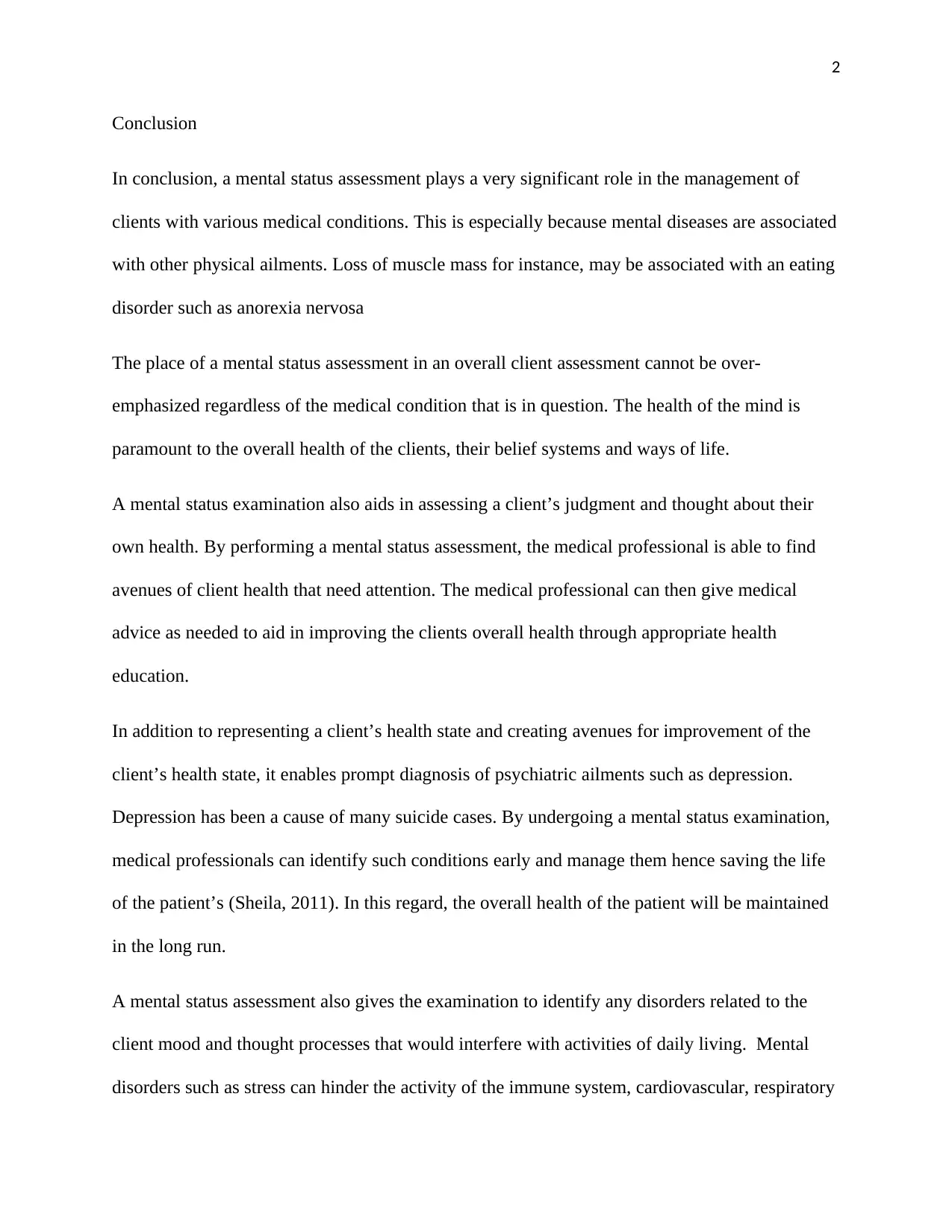
Conclusion
In conclusion, a mental status assessment plays a very significant role in the management of
clients with various medical conditions. This is especially because mental diseases are associated
with other physical ailments. Loss of muscle mass for instance, may be associated with an eating
disorder such as anorexia nervosa
The place of a mental status assessment in an overall client assessment cannot be over-
emphasized regardless of the medical condition that is in question. The health of the mind is
paramount to the overall health of the clients, their belief systems and ways of life.
A mental status examination also aids in assessing a client’s judgment and thought about their
own health. By performing a mental status assessment, the medical professional is able to find
avenues of client health that need attention. The medical professional can then give medical
advice as needed to aid in improving the clients overall health through appropriate health
education.
In addition to representing a client’s health state and creating avenues for improvement of the
client’s health state, it enables prompt diagnosis of psychiatric ailments such as depression.
Depression has been a cause of many suicide cases. By undergoing a mental status examination,
medical professionals can identify such conditions early and manage them hence saving the life
of the patient’s (Sheila, 2011). In this regard, the overall health of the patient will be maintained
in the long run.
A mental status assessment also gives the examination to identify any disorders related to the
client mood and thought processes that would interfere with activities of daily living. Mental
disorders such as stress can hinder the activity of the immune system, cardiovascular, respiratory
Document Page
3
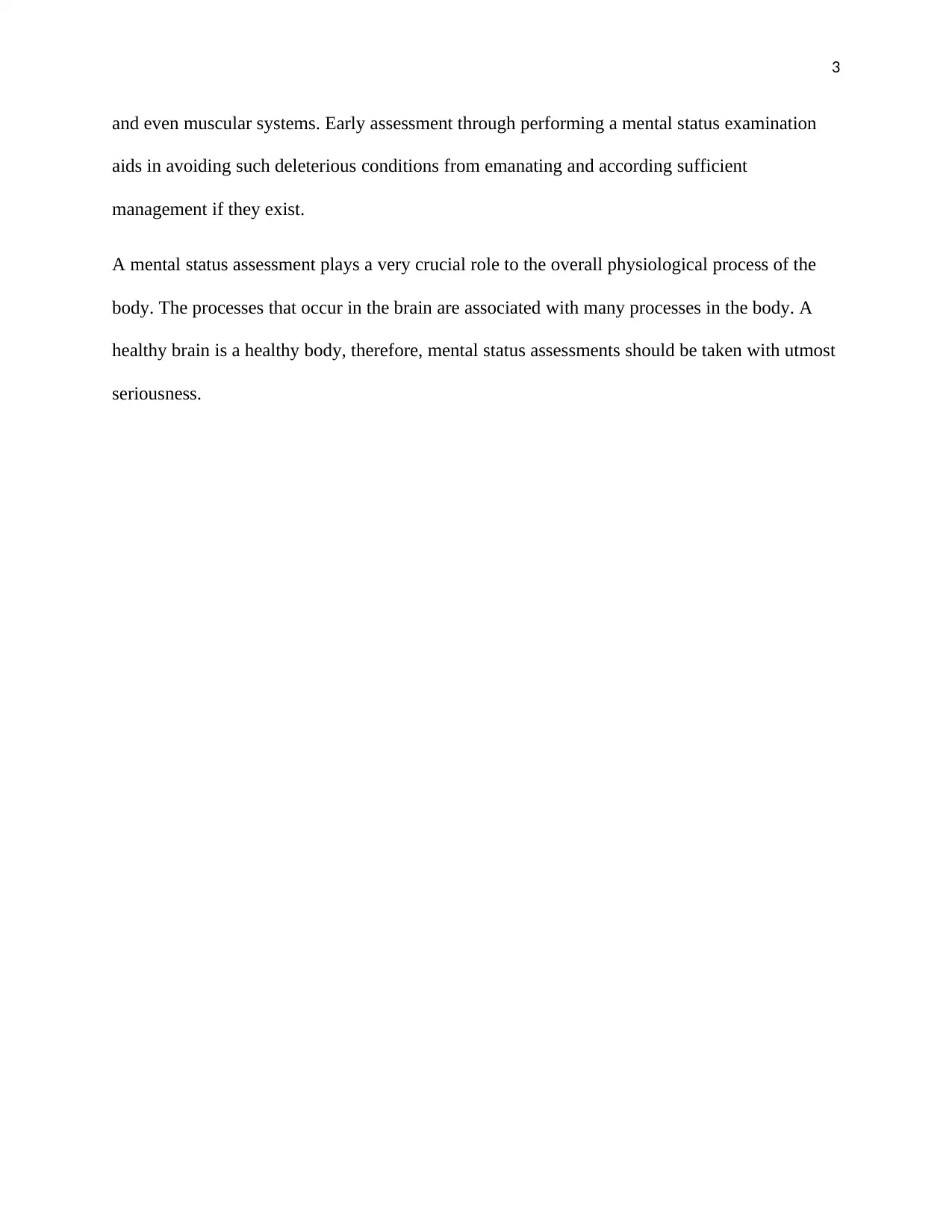
and even muscular systems. Early assessment through performing a mental status examination
aids in avoiding such deleterious conditions from emanating and according sufficient
management if they exist.
A mental status assessment plays a very crucial role to the overall physiological process of the
body. The processes that occur in the brain are associated with many processes in the body. A
healthy brain is a healthy body, therefore, mental status assessments should be taken with utmost
seriousness.
Document Page
4
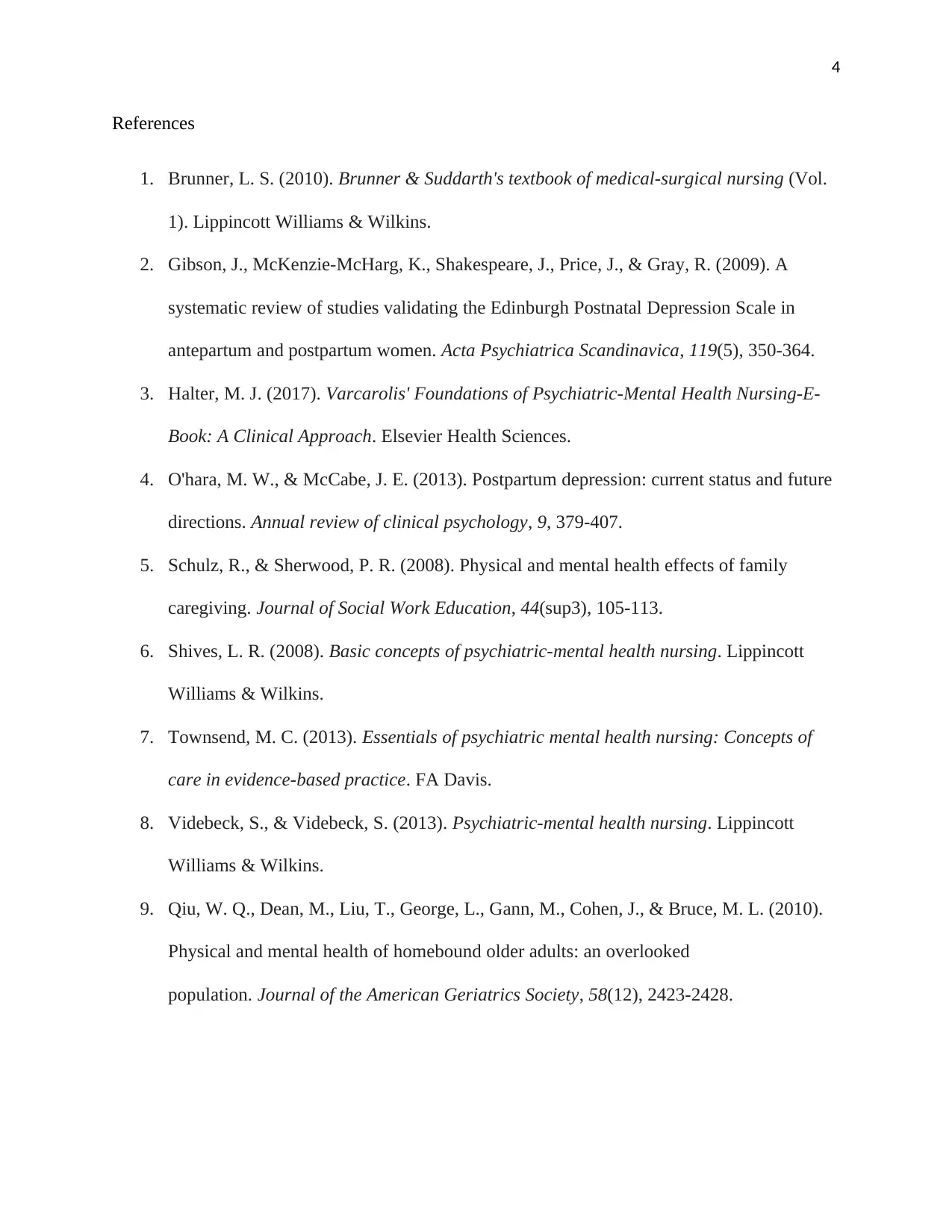
References
1. Brunner, L. S. (2010). Brunner & Suddarth's textbook of medical-surgical nursing (Vol.
1). Lippincott Williams & Wilkins.
2. Gibson, J., McKenzie‐McHarg, K., Shakespeare, J., Price, J., & Gray, R. (2009). A
systematic review of studies validating the Edinburgh Postnatal Depression Scale in
antepartum and postpartum women. Acta Psychiatrica Scandinavica, 119(5), 350-364.
3. Halter, M. J. (2017). Varcarolis' Foundations of Psychiatric-Mental Health Nursing-E-
Book: A Clinical Approach. Elsevier Health Sciences.
4. O'hara, M. W., & McCabe, J. E. (2013). Postpartum depression: current status and future
directions. Annual review of clinical psychology, 9, 379-407.
5. Schulz, R., & Sherwood, P. R. (2008). Physical and mental health effects of family
caregiving. Journal of Social Work Education, 44(sup3), 105-113.
6. Shives, L. R. (2008). Basic concepts of psychiatric-mental health nursing. Lippincott
Williams & Wilkins.
7. Townsend, M. C. (2013). Essentials of psychiatric mental health nursing: Concepts of
care in evidence-based practice. FA Davis.
8. Videbeck, S., & Videbeck, S. (2013). Psychiatric-mental health nursing. Lippincott
Williams & Wilkins.
9. Qiu, W. Q., Dean, M., Liu, T., George, L., Gann, M., Cohen, J., & Bruce, M. L. (2010).
Physical and mental health of homebound older adults: an overlooked
population. Journal of the American Geriatrics Society, 58(12), 2423-2428.
tabler-icon-diamond-filled.svg

Paraphrase This Document

Need a fresh take? Get an instant paraphrase of this document with our AI Paraphraser
Document Page
5
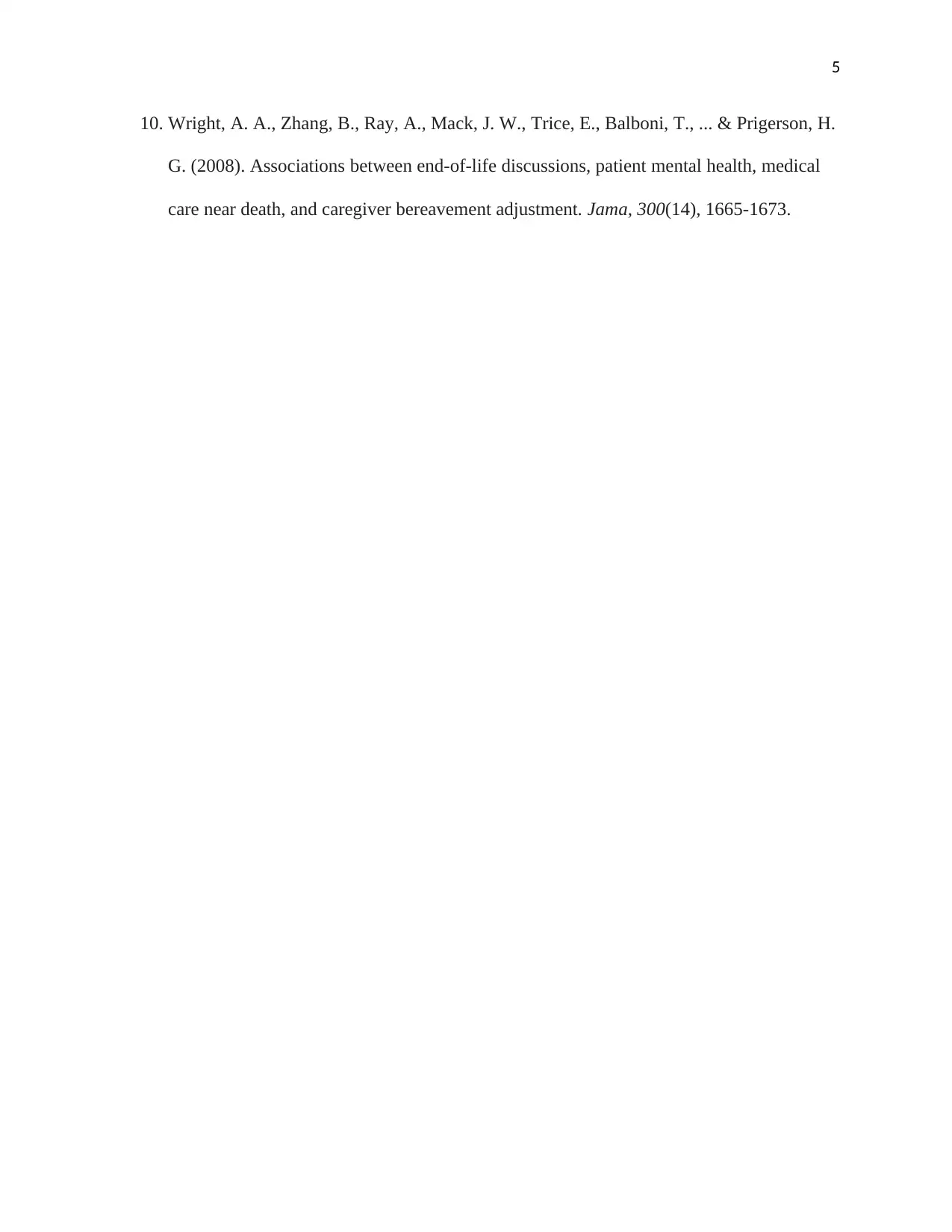
10. Wright, A. A., Zhang, B., Ray, A., Mack, J. W., Trice, E., Balboni, T., ... & Prigerson, H.
G. (2008). Associations between end-of-life discussions, patient mental health, medical
care near death, and caregiver bereavement adjustment. Jama, 300(14), 1665-1673.
chevron_up_icon
1 out of 5
circle_padding
hide_on_mobile
zoom_out_icon
[object Object]