James Cook University, EA5016 Hydrology: Water Export Essay

Verified

Added on  2022/07/28

|5
|753
|328
Essay
AI Summary
This essay, written for a Hydrology course (EA5016) at James Cook University, addresses the question of whether Australia should export water from Far North Queensland to drought-stricken areas. The author argues against the proposal, citing significant environmental, social, and economic drawbacks. The environmental impacts discussed include the production of greenhouse gases from infrastructure construction and the disruption of local ecosystems. Social impacts involve potential displacement of communities and a lack of local support. Economically, the essay highlights the high costs of infrastructure, energy consumption, and potential relocation of affected populations, suggesting that alternative solutions like water conservation, desalination, and water recycling are more cost-effective. The essay references academic journal articles to support its claims, providing a comprehensive overview of the issue and its complexities.
Document Page
1
HYDROLOGY
By Name
Course
Instructor
Institution
Location
Date
tabler-icon-diamond-filled.svg

Paraphrase This Document

Need a fresh take? Get an instant paraphrase of this document with our AI Paraphraser
Document Page
2
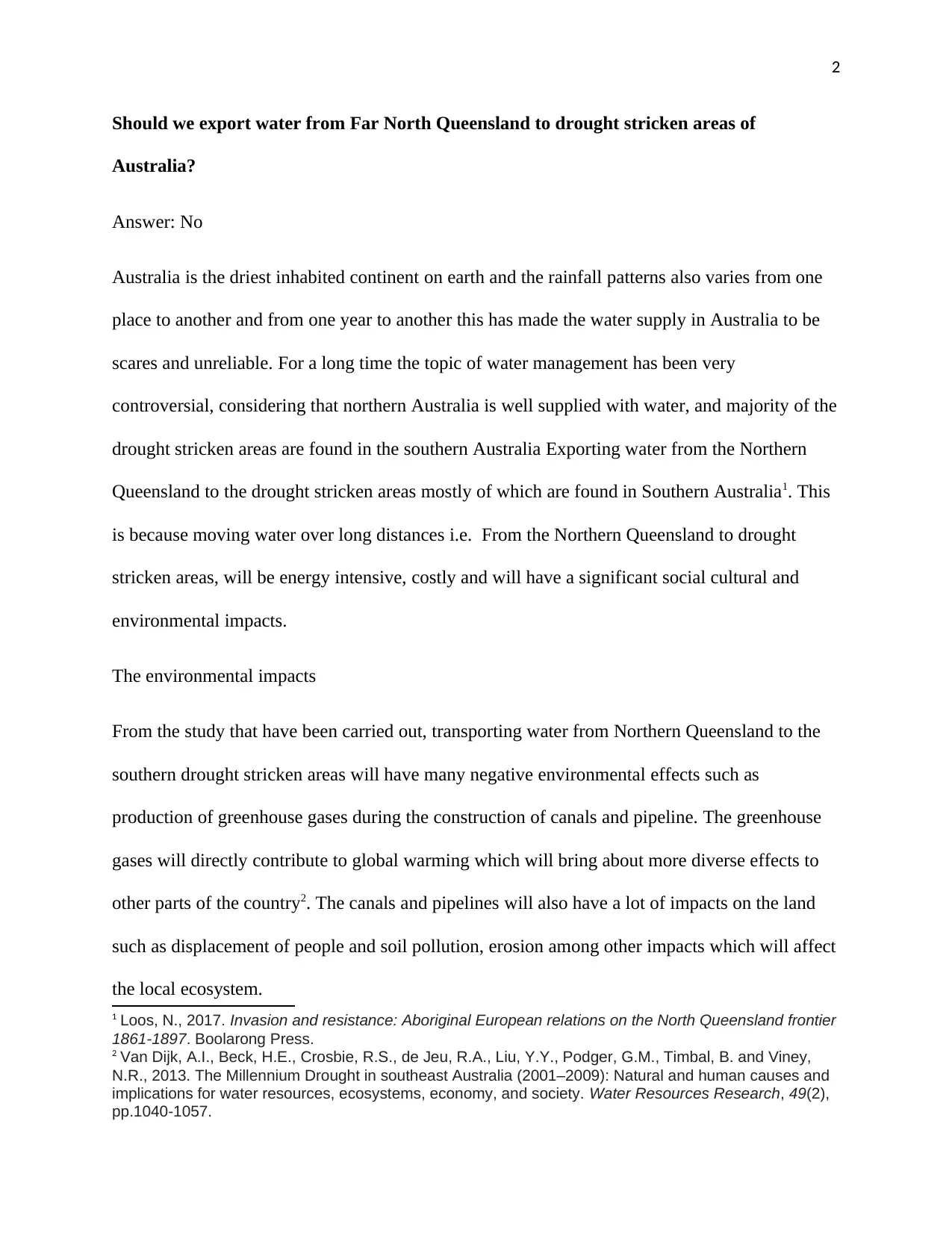
Should we export water from Far North Queensland to drought stricken areas of
Australia?
Answer: No
Australia is the driest inhabited continent on earth and the rainfall patterns also varies from one
place to another and from one year to another this has made the water supply in Australia to be
scares and unreliable. For a long time the topic of water management has been very
controversial, considering that northern Australia is well supplied with water, and majority of the
drought stricken areas are found in the southern Australia Exporting water from the Northern
Queensland to the drought stricken areas mostly of which are found in Southern Australia1. This
is because moving water over long distances i.e. From the Northern Queensland to drought
stricken areas, will be energy intensive, costly and will have a significant social cultural and
environmental impacts.
The environmental impacts
From the study that have been carried out, transporting water from Northern Queensland to the
southern drought stricken areas will have many negative environmental effects such as
production of greenhouse gases during the construction of canals and pipeline. The greenhouse
gases will directly contribute to global warming which will bring about more diverse effects to
other parts of the country2. The canals and pipelines will also have a lot of impacts on the land
such as displacement of people and soil pollution, erosion among other impacts which will affect
the local ecosystem.
1 Loos, N., 2017. Invasion and resistance: Aboriginal European relations on the North Queensland frontier
1861-1897. Boolarong Press.
2 Van Dijk, A.I., Beck, H.E., Crosbie, R.S., de Jeu, R.A., Liu, Y.Y., Podger, G.M., Timbal, B. and Viney,
N.R., 2013. The Millennium Drought in southeast Australia (2001–2009): Natural and human causes and
implications for water resources, ecosystems, economy, and society. Water Resources Research, 49(2),
pp.1040-1057.
Document Page
3
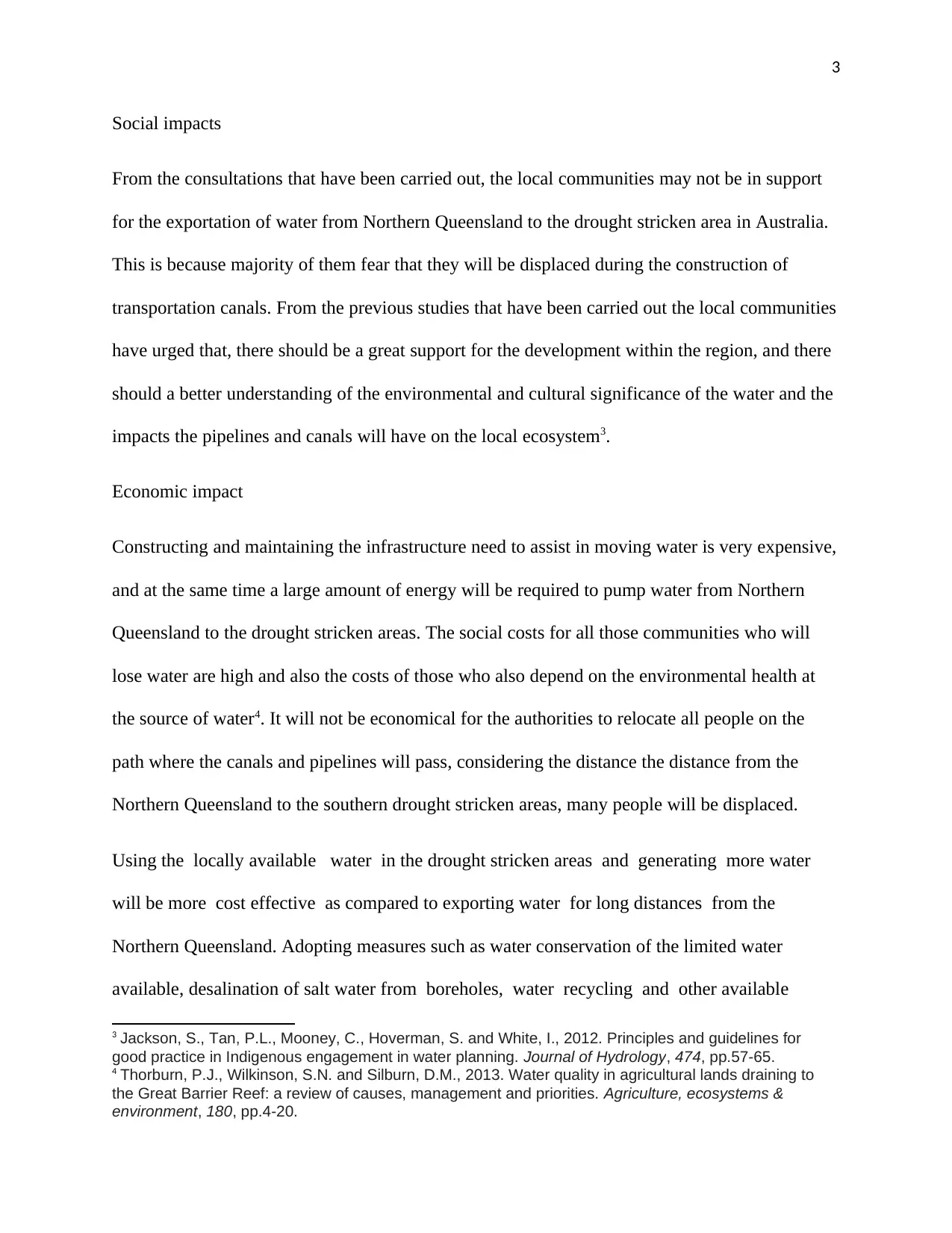
Social impacts
From the consultations that have been carried out, the local communities may not be in support
for the exportation of water from Northern Queensland to the drought stricken area in Australia.
This is because majority of them fear that they will be displaced during the construction of
transportation canals. From the previous studies that have been carried out the local communities
have urged that, there should be a great support for the development within the region, and there
should a better understanding of the environmental and cultural significance of the water and the
impacts the pipelines and canals will have on the local ecosystem3.
Economic impact
Constructing and maintaining the infrastructure need to assist in moving water is very expensive,
and at the same time a large amount of energy will be required to pump water from Northern
Queensland to the drought stricken areas. The social costs for all those communities who will
lose water are high and also the costs of those who also depend on the environmental health at
the source of water4. It will not be economical for the authorities to relocate all people on the
path where the canals and pipelines will pass, considering the distance the distance from the
Northern Queensland to the southern drought stricken areas, many people will be displaced.
Using the locally available water in the drought stricken areas and generating more water
will be more cost effective as compared to exporting water for long distances from the
Northern Queensland. Adopting measures such as water conservation of the limited water
available, desalination of salt water from boreholes, water recycling and other available
3 Jackson, S., Tan, P.L., Mooney, C., Hoverman, S. and White, I., 2012. Principles and guidelines for
good practice in Indigenous engagement in water planning. Journal of Hydrology, 474, pp.57-65.
4 Thorburn, P.J., Wilkinson, S.N. and Silburn, D.M., 2013. Water quality in agricultural lands draining to
the Great Barrier Reef: a review of causes, management and priorities. Agriculture, ecosystems &
environment, 180, pp.4-20.
Document Page
4
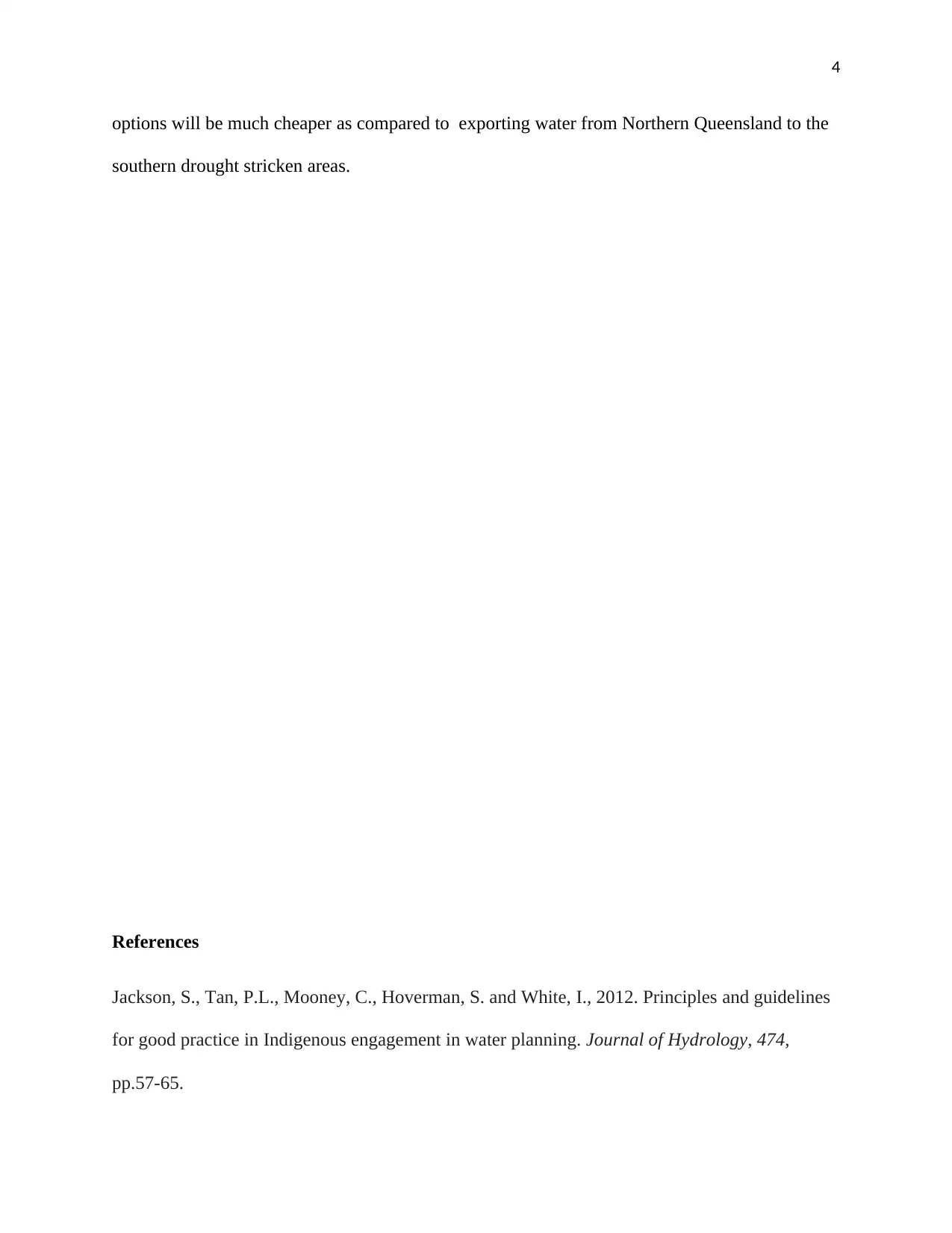
options will be much cheaper as compared to exporting water from Northern Queensland to the
southern drought stricken areas.
References
Jackson, S., Tan, P.L., Mooney, C., Hoverman, S. and White, I., 2012. Principles and guidelines
for good practice in Indigenous engagement in water planning. Journal of Hydrology, 474,
pp.57-65.
tabler-icon-diamond-filled.svg

Paraphrase This Document

Need a fresh take? Get an instant paraphrase of this document with our AI Paraphraser
Document Page
5
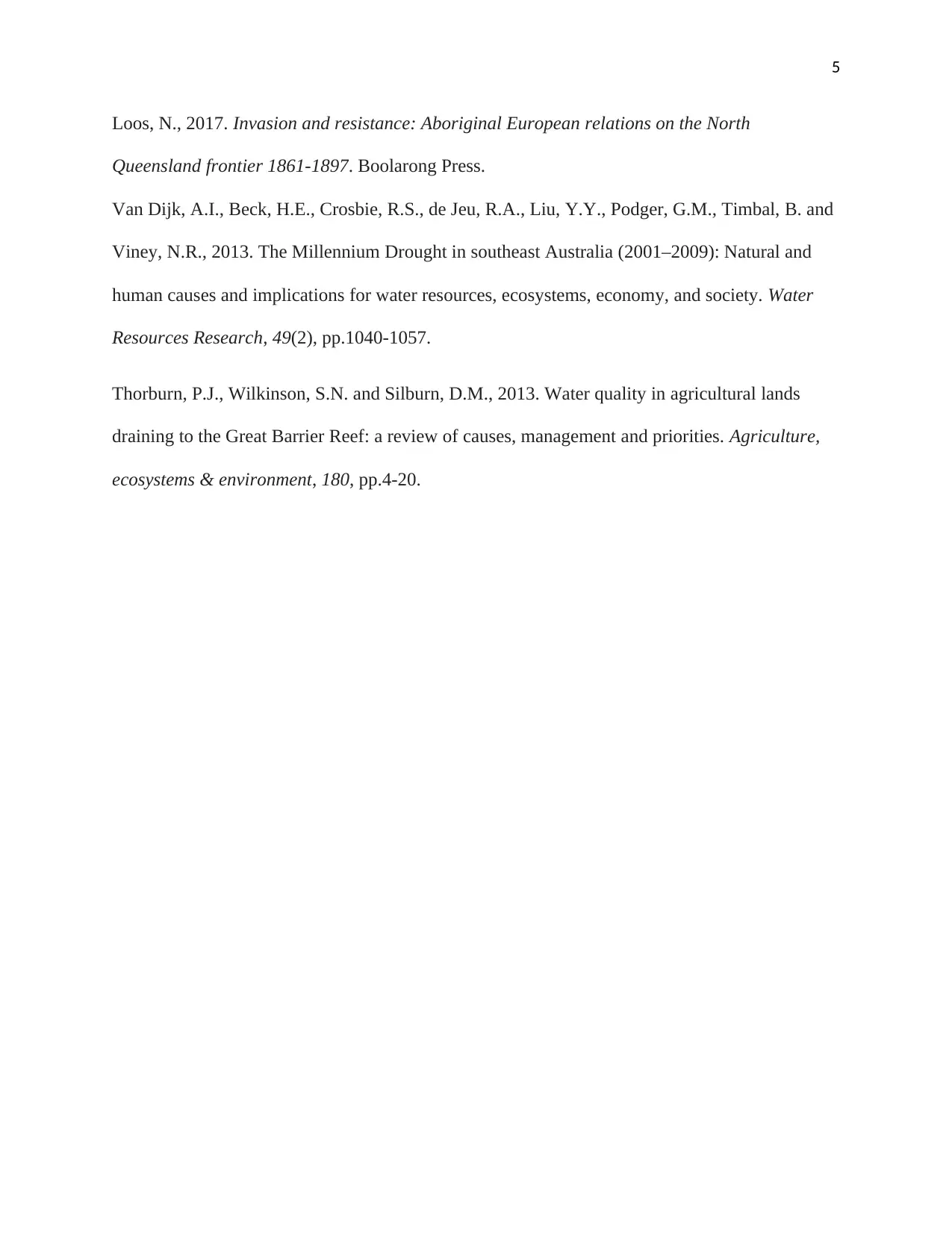
Loos, N., 2017. Invasion and resistance: Aboriginal European relations on the North
Queensland frontier 1861-1897. Boolarong Press.
Van Dijk, A.I., Beck, H.E., Crosbie, R.S., de Jeu, R.A., Liu, Y.Y., Podger, G.M., Timbal, B. and
Viney, N.R., 2013. The Millennium Drought in southeast Australia (2001–2009): Natural and
human causes and implications for water resources, ecosystems, economy, and society. Water
Resources Research, 49(2), pp.1040-1057.
Thorburn, P.J., Wilkinson, S.N. and Silburn, D.M., 2013. Water quality in agricultural lands
draining to the Great Barrier Reef: a review of causes, management and priorities. Agriculture,
ecosystems & environment, 180, pp.4-20.
chevron_up_icon
1 out of 5
circle_padding
hide_on_mobile
zoom_out_icon
[object Object]