Finance 149 - First Assignment

Verified

Added on  2019/10/18

|6
|958
|212
Homework Assignment
AI Summary
This document provides solutions to a finance assignment, specifically for Finance 149. The assignment includes several questions covering various financial concepts. Question 1 involves calculating the selling price and operating profit/loss of a utensil considering overhead and profit margins. Question 2 focuses on determining the highest simple interest rate equivalent to a trade discount and calculating savings from utilizing a lower interest rate. Question 3 deals with calculating the maturity value of a promissory note, the purchasing price for a bank, and the realized interest rate for the note's seller. Question 4 involves calculating the price of T-bills at different points in time, considering discount yields and rates of return. Finally, Question 5 demonstrates the calculation of future value using compound interest.
Document Page
1
FINANCE 149 – FIRST ASSIGNMENT
tabler-icon-diamond-filled.svg

Paraphrase This Document

Need a fresh take? Get an instant paraphrase of this document with our AI Paraphraser
Document Page
2
Contents
No table of contents entries found.
Document Page
3
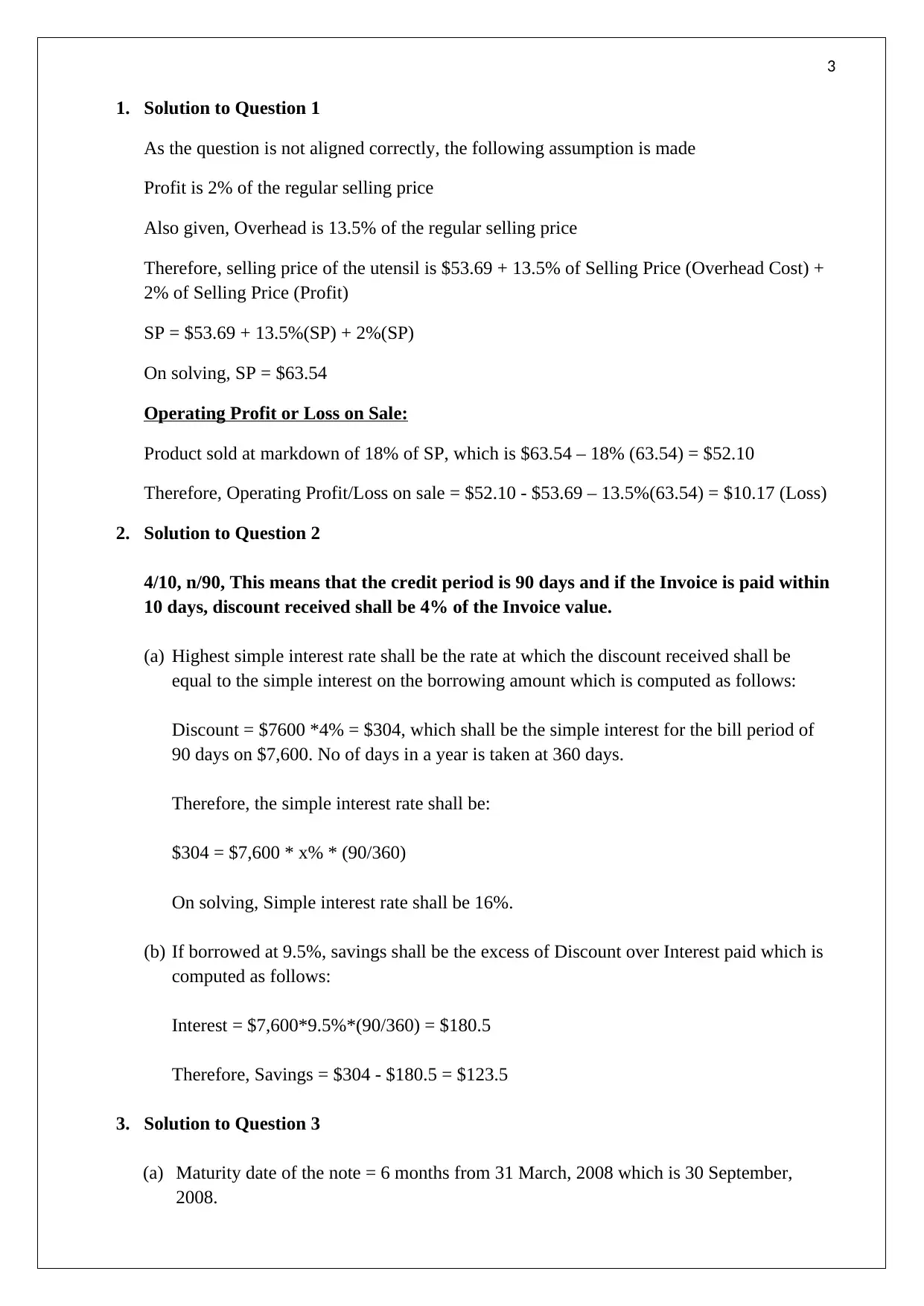
1. Solution to Question 1
As the question is not aligned correctly, the following assumption is made
Profit is 2% of the regular selling price
Also given, Overhead is 13.5% of the regular selling price
Therefore, selling price of the utensil is $53.69 + 13.5% of Selling Price (Overhead Cost) +
2% of Selling Price (Profit)
SP = $53.69 + 13.5%(SP) + 2%(SP)
On solving, SP = $63.54
Operating Profit or Loss on Sale:
Product sold at markdown of 18% of SP, which is $63.54 – 18% (63.54) = $52.10
Therefore, Operating Profit/Loss on sale = $52.10 - $53.69 – 13.5%(63.54) = $10.17 (Loss)
2. Solution to Question 2
4/10, n/90, This means that the credit period is 90 days and if the Invoice is paid within
10 days, discount received shall be 4% of the Invoice value.
(a) Highest simple interest rate shall be the rate at which the discount received shall be
equal to the simple interest on the borrowing amount which is computed as follows:
Discount = $7600 *4% = $304, which shall be the simple interest for the bill period of
90 days on $7,600. No of days in a year is taken at 360 days.
Therefore, the simple interest rate shall be:
$304 = $7,600 * x% * (90/360)
On solving, Simple interest rate shall be 16%.
(b) If borrowed at 9.5%, savings shall be the excess of Discount over Interest paid which is
computed as follows:
Interest = $7,600*9.5%*(90/360) = $180.5
Therefore, Savings = $304 - $180.5 = $123.5
3. Solution to Question 3
(a) Maturity date of the note = 6 months from 31 March, 2008 which is 30 September,
2008.
Document Page
4
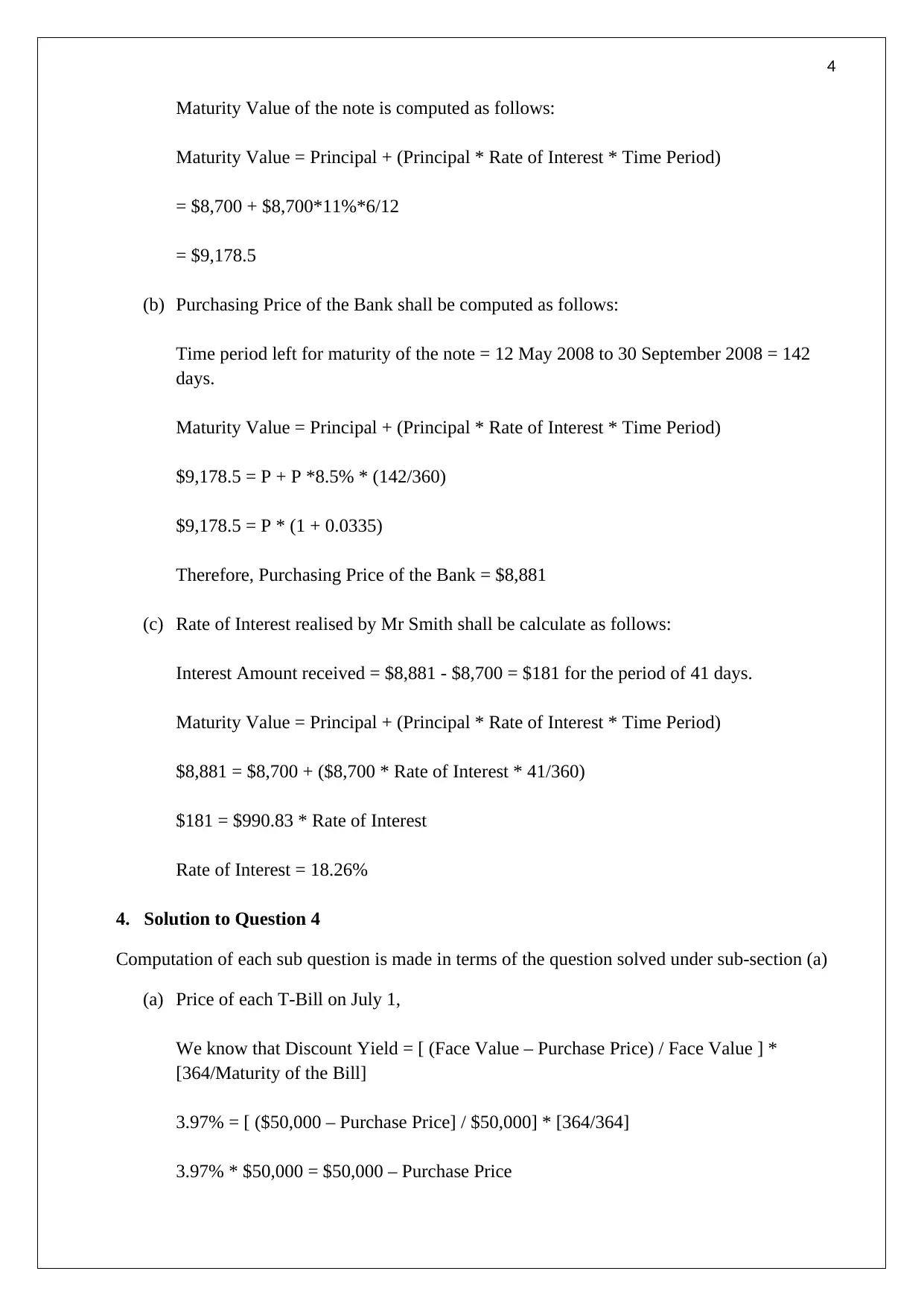
Maturity Value of the note is computed as follows:
Maturity Value = Principal + (Principal * Rate of Interest * Time Period)
= $8,700 + $8,700*11%*6/12
= $9,178.5
(b) Purchasing Price of the Bank shall be computed as follows:
Time period left for maturity of the note = 12 May 2008 to 30 September 2008 = 142
days.
Maturity Value = Principal + (Principal * Rate of Interest * Time Period)
$9,178.5 = P + P *8.5% * (142/360)
$9,178.5 = P * (1 + 0.0335)
Therefore, Purchasing Price of the Bank = $8,881
(c) Rate of Interest realised by Mr Smith shall be calculate as follows:
Interest Amount received = $8,881 - $8,700 = $181 for the period of 41 days.
Maturity Value = Principal + (Principal * Rate of Interest * Time Period)
$8,881 = $8,700 + ($8,700 * Rate of Interest * 41/360)
$181 = $990.83 * Rate of Interest
Rate of Interest = 18.26%
4. Solution to Question 4
Computation of each sub question is made in terms of the question solved under sub-section (a)
(a) Price of each T-Bill on July 1,
We know that Discount Yield = [ (Face Value – Purchase Price) / Face Value ] *
[364/Maturity of the Bill]
3.97% = [ ($50,000 – Purchase Price] / $50,000] * [364/364]
3.97% * $50,000 = $50,000 – Purchase Price
tabler-icon-diamond-filled.svg

Paraphrase This Document

Need a fresh take? Get an instant paraphrase of this document with our AI Paraphraser
Document Page
5
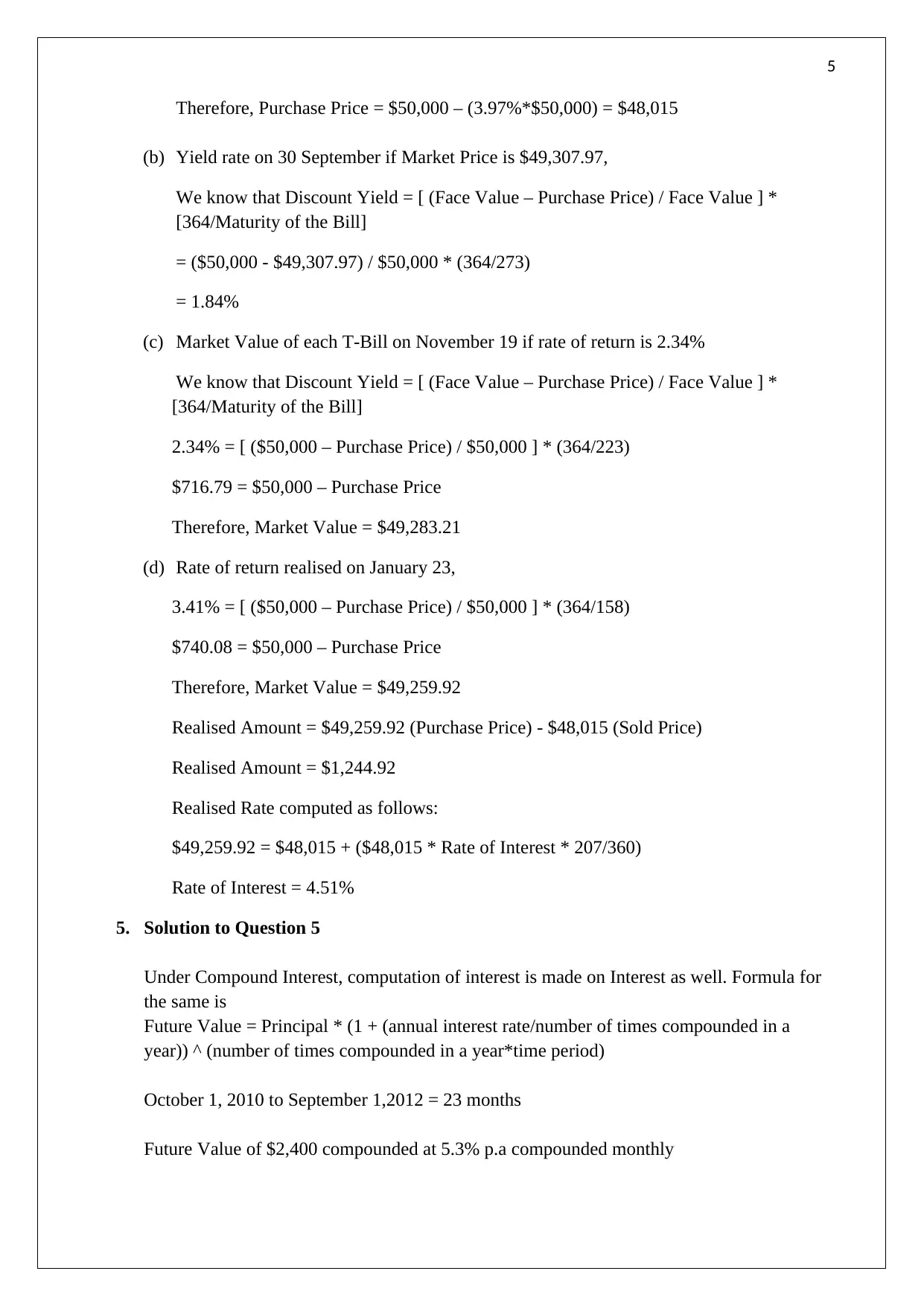
Therefore, Purchase Price = $50,000 – (3.97%*$50,000) = $48,015
(b) Yield rate on 30 September if Market Price is $49,307.97,
We know that Discount Yield = [ (Face Value – Purchase Price) / Face Value ] *
[364/Maturity of the Bill]
= ($50,000 - $49,307.97) / $50,000 * (364/273)
= 1.84%
(c) Market Value of each T-Bill on November 19 if rate of return is 2.34%
We know that Discount Yield = [ (Face Value – Purchase Price) / Face Value ] *
[364/Maturity of the Bill]
2.34% = [ ($50,000 – Purchase Price) / $50,000 ] * (364/223)
$716.79 = $50,000 – Purchase Price
Therefore, Market Value = $49,283.21
(d) Rate of return realised on January 23,
3.41% = [ ($50,000 – Purchase Price) / $50,000 ] * (364/158)
$740.08 = $50,000 – Purchase Price
Therefore, Market Value = $49,259.92
Realised Amount = $49,259.92 (Purchase Price) - $48,015 (Sold Price)
Realised Amount = $1,244.92
Realised Rate computed as follows:
$49,259.92 = $48,015 + ($48,015 * Rate of Interest * 207/360)
Rate of Interest = 4.51%
5. Solution to Question 5
Under Compound Interest, computation of interest is made on Interest as well. Formula for
the same is
Future Value = Principal * (1 + (annual interest rate/number of times compounded in a
year)) ^ (number of times compounded in a year*time period)
October 1, 2010 to September 1,2012 = 23 months
Future Value of $2,400 compounded at 5.3% p.a compounded monthly
Document Page
6
chevron_up_icon
1 out of 6
circle_padding
hide_on_mobile
zoom_out_icon
[object Object]