Evaluating Government Policy Impacts on the UK Hospitality Industry
VerifiedAdded on  2023/04/22
|7
|580
|384
Essay
AI Summary
This essay examines the impact of UK government policies, specifically fiscal and monetary policies, on the service industry, with a focus on the hospitality sector. It discusses how changes in interest rates and tax rates, influenced by expansionary and contractionary fiscal policies, affect the performance and operations of hospitality firms. The essay highlights that while government policies can significantly influence the industry, aligning these policies with business operations can mitigate negative impacts and foster growth. Desklib offers a wealth of similar academic resources for students.
EXTERNAL BUSINESS
ENVIRONMENT
(TASK 1.2)
ENVIRONMENT
(TASK 1.2)
Paraphrase This Document
Need a fresh take? Get an instant paraphrase of this document with our AI Paraphraser

Government policy and their impact on
service industry
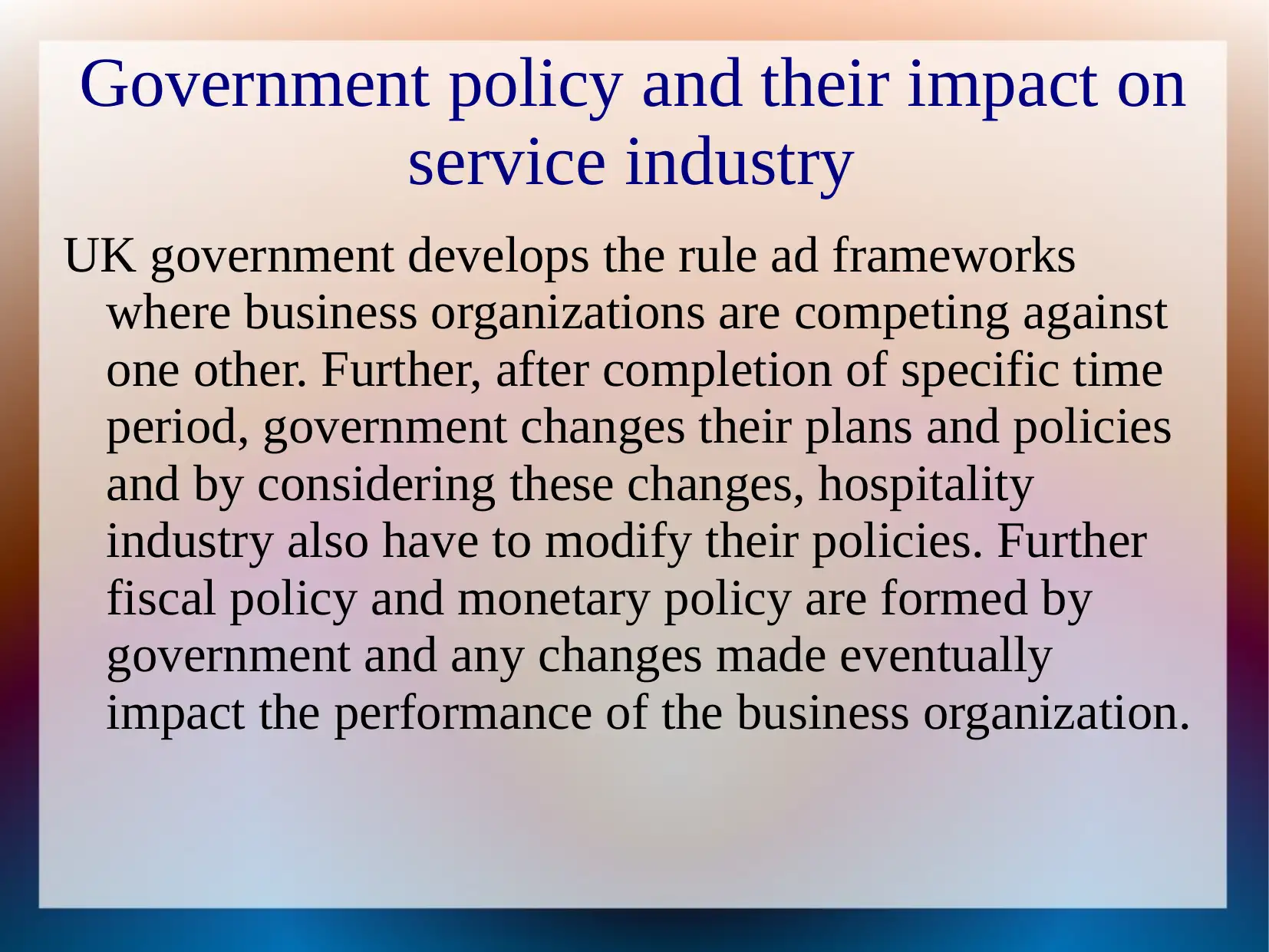
UK government develops the rule ad frameworks
where business organizations are competing against
one other. Further, after completion of specific time
period, government changes their plans and policies
and by considering these changes, hospitality
industry also have to modify their policies. Further
fiscal policy and monetary policy are formed by
government and any changes made eventually
impact the performance of the business organization.
service industry
UK government develops the rule ad frameworks
where business organizations are competing against
one other. Further, after completion of specific time
period, government changes their plans and policies
and by considering these changes, hospitality
industry also have to modify their policies. Further
fiscal policy and monetary policy are formed by
government and any changes made eventually
impact the performance of the business organization.

Continued...
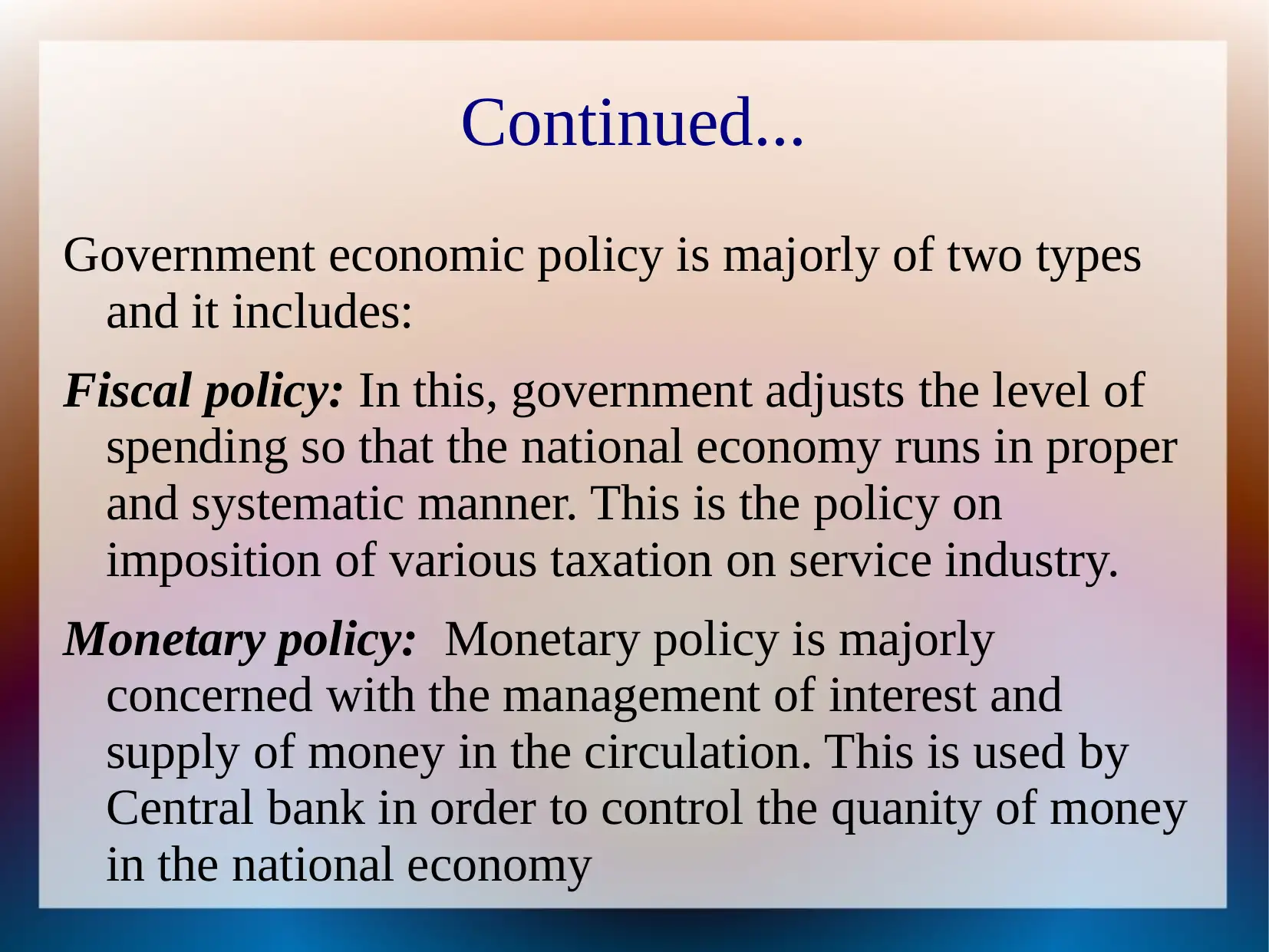
Government economic policy is majorly of two types
and it includes:
Fiscal policy: In this, government adjusts the level of
spending so that the national economy runs in proper
and systematic manner. This is the policy on
imposition of various taxation on service industry.
Monetary policy: Monetary policy is majorly
concerned with the management of interest and
supply of money in the circulation. This is used by
Central bank in order to control the quanity of money
in the national economy
Government economic policy is majorly of two types
and it includes:
Fiscal policy: In this, government adjusts the level of
spending so that the national economy runs in proper
and systematic manner. This is the policy on
imposition of various taxation on service industry.
Monetary policy: Monetary policy is majorly
concerned with the management of interest and
supply of money in the circulation. This is used by
Central bank in order to control the quanity of money
in the national economy
⊘ This is a preview!⊘
Do you want full access?
Subscribe today to unlock all pages.

Trusted by 1+ million students worldwide

Continued...
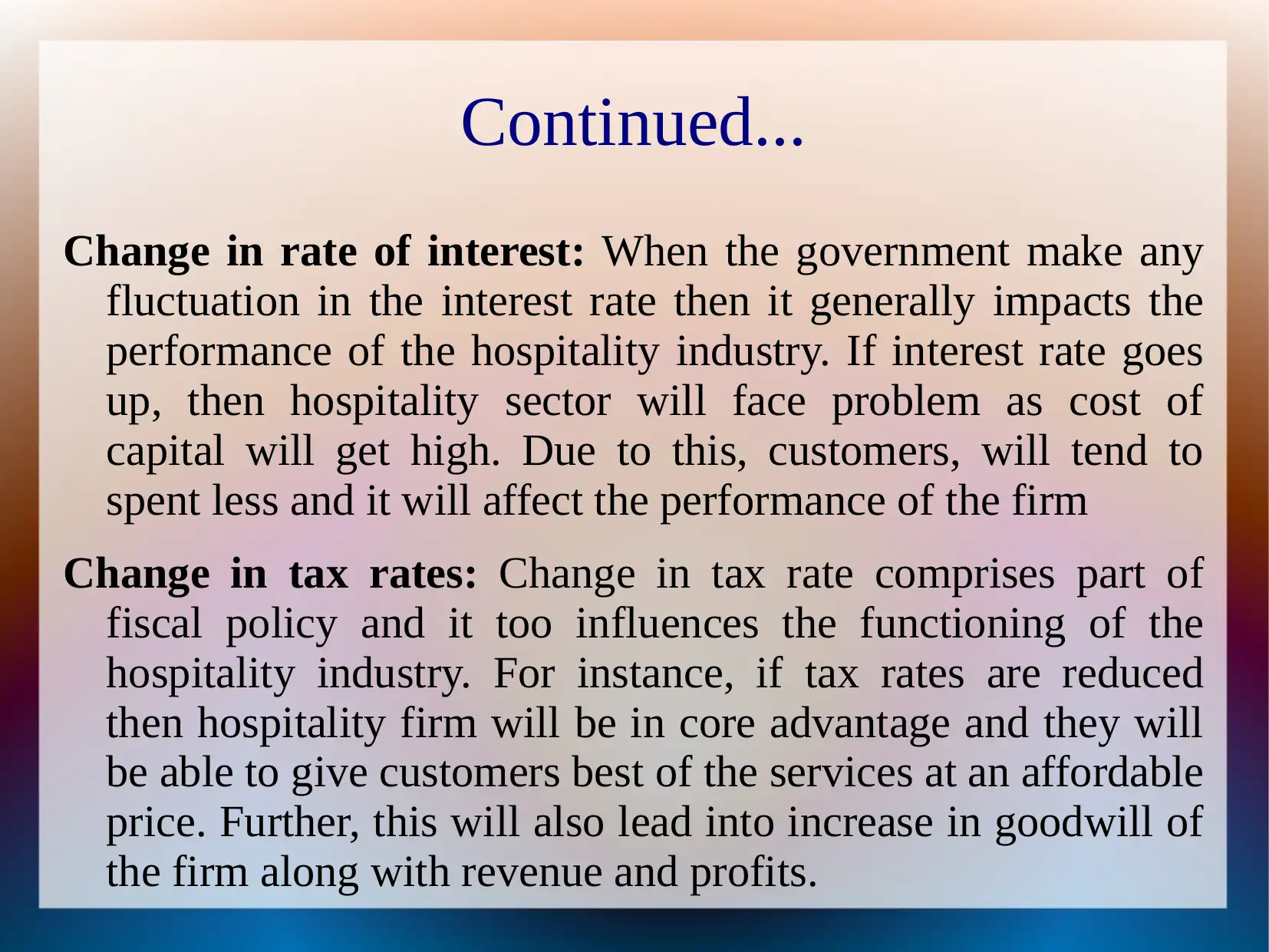
Change in rate of interest: When the government make any
fluctuation in the interest rate then it generally impacts the
performance of the hospitality industry. If interest rate goes
up, then hospitality sector will face problem as cost of
capital will get high. Due to this, customers, will tend to
spent less and it will affect the performance of the firm
Change in tax rates: Change in tax rate comprises part of
fiscal policy and it too influences the functioning of the
hospitality industry. For instance, if tax rates are reduced
then hospitality firm will be in core advantage and they will
be able to give customers best of the services at an affordable
price. Further, this will also lead into increase in goodwill of
the firm along with revenue and profits.
Change in rate of interest: When the government make any
fluctuation in the interest rate then it generally impacts the
performance of the hospitality industry. If interest rate goes
up, then hospitality sector will face problem as cost of
capital will get high. Due to this, customers, will tend to
spent less and it will affect the performance of the firm
Change in tax rates: Change in tax rate comprises part of
fiscal policy and it too influences the functioning of the
hospitality industry. For instance, if tax rates are reduced
then hospitality firm will be in core advantage and they will
be able to give customers best of the services at an affordable
price. Further, this will also lead into increase in goodwill of
the firm along with revenue and profits.
Paraphrase This Document
Need a fresh take? Get an instant paraphrase of this document with our AI Paraphraser

Continued...
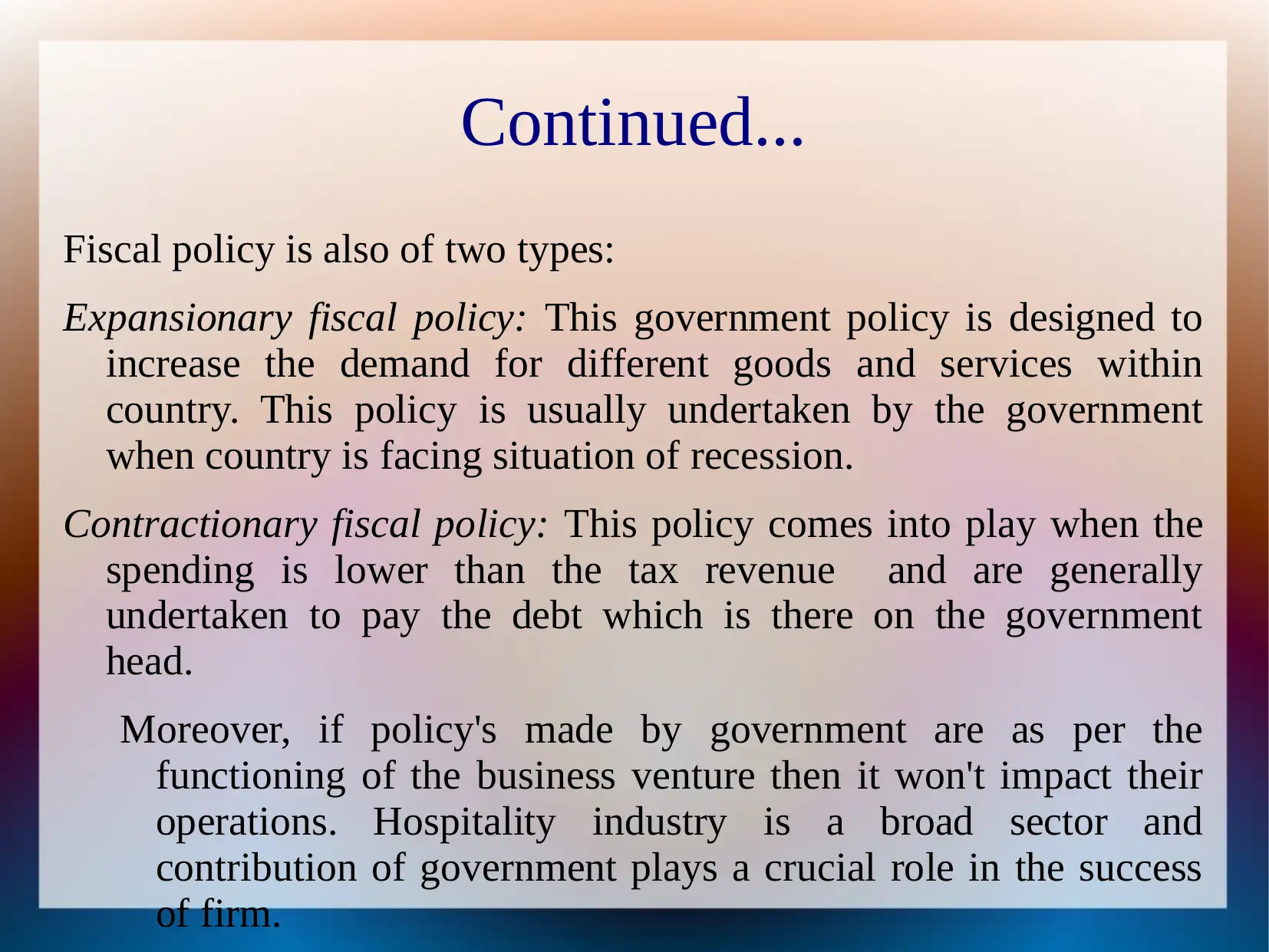
Fiscal policy is also of two types:
Expansionary fiscal policy: This government policy is designed to
increase the demand for different goods and services within
country. This policy is usually undertaken by the government
when country is facing situation of recession.
Contractionary fiscal policy: This policy comes into play when the
spending is lower than the tax revenue and are generally
undertaken to pay the debt which is there on the government
head.
Moreover, if policy's made by government are as per the
functioning of the business venture then it won't impact their
operations. Hospitality industry is a broad sector and
contribution of government plays a crucial role in the success
of firm.
Fiscal policy is also of two types:
Expansionary fiscal policy: This government policy is designed to
increase the demand for different goods and services within
country. This policy is usually undertaken by the government
when country is facing situation of recession.
Contractionary fiscal policy: This policy comes into play when the
spending is lower than the tax revenue and are generally
undertaken to pay the debt which is there on the government
head.
Moreover, if policy's made by government are as per the
functioning of the business venture then it won't impact their
operations. Hospitality industry is a broad sector and
contribution of government plays a crucial role in the success
of firm.

References
Correia, I., Nicolini, J. P. and Teles, P., 2008. Optimal fiscal
and monetary policy: Equivalence results. Journal of
Political Economy. 116(1). pp. 141-170.
De Vries, C. E., 2009. The impact of EU referenda on national
electoral politics: The Dutch case. West European Politics.
32(1). pp. 142-171.
Palmer, A. and Hartley, B., 2008. The business environment.
McGraw-Hill.
Lucky, E.O.I. and Minai, M.S., 2012. Re-investigating the
effect of individual determinant, external factor and firm
characteristics on small firm performance during economic
downturn. African Journal of Business Management. 6(1).
Correia, I., Nicolini, J. P. and Teles, P., 2008. Optimal fiscal
and monetary policy: Equivalence results. Journal of
Political Economy. 116(1). pp. 141-170.
De Vries, C. E., 2009. The impact of EU referenda on national
electoral politics: The Dutch case. West European Politics.
32(1). pp. 142-171.
Palmer, A. and Hartley, B., 2008. The business environment.
McGraw-Hill.
Lucky, E.O.I. and Minai, M.S., 2012. Re-investigating the
effect of individual determinant, external factor and firm
characteristics on small firm performance during economic
downturn. African Journal of Business Management. 6(1).
⊘ This is a preview!⊘
Do you want full access?
Subscribe today to unlock all pages.

Trusted by 1+ million students worldwide

THANK YOU
1 out of 7
Related Documents
Your All-in-One AI-Powered Toolkit for Academic Success.
 +13062052269
info@desklib.com
Available 24*7 on WhatsApp / Email
Unlock your academic potential
Copyright © 2020–2026 A2Z Services. All Rights Reserved. Developed and managed by ZUCOL.