University Law Assignment: Contracts and Property Law Cases
VerifiedAdded on 2022/11/13
|9
|1972
|267
Report
AI Summary
This report presents an analysis of several significant legal cases in the fields of contract and property law. Part A focuses on contract law, examining cases such as Oceanic Sun Line Special Shipping Co Inc v Fay (1988), which addresses the formation and jurisdiction of contracts, Esso Petroleum Ltd v Commissioners of Customs and Excise [1976], which explores the creation of consideration and legal relations in sales contracts, and Burger King Corp v Hungry Jack's Pty Ltd [2001], which deals with franchise agreements and breach of contract. Part B shifts to property law, analyzing Todd v Nicol [1957], a case involving contract law with elements of property law, considering the intentions and agreements between parties. The analysis includes the issues presented, the rules applied by the courts, and the ultimate conclusions reached, providing a comprehensive understanding of the legal principles and outcomes of each case. The assignment adheres to specific guidelines, including word count and referencing standards, as outlined in the assignment brief.
1
Name:
Course
Professor’s name
University name
City, State
Date of submission
Name:
Course
Professor’s name
University name
City, State
Date of submission

Paraphrase This Document
Need a fresh take? Get an instant paraphrase of this document with our AI Paraphraser
2
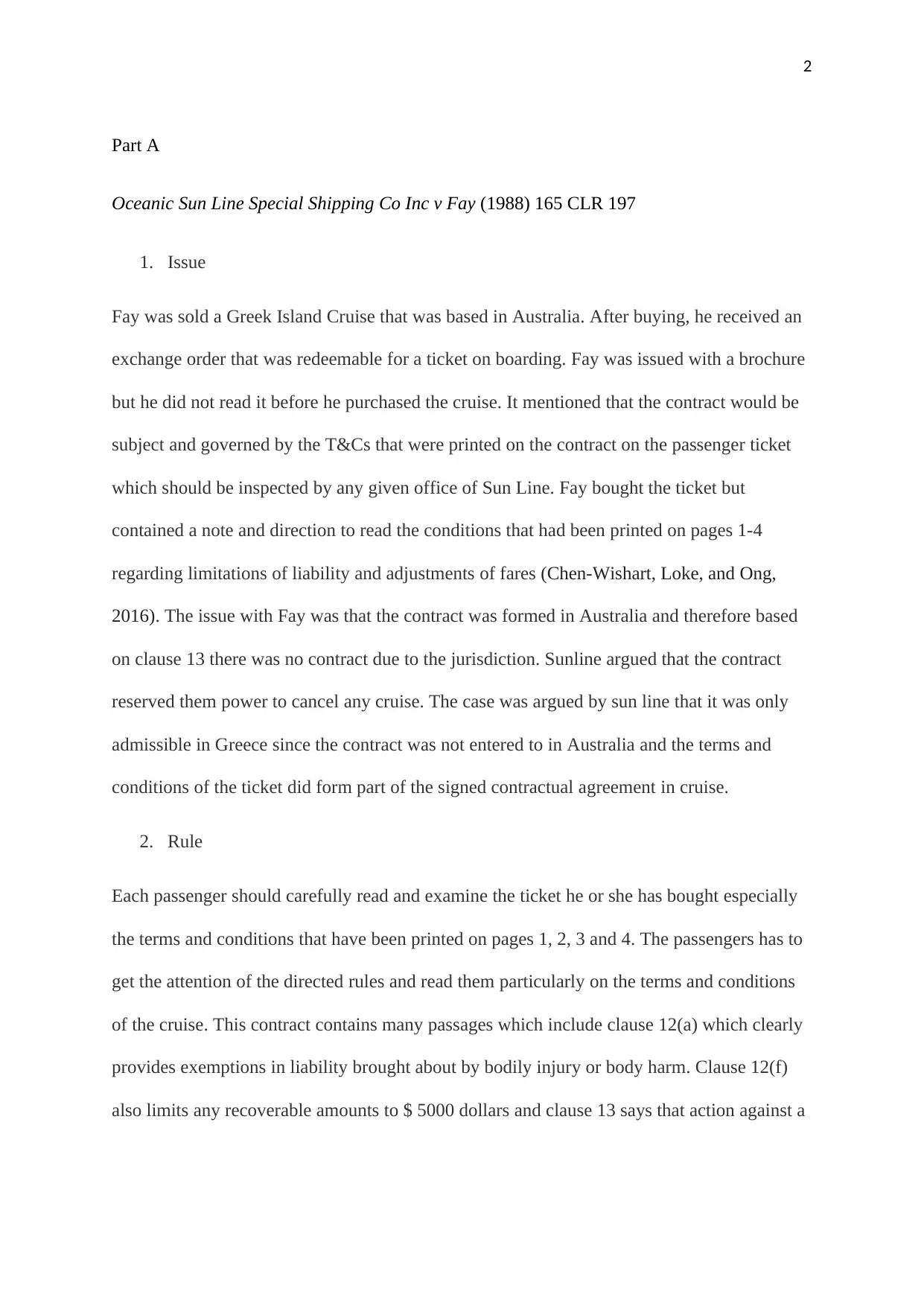
Part A
Oceanic Sun Line Special Shipping Co Inc v Fay (1988) 165 CLR 197
1. Issue
Fay was sold a Greek Island Cruise that was based in Australia. After buying, he received an
exchange order that was redeemable for a ticket on boarding. Fay was issued with a brochure
but he did not read it before he purchased the cruise. It mentioned that the contract would be
subject and governed by the T&Cs that were printed on the contract on the passenger ticket
which should be inspected by any given office of Sun Line. Fay bought the ticket but
contained a note and direction to read the conditions that had been printed on pages 1-4
regarding limitations of liability and adjustments of fares (Chen-Wishart, Loke, and Ong,
2016). The issue with Fay was that the contract was formed in Australia and therefore based
on clause 13 there was no contract due to the jurisdiction. Sunline argued that the contract
reserved them power to cancel any cruise. The case was argued by sun line that it was only
admissible in Greece since the contract was not entered to in Australia and the terms and
conditions of the ticket did form part of the signed contractual agreement in cruise.
2. Rule
Each passenger should carefully read and examine the ticket he or she has bought especially
the terms and conditions that have been printed on pages 1, 2, 3 and 4. The passengers has to
get the attention of the directed rules and read them particularly on the terms and conditions
of the cruise. This contract contains many passages which include clause 12(a) which clearly
provides exemptions in liability brought about by bodily injury or body harm. Clause 12(f)
also limits any recoverable amounts to $ 5000 dollars and clause 13 says that action against a
Part A
Oceanic Sun Line Special Shipping Co Inc v Fay (1988) 165 CLR 197
1. Issue
Fay was sold a Greek Island Cruise that was based in Australia. After buying, he received an
exchange order that was redeemable for a ticket on boarding. Fay was issued with a brochure
but he did not read it before he purchased the cruise. It mentioned that the contract would be
subject and governed by the T&Cs that were printed on the contract on the passenger ticket
which should be inspected by any given office of Sun Line. Fay bought the ticket but
contained a note and direction to read the conditions that had been printed on pages 1-4
regarding limitations of liability and adjustments of fares (Chen-Wishart, Loke, and Ong,
2016). The issue with Fay was that the contract was formed in Australia and therefore based
on clause 13 there was no contract due to the jurisdiction. Sunline argued that the contract
reserved them power to cancel any cruise. The case was argued by sun line that it was only
admissible in Greece since the contract was not entered to in Australia and the terms and
conditions of the ticket did form part of the signed contractual agreement in cruise.
2. Rule
Each passenger should carefully read and examine the ticket he or she has bought especially
the terms and conditions that have been printed on pages 1, 2, 3 and 4. The passengers has to
get the attention of the directed rules and read them particularly on the terms and conditions
of the cruise. This contract contains many passages which include clause 12(a) which clearly
provides exemptions in liability brought about by bodily injury or body harm. Clause 12(f)
also limits any recoverable amounts to $ 5000 dollars and clause 13 says that action against a
3
carrier must be only adjudicated by courts in Athens Greece and not any other country where
action took place (DeMatteo, Wagage, and Fairfax-Columbo, 2017).
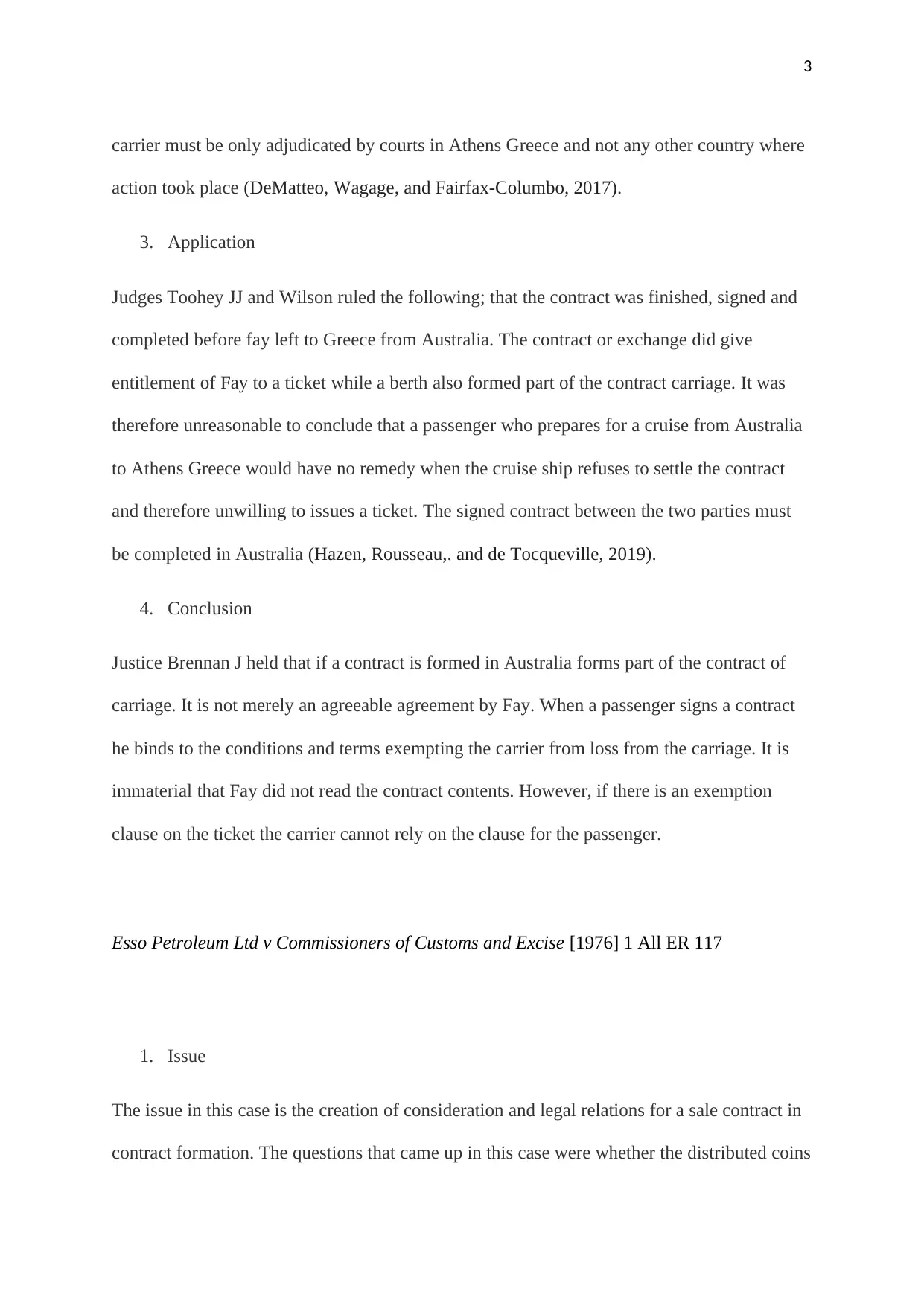
3. Application
Judges Toohey JJ and Wilson ruled the following; that the contract was finished, signed and
completed before fay left to Greece from Australia. The contract or exchange did give
entitlement of Fay to a ticket while a berth also formed part of the contract carriage. It was
therefore unreasonable to conclude that a passenger who prepares for a cruise from Australia
to Athens Greece would have no remedy when the cruise ship refuses to settle the contract
and therefore unwilling to issues a ticket. The signed contract between the two parties must
be completed in Australia (Hazen, Rousseau,. and de Tocqueville, 2019).
4. Conclusion
Justice Brennan J held that if a contract is formed in Australia forms part of the contract of
carriage. It is not merely an agreeable agreement by Fay. When a passenger signs a contract
he binds to the conditions and terms exempting the carrier from loss from the carriage. It is
immaterial that Fay did not read the contract contents. However, if there is an exemption
clause on the ticket the carrier cannot rely on the clause for the passenger.
Esso Petroleum Ltd v Commissioners of Customs and Excise [1976] 1 All ER 117
1. Issue
The issue in this case is the creation of consideration and legal relations for a sale contract in
contract formation. The questions that came up in this case were whether the distributed coins
carrier must be only adjudicated by courts in Athens Greece and not any other country where
action took place (DeMatteo, Wagage, and Fairfax-Columbo, 2017).
3. Application
Judges Toohey JJ and Wilson ruled the following; that the contract was finished, signed and
completed before fay left to Greece from Australia. The contract or exchange did give
entitlement of Fay to a ticket while a berth also formed part of the contract carriage. It was
therefore unreasonable to conclude that a passenger who prepares for a cruise from Australia
to Athens Greece would have no remedy when the cruise ship refuses to settle the contract
and therefore unwilling to issues a ticket. The signed contract between the two parties must
be completed in Australia (Hazen, Rousseau,. and de Tocqueville, 2019).
4. Conclusion
Justice Brennan J held that if a contract is formed in Australia forms part of the contract of
carriage. It is not merely an agreeable agreement by Fay. When a passenger signs a contract
he binds to the conditions and terms exempting the carrier from loss from the carriage. It is
immaterial that Fay did not read the contract contents. However, if there is an exemption
clause on the ticket the carrier cannot rely on the clause for the passenger.
Esso Petroleum Ltd v Commissioners of Customs and Excise [1976] 1 All ER 117
1. Issue
The issue in this case is the creation of consideration and legal relations for a sale contract in
contract formation. The questions that came up in this case were whether the distributed coins
⊘ This is a preview!⊘
Do you want full access?
Subscribe today to unlock all pages.

Trusted by 1+ million students worldwide
4
were goods that could be used for general sales. This led to a contractual legal obligation of
supplying coins by Esso under a contract relationship with its customers.
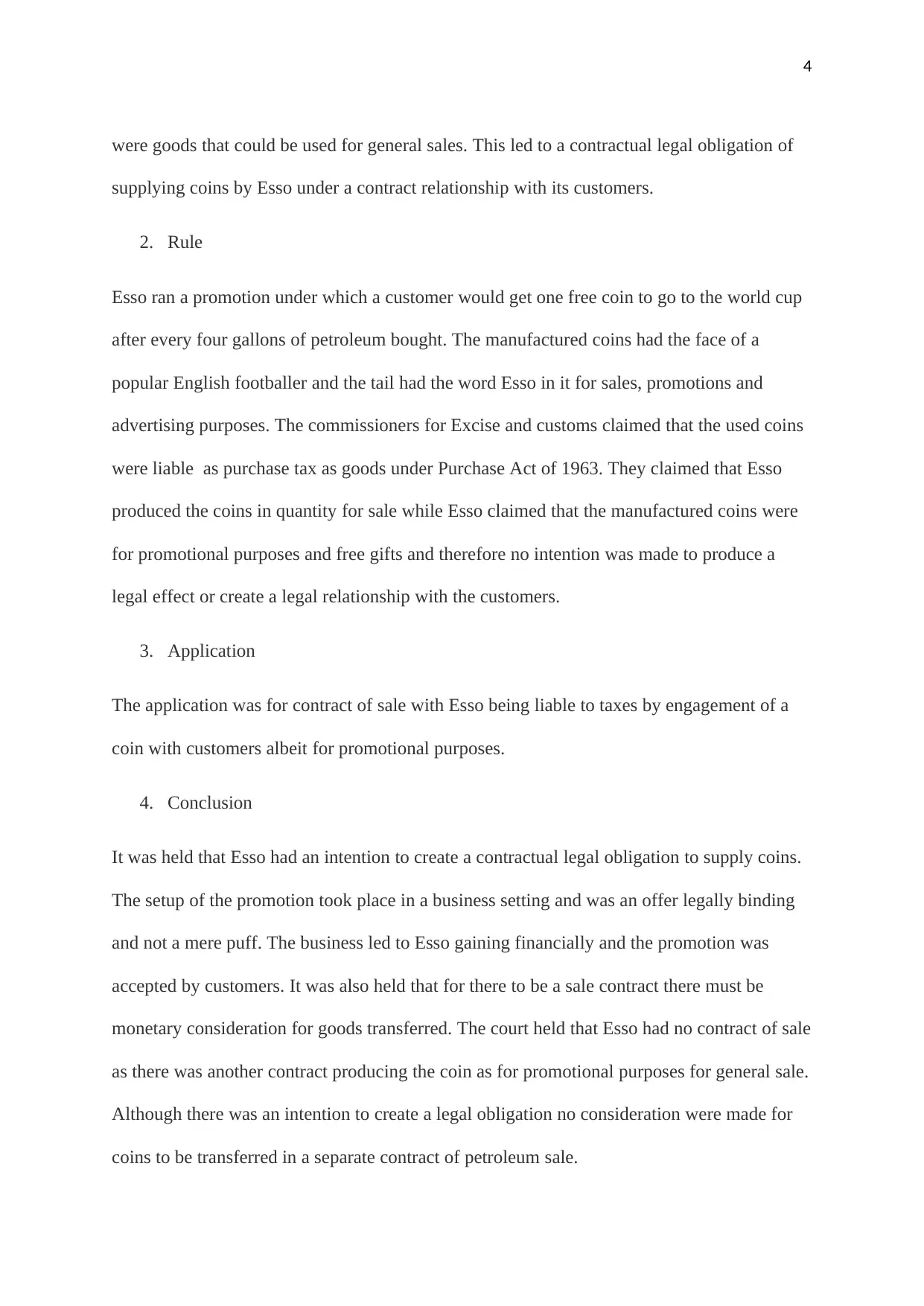
2. Rule
Esso ran a promotion under which a customer would get one free coin to go to the world cup
after every four gallons of petroleum bought. The manufactured coins had the face of a
popular English footballer and the tail had the word Esso in it for sales, promotions and
advertising purposes. The commissioners for Excise and customs claimed that the used coins
were liable as purchase tax as goods under Purchase Act of 1963. They claimed that Esso
produced the coins in quantity for sale while Esso claimed that the manufactured coins were
for promotional purposes and free gifts and therefore no intention was made to produce a
legal effect or create a legal relationship with the customers.
3. Application
The application was for contract of sale with Esso being liable to taxes by engagement of a
coin with customers albeit for promotional purposes.
4. Conclusion
It was held that Esso had an intention to create a contractual legal obligation to supply coins.
The setup of the promotion took place in a business setting and was an offer legally binding
and not a mere puff. The business led to Esso gaining financially and the promotion was
accepted by customers. It was also held that for there to be a sale contract there must be
monetary consideration for goods transferred. The court held that Esso had no contract of sale
as there was another contract producing the coin as for promotional purposes for general sale.
Although there was an intention to create a legal obligation no consideration were made for
coins to be transferred in a separate contract of petroleum sale.
were goods that could be used for general sales. This led to a contractual legal obligation of
supplying coins by Esso under a contract relationship with its customers.
2. Rule
Esso ran a promotion under which a customer would get one free coin to go to the world cup
after every four gallons of petroleum bought. The manufactured coins had the face of a
popular English footballer and the tail had the word Esso in it for sales, promotions and
advertising purposes. The commissioners for Excise and customs claimed that the used coins
were liable as purchase tax as goods under Purchase Act of 1963. They claimed that Esso
produced the coins in quantity for sale while Esso claimed that the manufactured coins were
for promotional purposes and free gifts and therefore no intention was made to produce a
legal effect or create a legal relationship with the customers.
3. Application
The application was for contract of sale with Esso being liable to taxes by engagement of a
coin with customers albeit for promotional purposes.
4. Conclusion
It was held that Esso had an intention to create a contractual legal obligation to supply coins.
The setup of the promotion took place in a business setting and was an offer legally binding
and not a mere puff. The business led to Esso gaining financially and the promotion was
accepted by customers. It was also held that for there to be a sale contract there must be
monetary consideration for goods transferred. The court held that Esso had no contract of sale
as there was another contract producing the coin as for promotional purposes for general sale.
Although there was an intention to create a legal obligation no consideration were made for
coins to be transferred in a separate contract of petroleum sale.
Paraphrase This Document
Need a fresh take? Get an instant paraphrase of this document with our AI Paraphraser
5
Burger King Corp v Hungry Jack’s Pty Ltd [2001] NSWCA 187
1. Issue
The issue raised was whether Burger King Corporation (BKC) was allowed by the
termination clause based on Hungry Jacks Pty Ltd( HJPL) inability or failure to open the
required minimum of four restaurants per region. HJPL was a franchisee of BKC trading
under it trademark name. under this contract HJPL was obligated to open four new
restaurants in four regions annually. When the franchise excelled beyond measures BKC
wanted to minimize HJPL role in Australian fast food market thereby imposing a $1000 non
refundable opening fee on every restaurant opened. BKC also withdrew operational and
financial support. Later, they terminated the contract for terming breach of contract. The
validity of the contract termination was challenged by HJPL as it had not been able to open
the required number of restaurant (Jintapitak, and Liu, 2017).
2. Rule
HJPL claimed that the contract enable it to operate and benefit inter alia while BKC
reasonably exercising massive powers under the development agreement
3. Application
HJPL role in Australian fast food market thereby imposing a $1000 nonrefundable opening
fee on every restaurant opened. BKC also withdrew operational and financial support. Later,
they terminated the contract for terming breach of contract (Petrovic, Hamilton, and Nguyen,
2017). The validity of the contract termination was challenged by HJPL as it had not been
able to open the required number of restaurant. HJPL claimed that the contract enable it to
operate and benefit inter alia while BKC reasonably exercising massive powers under the
development agreement
Burger King Corp v Hungry Jack’s Pty Ltd [2001] NSWCA 187
1. Issue
The issue raised was whether Burger King Corporation (BKC) was allowed by the
termination clause based on Hungry Jacks Pty Ltd( HJPL) inability or failure to open the
required minimum of four restaurants per region. HJPL was a franchisee of BKC trading
under it trademark name. under this contract HJPL was obligated to open four new
restaurants in four regions annually. When the franchise excelled beyond measures BKC
wanted to minimize HJPL role in Australian fast food market thereby imposing a $1000 non
refundable opening fee on every restaurant opened. BKC also withdrew operational and
financial support. Later, they terminated the contract for terming breach of contract. The
validity of the contract termination was challenged by HJPL as it had not been able to open
the required number of restaurant (Jintapitak, and Liu, 2017).
2. Rule
HJPL claimed that the contract enable it to operate and benefit inter alia while BKC
reasonably exercising massive powers under the development agreement
3. Application
HJPL role in Australian fast food market thereby imposing a $1000 nonrefundable opening
fee on every restaurant opened. BKC also withdrew operational and financial support. Later,
they terminated the contract for terming breach of contract (Petrovic, Hamilton, and Nguyen,
2017). The validity of the contract termination was challenged by HJPL as it had not been
able to open the required number of restaurant. HJPL claimed that the contract enable it to
operate and benefit inter alia while BKC reasonably exercising massive powers under the
development agreement
6
4. Conclusion
The supreme court found that there was a breach of development clause and it did not have
the right of termination. This was until 12 months which gave HJPL an opportunity to rectify
the breach. The discussion veered to application of good faith in business and reasonableness
was to be applied (Tshering, 2018). It implied this as an incident of the contract. It was
agreed that the development agreement remained subject to reasonableness in doing business
and good faith.
Part B-
Todd v Nicol [1957] SASR 72
1. Issue
This was a contract law in April 1947. The defendant D wrote to the plaintiff Ps( niece and
sister to the husband who is deceased and said how happy they would be to live in Australia
with her. D wrote that he lives all alone and would be happy to invite guest to help him. He
writes that he will help in the jobs and emigration of the Ps. He says that the girl may share
his home and pay no rent.
2. Rule
Ps sent a reply that they officially accepted the invitation. They bought tickets to Australia
after this gesture, put their house on tenancy, sold their belongings including furniture and
she up her job. D visited her solicitor and wrote to the Ps saying she had gone to add codicil
4. Conclusion
The supreme court found that there was a breach of development clause and it did not have
the right of termination. This was until 12 months which gave HJPL an opportunity to rectify
the breach. The discussion veered to application of good faith in business and reasonableness
was to be applied (Tshering, 2018). It implied this as an incident of the contract. It was
agreed that the development agreement remained subject to reasonableness in doing business
and good faith.
Part B-
Todd v Nicol [1957] SASR 72
1. Issue
This was a contract law in April 1947. The defendant D wrote to the plaintiff Ps( niece and
sister to the husband who is deceased and said how happy they would be to live in Australia
with her. D wrote that he lives all alone and would be happy to invite guest to help him. He
writes that he will help in the jobs and emigration of the Ps. He says that the girl may share
his home and pay no rent.
2. Rule
Ps sent a reply that they officially accepted the invitation. They bought tickets to Australia
after this gesture, put their house on tenancy, sold their belongings including furniture and
she up her job. D visited her solicitor and wrote to the Ps saying she had gone to add codicil
⊘ This is a preview!⊘
Do you want full access?
Subscribe today to unlock all pages.
Trusted by 1+ million students worldwide
7
to the will as they come. There was dispute with D after the Ps arrived. When she put certain
rules like unless gracie is married there was a dispute. D removed the Ps from her house so
the Ps sought a court action claiming that there was a contract formed by the two parties
(Whincop, Keyes, and Posner, 2018).
3. Application
It was held that whenever there is a mutual agreement between two parties is that there is
trust in reference to breakdown of the agreement. For there to be a contract there must be a
consideration.
4. Conclusion
In this case, there is no intention created explicitly. Considering all the Ps went to in selling
everything to come to Australia forms the goodwill considered testamentary adjunct. The
judge found that there was a binding contract created. However, they also found out that the
Ps behavior had been unreasonable and they lost their rights due to breach of contract.
to the will as they come. There was dispute with D after the Ps arrived. When she put certain
rules like unless gracie is married there was a dispute. D removed the Ps from her house so
the Ps sought a court action claiming that there was a contract formed by the two parties
(Whincop, Keyes, and Posner, 2018).
3. Application
It was held that whenever there is a mutual agreement between two parties is that there is
trust in reference to breakdown of the agreement. For there to be a contract there must be a
consideration.
4. Conclusion
In this case, there is no intention created explicitly. Considering all the Ps went to in selling
everything to come to Australia forms the goodwill considered testamentary adjunct. The
judge found that there was a binding contract created. However, they also found out that the
Ps behavior had been unreasonable and they lost their rights due to breach of contract.
Paraphrase This Document
Need a fresh take? Get an instant paraphrase of this document with our AI Paraphraser
8
References
Chen-Wishart, M., Loke, A. and Ong, B. eds., 2016. Studies in the Contract Laws of Asia:
Remedies for Breach of Contract. Oxford University Press.
DeMatteo, D., Wagage, S. and Fairfax-Columbo, J., 2017. Cyberstalking: Are we on the
same (web) page? A comparison of statutes, case law, and public perception. Journal of
aggression, conflict and peace research, 9(2), pp.83-94.
Hazen, C.D., Rousseau, J.J. and de Tocqueville, A., 2019. The French Revolution and
Napoleon: Including Key Works of the Enlightenment that Inspired the Revolution:
Declaration of the Rights of Man and of the Citizen, The Social Contract, The State of
Society in France & The Spirit of the Laws. e-artnow.
Hutchison, A., 2017. Decolonising South African Contract Law: An Argument for Synthesis.
In The Constitutional Dimension of Contract Law (pp. 151-184). Springer, Cham.
Jintapitak, N. and Liu, J., 2017. Harmonization of contract laws in ASEAN: Contract
entropy. Advanced Science Letters, 23(1), pp.440-443.
Petrovic, J., Hamilton, B. and Nguyen, C., 2017. The Exclusion of the Validity of the
Contract from the CISG: Does it still Matter?. Journal of Business Law, (2), p.101.
Tshering, S., 2018. Comparative Study on Principles of Good Faith and Fair Dealing in
Contract Laws of the United States of America and Bhutan. Bhutan Law Network/JSW Law
Research Paper Series, (18-1).
References
Chen-Wishart, M., Loke, A. and Ong, B. eds., 2016. Studies in the Contract Laws of Asia:
Remedies for Breach of Contract. Oxford University Press.
DeMatteo, D., Wagage, S. and Fairfax-Columbo, J., 2017. Cyberstalking: Are we on the
same (web) page? A comparison of statutes, case law, and public perception. Journal of
aggression, conflict and peace research, 9(2), pp.83-94.
Hazen, C.D., Rousseau, J.J. and de Tocqueville, A., 2019. The French Revolution and
Napoleon: Including Key Works of the Enlightenment that Inspired the Revolution:
Declaration of the Rights of Man and of the Citizen, The Social Contract, The State of
Society in France & The Spirit of the Laws. e-artnow.
Hutchison, A., 2017. Decolonising South African Contract Law: An Argument for Synthesis.
In The Constitutional Dimension of Contract Law (pp. 151-184). Springer, Cham.
Jintapitak, N. and Liu, J., 2017. Harmonization of contract laws in ASEAN: Contract
entropy. Advanced Science Letters, 23(1), pp.440-443.
Petrovic, J., Hamilton, B. and Nguyen, C., 2017. The Exclusion of the Validity of the
Contract from the CISG: Does it still Matter?. Journal of Business Law, (2), p.101.
Tshering, S., 2018. Comparative Study on Principles of Good Faith and Fair Dealing in
Contract Laws of the United States of America and Bhutan. Bhutan Law Network/JSW Law
Research Paper Series, (18-1).

9
Whincop, M.J., Keyes, M. and Posner, R.A., 2018. Policy and Pragmatism in the Conflict of
Laws. Routledge.
Whincop, M.J., Keyes, M. and Posner, R.A., 2018. Policy and Pragmatism in the Conflict of
Laws. Routledge.
⊘ This is a preview!⊘
Do you want full access?
Subscribe today to unlock all pages.
Trusted by 1+ million students worldwide

1 out of 9


Your All-in-One AI-Powered Toolkit for Academic Success.
+13062052269
info@desklib.com
Available 24*7 on WhatsApp / Email
![[object Object]](/_next/static/media/star-bottom.7253800d.svg)
Unlock your academic potential
Copyright © 2020–2026 A2Z Services. All Rights Reserved. Developed and managed by ZUCOL.