Mental Health Case Study: Educational Experiences and Support
VerifiedAdded on 2022/09/11
|7
|1650
|17
Case Study
AI Summary
This case study examines Emma's experiences with mental health challenges, particularly focusing on her difficulties adjusting to school from class eight through class twelve. Emma discusses her struggles with anxiety, depression, and feelings of disconnection from her peers, family, and school environment. The case study highlights the lack of appropriate support and the negative impact on her daily life and studies. It also explores the positive impact of attending a re-school, where she found a sense of belonging and support. The analysis applies a person-first perspective to identify the challenges Emma faced, including stress, anxiety, depression, and social isolation, and discusses the required support from schools, peers, and families. The case study also touches on the changes in generational knowledge and practices in mental health settings in Australia, including new treatment approaches and the importance of educational experiences in building emotional resilience. The assignment provides recommendations for support needs, including social, personal, and professional interventions, emphasizing the role of counselors, psychologists, psychiatrists, and mental health nurses.
Running head: MENTAL HEALTH
MENTAL HEALTH
Name of Student
Name of University
Author note
MENTAL HEALTH
Name of Student
Name of University
Author note
Paraphrase This Document
Need a fresh take? Get an instant paraphrase of this document with our AI Paraphraser

1
MENTAL HEALTH
Section 1:
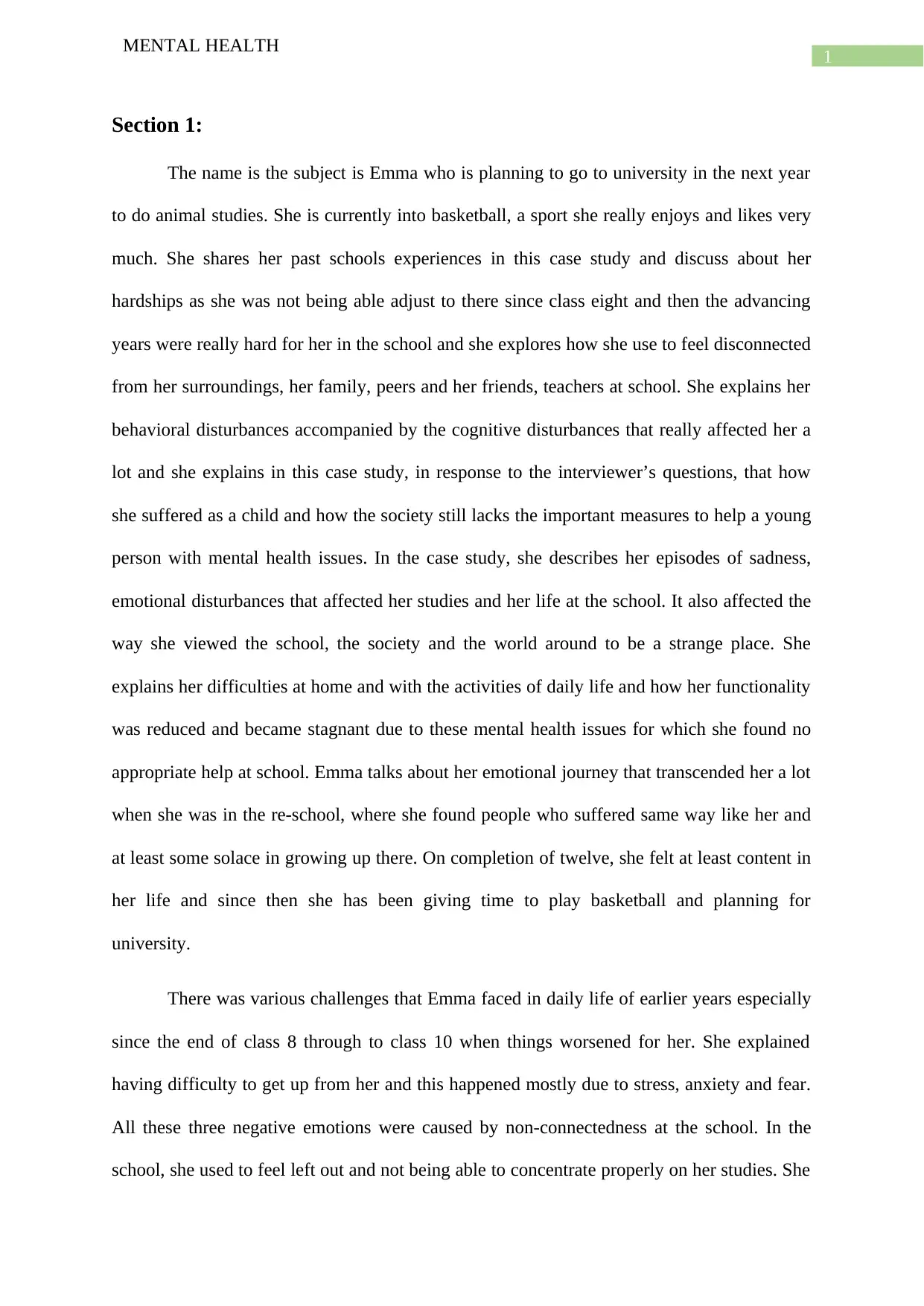
The name is the subject is Emma who is planning to go to university in the next year
to do animal studies. She is currently into basketball, a sport she really enjoys and likes very
much. She shares her past schools experiences in this case study and discuss about her
hardships as she was not being able adjust to there since class eight and then the advancing
years were really hard for her in the school and she explores how she use to feel disconnected
from her surroundings, her family, peers and her friends, teachers at school. She explains her
behavioral disturbances accompanied by the cognitive disturbances that really affected her a
lot and she explains in this case study, in response to the interviewer’s questions, that how
she suffered as a child and how the society still lacks the important measures to help a young
person with mental health issues. In the case study, she describes her episodes of sadness,
emotional disturbances that affected her studies and her life at the school. It also affected the
way she viewed the school, the society and the world around to be a strange place. She
explains her difficulties at home and with the activities of daily life and how her functionality
was reduced and became stagnant due to these mental health issues for which she found no
appropriate help at school. Emma talks about her emotional journey that transcended her a lot
when she was in the re-school, where she found people who suffered same way like her and
at least some solace in growing up there. On completion of twelve, she felt at least content in
her life and since then she has been giving time to play basketball and planning for
university.
There was various challenges that Emma faced in daily life of earlier years especially
since the end of class 8 through to class 10 when things worsened for her. She explained
having difficulty to get up from her and this happened mostly due to stress, anxiety and fear.
All these three negative emotions were caused by non-connectedness at the school. In the
school, she used to feel left out and not being able to concentrate properly on her studies. She
MENTAL HEALTH
Section 1:
The name is the subject is Emma who is planning to go to university in the next year
to do animal studies. She is currently into basketball, a sport she really enjoys and likes very
much. She shares her past schools experiences in this case study and discuss about her
hardships as she was not being able adjust to there since class eight and then the advancing
years were really hard for her in the school and she explores how she use to feel disconnected
from her surroundings, her family, peers and her friends, teachers at school. She explains her
behavioral disturbances accompanied by the cognitive disturbances that really affected her a
lot and she explains in this case study, in response to the interviewer’s questions, that how
she suffered as a child and how the society still lacks the important measures to help a young
person with mental health issues. In the case study, she describes her episodes of sadness,
emotional disturbances that affected her studies and her life at the school. It also affected the
way she viewed the school, the society and the world around to be a strange place. She
explains her difficulties at home and with the activities of daily life and how her functionality
was reduced and became stagnant due to these mental health issues for which she found no
appropriate help at school. Emma talks about her emotional journey that transcended her a lot
when she was in the re-school, where she found people who suffered same way like her and
at least some solace in growing up there. On completion of twelve, she felt at least content in
her life and since then she has been giving time to play basketball and planning for
university.
There was various challenges that Emma faced in daily life of earlier years especially
since the end of class 8 through to class 10 when things worsened for her. She explained
having difficulty to get up from her and this happened mostly due to stress, anxiety and fear.
All these three negative emotions were caused by non-connectedness at the school. In the
school, she used to feel left out and not being able to concentrate properly on her studies. She

2
MENTAL HEALTH
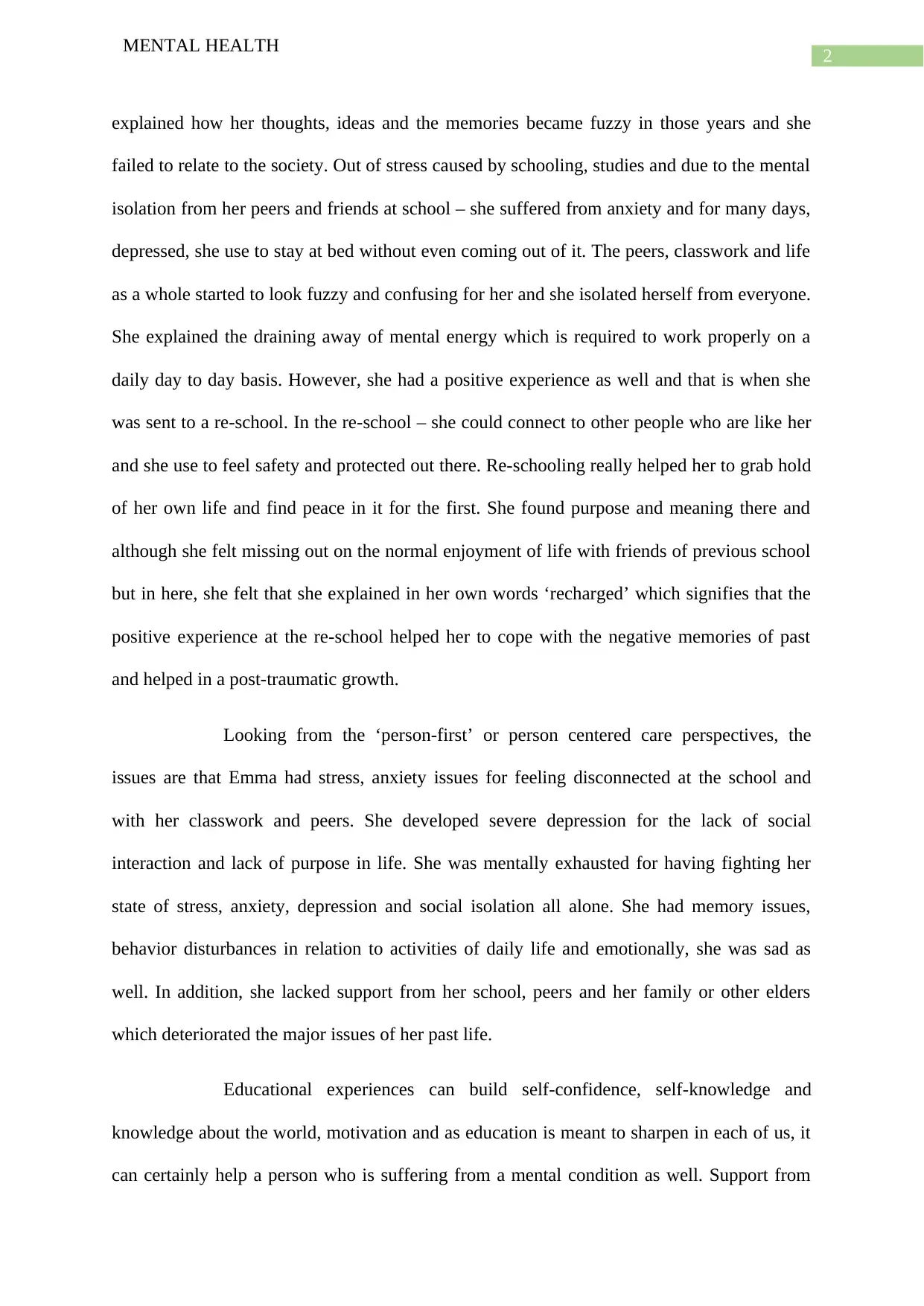
explained how her thoughts, ideas and the memories became fuzzy in those years and she
failed to relate to the society. Out of stress caused by schooling, studies and due to the mental
isolation from her peers and friends at school – she suffered from anxiety and for many days,
depressed, she use to stay at bed without even coming out of it. The peers, classwork and life
as a whole started to look fuzzy and confusing for her and she isolated herself from everyone.
She explained the draining away of mental energy which is required to work properly on a
daily day to day basis. However, she had a positive experience as well and that is when she
was sent to a re-school. In the re-school – she could connect to other people who are like her
and she use to feel safety and protected out there. Re-schooling really helped her to grab hold
of her own life and find peace in it for the first. She found purpose and meaning there and
although she felt missing out on the normal enjoyment of life with friends of previous school
but in here, she felt that she explained in her own words ‘recharged’ which signifies that the
positive experience at the re-school helped her to cope with the negative memories of past
and helped in a post-traumatic growth.
Looking from the ‘person-first’ or person centered care perspectives, the
issues are that Emma had stress, anxiety issues for feeling disconnected at the school and
with her classwork and peers. She developed severe depression for the lack of social
interaction and lack of purpose in life. She was mentally exhausted for having fighting her
state of stress, anxiety, depression and social isolation all alone. She had memory issues,
behavior disturbances in relation to activities of daily life and emotionally, she was sad as
well. In addition, she lacked support from her school, peers and her family or other elders
which deteriorated the major issues of her past life.
Educational experiences can build self-confidence, self-knowledge and
knowledge about the world, motivation and as education is meant to sharpen in each of us, it
can certainly help a person who is suffering from a mental condition as well. Support from
MENTAL HEALTH
explained how her thoughts, ideas and the memories became fuzzy in those years and she
failed to relate to the society. Out of stress caused by schooling, studies and due to the mental
isolation from her peers and friends at school – she suffered from anxiety and for many days,
depressed, she use to stay at bed without even coming out of it. The peers, classwork and life
as a whole started to look fuzzy and confusing for her and she isolated herself from everyone.
She explained the draining away of mental energy which is required to work properly on a
daily day to day basis. However, she had a positive experience as well and that is when she
was sent to a re-school. In the re-school – she could connect to other people who are like her
and she use to feel safety and protected out there. Re-schooling really helped her to grab hold
of her own life and find peace in it for the first. She found purpose and meaning there and
although she felt missing out on the normal enjoyment of life with friends of previous school
but in here, she felt that she explained in her own words ‘recharged’ which signifies that the
positive experience at the re-school helped her to cope with the negative memories of past
and helped in a post-traumatic growth.
Looking from the ‘person-first’ or person centered care perspectives, the
issues are that Emma had stress, anxiety issues for feeling disconnected at the school and
with her classwork and peers. She developed severe depression for the lack of social
interaction and lack of purpose in life. She was mentally exhausted for having fighting her
state of stress, anxiety, depression and social isolation all alone. She had memory issues,
behavior disturbances in relation to activities of daily life and emotionally, she was sad as
well. In addition, she lacked support from her school, peers and her family or other elders
which deteriorated the major issues of her past life.
Educational experiences can build self-confidence, self-knowledge and
knowledge about the world, motivation and as education is meant to sharpen in each of us, it
can certainly help a person who is suffering from a mental condition as well. Support from
⊘ This is a preview!⊘
Do you want full access?
Subscribe today to unlock all pages.

Trusted by 1+ million students worldwide

3
MENTAL HEALTH
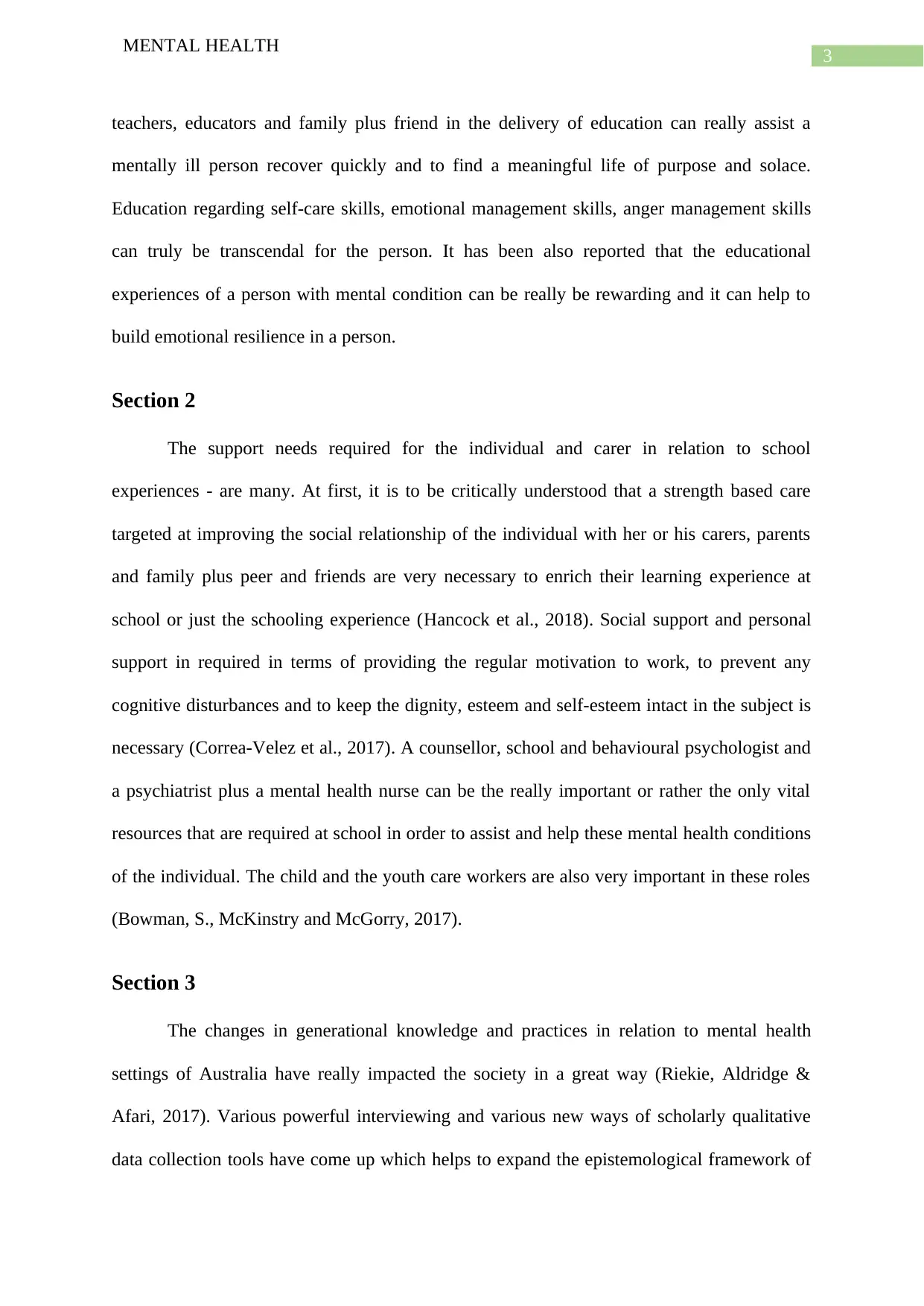
teachers, educators and family plus friend in the delivery of education can really assist a
mentally ill person recover quickly and to find a meaningful life of purpose and solace.
Education regarding self-care skills, emotional management skills, anger management skills
can truly be transcendal for the person. It has been also reported that the educational
experiences of a person with mental condition can be really be rewarding and it can help to
build emotional resilience in a person.
Section 2
The support needs required for the individual and carer in relation to school
experiences - are many. At first, it is to be critically understood that a strength based care
targeted at improving the social relationship of the individual with her or his carers, parents
and family plus peer and friends are very necessary to enrich their learning experience at
school or just the schooling experience (Hancock et al., 2018). Social support and personal
support in required in terms of providing the regular motivation to work, to prevent any
cognitive disturbances and to keep the dignity, esteem and self-esteem intact in the subject is
necessary (Correa-Velez et al., 2017). A counsellor, school and behavioural psychologist and
a psychiatrist plus a mental health nurse can be the really important or rather the only vital
resources that are required at school in order to assist and help these mental health conditions
of the individual. The child and the youth care workers are also very important in these roles
(Bowman, S., McKinstry and McGorry, 2017).
Section 3
The changes in generational knowledge and practices in relation to mental health
settings of Australia have really impacted the society in a great way (Riekie, Aldridge &
Afari, 2017). Various powerful interviewing and various new ways of scholarly qualitative
data collection tools have come up which helps to expand the epistemological framework of
MENTAL HEALTH
teachers, educators and family plus friend in the delivery of education can really assist a
mentally ill person recover quickly and to find a meaningful life of purpose and solace.
Education regarding self-care skills, emotional management skills, anger management skills
can truly be transcendal for the person. It has been also reported that the educational
experiences of a person with mental condition can be really be rewarding and it can help to
build emotional resilience in a person.
Section 2
The support needs required for the individual and carer in relation to school
experiences - are many. At first, it is to be critically understood that a strength based care
targeted at improving the social relationship of the individual with her or his carers, parents
and family plus peer and friends are very necessary to enrich their learning experience at
school or just the schooling experience (Hancock et al., 2018). Social support and personal
support in required in terms of providing the regular motivation to work, to prevent any
cognitive disturbances and to keep the dignity, esteem and self-esteem intact in the subject is
necessary (Correa-Velez et al., 2017). A counsellor, school and behavioural psychologist and
a psychiatrist plus a mental health nurse can be the really important or rather the only vital
resources that are required at school in order to assist and help these mental health conditions
of the individual. The child and the youth care workers are also very important in these roles
(Bowman, S., McKinstry and McGorry, 2017).
Section 3
The changes in generational knowledge and practices in relation to mental health
settings of Australia have really impacted the society in a great way (Riekie, Aldridge &
Afari, 2017). Various powerful interviewing and various new ways of scholarly qualitative
data collection tools have come up which helps to expand the epistemological framework of
Paraphrase This Document
Need a fresh take? Get an instant paraphrase of this document with our AI Paraphraser

4
MENTAL HEALTH
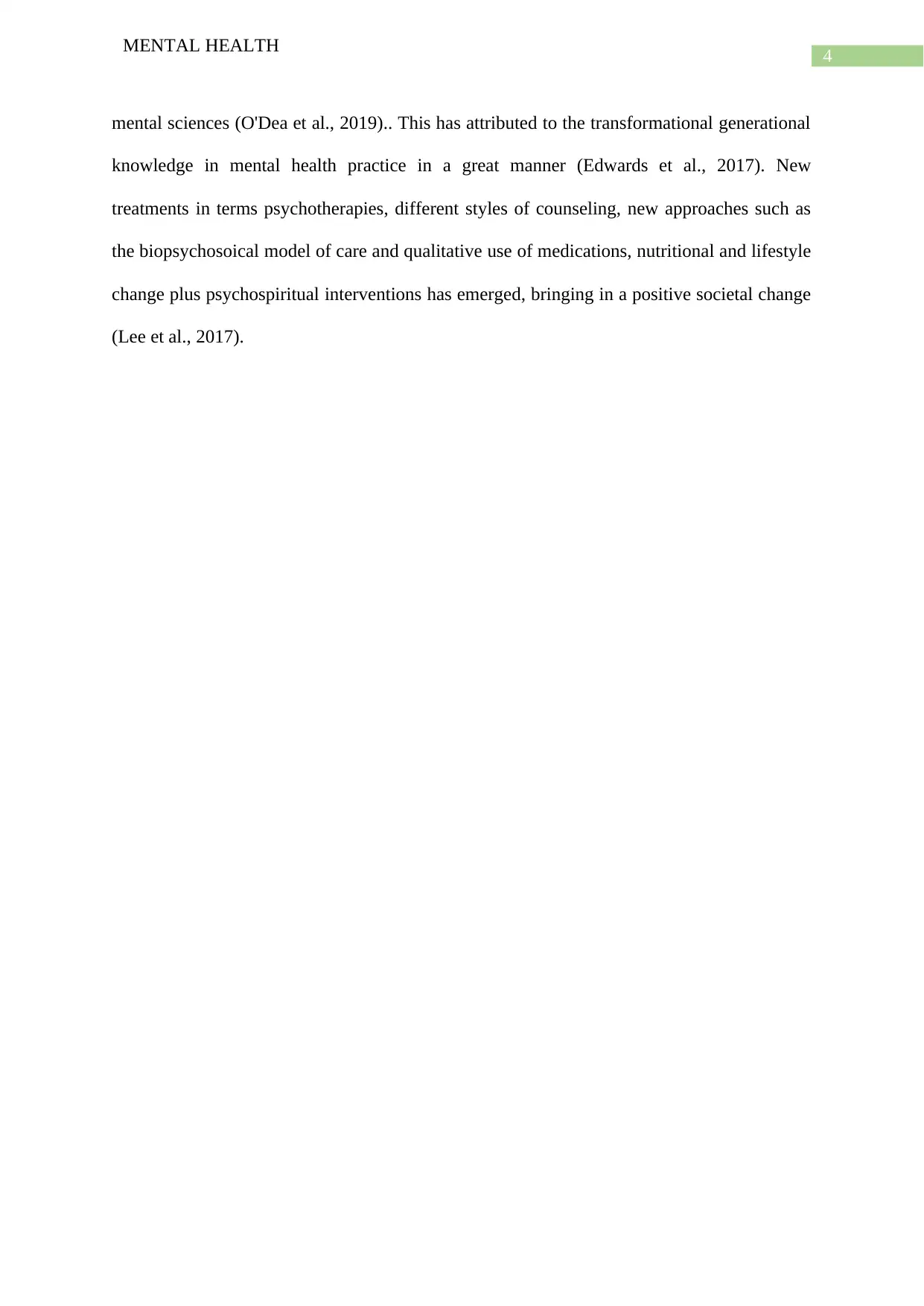
mental sciences (O'Dea et al., 2019).. This has attributed to the transformational generational
knowledge in mental health practice in a great manner (Edwards et al., 2017). New
treatments in terms psychotherapies, different styles of counseling, new approaches such as
the biopsychosoical model of care and qualitative use of medications, nutritional and lifestyle
change plus psychospiritual interventions has emerged, bringing in a positive societal change
(Lee et al., 2017).
MENTAL HEALTH
mental sciences (O'Dea et al., 2019).. This has attributed to the transformational generational
knowledge in mental health practice in a great manner (Edwards et al., 2017). New
treatments in terms psychotherapies, different styles of counseling, new approaches such as
the biopsychosoical model of care and qualitative use of medications, nutritional and lifestyle
change plus psychospiritual interventions has emerged, bringing in a positive societal change
(Lee et al., 2017).

5
MENTAL HEALTH
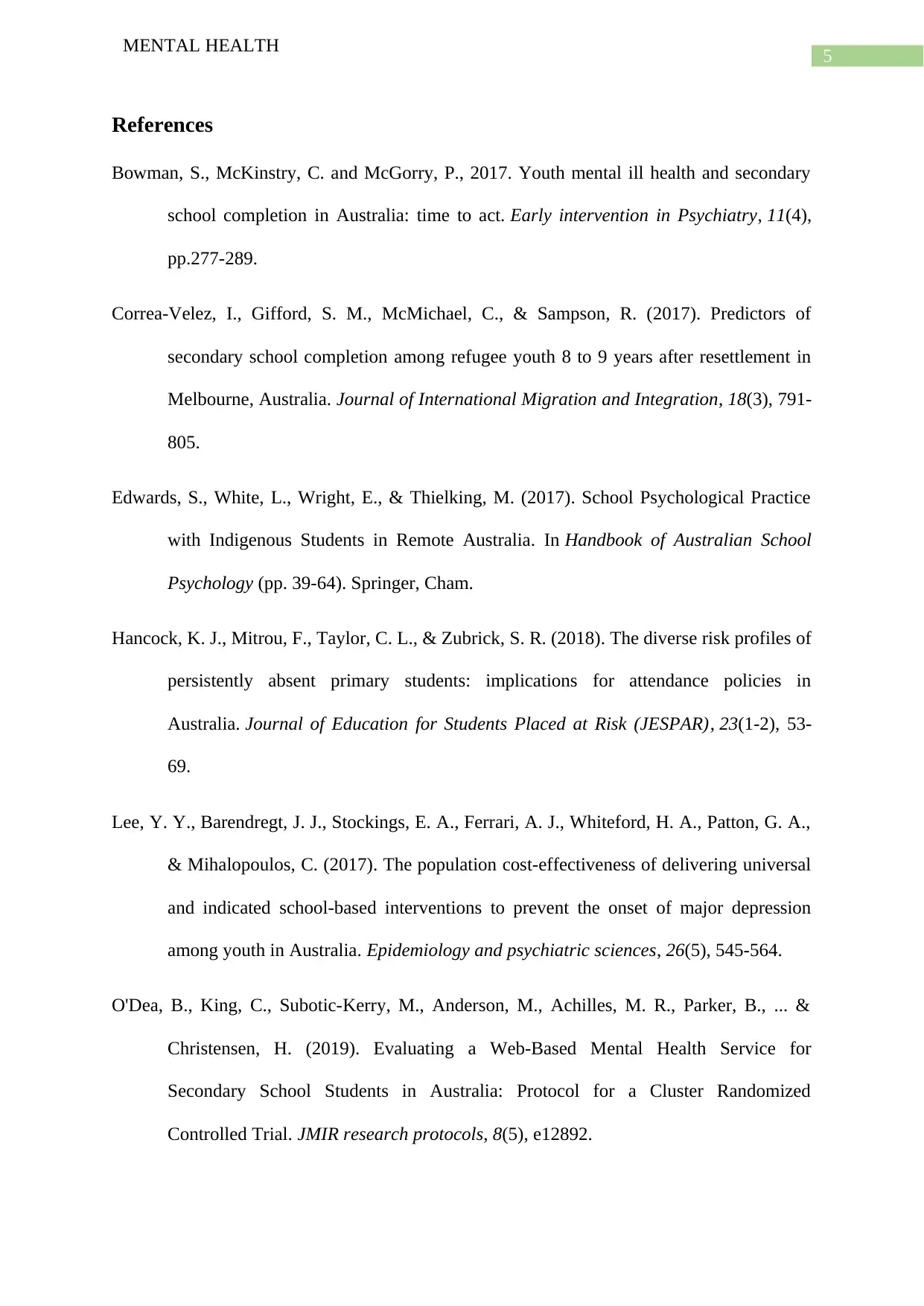
References
Bowman, S., McKinstry, C. and McGorry, P., 2017. Youth mental ill health and secondary
school completion in Australia: time to act. Early intervention in Psychiatry, 11(4),
pp.277-289.
Correa-Velez, I., Gifford, S. M., McMichael, C., & Sampson, R. (2017). Predictors of
secondary school completion among refugee youth 8 to 9 years after resettlement in
Melbourne, Australia. Journal of International Migration and Integration, 18(3), 791-
805.
Edwards, S., White, L., Wright, E., & Thielking, M. (2017). School Psychological Practice
with Indigenous Students in Remote Australia. In Handbook of Australian School
Psychology (pp. 39-64). Springer, Cham.
Hancock, K. J., Mitrou, F., Taylor, C. L., & Zubrick, S. R. (2018). The diverse risk profiles of
persistently absent primary students: implications for attendance policies in
Australia. Journal of Education for Students Placed at Risk (JESPAR), 23(1-2), 53-
69.
Lee, Y. Y., Barendregt, J. J., Stockings, E. A., Ferrari, A. J., Whiteford, H. A., Patton, G. A.,
& Mihalopoulos, C. (2017). The population cost-effectiveness of delivering universal
and indicated school-based interventions to prevent the onset of major depression
among youth in Australia. Epidemiology and psychiatric sciences, 26(5), 545-564.
O'Dea, B., King, C., Subotic-Kerry, M., Anderson, M., Achilles, M. R., Parker, B., ... &
Christensen, H. (2019). Evaluating a Web-Based Mental Health Service for
Secondary School Students in Australia: Protocol for a Cluster Randomized
Controlled Trial. JMIR research protocols, 8(5), e12892.
MENTAL HEALTH
References
Bowman, S., McKinstry, C. and McGorry, P., 2017. Youth mental ill health and secondary
school completion in Australia: time to act. Early intervention in Psychiatry, 11(4),
pp.277-289.
Correa-Velez, I., Gifford, S. M., McMichael, C., & Sampson, R. (2017). Predictors of
secondary school completion among refugee youth 8 to 9 years after resettlement in
Melbourne, Australia. Journal of International Migration and Integration, 18(3), 791-
805.
Edwards, S., White, L., Wright, E., & Thielking, M. (2017). School Psychological Practice
with Indigenous Students in Remote Australia. In Handbook of Australian School
Psychology (pp. 39-64). Springer, Cham.
Hancock, K. J., Mitrou, F., Taylor, C. L., & Zubrick, S. R. (2018). The diverse risk profiles of
persistently absent primary students: implications for attendance policies in
Australia. Journal of Education for Students Placed at Risk (JESPAR), 23(1-2), 53-
69.
Lee, Y. Y., Barendregt, J. J., Stockings, E. A., Ferrari, A. J., Whiteford, H. A., Patton, G. A.,
& Mihalopoulos, C. (2017). The population cost-effectiveness of delivering universal
and indicated school-based interventions to prevent the onset of major depression
among youth in Australia. Epidemiology and psychiatric sciences, 26(5), 545-564.
O'Dea, B., King, C., Subotic-Kerry, M., Anderson, M., Achilles, M. R., Parker, B., ... &
Christensen, H. (2019). Evaluating a Web-Based Mental Health Service for
Secondary School Students in Australia: Protocol for a Cluster Randomized
Controlled Trial. JMIR research protocols, 8(5), e12892.
⊘ This is a preview!⊘
Do you want full access?
Subscribe today to unlock all pages.

Trusted by 1+ million students worldwide

6
MENTAL HEALTH
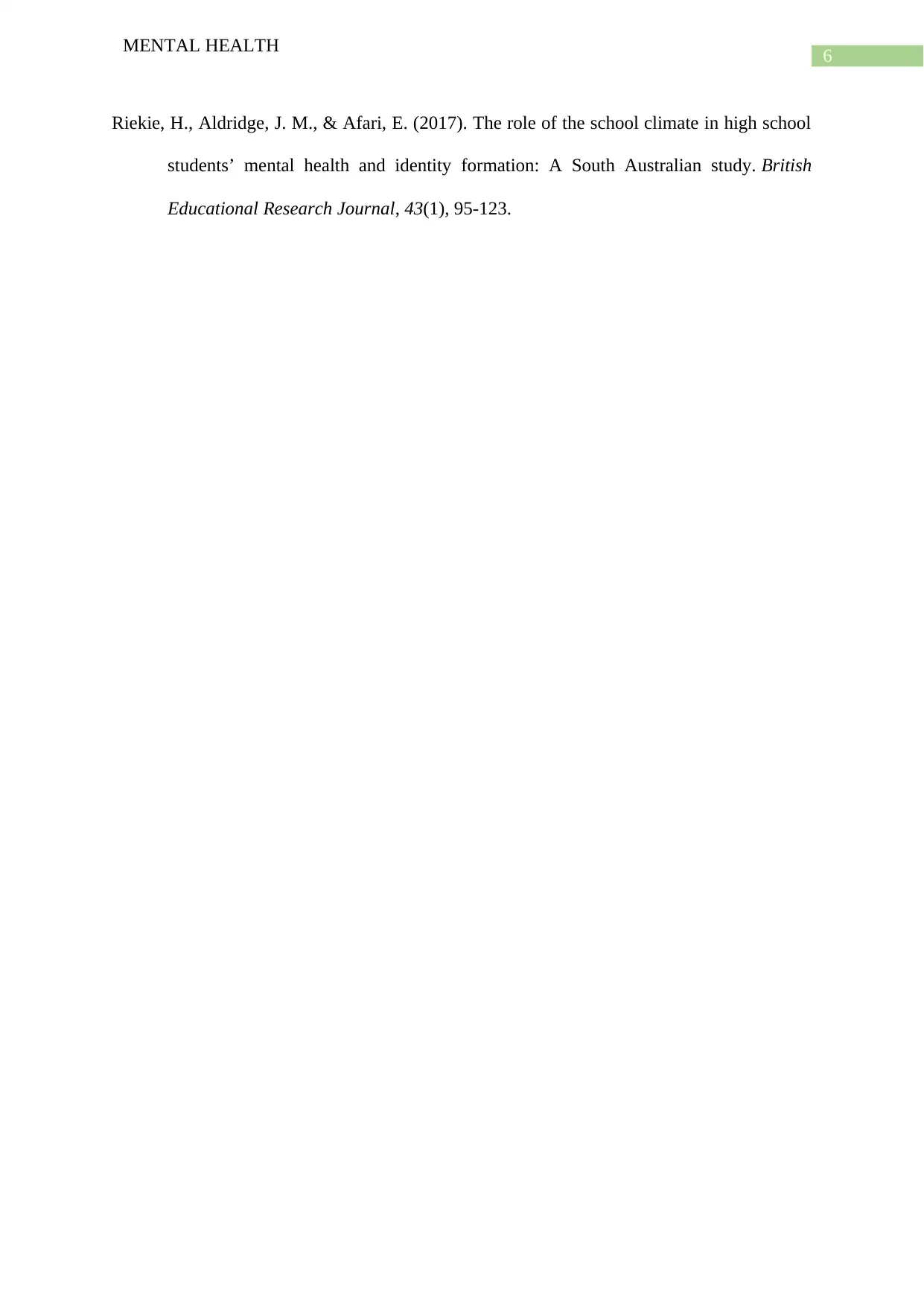
Riekie, H., Aldridge, J. M., & Afari, E. (2017). The role of the school climate in high school
students’ mental health and identity formation: A South Australian study. British
Educational Research Journal, 43(1), 95-123.
MENTAL HEALTH
Riekie, H., Aldridge, J. M., & Afari, E. (2017). The role of the school climate in high school
students’ mental health and identity formation: A South Australian study. British
Educational Research Journal, 43(1), 95-123.
1 out of 7
Related Documents
Your All-in-One AI-Powered Toolkit for Academic Success.
+13062052269
info@desklib.com
Available 24*7 on WhatsApp / Email
Unlock your academic potential
Copyright © 2020–2026 A2Z Services. All Rights Reserved. Developed and managed by ZUCOL.