BIOC311 - EMSA: Analysis of Liver Nuclear Extract Experiment Report
VerifiedAdded on 2022/09/02
|5
|851
|27
Homework Assignment
AI Summary
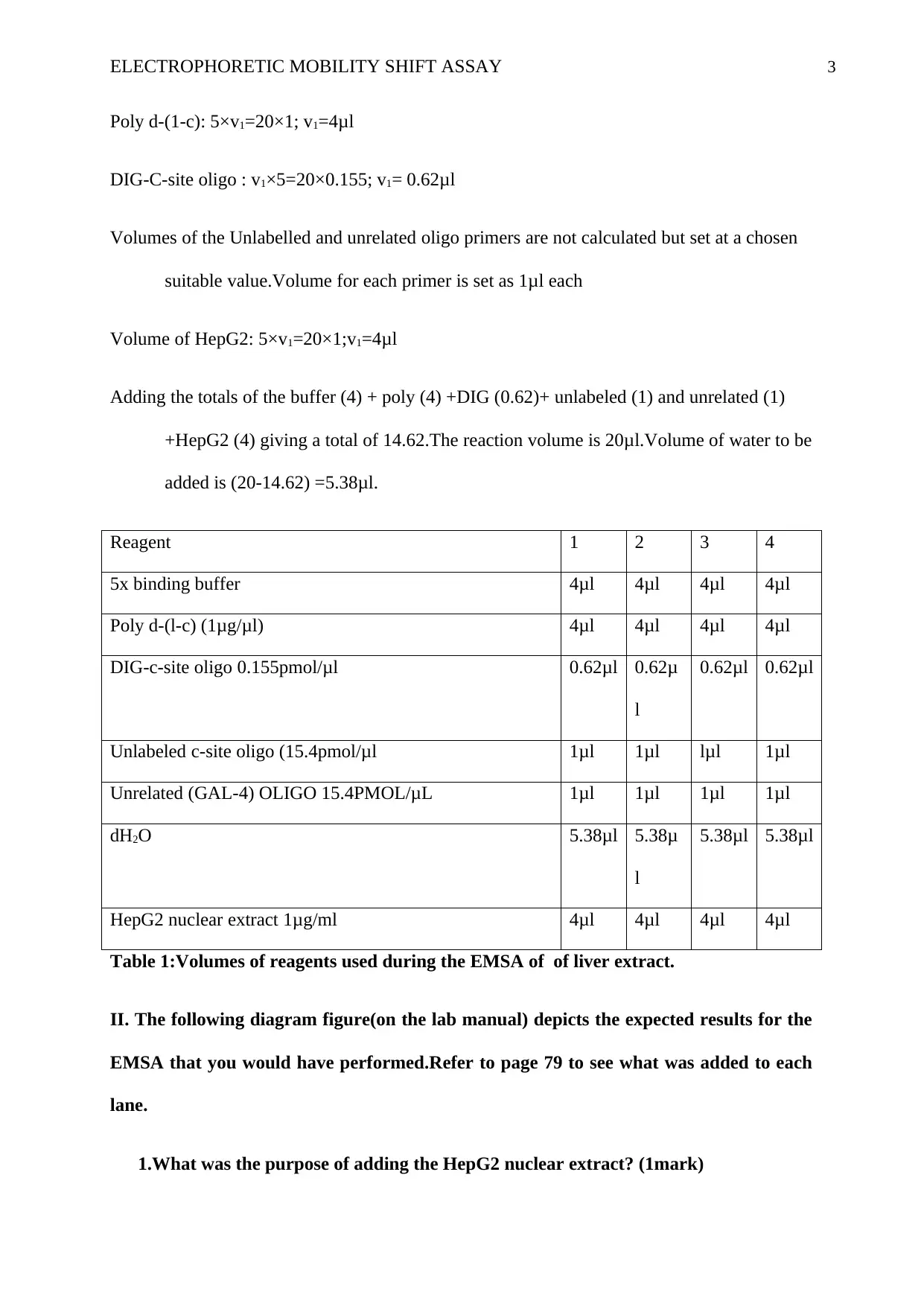
This EMSA lab report details an experiment investigating DNA-protein interactions using a liver nuclear extract. The report includes calculations for reagent volumes, based on provided stock concentrations, to achieve specific final concentrations of binding buffer, poly [d-(I-C)], DIG-C-site oligo, unlabeled C-site oligo, unrelated (GAL-4) oligo, and HepG2 nuclear extract. The core of the experiment revolves around the electrophoretic mobility shift assay (EMSA), a technique used to detect the binding of proteins to DNA fragments. The report answers questions regarding the purpose of adding HepG2 nuclear extract, the presence of unbound DIG-C-site oligo in lane 1, the effect of unlabeled C-site oligo on binding, the role of unrelated GAL-4 oligo, the function of the stratalinker, and what the antibody detected. The EMSA technique relies on the principle that DNA-protein complexes migrate differently in a gel compared to free DNA, allowing for the visualization and analysis of these interactions. The experiment utilizes the DIG Gel Shift Kit, 2nd Generation, to label DNA oligos with digoxigenin for detection. The results of the experiment are analyzed by comparing the migration of bound and unbound DIG-C-site oligo, revealing the presence and specificity of DNA-binding proteins in the liver nuclear extract.



1 out of 5


Your All-in-One AI-Powered Toolkit for Academic Success.
+13062052269
info@desklib.com
Available 24*7 on WhatsApp / Email
![[object Object]](/_next/static/media/star-bottom.7253800d.svg)
Copyright © 2020–2026 A2Z Services. All Rights Reserved. Developed and managed by ZUCOL.