Conceptual and Operational Definitions of Constructs in Business
VerifiedAdded on 2022/08/26
|11
|2564
|29
Report
AI Summary
This report delves into the conceptual and operational definitions of several key management constructs. It begins by examining constructs such as attitude towards new technology, customer satisfaction, self-concept, leadership style, and organizational commitment, providing both conceptual definitions and operational definitions based on recent scholarly research. The report further explores how these constructs can be measured, specifying the level of measurement (nominal, ordinal, interval, or ratio) for each. The report then focuses on two selected constructs, customer satisfaction and organizational commitment, providing detailed measurement methods. The report concludes by highlighting the importance of measuring various aspects of business performance and the implications of changes in these measurements, such as employee turnover and customer satisfaction. The paper uses a minimum of eight scholarly sources published within the last five years.
Running head: MANAGEMENT
Management
Name of the student
Name of the university
Author Note:
Management
Name of the student
Name of the university
Author Note:

Paraphrase This Document
Need a fresh take? Get an instant paraphrase of this document with our AI Paraphraser
1
MANAGEMENT
Table of Contents
Introduction:....................................................................................................................................2
Part a. Attitude towards new technology:........................................................................................2
Part b. Customer satisfaction:..........................................................................................................3
Part c. Self-concept:.........................................................................................................................4
Part d. Leadership style:..................................................................................................................5
Part e. Organisational commitment:................................................................................................6
Part f. Constructs intended to measure:...........................................................................................7
Customer satisfaction:.................................................................................................................7
Organisational commitment:.......................................................................................................8
Conclusion:......................................................................................................................................8
References:......................................................................................................................................9
MANAGEMENT
Table of Contents
Introduction:....................................................................................................................................2
Part a. Attitude towards new technology:........................................................................................2
Part b. Customer satisfaction:..........................................................................................................3
Part c. Self-concept:.........................................................................................................................4
Part d. Leadership style:..................................................................................................................5
Part e. Organisational commitment:................................................................................................6
Part f. Constructs intended to measure:...........................................................................................7
Customer satisfaction:.................................................................................................................7
Organisational commitment:.......................................................................................................8
Conclusion:......................................................................................................................................8
References:......................................................................................................................................9
2
MANAGEMENT
Introduction:
The business organisations in order to measure their performance in the market have to
measure different aspects of business quantitatively and qualitatively. This enables them to
identify the actual performance levels achieved against the predetermined benchmarks. They are
also able to recognise the shortfall between the two variables and make strategies to improve
their performance. The aim of the paper would be exploring five aspects of business
performance, hereby referred to as constructs. The five constructs or variables are attitude
towards new technology, customer satisfaction, self-concept, leadership style and
organisational commitment. The research would then go on to measure two chosen variables as
per the four categories namely, nominal, ordinal, interval and ratio. The two constructs which
the researcher would nominate for measurement would be customer satisfaction and
organisational commitment for future research.
Part a. Attitude towards new technology:
The concept ‘attitude towards new technology’ refers to the attitude which the
management and the employees of business organisations exhibit towards emergence of
technology and adoption of advanced technology in their respective operations. It also holds
relevance for the society as a whole as well. Kerschner and Ehlers (2016) defines attitude
towards new technology as the perception which a particular population of people have towards
technological advancements. Dubihlela and Kupangwa (2016) in the section, ‘Employee
technological aptitude’ in their work define the construct from a business operational
perspective. They mention that the attitude towards new technology refers to the level of
readiness of employees to use modern technology to achieve their performance targets. The
authors on the other mention that employees possessing negative perceptions towards modern
MANAGEMENT
Introduction:
The business organisations in order to measure their performance in the market have to
measure different aspects of business quantitatively and qualitatively. This enables them to
identify the actual performance levels achieved against the predetermined benchmarks. They are
also able to recognise the shortfall between the two variables and make strategies to improve
their performance. The aim of the paper would be exploring five aspects of business
performance, hereby referred to as constructs. The five constructs or variables are attitude
towards new technology, customer satisfaction, self-concept, leadership style and
organisational commitment. The research would then go on to measure two chosen variables as
per the four categories namely, nominal, ordinal, interval and ratio. The two constructs which
the researcher would nominate for measurement would be customer satisfaction and
organisational commitment for future research.
Part a. Attitude towards new technology:
The concept ‘attitude towards new technology’ refers to the attitude which the
management and the employees of business organisations exhibit towards emergence of
technology and adoption of advanced technology in their respective operations. It also holds
relevance for the society as a whole as well. Kerschner and Ehlers (2016) defines attitude
towards new technology as the perception which a particular population of people have towards
technological advancements. Dubihlela and Kupangwa (2016) in the section, ‘Employee
technological aptitude’ in their work define the construct from a business operational
perspective. They mention that the attitude towards new technology refers to the level of
readiness of employees to use modern technology to achieve their performance targets. The
authors on the other mention that employees possessing negative perceptions towards modern
⊘ This is a preview!⊘
Do you want full access?
Subscribe today to unlock all pages.

Trusted by 1+ million students worldwide
3
MANAGEMENT
technology usually either try to prevent adoption of advanced technology or avoid its use to the
feasible extent. The construct also refers to efficient and effective of new technology. Irma,
Chong and Ram (2016) contradict the arguments of the previous authors to point out that
external factors like lack of technological advancements available in a particular may also results
in development of negative attitude among the people and/or employees employed in the firms
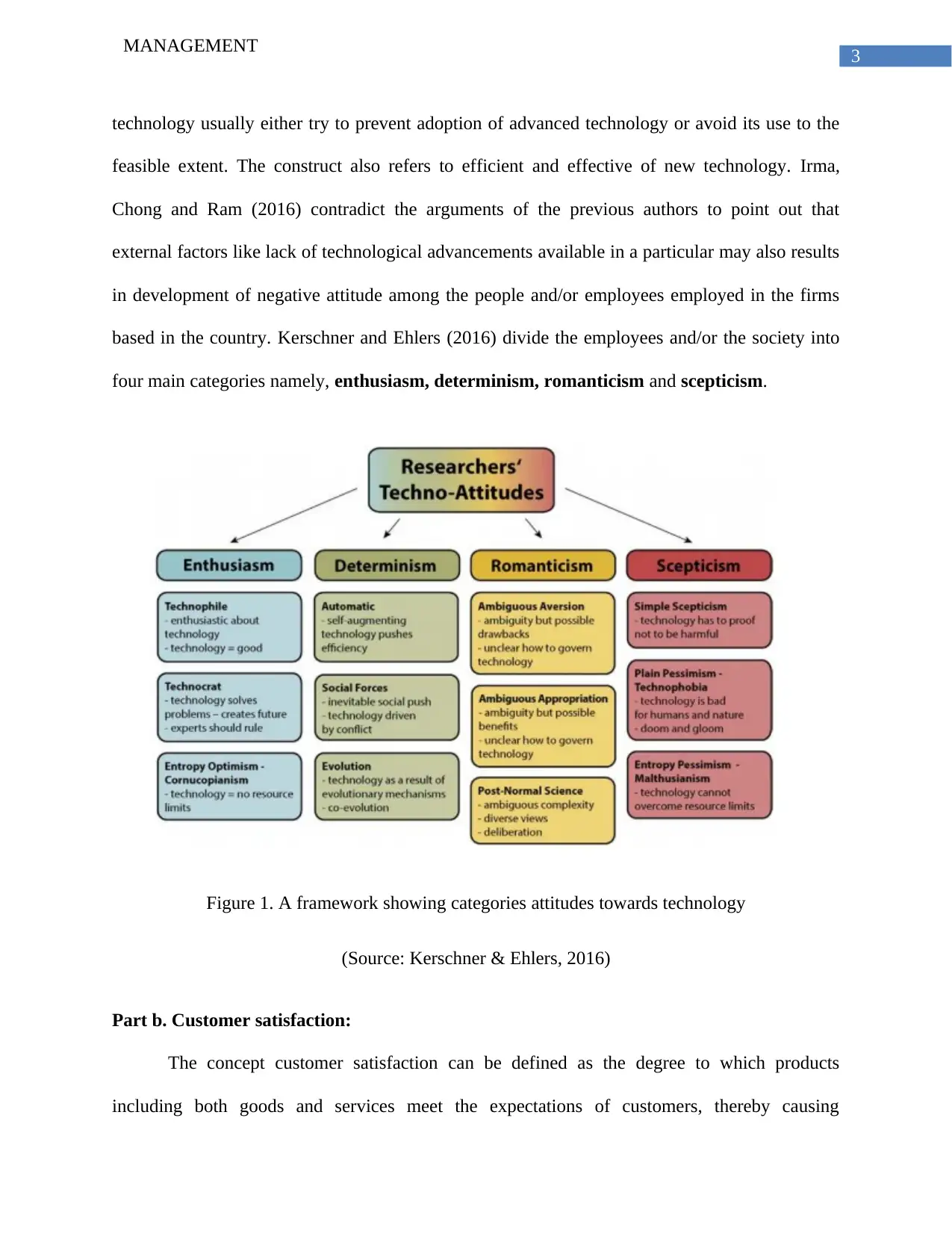
based in the country. Kerschner and Ehlers (2016) divide the employees and/or the society into
four main categories namely, enthusiasm, determinism, romanticism and scepticism.
Figure 1. A framework showing categories attitudes towards technology
(Source: Kerschner & Ehlers, 2016)
Part b. Customer satisfaction:
The concept customer satisfaction can be defined as the degree to which products
including both goods and services meet the expectations of customers, thereby causing
MANAGEMENT
technology usually either try to prevent adoption of advanced technology or avoid its use to the
feasible extent. The construct also refers to efficient and effective of new technology. Irma,
Chong and Ram (2016) contradict the arguments of the previous authors to point out that
external factors like lack of technological advancements available in a particular may also results
in development of negative attitude among the people and/or employees employed in the firms
based in the country. Kerschner and Ehlers (2016) divide the employees and/or the society into
four main categories namely, enthusiasm, determinism, romanticism and scepticism.
Figure 1. A framework showing categories attitudes towards technology
(Source: Kerschner & Ehlers, 2016)
Part b. Customer satisfaction:
The concept customer satisfaction can be defined as the degree to which products
including both goods and services meet the expectations of customers, thereby causing
Paraphrase This Document
Need a fresh take? Get an instant paraphrase of this document with our AI Paraphraser
4
MANAGEMENT
satisfaction to the latter. Khan and Ghouri (2018) in their article define customer satisfaction as
the positive perceptions which the business organisations need to create among their customers
in order gain their loyalty. They go to extent of defining customer satisfaction as the very heart
of marketing operations in the section ‘Customer-Defined Market Orientation and Customer
Satisfaction’ in the article. Sorescu and Sorescu (2016) strengthen the definition of customer
satisfaction by pointing out that it is also capable of giving high returns from the stock market.
Zablah et al. (2016) point out to the third aspect of the concept which is employee satisfaction.
Thus, as far as operational aspects are concerned, customer satisfaction ushers on the basis of
which it can be defined. First of all, customer satisfaction is the crux of the marketing operations
of business organisations which leads to generation of revenue. Secondly, customer satisfaction
can be defined as one of the factors which results in employee satisfaction. Finally, it even
results in generation of supernormal profits from the securities market.
Part c. Self-concept:
Self-concept of business organisations can be conceptually defined as the individual legal
identities which business organisations enjoy which separate them from other business
organisations. Wille et al.(2018) mention that employees generally join business organisations
with whose characteristics they can relate. In other words, self-image concept of business
organisations can be defined as the collective images formed by their respective bodies of
management and employees in terms of leadership and operations. The second aspect of self-
concept namely, self-ideal of business organisations can be defined as the summation of
organisational visions, missions and values which business organisations follow. Yang et al.
(2018) in their article titled, ‘Crossover effects of servant leadership and job social support on
employee spouses: The mediating role of employee organization-based self-esteem’ define
MANAGEMENT
satisfaction to the latter. Khan and Ghouri (2018) in their article define customer satisfaction as
the positive perceptions which the business organisations need to create among their customers
in order gain their loyalty. They go to extent of defining customer satisfaction as the very heart
of marketing operations in the section ‘Customer-Defined Market Orientation and Customer
Satisfaction’ in the article. Sorescu and Sorescu (2016) strengthen the definition of customer
satisfaction by pointing out that it is also capable of giving high returns from the stock market.
Zablah et al. (2016) point out to the third aspect of the concept which is employee satisfaction.
Thus, as far as operational aspects are concerned, customer satisfaction ushers on the basis of
which it can be defined. First of all, customer satisfaction is the crux of the marketing operations
of business organisations which leads to generation of revenue. Secondly, customer satisfaction
can be defined as one of the factors which results in employee satisfaction. Finally, it even
results in generation of supernormal profits from the securities market.
Part c. Self-concept:
Self-concept of business organisations can be conceptually defined as the individual legal
identities which business organisations enjoy which separate them from other business
organisations. Wille et al.(2018) mention that employees generally join business organisations
with whose characteristics they can relate. In other words, self-image concept of business
organisations can be defined as the collective images formed by their respective bodies of
management and employees in terms of leadership and operations. The second aspect of self-
concept namely, self-ideal of business organisations can be defined as the summation of
organisational visions, missions and values which business organisations follow. Yang et al.
(2018) in their article titled, ‘Crossover effects of servant leadership and job social support on
employee spouses: The mediating role of employee organization-based self-esteem’ define
5
MANAGEMENT
organisation based self-esteem as the positive perception which employees perceive owing to the
market positions of their respective employer organisations. Thus, the definition of the term
organisational self-esteem can be derived from this definition. The term organisational self-
esteem can be defined as the esteem or prestige which business organisations enjoy owing to
their market performances and dominating positions in the market. Thus, the term self-concept
in terms of business organisations can be defined as the summation of self-image, self-ideal and
self-esteem which business organisations perceive about themselves owing to their market
positions and high market performance standards.
Part d. Leadership style:
The concept of leadership style can be defined as the style in which leaders lead their
followers towards achievement of predetermined goals. Yahaya and Ebrahim (2016) define the
term leadership style in several facets in their work titled, ‘Leadership styles and
organizational commitment: literature review’. They define leadership as the methodologies
in which management bodies of business organisations lead their respective teams of employees
towards achievement of business goals. They then go on to define the term as ways in which the
former influence the latter towards achievement of business goals. Gandolfi and Stone (2018)
define the concept of leadership style as purposeful ways in which leaders affect their
subordinates towards achievement of future business goals which are different from the present
business situations. Thus, combining the works of the aforementioned authors leadership styles
can be defined as processes which managers holding leadership positions lead their subordinates
towards achievement of future business positions which are perceived more beneficial compared
to the prevailing positions. It can also be inferred from the definitions that leadership styles
MANAGEMENT
organisation based self-esteem as the positive perception which employees perceive owing to the
market positions of their respective employer organisations. Thus, the definition of the term
organisational self-esteem can be derived from this definition. The term organisational self-
esteem can be defined as the esteem or prestige which business organisations enjoy owing to
their market performances and dominating positions in the market. Thus, the term self-concept
in terms of business organisations can be defined as the summation of self-image, self-ideal and
self-esteem which business organisations perceive about themselves owing to their market
positions and high market performance standards.
Part d. Leadership style:
The concept of leadership style can be defined as the style in which leaders lead their
followers towards achievement of predetermined goals. Yahaya and Ebrahim (2016) define the
term leadership style in several facets in their work titled, ‘Leadership styles and
organizational commitment: literature review’. They define leadership as the methodologies
in which management bodies of business organisations lead their respective teams of employees
towards achievement of business goals. They then go on to define the term as ways in which the
former influence the latter towards achievement of business goals. Gandolfi and Stone (2018)
define the concept of leadership style as purposeful ways in which leaders affect their
subordinates towards achievement of future business goals which are different from the present
business situations. Thus, combining the works of the aforementioned authors leadership styles
can be defined as processes which managers holding leadership positions lead their subordinates
towards achievement of future business positions which are perceived more beneficial compared
to the prevailing positions. It can also be inferred from the definitions that leadership styles
⊘ This is a preview!⊘
Do you want full access?
Subscribe today to unlock all pages.
Trusted by 1+ million students worldwide
6
MANAGEMENT
involve decision making, motivating and training subordinates to operate in order to achieve the
goals.
Part e. Organisational commitment:
Organisational commitment is a concept which refers to the commitment levels which
employees share with the business organisations employing them. Yahaya and Ebrahim (2016)
defines the term organisational commitment as the levels of commitment which employees hold
towards the employing organisations they serve in terms of achievement of the business targets.
Hanaysha(2016) defines the term organisational commitment as ‘as a psychological attitude
that attaches an employee to an organization in a manner that reduces his or her turnover
intention’. Thus it can be inferred from the discussion that organisational commitment creates a
perception of commitment to the employer organisations among employees which in turn
contribute towards employees taking up more responsibilities and achieve higher targets. This
means that the committed employees are more aligned to the business strategies and goals of the
companies and tend to continue serving their employers for a longer span of time. In other
words, achievement of organisational commitment enables the employing organisations to
reduce employee turnover. Hanaysha, J. (2016) again defines term organisational commitment as
‘the relative strength of an individual’s identification with and involvement in a particular
organization and can be characterized by a strong belief in and acceptance of the
organization’s goals and values, willingness to exert considerable effort on behalf of the
organization and a strong desire to maintain membership of the organization’. Thus, in
short the organisational commitment among employees is also dependent on the attributes like
values, policies, visions and mission of the employer companies. These attributes create a bond
MANAGEMENT
involve decision making, motivating and training subordinates to operate in order to achieve the
goals.
Part e. Organisational commitment:
Organisational commitment is a concept which refers to the commitment levels which
employees share with the business organisations employing them. Yahaya and Ebrahim (2016)
defines the term organisational commitment as the levels of commitment which employees hold
towards the employing organisations they serve in terms of achievement of the business targets.
Hanaysha(2016) defines the term organisational commitment as ‘as a psychological attitude
that attaches an employee to an organization in a manner that reduces his or her turnover
intention’. Thus it can be inferred from the discussion that organisational commitment creates a
perception of commitment to the employer organisations among employees which in turn
contribute towards employees taking up more responsibilities and achieve higher targets. This
means that the committed employees are more aligned to the business strategies and goals of the
companies and tend to continue serving their employers for a longer span of time. In other
words, achievement of organisational commitment enables the employing organisations to
reduce employee turnover. Hanaysha, J. (2016) again defines term organisational commitment as
‘the relative strength of an individual’s identification with and involvement in a particular
organization and can be characterized by a strong belief in and acceptance of the
organization’s goals and values, willingness to exert considerable effort on behalf of the
organization and a strong desire to maintain membership of the organization’. Thus, in
short the organisational commitment among employees is also dependent on the attributes like
values, policies, visions and mission of the employer companies. These attributes create a bond
Paraphrase This Document
Need a fresh take? Get an instant paraphrase of this document with our AI Paraphraser
7
MANAGEMENT
between the employees and the employers which create job satisfaction in the former which
ultimately contributes to high level of job commitment.
Part f. Constructs intended to measure:
Customer satisfaction:
Customer satisfaction is the measurement of the level of satisfaction which customers
experience when goods and services meet or surpass their expectations. Customer satisfaction is
a nominal variable since it cannot be expressed in numbers accurately. Khan and Ghouri (2018)
can be iterated here. They defined customer satisfaction that the degree to which the companies
are able to satisfy customers’ needs and expectations. Sorescu and Sorescu (2016) can be iterated
here to mention that customer satisfaction can not only to be used to generate revenue but also
higher returns from the stock markets. This means that the companies require to measure the
level of customer satisfaction they have achieved in indirect manner since customer satisfaction
cannot be quantified. Khan and Ghouri (2018) can again be reiterated here to point out that
customer satisfaction results in customer loyalty and customer retention besides acquisition of
new customers. In other words, lack of customer satisfaction results in escalations received from
customers and losing of customers. Business organisations can combine these variables to get an
idea of customer satisfaction levels they achieve by comparing these results between two or more
given periods. For example, if a company serves total 100 customers in January out of which it
receives 10 escalations and generated 30 repeat business orders, it means its customer
satisfaction level is 100+30-10=120. Similarly, again in February it receives 20 escalations and
40 repeat business by serving 150 customers, it means the customer satisfaction level it achieves
in February is 150+50-10=190. This means that customer satisfaction level the firm ensured per
customer is (120/100)=1.2 while in February the level is (190/150)=1.26. Thus, in the month
MANAGEMENT
between the employees and the employers which create job satisfaction in the former which
ultimately contributes to high level of job commitment.
Part f. Constructs intended to measure:
Customer satisfaction:
Customer satisfaction is the measurement of the level of satisfaction which customers
experience when goods and services meet or surpass their expectations. Customer satisfaction is
a nominal variable since it cannot be expressed in numbers accurately. Khan and Ghouri (2018)
can be iterated here. They defined customer satisfaction that the degree to which the companies
are able to satisfy customers’ needs and expectations. Sorescu and Sorescu (2016) can be iterated
here to mention that customer satisfaction can not only to be used to generate revenue but also
higher returns from the stock markets. This means that the companies require to measure the
level of customer satisfaction they have achieved in indirect manner since customer satisfaction
cannot be quantified. Khan and Ghouri (2018) can again be reiterated here to point out that
customer satisfaction results in customer loyalty and customer retention besides acquisition of
new customers. In other words, lack of customer satisfaction results in escalations received from
customers and losing of customers. Business organisations can combine these variables to get an
idea of customer satisfaction levels they achieve by comparing these results between two or more
given periods. For example, if a company serves total 100 customers in January out of which it
receives 10 escalations and generated 30 repeat business orders, it means its customer
satisfaction level is 100+30-10=120. Similarly, again in February it receives 20 escalations and
40 repeat business by serving 150 customers, it means the customer satisfaction level it achieves
in February is 150+50-10=190. This means that customer satisfaction level the firm ensured per
customer is (120/100)=1.2 while in February the level is (190/150)=1.26. Thus, in the month
8
MANAGEMENT
February, the firm has earned higher customer satisfaction level. Thus, in other words, if the
customer satisfaction level falls, the management of the company would be to identify needs to
restructure the strategies.
Organisational commitment:
Organisational commitment as already mentioned, refers to the levels of commitments
which employees towards organisations employing them. Hanaysha(2016) can be iterated to
point out that organisational commitment can be defined as the level in which companies reduce
their employee turnover. Thus, it is clear from the definition that organisational commitment can
be measured in terms of employee turnover. This means that organisational commitment is
ordinal by nature since it can be presented statistically. Business organisations can measure
employee turnover rates by measuring the employees resigned for a particular year. For example,
if in 2018, the employee turnover rate was 10% and it rose to 20% in 2019, this means the level
of organisational commitment among employees has fallen in 2019 compared to 2018.
Conclusion:
One can conclude that companies should measure their different areas of business
performances directly or in directly, if not possible directly. For example, customer satisfaction
cannot be measured directly but employee turnover can be measured directly. The management
of the companies should take appropriate steps whenever, fall in achievement of particular
business parameters appear.
MANAGEMENT
February, the firm has earned higher customer satisfaction level. Thus, in other words, if the
customer satisfaction level falls, the management of the company would be to identify needs to
restructure the strategies.
Organisational commitment:
Organisational commitment as already mentioned, refers to the levels of commitments
which employees towards organisations employing them. Hanaysha(2016) can be iterated to
point out that organisational commitment can be defined as the level in which companies reduce
their employee turnover. Thus, it is clear from the definition that organisational commitment can
be measured in terms of employee turnover. This means that organisational commitment is
ordinal by nature since it can be presented statistically. Business organisations can measure
employee turnover rates by measuring the employees resigned for a particular year. For example,
if in 2018, the employee turnover rate was 10% and it rose to 20% in 2019, this means the level
of organisational commitment among employees has fallen in 2019 compared to 2018.
Conclusion:
One can conclude that companies should measure their different areas of business
performances directly or in directly, if not possible directly. For example, customer satisfaction
cannot be measured directly but employee turnover can be measured directly. The management
of the companies should take appropriate steps whenever, fall in achievement of particular
business parameters appear.
⊘ This is a preview!⊘
Do you want full access?
Subscribe today to unlock all pages.
Trusted by 1+ million students worldwide
9
MANAGEMENT
References:
Dubihlela, J., & Kupangwa, W. (2016). Employee perspectives of factors influencing e-business
technology adoption and use by small and medium retail enterprises. International
Journal of Business and Management Studies, 8(1), 1-19.
Gandolfi, F., & Stone, S. (2018). Leadership, leadership styles, and servant leadership. Journal
of Management Research, 18(4), 261-269.
Hanaysha, J. (2016). Examining the effects of employee empowerment, teamwork, and
employee training on organizational commitment. Procedia-Social and Behavioral
Sciences, 229, 298-306.
Hanaysha, J. (2016). Testing the effects of employee engagement, work environment, and
organizational learning on organizational commitment. Procedia-Social and Behavioral
Sciences, 229, 289-297.
Irma, J., Chong, T., & Ram, J. (2016). Empirically examining barriers to e‐business adoption in
SMEs in Indonesia. The Electronic Journal of Information Systems in Developing
Countries, 72(1), 1-16.
Kerschner, C., & Ehlers, M. H. (2016). A framework of attitudes towards technology in theory
and practice. Ecological Economics, 126, 139-151.
Khan, M., & Ghouri, A. M. (2018). Enhancing Customer Satisfaction and Loyalty through
Customer-Defined Market Orientation and Customer Inspiration: A Critical Literature
Review. International Business Education Journal, 11(1), 25-39.
MANAGEMENT
References:
Dubihlela, J., & Kupangwa, W. (2016). Employee perspectives of factors influencing e-business
technology adoption and use by small and medium retail enterprises. International
Journal of Business and Management Studies, 8(1), 1-19.
Gandolfi, F., & Stone, S. (2018). Leadership, leadership styles, and servant leadership. Journal
of Management Research, 18(4), 261-269.
Hanaysha, J. (2016). Examining the effects of employee empowerment, teamwork, and
employee training on organizational commitment. Procedia-Social and Behavioral
Sciences, 229, 298-306.
Hanaysha, J. (2016). Testing the effects of employee engagement, work environment, and
organizational learning on organizational commitment. Procedia-Social and Behavioral
Sciences, 229, 289-297.
Irma, J., Chong, T., & Ram, J. (2016). Empirically examining barriers to e‐business adoption in
SMEs in Indonesia. The Electronic Journal of Information Systems in Developing
Countries, 72(1), 1-16.
Kerschner, C., & Ehlers, M. H. (2016). A framework of attitudes towards technology in theory
and practice. Ecological Economics, 126, 139-151.
Khan, M., & Ghouri, A. M. (2018). Enhancing Customer Satisfaction and Loyalty through
Customer-Defined Market Orientation and Customer Inspiration: A Critical Literature
Review. International Business Education Journal, 11(1), 25-39.
Paraphrase This Document
Need a fresh take? Get an instant paraphrase of this document with our AI Paraphraser
10
MANAGEMENT
Sorescu, A., & Sorescu, S. M. (2016). Customer satisfaction and long-term stock
returns. Journal of Marketing, 80(5), 110-115.
Wille, L., Van Hoye, G., Weijters, B., Rangarajan, D., & Carpentier, M. (2018). To be yourself
or to be your ideal self? Outcomes of potential applicants’ actual and ideal self-congruity
perceptions. Journal of Personnel Psychology, 17(3), 107.
Yahaya, R., & Ebrahim, F. (2016). Leadership styles and organizational commitment: literature
review. Journal of Management Development, 35(2), 190-216.
Yang, Z., Zhang, H., Kwan, H. K., & Chen, S. (2018). Crossover effects of servant leadership
and job social support on employee spouses: The mediating role of employee
organization-based self-esteem. Journal of Business Ethics, 147(3), 595-604.
Zablah, A. R., Carlson, B. D., Donavan, D. T., Maxham III, J. G., & Brown, T. J. (2016). A
cross-lagged test of the association between customer satisfaction and employee job
satisfaction in a relational context. Journal of Applied Psychology, 101(5), 743.
MANAGEMENT
Sorescu, A., & Sorescu, S. M. (2016). Customer satisfaction and long-term stock
returns. Journal of Marketing, 80(5), 110-115.
Wille, L., Van Hoye, G., Weijters, B., Rangarajan, D., & Carpentier, M. (2018). To be yourself
or to be your ideal self? Outcomes of potential applicants’ actual and ideal self-congruity
perceptions. Journal of Personnel Psychology, 17(3), 107.
Yahaya, R., & Ebrahim, F. (2016). Leadership styles and organizational commitment: literature
review. Journal of Management Development, 35(2), 190-216.
Yang, Z., Zhang, H., Kwan, H. K., & Chen, S. (2018). Crossover effects of servant leadership
and job social support on employee spouses: The mediating role of employee
organization-based self-esteem. Journal of Business Ethics, 147(3), 595-604.
Zablah, A. R., Carlson, B. D., Donavan, D. T., Maxham III, J. G., & Brown, T. J. (2016). A
cross-lagged test of the association between customer satisfaction and employee job
satisfaction in a relational context. Journal of Applied Psychology, 101(5), 743.

1 out of 11


Related Documents


Your All-in-One AI-Powered Toolkit for Academic Success.
+13062052269
info@desklib.com
Available 24*7 on WhatsApp / Email
![[object Object]](/_next/static/media/star-bottom.7253800d.svg)
Unlock your academic potential
Copyright © 2020–2025 A2Z Services. All Rights Reserved. Developed and managed by ZUCOL.