Estimating Risk and Return: Assignment for Fundamentals of Finance

Verified

Added on  2022/08/22

|7
|995
|31
Homework Assignment
AI Summary
This assignment provides a comprehensive analysis of expected return and related financial concepts. It begins by defining expected return and its practical applications, followed by an exploration of the challenges associated with its use. The assignment then delves into portfolio construction, explaining how different allocations between risk-free securities and market portfolios can achieve desired risk levels. Furthermore, it covers the calculation of expected return under varying economic states, required return, and the market risk premium. The assignment culminates in the application of the Capital Asset Pricing Model (CAPM) and the calculation of portfolio beta, offering a complete understanding of risk and return estimation in finance.

Document Page
Running head: EXPECTED RETURN
Expected Return
Name of the Student:
Name of the University:
Author Note:
tabler-icon-diamond-filled.svg

Paraphrase This Document

Need a fresh take? Get an instant paraphrase of this document with our AI Paraphraser
Document Page
2EXPECTED RETURN
Table of Contents
Answer to Question 1:................................................................................................................3
Answer to Question 2:................................................................................................................3
Answer to Question 7:................................................................................................................4
Answer to Question 8:................................................................................................................4
Answer to Question 9:................................................................................................................5
Answer to Question 10:..............................................................................................................5
Answer to Question 11:..............................................................................................................6
References:.................................................................................................................................7
Document Page
3EXPECTED RETURN
Answer to Question 1:
The term expected return means the return which is expected in future or the probable
return which can be generated from an investment. Thus the word expected return defines the
return which is expected for the risk which is taken by the investors at the present moment.
Thus the expected return is calculated by multiplying the probability with the return which
had been generated in the past or the outcomes which are expected in future. Thus the various
outcomes with different probabilities is calculated and the sum of these constitutes the
expected return. Thus expected return is a forward looking estimate since it uses the
probability which is based on a future event and the outcomes which is also based on future
event (Martin, 2017).
The limitation of using expected return or the challenges which arise when expected
return is used is given in the following points,
The expected return is calculated using estimates which are based in the future, which
can change making the analysis using expected return meaningless.
The investments should not be considered on a standalone basis of expected return.
Thus, for example two investments have the same expected return, however the risk
of one investment is greater than the other. Thus making the investment with less
standard deviation attractive.
Since the expected return is a forward estimate of return for the risk which is taken at
the present moment. Thus, if the risk rises the risk return profile of the investor
changes (Zundert & Driessen, 2017).
Document Page
4EXPECTED RETURN
Answer to Question 2:
If a client makes an investment in a portfolio which consists of only risk free security
the beta of the portfolio is equal to 0. While if the portfolio consist of the investment in the
market portfolio it represents a beta of 1. Thus the highly risk averse investor will invest in
the security which consists of the risk free security while highly risk seeking investor will
invest in a portfolio which consist of market security. Thus, if a portfolio is constructed
which consists of 25% weights to the risk free security and 75% in market portfolio, the beta
of the investor is reduced and the market level of risk is less than 1. Thus when the allocation
of securities in the portfolio lies between 0 and 100% comprising of different level risk, the
desired risk level is achieved by the investor with the corresponding return associated with
the portfolio (Lof, 2019).
Answer to Question 7:
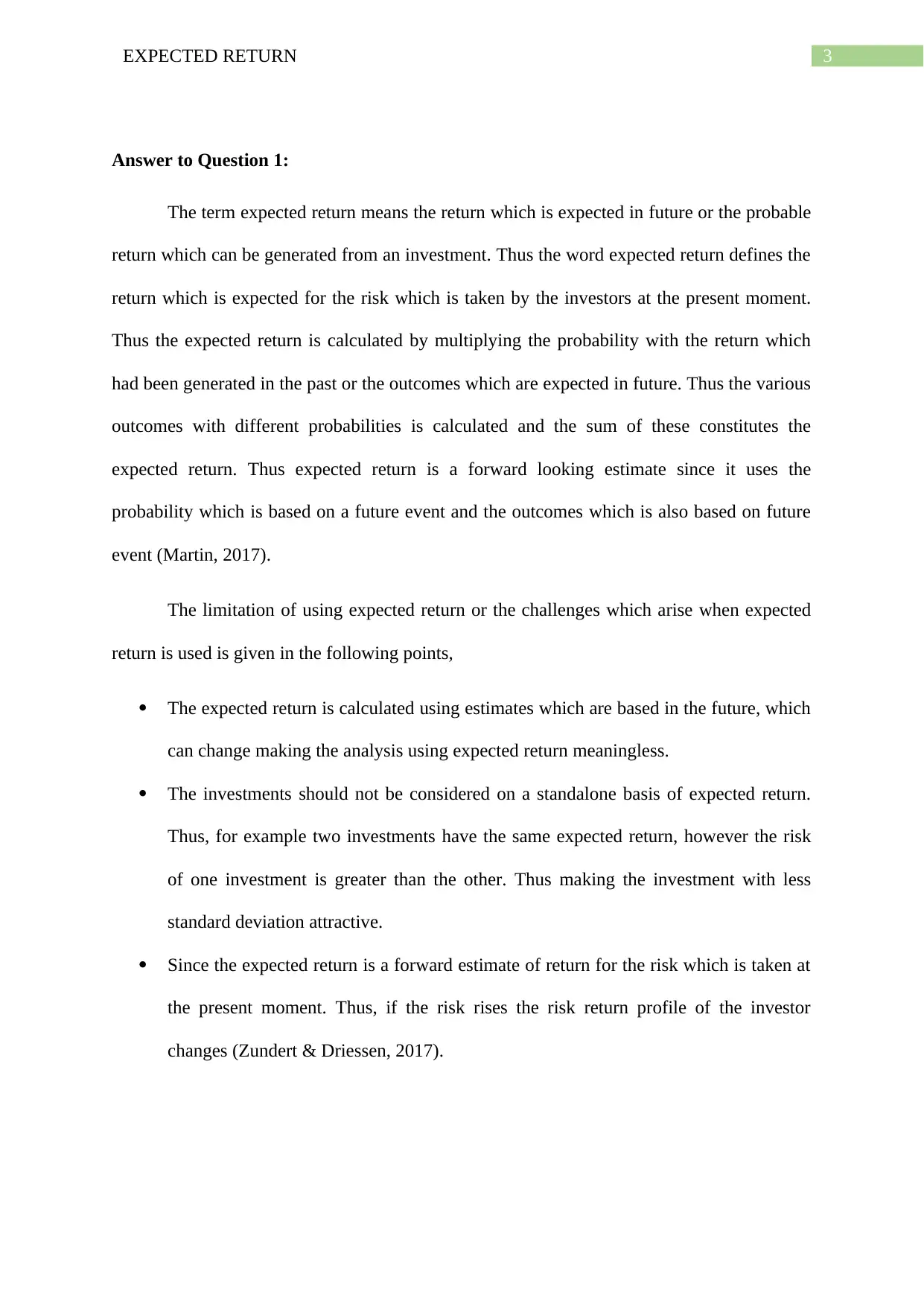
The expected return for the economic states is calculated by multiplying the
probability with the return (Cheema, Nartea & Man 2018). Thus the individual probabilistic
return is determined which is then summed to calculate the expected return.
Figure 1: Calculation of Expected Return
Source: By the Author
tabler-icon-diamond-filled.svg

Paraphrase This Document

Need a fresh take? Get an instant paraphrase of this document with our AI Paraphraser
Document Page
5EXPECTED RETURN
Answer to Question 8:
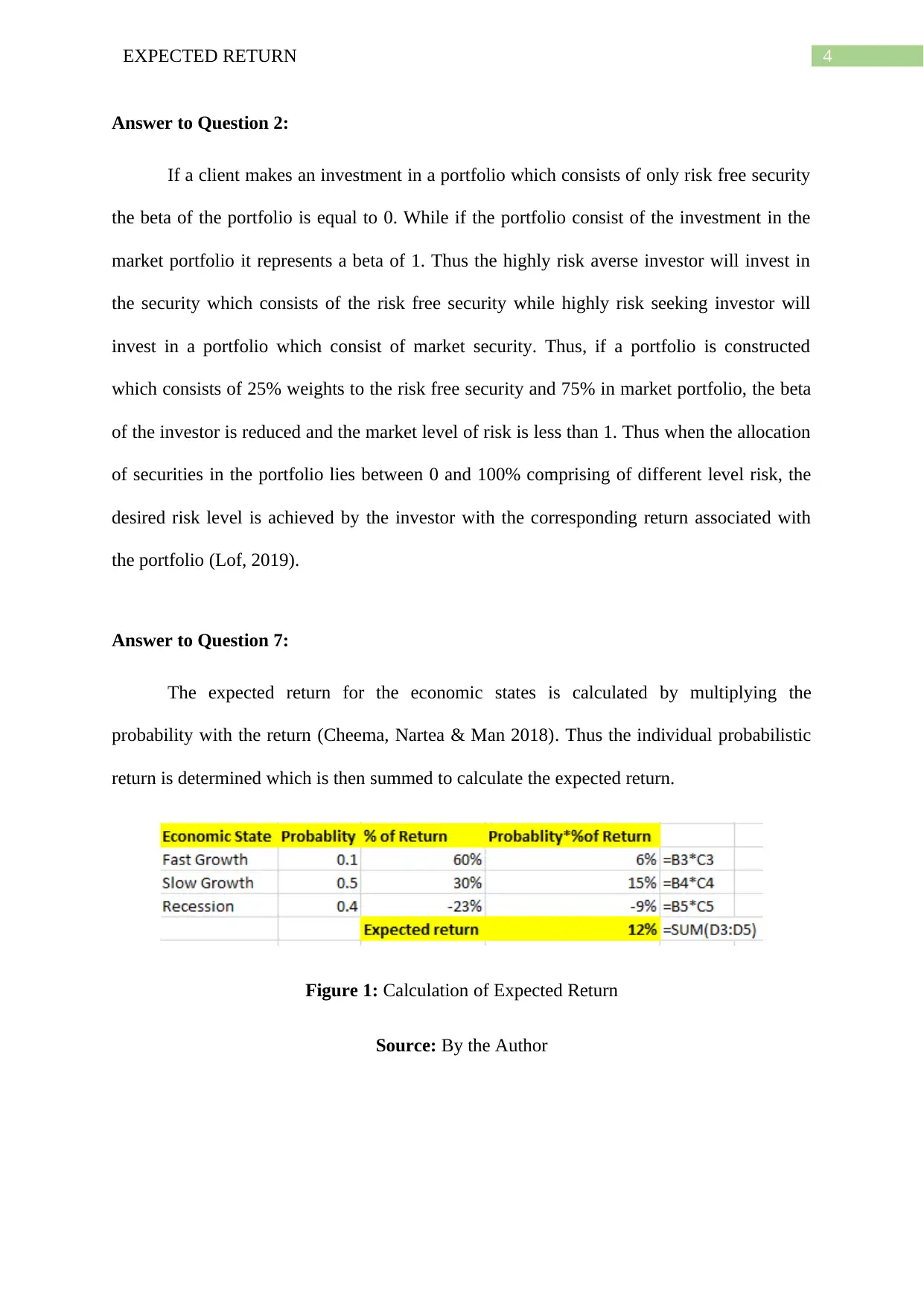
The required return of an investment is calculated by summing the risk free rate with
the risk premium. Thus the required return is the sum of risk free rate and the risk premium of
an investment.
Figure 2: Calculation of Required Return
Source: By the Author
Answer to Question 9:
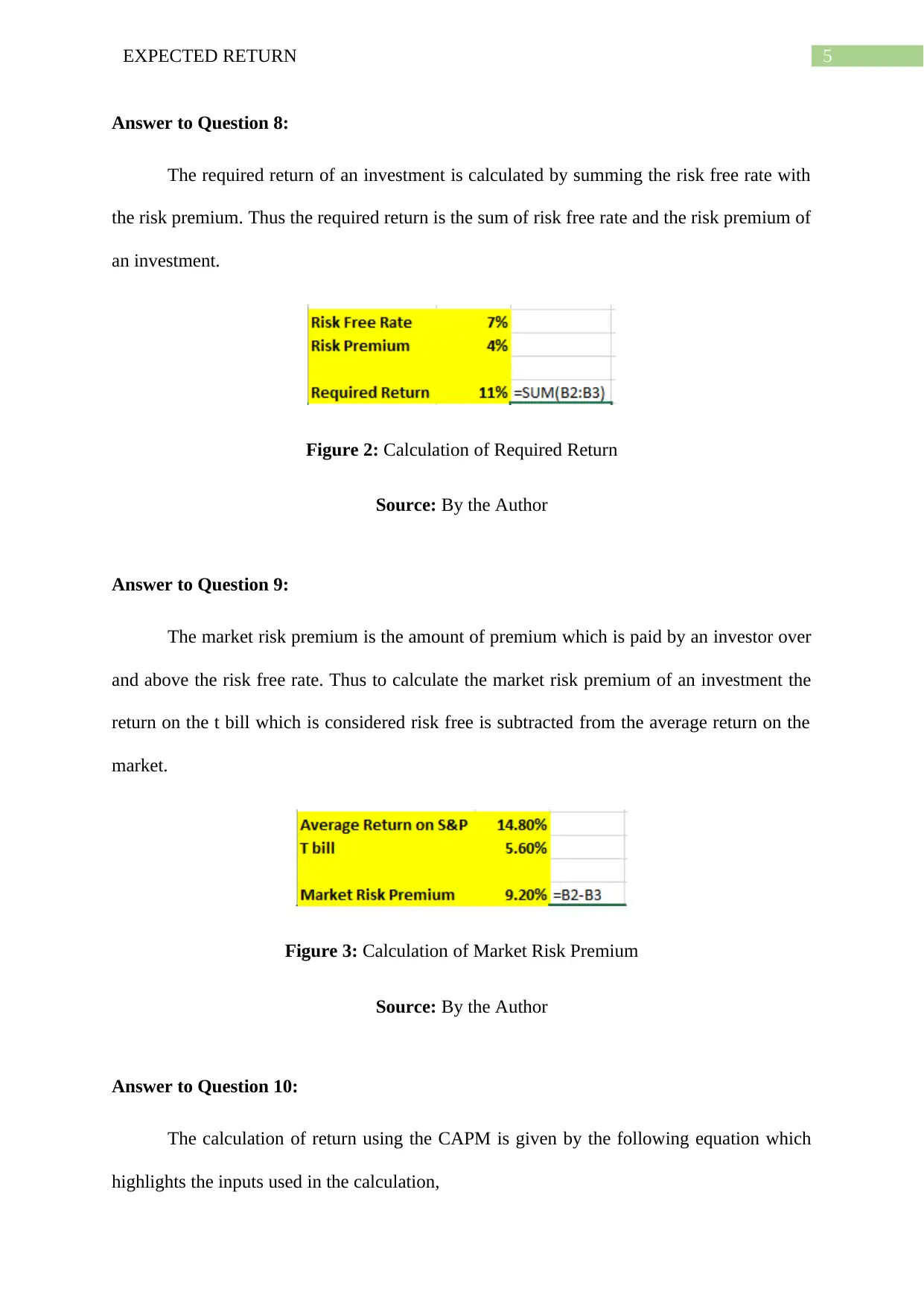
The market risk premium is the amount of premium which is paid by an investor over
and above the risk free rate. Thus to calculate the market risk premium of an investment the
return on the t bill which is considered risk free is subtracted from the average return on the
market.
Figure 3: Calculation of Market Risk Premium
Source: By the Author
Answer to Question 10:
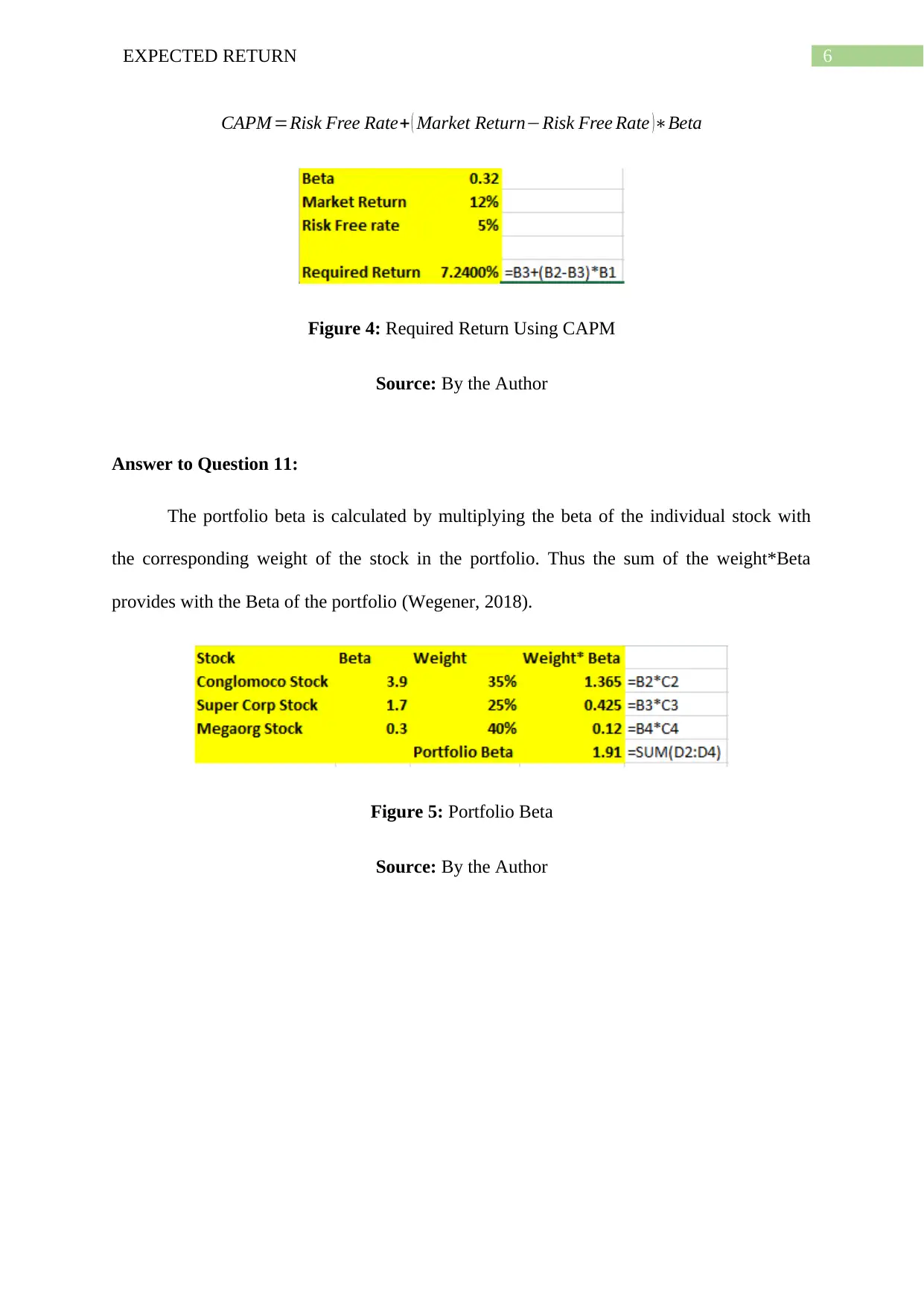
The calculation of return using the CAPM is given by the following equation which
highlights the inputs used in the calculation,
Document Page
6EXPECTED RETURN
CAPM =Risk Free Rate+ ( Market ReturnRisk Free Rate )Beta
Figure 4: Required Return Using CAPM
Source: By the Author
Answer to Question 11:
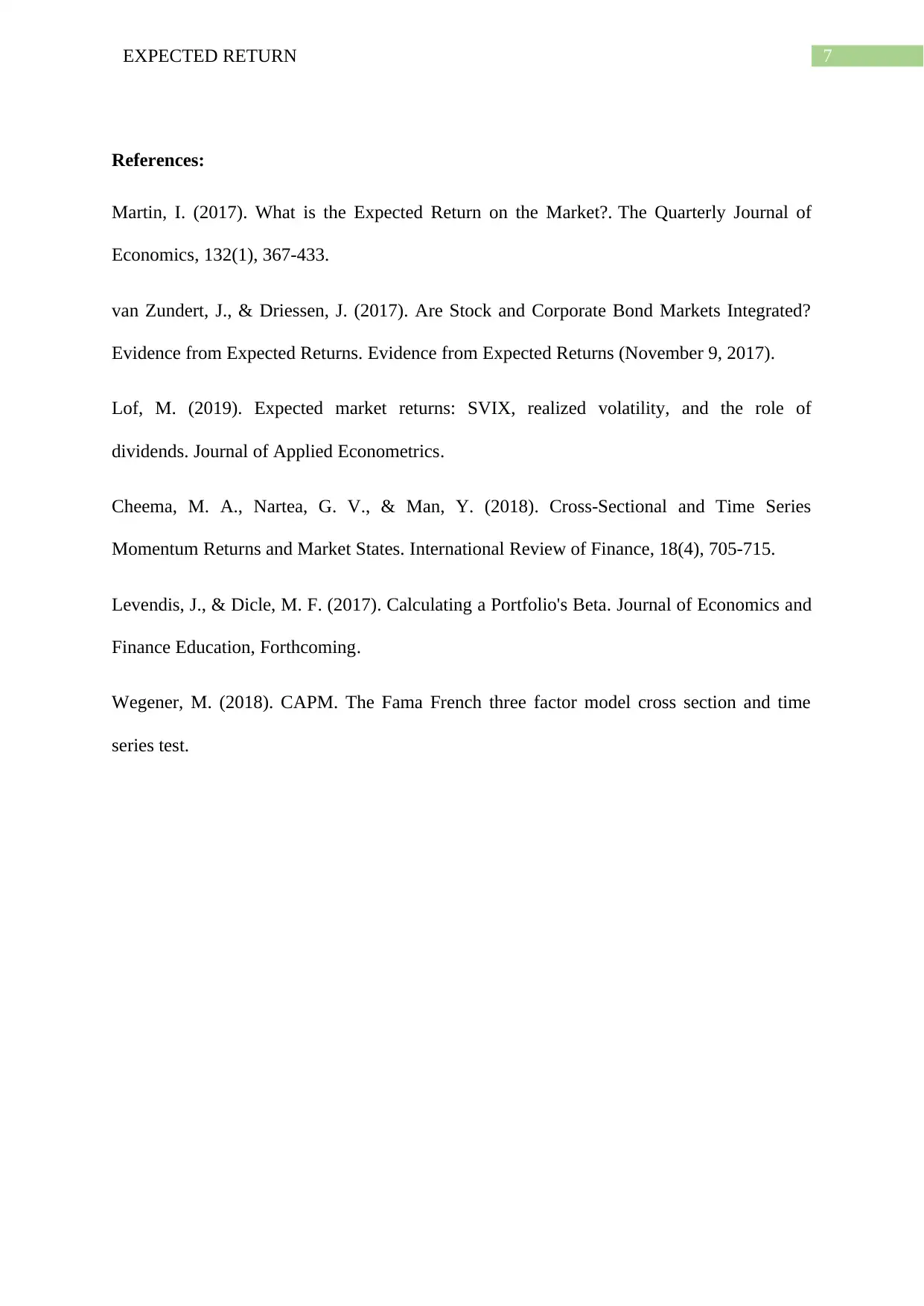
The portfolio beta is calculated by multiplying the beta of the individual stock with
the corresponding weight of the stock in the portfolio. Thus the sum of the weight*Beta
provides with the Beta of the portfolio (Wegener, 2018).
Figure 5: Portfolio Beta
Source: By the Author
Document Page
7EXPECTED RETURN
References:
Martin, I. (2017). What is the Expected Return on the Market?. The Quarterly Journal of
Economics, 132(1), 367-433.
van Zundert, J., & Driessen, J. (2017). Are Stock and Corporate Bond Markets Integrated?
Evidence from Expected Returns. Evidence from Expected Returns (November 9, 2017).
Lof, M. (2019). Expected market returns: SVIX, realized volatility, and the role of
dividends. Journal of Applied Econometrics.
Cheema, M. A., Nartea, G. V., & Man, Y. (2018). Cross‐Sectional and Time Series
Momentum Returns and Market States. International Review of Finance, 18(4), 705-715.
Levendis, J., & Dicle, M. F. (2017). Calculating a Portfolio's Beta. Journal of Economics and
Finance Education, Forthcoming.
Wegener, M. (2018). CAPM. The Fama French three factor model cross section and time
series test.
chevron_up_icon
1 out of 7
circle_padding
hide_on_mobile
zoom_out_icon
[object Object]