Communication Accommodation Theory: Exploring Over-Accommodation Types

Verified

Added on  2022/09/02

|4
|467
|28
Report
AI Summary
This report delves into the concept of over-accommodation within the framework of Communication Accommodation Theory (CAT). It explores how individuals may unintentionally or intentionally adjust their communication styles, potentially leading to miscommunication. The report outlines three primary types of over-accommodation: sensory, dependency, and intergroup. Sensory over-accommodation is described as adapting communication to perceived limitations, such as physical or linguistic disabilities. Dependency over-accommodation involves assuming a lower status for the audience, while intergroup over-accommodation stems from stereotyping and failing to recognize individual differences. The report provides real-world examples for each type, enhancing understanding of these communication dynamics. This assignment is a valuable resource for students to grasp the complexities of effective communication and avoid potential pitfalls. The report is a valuable resource for students studying communication and related fields.
Document Page
Running head: CAT
Discussion of Type of Over-Accommodation
Name of the Student
Name of the University
Author Note
tabler-icon-diamond-filled.svg

Paraphrase This Document

Need a fresh take? Get an instant paraphrase of this document with our AI Paraphraser
Document Page
CAT
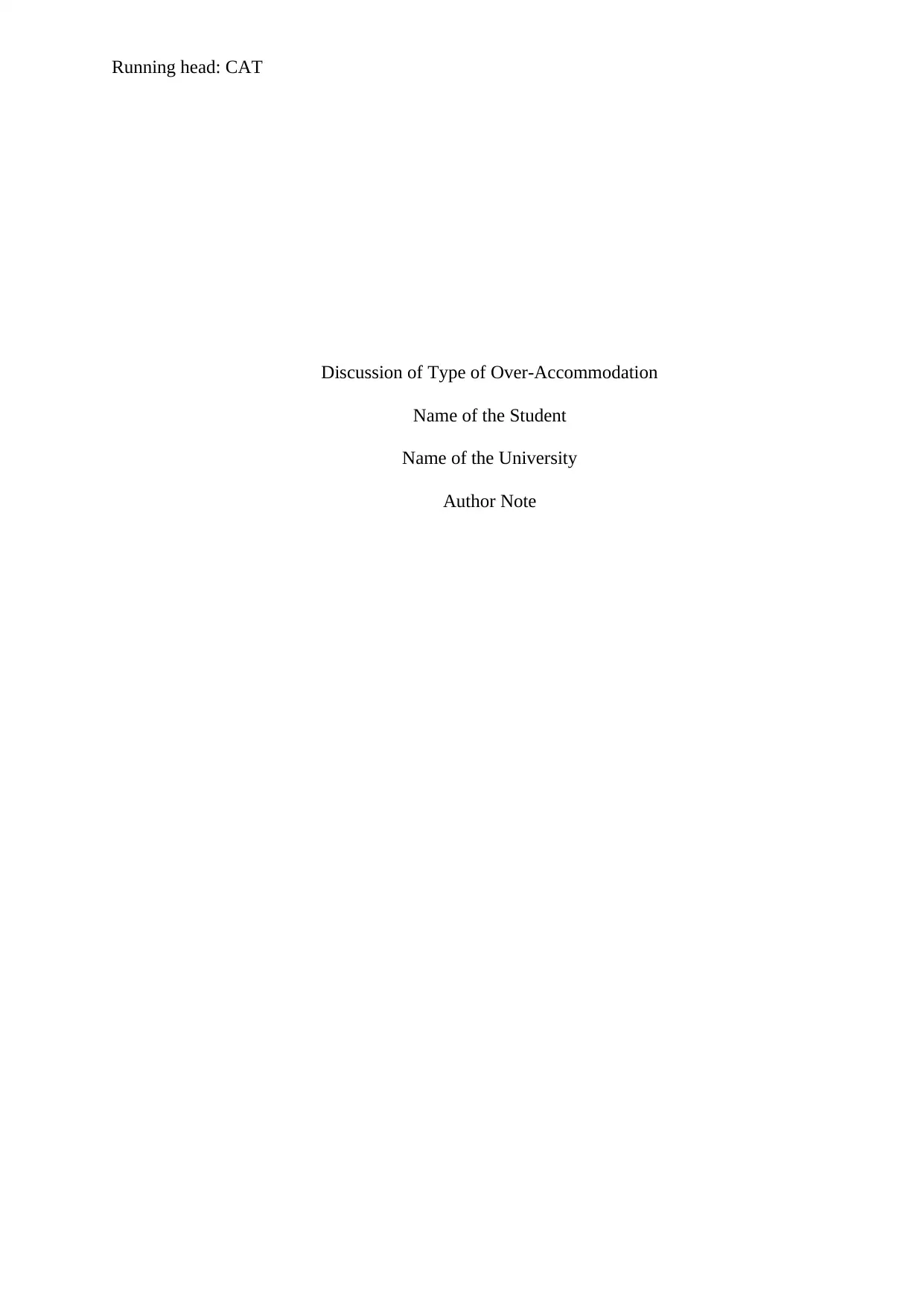
The Communication Accommodation Theory by Giles’s examines the adjustments in
the gestures, vocal patterns, and speech to accommodate the audience for the speech. Such
interactions are accommodative, as they tend to achieve communication efficiency, elicit
approval, to maintain a positive social identity and to assert a dominant position (Giles,
2016). Accommodation can be defined as the speaker’s ability to adjust, regulate, or modify
the behaviour in response to others, which usually occurs unconsciously. While
communicating with someone, the overdoing of such adjustments and efforts, and patronizing
perception of accommodations can be regarded as overaccommodation (Dragojevic, Gasiorek
& Giles, 2015).
In simple terms, overaccommodation can be referred to as the scenario where an
individual miscommunicates with the other person, consciously, and with an intended
purpose. Following are the three types of overaccommodation identified:
a) Sensory Overaccommodation: This occurs when the speaker over adapts to
someone specific when the speaker might be perceiving the other as limited in
some or other ways. Such limitations in the other person may be in the form of
Document Page
CAT
linguistic limitations or physical disability. In other terms, this type of
overaccommodation is concerned with adaptation to physical limits, where the
speaker might be the opposite person as limited.
Example: The teacher asks students to pick the right choice instead of short answers,
to reduce the need for writing by hand.
b) Dependency Overaccommodation: in this type of overaccommodation, the
speaker assumes a lower opinion of the audience listening to him or her.
Dependency in this situation is assured when the audience is put in the dependent
position or lower-status function. In this, the speaker might attain the position of
showing off status.
Example- The foreigners are deemed to be felt inferior or minor when engaging in
communication with native citizens.
c) Intergroup Overaccommodation: This type of overaccommodation occurs when
the speaker fails to recognize the individual differences as he assumes the
audience as a big lump or group. Stereotyping is the root of this type of
overaccommodation.
Example: the speaker speaks continuously regarding culture but does not
acknowledge individual talent and uniqueness.
Document Page
CAT
References
Giles, H. (2016). Communication accommodation theory. The international encyclopedia of
communication theory and philosophy, 1-7.
Dragojevic, M., Gasiorek, J., & Giles, H. (2015). Communication accommodation
theory. The international encyclopedia of interpersonal communication, 1-21.
chevron_up_icon
1 out of 4
circle_padding
hide_on_mobile
zoom_out_icon
[object Object]