A Comparison of Psychological Approaches to Understanding Self-Esteem

Verified

Added on  2022/08/26

|5
|1072
|22
Essay
AI Summary
This essay provides a comprehensive comparison and contrast of two major psychological approaches to understanding self-esteem: the relational approach and the cognitive attitude approach. The essay explores the core tenets of each approach, including the three-component model of the self within the relational perspective and the use of Rosenberg's Self-Esteem Scale and cognitive biases within the cognitive attitude perspective. The analysis delves into the strengths and weaknesses of each approach, using examples of theory and research from the provided material, such as the Dove campaign for relational self-esteem and the understanding of cognitive biases. The essay also touches upon the sociocultural explanation of self-esteem, specifically self-objectification, offering a broader perspective on how self-esteem is shaped by societal factors. The conclusion synthesizes the key differences and similarities between the approaches, highlighting the importance of understanding self-esteem from multiple perspectives.

Document Page
0
Self-esteem
tabler-icon-diamond-filled.svg

Paraphrase This Document

Need a fresh take? Get an instant paraphrase of this document with our AI Paraphraser
Document Page
1
Introduction
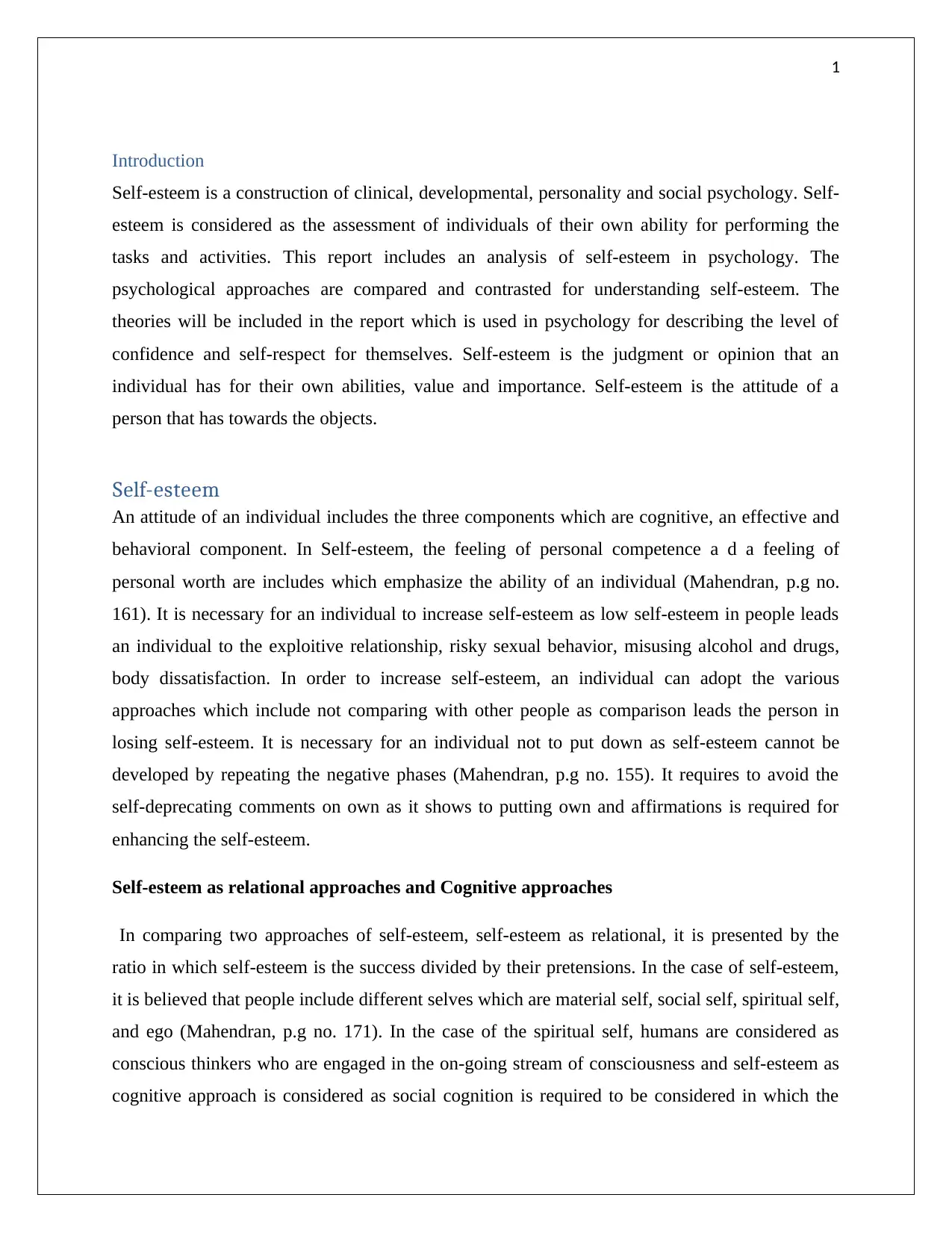
Self-esteem is a construction of clinical, developmental, personality and social psychology. Self-
esteem is considered as the assessment of individuals of their own ability for performing the
tasks and activities. This report includes an analysis of self-esteem in psychology. The
psychological approaches are compared and contrasted for understanding self-esteem. The
theories will be included in the report which is used in psychology for describing the level of
confidence and self-respect for themselves. Self-esteem is the judgment or opinion that an
individual has for their own abilities, value and importance. Self-esteem is the attitude of a
person that has towards the objects.
Self-esteem
An attitude of an individual includes the three components which are cognitive, an effective and
behavioral component. In Self-esteem, the feeling of personal competence a d a feeling of
personal worth are includes which emphasize the ability of an individual (Mahendran, p.g no.
161). It is necessary for an individual to increase self-esteem as low self-esteem in people leads
an individual to the exploitive relationship, risky sexual behavior, misusing alcohol and drugs,
body dissatisfaction. In order to increase self-esteem, an individual can adopt the various
approaches which include not comparing with other people as comparison leads the person in
losing self-esteem. It is necessary for an individual not to put down as self-esteem cannot be
developed by repeating the negative phases (Mahendran, p.g no. 155). It requires to avoid the
self-deprecating comments on own as it shows to putting own and affirmations is required for
enhancing the self-esteem.
Self-esteem as relational approaches and Cognitive approaches
In comparing two approaches of self-esteem, self-esteem as relational, it is presented by the
ratio in which self-esteem is the success divided by their pretensions. In the case of self-esteem,
it is believed that people include different selves which are material self, social self, spiritual self,
and ego (Mahendran, p.g no. 171). In the case of the spiritual self, humans are considered as
conscious thinkers who are engaged in the on-going stream of consciousness and self-esteem as
cognitive approach is considered as social cognition is required to be considered in which the
Document Page
2
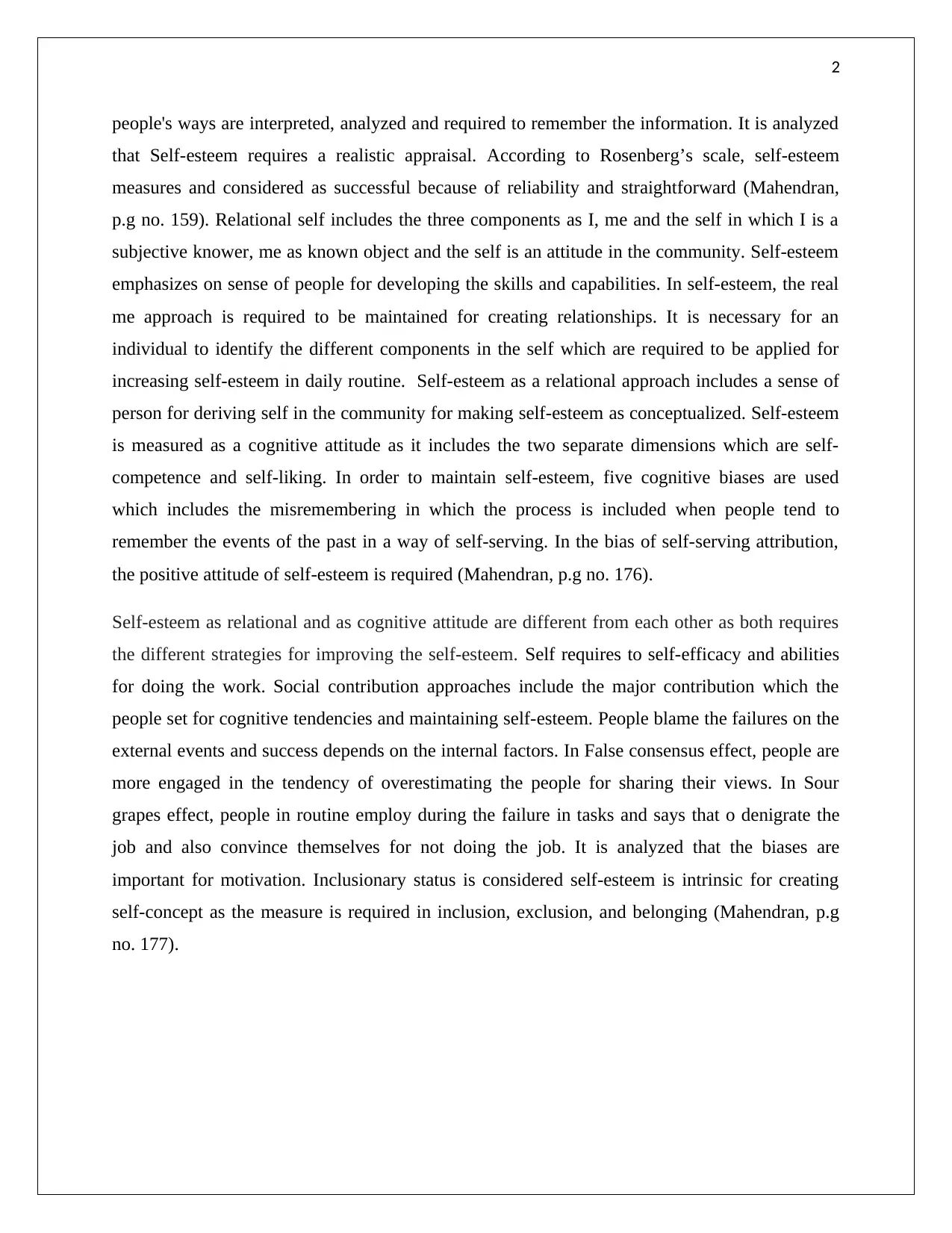
people's ways are interpreted, analyzed and required to remember the information. It is analyzed
that Self-esteem requires a realistic appraisal. According to Rosenberg’s scale, self-esteem
measures and considered as successful because of reliability and straightforward (Mahendran,
p.g no. 159). Relational self includes the three components as I, me and the self in which I is a
subjective knower, me as known object and the self is an attitude in the community. Self-esteem
emphasizes on sense of people for developing the skills and capabilities. In self-esteem, the real
me approach is required to be maintained for creating relationships. It is necessary for an
individual to identify the different components in the self which are required to be applied for
increasing self-esteem in daily routine. Self-esteem as a relational approach includes a sense of
person for deriving self in the community for making self-esteem as conceptualized. Self-esteem
is measured as a cognitive attitude as it includes the two separate dimensions which are self-
competence and self-liking. In order to maintain self-esteem, five cognitive biases are used
which includes the misremembering in which the process is included when people tend to
remember the events of the past in a way of self-serving. In the bias of self-serving attribution,
the positive attitude of self-esteem is required (Mahendran, p.g no. 176).
Self-esteem as relational and as cognitive attitude are different from each other as both requires
the different strategies for improving the self-esteem. Self requires to self-efficacy and abilities
for doing the work. Social contribution approaches include the major contribution which the
people set for cognitive tendencies and maintaining self-esteem. People blame the failures on the
external events and success depends on the internal factors. In False consensus effect, people are
more engaged in the tendency of overestimating the people for sharing their views. In Sour
grapes effect, people in routine employ during the failure in tasks and says that o denigrate the
job and also convince themselves for not doing the job. It is analyzed that the biases are
important for motivation. Inclusionary status is considered self-esteem is intrinsic for creating
self-concept as the measure is required in inclusion, exclusion, and belonging (Mahendran, p.g
no. 177).
Document Page
3
Self-esteem and self-objectification
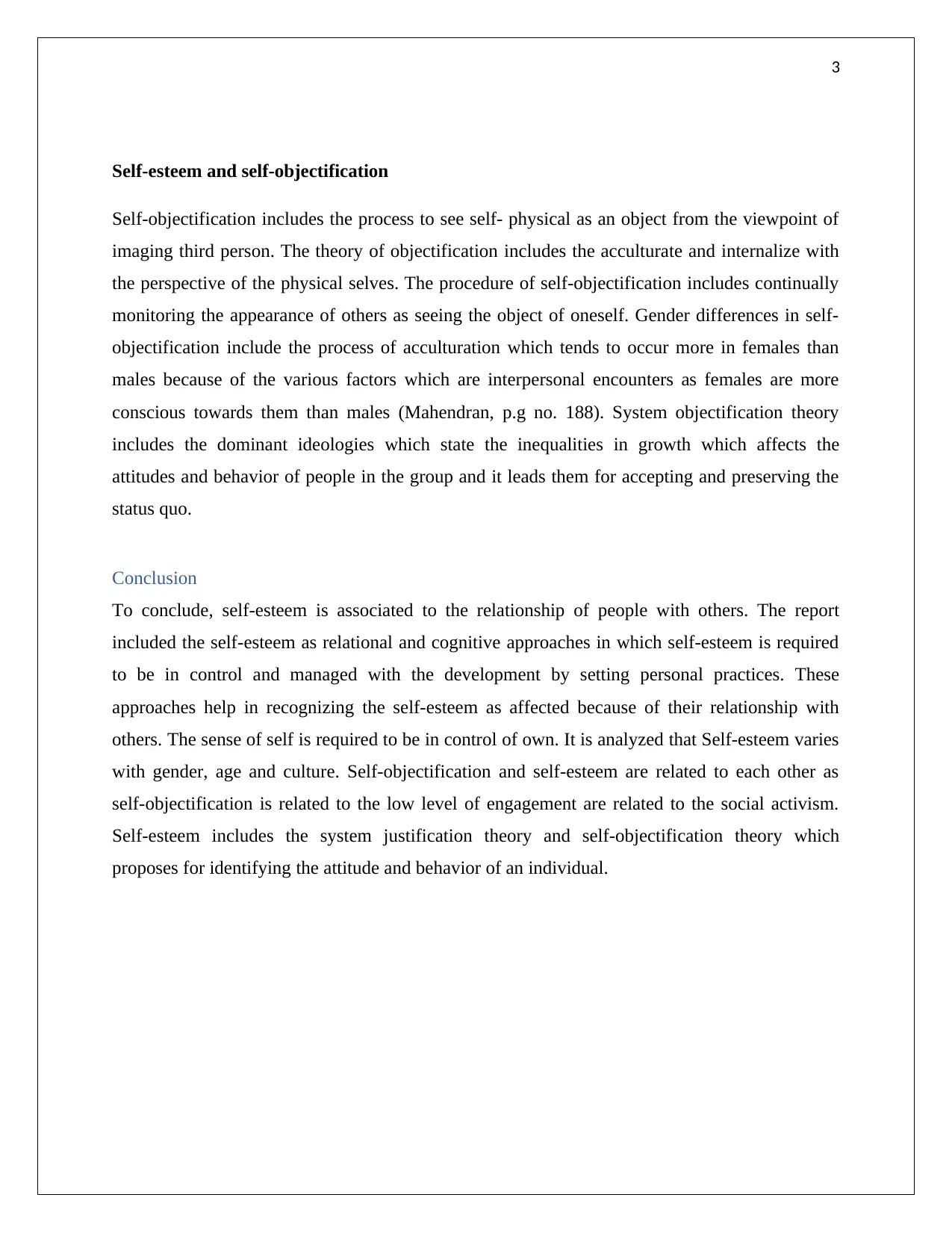
Self-objectification includes the process to see self- physical as an object from the viewpoint of
imaging third person. The theory of objectification includes the acculturate and internalize with
the perspective of the physical selves. The procedure of self-objectification includes continually
monitoring the appearance of others as seeing the object of oneself. Gender differences in self-
objectification include the process of acculturation which tends to occur more in females than
males because of the various factors which are interpersonal encounters as females are more
conscious towards them than males (Mahendran, p.g no. 188). System objectification theory
includes the dominant ideologies which state the inequalities in growth which affects the
attitudes and behavior of people in the group and it leads them for accepting and preserving the
status quo.
Conclusion
To conclude, self-esteem is associated to the relationship of people with others. The report
included the self-esteem as relational and cognitive approaches in which self-esteem is required
to be in control and managed with the development by setting personal practices. These
approaches help in recognizing the self-esteem as affected because of their relationship with
others. The sense of self is required to be in control of own. It is analyzed that Self-esteem varies
with gender, age and culture. Self-objectification and self-esteem are related to each other as
self-objectification is related to the low level of engagement are related to the social activism.
Self-esteem includes the system justification theory and self-objectification theory which
proposes for identifying the attitude and behavior of an individual.
tabler-icon-diamond-filled.svg

Paraphrase This Document

Need a fresh take? Get an instant paraphrase of this document with our AI Paraphraser
Document Page
4
chevron_up_icon
1 out of 5
circle_padding
hide_on_mobile
zoom_out_icon
[object Object]