Pizza Restaurant Simulation Project

Verified

Added on  2019/09/18

|2
|898
|360
Project
AI Summary
This project involves building a simulation model of a pizza restaurant's operations. The restaurant takes online orders for six pizza types in three sizes, with no dine-in or custom orders. The simulation incorporates five processes: ordering, pizza making (divided into three sub-processes with triangular distributions for time estimates), baking (with two ovens and a conveyor belt), slicing/packing, and customer pickup. The model considers varying order volumes (normal and peak hours), order sizes (one to three pizzas), pizza size distributions, and pizza type distributions. The project requires simulating the model for a week, creating a queuing animation, analyzing worker and oven utilization, suggesting efficient pizza-making protocols, evaluating the need for a buffer zone, assessing the impact of replacing an oven with a higher-capacity one, and proposing overall improvements. The challenges include the dynamic role of the third worker, the correlation between pizza sizes and oven capacities, and modeling the conveyor belt as a material handling system.
Document Page
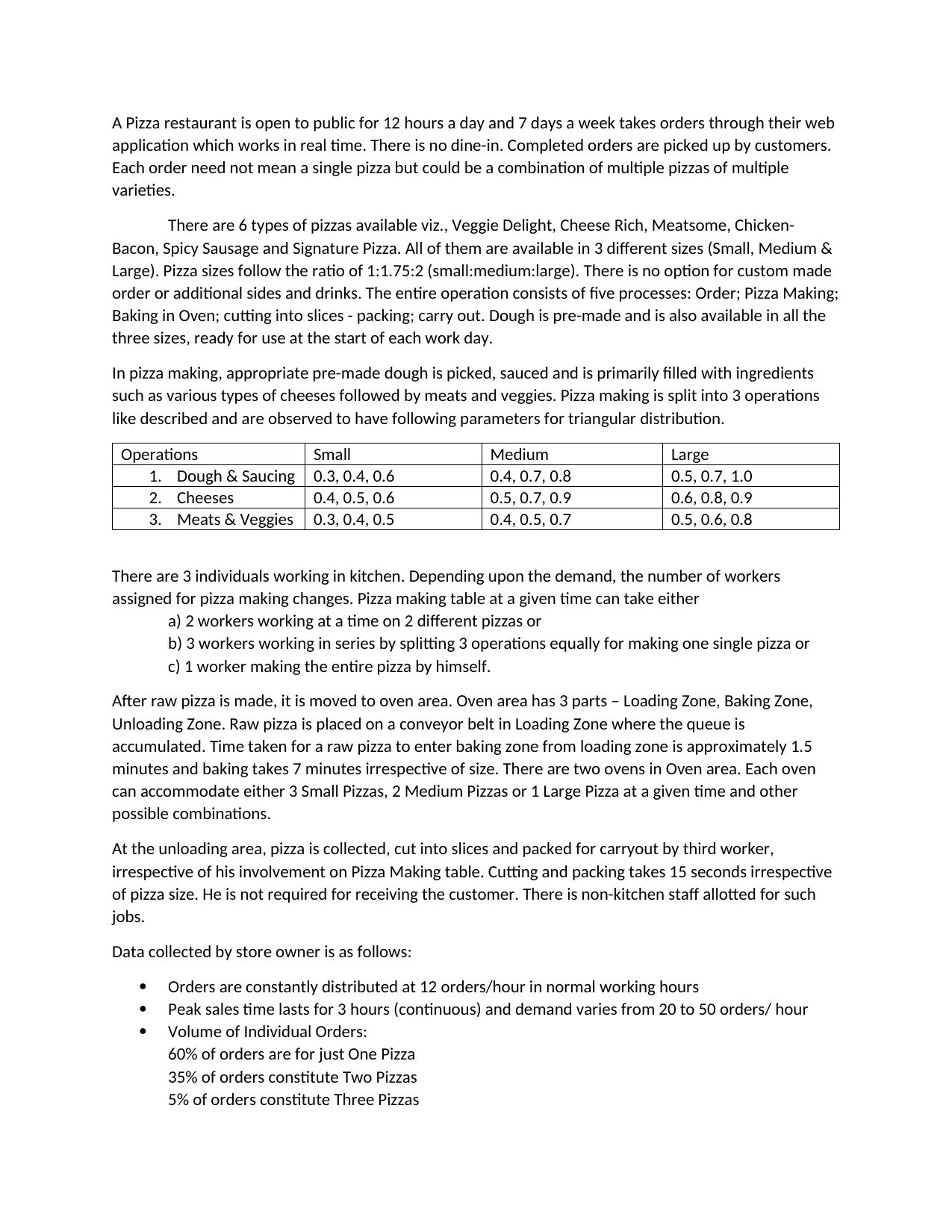
A Pizza restaurant is open to public for 12 hours a day and 7 days a week takes orders through their web
application which works in real time. There is no dine-in. Completed orders are picked up by customers.
Each order need not mean a single pizza but could be a combination of multiple pizzas of multiple
varieties.
There are 6 types of pizzas available viz., Veggie Delight, Cheese Rich, Meatsome, Chicken-
Bacon, Spicy Sausage and Signature Pizza. All of them are available in 3 different sizes (Small, Medium &
Large). Pizza sizes follow the ratio of 1:1.75:2 (small:medium:large). There is no option for custom made
order or additional sides and drinks. The entire operation consists of five processes: Order; Pizza Making;
Baking in Oven; cutting into slices - packing; carry out. Dough is pre-made and is also available in all the
three sizes, ready for use at the start of each work day.
In pizza making, appropriate pre-made dough is picked, sauced and is primarily filled with ingredients
such as various types of cheeses followed by meats and veggies. Pizza making is split into 3 operations
like described and are observed to have following parameters for triangular distribution.
Operations Small Medium Large
1. Dough & Saucing 0.3, 0.4, 0.6 0.4, 0.7, 0.8 0.5, 0.7, 1.0
2. Cheeses 0.4, 0.5, 0.6 0.5, 0.7, 0.9 0.6, 0.8, 0.9
3. Meats & Veggies 0.3, 0.4, 0.5 0.4, 0.5, 0.7 0.5, 0.6, 0.8
There are 3 individuals working in kitchen. Depending upon the demand, the number of workers
assigned for pizza making changes. Pizza making table at a given time can take either
a) 2 workers working at a time on 2 different pizzas or
b) 3 workers working in series by splitting 3 operations equally for making one single pizza or
c) 1 worker making the entire pizza by himself.
After raw pizza is made, it is moved to oven area. Oven area has 3 parts – Loading Zone, Baking Zone,
Unloading Zone. Raw pizza is placed on a conveyor belt in Loading Zone where the queue is
accumulated. Time taken for a raw pizza to enter baking zone from loading zone is approximately 1.5
minutes and baking takes 7 minutes irrespective of size. There are two ovens in Oven area. Each oven
can accommodate either 3 Small Pizzas, 2 Medium Pizzas or 1 Large Pizza at a given time and other
possible combinations.
At the unloading area, pizza is collected, cut into slices and packed for carryout by third worker,
irrespective of his involvement on Pizza Making table. Cutting and packing takes 15 seconds irrespective
of pizza size. He is not required for receiving the customer. There is non-kitchen staff allotted for such
jobs.
Data collected by store owner is as follows:
Orders are constantly distributed at 12 orders/hour in normal working hours
Peak sales time lasts for 3 hours (continuous) and demand varies from 20 to 50 orders/ hour
Volume of Individual Orders:
60% of orders are for just One Pizza
35% of orders constitute Two Pizzas
5% of orders constitute Three Pizzas
tabler-icon-diamond-filled.svg

Paraphrase This Document

Need a fresh take? Get an instant paraphrase of this document with our AI Paraphraser
Document Page
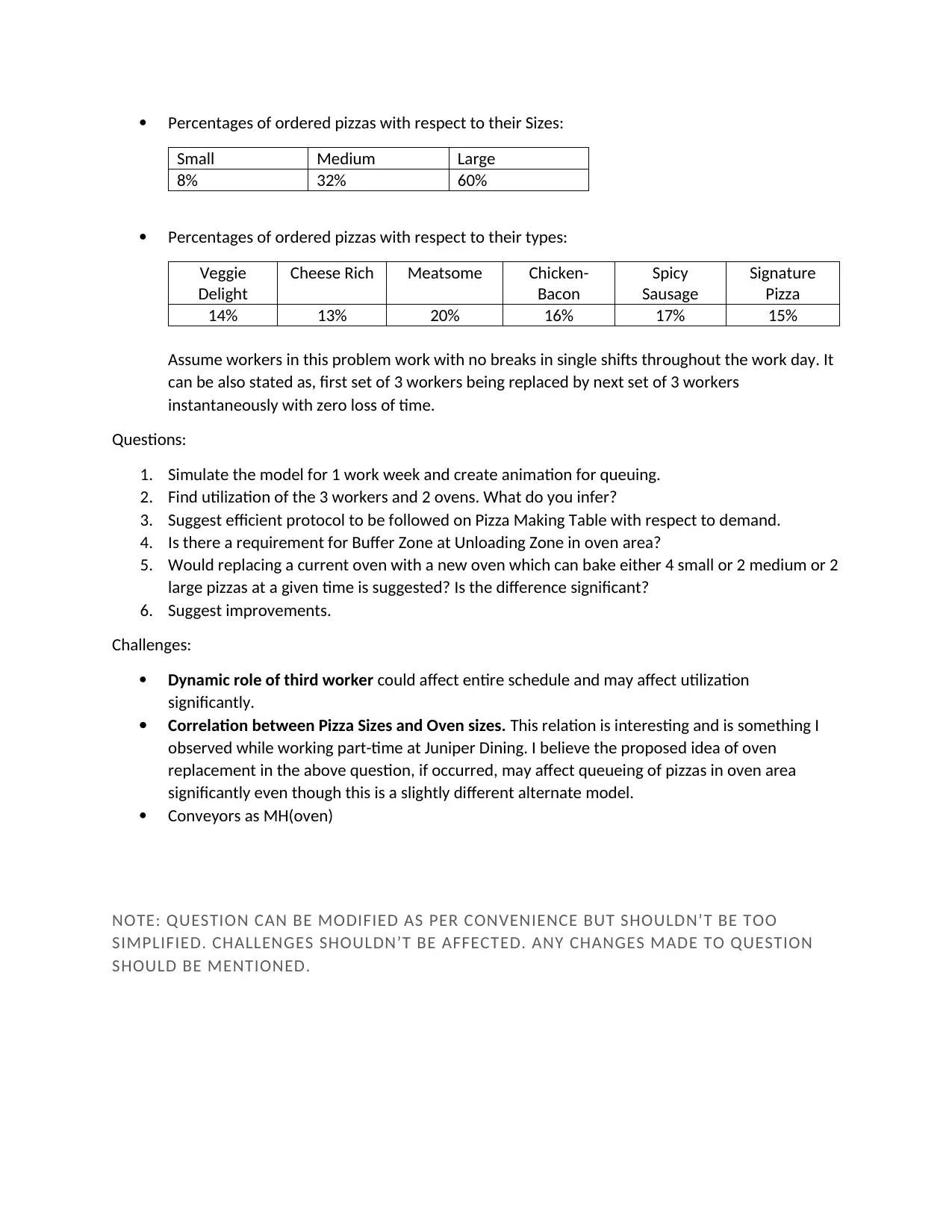
Percentages of ordered pizzas with respect to their Sizes:
Small Medium Large
8% 32% 60%
Percentages of ordered pizzas with respect to their types:
Veggie
Delight
Cheese Rich Meatsome Chicken-
Bacon
Spicy
Sausage
Signature
Pizza
14% 13% 20% 16% 17% 15%
Assume workers in this problem work with no breaks in single shifts throughout the work day. It
can be also stated as, first set of 3 workers being replaced by next set of 3 workers
instantaneously with zero loss of time.
Questions:
1. Simulate the model for 1 work week and create animation for queuing.
2. Find utilization of the 3 workers and 2 ovens. What do you infer?
3. Suggest efficient protocol to be followed on Pizza Making Table with respect to demand.
4. Is there a requirement for Buffer Zone at Unloading Zone in oven area?
5. Would replacing a current oven with a new oven which can bake either 4 small or 2 medium or 2
large pizzas at a given time is suggested? Is the difference significant?
6. Suggest improvements.
Challenges:
Dynamic role of third worker could affect entire schedule and may affect utilization
significantly.
Correlation between Pizza Sizes and Oven sizes. This relation is interesting and is something I
observed while working part-time at Juniper Dining. I believe the proposed idea of oven
replacement in the above question, if occurred, may affect queueing of pizzas in oven area
significantly even though this is a slightly different alternate model.
Conveyors as MH(oven)
NOTE: QUESTION CAN BE MODIFIED AS PER CONVENIENCE BUT SHOULDN’T BE TOO
SIMPLIFIED. CHALLENGES SHOULDN’T BE AFFECTED. ANY CHANGES MADE TO QUESTION
SHOULD BE MENTIONED.
chevron_up_icon
1 out of 2
circle_padding
hide_on_mobile
zoom_out_icon
[object Object]