Education and Support Assignment: Cultural Safety Strategies
VerifiedAdded on 2023/06/03
|10
|1373
|221
Homework Assignment
AI Summary
This assignment explores the principles of education and support for Aboriginal and Islander people, emphasizing cultural safety. It examines five key principles to engender cultural safety: protocols, personal knowledge, partnerships, process, and positive purpose. The assignment discusses the significance of kinship and family structures in Aboriginal culture, contrasting them with Western family models. It provides strategies for schools to incorporate Aboriginal perspectives, including practical steps like engaging with the community and accessing relevant resources. The document also outlines cultural safety strategies involving Aboriginal people, such as balancing clinical expertise with cultural knowledge and promoting awareness of communication styles. Additionally, it suggests ways schools can connect with Aboriginal people and foster their participation in cultural safety, including policy improvements, early intervention support, and inclusive recruitment practices. The references provided support the concepts discussed throughout the assignment.
0
Running Head: Education and Support
Education and Support
Aboriginal and Islander People
Running Head: Education and Support
Education and Support
Aboriginal and Islander People
Paraphrase This Document
Need a fresh take? Get an instant paraphrase of this document with our AI Paraphraser

Education and Support
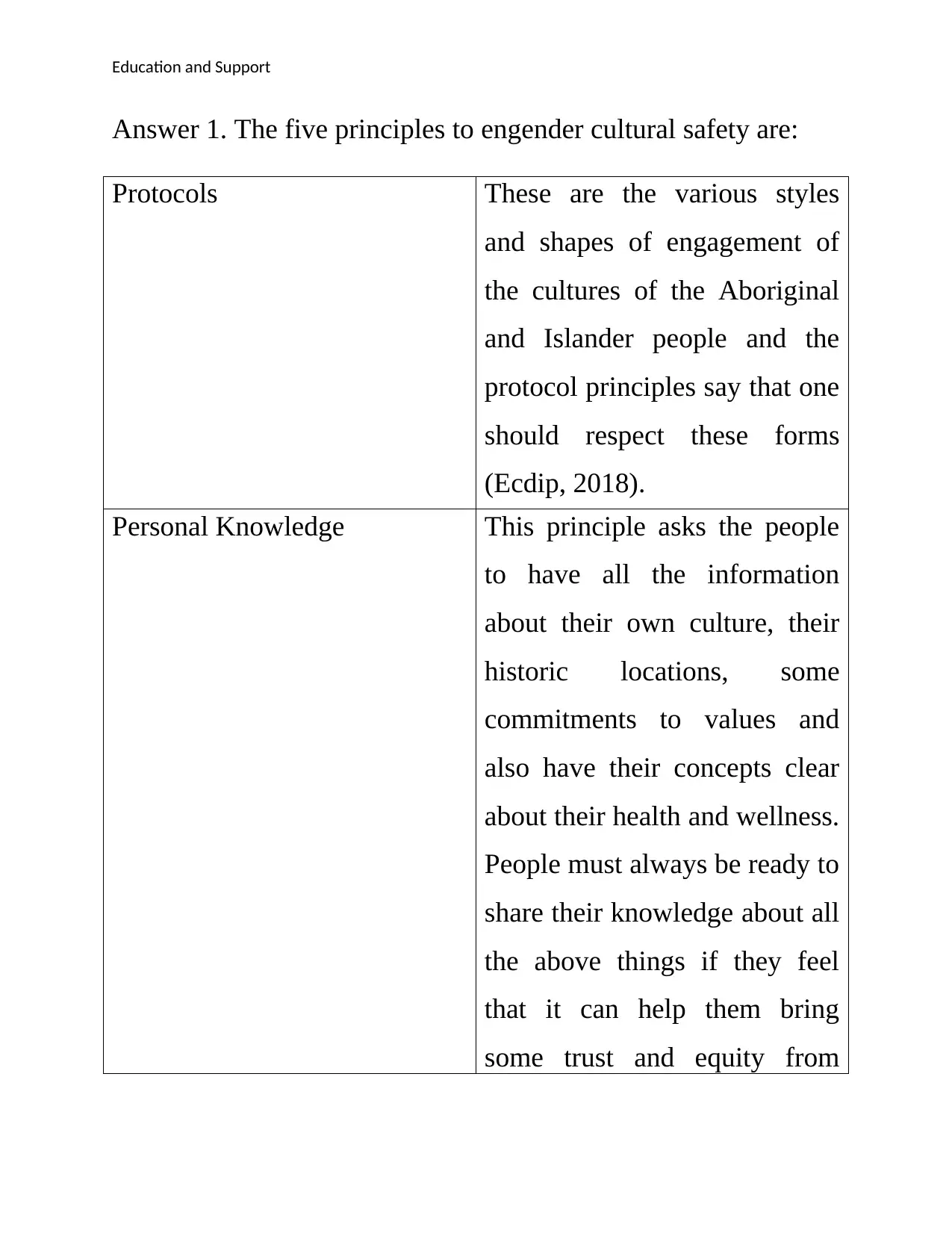
Answer 1. The five principles to engender cultural safety are:
Protocols These are the various styles
and shapes of engagement of
the cultures of the Aboriginal
and Islander people and the
protocol principles say that one
should respect these forms
(Ecdip, 2018).
Personal Knowledge This principle asks the people
to have all the information
about their own culture, their
historic locations, some
commitments to values and
also have their concepts clear
about their health and wellness.
People must always be ready to
share their knowledge about all
the above things if they feel
that it can help them bring
some trust and equity from
Answer 1. The five principles to engender cultural safety are:
Protocols These are the various styles
and shapes of engagement of
the cultures of the Aboriginal
and Islander people and the
protocol principles say that one
should respect these forms
(Ecdip, 2018).
Personal Knowledge This principle asks the people
to have all the information
about their own culture, their
historic locations, some
commitments to values and
also have their concepts clear
about their health and wellness.
People must always be ready to
share their knowledge about all
the above things if they feel
that it can help them bring
some trust and equity from

Education and Support
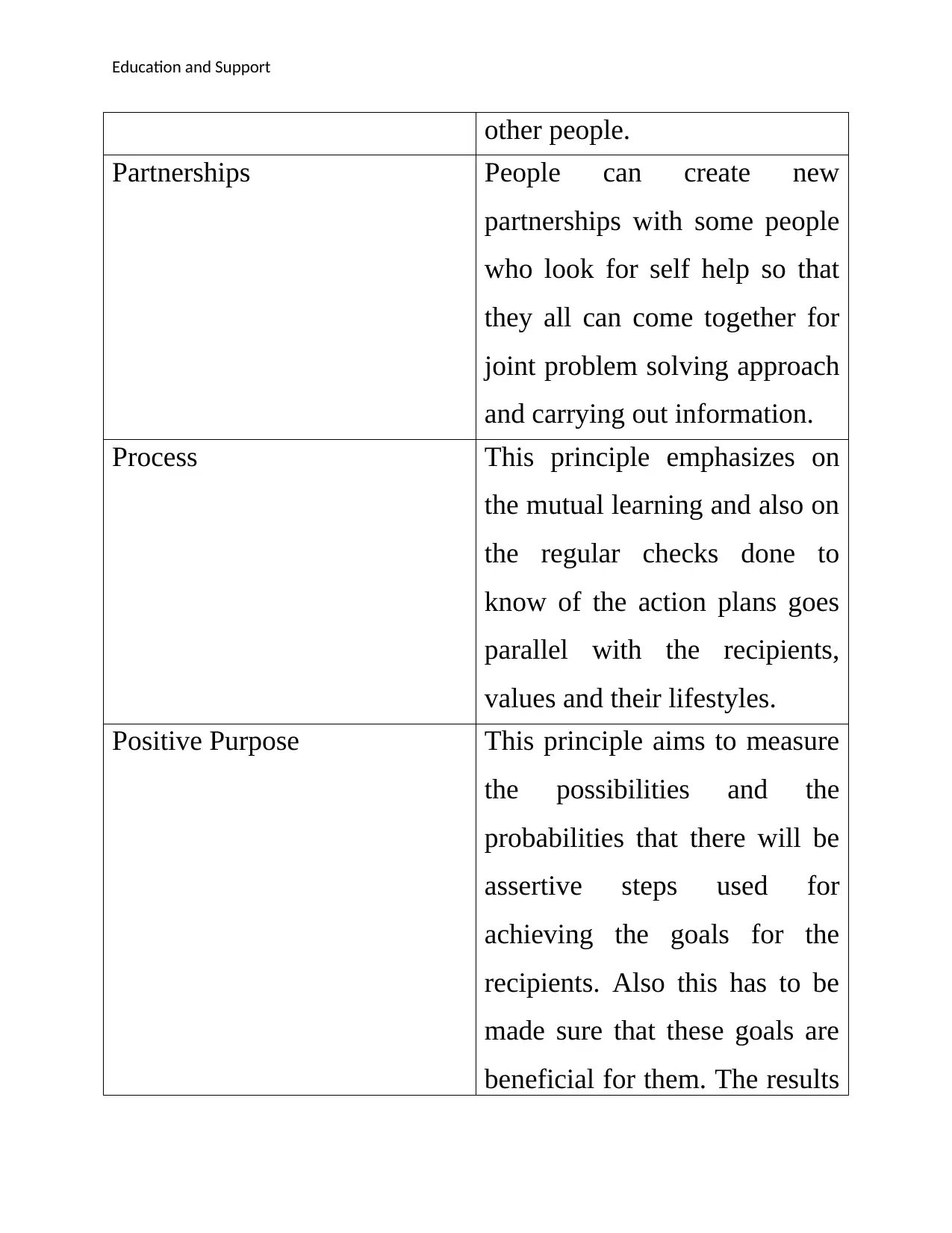
other people.
Partnerships People can create new
partnerships with some people
who look for self help so that
they all can come together for
joint problem solving approach
and carrying out information.
Process This principle emphasizes on
the mutual learning and also on
the regular checks done to
know of the action plans goes
parallel with the recipients,
values and their lifestyles.
Positive Purpose This principle aims to measure
the possibilities and the
probabilities that there will be
assertive steps used for
achieving the goals for the
recipients. Also this has to be
made sure that these goals are
beneficial for them. The results
other people.
Partnerships People can create new
partnerships with some people
who look for self help so that
they all can come together for
joint problem solving approach
and carrying out information.
Process This principle emphasizes on
the mutual learning and also on
the regular checks done to
know of the action plans goes
parallel with the recipients,
values and their lifestyles.
Positive Purpose This principle aims to measure
the possibilities and the
probabilities that there will be
assertive steps used for
achieving the goals for the
recipients. Also this has to be
made sure that these goals are
beneficial for them. The results
⊘ This is a preview!⊘
Do you want full access?
Subscribe today to unlock all pages.

Trusted by 1+ million students worldwide

Education and Support
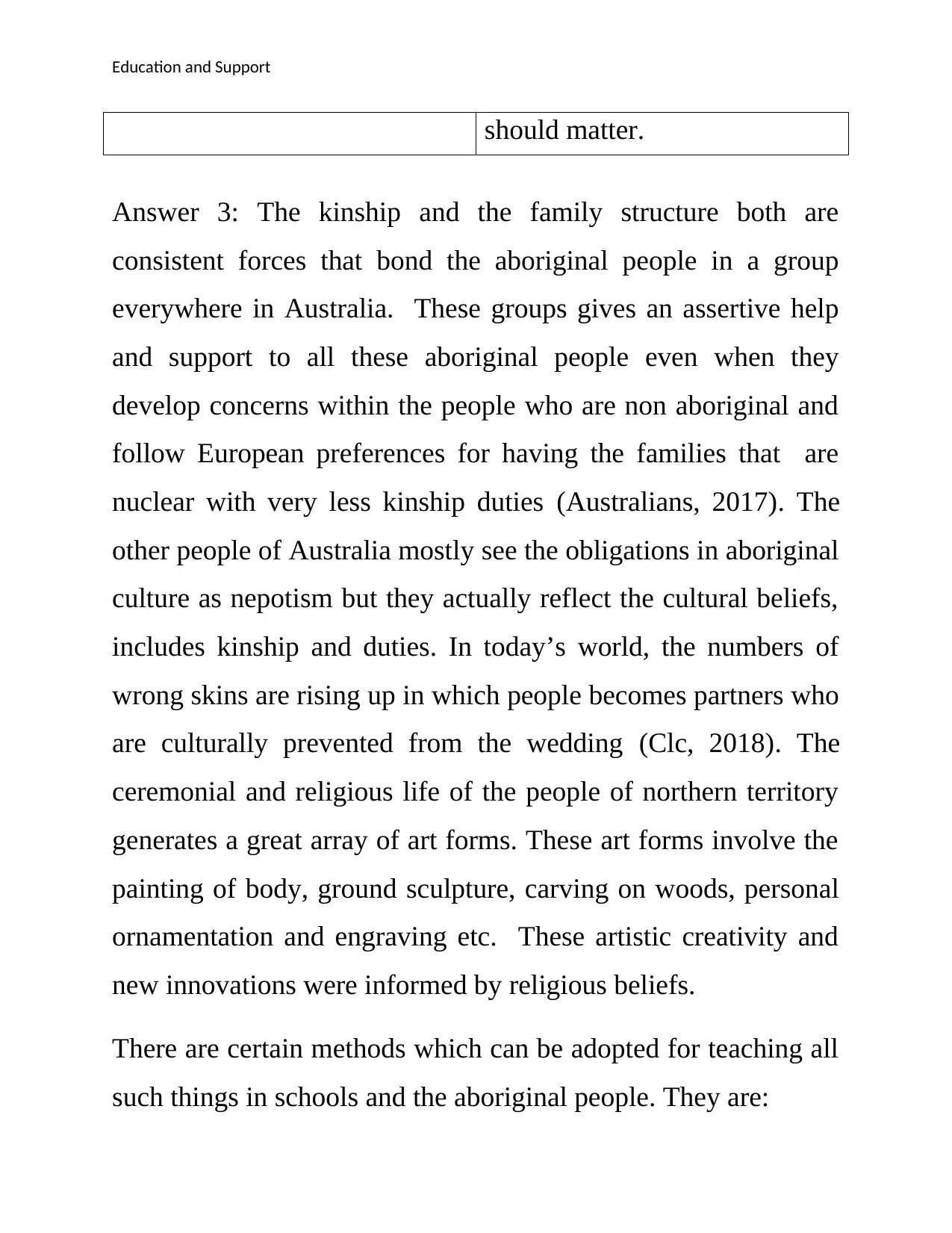
should matter.
Answer 3: The kinship and the family structure both are
consistent forces that bond the aboriginal people in a group
everywhere in Australia. These groups gives an assertive help
and support to all these aboriginal people even when they
develop concerns within the people who are non aboriginal and
follow European preferences for having the families that are
nuclear with very less kinship duties (Australians, 2017). The
other people of Australia mostly see the obligations in aboriginal
culture as nepotism but they actually reflect the cultural beliefs,
includes kinship and duties. In today’s world, the numbers of
wrong skins are rising up in which people becomes partners who
are culturally prevented from the wedding (Clc, 2018). The
ceremonial and religious life of the people of northern territory
generates a great array of art forms. These art forms involve the
painting of body, ground sculpture, carving on woods, personal
ornamentation and engraving etc. These artistic creativity and
new innovations were informed by religious beliefs.
There are certain methods which can be adopted for teaching all
such things in schools and the aboriginal people. They are:
should matter.
Answer 3: The kinship and the family structure both are
consistent forces that bond the aboriginal people in a group
everywhere in Australia. These groups gives an assertive help
and support to all these aboriginal people even when they
develop concerns within the people who are non aboriginal and
follow European preferences for having the families that are
nuclear with very less kinship duties (Australians, 2017). The
other people of Australia mostly see the obligations in aboriginal
culture as nepotism but they actually reflect the cultural beliefs,
includes kinship and duties. In today’s world, the numbers of
wrong skins are rising up in which people becomes partners who
are culturally prevented from the wedding (Clc, 2018). The
ceremonial and religious life of the people of northern territory
generates a great array of art forms. These art forms involve the
painting of body, ground sculpture, carving on woods, personal
ornamentation and engraving etc. These artistic creativity and
new innovations were informed by religious beliefs.
There are certain methods which can be adopted for teaching all
such things in schools and the aboriginal people. They are:
Paraphrase This Document
Need a fresh take? Get an instant paraphrase of this document with our AI Paraphraser

Education and Support
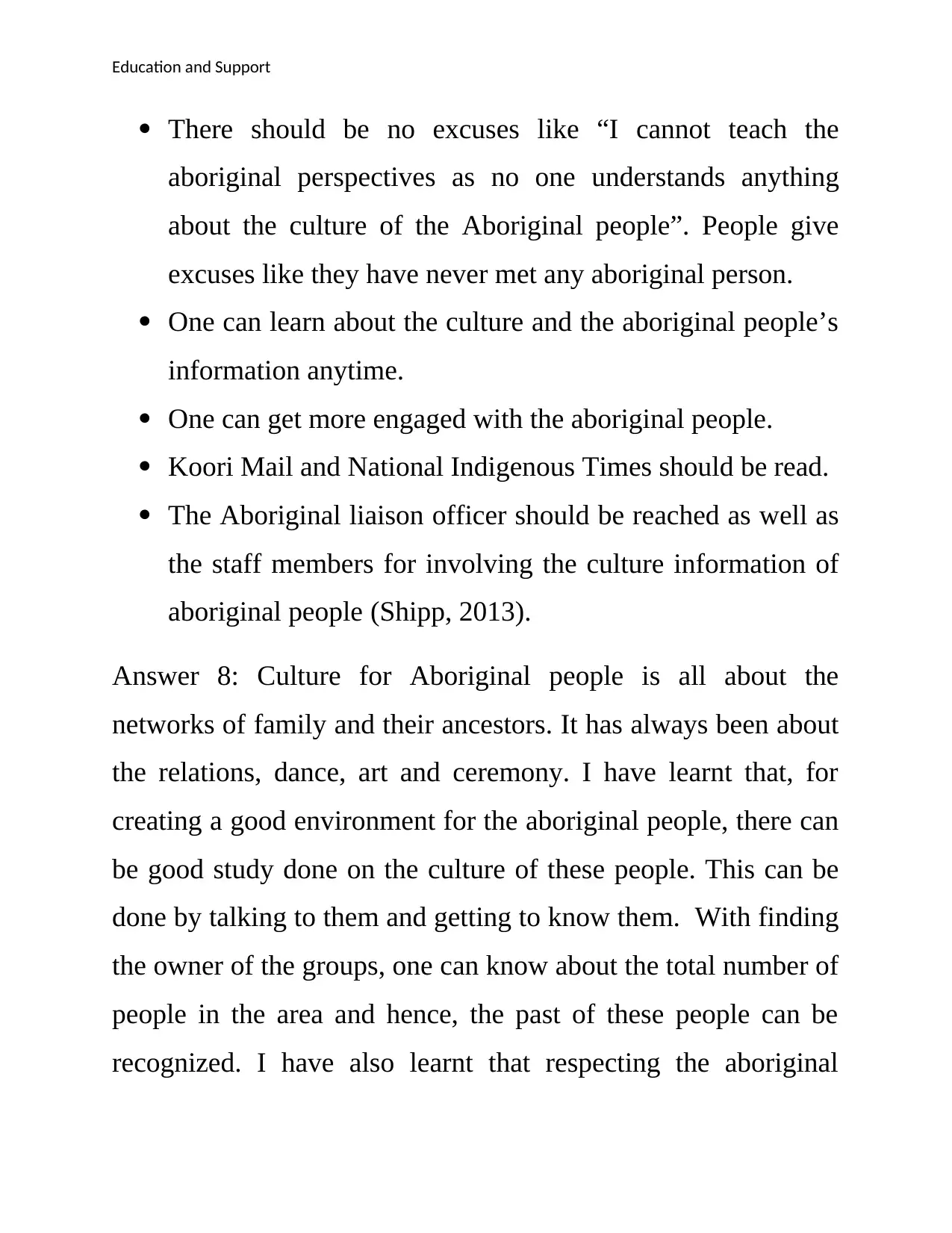
There should be no excuses like “I cannot teach the
aboriginal perspectives as no one understands anything
about the culture of the Aboriginal people”. People give
excuses like they have never met any aboriginal person.
One can learn about the culture and the aboriginal people’s
information anytime.
One can get more engaged with the aboriginal people.
Koori Mail and National Indigenous Times should be read.
The Aboriginal liaison officer should be reached as well as
the staff members for involving the culture information of
aboriginal people (Shipp, 2013).
Answer 8: Culture for Aboriginal people is all about the
networks of family and their ancestors. It has always been about
the relations, dance, art and ceremony. I have learnt that, for
creating a good environment for the aboriginal people, there can
be good study done on the culture of these people. This can be
done by talking to them and getting to know them. With finding
the owner of the groups, one can know about the total number of
people in the area and hence, the past of these people can be
recognized. I have also learnt that respecting the aboriginal
There should be no excuses like “I cannot teach the
aboriginal perspectives as no one understands anything
about the culture of the Aboriginal people”. People give
excuses like they have never met any aboriginal person.
One can learn about the culture and the aboriginal people’s
information anytime.
One can get more engaged with the aboriginal people.
Koori Mail and National Indigenous Times should be read.
The Aboriginal liaison officer should be reached as well as
the staff members for involving the culture information of
aboriginal people (Shipp, 2013).
Answer 8: Culture for Aboriginal people is all about the
networks of family and their ancestors. It has always been about
the relations, dance, art and ceremony. I have learnt that, for
creating a good environment for the aboriginal people, there can
be good study done on the culture of these people. This can be
done by talking to them and getting to know them. With finding
the owner of the groups, one can know about the total number of
people in the area and hence, the past of these people can be
recognized. I have also learnt that respecting the aboriginal

Education and Support
people’s culture would be the best thing to do to make them feel
safe (Ccyp, 2014). The five practices which can be used to
create a safe environment can be: Respecting their culture,
respecting them, know them from the core, give them equality
and treat them with dignity (Funston, 2013).
Answer 9a: There are some cultural safety strategies which
involves aboriginal people too. They are:
The achievement of balance in between the clinical
expertise and aboriginal knowledge about culture.
The cultural safety should be made universal at every
workplace.
There can be implementation of the cultural safety with the
accreditation of the health professional practices and
services.
The awareness should be spread for letting people know
about the significance of verbal and non verbal aboriginal
communication styles (Natsihwa, 2018).
Recognition should be given to the culture.
people’s culture would be the best thing to do to make them feel
safe (Ccyp, 2014). The five practices which can be used to
create a safe environment can be: Respecting their culture,
respecting them, know them from the core, give them equality
and treat them with dignity (Funston, 2013).
Answer 9a: There are some cultural safety strategies which
involves aboriginal people too. They are:
The achievement of balance in between the clinical
expertise and aboriginal knowledge about culture.
The cultural safety should be made universal at every
workplace.
There can be implementation of the cultural safety with the
accreditation of the health professional practices and
services.
The awareness should be spread for letting people know
about the significance of verbal and non verbal aboriginal
communication styles (Natsihwa, 2018).
Recognition should be given to the culture.
⊘ This is a preview!⊘
Do you want full access?
Subscribe today to unlock all pages.

Trusted by 1+ million students worldwide

Education and Support
Answer 10: There are a few things through which the schools
can make the connection with the aboriginal people as well as
include their participation in cultural safety as well. They are:
There should be new strategies made for the young people
and most of all children to improve adherence to the
principles and the laws.
There should be enhancement about the understanding of
the intention of the principles.
The links between the policies and the legislation should be
improved.
An early intervention and prevention support for the
families in the communities could be given.
Enhancement of the leadership should be done.
The participation and decision making of these aboriginal
and Indigenous people in protecting children always
matters. Hence, the decision making process should always
involve aboriginal people. Also before taking any decision,
their culture should be studied deeply for making the better
decisions.
Answer 10: There are a few things through which the schools
can make the connection with the aboriginal people as well as
include their participation in cultural safety as well. They are:
There should be new strategies made for the young people
and most of all children to improve adherence to the
principles and the laws.
There should be enhancement about the understanding of
the intention of the principles.
The links between the policies and the legislation should be
improved.
An early intervention and prevention support for the
families in the communities could be given.
Enhancement of the leadership should be done.
The participation and decision making of these aboriginal
and Indigenous people in protecting children always
matters. Hence, the decision making process should always
involve aboriginal people. Also before taking any decision,
their culture should be studied deeply for making the better
decisions.
Paraphrase This Document
Need a fresh take? Get an instant paraphrase of this document with our AI Paraphraser

Education and Support
New Recruitments and assessments should be done for
having better people in teams. If there would be people
who would know the culture of the aboriginal and
indigenous people from deep within, they will be able to
make others understand a little better. At the same time,
new people and new youth who feel that there should be
equality for each human being will be able to understand
the aboriginal and indigenous people in a much better way
as compared to other people (Aseron et al., 2013).
New Recruitments and assessments should be done for
having better people in teams. If there would be people
who would know the culture of the aboriginal and
indigenous people from deep within, they will be able to
make others understand a little better. At the same time,
new people and new youth who feel that there should be
equality for each human being will be able to understand
the aboriginal and indigenous people in a much better way
as compared to other people (Aseron et al., 2013).

Education and Support
References
Aseron, J., Miller, A. & Wilde, S., 2013. Cultural Safety Circles
And Indigenous Peoples’ Perspectives: Inclusive Practices For
Participation In Higher Education. Contemporary Issues In
Education Research, 6(4).
Australians, W.W.I., 2017. Culture: Family and Kinship.
[Online] Available at:
http://www.workingwithindigenousaustralians.info/content/Cult
ure_5_Family_and_Kinship.html [Accessed 1 November 2018].
Ccyp, 2014. Cultural safety for Aboriginal children. [Online]
Available at: https://ccyp.vic.gov.au/assets/resources/tipsheet-
cultural-safety-aboriginal-children.pdf [Accessed 1 November
2018].
Clc, 2018. Kinship and Skin Names. [Online] Available at:
https://www.clc.org.au/index.php?/articles/info/aboriginal-
kinship [Accessed 1 November 2018].
Ecdip, 2018. Culture Safety in Practice with Children, Families
and Communities. [Online] Available at:
References
Aseron, J., Miller, A. & Wilde, S., 2013. Cultural Safety Circles
And Indigenous Peoples’ Perspectives: Inclusive Practices For
Participation In Higher Education. Contemporary Issues In
Education Research, 6(4).
Australians, W.W.I., 2017. Culture: Family and Kinship.
[Online] Available at:
http://www.workingwithindigenousaustralians.info/content/Cult
ure_5_Family_and_Kinship.html [Accessed 1 November 2018].
Ccyp, 2014. Cultural safety for Aboriginal children. [Online]
Available at: https://ccyp.vic.gov.au/assets/resources/tipsheet-
cultural-safety-aboriginal-children.pdf [Accessed 1 November
2018].
Clc, 2018. Kinship and Skin Names. [Online] Available at:
https://www.clc.org.au/index.php?/articles/info/aboriginal-
kinship [Accessed 1 November 2018].
Ecdip, 2018. Culture Safety in Practice with Children, Families
and Communities. [Online] Available at:
⊘ This is a preview!⊘
Do you want full access?
Subscribe today to unlock all pages.

Trusted by 1+ million students worldwide

Education and Support
http://ecdip.org/culturalsafety/ [Accessed 2 November 2018].
Funston, L., 2013. Aboriginal and Torres Strait Islander
Worldviews and Cultural Safety Transforming Sexual Assault
Service Provision for Children and Young People. International
Journal of Environmental Research and Public Health, 10,
pp.3818-33.
Natsihwa, 2018. Cultural Safety Framework. [Online] Available
at: https://www.natsihwa.org.au/cultural-safety-framework
[Accessed 1 November 2018].
Shipp, C., 2013. Bringing Aboriginal and Torres Strait Islander
perspectives into the classroom: Why and how. Literacy
Learning: the Middle Years, 21(3).
http://ecdip.org/culturalsafety/ [Accessed 2 November 2018].
Funston, L., 2013. Aboriginal and Torres Strait Islander
Worldviews and Cultural Safety Transforming Sexual Assault
Service Provision for Children and Young People. International
Journal of Environmental Research and Public Health, 10,
pp.3818-33.
Natsihwa, 2018. Cultural Safety Framework. [Online] Available
at: https://www.natsihwa.org.au/cultural-safety-framework
[Accessed 1 November 2018].
Shipp, C., 2013. Bringing Aboriginal and Torres Strait Islander
perspectives into the classroom: Why and how. Literacy
Learning: the Middle Years, 21(3).
1 out of 10
Related Documents
Your All-in-One AI-Powered Toolkit for Academic Success.
+13062052269
info@desklib.com
Available 24*7 on WhatsApp / Email
Unlock your academic potential
Copyright © 2020–2026 A2Z Services. All Rights Reserved. Developed and managed by ZUCOL.