Ethical Analysis of Business Practices: Kellogg's Case Study - BM 401
VerifiedAdded on 2022/09/12
|4
|930
|67
Homework Assignment
AI Summary
This assignment examines ethical issues in business, focusing on the actions of Kellogg's in response to a controversy involving Breitbart News. The student analyzes the company's responsibility to society versus its shareholders, referencing Milton Friedman's shareholder theory and the importance of aligning actions with company values. The assignment explores the implications of ethical decision-making, the impact on consumers, and the long-term benefits of adhering to ethical practices. It also touches upon issues such as falsification of accounting books, discrimination, privacy issues and misuse of social media channels. The student argues that Kellogg's decision, though potentially leading to short-term losses, was a demonstration of its values, which would likely lead to long-term success. The assignment references various academic sources to support its arguments.
ETHICAL ISSUES IN BUSINESS
Name of Student
Institutional Affiliation
Name of Student
Institutional Affiliation
Paraphrase This Document
Need a fresh take? Get an instant paraphrase of this document with our AI Paraphraser

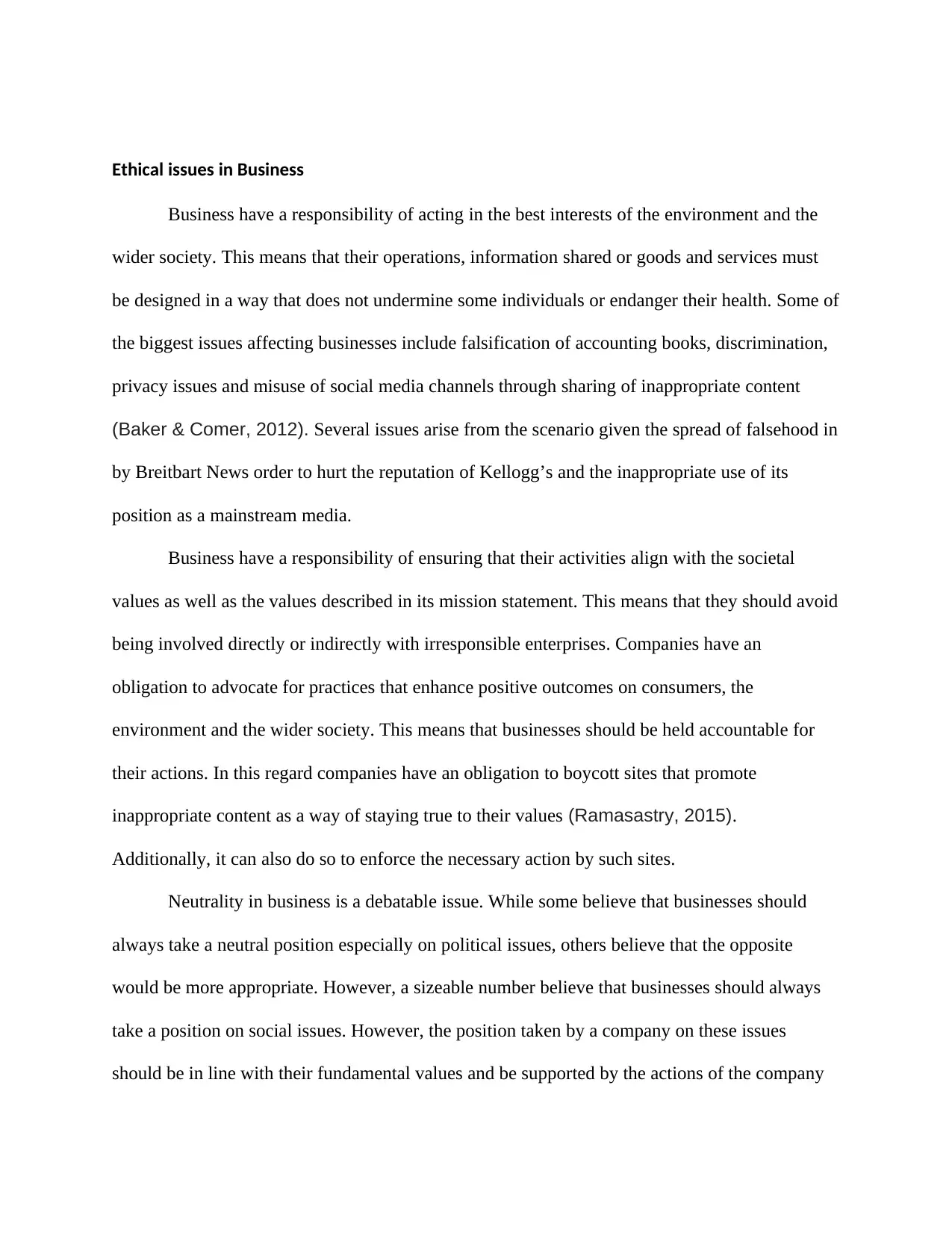
Ethical issues in Business
Business have a responsibility of acting in the best interests of the environment and the
wider society. This means that their operations, information shared or goods and services must
be designed in a way that does not undermine some individuals or endanger their health. Some of
the biggest issues affecting businesses include falsification of accounting books, discrimination,
privacy issues and misuse of social media channels through sharing of inappropriate content
(Baker & Comer, 2012). Several issues arise from the scenario given the spread of falsehood in
by Breitbart News order to hurt the reputation of Kellogg’s and the inappropriate use of its
position as a mainstream media.
Business have a responsibility of ensuring that their activities align with the societal
values as well as the values described in its mission statement. This means that they should avoid
being involved directly or indirectly with irresponsible enterprises. Companies have an
obligation to advocate for practices that enhance positive outcomes on consumers, the
environment and the wider society. This means that businesses should be held accountable for
their actions. In this regard companies have an obligation to boycott sites that promote
inappropriate content as a way of staying true to their values (Ramasastry, 2015).
Additionally, it can also do so to enforce the necessary action by such sites.
Neutrality in business is a debatable issue. While some believe that businesses should
always take a neutral position especially on political issues, others believe that the opposite
would be more appropriate. However, a sizeable number believe that businesses should always
take a position on social issues. However, the position taken by a company on these issues
should be in line with their fundamental values and be supported by the actions of the company
Business have a responsibility of acting in the best interests of the environment and the
wider society. This means that their operations, information shared or goods and services must
be designed in a way that does not undermine some individuals or endanger their health. Some of
the biggest issues affecting businesses include falsification of accounting books, discrimination,
privacy issues and misuse of social media channels through sharing of inappropriate content
(Baker & Comer, 2012). Several issues arise from the scenario given the spread of falsehood in
by Breitbart News order to hurt the reputation of Kellogg’s and the inappropriate use of its
position as a mainstream media.
Business have a responsibility of ensuring that their activities align with the societal
values as well as the values described in its mission statement. This means that they should avoid
being involved directly or indirectly with irresponsible enterprises. Companies have an
obligation to advocate for practices that enhance positive outcomes on consumers, the
environment and the wider society. This means that businesses should be held accountable for
their actions. In this regard companies have an obligation to boycott sites that promote
inappropriate content as a way of staying true to their values (Ramasastry, 2015).
Additionally, it can also do so to enforce the necessary action by such sites.
Neutrality in business is a debatable issue. While some believe that businesses should
always take a neutral position especially on political issues, others believe that the opposite
would be more appropriate. However, a sizeable number believe that businesses should always
take a position on social issues. However, the position taken by a company on these issues
should be in line with their fundamental values and be supported by the actions of the company

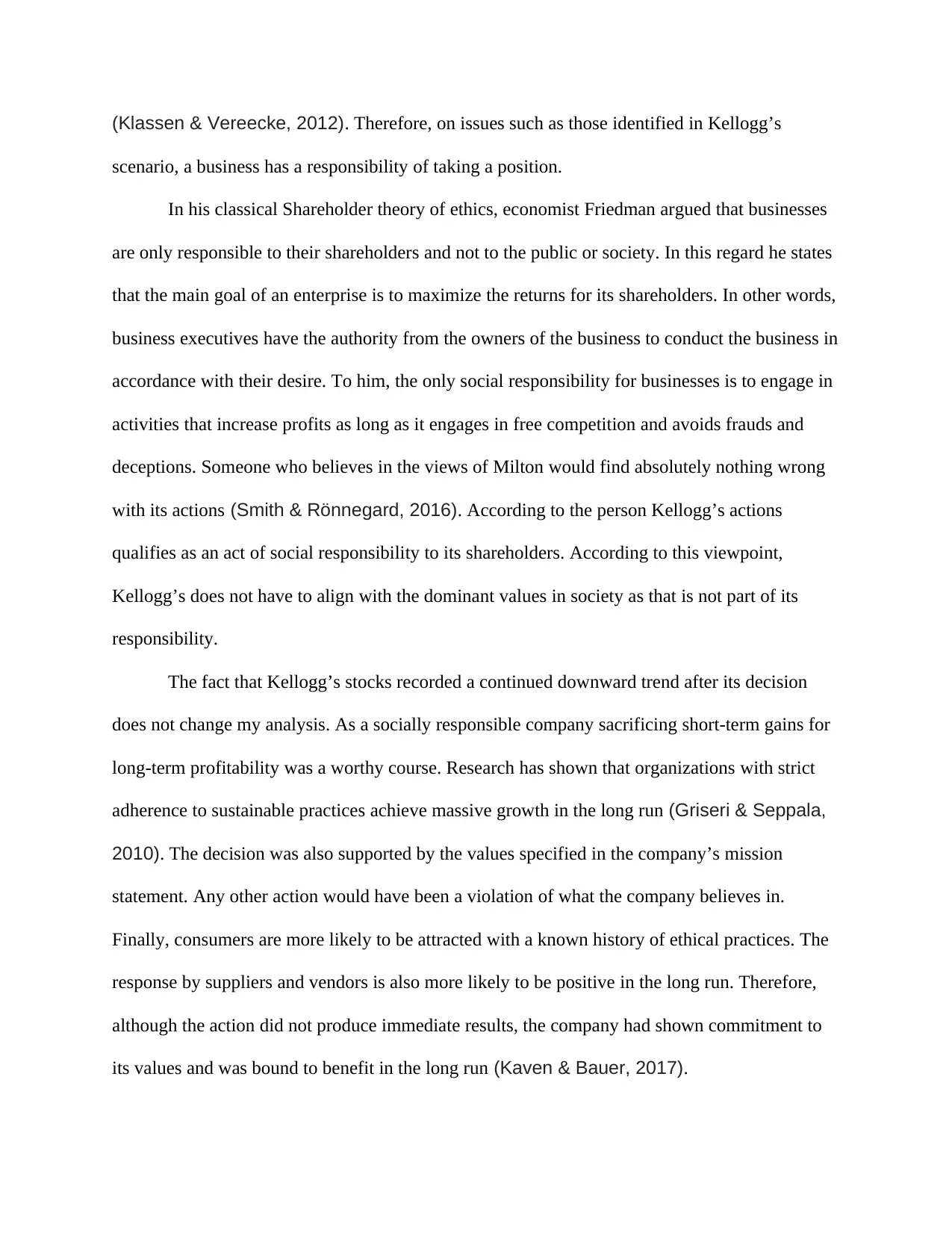
(Klassen & Vereecke, 2012). Therefore, on issues such as those identified in Kellogg’s
scenario, a business has a responsibility of taking a position.
In his classical Shareholder theory of ethics, economist Friedman argued that businesses
are only responsible to their shareholders and not to the public or society. In this regard he states
that the main goal of an enterprise is to maximize the returns for its shareholders. In other words,
business executives have the authority from the owners of the business to conduct the business in
accordance with their desire. To him, the only social responsibility for businesses is to engage in
activities that increase profits as long as it engages in free competition and avoids frauds and
deceptions. Someone who believes in the views of Milton would find absolutely nothing wrong
with its actions (Smith & Rönnegard, 2016). According to the person Kellogg’s actions
qualifies as an act of social responsibility to its shareholders. According to this viewpoint,
Kellogg’s does not have to align with the dominant values in society as that is not part of its
responsibility.
The fact that Kellogg’s stocks recorded a continued downward trend after its decision
does not change my analysis. As a socially responsible company sacrificing short-term gains for
long-term profitability was a worthy course. Research has shown that organizations with strict
adherence to sustainable practices achieve massive growth in the long run (Griseri & Seppala,
2010). The decision was also supported by the values specified in the company’s mission
statement. Any other action would have been a violation of what the company believes in.
Finally, consumers are more likely to be attracted with a known history of ethical practices. The
response by suppliers and vendors is also more likely to be positive in the long run. Therefore,
although the action did not produce immediate results, the company had shown commitment to
its values and was bound to benefit in the long run (Kaven & Bauer, 2017).
scenario, a business has a responsibility of taking a position.
In his classical Shareholder theory of ethics, economist Friedman argued that businesses
are only responsible to their shareholders and not to the public or society. In this regard he states
that the main goal of an enterprise is to maximize the returns for its shareholders. In other words,
business executives have the authority from the owners of the business to conduct the business in
accordance with their desire. To him, the only social responsibility for businesses is to engage in
activities that increase profits as long as it engages in free competition and avoids frauds and
deceptions. Someone who believes in the views of Milton would find absolutely nothing wrong
with its actions (Smith & Rönnegard, 2016). According to the person Kellogg’s actions
qualifies as an act of social responsibility to its shareholders. According to this viewpoint,
Kellogg’s does not have to align with the dominant values in society as that is not part of its
responsibility.
The fact that Kellogg’s stocks recorded a continued downward trend after its decision
does not change my analysis. As a socially responsible company sacrificing short-term gains for
long-term profitability was a worthy course. Research has shown that organizations with strict
adherence to sustainable practices achieve massive growth in the long run (Griseri & Seppala,
2010). The decision was also supported by the values specified in the company’s mission
statement. Any other action would have been a violation of what the company believes in.
Finally, consumers are more likely to be attracted with a known history of ethical practices. The
response by suppliers and vendors is also more likely to be positive in the long run. Therefore,
although the action did not produce immediate results, the company had shown commitment to
its values and was bound to benefit in the long run (Kaven & Bauer, 2017).
⊘ This is a preview!⊘
Do you want full access?
Subscribe today to unlock all pages.

Trusted by 1+ million students worldwide

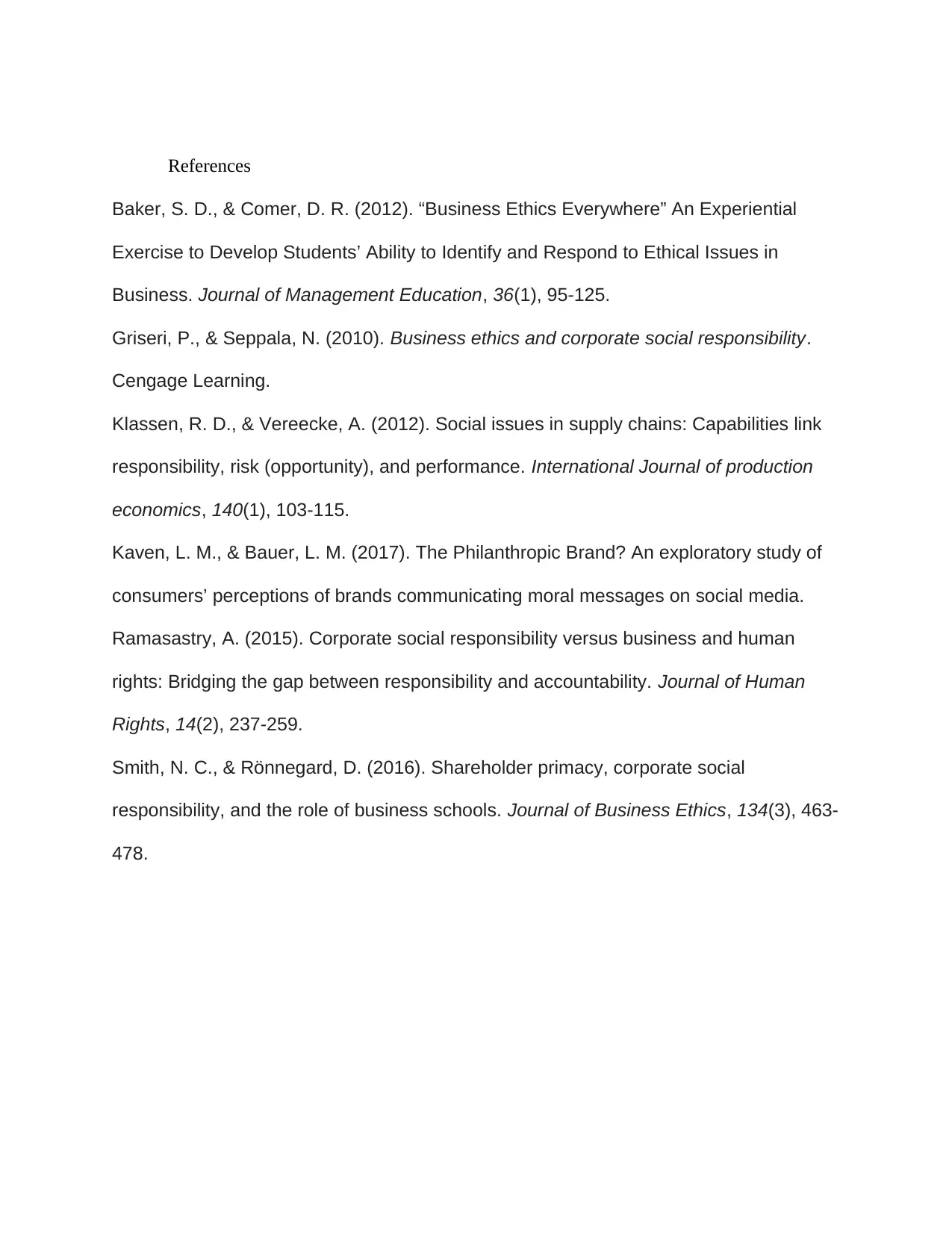
References
Baker, S. D., & Comer, D. R. (2012). “Business Ethics Everywhere” An Experiential
Exercise to Develop Students’ Ability to Identify and Respond to Ethical Issues in
Business. Journal of Management Education, 36(1), 95-125.
Griseri, P., & Seppala, N. (2010). Business ethics and corporate social responsibility.
Cengage Learning.
Klassen, R. D., & Vereecke, A. (2012). Social issues in supply chains: Capabilities link
responsibility, risk (opportunity), and performance. International Journal of production
economics, 140(1), 103-115.
Kaven, L. M., & Bauer, L. M. (2017). The Philanthropic Brand? An exploratory study of
consumers’ perceptions of brands communicating moral messages on social media.
Ramasastry, A. (2015). Corporate social responsibility versus business and human
rights: Bridging the gap between responsibility and accountability. Journal of Human
Rights, 14(2), 237-259.
Smith, N. C., & Rönnegard, D. (2016). Shareholder primacy, corporate social
responsibility, and the role of business schools. Journal of Business Ethics, 134(3), 463-
478.
Baker, S. D., & Comer, D. R. (2012). “Business Ethics Everywhere” An Experiential
Exercise to Develop Students’ Ability to Identify and Respond to Ethical Issues in
Business. Journal of Management Education, 36(1), 95-125.
Griseri, P., & Seppala, N. (2010). Business ethics and corporate social responsibility.
Cengage Learning.
Klassen, R. D., & Vereecke, A. (2012). Social issues in supply chains: Capabilities link
responsibility, risk (opportunity), and performance. International Journal of production
economics, 140(1), 103-115.
Kaven, L. M., & Bauer, L. M. (2017). The Philanthropic Brand? An exploratory study of
consumers’ perceptions of brands communicating moral messages on social media.
Ramasastry, A. (2015). Corporate social responsibility versus business and human
rights: Bridging the gap between responsibility and accountability. Journal of Human
Rights, 14(2), 237-259.
Smith, N. C., & Rönnegard, D. (2016). Shareholder primacy, corporate social
responsibility, and the role of business schools. Journal of Business Ethics, 134(3), 463-
478.
1 out of 4
Related Documents
Your All-in-One AI-Powered Toolkit for Academic Success.
+13062052269
info@desklib.com
Available 24*7 on WhatsApp / Email
Unlock your academic potential
Copyright © 2020–2026 A2Z Services. All Rights Reserved. Developed and managed by ZUCOL.