Research Proposal: Starbucks Coffee Price Impact in New Zealand
VerifiedAdded on 2022/09/16
|12
|2792
|21
Report
AI Summary
This research proposal investigates the dependence of price on beverage purchases at Starbucks Coffee in New Zealand. The study aims to determine if the price of Starbucks products influences customer purchasing behavior. The research will explore consumer behavior, pricing strategies (penetration and niche pricing), and the role of price as a key factor in purchase decisions. The methodology includes both primary and secondary data collection, utilizing surveys, interviews, and literature reviews. The research will employ both qualitative and quantitative analysis methods. The proposal outlines research questions, assumptions, and ethical considerations, providing a comprehensive framework for examining the impact of price on consumer behavior within the context of Starbucks Coffee in the New Zealand market. The study aims to provide insights into factors affecting customer purchase decisions, considering both price and other influencing factors.
Running head: RESEARCH PROPOSAL
Research Proposal
Starbucks Coffee: The dependence of price of beverage purchases in New Zealand
Name of the Student
Name of the University
Author Notes:
Research Proposal
Starbucks Coffee: The dependence of price of beverage purchases in New Zealand
Name of the Student
Name of the University
Author Notes:

Paraphrase This Document
Need a fresh take? Get an instant paraphrase of this document with our AI Paraphraser
1RESEARCH PROPOSAL
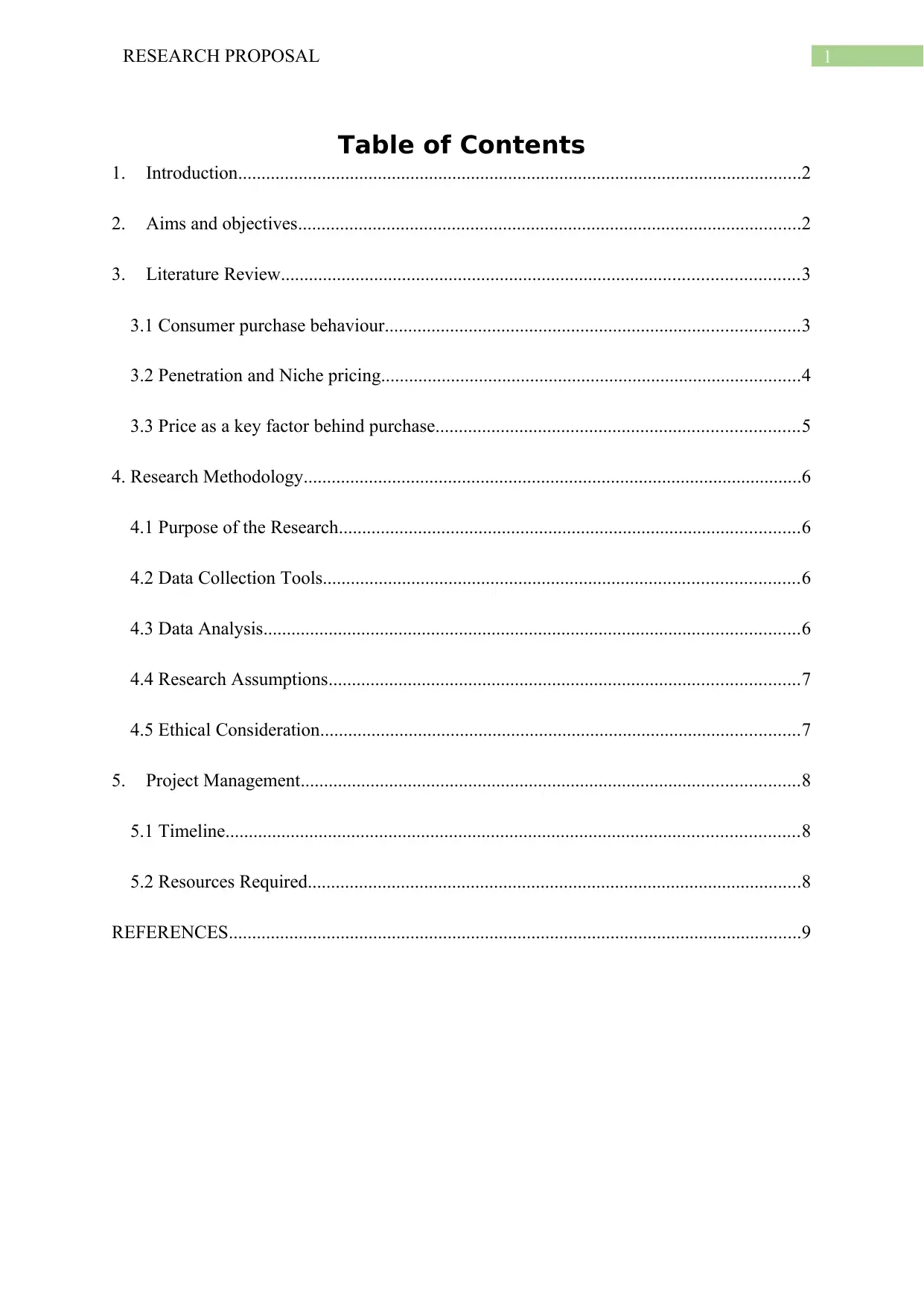
Table of Contents
1. Introduction.........................................................................................................................2
2. Aims and objectives............................................................................................................2
3. Literature Review...............................................................................................................3
3.1 Consumer purchase behaviour.........................................................................................3
3.2 Penetration and Niche pricing..........................................................................................4
3.3 Price as a key factor behind purchase..............................................................................5
4. Research Methodology...........................................................................................................6
4.1 Purpose of the Research...................................................................................................6
4.2 Data Collection Tools......................................................................................................6
4.3 Data Analysis...................................................................................................................6
4.4 Research Assumptions.....................................................................................................7
4.5 Ethical Consideration.......................................................................................................7
5. Project Management...........................................................................................................8
5.1 Timeline...........................................................................................................................8
5.2 Resources Required..........................................................................................................8
REFERENCES...........................................................................................................................9
Table of Contents
1. Introduction.........................................................................................................................2
2. Aims and objectives............................................................................................................2
3. Literature Review...............................................................................................................3
3.1 Consumer purchase behaviour.........................................................................................3
3.2 Penetration and Niche pricing..........................................................................................4
3.3 Price as a key factor behind purchase..............................................................................5
4. Research Methodology...........................................................................................................6
4.1 Purpose of the Research...................................................................................................6
4.2 Data Collection Tools......................................................................................................6
4.3 Data Analysis...................................................................................................................6
4.4 Research Assumptions.....................................................................................................7
4.5 Ethical Consideration.......................................................................................................7
5. Project Management...........................................................................................................8
5.1 Timeline...........................................................................................................................8
5.2 Resources Required..........................................................................................................8
REFERENCES...........................................................................................................................9
2RESEARCH PROPOSAL
1. Introduction
Starbuck Coffee is a brand that has been recognized as a company that offers highly
graded coffee throughout the world. The coffee offered by the company has gained popularity
due to the high-quality quotient associated to the coffee that is produced by the company
(Azriuddin et al., 2020). Regardless of the popularity of the company and the coffee-based
beverages offered by the company are deemed to be overpriced for the masses. Even, if the
company offered by the company are couple with high quality, the pricing strategy adopted
by the company is a little too high for the masses. Hence, a research is being conducted to test
the dependence of price of beverage purchases in New Zealand. Starbuck coffee will be the
beverage offering company that will be referred to in the study which will be supported by a
research methodology and literature review once the aims and objectives have been
developed.
2. Aims and objectives
The aim of the study is to identify whether price of the products and services offered
at Starbucks Coffee is affecting customer purchaser behavior. The research variables have
been identified. The dependent variable has been identified as the customer purchase
behavior and the independent variable for the said study has been identified as the price of the
products that are offered at Starbucks. The following section will state the research questions
and align them with the objectives of the research, thus, communicating the direction of the
research.
Following are the research questions and the objectives aligned to the research questions;
Q1. Do Starbuck Coffee customer consider the price while making purchase? To identify
whether price of the beverages is something considered by the customers in Starbucks
Coffee.
1. Introduction
Starbuck Coffee is a brand that has been recognized as a company that offers highly
graded coffee throughout the world. The coffee offered by the company has gained popularity
due to the high-quality quotient associated to the coffee that is produced by the company
(Azriuddin et al., 2020). Regardless of the popularity of the company and the coffee-based
beverages offered by the company are deemed to be overpriced for the masses. Even, if the
company offered by the company are couple with high quality, the pricing strategy adopted
by the company is a little too high for the masses. Hence, a research is being conducted to test
the dependence of price of beverage purchases in New Zealand. Starbuck coffee will be the
beverage offering company that will be referred to in the study which will be supported by a
research methodology and literature review once the aims and objectives have been
developed.
2. Aims and objectives
The aim of the study is to identify whether price of the products and services offered
at Starbucks Coffee is affecting customer purchaser behavior. The research variables have
been identified. The dependent variable has been identified as the customer purchase
behavior and the independent variable for the said study has been identified as the price of the
products that are offered at Starbucks. The following section will state the research questions
and align them with the objectives of the research, thus, communicating the direction of the
research.
Following are the research questions and the objectives aligned to the research questions;
Q1. Do Starbuck Coffee customer consider the price while making purchase? To identify
whether price of the beverages is something considered by the customers in Starbucks
Coffee.
⊘ This is a preview!⊘
Do you want full access?
Subscribe today to unlock all pages.

Trusted by 1+ million students worldwide
3RESEARCH PROPOSAL
Q2. Do people think visiting status will increase their niche quotient? To understand whether
people visiting Starbucks think of visiting Starbuck as a status Symbol?
Q3: Are the products at Starbuck coffee offered in higher than fair prices? Developing ideas
regarding the feasibility or pricing at Starbucks Coffee.
Q4: What are the factors the people consider before purchasing beverages at Starbucks
Coffee? Identifying factors considered before making a purchase at Starbucks.
3. Literature Review
There are various sources of incubation of understanding that can be used to
supported the objectives of the research. The relationship between price and consumers
purchase behaviour of beverages will be discussed in the following sections. The factors that
directly determines the purchase behaviour along with the related factors will be discussed in
the following sections.
3.1 Consumer purchase behaviour
There are certain characteristics that a consumer shows while they are pictured with
an array of products in the market that they belong to (Moon & Kamakura, 2017). There are
products offered by the various companies who aim to increase the turnover with the help of
tactics that can help in turning prospective consumers into real customers. The tactics that are
practiced by the companies to gain effectiveness in conversation of prospective customers to
actual customers. According to McDonald and Wilson (2016), strategies such as product
development, pricing related marketing strategy, various promotional activities and others are
carried out in order to bolster the competency of the company on generating revenue with the
help of favourable attitudes and behaviour from the part of the consumers of a particular
market. Hence, it can be said that it is must be effectively analysed by marketers of
companies.
Q2. Do people think visiting status will increase their niche quotient? To understand whether
people visiting Starbucks think of visiting Starbuck as a status Symbol?
Q3: Are the products at Starbuck coffee offered in higher than fair prices? Developing ideas
regarding the feasibility or pricing at Starbucks Coffee.
Q4: What are the factors the people consider before purchasing beverages at Starbucks
Coffee? Identifying factors considered before making a purchase at Starbucks.
3. Literature Review
There are various sources of incubation of understanding that can be used to
supported the objectives of the research. The relationship between price and consumers
purchase behaviour of beverages will be discussed in the following sections. The factors that
directly determines the purchase behaviour along with the related factors will be discussed in
the following sections.
3.1 Consumer purchase behaviour
There are certain characteristics that a consumer shows while they are pictured with
an array of products in the market that they belong to (Moon & Kamakura, 2017). There are
products offered by the various companies who aim to increase the turnover with the help of
tactics that can help in turning prospective consumers into real customers. The tactics that are
practiced by the companies to gain effectiveness in conversation of prospective customers to
actual customers. According to McDonald and Wilson (2016), strategies such as product
development, pricing related marketing strategy, various promotional activities and others are
carried out in order to bolster the competency of the company on generating revenue with the
help of favourable attitudes and behaviour from the part of the consumers of a particular
market. Hence, it can be said that it is must be effectively analysed by marketers of
companies.
Paraphrase This Document
Need a fresh take? Get an instant paraphrase of this document with our AI Paraphraser
4RESEARCH PROPOSAL
As stated by Nisar & Prabhakar (2017), consumers behaviour can be determined with
the help of factors such as the needs that the product or service is fulfilling the needs, the
prices at which the products are being offered, promotional tactics that are used by companies
in communicating the value proposition of the products to the customers. Furthermore, there
exists factors such as the income of the consumer, the influence of family and friends in the
process of purchasing the products (Nisar & Prabhakar, 2017). These are some of the key
factors that determine the ultimate purchase behaviour of the consumer regarding certain
products offered by certain companies. Hence, consumer purchase behaviour is an important
aspect of consumer behaviour.
3.2 Penetration and Niche pricing
The pricing strategy that is adopted by a company is the part of the operational
activities of the organization and it determines the price at which certain goods and services
would be offered by the company in the market (Kumar, Lahiri & Dogan, 2018). Hence, a
company must carry out research in order to come up with the most appropriate type of
pricing strategy with the help of which the company can generate turnover by capitalising on
the consumers that they have been able to convert.
In the words of Krämer et al., (2017), penetration pricing refers to extremely
aggressive pricing carried out by an organisation. In penetration pricing, the prices of the
products are as low as possible so that the products can be afforded by anyone in the market
(Keegan, 2017). By achieving a state of being able to be purchased by anyone, products
offered at penetration pricing receive mass market capability. Now, the products offered at
penetration price can be offered by the masses, increasing the chances of conversion of
potential consumers to actual consumers. On the other hand, niche pricing is the exact
opposite of penetration pricing. While prices are reduced to the lowest possible extent in
penetration pricing, niche pricing is characterised by elevating the price of product or service
As stated by Nisar & Prabhakar (2017), consumers behaviour can be determined with
the help of factors such as the needs that the product or service is fulfilling the needs, the
prices at which the products are being offered, promotional tactics that are used by companies
in communicating the value proposition of the products to the customers. Furthermore, there
exists factors such as the income of the consumer, the influence of family and friends in the
process of purchasing the products (Nisar & Prabhakar, 2017). These are some of the key
factors that determine the ultimate purchase behaviour of the consumer regarding certain
products offered by certain companies. Hence, consumer purchase behaviour is an important
aspect of consumer behaviour.
3.2 Penetration and Niche pricing
The pricing strategy that is adopted by a company is the part of the operational
activities of the organization and it determines the price at which certain goods and services
would be offered by the company in the market (Kumar, Lahiri & Dogan, 2018). Hence, a
company must carry out research in order to come up with the most appropriate type of
pricing strategy with the help of which the company can generate turnover by capitalising on
the consumers that they have been able to convert.
In the words of Krämer et al., (2017), penetration pricing refers to extremely
aggressive pricing carried out by an organisation. In penetration pricing, the prices of the
products are as low as possible so that the products can be afforded by anyone in the market
(Keegan, 2017). By achieving a state of being able to be purchased by anyone, products
offered at penetration pricing receive mass market capability. Now, the products offered at
penetration price can be offered by the masses, increasing the chances of conversion of
potential consumers to actual consumers. On the other hand, niche pricing is the exact
opposite of penetration pricing. While prices are reduced to the lowest possible extent in
penetration pricing, niche pricing is characterised by elevating the price of product or service
5RESEARCH PROPOSAL
offerings to the ceiling (Filippas, & Gramstad, 2016). In penetration pricing, it is the key
motive of the organisation to be able to be approachable by the masses, but niche pricing is
characterised by high price only to promote the exclusive quotient of the product. Niche
pricing tends to eliminate the masses and aims be consumable just by the niche market
(Bertozzi et al., 2016). It is the motive of companies carrying out Niche pricing to maximize
consumption from the creme of the market. Products that are considered luxurious and that
have supreme quality are coupled with niche prices (Ohri & Sharma, 2018). Niche prices not
only set the luxury quotient of the products and services offered at such high prices but it also
gives the companies a cost advantage with the help of which they can maximize the revenue
that they are earning while part of the market.
3.3 Price as a key factor behind purchase
There are various factors that affect the ultimate purchase decision of a particular
individual. There might be some factors that are applicable to one individual and other factors
that are applicable to other individuals. However, price is a factor that is taken into
consideration regardless of the economic capability of an individual. Chernev (2018), states
price as the value for which a product is offered in a market. It is the return that a company is
subject to and it’s it the cost that a customer has to pay when he or she opts for a particular
product. The price for different items can vary depend on the age, ownership or the unique
value proposition associated with the item (Metallo et al., 2018). Unique value proposition
refers to the unique value that is provided by a particular product of service (Dingus &
Milovic, 2019). On various cases it is the unique value proposition of a product or service
that determines the effectiveness of acceptance and reception of the products or services in
the market.
While price elasticity of demand refers to the responsiveness of an individual to the
price of a product, income electricity refers to the degree of responsiveness of one's income
offerings to the ceiling (Filippas, & Gramstad, 2016). In penetration pricing, it is the key
motive of the organisation to be able to be approachable by the masses, but niche pricing is
characterised by high price only to promote the exclusive quotient of the product. Niche
pricing tends to eliminate the masses and aims be consumable just by the niche market
(Bertozzi et al., 2016). It is the motive of companies carrying out Niche pricing to maximize
consumption from the creme of the market. Products that are considered luxurious and that
have supreme quality are coupled with niche prices (Ohri & Sharma, 2018). Niche prices not
only set the luxury quotient of the products and services offered at such high prices but it also
gives the companies a cost advantage with the help of which they can maximize the revenue
that they are earning while part of the market.
3.3 Price as a key factor behind purchase
There are various factors that affect the ultimate purchase decision of a particular
individual. There might be some factors that are applicable to one individual and other factors
that are applicable to other individuals. However, price is a factor that is taken into
consideration regardless of the economic capability of an individual. Chernev (2018), states
price as the value for which a product is offered in a market. It is the return that a company is
subject to and it’s it the cost that a customer has to pay when he or she opts for a particular
product. The price for different items can vary depend on the age, ownership or the unique
value proposition associated with the item (Metallo et al., 2018). Unique value proposition
refers to the unique value that is provided by a particular product of service (Dingus &
Milovic, 2019). On various cases it is the unique value proposition of a product or service
that determines the effectiveness of acceptance and reception of the products or services in
the market.
While price elasticity of demand refers to the responsiveness of an individual to the
price of a product, income electricity refers to the degree of responsiveness of one's income
⊘ This is a preview!⊘
Do you want full access?
Subscribe today to unlock all pages.
Trusted by 1+ million students worldwide
6RESEARCH PROPOSAL
in their purchase behaviours (Rassenfosse, 2020). Just as price of a product, income also has
a significant effect on the purchase behaviour of consumers. People are likely to overlook
certain items that do not permit their wallet. This is also applicable when it comes to the price
of products. The purchase decision of a customer depends on the price at which the products
are offered. Hence, regardless of other factors that affect the purchase decision of an
individual, the price is a constant factor that influences the purchase. Even if the product or
service is categorised as niche, price plays a dominant role.
4. Research Methodology
4.1 Purpose of the Research
The particular research purpose is Descriptive and Explanatory. The research will
provide detailed descriptions of concepts and theories to assist in development of proper
understanding in the regarding the scope of the research. The research will be based on the
theory of interpretivism which is a theory that helps in developing understanding based on
interpretations. It should be noted that interpretations can be differently based on the
perception and the purview of the researcher.
4.2 Data Collection Tools
The proposed research will be using both primary and secondary data to satiate the
needs of the research. Secondary sources that will be used are scholarly papers, such as peer
reviewed journals, online databases and authentic scholarly sources. The primary data to be
used for the purpose of the research is data from surveys. Data from personal interviews with
store managers and servers at Starbuck Coffee and questionnaire survey with the customers at
Starbucks Coffee will be the sources of primary data. Furthermore, qualitative and
quantitative data are being used to comply with the needs of the research. Quantitative data
will be obtained by analysis of secondary data such as theories and purview of different
in their purchase behaviours (Rassenfosse, 2020). Just as price of a product, income also has
a significant effect on the purchase behaviour of consumers. People are likely to overlook
certain items that do not permit their wallet. This is also applicable when it comes to the price
of products. The purchase decision of a customer depends on the price at which the products
are offered. Hence, regardless of other factors that affect the purchase decision of an
individual, the price is a constant factor that influences the purchase. Even if the product or
service is categorised as niche, price plays a dominant role.
4. Research Methodology
4.1 Purpose of the Research
The particular research purpose is Descriptive and Explanatory. The research will
provide detailed descriptions of concepts and theories to assist in development of proper
understanding in the regarding the scope of the research. The research will be based on the
theory of interpretivism which is a theory that helps in developing understanding based on
interpretations. It should be noted that interpretations can be differently based on the
perception and the purview of the researcher.
4.2 Data Collection Tools
The proposed research will be using both primary and secondary data to satiate the
needs of the research. Secondary sources that will be used are scholarly papers, such as peer
reviewed journals, online databases and authentic scholarly sources. The primary data to be
used for the purpose of the research is data from surveys. Data from personal interviews with
store managers and servers at Starbuck Coffee and questionnaire survey with the customers at
Starbucks Coffee will be the sources of primary data. Furthermore, qualitative and
quantitative data are being used to comply with the needs of the research. Quantitative data
will be obtained by analysis of secondary data such as theories and purview of different
Paraphrase This Document
Need a fresh take? Get an instant paraphrase of this document with our AI Paraphraser
7RESEARCH PROPOSAL
scholars or field practitioners along with analysis of the interviews that will be conducted at
Starbucks.
4.3 Data Analysis
Quantitative data to be used for the purpose of the research will be carried out with
the help of simple random sampling. The data obtained from the survey will be compiled into
data sheet using MS Excel. The data would be presented in the form of tables, graphs and pie
charts apart from written explanation that will be provided in the findings section. As
mentioned, the before, the qualitive analysis will be carried out with the help of
interpretivism. Moreover, theories of positivism and realism will be also be used to analyze
and compile qualitative data. The data for quantitative data will be obtained with the help of
the Likert Scale in which the respondents would provide their insights in accordance with
their personal beliefs and perceptions. The sample size for the said survey would be 150. The
sample size of the interviews would be 6.
4.4 Research Assumptions
Following are the assumptions that are being made in accordance with the said
research;
1. The respondents taking part in the research will not misinterpret the questions. The latter
would be informed that the questions would be explained to them if they have any
difficulty.
2. The limitation of the research is the limited finances. If there was a little more financial
support, people could have been hired and dispersed throughout the country to get a
complete overview of the scenario existing in New Zealand as a whole.
scholars or field practitioners along with analysis of the interviews that will be conducted at
Starbucks.
4.3 Data Analysis
Quantitative data to be used for the purpose of the research will be carried out with
the help of simple random sampling. The data obtained from the survey will be compiled into
data sheet using MS Excel. The data would be presented in the form of tables, graphs and pie
charts apart from written explanation that will be provided in the findings section. As
mentioned, the before, the qualitive analysis will be carried out with the help of
interpretivism. Moreover, theories of positivism and realism will be also be used to analyze
and compile qualitative data. The data for quantitative data will be obtained with the help of
the Likert Scale in which the respondents would provide their insights in accordance with
their personal beliefs and perceptions. The sample size for the said survey would be 150. The
sample size of the interviews would be 6.
4.4 Research Assumptions
Following are the assumptions that are being made in accordance with the said
research;
1. The respondents taking part in the research will not misinterpret the questions. The latter
would be informed that the questions would be explained to them if they have any
difficulty.
2. The limitation of the research is the limited finances. If there was a little more financial
support, people could have been hired and dispersed throughout the country to get a
complete overview of the scenario existing in New Zealand as a whole.
8RESEARCH PROPOSAL
4.5 Ethical Consideration
Ethical actions have been prioritized while the study is being carried out. The research
will be conducted with full consent of all the parties associated to the research. All the
sources that have been used in the research will be cited and it will be ensured that the
research is avoiding unethical activities such as plagiarism. Furthermore, the use of paper will
be limited for the said study as a result of the need for conservation of the environment in the
form of such small considerations.
5. Project Management
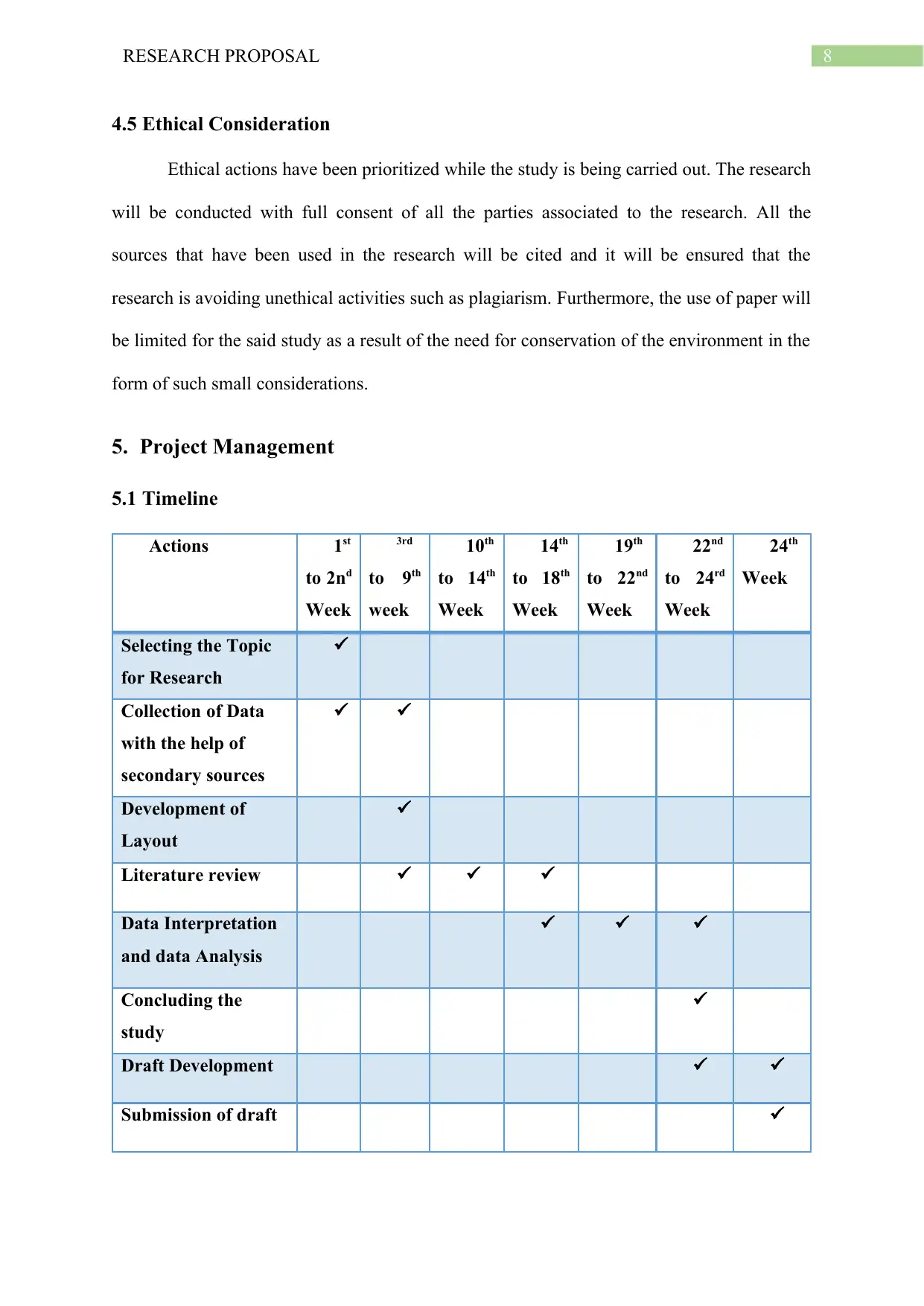
5.1 Timeline
Actions 1st
to 2nd
Week
3rd
to 9th
week
10th
to 14th
Week
14th
to 18th
Week
19th
to 22nd
Week
22nd
to 24rd
Week
24th
Week
Selecting the Topic
for Research
Collection of Data
with the help of
secondary sources
Development of
Layout
Literature review
Data Interpretation
and data Analysis
Concluding the
study
Draft Development
Submission of draft
4.5 Ethical Consideration
Ethical actions have been prioritized while the study is being carried out. The research
will be conducted with full consent of all the parties associated to the research. All the
sources that have been used in the research will be cited and it will be ensured that the
research is avoiding unethical activities such as plagiarism. Furthermore, the use of paper will
be limited for the said study as a result of the need for conservation of the environment in the
form of such small considerations.
5. Project Management
5.1 Timeline
Actions 1st
to 2nd
Week
3rd
to 9th
week
10th
to 14th
Week
14th
to 18th
Week
19th
to 22nd
Week
22nd
to 24rd
Week
24th
Week
Selecting the Topic
for Research
Collection of Data
with the help of
secondary sources
Development of
Layout
Literature review
Data Interpretation
and data Analysis
Concluding the
study
Draft Development
Submission of draft
⊘ This is a preview!⊘
Do you want full access?
Subscribe today to unlock all pages.
Trusted by 1+ million students worldwide

9RESEARCH PROPOSAL
5.2 Resources Required
i. Capital
ii. Tablets, Laptops and Smartphones
iii. 4G Internet connectivity
iv. Microsoft Office Software: MS Word, MS Excel, etc.
v. Offline and online Library Access.
5.2 Resources Required
i. Capital
ii. Tablets, Laptops and Smartphones
iii. 4G Internet connectivity
iv. Microsoft Office Software: MS Word, MS Excel, etc.
v. Offline and online Library Access.
Paraphrase This Document
Need a fresh take? Get an instant paraphrase of this document with our AI Paraphraser
10RESEARCH PROPOSAL
REFERENCES
Azriuddin, M., Kee, D. M. H., Hafizzudin, M., Fitri, M., Zakwan, M. A., AlSanousi, D., ... &
Kurniawan, O. (2020). Becoming an International Brand: A Case Study of
Starbucks. Journal of the community development in Asia, 3(1), 33-43.
Bertozzi, T. E. R. R. Y., Lee, M. S., & Donnellan, S. C. (2016). Stingray diversification
across the end-Cretaceous extinctions. Memoirs of Museum Victoria, 74, 379-390.
Chernev, A. (2018). Strategic marketing management. Cerebellum Press.
de Rassenfosse, G. (2020). On the price elasticity of demand for trademarks. Industry and
Innovation, 27(1-2), 11-24.
Dingus, R., & Milovic, A. (2019). SOMETHING OF VALUE: A VALUE PROPOSITION
EXERCISE FOR THE MARKETING CLASSROOM. Marketing Education
Review, 29(2), 119-124.
Filippas, A., & Gramstad, A. R. (2016). A model of pricing in the Sharing Economy: pricing
dynamics with awareness-generating adoptions.
Keegan, W. J. (2017). Global marketing management. Pearson India.
Krämer, F., Schmidt, K. M., Spann, M., & Stich, L. (2017). Delegating pricing power to
customers: Pay what you want or name your own price?. Journal of Economic
Behavior & Organization, 136, 125-140.
Kumar, V., Lahiri, A., & Dogan, O. B. (2018). A strategic framework for a profitable
business model in the sharing economy. Industrial Marketing Management, 69, 147-
160.
REFERENCES
Azriuddin, M., Kee, D. M. H., Hafizzudin, M., Fitri, M., Zakwan, M. A., AlSanousi, D., ... &
Kurniawan, O. (2020). Becoming an International Brand: A Case Study of
Starbucks. Journal of the community development in Asia, 3(1), 33-43.
Bertozzi, T. E. R. R. Y., Lee, M. S., & Donnellan, S. C. (2016). Stingray diversification
across the end-Cretaceous extinctions. Memoirs of Museum Victoria, 74, 379-390.
Chernev, A. (2018). Strategic marketing management. Cerebellum Press.
de Rassenfosse, G. (2020). On the price elasticity of demand for trademarks. Industry and
Innovation, 27(1-2), 11-24.
Dingus, R., & Milovic, A. (2019). SOMETHING OF VALUE: A VALUE PROPOSITION
EXERCISE FOR THE MARKETING CLASSROOM. Marketing Education
Review, 29(2), 119-124.
Filippas, A., & Gramstad, A. R. (2016). A model of pricing in the Sharing Economy: pricing
dynamics with awareness-generating adoptions.
Keegan, W. J. (2017). Global marketing management. Pearson India.
Krämer, F., Schmidt, K. M., Spann, M., & Stich, L. (2017). Delegating pricing power to
customers: Pay what you want or name your own price?. Journal of Economic
Behavior & Organization, 136, 125-140.
Kumar, V., Lahiri, A., & Dogan, O. B. (2018). A strategic framework for a profitable
business model in the sharing economy. Industrial Marketing Management, 69, 147-
160.
11RESEARCH PROPOSAL
McDonald, M. and Wilson, H., 2016. Marketing Plans: How to prepare them, how to profit
from them. John Wiley & Sons.
Metallo, C., Agrifoglio, R., Schiavone, F., & Mueller, J. (2018). Understanding business
model in the Internet of Things industry. Technological Forecasting and Social
Change, 136, 298-306.
Moon, S., & Kamakura, W. A. (2017). A picture is worth a thousand words: Translating
product reviews into a product positioning map. International Journal of Research in
Marketing, 34(1), 265-285.
Nisar, T. M., & Prabhakar, G. (2017). What factors determine e-satisfaction and consumer
spending in e-commerce retailing?. Journal of Retailing and Consumer Services, 39,
135-144.
Ohri, A. R., & Sharma, S. (2018). SOURCE & ROLE OF ONLINE INFORMATION IN
PRE-PURCHASE CONSUMER BEHAVIOR IN NEW PASSENGER CAR
INDUSTRY.
McDonald, M. and Wilson, H., 2016. Marketing Plans: How to prepare them, how to profit
from them. John Wiley & Sons.
Metallo, C., Agrifoglio, R., Schiavone, F., & Mueller, J. (2018). Understanding business
model in the Internet of Things industry. Technological Forecasting and Social
Change, 136, 298-306.
Moon, S., & Kamakura, W. A. (2017). A picture is worth a thousand words: Translating
product reviews into a product positioning map. International Journal of Research in
Marketing, 34(1), 265-285.
Nisar, T. M., & Prabhakar, G. (2017). What factors determine e-satisfaction and consumer
spending in e-commerce retailing?. Journal of Retailing and Consumer Services, 39,
135-144.
Ohri, A. R., & Sharma, S. (2018). SOURCE & ROLE OF ONLINE INFORMATION IN
PRE-PURCHASE CONSUMER BEHAVIOR IN NEW PASSENGER CAR
INDUSTRY.
⊘ This is a preview!⊘
Do you want full access?
Subscribe today to unlock all pages.
Trusted by 1+ million students worldwide

1 out of 12


Related Documents


Your All-in-One AI-Powered Toolkit for Academic Success.
+13062052269
info@desklib.com
Available 24*7 on WhatsApp / Email
![[object Object]](/_next/static/media/star-bottom.7253800d.svg)
Unlock your academic potential
Copyright © 2020–2026 A2Z Services. All Rights Reserved. Developed and managed by ZUCOL.