Analysis of Priming on Abstract Object Recognition Experiment
VerifiedAdded on 2023/06/03
|13
|2668
|476
Report
AI Summary
This report details an experiment investigating the effects of priming on abstract object recognition. Participants were presented with abstract objects under fast and slow priming conditions, and their reaction times were measured. The study aimed to determine whether action representations influence object detection in the early stages of visual processing. The results indicated that priming affected object detection, with a significant positive correlation found between reaction times in both fast and slow priming conditions. However, the study found no significant difference in reaction times between the two priming stimuli. The experiment also explored the influence of the visual stimuli and their effects on the recognition of abstract objects. The research supports the idea that object recognition involves both visual analysis and the activation of stored visual representations, and that action representations play a crucial role in this process, influencing the speed and accuracy of object identification. The report includes descriptive and inferential statistical analysis of the collected data, discusses the findings in relation to existing literature on object recognition, and highlights the importance of understanding the cognitive processes involved in perception.
Priming on Abstract Object Recognition – An
Experiment on Time of Reaction
Experiment on Time of Reaction

Paraphrase This Document
Need a fresh take? Get an instant paraphrase of this document with our AI Paraphraser
Introduction
Action and perception are considered classical as different functional and neurological
mechanisms. However, recent studies that use an action planning paradigm have defied this
perception and demonstrated that narratives can facilitate the recognition of objects (Chilisa,
2011). The objective of the research was to resolve whether representations of the action affect
object detection at the beginning of the visual process. The moment of activation of the
underlying brain for this purpose was studied at the time of the description of the object. The
subjects were presented with objects manipulated sequentially to describe in slow priming mode.
In fast simulating mode, the participants performed similar actions, while in the intransigent
mode different actions were performed. The objects were shown as an abstract image or a word
to test the effects of the main mode on the main operations. A priming effect was found
recognizing shapes or patterns after selecting image primers. The results suggest that the primer
affects the detection of objects by fast and slow signal curves, but, there was no significance in
the time difference for the fast process and slow process, when it was activated with visual
stimuli.
It is generally accepted that the detection of a object visually, depends largely on the
analysis of information perceived visually, and on the active realization of representations of
stored visual objects (Barsalou, 2008). However, recent studies show that the detection of
manipulated objects includes visual representations, and also initializes actions in the functional
system of the brain (Binder, Desai, Graves, & Conant, 2009). Behavioral studies using a start-of-
action paradigm, as described below, have shown that action implementation makes the
recognition of objects possible, and thus play a pivotal role in recognizing objects visually
(Gupta, Kembhavi, & Davis, 2009). The purpose of this study was to describe the influence of
Action and perception are considered classical as different functional and neurological
mechanisms. However, recent studies that use an action planning paradigm have defied this
perception and demonstrated that narratives can facilitate the recognition of objects (Chilisa,
2011). The objective of the research was to resolve whether representations of the action affect
object detection at the beginning of the visual process. The moment of activation of the
underlying brain for this purpose was studied at the time of the description of the object. The
subjects were presented with objects manipulated sequentially to describe in slow priming mode.
In fast simulating mode, the participants performed similar actions, while in the intransigent
mode different actions were performed. The objects were shown as an abstract image or a word
to test the effects of the main mode on the main operations. A priming effect was found
recognizing shapes or patterns after selecting image primers. The results suggest that the primer
affects the detection of objects by fast and slow signal curves, but, there was no significance in
the time difference for the fast process and slow process, when it was activated with visual
stimuli.
It is generally accepted that the detection of a object visually, depends largely on the
analysis of information perceived visually, and on the active realization of representations of
stored visual objects (Barsalou, 2008). However, recent studies show that the detection of
manipulated objects includes visual representations, and also initializes actions in the functional
system of the brain (Binder, Desai, Graves, & Conant, 2009). Behavioral studies using a start-of-
action paradigm, as described below, have shown that action implementation makes the
recognition of objects possible, and thus play a pivotal role in recognizing objects visually
(Gupta, Kembhavi, & Davis, 2009). The purpose of this study was to describe the influence of
diagrams on the perception of objects taking advantage of the high temporal dissolution of
temporary recordings. In particular, the scholar wanted to determine whether the action
representations had already influenced the recognition of objects in a first editing window, that
is, a few seconds after the start of the stimulus, which is temporarily extended to the levels.
The main effect of action on object recognition is the question of conventional cognitive
models for recognition of objects and control of actions, which offers two different functional
and neurological forms for targeted actions stimulate (Milner, & Goodale, 2008). Extension of
the primary visual cortex of the brain stimulates visual recognition of objects. However, dorsal
visual flow, which also comes from the primary visual cortex, continues to show superior
computation of visual cognition information (Silver, & Kastner, 2009). In this context, object-
oriented recognition and object-oriented action are considered fundamentally different processes
according to the different computational principles. The relative detection of objects is slow and
depends on the construction of a deliberate visual perception (Haggard, 2008). On the other
hand, the preparation of the action sent through the object is fast and unconscious.
Given the evidence in the current study, the scholar scrutinized the effects of fast and
slow priming stimuli on description time for abstract subjects. It was hypothesized that speed of
abstract description for fast priming was greater than that of the slow priming stimuli. The null
hypothesis was constructed assuming that there was no difference in speed of abstract narration
due to the two stimuli. The scholar also hypothesized that there strong correlation between these
two effects, signifying the consistency of the human brain. These claims were tested at 5% level
of significance to inculcate previous results of various literatures.
temporary recordings. In particular, the scholar wanted to determine whether the action
representations had already influenced the recognition of objects in a first editing window, that
is, a few seconds after the start of the stimulus, which is temporarily extended to the levels.
The main effect of action on object recognition is the question of conventional cognitive
models for recognition of objects and control of actions, which offers two different functional
and neurological forms for targeted actions stimulate (Milner, & Goodale, 2008). Extension of
the primary visual cortex of the brain stimulates visual recognition of objects. However, dorsal
visual flow, which also comes from the primary visual cortex, continues to show superior
computation of visual cognition information (Silver, & Kastner, 2009). In this context, object-
oriented recognition and object-oriented action are considered fundamentally different processes
according to the different computational principles. The relative detection of objects is slow and
depends on the construction of a deliberate visual perception (Haggard, 2008). On the other
hand, the preparation of the action sent through the object is fast and unconscious.
Given the evidence in the current study, the scholar scrutinized the effects of fast and
slow priming stimuli on description time for abstract subjects. It was hypothesized that speed of
abstract description for fast priming was greater than that of the slow priming stimuli. The null
hypothesis was constructed assuming that there was no difference in speed of abstract narration
due to the two stimuli. The scholar also hypothesized that there strong correlation between these
two effects, signifying the consistency of the human brain. These claims were tested at 5% level
of significance to inculcate previous results of various literatures.
⊘ This is a preview!⊘
Do you want full access?
Subscribe today to unlock all pages.

Trusted by 1+ million students worldwide
One hundred twenty four healthy volunteers (MED = 26 years, Range = 18 – 29 years)
with normal vision or corrected normal eyesight were involved in the experiment. The
participants signed the consent form for the experiment and were briefed by the scholar about the
purpose of the research, and were informed that no payment would be provided in appropriation
of their service. The experience was conducted according to the ethical standards prevailing in
the university administration and approved by the university ethics committee. The stimuli
consisted of artificial family objects that were visually presented on a giant screen. Key object
and target pairs were chosen for the main objects and objectives to be associated with a typical
similar action, whereas the typical actions did not coincide with the other half. Since each main
object was associated with the same number of simultaneous goals, hence, possible repetition
effects may also affect congruent and inadequate states.
Results
Descriptive Analysis
The average reaction time to describe abstract objects for positively primed situation (M
= 24.47, SD = 11.89) was slightly greater than that of the slow primed reaction time (M = 23.39,
SD = 11.75). Due to presence of few outlier reaction times positive skewness for both the
reaction times were observed. From the side-by-side box plot in Figure 1, it was identified that
Interquartile range of reaction timing for fast priming was larger than that of the slow primed
situation. Due to presence of outliers the skewness in slow priming was greater than fast priming.
But, abstract description timing for priming fast (W = 0.94, P < 0.05), and priming slow (W =
with normal vision or corrected normal eyesight were involved in the experiment. The
participants signed the consent form for the experiment and were briefed by the scholar about the
purpose of the research, and were informed that no payment would be provided in appropriation
of their service. The experience was conducted according to the ethical standards prevailing in
the university administration and approved by the university ethics committee. The stimuli
consisted of artificial family objects that were visually presented on a giant screen. Key object
and target pairs were chosen for the main objects and objectives to be associated with a typical
similar action, whereas the typical actions did not coincide with the other half. Since each main
object was associated with the same number of simultaneous goals, hence, possible repetition
effects may also affect congruent and inadequate states.
Results
Descriptive Analysis
The average reaction time to describe abstract objects for positively primed situation (M
= 24.47, SD = 11.89) was slightly greater than that of the slow primed reaction time (M = 23.39,
SD = 11.75). Due to presence of few outlier reaction times positive skewness for both the
reaction times were observed. From the side-by-side box plot in Figure 1, it was identified that
Interquartile range of reaction timing for fast priming was larger than that of the slow primed
situation. Due to presence of outliers the skewness in slow priming was greater than fast priming.
But, abstract description timing for priming fast (W = 0.94, P < 0.05), and priming slow (W =
Paraphrase This Document
Need a fresh take? Get an instant paraphrase of this document with our AI Paraphraser
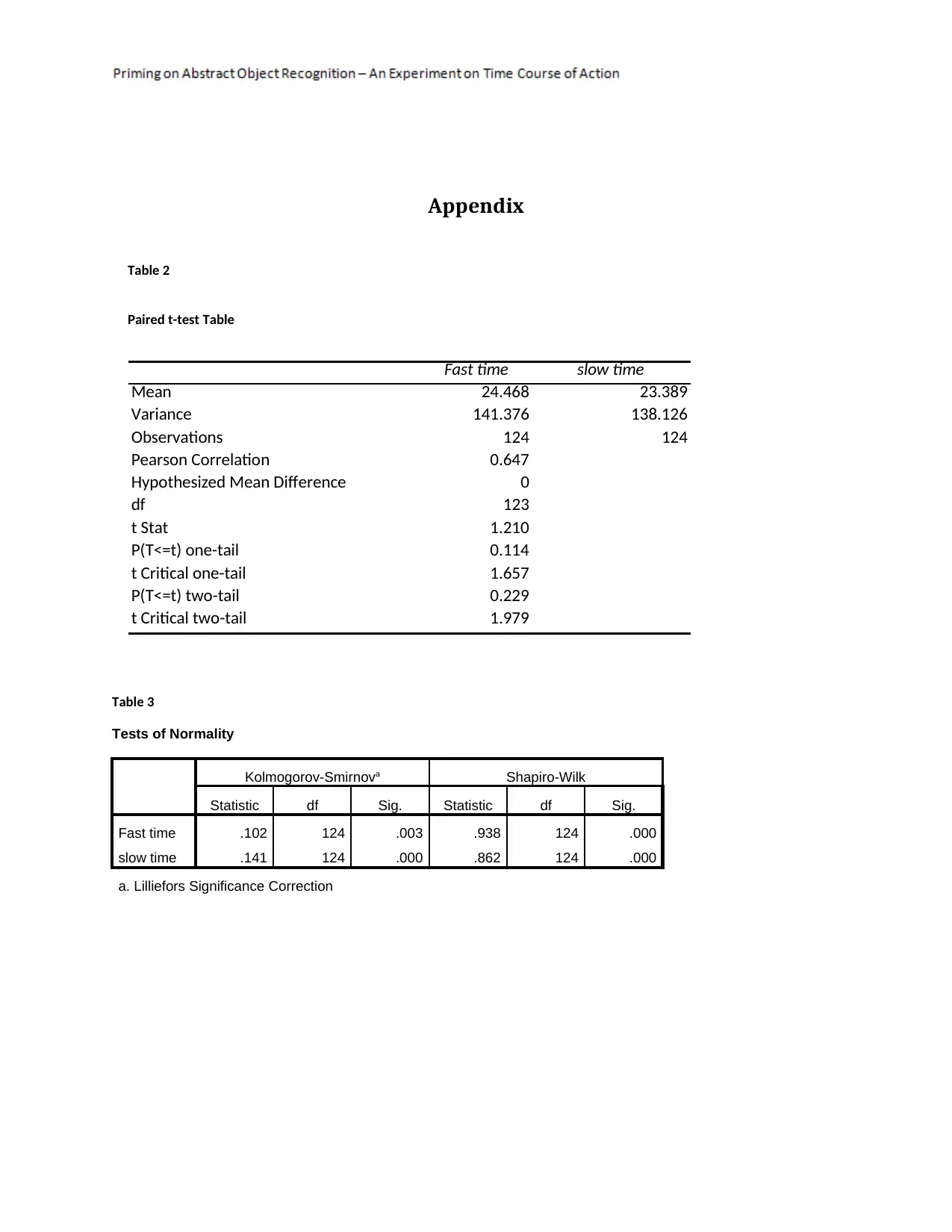
0.86, P < 0.05) were found to be normally distributed, by Shapiro-Wilk test (Razali, & Wah,
2011).
Table 1
Descriptive Statistics for Fast and Slow Primed Timing
Descriptives Count Mean Standard Error Median Standard Deviation Kurtosis Skewness Minimum Maximum
Fast time 124 24.468 1.068 22.410 11.890 1.230 1.022 5.95 67.11
slow time 124 23.389 1.055 21.045 11.753 3.941 1.722 7.21 72.77
Figure 1: Side-by-side Box Plot for Reaction Time in Fast and Slow Priming
Inferential Analysis
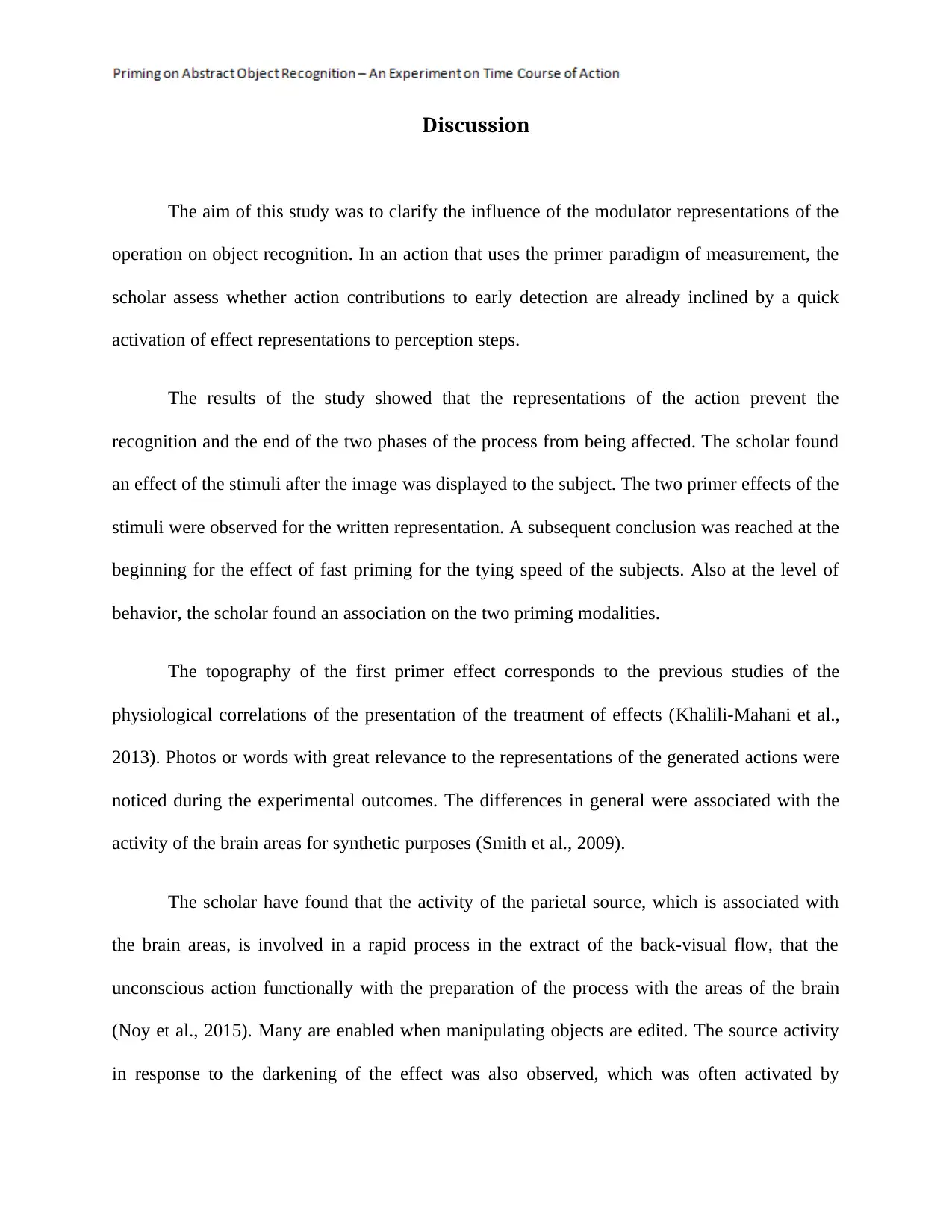
The correlation between the reaction times for fast and slow priming were found to have
a significant positive correlation (r = 0.647, p < 0.05) at 5% level of significance. Therefore,
dominant effect of human brain and its functionality was one of the primary impact factors for
the consistency between the typing speeds for the abstract shape descriptions under the stimulli
of both type of priming.
2011).
Table 1
Descriptive Statistics for Fast and Slow Primed Timing
Descriptives Count Mean Standard Error Median Standard Deviation Kurtosis Skewness Minimum Maximum
Fast time 124 24.468 1.068 22.410 11.890 1.230 1.022 5.95 67.11
slow time 124 23.389 1.055 21.045 11.753 3.941 1.722 7.21 72.77
Figure 1: Side-by-side Box Plot for Reaction Time in Fast and Slow Priming
Inferential Analysis
The correlation between the reaction times for fast and slow priming were found to have
a significant positive correlation (r = 0.647, p < 0.05) at 5% level of significance. Therefore,
dominant effect of human brain and its functionality was one of the primary impact factors for
the consistency between the typing speeds for the abstract shape descriptions under the stimulli
of both type of priming.
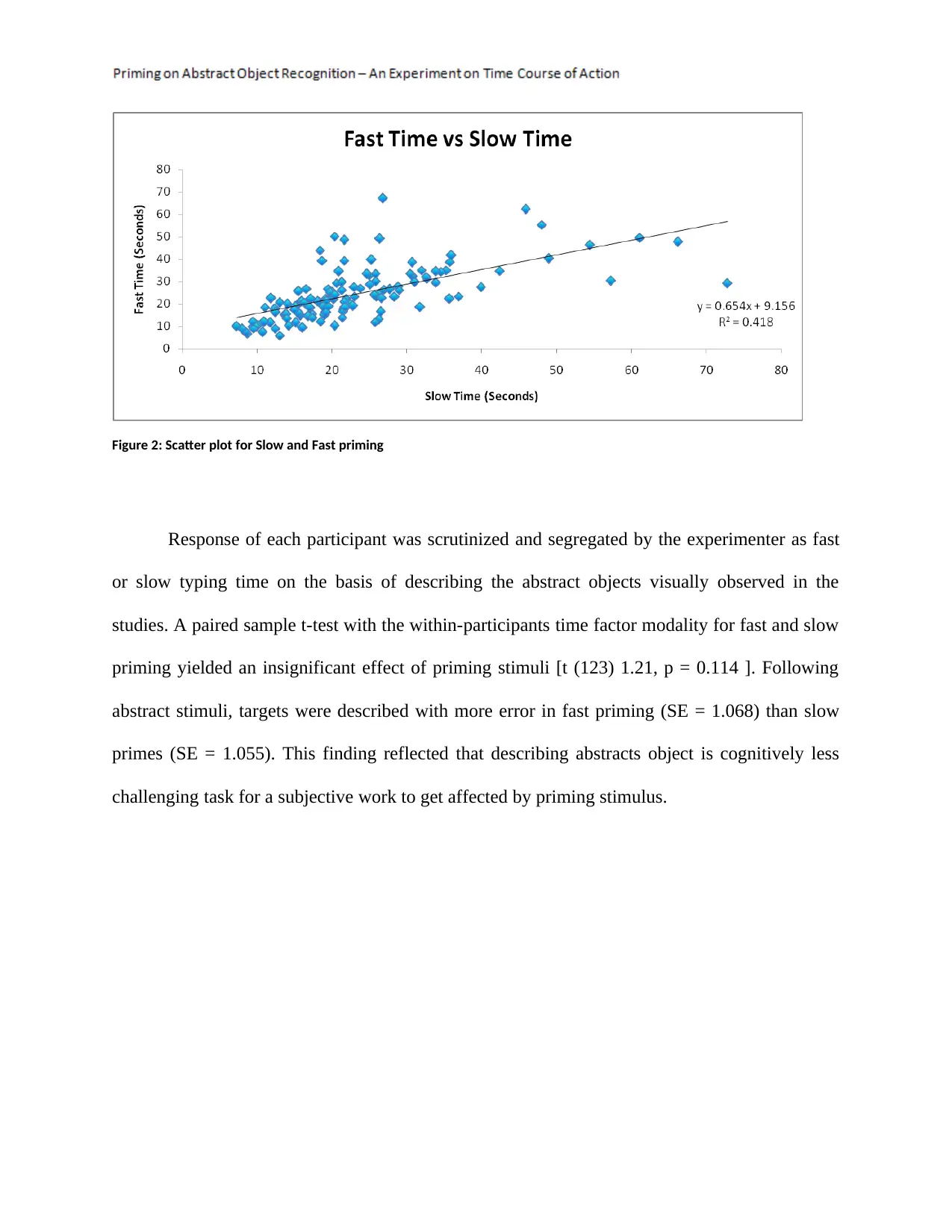
Figure 2: Scatter plot for Slow and Fast priming
Response of each participant was scrutinized and segregated by the experimenter as fast
or slow typing time on the basis of describing the abstract objects visually observed in the
studies. A paired sample t-test with the within-participants time factor modality for fast and slow
priming yielded an insignificant effect of priming stimuli [t (123) 1.21, p = 0.114 ]. Following
abstract stimuli, targets were described with more error in fast priming (SE = 1.068) than slow
primes (SE = 1.055). This finding reflected that describing abstracts object is cognitively less
challenging task for a subjective work to get affected by priming stimulus.
Response of each participant was scrutinized and segregated by the experimenter as fast
or slow typing time on the basis of describing the abstract objects visually observed in the
studies. A paired sample t-test with the within-participants time factor modality for fast and slow
priming yielded an insignificant effect of priming stimuli [t (123) 1.21, p = 0.114 ]. Following
abstract stimuli, targets were described with more error in fast priming (SE = 1.068) than slow
primes (SE = 1.055). This finding reflected that describing abstracts object is cognitively less
challenging task for a subjective work to get affected by priming stimulus.
⊘ This is a preview!⊘
Do you want full access?
Subscribe today to unlock all pages.
Trusted by 1+ million students worldwide
Discussion
The aim of this study was to clarify the influence of the modulator representations of the
operation on object recognition. In an action that uses the primer paradigm of measurement, the
scholar assess whether action contributions to early detection are already inclined by a quick
activation of effect representations to perception steps.
The results of the study showed that the representations of the action prevent the
recognition and the end of the two phases of the process from being affected. The scholar found
an effect of the stimuli after the image was displayed to the subject. The two primer effects of the
stimuli were observed for the written representation. A subsequent conclusion was reached at the
beginning for the effect of fast priming for the tying speed of the subjects. Also at the level of
behavior, the scholar found an association on the two priming modalities.
The topography of the first primer effect corresponds to the previous studies of the
physiological correlations of the presentation of the treatment of effects (Khalili-Mahani et al.,
2013). Photos or words with great relevance to the representations of the generated actions were
noticed during the experimental outcomes. The differences in general were associated with the
activity of the brain areas for synthetic purposes (Smith et al., 2009).
The scholar have found that the activity of the parietal source, which is associated with
the brain areas, is involved in a rapid process in the extract of the back-visual flow, that the
unconscious action functionally with the preparation of the process with the areas of the brain
(Noy et al., 2015). Many are enabled when manipulating objects are edited. The source activity
in response to the darkening of the effect was also observed, which was often activated by
The aim of this study was to clarify the influence of the modulator representations of the
operation on object recognition. In an action that uses the primer paradigm of measurement, the
scholar assess whether action contributions to early detection are already inclined by a quick
activation of effect representations to perception steps.
The results of the study showed that the representations of the action prevent the
recognition and the end of the two phases of the process from being affected. The scholar found
an effect of the stimuli after the image was displayed to the subject. The two primer effects of the
stimuli were observed for the written representation. A subsequent conclusion was reached at the
beginning for the effect of fast priming for the tying speed of the subjects. Also at the level of
behavior, the scholar found an association on the two priming modalities.
The topography of the first primer effect corresponds to the previous studies of the
physiological correlations of the presentation of the treatment of effects (Khalili-Mahani et al.,
2013). Photos or words with great relevance to the representations of the generated actions were
noticed during the experimental outcomes. The differences in general were associated with the
activity of the brain areas for synthetic purposes (Smith et al., 2009).
The scholar have found that the activity of the parietal source, which is associated with
the brain areas, is involved in a rapid process in the extract of the back-visual flow, that the
unconscious action functionally with the preparation of the process with the areas of the brain
(Noy et al., 2015). Many are enabled when manipulating objects are edited. The source activity
in response to the darkening of the effect was also observed, which was often activated by
Paraphrase This Document
Need a fresh take? Get an instant paraphrase of this document with our AI Paraphraser
manipulated objects (Santos, Iglesias, Olivares, & Young, 2008). It has been suggested that the
memory is more closely involved in the representation of the movement. Unlike previous studies
on the beginning of treatment, an action activity was found, with the exception of the primer
zones. The scholar assumed that this was due to the fact that the right hemisphere functions
dominantly in the treatment of visual stimuli and conscious detection. The system of the right
hemisphere was more responsive to object-sensing measures compared to the left hemisphere.
Additionally, for the abstract areas and other attention activities are related to the start of
the action. These play an important role in the treatment of visual recognition, especially in the
right hemisphere of the human brain. This simultaneous activation in response to an interaction
creates a primer between recoil processes and previous visual flow processes when objects are
visually detected.
Contrary to this conventional vision, however, it became increasingly clear that the neural
and functional pathways found at the root of object recognition and object-oriented action are
interdependent and based on calculations. According to research literatures close links between
representations of conceptual objects and sensory brain systems for different representations of
the plots in the system of critical detection of visual objects is evident (Kiefer, & Pulvermüller,
2012). For example, some patients suffer from acquiring knowledge of small and manipulated
artificial objects, but have acquired knowledge of large objects such as large structures and
animals and plants.
In summary, the scholar noted effects on the participants in two different phases, which
were classified for abstract subjects formed by images, which means a fast reaction and initiation
of the action representations in the return response under the object recognition. On the other
memory is more closely involved in the representation of the movement. Unlike previous studies
on the beginning of treatment, an action activity was found, with the exception of the primer
zones. The scholar assumed that this was due to the fact that the right hemisphere functions
dominantly in the treatment of visual stimuli and conscious detection. The system of the right
hemisphere was more responsive to object-sensing measures compared to the left hemisphere.
Additionally, for the abstract areas and other attention activities are related to the start of
the action. These play an important role in the treatment of visual recognition, especially in the
right hemisphere of the human brain. This simultaneous activation in response to an interaction
creates a primer between recoil processes and previous visual flow processes when objects are
visually detected.
Contrary to this conventional vision, however, it became increasingly clear that the neural
and functional pathways found at the root of object recognition and object-oriented action are
interdependent and based on calculations. According to research literatures close links between
representations of conceptual objects and sensory brain systems for different representations of
the plots in the system of critical detection of visual objects is evident (Kiefer, & Pulvermüller,
2012). For example, some patients suffer from acquiring knowledge of small and manipulated
artificial objects, but have acquired knowledge of large objects such as large structures and
animals and plants.
In summary, the scholar noted effects on the participants in two different phases, which
were classified for abstract subjects formed by images, which means a fast reaction and initiation
of the action representations in the return response under the object recognition. On the other
hand, the initial effect of successive actions for the primary stimuli of abstract images has been
achieved. This is probably due to the fact that this effect comes from the regions of the brain and
reflects the integration of the semantic traits into a coherent concept, regardless of the primary
modality. Recent results show that priming operations can quickly and slowly affect the
recording of objects (Barsalou, 2008). It affects the fast processes induced by the first stimuli
with images, but it can also adapt in the slow abstract image integration process that is caused
due to functionality of subconscious human brain.
achieved. This is probably due to the fact that this effect comes from the regions of the brain and
reflects the integration of the semantic traits into a coherent concept, regardless of the primary
modality. Recent results show that priming operations can quickly and slowly affect the
recording of objects (Barsalou, 2008). It affects the fast processes induced by the first stimuli
with images, but it can also adapt in the slow abstract image integration process that is caused
due to functionality of subconscious human brain.
⊘ This is a preview!⊘
Do you want full access?
Subscribe today to unlock all pages.
Trusted by 1+ million students worldwide
Reference
Barsalou, L. W. (2008). Grounded cognition. Annu. Rev. Psychol., 59, 617-645.
Binder, J. R., Desai, R. H., Graves, W. W., & Conant, L. L. (2009). Where is the semantic
system? A critical review and meta-analysis of 120 functional neuroimaging studies.
Cerebral Cortex, 19(12), 2767-2796.
Chilisa, B. (2011). Indigenous research methodologies. Sage Publications.
Gupta, A., Kembhavi, A., & Davis, L. S. (2009). Observing human-object interactions: Using
spatial and functional compatibility for recognition. IEEE Transactions on Pattern
Analysis and Machine Intelligence, 31(10), 1775-1789.
Haggard, P. (2008). Human volition: towards a neuroscience of will. Nature Reviews
Neuroscience, 9(12), 934.
Khalili-Mahani, N., Chang, C., van Osch, M. J., Veer, I. M., van Buchem, M. A., Dahan, A., ...
& Rombouts, S. A. (2013). The impact of “physiological correction” on functional
connectivity analysis of pharmacological resting state fMRI. Neuroimage, 65, 499-510.
Kiefer, M., & Pulvermüller, F. (2012). Conceptual representations in mind and brain: theoretical
developments, current evidence and future directions. cortex, 48(7), 805-825.
Milner, A. D., & Goodale, M. A. (2008). Two visual systems re-viewed. Neuropsychologia,
46(3), 774-785.
Noy, N., Bickel, S., Zion-Golumbic, E., Harel, M., Golan, T., Davidesco, I., ... & Mehta, A. D.
(2015). Ignition’s glow: Ultra-fast spread of global cortical activity accompanying local
Barsalou, L. W. (2008). Grounded cognition. Annu. Rev. Psychol., 59, 617-645.
Binder, J. R., Desai, R. H., Graves, W. W., & Conant, L. L. (2009). Where is the semantic
system? A critical review and meta-analysis of 120 functional neuroimaging studies.
Cerebral Cortex, 19(12), 2767-2796.
Chilisa, B. (2011). Indigenous research methodologies. Sage Publications.
Gupta, A., Kembhavi, A., & Davis, L. S. (2009). Observing human-object interactions: Using
spatial and functional compatibility for recognition. IEEE Transactions on Pattern
Analysis and Machine Intelligence, 31(10), 1775-1789.
Haggard, P. (2008). Human volition: towards a neuroscience of will. Nature Reviews
Neuroscience, 9(12), 934.
Khalili-Mahani, N., Chang, C., van Osch, M. J., Veer, I. M., van Buchem, M. A., Dahan, A., ...
& Rombouts, S. A. (2013). The impact of “physiological correction” on functional
connectivity analysis of pharmacological resting state fMRI. Neuroimage, 65, 499-510.
Kiefer, M., & Pulvermüller, F. (2012). Conceptual representations in mind and brain: theoretical
developments, current evidence and future directions. cortex, 48(7), 805-825.
Milner, A. D., & Goodale, M. A. (2008). Two visual systems re-viewed. Neuropsychologia,
46(3), 774-785.
Noy, N., Bickel, S., Zion-Golumbic, E., Harel, M., Golan, T., Davidesco, I., ... & Mehta, A. D.
(2015). Ignition’s glow: Ultra-fast spread of global cortical activity accompanying local
Paraphrase This Document
Need a fresh take? Get an instant paraphrase of this document with our AI Paraphraser
“ignitions” in visual cortex during conscious visual perception. Consciousness and
cognition, 35, 206-224.
Razali, N. M., & Wah, Y. B. (2011). Power comparisons of shapiro-wilk, kolmogorov-smirnov,
lilliefors and anderson-darling tests. Journal of statistical modeling and analytics, 2(1),
21-33.
Santos, I. M., Iglesias, J., Olivares, E. I., & Young, A. W. (2008). Differential effects of object-
based attention on evoked potentials to fearful and disgusted faces. Neuropsychologia,
46(5), 1468-1479.
Silver, M. A., & Kastner, S. (2009). Topographic maps in human frontal and parietal cortex.
Trends in cognitive sciences, 13(11), 488-495.
Smith, S. M., Fox, P. T., Miller, K. L., Glahn, D. C., Fox, P. M., Mackay, C. E., ... & Beckmann,
C. F. (2009). Correspondence of the brain's functional architecture during activation and
rest. Proceedings of the National Academy of Sciences, 106(31), 13040-13045.
cognition, 35, 206-224.
Razali, N. M., & Wah, Y. B. (2011). Power comparisons of shapiro-wilk, kolmogorov-smirnov,
lilliefors and anderson-darling tests. Journal of statistical modeling and analytics, 2(1),
21-33.
Santos, I. M., Iglesias, J., Olivares, E. I., & Young, A. W. (2008). Differential effects of object-
based attention on evoked potentials to fearful and disgusted faces. Neuropsychologia,
46(5), 1468-1479.
Silver, M. A., & Kastner, S. (2009). Topographic maps in human frontal and parietal cortex.
Trends in cognitive sciences, 13(11), 488-495.
Smith, S. M., Fox, P. T., Miller, K. L., Glahn, D. C., Fox, P. M., Mackay, C. E., ... & Beckmann,
C. F. (2009). Correspondence of the brain's functional architecture during activation and
rest. Proceedings of the National Academy of Sciences, 106(31), 13040-13045.
Appendix
Table 2
Paired t-test Table
Fast time slow time
Mean 24.468 23.389
Variance 141.376 138.126
Observations 124 124
Pearson Correlation 0.647
Hypothesized Mean Difference 0
df 123
t Stat 1.210
P(T<=t) one-tail 0.114
t Critical one-tail 1.657
P(T<=t) two-tail 0.229
t Critical two-tail 1.979
Table 3
Tests of Normality
Kolmogorov-Smirnova Shapiro-Wilk
Statistic df Sig. Statistic df Sig.
Fast time .102 124 .003 .938 124 .000
slow time .141 124 .000 .862 124 .000
a. Lilliefors Significance Correction
Table 2
Paired t-test Table
Fast time slow time
Mean 24.468 23.389
Variance 141.376 138.126
Observations 124 124
Pearson Correlation 0.647
Hypothesized Mean Difference 0
df 123
t Stat 1.210
P(T<=t) one-tail 0.114
t Critical one-tail 1.657
P(T<=t) two-tail 0.229
t Critical two-tail 1.979
Table 3
Tests of Normality
Kolmogorov-Smirnova Shapiro-Wilk
Statistic df Sig. Statistic df Sig.
Fast time .102 124 .003 .938 124 .000
slow time .141 124 .000 .862 124 .000
a. Lilliefors Significance Correction
⊘ This is a preview!⊘
Do you want full access?
Subscribe today to unlock all pages.
Trusted by 1+ million students worldwide

1 out of 13


Your All-in-One AI-Powered Toolkit for Academic Success.
+13062052269
info@desklib.com
Available 24*7 on WhatsApp / Email
![[object Object]](/_next/static/media/star-bottom.7253800d.svg)
Unlock your academic potential
Copyright © 2020–2026 A2Z Services. All Rights Reserved. Developed and managed by ZUCOL.