Academic Integrity: Importance, Implications, and Project Reflection
VerifiedAdded on 2023/06/14
|8
|2654
|132
Report
AI Summary
This report delves into the critical importance of academic integrity within higher education, defining it as a cornerstone of ethical conduct, fairness, and honesty in academic pursuits. It highlights the significance of upholding academic integrity to foster a productive learning environment and prevent the development of an unethical workforce. The report explores the potential consequences of academic misconduct, emphasizing its impact on individual reputations, professional credibility, and the overall trustworthiness of academic institutions. Furthermore, it includes a reflective evaluation of skills developed through a game design project, focusing on challenges encountered, decision-making processes, and the value of collaborative teamwork in enhancing creativity and achieving project goals. The reflection underscores the development of personal and professional skills, such as time management, communication, research proficiency, and public speaking, all of which contribute to improved personality and professional efficiency.
ACADEMIC INTEGRITY
1
1

Paraphrase This Document
Need a fresh take? Get an instant paraphrase of this document with our AI Paraphraser
TABLE OF CONTENTS
Table of Contents.............................................................................................................................1
INTRODUCTION...........................................................................................................................2
SECTION 1.....................................................................................................................................2
Academic integrity.......................................................................................................................2
Significance of academic integrity..............................................................................................2
Implications of academic misconduct.........................................................................................3
SECTION 2.....................................................................................................................................5
Reflection on producing game.....................................................................................................5
Reflection on skill learned...........................................................................................................5
CONCLUSION................................................................................................................................6
REFERENCES................................................................................................................................7
2
Table of Contents.............................................................................................................................1
INTRODUCTION...........................................................................................................................2
SECTION 1.....................................................................................................................................2
Academic integrity.......................................................................................................................2
Significance of academic integrity..............................................................................................2
Implications of academic misconduct.........................................................................................3
SECTION 2.....................................................................................................................................5
Reflection on producing game.....................................................................................................5
Reflection on skill learned...........................................................................................................5
CONCLUSION................................................................................................................................6
REFERENCES................................................................................................................................7
2
INTRODUCTION
Academic integrity is defined as the practice to accomplish academic related work with
honesty, fairness, ethics and required discipline. The integrity principles are not only vital for
sustaining the quality of learning but are also important for building and maintaining a
productive educational and workplace environment (Patra and Das, 2019). If academic integrity
is not managed then it may lead to develop a work force which is unethical as well as inefficient
in terms of productivity. This report will discuss the importance of academic integrity and the
potential consequences of academic misconduct. It will also provide a reflective evaluation of the
skills developed through this academic year and the lessons learned while producing project 2
game.
SECTION 1
Academic integrity
Academic integrity is known as the standards and responsibility which abide researchers,
teachers, students and all academic personnel to act with responsibility, fairness, trust, honesty
and respect. The breach of academic integrity is called academic misconduct or dishonesty. The
actions which affect or undermine academic integrity of academic course or institution can
influence the reputation of individual in future (Cronan, Mullins and Douglas, 2018). If any student
is involved in any of such unfair practices then in future as well the professional bodies may not
allow such students to accredit. Research and academic work plays an important role in the
development of human and planet. Thus the sensitive and valuable research content must also be
protected. As a result assuring academic integrity also helps to build a better and ethical society
which is free from criminals and crime activities. Integrity is fundamental aspect and paramount
to success of individual. Academic integrity is not only followed when someone is observing or
monitoring instead individuals must hold their honesty practices and integrity policies which are
set by educational institutions. It aims at ensuring that learners complete their academic work on
their own without cheating or getting it done from others (Foltýnek and Dlabolová, 2020). Thus
integrity ensures that standards of community are protected and behaviour of learners is
consistent with the welfare and principles of academic integrity.
Significance of academic integrity
It is highly necessary that academic integrity must be developed and encouraged among
students (Eaton, 2021). When students does not follow the ethical guidelines of academics and
3
Academic integrity is defined as the practice to accomplish academic related work with
honesty, fairness, ethics and required discipline. The integrity principles are not only vital for
sustaining the quality of learning but are also important for building and maintaining a
productive educational and workplace environment (Patra and Das, 2019). If academic integrity
is not managed then it may lead to develop a work force which is unethical as well as inefficient
in terms of productivity. This report will discuss the importance of academic integrity and the
potential consequences of academic misconduct. It will also provide a reflective evaluation of the
skills developed through this academic year and the lessons learned while producing project 2
game.
SECTION 1
Academic integrity
Academic integrity is known as the standards and responsibility which abide researchers,
teachers, students and all academic personnel to act with responsibility, fairness, trust, honesty
and respect. The breach of academic integrity is called academic misconduct or dishonesty. The
actions which affect or undermine academic integrity of academic course or institution can
influence the reputation of individual in future (Cronan, Mullins and Douglas, 2018). If any student
is involved in any of such unfair practices then in future as well the professional bodies may not
allow such students to accredit. Research and academic work plays an important role in the
development of human and planet. Thus the sensitive and valuable research content must also be
protected. As a result assuring academic integrity also helps to build a better and ethical society
which is free from criminals and crime activities. Integrity is fundamental aspect and paramount
to success of individual. Academic integrity is not only followed when someone is observing or
monitoring instead individuals must hold their honesty practices and integrity policies which are
set by educational institutions. It aims at ensuring that learners complete their academic work on
their own without cheating or getting it done from others (Foltýnek and Dlabolová, 2020). Thus
integrity ensures that standards of community are protected and behaviour of learners is
consistent with the welfare and principles of academic integrity.
Significance of academic integrity
It is highly necessary that academic integrity must be developed and encouraged among
students (Eaton, 2021). When students does not follow the ethical guidelines of academics and
3
⊘ This is a preview!⊘
Do you want full access?
Subscribe today to unlock all pages.

Trusted by 1+ million students worldwide

they follow misconduct practices such as contract cheating or using work of other students
without their knowledge and consent then they are also taking away an opportunity to improve
their skills. The individuals who received their educational qualification with misconduct create
a question on their own capabilities and achievements (Gottardello and Karabag, 2020). Academic
integrity is significant in several aspects as it gives guarantee or assurance that other people can
trust on education, capability and worthiness of an individual. Thus if people rely on an
individual’s professionally then they can rely without any fear or doubt because their behaviour
and knowledge was regulated by well governing authorities. For becoming a successful leader
also trust is an important characteristic.
Thus for professional success individuals must develop have fairness and honesty. This
can be developed only when academic integrity has been followed and maintained while gaining
education or knowledge (Cronan, Mullins and Douglas, 2018). Business or any professional words
depends upon trust or the faith which service users have on service providers. This can be
sustained only if students or professionals possess required knowledge. The lack of integrity also
creates a question on reliability and ability of learner. For students it is important to assure
integrity because it will give them a fair chance of achieving success and knowledge by
completing all learning activities with honesty. As students denote their time, efforts and money
misconduct activities can ruin their professional growth and reputation. Along with the student’s
academic integrity is equally important for university because the staff members, students or
researchers are associated with name of university (Jamieson and Howard, 2019).
Thus universities must also be consistent in terms of assessment and standards of
education. It will create a sense of confidence among individuals and communities about the
people who received their degrees from the particular university. The ethics and integrity of
university also influence the way in which organisations recruit graduates (Eaton, 2021). If any
university is not able to follow the standards of ethics then it may also create problem for
learners so get a job or professional opportunity because recruiters may have negative perception
about those who have association or name associated with an unethical university where
academic misconduct is common practice and integrity is not maintained.
Implications of academic misconduct
Academic misconduct is important to consider and to build a better future of children
who will gain education for contributing in the development of nation and economy (Chankova,
4
without their knowledge and consent then they are also taking away an opportunity to improve
their skills. The individuals who received their educational qualification with misconduct create
a question on their own capabilities and achievements (Gottardello and Karabag, 2020). Academic
integrity is significant in several aspects as it gives guarantee or assurance that other people can
trust on education, capability and worthiness of an individual. Thus if people rely on an
individual’s professionally then they can rely without any fear or doubt because their behaviour
and knowledge was regulated by well governing authorities. For becoming a successful leader
also trust is an important characteristic.
Thus for professional success individuals must develop have fairness and honesty. This
can be developed only when academic integrity has been followed and maintained while gaining
education or knowledge (Cronan, Mullins and Douglas, 2018). Business or any professional words
depends upon trust or the faith which service users have on service providers. This can be
sustained only if students or professionals possess required knowledge. The lack of integrity also
creates a question on reliability and ability of learner. For students it is important to assure
integrity because it will give them a fair chance of achieving success and knowledge by
completing all learning activities with honesty. As students denote their time, efforts and money
misconduct activities can ruin their professional growth and reputation. Along with the student’s
academic integrity is equally important for university because the staff members, students or
researchers are associated with name of university (Jamieson and Howard, 2019).
Thus universities must also be consistent in terms of assessment and standards of
education. It will create a sense of confidence among individuals and communities about the
people who received their degrees from the particular university. The ethics and integrity of
university also influence the way in which organisations recruit graduates (Eaton, 2021). If any
university is not able to follow the standards of ethics then it may also create problem for
learners so get a job or professional opportunity because recruiters may have negative perception
about those who have association or name associated with an unethical university where
academic misconduct is common practice and integrity is not maintained.
Implications of academic misconduct
Academic misconduct is important to consider and to build a better future of children
who will gain education for contributing in the development of nation and economy (Chankova,
4
Paraphrase This Document
Need a fresh take? Get an instant paraphrase of this document with our AI Paraphraser

2020). Thus they have great responsibility to learn and act with higher responsibility, ethics and
moral values because their actions will define the future of nation and learning of their coming
generation. Individuals who obtained their education qualification via misconduct activities used
to develop a habit of following unethical practices and cheating approach (Peytcheva-Forsyth,
Mellar and Aleksieva, 2019). Even when they enter into professional world working for big
organisations or even global customer base they used to follow the same unethical or misconduct
practices.
When unethical people are in important or crucial career options such as in journalism,
healthcare, legal and research then their unethical practices and even take lives of other
(Gottardello and Karabag, 2020). It can be very threatening to imagine that if a health care or
medical student is involved in academic misconduct and gain degree with contract cheating,
lying or other illegal activities. Such professionals may receive degree but when in practical
world they will enter it is impossible for them to provide fair and accurate services to the patients
because they do not have necessary skills and knowledge which are obtained by fair and ethical
completion of education. Thus they can endanger the lives of thousands of people. Hence it is of
utmost importance that in all academic institutions measures are taken to ensure that integrity is
protected in the academic work (Joob and Wiwanitkit, 2018). The dishonesty of students can also
lower their learning and capability in class. Though they may receive higher marks and ranking
but it will be unjust and unfair with all other deserving students who truly work hard to secure a
good rank and to obtain knowledge. It can also have adverse impact on reputation of the research
or academic institution.
A student represent the entire university and this even in professional life any student is
involved in any ethical and illegal activity supported by his academic knowledge then it also
question the existence and quality of the university. In such cases the entire university and all of
its other students may face its consequences. For instance if any student who obtained his degree
via contract cheating and is not capable to do a basic task at work place then management may
decide to have negative perception about all students and deliverables of university (Peytcheva-
Forsyth, Mellar and Aleksieva, 2019). Thus in future they may not prefer to select candidates which
are passing out from that college. Hence for assuring the welfare and well being of society,
people, development of nation and university reputation academic misconduct must be controlled
and eliminated.
5
moral values because their actions will define the future of nation and learning of their coming
generation. Individuals who obtained their education qualification via misconduct activities used
to develop a habit of following unethical practices and cheating approach (Peytcheva-Forsyth,
Mellar and Aleksieva, 2019). Even when they enter into professional world working for big
organisations or even global customer base they used to follow the same unethical or misconduct
practices.
When unethical people are in important or crucial career options such as in journalism,
healthcare, legal and research then their unethical practices and even take lives of other
(Gottardello and Karabag, 2020). It can be very threatening to imagine that if a health care or
medical student is involved in academic misconduct and gain degree with contract cheating,
lying or other illegal activities. Such professionals may receive degree but when in practical
world they will enter it is impossible for them to provide fair and accurate services to the patients
because they do not have necessary skills and knowledge which are obtained by fair and ethical
completion of education. Thus they can endanger the lives of thousands of people. Hence it is of
utmost importance that in all academic institutions measures are taken to ensure that integrity is
protected in the academic work (Joob and Wiwanitkit, 2018). The dishonesty of students can also
lower their learning and capability in class. Though they may receive higher marks and ranking
but it will be unjust and unfair with all other deserving students who truly work hard to secure a
good rank and to obtain knowledge. It can also have adverse impact on reputation of the research
or academic institution.
A student represent the entire university and this even in professional life any student is
involved in any ethical and illegal activity supported by his academic knowledge then it also
question the existence and quality of the university. In such cases the entire university and all of
its other students may face its consequences. For instance if any student who obtained his degree
via contract cheating and is not capable to do a basic task at work place then management may
decide to have negative perception about all students and deliverables of university (Peytcheva-
Forsyth, Mellar and Aleksieva, 2019). Thus in future they may not prefer to select candidates which
are passing out from that college. Hence for assuring the welfare and well being of society,
people, development of nation and university reputation academic misconduct must be controlled
and eliminated.
5

SECTION 2
Reflection on producing game
I successfully completed a project in which I was asked to design a game related to
plagiarism. For me more than a challenge the task was quite interesting. There were several skills
which I used to successfully accomplish the project and skills to overcome the challenges in
producing game. I think the most challenging part of the game design project was to do good
research and then to effectively implement idea in the given duration of time. I do not have
efficient time management ability and thus for me it was extremely hard to quickly act and
complete the work. At first I conducted plenty of research to grab better understanding of the
plagiarism concept. Then I also searched for different educational games which can make
someone learn about integrity and plagiarism. With excessive researching I was able to make
myself clear that which creativity I want to include in my project and what uniqueness I can
bring in my game.
Another challenging aspect in project 2 was to take correct decisions at right time. It’s
very crucial that good and right decisions are taken on different aspects of game design (Ellis and
et.al., 2020). Before taking any decision I used to consider all its pros and limitations so that my
decision does not have any negative impact on the end outcomes. For this purpose I utilised my
decision making skills and feedback from others. I also worked in team so that along with my
skills I can also get creative ideas from other team members. The team working approach made
me learn that for improving the creativity and own performance it is equally important to work
with other people who may have diverse opinion or working pattern. Initially I faced difficulty in
matching their opinion but gradually I learned to work with collaboration. The collaborative
team and understanding were helpful for me to complete my project successfully.
Reflection on skill learned
In the entire academic year I got chance to complete the game project as well as several
other tasks. The accomplishment of all activities as well as learning helped me to develop and
learn various personal and professional skills. There were several projects which made me
understand the importance of team work and decision making. Personally I always used to think
that a business or any complex professional role is achievable only because of the capabilities of
individual. However while designing game I realised that it’s not easy and possible for any single
6
Reflection on producing game
I successfully completed a project in which I was asked to design a game related to
plagiarism. For me more than a challenge the task was quite interesting. There were several skills
which I used to successfully accomplish the project and skills to overcome the challenges in
producing game. I think the most challenging part of the game design project was to do good
research and then to effectively implement idea in the given duration of time. I do not have
efficient time management ability and thus for me it was extremely hard to quickly act and
complete the work. At first I conducted plenty of research to grab better understanding of the
plagiarism concept. Then I also searched for different educational games which can make
someone learn about integrity and plagiarism. With excessive researching I was able to make
myself clear that which creativity I want to include in my project and what uniqueness I can
bring in my game.
Another challenging aspect in project 2 was to take correct decisions at right time. It’s
very crucial that good and right decisions are taken on different aspects of game design (Ellis and
et.al., 2020). Before taking any decision I used to consider all its pros and limitations so that my
decision does not have any negative impact on the end outcomes. For this purpose I utilised my
decision making skills and feedback from others. I also worked in team so that along with my
skills I can also get creative ideas from other team members. The team working approach made
me learn that for improving the creativity and own performance it is equally important to work
with other people who may have diverse opinion or working pattern. Initially I faced difficulty in
matching their opinion but gradually I learned to work with collaboration. The collaborative
team and understanding were helpful for me to complete my project successfully.
Reflection on skill learned
In the entire academic year I got chance to complete the game project as well as several
other tasks. The accomplishment of all activities as well as learning helped me to develop and
learn various personal and professional skills. There were several projects which made me
understand the importance of team work and decision making. Personally I always used to think
that a business or any complex professional role is achievable only because of the capabilities of
individual. However while designing game I realised that it’s not easy and possible for any single
6
⊘ This is a preview!⊘
Do you want full access?
Subscribe today to unlock all pages.
Trusted by 1+ million students worldwide
individual. Instead for long term success it requires a creative team work and an effective team
(Kaktiņš, 2019). Thus one must have ability to work in diverse environment and to manage the
team conflicts. Working on several group projects made me understand that very well. In the
year I also used to make lot of interaction with professors and my classmates. It gave me courage
to speak up in public without any fear or nervousness. Thus my communication skills and public
speaking abilities were developed so that I can communicate with people easily.
While completing class activities I also used to employ and learn extensive research and
technical skills. These skills learned are very helpful from the professional context as they can
make work very efficient and quick. Even while design games I used to get different ideas only
with the help of effective and detailed researching techniques. Decision making skill is also one
of the crucial skill which is not required only in professional or growth context but also in
making life related decision at different phases of life (Sheard and et.al., 2018). Thus with the
development of time management and decision skills I will be able to choose and take the most
suitable decisions of my life. The public speaking skills and presentation skills learned in
academic year also hold great importance for expressing my thoughts, opinion, creativity and
ideas. All these skills which I learned will thus help me to improve my personality as well as
professional efficiency and skills.
CONCLUSION
It can be concluded from the above discussion that it is important that students must be
made aware about the concept and role of academic integrity. They must also be learned about
the way in which academic integrity can be maintained and plagiarism can be avoided.
Academic integrity is not only important for the development and growth of students but also to
promote the sense of professionalism among them. Thus it can be concluded that with academic
knowledge and skills students must also emphasis on gaining understanding related to academic
integrity and reflective practices. This will be helpful for their overall holistic development in
academic as well as future career progressions and professional paths.
7
(Kaktiņš, 2019). Thus one must have ability to work in diverse environment and to manage the
team conflicts. Working on several group projects made me understand that very well. In the
year I also used to make lot of interaction with professors and my classmates. It gave me courage
to speak up in public without any fear or nervousness. Thus my communication skills and public
speaking abilities were developed so that I can communicate with people easily.
While completing class activities I also used to employ and learn extensive research and
technical skills. These skills learned are very helpful from the professional context as they can
make work very efficient and quick. Even while design games I used to get different ideas only
with the help of effective and detailed researching techniques. Decision making skill is also one
of the crucial skill which is not required only in professional or growth context but also in
making life related decision at different phases of life (Sheard and et.al., 2018). Thus with the
development of time management and decision skills I will be able to choose and take the most
suitable decisions of my life. The public speaking skills and presentation skills learned in
academic year also hold great importance for expressing my thoughts, opinion, creativity and
ideas. All these skills which I learned will thus help me to improve my personality as well as
professional efficiency and skills.
CONCLUSION
It can be concluded from the above discussion that it is important that students must be
made aware about the concept and role of academic integrity. They must also be learned about
the way in which academic integrity can be maintained and plagiarism can be avoided.
Academic integrity is not only important for the development and growth of students but also to
promote the sense of professionalism among them. Thus it can be concluded that with academic
knowledge and skills students must also emphasis on gaining understanding related to academic
integrity and reflective practices. This will be helpful for their overall holistic development in
academic as well as future career progressions and professional paths.
7
Paraphrase This Document
Need a fresh take? Get an instant paraphrase of this document with our AI Paraphraser
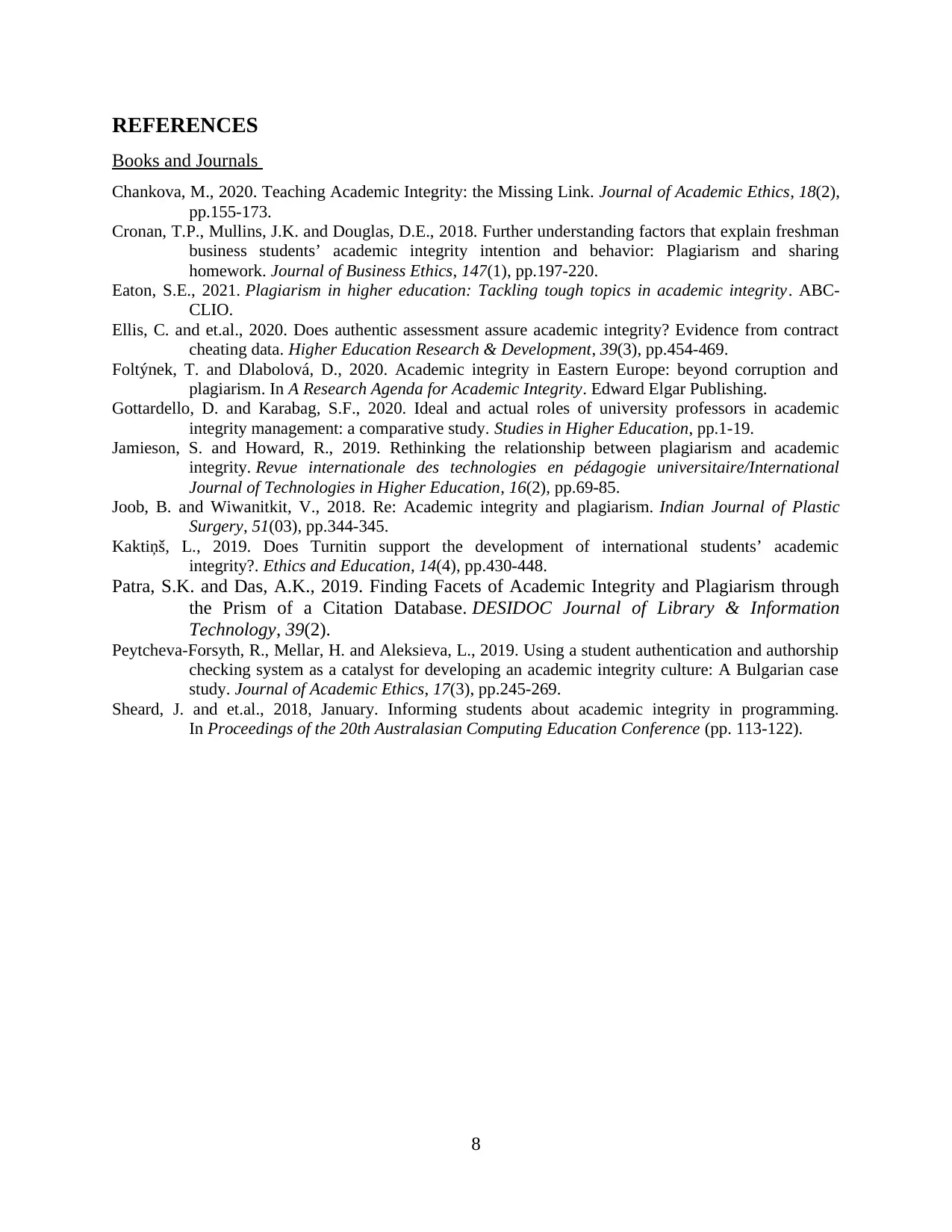
REFERENCES
Books and Journals
Chankova, M., 2020. Teaching Academic Integrity: the Missing Link. Journal of Academic Ethics, 18(2),
pp.155-173.
Cronan, T.P., Mullins, J.K. and Douglas, D.E., 2018. Further understanding factors that explain freshman
business students’ academic integrity intention and behavior: Plagiarism and sharing
homework. Journal of Business Ethics, 147(1), pp.197-220.
Eaton, S.E., 2021. Plagiarism in higher education: Tackling tough topics in academic integrity. ABC-
CLIO.
Ellis, C. and et.al., 2020. Does authentic assessment assure academic integrity? Evidence from contract
cheating data. Higher Education Research & Development, 39(3), pp.454-469.
Foltýnek, T. and Dlabolová, D., 2020. Academic integrity in Eastern Europe: beyond corruption and
plagiarism. In A Research Agenda for Academic Integrity. Edward Elgar Publishing.
Gottardello, D. and Karabag, S.F., 2020. Ideal and actual roles of university professors in academic
integrity management: a comparative study. Studies in Higher Education, pp.1-19.
Jamieson, S. and Howard, R., 2019. Rethinking the relationship between plagiarism and academic
integrity. Revue internationale des technologies en pédagogie universitaire/International
Journal of Technologies in Higher Education, 16(2), pp.69-85.
Joob, B. and Wiwanitkit, V., 2018. Re: Academic integrity and plagiarism. Indian Journal of Plastic
Surgery, 51(03), pp.344-345.
Kaktiņš, L., 2019. Does Turnitin support the development of international students’ academic
integrity?. Ethics and Education, 14(4), pp.430-448.
Patra, S.K. and Das, A.K., 2019. Finding Facets of Academic Integrity and Plagiarism through
the Prism of a Citation Database. DESIDOC Journal of Library & Information
Technology, 39(2).
Peytcheva-Forsyth, R., Mellar, H. and Aleksieva, L., 2019. Using a student authentication and authorship
checking system as a catalyst for developing an academic integrity culture: A Bulgarian case
study. Journal of Academic Ethics, 17(3), pp.245-269.
Sheard, J. and et.al., 2018, January. Informing students about academic integrity in programming.
In Proceedings of the 20th Australasian Computing Education Conference (pp. 113-122).
8
Books and Journals
Chankova, M., 2020. Teaching Academic Integrity: the Missing Link. Journal of Academic Ethics, 18(2),
pp.155-173.
Cronan, T.P., Mullins, J.K. and Douglas, D.E., 2018. Further understanding factors that explain freshman
business students’ academic integrity intention and behavior: Plagiarism and sharing
homework. Journal of Business Ethics, 147(1), pp.197-220.
Eaton, S.E., 2021. Plagiarism in higher education: Tackling tough topics in academic integrity. ABC-
CLIO.
Ellis, C. and et.al., 2020. Does authentic assessment assure academic integrity? Evidence from contract
cheating data. Higher Education Research & Development, 39(3), pp.454-469.
Foltýnek, T. and Dlabolová, D., 2020. Academic integrity in Eastern Europe: beyond corruption and
plagiarism. In A Research Agenda for Academic Integrity. Edward Elgar Publishing.
Gottardello, D. and Karabag, S.F., 2020. Ideal and actual roles of university professors in academic
integrity management: a comparative study. Studies in Higher Education, pp.1-19.
Jamieson, S. and Howard, R., 2019. Rethinking the relationship between plagiarism and academic
integrity. Revue internationale des technologies en pédagogie universitaire/International
Journal of Technologies in Higher Education, 16(2), pp.69-85.
Joob, B. and Wiwanitkit, V., 2018. Re: Academic integrity and plagiarism. Indian Journal of Plastic
Surgery, 51(03), pp.344-345.
Kaktiņš, L., 2019. Does Turnitin support the development of international students’ academic
integrity?. Ethics and Education, 14(4), pp.430-448.
Patra, S.K. and Das, A.K., 2019. Finding Facets of Academic Integrity and Plagiarism through
the Prism of a Citation Database. DESIDOC Journal of Library & Information
Technology, 39(2).
Peytcheva-Forsyth, R., Mellar, H. and Aleksieva, L., 2019. Using a student authentication and authorship
checking system as a catalyst for developing an academic integrity culture: A Bulgarian case
study. Journal of Academic Ethics, 17(3), pp.245-269.
Sheard, J. and et.al., 2018, January. Informing students about academic integrity in programming.
In Proceedings of the 20th Australasian Computing Education Conference (pp. 113-122).
8

1 out of 8


Related Documents


Your All-in-One AI-Powered Toolkit for Academic Success.
+13062052269
info@desklib.com
Available 24*7 on WhatsApp / Email
![[object Object]](/_next/static/media/star-bottom.7253800d.svg)
Unlock your academic potential
Copyright © 2020–2026 A2Z Services. All Rights Reserved. Developed and managed by ZUCOL.