ACC 200: Evaluation of Job Costing System for Connectta Limited
VerifiedAdded on 2022/11/13
|14
|2693
|249
Report
AI Summary
This report provides a detailed analysis of the costing system employed by Connectta Limited, a furniture manufacturing company. It begins with an executive summary and introduction to job costing, the system used to ascertain the cost of manufacturing. The report then delves into a discussion and analysis section, divided into six parts. Part 1 examines the suitability of job costing for Connectta Limited, given its manufacturing processes. Part 2 calculates the work in process for the period ending December 31, 2018. Part 3 calculates the cost of chairs in finished goods inventory. Part 4 analyzes the over or under-applied overhead. Part 5 discusses the accounting treatments for overhead application. Finally, Part 6 highlights the deficiencies of traditional costing methods and advocates for Activity Based Costing (ABC) to improve overhead allocation and product costing accuracy. The report concludes with a summary of findings and references.
Running head: ACC 200
ACC 200
Name of the Student:
Name of the University:
Authors Note:
ACC 200
Name of the Student:
Name of the University:
Authors Note:

Paraphrase This Document
Need a fresh take? Get an instant paraphrase of this document with our AI Paraphraser
1
ACC 200
Executive summary:
Costing system helps business entities especially manufacturing entities to ascertain the
cost of manufacturing. Ascertainment of proper cost of products manufactured helps the
management of such entity to impose suitable profit margin on such products to maximize the
amount of revenue and subsequent profit. Job costing is an integral branch of costing system that
is used to ascertain the cost of specific job orders performed and completed by an organization.
A detailed analysis of the costing system used in Connectta Limited along with necessary
calculation below shows the importance of a consisting system to the decision making process of
the organization. It is important to note though that the use of costing system by an organization
will be effective only when the system chosen is appropriate to the nature of business and the
business itself.
ACC 200
Executive summary:
Costing system helps business entities especially manufacturing entities to ascertain the
cost of manufacturing. Ascertainment of proper cost of products manufactured helps the
management of such entity to impose suitable profit margin on such products to maximize the
amount of revenue and subsequent profit. Job costing is an integral branch of costing system that
is used to ascertain the cost of specific job orders performed and completed by an organization.
A detailed analysis of the costing system used in Connectta Limited along with necessary
calculation below shows the importance of a consisting system to the decision making process of
the organization. It is important to note though that the use of costing system by an organization
will be effective only when the system chosen is appropriate to the nature of business and the
business itself.
2
ACC 200
Contents
Executive summary:........................................................................................................................1
Introduction:....................................................................................................................................3
Discussion and analysis:..................................................................................................................3
Part 1:...........................................................................................................................................3
Part 2:...........................................................................................................................................3
Part 3:...........................................................................................................................................5
Part 4:...........................................................................................................................................7
Part 5:...........................................................................................................................................8
Part 6:...........................................................................................................................................9
Conclusion:....................................................................................................................................11
References:....................................................................................................................................12
ACC 200
Contents
Executive summary:........................................................................................................................1
Introduction:....................................................................................................................................3
Discussion and analysis:..................................................................................................................3
Part 1:...........................................................................................................................................3
Part 2:...........................................................................................................................................3
Part 3:...........................................................................................................................................5
Part 4:...........................................................................................................................................7
Part 5:...........................................................................................................................................8
Part 6:...........................................................................................................................................9
Conclusion:....................................................................................................................................11
References:....................................................................................................................................12
⊘ This is a preview!⊘
Do you want full access?
Subscribe today to unlock all pages.

Trusted by 1+ million students worldwide
3
ACC 200
Introduction:
Connectta Limited is involved in manufacturing of furniture. In order to ascertain the cost of
manufacturing the company uses job costing system. All the information provided about the
manufacturing activities of the company shall be used to ascertain whether the job costing
system is appropriate for the company and disclosing the actual cost of production. On the basis
of available information necessary calculation shall also be made to ascertain the cost of
furniture manufactured by the company (Askarany, 2011).
Discussion and analysis:
Part 1:
Manufacturing entities such as cloth manufacturing entities, food manufacturing entities, air craft
manufacturing entities are examples of entities which use job costing system to ascertain the cost
of cloths, foods and aircrafts. Thus, entities with manufacturing settings that enable them to track
jobs with different types of direct expenses including direct materials and direct labor will use
job costing. Thus, an organization that manufactures such products that enable them to track
different jobs used to manufacture these products will use job costing system. Hence, when a
company manufactures products which are not identical and requires different specifications for
different products use of job costing system shall be appropriate (Esmalifalak, Albin and
Behzadpoor, 2015).
Part 2:
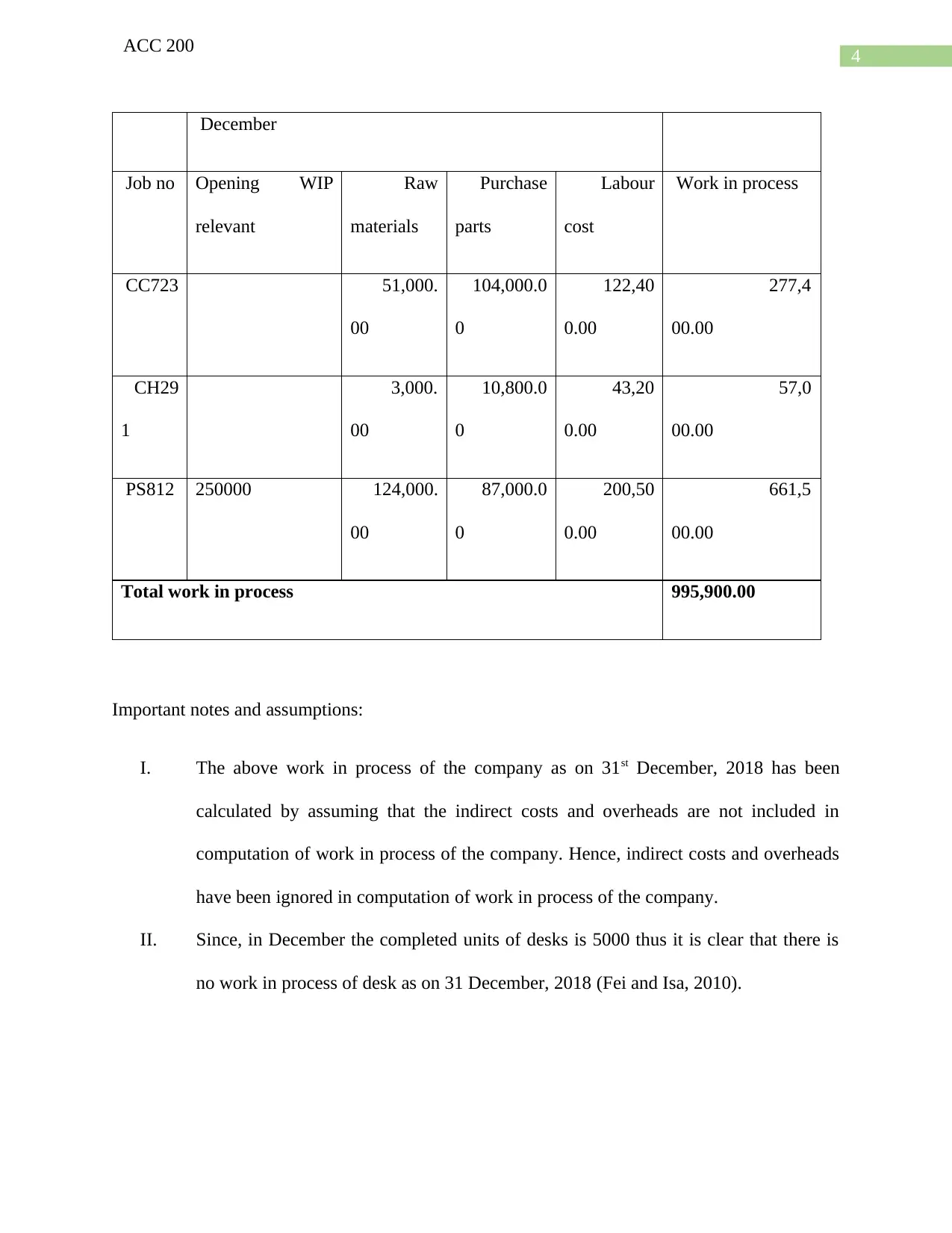
As per the information the work in process of the company for the period ending on November
30 has been provided. Taking into consideration the requisition of raw materials, use of labor and
other direct costs incurred in the month of December the work in process of the company as on
December 31 is calculated below:
ACC 200
Introduction:
Connectta Limited is involved in manufacturing of furniture. In order to ascertain the cost of
manufacturing the company uses job costing system. All the information provided about the
manufacturing activities of the company shall be used to ascertain whether the job costing
system is appropriate for the company and disclosing the actual cost of production. On the basis
of available information necessary calculation shall also be made to ascertain the cost of
furniture manufactured by the company (Askarany, 2011).
Discussion and analysis:
Part 1:
Manufacturing entities such as cloth manufacturing entities, food manufacturing entities, air craft
manufacturing entities are examples of entities which use job costing system to ascertain the cost
of cloths, foods and aircrafts. Thus, entities with manufacturing settings that enable them to track
jobs with different types of direct expenses including direct materials and direct labor will use
job costing. Thus, an organization that manufactures such products that enable them to track
different jobs used to manufacture these products will use job costing system. Hence, when a
company manufactures products which are not identical and requires different specifications for
different products use of job costing system shall be appropriate (Esmalifalak, Albin and
Behzadpoor, 2015).
Part 2:
As per the information the work in process of the company for the period ending on November
30 has been provided. Taking into consideration the requisition of raw materials, use of labor and
other direct costs incurred in the month of December the work in process of the company as on
December 31 is calculated below:
Paraphrase This Document
Need a fresh take? Get an instant paraphrase of this document with our AI Paraphraser
4
ACC 200
December
Job no Opening WIP
relevant
Raw
materials
Purchase
parts
Labour
cost
Work in process
CC723 51,000.
00
104,000.0
0
122,40
0.00
277,4
00.00
CH29
1
3,000.
00
10,800.0
0
43,20
0.00
57,0
00.00
PS812 250000 124,000.
00
87,000.0
0
200,50
0.00
661,5
00.00
Total work in process 995,900.00
Important notes and assumptions:
I. The above work in process of the company as on 31st December, 2018 has been
calculated by assuming that the indirect costs and overheads are not included in
computation of work in process of the company. Hence, indirect costs and overheads
have been ignored in computation of work in process of the company.
II. Since, in December the completed units of desks is 5000 thus it is clear that there is
no work in process of desk as on 31 December, 2018 (Fei and Isa, 2010).
ACC 200
December
Job no Opening WIP
relevant
Raw
materials
Purchase
parts
Labour
cost
Work in process
CC723 51,000.
00
104,000.0
0
122,40
0.00
277,4
00.00
CH29
1
3,000.
00
10,800.0
0
43,20
0.00
57,0
00.00
PS812 250000 124,000.
00
87,000.0
0
200,50
0.00
661,5
00.00
Total work in process 995,900.00
Important notes and assumptions:
I. The above work in process of the company as on 31st December, 2018 has been
calculated by assuming that the indirect costs and overheads are not included in
computation of work in process of the company. Hence, indirect costs and overheads
have been ignored in computation of work in process of the company.
II. Since, in December the completed units of desks is 5000 thus it is clear that there is
no work in process of desk as on 31 December, 2018 (Fei and Isa, 2010).
5
ACC 200
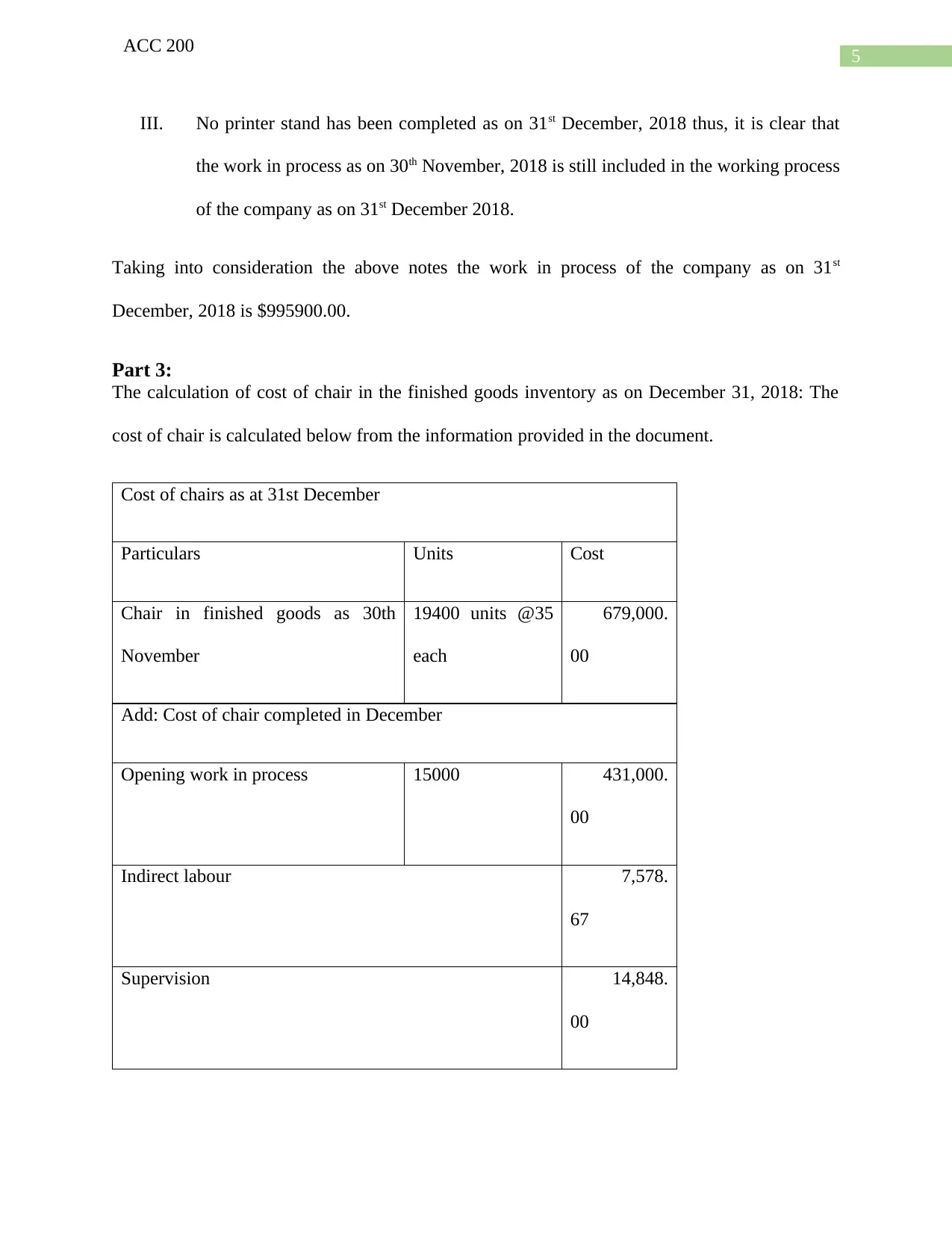
III. No printer stand has been completed as on 31st December, 2018 thus, it is clear that
the work in process as on 30th November, 2018 is still included in the working process
of the company as on 31st December 2018.
Taking into consideration the above notes the work in process of the company as on 31st
December, 2018 is $995900.00.
Part 3:
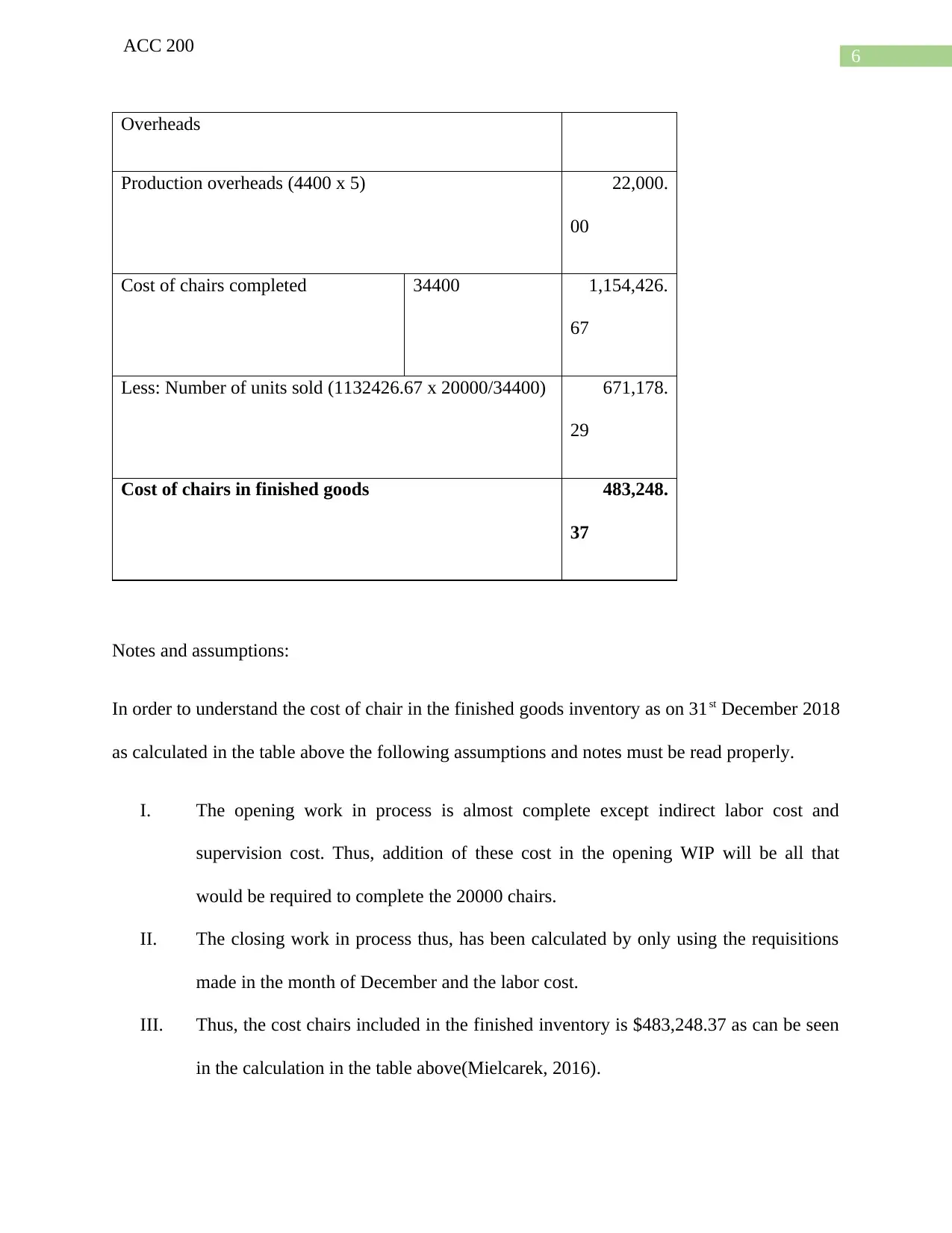
The calculation of cost of chair in the finished goods inventory as on December 31, 2018: The
cost of chair is calculated below from the information provided in the document.
Cost of chairs as at 31st December
Particulars Units Cost
Chair in finished goods as 30th
November
19400 units @35
each
679,000.
00
Add: Cost of chair completed in December
Opening work in process 15000 431,000.
00
Indirect labour 7,578.
67
Supervision 14,848.
00
ACC 200
III. No printer stand has been completed as on 31st December, 2018 thus, it is clear that
the work in process as on 30th November, 2018 is still included in the working process
of the company as on 31st December 2018.
Taking into consideration the above notes the work in process of the company as on 31st
December, 2018 is $995900.00.
Part 3:
The calculation of cost of chair in the finished goods inventory as on December 31, 2018: The
cost of chair is calculated below from the information provided in the document.
Cost of chairs as at 31st December
Particulars Units Cost
Chair in finished goods as 30th
November
19400 units @35
each
679,000.
00
Add: Cost of chair completed in December
Opening work in process 15000 431,000.
00
Indirect labour 7,578.
67
Supervision 14,848.
00
⊘ This is a preview!⊘
Do you want full access?
Subscribe today to unlock all pages.
Trusted by 1+ million students worldwide
6
ACC 200
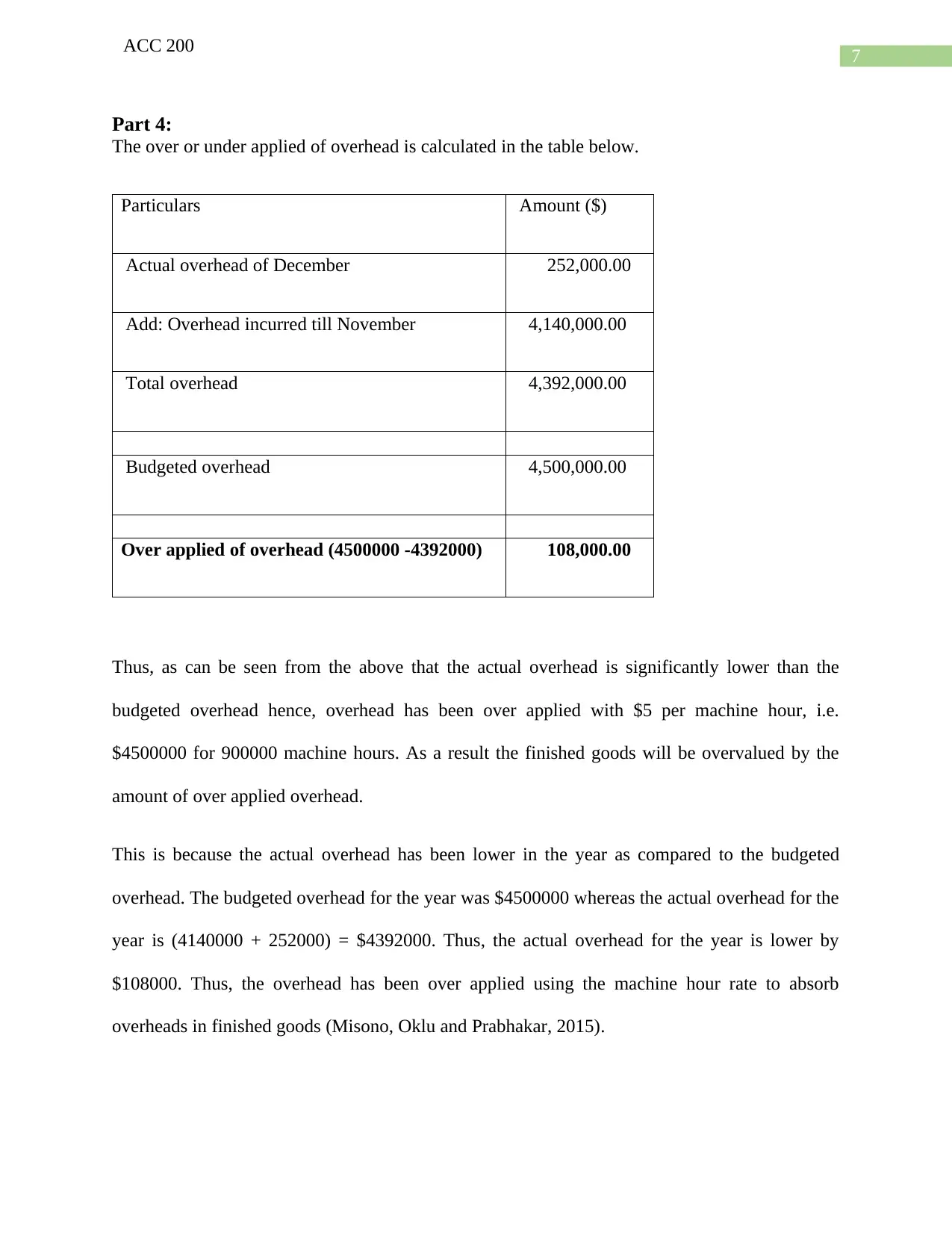
Overheads
Production overheads (4400 x 5) 22,000.
00
Cost of chairs completed 34400 1,154,426.
67
Less: Number of units sold (1132426.67 x 20000/34400) 671,178.
29
Cost of chairs in finished goods 483,248.
37
Notes and assumptions:
In order to understand the cost of chair in the finished goods inventory as on 31st December 2018
as calculated in the table above the following assumptions and notes must be read properly.
I. The opening work in process is almost complete except indirect labor cost and
supervision cost. Thus, addition of these cost in the opening WIP will be all that
would be required to complete the 20000 chairs.
II. The closing work in process thus, has been calculated by only using the requisitions
made in the month of December and the labor cost.
III. Thus, the cost chairs included in the finished inventory is $483,248.37 as can be seen
in the calculation in the table above(Mielcarek, 2016).
ACC 200
Overheads
Production overheads (4400 x 5) 22,000.
00
Cost of chairs completed 34400 1,154,426.
67
Less: Number of units sold (1132426.67 x 20000/34400) 671,178.
29
Cost of chairs in finished goods 483,248.
37
Notes and assumptions:
In order to understand the cost of chair in the finished goods inventory as on 31st December 2018
as calculated in the table above the following assumptions and notes must be read properly.
I. The opening work in process is almost complete except indirect labor cost and
supervision cost. Thus, addition of these cost in the opening WIP will be all that
would be required to complete the 20000 chairs.
II. The closing work in process thus, has been calculated by only using the requisitions
made in the month of December and the labor cost.
III. Thus, the cost chairs included in the finished inventory is $483,248.37 as can be seen
in the calculation in the table above(Mielcarek, 2016).
Paraphrase This Document
Need a fresh take? Get an instant paraphrase of this document with our AI Paraphraser
7
ACC 200
Part 4:
The over or under applied of overhead is calculated in the table below.
Particulars Amount ($)
Actual overhead of December 252,000.00
Add: Overhead incurred till November 4,140,000.00
Total overhead 4,392,000.00
Budgeted overhead 4,500,000.00
Over applied of overhead (4500000 -4392000) 108,000.00
Thus, as can be seen from the above that the actual overhead is significantly lower than the
budgeted overhead hence, overhead has been over applied with $5 per machine hour, i.e.
$4500000 for 900000 machine hours. As a result the finished goods will be overvalued by the
amount of over applied overhead.
This is because the actual overhead has been lower in the year as compared to the budgeted
overhead. The budgeted overhead for the year was $4500000 whereas the actual overhead for the
year is (4140000 + 252000) = $4392000. Thus, the actual overhead for the year is lower by
$108000. Thus, the overhead has been over applied using the machine hour rate to absorb
overheads in finished goods (Misono, Oklu and Prabhakar, 2015).
ACC 200
Part 4:
The over or under applied of overhead is calculated in the table below.
Particulars Amount ($)
Actual overhead of December 252,000.00
Add: Overhead incurred till November 4,140,000.00
Total overhead 4,392,000.00
Budgeted overhead 4,500,000.00
Over applied of overhead (4500000 -4392000) 108,000.00
Thus, as can be seen from the above that the actual overhead is significantly lower than the
budgeted overhead hence, overhead has been over applied with $5 per machine hour, i.e.
$4500000 for 900000 machine hours. As a result the finished goods will be overvalued by the
amount of over applied overhead.
This is because the actual overhead has been lower in the year as compared to the budgeted
overhead. The budgeted overhead for the year was $4500000 whereas the actual overhead for the
year is (4140000 + 252000) = $4392000. Thus, the actual overhead for the year is lower by
$108000. Thus, the overhead has been over applied using the machine hour rate to absorb
overheads in finished goods (Misono, Oklu and Prabhakar, 2015).
8
ACC 200
Part 5:
The accounting treatment of overhead applied on products to ascertain the cost of production is
quite complex especially when the overhead is over or under applied. In general the overhead
absorbed is directly debited to the cost of production in accounting when the overhead is neither
under nor over applied. However, in case of under or over application of overhead then there are
alternative accounting treatment to account for the over applied or under applied overhead as the
case may be (RUAN and ZHOU, 2017).
Firstly, in accounting the overheads are directly transferred to the cost of production thus, the
cost of production is debited with proportionate credit to the production overhead. In case the
actual overhead is lower than the budgeted overhead then the actual overhead is considered in
accounting to ensure that the goods are not overvalued. For example the budgeted overhead is $5
per hour however, the actual production is lower at $4.50 per hour then the accounting treatment
will record the production overhead at $4.50 per hour to make sure that the finished goods are
not overvalued.
In case the actual production overhead is higher than the budgeted production overhead then
contrastingly the actual production overhead is not considered to value the inventory. Instead the
budgeted production overheads is used to ascertain the cost of goods sold and accordingly,
accounting treatment is made. The excess production overhead over and above the budgeted
production overhead is directly debited in the profit and loss account. This is again done to
ensure that the inefficiency of a firm should not be reflected in finished inventory as this will
inflate the profit also (Sheu and Pan, 2009).
ACC 200
Part 5:
The accounting treatment of overhead applied on products to ascertain the cost of production is
quite complex especially when the overhead is over or under applied. In general the overhead
absorbed is directly debited to the cost of production in accounting when the overhead is neither
under nor over applied. However, in case of under or over application of overhead then there are
alternative accounting treatment to account for the over applied or under applied overhead as the
case may be (RUAN and ZHOU, 2017).
Firstly, in accounting the overheads are directly transferred to the cost of production thus, the
cost of production is debited with proportionate credit to the production overhead. In case the
actual overhead is lower than the budgeted overhead then the actual overhead is considered in
accounting to ensure that the goods are not overvalued. For example the budgeted overhead is $5
per hour however, the actual production is lower at $4.50 per hour then the accounting treatment
will record the production overhead at $4.50 per hour to make sure that the finished goods are
not overvalued.
In case the actual production overhead is higher than the budgeted production overhead then
contrastingly the actual production overhead is not considered to value the inventory. Instead the
budgeted production overheads is used to ascertain the cost of goods sold and accordingly,
accounting treatment is made. The excess production overhead over and above the budgeted
production overhead is directly debited in the profit and loss account. This is again done to
ensure that the inefficiency of a firm should not be reflected in finished inventory as this will
inflate the profit also (Sheu and Pan, 2009).
⊘ This is a preview!⊘
Do you want full access?
Subscribe today to unlock all pages.
Trusted by 1+ million students worldwide
9
ACC 200
Completely separate from the above accounting treatments an alternative accounting treatment is
to only consider the direct cost of production while calculating cost of goods sold. In such case
the production overheads are directly debited in the profit and loss account. In this case the
concept of over applied and under applied of overheads are not relevant any more. However, the
accounting treatment has a major fault line and it lies with the fact that assessing the efficiency
of an organization will be difficult as the indirect costs will be directly debited in the profit and
loss account (Vazakidis and Karagiannis, 2009).
Part 6:
There are number of deficiencies in traditional costing method in which a predetermined
overhead rate is calculated by using either direct labor hour or machine hour. The deficiencies of
the traditional costing system firstly need to be discussed before analyzing the merit behind using
an alternative costing method to apply production overheads. The deficiencies are discussed
below:
I. The production overheads are an indirect cost pool where number of indirect costs are
accumulated. Using a single pre-determined overhead rate by using direct material or
direct labor or machine hour cannot properly allocate the production overheads to
different products.
II. There are number of components of production overheads such as ordering cost,
machine set up cost, inspection cost, power electricity and other such cost. Different
products require different quantum of these elements thus using a single
predetermined overhead rate based on a pre-determined yardstick will not correctly
ascertain the cost of different products (Wegmann, 2011).
ACC 200
Completely separate from the above accounting treatments an alternative accounting treatment is
to only consider the direct cost of production while calculating cost of goods sold. In such case
the production overheads are directly debited in the profit and loss account. In this case the
concept of over applied and under applied of overheads are not relevant any more. However, the
accounting treatment has a major fault line and it lies with the fact that assessing the efficiency
of an organization will be difficult as the indirect costs will be directly debited in the profit and
loss account (Vazakidis and Karagiannis, 2009).
Part 6:
There are number of deficiencies in traditional costing method in which a predetermined
overhead rate is calculated by using either direct labor hour or machine hour. The deficiencies of
the traditional costing system firstly need to be discussed before analyzing the merit behind using
an alternative costing method to apply production overheads. The deficiencies are discussed
below:
I. The production overheads are an indirect cost pool where number of indirect costs are
accumulated. Using a single pre-determined overhead rate by using direct material or
direct labor or machine hour cannot properly allocate the production overheads to
different products.
II. There are number of components of production overheads such as ordering cost,
machine set up cost, inspection cost, power electricity and other such cost. Different
products require different quantum of these elements thus using a single
predetermined overhead rate based on a pre-determined yardstick will not correctly
ascertain the cost of different products (Wegmann, 2011).
Paraphrase This Document
Need a fresh take? Get an instant paraphrase of this document with our AI Paraphraser
10
ACC 200
Thus, with passage of time of traditional costing system has lose its popularity and organizations
now use activity based costing and other costing methods to allocate the production overheads
properly. A brief introduction about the Activity Based Costing shall be helpful to the readers
before proceeding to dissect the benefits using the method to overcome the deficiencies of
traditional costing system.
Activity based costing (ABC): In ABC method the indirect costs are divided into different cost
pools. The cost drivers are identified which are contributing to the cost pools. Based on the cost
drivers the costs of different cost pools are allocated to different products. Identification of cost
drivers is the most crucial element in ABC system to correctly allocate the production overheads.
Thus, it is clear that there is significant difference between the traditional costing method and
activity based costing method. Unlike traditional costing method in ABC method the production
overheads are segregated into different cost pools depending on the cost drivers. The cost pools
then allocated to different products on the basis of cost drivers. Thus, the following deficiencies
of traditional costing system can be overcame with the use of ABC system to allocate production
overheads.
The overheads will not be allocated on the basis of a pre-determined overhead rate:
The production overheads will be allocated on the basis of cost drivers after identifying the
drivers and allocating the costs to different costs pools. Thus, no single pre-determined overhead
arte will be used to allocate the production overheads.
Unscientific method of traditional costing system will not be followed: The traditional costing
system is quite unscientific when it comes to allocation of production overheads in different
products. Use of cost drivers and cost pools is a scientific way to allocate production overheads.
ACC 200
Thus, with passage of time of traditional costing system has lose its popularity and organizations
now use activity based costing and other costing methods to allocate the production overheads
properly. A brief introduction about the Activity Based Costing shall be helpful to the readers
before proceeding to dissect the benefits using the method to overcome the deficiencies of
traditional costing system.
Activity based costing (ABC): In ABC method the indirect costs are divided into different cost
pools. The cost drivers are identified which are contributing to the cost pools. Based on the cost
drivers the costs of different cost pools are allocated to different products. Identification of cost
drivers is the most crucial element in ABC system to correctly allocate the production overheads.
Thus, it is clear that there is significant difference between the traditional costing method and
activity based costing method. Unlike traditional costing method in ABC method the production
overheads are segregated into different cost pools depending on the cost drivers. The cost pools
then allocated to different products on the basis of cost drivers. Thus, the following deficiencies
of traditional costing system can be overcame with the use of ABC system to allocate production
overheads.
The overheads will not be allocated on the basis of a pre-determined overhead rate:
The production overheads will be allocated on the basis of cost drivers after identifying the
drivers and allocating the costs to different costs pools. Thus, no single pre-determined overhead
arte will be used to allocate the production overheads.
Unscientific method of traditional costing system will not be followed: The traditional costing
system is quite unscientific when it comes to allocation of production overheads in different
products. Use of cost drivers and cost pools is a scientific way to allocate production overheads.
11
ACC 200
Ascertainment of product cost correctly: With the use of ABC method it would be possible to
correctly ascertain the cost of product properly. With Traditional costing method it is not
possible to correctly ascertain the cost of different products as the overhead allocation in most of
the times is improper and incorrect (Woodward, 2005).
Dealing with ineffective management: With the use of ABC method it would be possible to
correctly ascertain the cost of different products which will help the management to correctly
price these products. This will help the management to efficiently manage an organization as
correct product pricing often end up increasing the amount of revenue of an organization.
Increase amount of profitability with proper management: The ABC system as already
mentioned will help the management to correctly ascertain the cost of products. Once the cost of
products is correctly determined it would be possible for the management to impose appropriate
percentage as the margin tom determine the selling price with the objective of maximizing the
amount of revenue and resultant profit. Thus, achieving higher profitability and revenue would
be possible with the use of ABC method to allocate production overheads.
Conclusion:
Discussion in the above document shows the importance of allocation of production
overheads correctly. There are primarily two methods to allocate production overheads in
different products these are Traditional and Activity Based Costing (ABC). Using ABC method
will help the management of an organization to allocate the production overheads in different
products correctly. Thus, it is important to use ABC method to correctly ascertain the cost of
products.
ACC 200
Ascertainment of product cost correctly: With the use of ABC method it would be possible to
correctly ascertain the cost of product properly. With Traditional costing method it is not
possible to correctly ascertain the cost of different products as the overhead allocation in most of
the times is improper and incorrect (Woodward, 2005).
Dealing with ineffective management: With the use of ABC method it would be possible to
correctly ascertain the cost of different products which will help the management to correctly
price these products. This will help the management to efficiently manage an organization as
correct product pricing often end up increasing the amount of revenue of an organization.
Increase amount of profitability with proper management: The ABC system as already
mentioned will help the management to correctly ascertain the cost of products. Once the cost of
products is correctly determined it would be possible for the management to impose appropriate
percentage as the margin tom determine the selling price with the objective of maximizing the
amount of revenue and resultant profit. Thus, achieving higher profitability and revenue would
be possible with the use of ABC method to allocate production overheads.
Conclusion:
Discussion in the above document shows the importance of allocation of production
overheads correctly. There are primarily two methods to allocate production overheads in
different products these are Traditional and Activity Based Costing (ABC). Using ABC method
will help the management of an organization to allocate the production overheads in different
products correctly. Thus, it is important to use ABC method to correctly ascertain the cost of
products.
⊘ This is a preview!⊘
Do you want full access?
Subscribe today to unlock all pages.
Trusted by 1+ million students worldwide

1 out of 14


Related Documents


Your All-in-One AI-Powered Toolkit for Academic Success.
+13062052269
info@desklib.com
Available 24*7 on WhatsApp / Email
![[object Object]](/_next/static/media/star-bottom.7253800d.svg)
Unlock your academic potential
Copyright © 2020–2026 A2Z Services. All Rights Reserved. Developed and managed by ZUCOL.