University Case Study: ACT for Social Anxiety Disorder (Bill's Case)
VerifiedAdded on 2020/07/23
|9
|2498
|68
Case Study
AI Summary
This case study examines the application of Acceptance and Commitment Therapy (ACT) to a 23-year-old university student named Bill, who is experiencing social anxiety disorder. The assignment begins by describing Bill's symptoms and how his anxiety manifests in social situations, including avoidance behaviors and reliance on substances. The core of the case study involves applying the ACT framework to understand the processes maintaining Bill's anxiety, including cognitive diffusion, contact with the present moment, the observing self, acceptance, values, and committed action. The therapeutic plans based on ACT principles are outlined in detail, providing strategies for Bill to manage his anxiety and improve his social functioning. Finally, the case study critically evaluates relevant research evidence regarding the effectiveness of ACT in treating social anxiety, discussing both supporting and contradictory findings. The paper concludes by synthesizing the findings and providing recommendations for Bill's treatment.
ACCEPTANCE
AND
COMMITMENT
THERAPY
(ACT)
CASE STUDY
AND
COMMITMENT
THERAPY
(ACT)
CASE STUDY

Paraphrase This Document
Need a fresh take? Get an instant paraphrase of this document with our AI Paraphraser
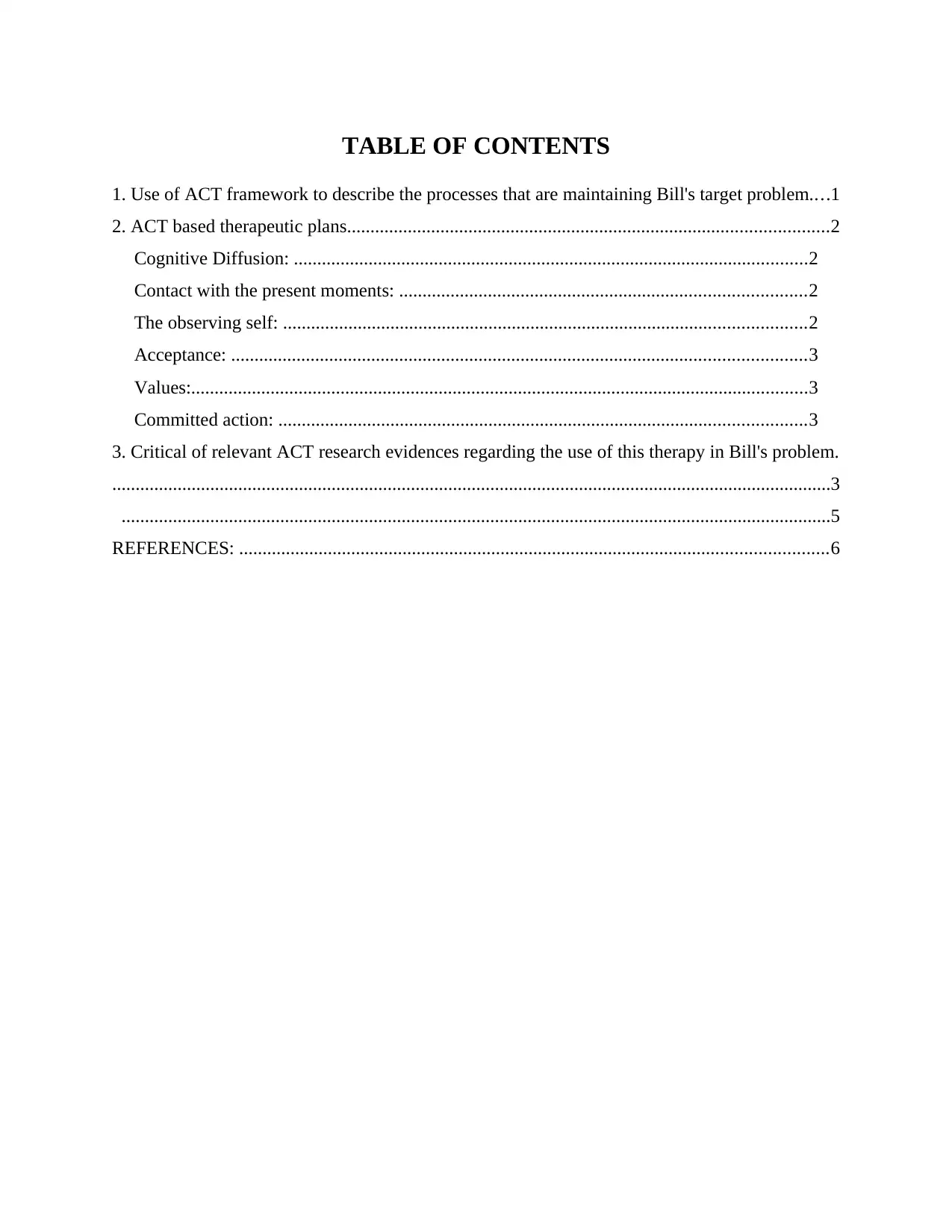
TABLE OF CONTENTS
1. Use of ACT framework to describe the processes that are maintaining Bill's target problem....1
2. ACT based therapeutic plans.......................................................................................................2
Cognitive Diffusion: ..............................................................................................................2
Contact with the present moments: .......................................................................................2
The observing self: ................................................................................................................2
Acceptance: ...........................................................................................................................3
Values:....................................................................................................................................3
Committed action: .................................................................................................................3
3. Critical of relevant ACT research evidences regarding the use of this therapy in Bill's problem.
..........................................................................................................................................................3
........................................................................................................................................................5
REFERENCES: ..............................................................................................................................6
1. Use of ACT framework to describe the processes that are maintaining Bill's target problem....1
2. ACT based therapeutic plans.......................................................................................................2
Cognitive Diffusion: ..............................................................................................................2
Contact with the present moments: .......................................................................................2
The observing self: ................................................................................................................2
Acceptance: ...........................................................................................................................3
Values:....................................................................................................................................3
Committed action: .................................................................................................................3
3. Critical of relevant ACT research evidences regarding the use of this therapy in Bill's problem.
..........................................................................................................................................................3
........................................................................................................................................................5
REFERENCES: ..............................................................................................................................6
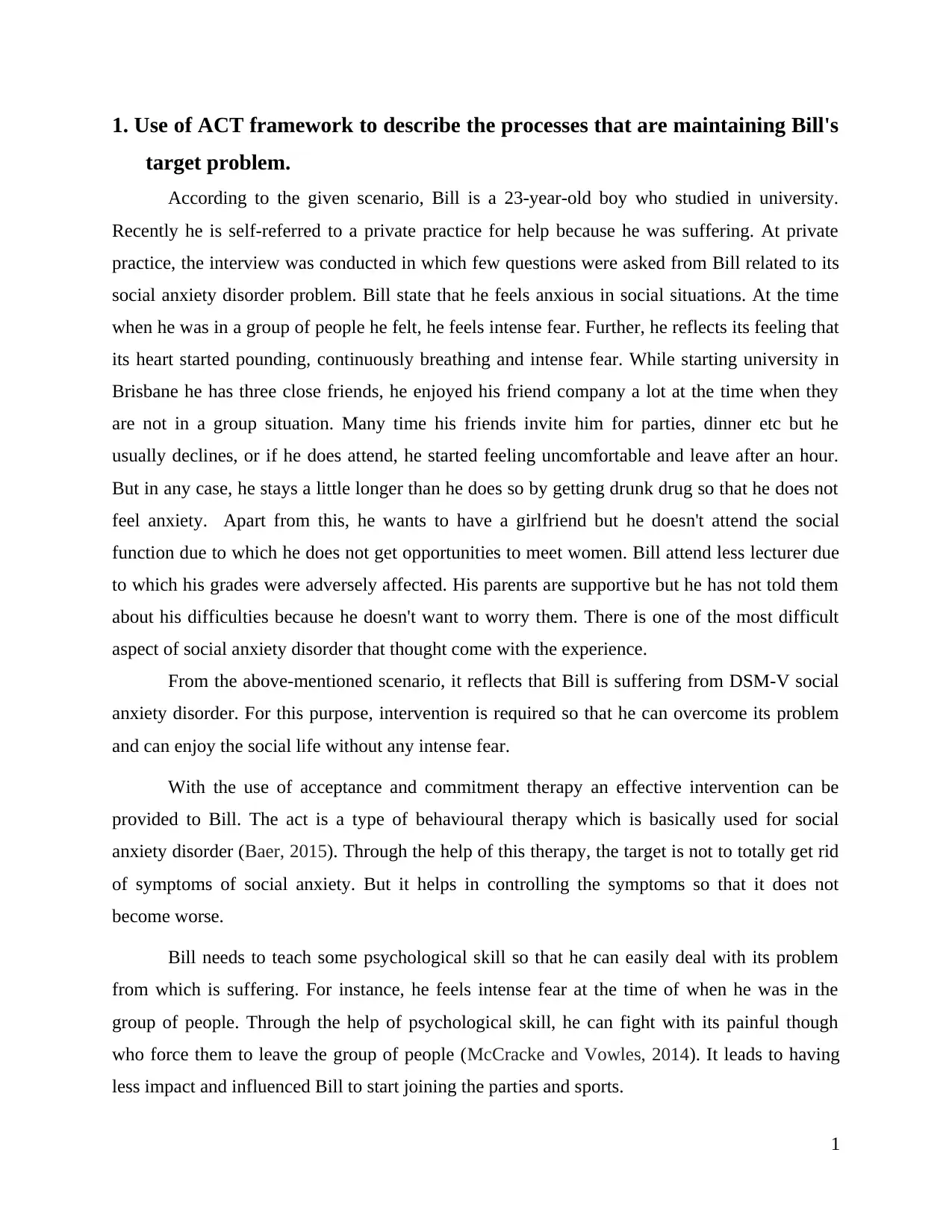
1. Use of ACT framework to describe the processes that are maintaining Bill's
target problem.
According to the given scenario, Bill is a 23-year-old boy who studied in university.
Recently he is self-referred to a private practice for help because he was suffering. At private
practice, the interview was conducted in which few questions were asked from Bill related to its
social anxiety disorder problem. Bill state that he feels anxious in social situations. At the time
when he was in a group of people he felt, he feels intense fear. Further, he reflects its feeling that
its heart started pounding, continuously breathing and intense fear. While starting university in
Brisbane he has three close friends, he enjoyed his friend company a lot at the time when they
are not in a group situation. Many time his friends invite him for parties, dinner etc but he
usually declines, or if he does attend, he started feeling uncomfortable and leave after an hour.
But in any case, he stays a little longer than he does so by getting drunk drug so that he does not
feel anxiety. Apart from this, he wants to have a girlfriend but he doesn't attend the social
function due to which he does not get opportunities to meet women. Bill attend less lecturer due
to which his grades were adversely affected. His parents are supportive but he has not told them
about his difficulties because he doesn't want to worry them. There is one of the most difficult
aspect of social anxiety disorder that thought come with the experience.
From the above-mentioned scenario, it reflects that Bill is suffering from DSM-V social
anxiety disorder. For this purpose, intervention is required so that he can overcome its problem
and can enjoy the social life without any intense fear.
With the use of acceptance and commitment therapy an effective intervention can be
provided to Bill. The act is a type of behavioural therapy which is basically used for social
anxiety disorder (Baer, 2015). Through the help of this therapy, the target is not to totally get rid
of symptoms of social anxiety. But it helps in controlling the symptoms so that it does not
become worse.
Bill needs to teach some psychological skill so that he can easily deal with its problem
from which is suffering. For instance, he feels intense fear at the time of when he was in the
group of people. Through the help of psychological skill, he can fight with its painful though
who force them to leave the group of people (McCracke and Vowles, 2014). It leads to having
less impact and influenced Bill to start joining the parties and sports.
1
target problem.
According to the given scenario, Bill is a 23-year-old boy who studied in university.
Recently he is self-referred to a private practice for help because he was suffering. At private
practice, the interview was conducted in which few questions were asked from Bill related to its
social anxiety disorder problem. Bill state that he feels anxious in social situations. At the time
when he was in a group of people he felt, he feels intense fear. Further, he reflects its feeling that
its heart started pounding, continuously breathing and intense fear. While starting university in
Brisbane he has three close friends, he enjoyed his friend company a lot at the time when they
are not in a group situation. Many time his friends invite him for parties, dinner etc but he
usually declines, or if he does attend, he started feeling uncomfortable and leave after an hour.
But in any case, he stays a little longer than he does so by getting drunk drug so that he does not
feel anxiety. Apart from this, he wants to have a girlfriend but he doesn't attend the social
function due to which he does not get opportunities to meet women. Bill attend less lecturer due
to which his grades were adversely affected. His parents are supportive but he has not told them
about his difficulties because he doesn't want to worry them. There is one of the most difficult
aspect of social anxiety disorder that thought come with the experience.
From the above-mentioned scenario, it reflects that Bill is suffering from DSM-V social
anxiety disorder. For this purpose, intervention is required so that he can overcome its problem
and can enjoy the social life without any intense fear.
With the use of acceptance and commitment therapy an effective intervention can be
provided to Bill. The act is a type of behavioural therapy which is basically used for social
anxiety disorder (Baer, 2015). Through the help of this therapy, the target is not to totally get rid
of symptoms of social anxiety. But it helps in controlling the symptoms so that it does not
become worse.
Bill needs to teach some psychological skill so that he can easily deal with its problem
from which is suffering. For instance, he feels intense fear at the time of when he was in the
group of people. Through the help of psychological skill, he can fight with its painful though
who force them to leave the group of people (McCracke and Vowles, 2014). It leads to having
less impact and influenced Bill to start joining the parties and sports.
1
⊘ This is a preview!⊘
Do you want full access?
Subscribe today to unlock all pages.

Trusted by 1+ million students worldwide
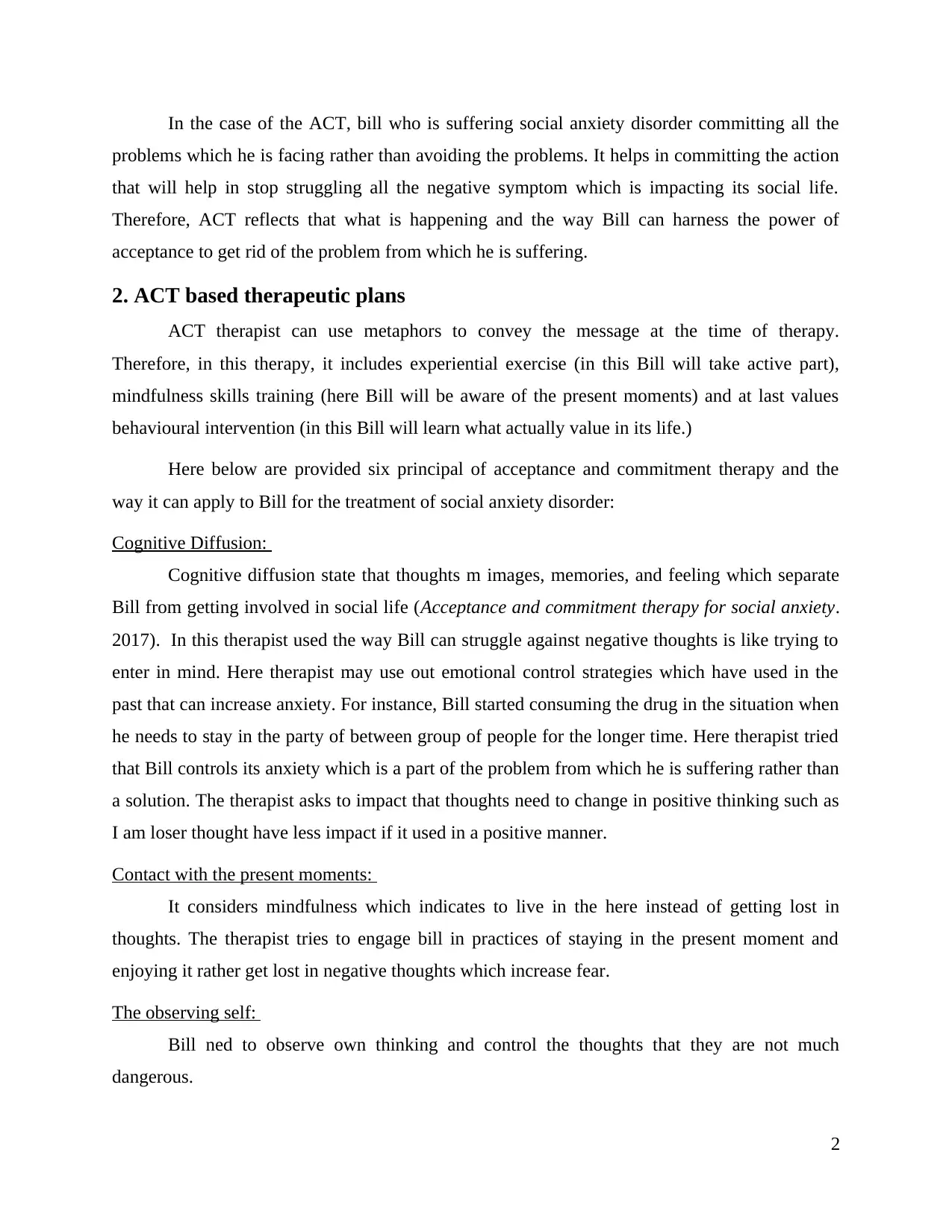
In the case of the ACT, bill who is suffering social anxiety disorder committing all the
problems which he is facing rather than avoiding the problems. It helps in committing the action
that will help in stop struggling all the negative symptom which is impacting its social life.
Therefore, ACT reflects that what is happening and the way Bill can harness the power of
acceptance to get rid of the problem from which he is suffering.
2. ACT based therapeutic plans
ACT therapist can use metaphors to convey the message at the time of therapy.
Therefore, in this therapy, it includes experiential exercise (in this Bill will take active part),
mindfulness skills training (here Bill will be aware of the present moments) and at last values
behavioural intervention (in this Bill will learn what actually value in its life.)
Here below are provided six principal of acceptance and commitment therapy and the
way it can apply to Bill for the treatment of social anxiety disorder:
Cognitive Diffusion:
Cognitive diffusion state that thoughts m images, memories, and feeling which separate
Bill from getting involved in social life (Acceptance and commitment therapy for social anxiety.
2017). In this therapist used the way Bill can struggle against negative thoughts is like trying to
enter in mind. Here therapist may use out emotional control strategies which have used in the
past that can increase anxiety. For instance, Bill started consuming the drug in the situation when
he needs to stay in the party of between group of people for the longer time. Here therapist tried
that Bill controls its anxiety which is a part of the problem from which he is suffering rather than
a solution. The therapist asks to impact that thoughts need to change in positive thinking such as
I am loser thought have less impact if it used in a positive manner.
Contact with the present moments:
It considers mindfulness which indicates to live in the here instead of getting lost in
thoughts. The therapist tries to engage bill in practices of staying in the present moment and
enjoying it rather get lost in negative thoughts which increase fear.
The observing self:
Bill ned to observe own thinking and control the thoughts that they are not much
dangerous.
2
problems which he is facing rather than avoiding the problems. It helps in committing the action
that will help in stop struggling all the negative symptom which is impacting its social life.
Therefore, ACT reflects that what is happening and the way Bill can harness the power of
acceptance to get rid of the problem from which he is suffering.
2. ACT based therapeutic plans
ACT therapist can use metaphors to convey the message at the time of therapy.
Therefore, in this therapy, it includes experiential exercise (in this Bill will take active part),
mindfulness skills training (here Bill will be aware of the present moments) and at last values
behavioural intervention (in this Bill will learn what actually value in its life.)
Here below are provided six principal of acceptance and commitment therapy and the
way it can apply to Bill for the treatment of social anxiety disorder:
Cognitive Diffusion:
Cognitive diffusion state that thoughts m images, memories, and feeling which separate
Bill from getting involved in social life (Acceptance and commitment therapy for social anxiety.
2017). In this therapist used the way Bill can struggle against negative thoughts is like trying to
enter in mind. Here therapist may use out emotional control strategies which have used in the
past that can increase anxiety. For instance, Bill started consuming the drug in the situation when
he needs to stay in the party of between group of people for the longer time. Here therapist tried
that Bill controls its anxiety which is a part of the problem from which he is suffering rather than
a solution. The therapist asks to impact that thoughts need to change in positive thinking such as
I am loser thought have less impact if it used in a positive manner.
Contact with the present moments:
It considers mindfulness which indicates to live in the here instead of getting lost in
thoughts. The therapist tries to engage bill in practices of staying in the present moment and
enjoying it rather get lost in negative thoughts which increase fear.
The observing self:
Bill ned to observe own thinking and control the thoughts that they are not much
dangerous.
2
Paraphrase This Document
Need a fresh take? Get an instant paraphrase of this document with our AI Paraphraser
Acceptance:
Acceptance refers to accept the unpleasant internal experience to come and go away
without controlling an individual (Hayes, Levin and Pistorello, 2013). Here Bill can image that
there is switch betwixt the back of the brain. When the switch is ON it will struggle against
unpleasant private experience to becoming them worse.
Values:
Therapist tries to identify which things value in the life of Bill and what is important for
Bill. For instance, for Bill his friends are important and he liked to play rugby. Therefore, he can
make stronger relations with them and started playing rugby because values help in avoiding
negative feeling.
Committed action:
Here therapist try to commit an action which is line with the value, even if it causes some
hurt (Öst, 2014). For instance, Bill can set a goal that he will attend one group meeting in every
week and make new friends. Therefore, committing action after setting the goal is one of the
effective ways to reduce the impact of social anxiety disorder.
The above-mentioned strategies are effective for Bill in respect to overcome its anxiety
problem and can enjoy the social life. Through this, it becomes easy to achieve the higher grade
in University and to be active in social life.
3. Critical of relevant ACT research evidences regarding the use of this
therapy in Bill's problem.
Acceptance and commitment therapy is a type of psychotherapy which is used for clinical
behaviour analysis. It is a psychological intervention that use mixed strategies of mindfulness
and acceptance to increase the psychological flexibility. This therapy is mainly used for the
treatment of disorders, anxiety, addiction and depression. As per the views of Frank, (2015) the
acceptance and commitment therapy is considered as the best available therapy and more
effective than placebo for the treatment of the anxiety in case of anxiety in Bill. It can help bill
by teaching him the psychological skills that help him to deal with his fear and thoughts of
remaining in the group effectively in such as way that he will have less impact and influence by
sitting in group. However according to Marshall, Parker, Ciarrochi and Heaven (2014), meta
3
Acceptance refers to accept the unpleasant internal experience to come and go away
without controlling an individual (Hayes, Levin and Pistorello, 2013). Here Bill can image that
there is switch betwixt the back of the brain. When the switch is ON it will struggle against
unpleasant private experience to becoming them worse.
Values:
Therapist tries to identify which things value in the life of Bill and what is important for
Bill. For instance, for Bill his friends are important and he liked to play rugby. Therefore, he can
make stronger relations with them and started playing rugby because values help in avoiding
negative feeling.
Committed action:
Here therapist try to commit an action which is line with the value, even if it causes some
hurt (Öst, 2014). For instance, Bill can set a goal that he will attend one group meeting in every
week and make new friends. Therefore, committing action after setting the goal is one of the
effective ways to reduce the impact of social anxiety disorder.
The above-mentioned strategies are effective for Bill in respect to overcome its anxiety
problem and can enjoy the social life. Through this, it becomes easy to achieve the higher grade
in University and to be active in social life.
3. Critical of relevant ACT research evidences regarding the use of this
therapy in Bill's problem.
Acceptance and commitment therapy is a type of psychotherapy which is used for clinical
behaviour analysis. It is a psychological intervention that use mixed strategies of mindfulness
and acceptance to increase the psychological flexibility. This therapy is mainly used for the
treatment of disorders, anxiety, addiction and depression. As per the views of Frank, (2015) the
acceptance and commitment therapy is considered as the best available therapy and more
effective than placebo for the treatment of the anxiety in case of anxiety in Bill. It can help bill
by teaching him the psychological skills that help him to deal with his fear and thoughts of
remaining in the group effectively in such as way that he will have less impact and influence by
sitting in group. However according to Marshall, Parker, Ciarrochi and Heaven (2014), meta
3
analysis concluded that there are too fewer evidences available to support the acceptance and
commitment therapy as the effective treatment of anxiety and depression.
This therapy is developed with the pragmatic philosophy which is known as functional
contextualism. It is different from other available traditional therapies which believe in teaching
people to control their feelings, sensations, thoughts and memories. According to Koole, Tops,
Strübin, Bouw, Schneider and Jostmann (2014), ACT work on the three virtues that effectively
help Jim to overcome the feeling of anxiety. First virtue includes the acceptance of the reaction
in the present moment in which the Jim will recognize the gravity of situation that he is dealing
with. Then only after knowing the problem Jim can help himself by choosing the valued
intervention that will help in getting acknowledged by the direction that will help in overcoming
his fear. Then final step is taking action against the ongoing situation. Thus, through these steps
Jim can easily overcome the feeling of anxiety which will help in placing himself again in the
group.
On the other hand as per the views of Frank, (2015) there are several theoretical and
empirical concerns that are prevailing with response to ascendency of ACT. Among the several
concern one important theoretical concern is the authors of ACT and of other correspondence
theories related to the behaviour of humans recommend there approach as holy grail of various
therapies associated to psychology. Also, as per the context of meta analysis the acceptance and
commitment therapy fails in effectively treatment of depression, quality of life and anxiety.
Thus, according to Witkiewitz, Bowen, Douglas and Hsu (2013), this therapy of ACT is not that
much effective to treat the feeling of anxiety in Jim and will not help in overcoming his problem.
Also, according to the paper that was published in 2013 when ACT was compared to cognitive
therapy it was concluded that Act is not a unique intervention for the people who are severely
suffering from depressions and anxiety.
However, as per the views of Öst, (2014) this therapy will Jim to clarify him about the
importance of values that can effectively help him by guiding how to overcome from the fear he
is suffering from. This therapy will help Jim to increase the mindfulness which is the state of
mind in which brain is focussed and aware that engage him in the present moment. And in the
state of mindfulness the difficult thought and fear that Jim was having have less impact on him
and pose much less influence on his activity. Thus, Acceptance and commitment therapy is
4
commitment therapy as the effective treatment of anxiety and depression.
This therapy is developed with the pragmatic philosophy which is known as functional
contextualism. It is different from other available traditional therapies which believe in teaching
people to control their feelings, sensations, thoughts and memories. According to Koole, Tops,
Strübin, Bouw, Schneider and Jostmann (2014), ACT work on the three virtues that effectively
help Jim to overcome the feeling of anxiety. First virtue includes the acceptance of the reaction
in the present moment in which the Jim will recognize the gravity of situation that he is dealing
with. Then only after knowing the problem Jim can help himself by choosing the valued
intervention that will help in getting acknowledged by the direction that will help in overcoming
his fear. Then final step is taking action against the ongoing situation. Thus, through these steps
Jim can easily overcome the feeling of anxiety which will help in placing himself again in the
group.
On the other hand as per the views of Frank, (2015) there are several theoretical and
empirical concerns that are prevailing with response to ascendency of ACT. Among the several
concern one important theoretical concern is the authors of ACT and of other correspondence
theories related to the behaviour of humans recommend there approach as holy grail of various
therapies associated to psychology. Also, as per the context of meta analysis the acceptance and
commitment therapy fails in effectively treatment of depression, quality of life and anxiety.
Thus, according to Witkiewitz, Bowen, Douglas and Hsu (2013), this therapy of ACT is not that
much effective to treat the feeling of anxiety in Jim and will not help in overcoming his problem.
Also, according to the paper that was published in 2013 when ACT was compared to cognitive
therapy it was concluded that Act is not a unique intervention for the people who are severely
suffering from depressions and anxiety.
However, as per the views of Öst, (2014) this therapy will Jim to clarify him about the
importance of values that can effectively help him by guiding how to overcome from the fear he
is suffering from. This therapy will help Jim to increase the mindfulness which is the state of
mind in which brain is focussed and aware that engage him in the present moment. And in the
state of mindfulness the difficult thought and fear that Jim was having have less impact on him
and pose much less influence on his activity. Thus, Acceptance and commitment therapy is
4
⊘ This is a preview!⊘
Do you want full access?
Subscribe today to unlock all pages.
Trusted by 1+ million students worldwide
considered to be the effective tool for overcoming the stress that result in depressions and helps
in increasing the emotional intelligence of Jim.
As per the views of Boal (2013), this therapy helps in the exploration of emotions that are
painful that interferes with one's actions which further helps Jim in identifying the cause of his
fear and help in acting more congruently in the ongoing situation. It acts as an action based
approach that effectively help Jim in developing the acceptance, mindful and other valued skills
in his college. The emphasize of this therapy on the current prevailing moments related to
awareness, committed actions and valued direction is similar to that other psycho therapies
approach.
Thus, at the end it can be concluded that ACT is the best available therapy for the
treatment of the anxiety, depression and other disorders. It tends to fuse with the thoughts and
then evaluate the experience faced by particular person that avoid those experience and give
reason for the particular behaviour (Acceptance And Commitment Therapy Training, 2013).
5
in increasing the emotional intelligence of Jim.
As per the views of Boal (2013), this therapy helps in the exploration of emotions that are
painful that interferes with one's actions which further helps Jim in identifying the cause of his
fear and help in acting more congruently in the ongoing situation. It acts as an action based
approach that effectively help Jim in developing the acceptance, mindful and other valued skills
in his college. The emphasize of this therapy on the current prevailing moments related to
awareness, committed actions and valued direction is similar to that other psycho therapies
approach.
Thus, at the end it can be concluded that ACT is the best available therapy for the
treatment of the anxiety, depression and other disorders. It tends to fuse with the thoughts and
then evaluate the experience faced by particular person that avoid those experience and give
reason for the particular behaviour (Acceptance And Commitment Therapy Training, 2013).
5
Paraphrase This Document
Need a fresh take? Get an instant paraphrase of this document with our AI Paraphraser
REFERENCES:
Books and journals
Baer, R. A. ed., (2015). Mindfulness-based treatment approaches: Clinician's guide to evidence
base and applications. Academic Press.
Boal, A. (2013). The rainbow of desire: The Boal method of theatre and therapy. Routledge.
Frank, A. W. (2015). Asking the right question about pain: narrative and phronesis. British
Journal of Pain, 9(1), 209-225.
Hayes, S. C., Levin, M.E., Plumb-Vilardaga, J., Villatte, J.L., & Pistorello, J., 2013. Acceptance
and commitment therapy and contextual behavioral science: Examining the progress of
a distinctive model of behavioral and cognitive therapy. Behavior therapy, 44(2),
pp.180-198.
Koole, S. L., Tops, M., Strübin, S., Bouw, J., Schneider, I. K., & Jostmann, N. B. (2014). The
ego fixation hypothesis: Involuntary persistence of self-control. The control within:
Motivation and its regulation, 95-112.
Marshall, S. L., Parker, P. D., Ciarrochi, J., & Heaven, P. C. (2014). Is self‐esteem a cause or
consequence of social support? A 4‐year longitudinal study. Child Development, 85(3),
1275-1291.
McCracken, L. M., & Vowles, K. E., 2014. Acceptance and commitment therapy and
mindfulness for chronic pain: Model, process, and progress. American
Psychologist, 69(2), p.178.
Öst, L. G., 2014. The efficacy of Acceptance and Commitment Therapy: an updated systematic
review and meta-analysis. Behaviour research and therapy, 61, pp.105-121.
Witkiewitz, K., Bowen, S., Douglas, H., & Hsu, S. H. (2013). Mindfulness-based relapse
prevention for substance craving. Addictive behaviors, 38(2), 1563-1571.
Online
Acceptance and commitment therapy for social anxiety. (2017). [Online]. Available through
<http://nationalsocialanxietycenter.com/2017/07/16/acceptance-and-commitment-
therapy-for-social-anxiety/>. [Accessed on 2nd October 2017].
6
Books and journals
Baer, R. A. ed., (2015). Mindfulness-based treatment approaches: Clinician's guide to evidence
base and applications. Academic Press.
Boal, A. (2013). The rainbow of desire: The Boal method of theatre and therapy. Routledge.
Frank, A. W. (2015). Asking the right question about pain: narrative and phronesis. British
Journal of Pain, 9(1), 209-225.
Hayes, S. C., Levin, M.E., Plumb-Vilardaga, J., Villatte, J.L., & Pistorello, J., 2013. Acceptance
and commitment therapy and contextual behavioral science: Examining the progress of
a distinctive model of behavioral and cognitive therapy. Behavior therapy, 44(2),
pp.180-198.
Koole, S. L., Tops, M., Strübin, S., Bouw, J., Schneider, I. K., & Jostmann, N. B. (2014). The
ego fixation hypothesis: Involuntary persistence of self-control. The control within:
Motivation and its regulation, 95-112.
Marshall, S. L., Parker, P. D., Ciarrochi, J., & Heaven, P. C. (2014). Is self‐esteem a cause or
consequence of social support? A 4‐year longitudinal study. Child Development, 85(3),
1275-1291.
McCracken, L. M., & Vowles, K. E., 2014. Acceptance and commitment therapy and
mindfulness for chronic pain: Model, process, and progress. American
Psychologist, 69(2), p.178.
Öst, L. G., 2014. The efficacy of Acceptance and Commitment Therapy: an updated systematic
review and meta-analysis. Behaviour research and therapy, 61, pp.105-121.
Witkiewitz, K., Bowen, S., Douglas, H., & Hsu, S. H. (2013). Mindfulness-based relapse
prevention for substance craving. Addictive behaviors, 38(2), 1563-1571.
Online
Acceptance and commitment therapy for social anxiety. (2017). [Online]. Available through
<http://nationalsocialanxietycenter.com/2017/07/16/acceptance-and-commitment-
therapy-for-social-anxiety/>. [Accessed on 2nd October 2017].
6
Acceptance And Commitment Therapy Training. (2013). [Online]. Available through
<https://www.actmindfully.com.au/acceptance_&_commitment_therapy>. [Accessed
on 2nd October 2017].
7
<https://www.actmindfully.com.au/acceptance_&_commitment_therapy>. [Accessed
on 2nd October 2017].
7
⊘ This is a preview!⊘
Do you want full access?
Subscribe today to unlock all pages.
Trusted by 1+ million students worldwide

1 out of 9


Related Documents


Your All-in-One AI-Powered Toolkit for Academic Success.
+13062052269
info@desklib.com
Available 24*7 on WhatsApp / Email
![[object Object]](/_next/static/media/star-bottom.7253800d.svg)
Unlock your academic potential
Copyright © 2020–2026 A2Z Services. All Rights Reserved. Developed and managed by ZUCOL.