ACC5000 Assignment 2: Accounting Applications and Inventory Costing

Verified

Added on  2023/01/05

|8
|1400
|60
Report
AI Summary
This report, prepared for an accounting course, delves into the application of accounting principles and the analysis of financial statements. Part A presents an aged payables summary, aged receivables summary, a balance sheet, and a profit and loss statement for Outback Camping Supplies Ltd. Part B focuses on different inventory costing methods, including specific identification, FIFO, LIFO, and weighted average methods, comparing their advantages and disadvantages. The report emphasizes the importance of appropriate inventory valuation and concludes that LIFO method is appropriate for valuing inventory. The report also includes references to support the analysis and findings, offering a comprehensive overview of accounting applications and inventory management.
Document Page
Running head: ACCOUNTING APPLICATIONS
Accounting Applications
Name of the Student:
Name of the University:
Author’s Note:
tabler-icon-diamond-filled.svg

Paraphrase This Document

Need a fresh take? Get an instant paraphrase of this document with our AI Paraphraser
Document Page
1ACCOUNTING APPLICATIONS
Table of Contents
Part A.........................................................................................................................................2
Part B.........................................................................................................................................4
Different types of Inventory costing Methods.......................................................................4
Comparisons between the Methods.......................................................................................6
Reference...................................................................................................................................7
Document Page
2ACCOUNTING APPLICATIONS
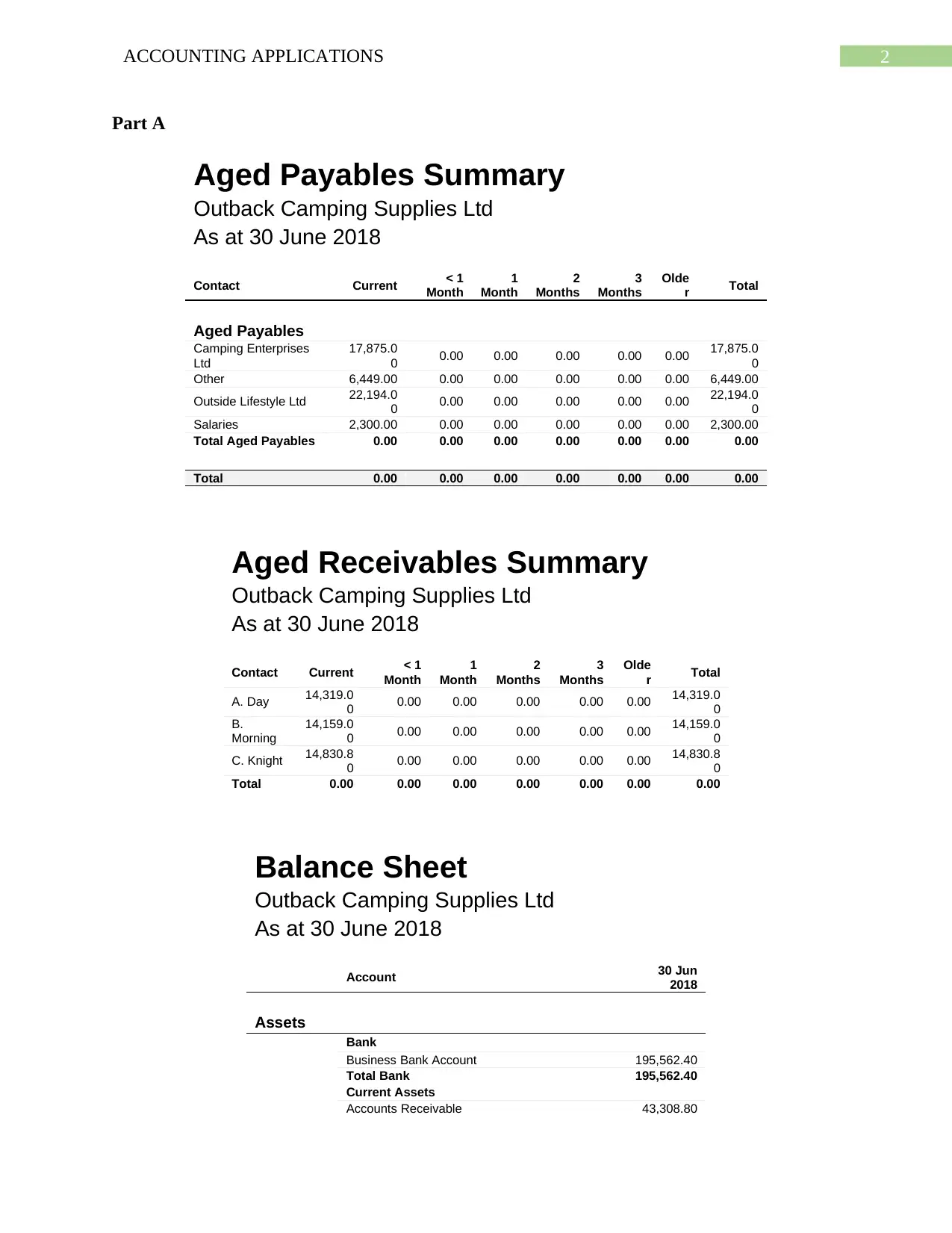
Part A
Aged Payables Summary
Outback Camping Supplies Ltd
As at 30 June 2018
Contact Current < 1
Month
1
Month
2
Months
3
Months
Olde
r Total
Aged Payables
Camping Enterprises
Ltd
17,875.0
0 0.00 0.00 0.00 0.00 0.00 17,875.0
0
Other 6,449.00 0.00 0.00 0.00 0.00 0.00 6,449.00
Outside Lifestyle Ltd 22,194.0
0 0.00 0.00 0.00 0.00 0.00 22,194.0
0
Salaries 2,300.00 0.00 0.00 0.00 0.00 0.00 2,300.00
Total Aged Payables 0.00 0.00 0.00 0.00 0.00 0.00 0.00
Total 0.00 0.00 0.00 0.00 0.00 0.00 0.00
Aged Receivables Summary
Outback Camping Supplies Ltd
As at 30 June 2018
Contact Current < 1
Month
1
Month
2
Months
3
Months
Olde
r Total
A. Day 14,319.0
0 0.00 0.00 0.00 0.00 0.00 14,319.0
0
B.
Morning
14,159.0
0 0.00 0.00 0.00 0.00 0.00 14,159.0
0
C. Knight 14,830.8
0 0.00 0.00 0.00 0.00 0.00 14,830.8
0
Total 0.00 0.00 0.00 0.00 0.00 0.00 0.00
Balance Sheet
Outback Camping Supplies Ltd
As at 30 June 2018
Account 30 Jun
2018
Assets
Bank
Business Bank Account 195,562.40
Total Bank 195,562.40
Current Assets
Accounts Receivable 43,308.80
Document Page
3ACCOUNTING APPLICATIONS
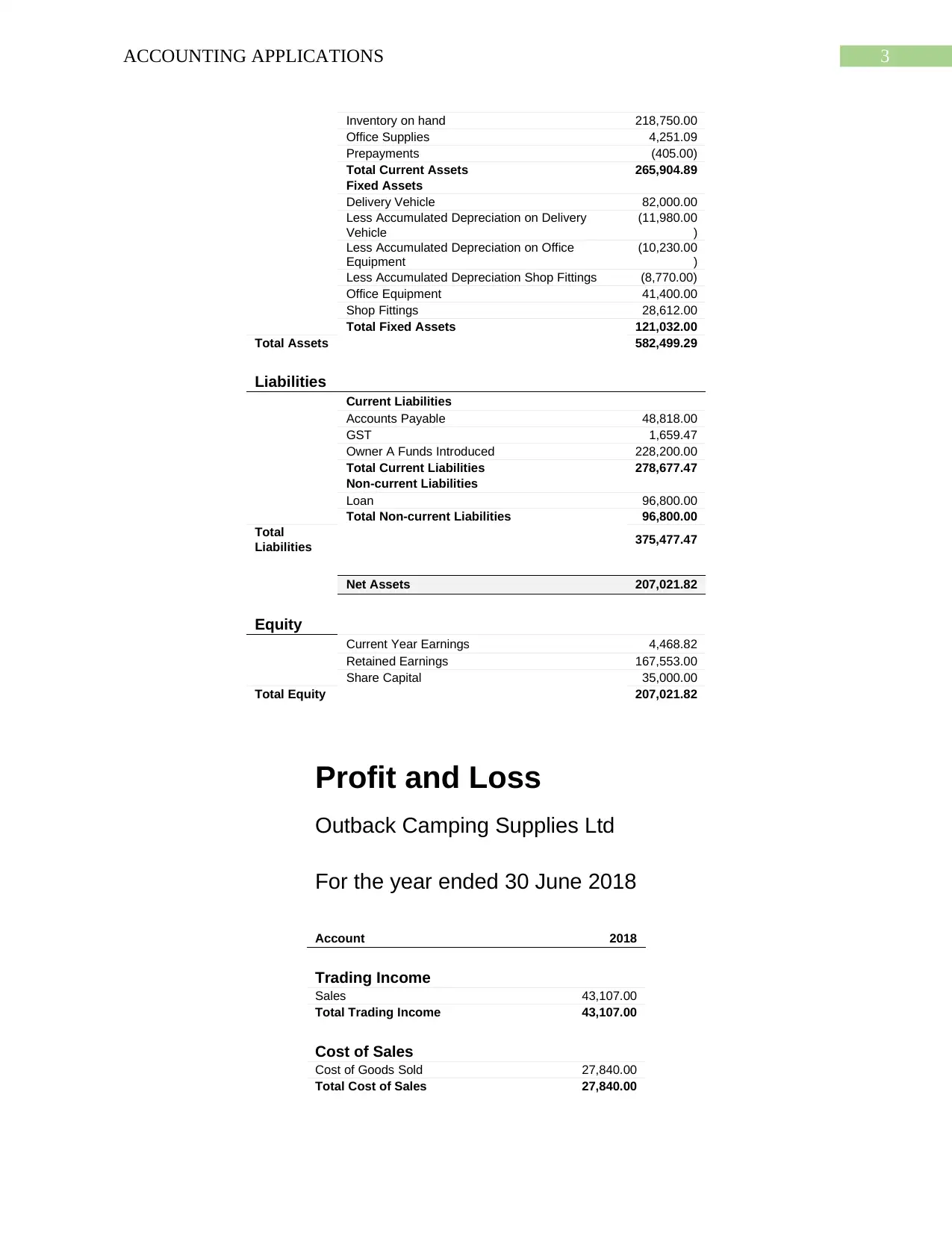
Inventory on hand 218,750.00
Office Supplies 4,251.09
Prepayments (405.00)
Total Current Assets 265,904.89
Fixed Assets
Delivery Vehicle 82,000.00
Less Accumulated Depreciation on Delivery
Vehicle
(11,980.00
)
Less Accumulated Depreciation on Office
Equipment
(10,230.00
)
Less Accumulated Depreciation Shop Fittings (8,770.00)
Office Equipment 41,400.00
Shop Fittings 28,612.00
Total Fixed Assets 121,032.00
Total Assets 582,499.29
Liabilities
Current Liabilities
Accounts Payable 48,818.00
GST 1,659.47
Owner A Funds Introduced 228,200.00
Total Current Liabilities 278,677.47
Non-current Liabilities
Loan 96,800.00
Total Non-current Liabilities 96,800.00
Total
Liabilities 375,477.47
Net Assets 207,021.82
Equity
Current Year Earnings 4,468.82
Retained Earnings 167,553.00
Share Capital 35,000.00
Total Equity 207,021.82
Profit and Loss
Outback Camping Supplies Ltd
For the year ended 30 June 2018
Account 2018
Trading Income
Sales 43,107.00
Total Trading Income 43,107.00
Cost of Sales
Cost of Goods Sold 27,840.00
Total Cost of Sales 27,840.00
tabler-icon-diamond-filled.svg

Paraphrase This Document

Need a fresh take? Get an instant paraphrase of this document with our AI Paraphraser
Document Page
4ACCOUNTING APPLICATIONS
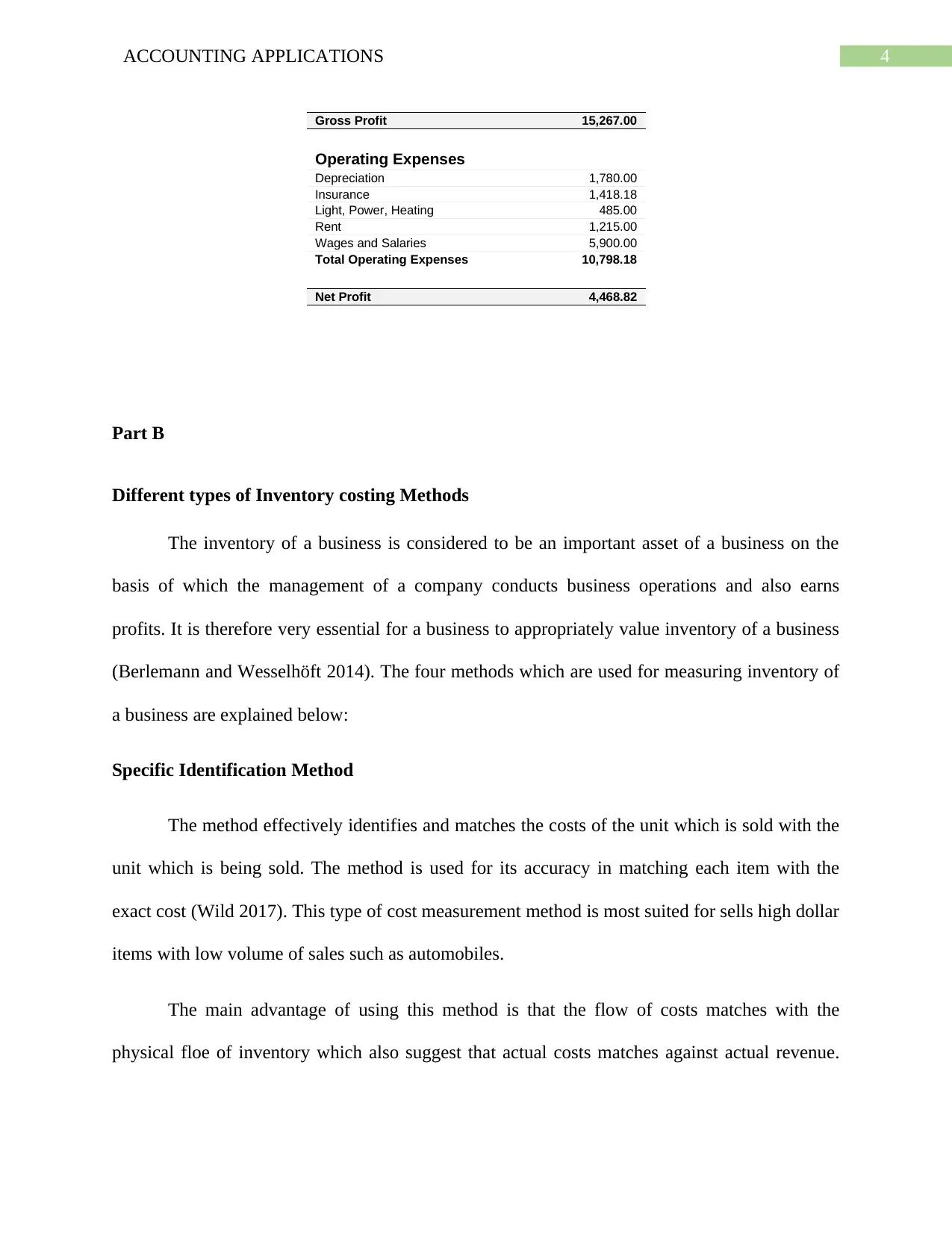
Gross Profit 15,267.00
Operating Expenses
Depreciation 1,780.00
Insurance 1,418.18
Light, Power, Heating 485.00
Rent 1,215.00
Wages and Salaries 5,900.00
Total Operating Expenses 10,798.18
Net Profit 4,468.82
Part B
Different types of Inventory costing Methods
The inventory of a business is considered to be an important asset of a business on the
basis of which the management of a company conducts business operations and also earns
profits. It is therefore very essential for a business to appropriately value inventory of a business
(Berlemann and Wesselhöft 2014). The four methods which are used for measuring inventory of
a business are explained below:
Specific Identification Method
The method effectively identifies and matches the costs of the unit which is sold with the
unit which is being sold. The method is used for its accuracy in matching each item with the
exact cost (Wild 2017). This type of cost measurement method is most suited for sells high dollar
items with low volume of sales such as automobiles.
The main advantage of using this method is that the flow of costs matches with the
physical floe of inventory which also suggest that actual costs matches against actual revenue.
Document Page
5ACCOUNTING APPLICATIONS
The major disadvantage which can be ascertained in this method is that net profit can easily be
manipulated and discrepancies might take place in the records.
First-in first out (FIFO) Method
The method of First-in first out assumes that the inventory are sold in the order in which
the same were manufactured or purchased and costs for valuation are taken accordingly. In other
words, the oldest inventory in the store is sold out first (Nisha 2015). The method is mostly for
products which are more perishable such as food products.
The main advantage of using FIFO method is that it is more logical and simple to
understand and at times of inflation FIFO method enhances the value of remaining inventory
thus increasing the revenue of the business (Onoja and Abdullahi 2015). On the other hand, the
disadvantage which can be identified of FIFO method is that it fails to depict an accurate
presentation of cost when prices of materials are on the rise and there is also no tax advantage in
such a case.
Last-in First out (LIFO) Method
The Last-in first out method assumes that the inventory which are manufactured or
purchased last would be sold out first (Gray 2013). This method is the exact opposite of FIFO
method and it is mostly used in retail businesses such as supermarkets.
The advantages of LIFO method which can be identified are it is most proficient in
matching revenues and costs of business and effectively presents material costs (Onyekwelu and
Ugwuanyi 2014). On the other hand, the disadvantage which can be identified is that inventory
which are valued are not depicting current prices and it is more complex and difficult to
maintain.
Document Page
6ACCOUNTING APPLICATIONS
Weighted Average Method
This method considers the average costs of the all the units which is produced or
purchased during the period for valuing the costs. This method is mostly used in a business
where the products remain the same and there is not much variation in the inventory.
The advantage of weighted average cost method is that it is steadier and reliant method of
recognizing the costs of the inventory. The cost which is shown under this method does not
represent actual costs of the business.
Comparisons between the Methods
The most popular methods which are used for the purpose of valuing inventory are shown
above and each method applies a different approach. In specific identification method, exact cost
for exact unit is considered for valuing the inventory of the business. While in the case of FIFO
method, the inventory which is the oldest is considered to be sold first while in case of LIFO the
latest unit is sold first. This shows that FIFO and LIFO are opposite to each other and used in
retail industries. Weighted average method is used considering all units which are manufactured
or purchased and average costs for the same is considered for valuation (Gu 2013).
An analysis of the above discussion shows that the most appropriate method for valuing
inventory is LIFO method as it provides an appropriate matching for revenue and costs of the
business. Secondly, it has a tax advantage if the method is applied in a business and is most
preferable for a retail business.
tabler-icon-diamond-filled.svg

Paraphrase This Document

Need a fresh take? Get an instant paraphrase of this document with our AI Paraphraser
Document Page
7ACCOUNTING APPLICATIONS
Reference
Berlemann, M. and Wesselhöft, J.E., 2014. Estimating aggregate capital stocks using the
perpetual inventory method. Review of Economics, 65(1), pp.1-34.
Gray, D., 2013. IFRS and US GAAP convergence progressing: As taxpayers voluntarily stop
using LIFO. The International Business & Economics Research Journal (Online), 12(4), p.451.
Gu, S., 2013, October. Research and analysis on issued inventory valuation methods of
enterprises. In International Academic Workshop on Social Science (IAW-SC-13). Atlantis Press.
Nisha, N., 2015. Inventory valuation practices: A developing country perspective. International
Journal of Information Research and Review, 2(7), pp.867-874.
Onoja, E.E. and Abdullahi, Y.U., 2015. Inventory valuation practices and reporting: Nigerian
textile industry experience. Mediterranean Journal of Social Sciences, 6(4), p.74.
Onyekwelu, U. and Ugwuanyi, U.B., 2014. Effects of IFRS adoption on inventory valuation and
financial reporting in Nigeria. European Journal of Business and Management, 6(8), pp.29-34.
Wild, T., 2017. Best practice in inventory management. Routledge.
chevron_up_icon
1 out of 8
circle_padding
hide_on_mobile
zoom_out_icon
[object Object]