Price Elasticity and Monopoly Power Analysis: Accounting Assignment
VerifiedAdded on 2023/01/19
|10
|2383
|33
Report
AI Summary
This accounting assignment, completed by a student, addresses two key economic concepts: price elasticity of demand and monopoly power. The first part analyzes the price elasticity of demand for three different products or services, referencing articles published between 2017 and 2019. The student examines the magnitudes of these estimates, considering standard economic determinants. The second part of the assignment focuses on the Australian banking industry, identifying an organization with significant monopoly power (Commonwealth Bank of Australia). The report discusses the sources of this monopoly power, how the organization benefits, and the impact on consumers, including both the advantages and disadvantages of such power. The assignment draws on various sources to support its arguments, providing a comprehensive overview of the topics.

Accounting
Assignment
Assignment

Paraphrase This Document
Need a fresh take? Get an instant paraphrase of this document with our AI Paraphraser
By student name
Professor
University
Date: 19TH April 2019.
Page 1
Professor
University
Date: 19TH April 2019.
Page 1
Table of Contents
Question 1..................................................................................................................... 3
First Article................................................................................................................. 3
Second Article............................................................................................................. 3
Third Article............................................................................................................... 4
Magnitude of these Estimates of the three articles.....................................................................5
Question 2..................................................................................................................... 6
References..................................................................................................................... 9
Page 2
Question 1..................................................................................................................... 3
First Article................................................................................................................. 3
Second Article............................................................................................................. 3
Third Article............................................................................................................... 4
Magnitude of these Estimates of the three articles.....................................................................5
Question 2..................................................................................................................... 6
References..................................................................................................................... 9
Page 2
⊘ This is a preview!⊘
Do you want full access?
Subscribe today to unlock all pages.

Trusted by 1+ million students worldwide
Question 1
Three articles have been stated below that highlights the elasticity of the demand with regards to
the price.
First Article
The first article has been published in Thought Co, and highlights the elasticity of gasoline,
whether the imposition of taxes shall reduce the consumption of gas. It highlights the price
elasticity of demand of gasoline and states that in practical life, the price elasticity is said to be
very hypothetical, as even though the price increases, people will consume gas, as it is needed
for their daily activities. Two meta-analysis on the elasticity of gasoline has been provided in this
article. The first was published in the energy journal that was written by Molly Espey and talked
about the variations that were noticed in demand of gasoline in the United States (Moffatt, 2018).
In a short period, analysis like in a year if we see there was a considerable increase in the
demand with fall in prices. However, if we go for long term analysis like a period of 10 years,
the difference was not found so much. The second metanalysis was the contribution of the work
done jointly by Joyce Digraphia Goodwin and Mark Hanly with the title of Review of income
and price elasticities of demand in the road traffic. It highlighted the relationship between prices
of the fuel and the volume of traffic. It was found that with 10% increase in the price of the fuel,
the traffic will come down by 1% in a short period of time and the same shall be 3% in the long
period of time.
Source : https://www.thoughtco.com/price-elasticity-of-demand-for-gasoline-1147841
Second Article
The second article has been written by Econlife in June 2013 and stated the elasticity of price
and demand of Hamilton Tickets. The study highlighted the facts that when an award show is
going in the theaters then the management gets a monopoly status and they can charge different
prices from different group of people, irrespective of the fact that who is ready to pay how much.
In this case it would found the price elasticity was found to be very fluctuating in some group of
people, where in some group the demand was very inelastic (Schwartz, 2017). There were people
Page 3
Three articles have been stated below that highlights the elasticity of the demand with regards to
the price.
First Article
The first article has been published in Thought Co, and highlights the elasticity of gasoline,
whether the imposition of taxes shall reduce the consumption of gas. It highlights the price
elasticity of demand of gasoline and states that in practical life, the price elasticity is said to be
very hypothetical, as even though the price increases, people will consume gas, as it is needed
for their daily activities. Two meta-analysis on the elasticity of gasoline has been provided in this
article. The first was published in the energy journal that was written by Molly Espey and talked
about the variations that were noticed in demand of gasoline in the United States (Moffatt, 2018).
In a short period, analysis like in a year if we see there was a considerable increase in the
demand with fall in prices. However, if we go for long term analysis like a period of 10 years,
the difference was not found so much. The second metanalysis was the contribution of the work
done jointly by Joyce Digraphia Goodwin and Mark Hanly with the title of Review of income
and price elasticities of demand in the road traffic. It highlighted the relationship between prices
of the fuel and the volume of traffic. It was found that with 10% increase in the price of the fuel,
the traffic will come down by 1% in a short period of time and the same shall be 3% in the long
period of time.
Source : https://www.thoughtco.com/price-elasticity-of-demand-for-gasoline-1147841
Second Article
The second article has been written by Econlife in June 2013 and stated the elasticity of price
and demand of Hamilton Tickets. The study highlighted the facts that when an award show is
going in the theaters then the management gets a monopoly status and they can charge different
prices from different group of people, irrespective of the fact that who is ready to pay how much.
In this case it would found the price elasticity was found to be very fluctuating in some group of
people, where in some group the demand was very inelastic (Schwartz, 2017). There were people
Page 3
Paraphrase This Document
Need a fresh take? Get an instant paraphrase of this document with our AI Paraphraser
who preferred to buy the tickets only when the prices went down and there were people who
bought the tickets irrespective of the prices whether they were. Thus, we see that demand keep
fluctuating on all ends.
Sources: Econlife, by Elaine Schwartz, dated June 13,2017 ( Prices takenFrom NY Daily
News)
Third Article
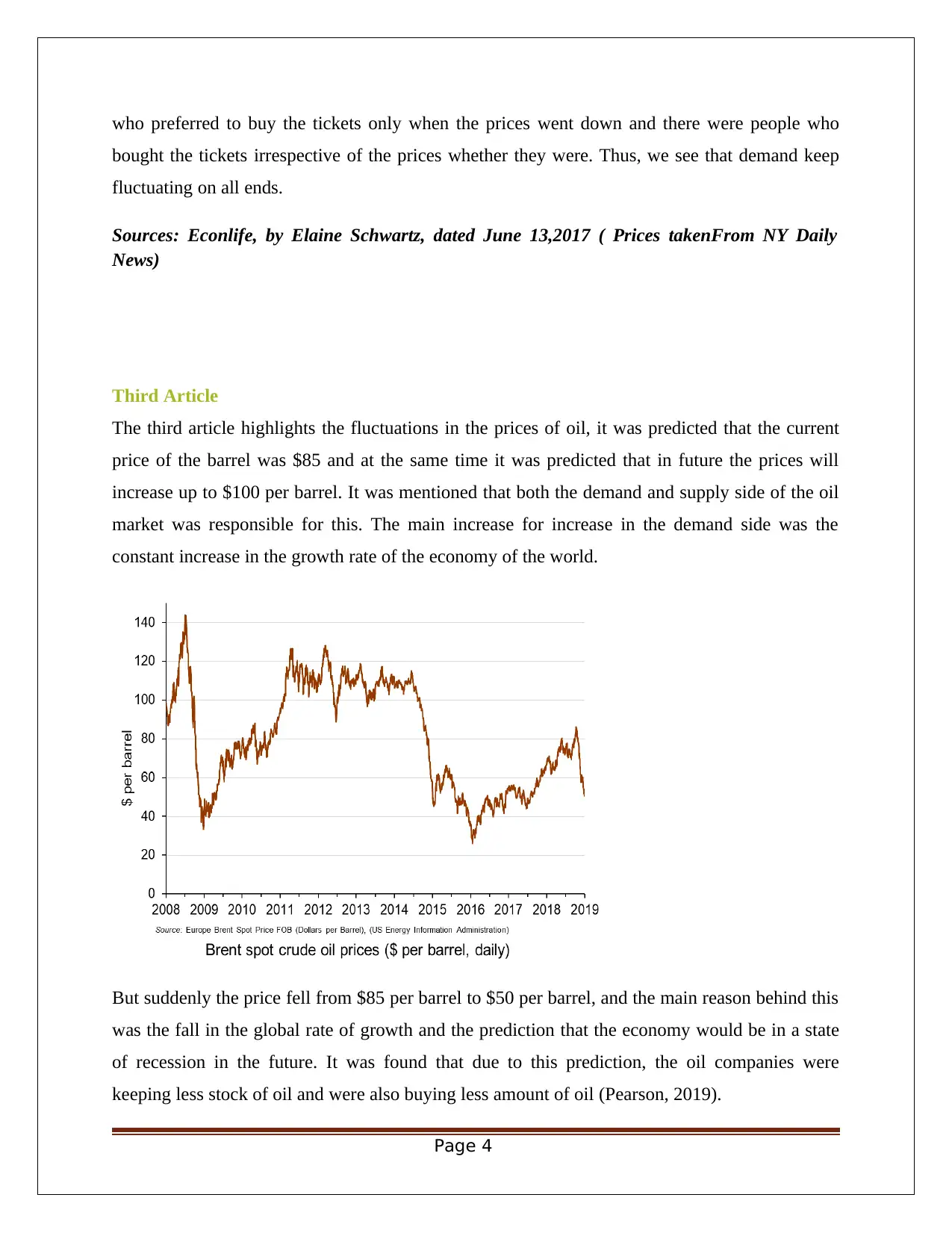
The third article highlights the fluctuations in the prices of oil, it was predicted that the current
price of the barrel was $85 and at the same time it was predicted that in future the prices will
increase up to $100 per barrel. It was mentioned that both the demand and supply side of the oil
market was responsible for this. The main increase for increase in the demand side was the
constant increase in the growth rate of the economy of the world.
But suddenly the price fell from $85 per barrel to $50 per barrel, and the main reason behind this
was the fall in the global rate of growth and the prediction that the economy would be in a state
of recession in the future. It was found that due to this prediction, the oil companies were
keeping less stock of oil and were also buying less amount of oil (Pearson, 2019).
Page 4
bought the tickets irrespective of the prices whether they were. Thus, we see that demand keep
fluctuating on all ends.
Sources: Econlife, by Elaine Schwartz, dated June 13,2017 ( Prices takenFrom NY Daily
News)
Third Article
The third article highlights the fluctuations in the prices of oil, it was predicted that the current
price of the barrel was $85 and at the same time it was predicted that in future the prices will
increase up to $100 per barrel. It was mentioned that both the demand and supply side of the oil
market was responsible for this. The main increase for increase in the demand side was the
constant increase in the growth rate of the economy of the world.
But suddenly the price fell from $85 per barrel to $50 per barrel, and the main reason behind this
was the fall in the global rate of growth and the prediction that the economy would be in a state
of recession in the future. It was found that due to this prediction, the oil companies were
keeping less stock of oil and were also buying less amount of oil (Pearson, 2019).
Page 4
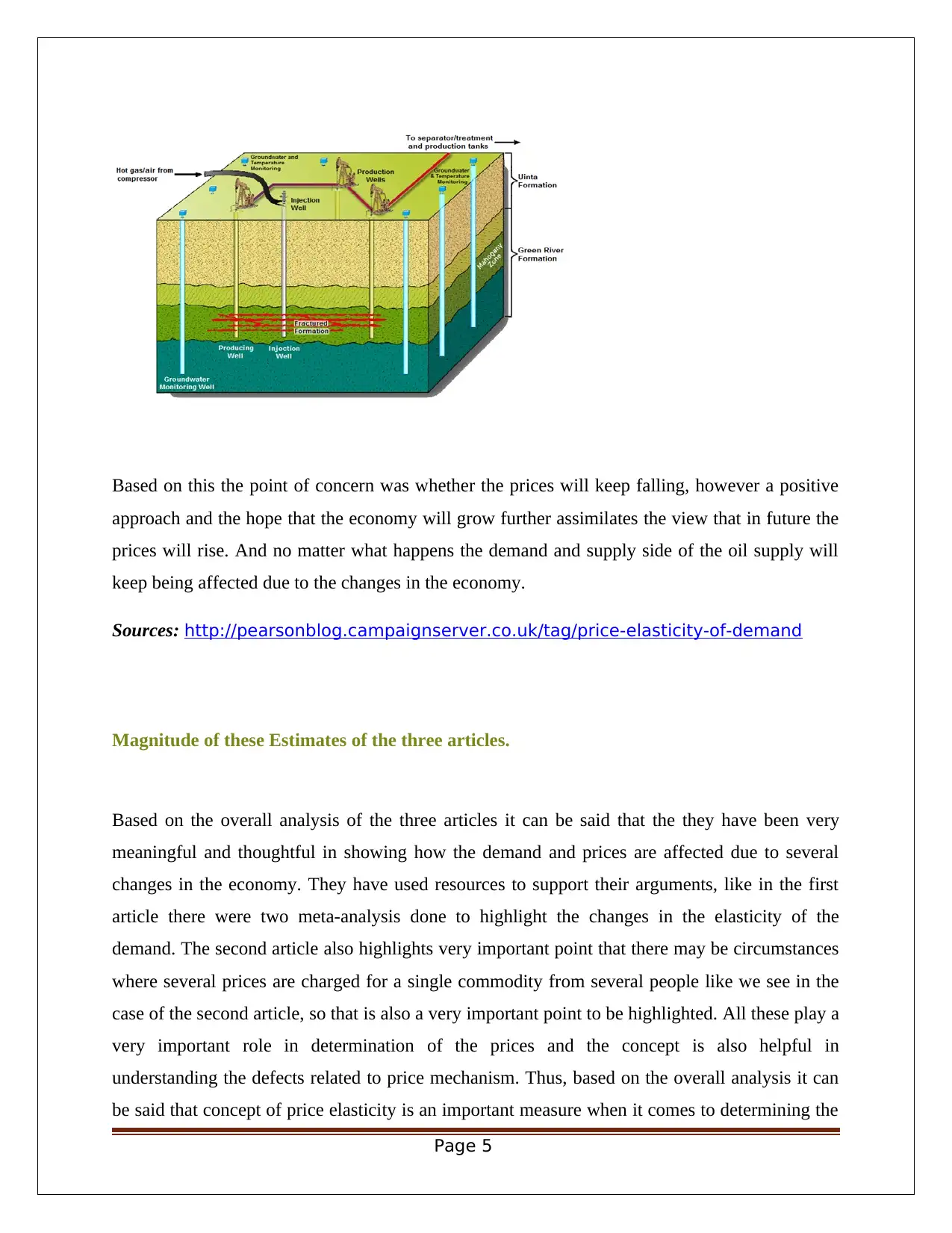
Based on this the point of concern was whether the prices will keep falling, however a positive
approach and the hope that the economy will grow further assimilates the view that in future the
prices will rise. And no matter what happens the demand and supply side of the oil supply will
keep being affected due to the changes in the economy.
Sources: http://pearsonblog.campaignserver.co.uk/tag/price-elasticity-of-demand
Magnitude of these Estimates of the three articles.
Based on the overall analysis of the three articles it can be said that the they have been very
meaningful and thoughtful in showing how the demand and prices are affected due to several
changes in the economy. They have used resources to support their arguments, like in the first
article there were two meta-analysis done to highlight the changes in the elasticity of the
demand. The second article also highlights very important point that there may be circumstances
where several prices are charged for a single commodity from several people like we see in the
case of the second article, so that is also a very important point to be highlighted. All these play a
very important role in determination of the prices and the concept is also helpful in
understanding the defects related to price mechanism. Thus, based on the overall analysis it can
be said that concept of price elasticity is an important measure when it comes to determining the
Page 5
approach and the hope that the economy will grow further assimilates the view that in future the
prices will rise. And no matter what happens the demand and supply side of the oil supply will
keep being affected due to the changes in the economy.
Sources: http://pearsonblog.campaignserver.co.uk/tag/price-elasticity-of-demand
Magnitude of these Estimates of the three articles.
Based on the overall analysis of the three articles it can be said that the they have been very
meaningful and thoughtful in showing how the demand and prices are affected due to several
changes in the economy. They have used resources to support their arguments, like in the first
article there were two meta-analysis done to highlight the changes in the elasticity of the
demand. The second article also highlights very important point that there may be circumstances
where several prices are charged for a single commodity from several people like we see in the
case of the second article, so that is also a very important point to be highlighted. All these play a
very important role in determination of the prices and the concept is also helpful in
understanding the defects related to price mechanism. Thus, based on the overall analysis it can
be said that concept of price elasticity is an important measure when it comes to determining the
Page 5
⊘ This is a preview!⊘
Do you want full access?
Subscribe today to unlock all pages.
Trusted by 1+ million students worldwide
prices and value for different products. This basic thought has been very much elaborated in all
the three articles above. The articles have been included in renowned publications, thus they also
increase the confidence of the users in such articles and provides them with relevant information
that would help in understanding how the economy works in different situation.
Question 2
The banking industry in Australia have significant monopoly power and there are just few banks
that control the entire industry. The banking industry is dominated by four banks that includes
Commonwealth Bank of Australia, Westpac Banking Corporation, Australia and New Zealand
Banking Group, and National Australia Bank. There are other smaller banks also in the industry,
but these four banks occupy 80% of the entire operations and thus there is a huge barrier for the
entry of new entrants in the industry (Borit & Olsen, 2012).
The Commonwealth Bank of Australia is the largest bank that provides several financial services
including retail, business and institutional banking. It is the largest Australian listed company on
the Australian Securities Exchange in 2015 and is listed on the Australian Stock Exchange. The
company was founded in 1911 and has been in operation since the long time (Dierks, et al.,
2017). The company has the maximum share in the overall operations in the industry and along
Page 6
the three articles above. The articles have been included in renowned publications, thus they also
increase the confidence of the users in such articles and provides them with relevant information
that would help in understanding how the economy works in different situation.
Question 2
The banking industry in Australia have significant monopoly power and there are just few banks
that control the entire industry. The banking industry is dominated by four banks that includes
Commonwealth Bank of Australia, Westpac Banking Corporation, Australia and New Zealand
Banking Group, and National Australia Bank. There are other smaller banks also in the industry,
but these four banks occupy 80% of the entire operations and thus there is a huge barrier for the
entry of new entrants in the industry (Borit & Olsen, 2012).
The Commonwealth Bank of Australia is the largest bank that provides several financial services
including retail, business and institutional banking. It is the largest Australian listed company on
the Australian Securities Exchange in 2015 and is listed on the Australian Stock Exchange. The
company was founded in 1911 and has been in operation since the long time (Dierks, et al.,
2017). The company has the maximum share in the overall operations in the industry and along
Page 6
Paraphrase This Document
Need a fresh take? Get an instant paraphrase of this document with our AI Paraphraser
with the four other major retail banks the organization has form a cartel, and they do not allow
the entry of other banks in the industry. They control the overall interest rates fluctuations and
are managing the flow of funds in the company.
The organization benefits a lot from the monopoly power that it has, the monopoly power came
from the fact that the organization was able to start its operation in the several years ago, before
other banks came into the picture, thus this gives the bank a superior hand over its competitor.
The company enjoy monopoly power in terms of management of the interest rates, as even
though there are fluctuations in the market, the commonwealth bank will not be affected by it.
The company has a huge consumer base and they have always switched to the services that the
company is providing. The bank has also changed its course of operations in the current year and
have try to bring in the technologically advanced services so that their consumer can benefit
from the same. This includes the fact that the company has started to become more consumer
centric in its overall approach and aims to provide its consumer with the best services, and
because of this change and the facilities that the bank is providing the customer do not switch to
other banks. The structure of the bank is such that it does not allow the entry of other banks into
the industry (Giacomo, et al., 2013). The cartel contributes to almost 75% of the total revenue of
the industry and this also contributes to the industry and the GDP and the economy. Thus, the
government also supports their operations and make sure that the regulatory requirements of the
banks are not so complex that the banks are not able to fulfil and there is a hindrance in their
operations. So, the government also support the banks and thus we see that there is a huge
support to the bank in the industry and so we see that there is a huge exercise of monopoly power
in the industry.
In case the monopoly power is lost, that will be both good and bad for the consumers. As the
monopoly power is lost we will see that there will be entry of new banks into the system, which
means that there will be leverage of funds. The new banks will include different retail banks and
foreign banks and these banks will provide different services to the consumer hence they will
benefit from the same. The interest rates fluctuation can be also controlled, as new entrants shall
always try to provide the best services at the lower prices so that they can make a hold in the
industry. So, this will be a win-win situation for the consumer, but there are negative points also
of losing the monopoly power, as we see that this lose will lead to the banks losing their hold in
Page 7
the entry of other banks in the industry. They control the overall interest rates fluctuations and
are managing the flow of funds in the company.
The organization benefits a lot from the monopoly power that it has, the monopoly power came
from the fact that the organization was able to start its operation in the several years ago, before
other banks came into the picture, thus this gives the bank a superior hand over its competitor.
The company enjoy monopoly power in terms of management of the interest rates, as even
though there are fluctuations in the market, the commonwealth bank will not be affected by it.
The company has a huge consumer base and they have always switched to the services that the
company is providing. The bank has also changed its course of operations in the current year and
have try to bring in the technologically advanced services so that their consumer can benefit
from the same. This includes the fact that the company has started to become more consumer
centric in its overall approach and aims to provide its consumer with the best services, and
because of this change and the facilities that the bank is providing the customer do not switch to
other banks. The structure of the bank is such that it does not allow the entry of other banks into
the industry (Giacomo, et al., 2013). The cartel contributes to almost 75% of the total revenue of
the industry and this also contributes to the industry and the GDP and the economy. Thus, the
government also supports their operations and make sure that the regulatory requirements of the
banks are not so complex that the banks are not able to fulfil and there is a hindrance in their
operations. So, the government also support the banks and thus we see that there is a huge
support to the bank in the industry and so we see that there is a huge exercise of monopoly power
in the industry.
In case the monopoly power is lost, that will be both good and bad for the consumers. As the
monopoly power is lost we will see that there will be entry of new banks into the system, which
means that there will be leverage of funds. The new banks will include different retail banks and
foreign banks and these banks will provide different services to the consumer hence they will
benefit from the same. The interest rates fluctuation can be also controlled, as new entrants shall
always try to provide the best services at the lower prices so that they can make a hold in the
industry. So, this will be a win-win situation for the consumer, but there are negative points also
of losing the monopoly power, as we see that this lose will lead to the banks losing their hold in
Page 7
the industry (Kaufmann, 2017). The industry might not be properly regulated as we see that there
would be so many new banks in the system, so the government needs to make better regulations
so that they can control the operations of all such banks. There are high chances that this entry of
new banks can be beneficial for the industry or can be negative in a way that it disrupts the sector
and the interest rates increase. There is a huge household debt in Australia and the growth of the
economy depends on the income ratio to the household debt. Thus, if there are new banks in the
system we will see that there will be an increase in the overall household debt and that will lead
to less liquid assets and more liability and this might hamper the financial statements and the
financial growth of the economy. Thus, it would be imperative if there are new banks coming
into the system, the process should be highly regulated, there should be entry barriers in some
fields, which the government need to take care of. The four biggest retail banks in Australia are
the pillars based on which this industry stands, and hence it is important that government
supports the operation of these banks (Kusnadi & Wei, 2017). The Commonwealth bank is the
flag bearer of the banking industry in Australia and the government cannot ignore that fact and it
would be hard to snatch the monopoly power from this bank. The monopoly power is enjoyed in
terms of different services also within the sector as the bank is having a huge support from its
consumers.
Based on the overall analysis if the bank loses its financial monopoly power, the consumer will
both gain and lose, as they will have new services but there are high chances that the industry
will get deregulated because of that. So, the aim should be that the government exercise its
power and make sure that entry and exit of banks in the industry is regulated and supports the
overall operations of the banks by forming good regulatory measures to support the operations of
the industry.
Page 8
would be so many new banks in the system, so the government needs to make better regulations
so that they can control the operations of all such banks. There are high chances that this entry of
new banks can be beneficial for the industry or can be negative in a way that it disrupts the sector
and the interest rates increase. There is a huge household debt in Australia and the growth of the
economy depends on the income ratio to the household debt. Thus, if there are new banks in the
system we will see that there will be an increase in the overall household debt and that will lead
to less liquid assets and more liability and this might hamper the financial statements and the
financial growth of the economy. Thus, it would be imperative if there are new banks coming
into the system, the process should be highly regulated, there should be entry barriers in some
fields, which the government need to take care of. The four biggest retail banks in Australia are
the pillars based on which this industry stands, and hence it is important that government
supports the operation of these banks (Kusnadi & Wei, 2017). The Commonwealth bank is the
flag bearer of the banking industry in Australia and the government cannot ignore that fact and it
would be hard to snatch the monopoly power from this bank. The monopoly power is enjoyed in
terms of different services also within the sector as the bank is having a huge support from its
consumers.
Based on the overall analysis if the bank loses its financial monopoly power, the consumer will
both gain and lose, as they will have new services but there are high chances that the industry
will get deregulated because of that. So, the aim should be that the government exercise its
power and make sure that entry and exit of banks in the industry is regulated and supports the
overall operations of the banks by forming good regulatory measures to support the operations of
the industry.
Page 8
⊘ This is a preview!⊘
Do you want full access?
Subscribe today to unlock all pages.
Trusted by 1+ million students worldwide
References
Borit, M. & Olsen, P., 2012. Evaluation framework for regulatory requirements
related to data recording and traceability designed to prevent illegal, unreported
and unregulated fishing. Marine Policy, 36(1), pp. 96-102.
Dierks, R., Bruyere, O. & Reginster, O., 2017. Critical analysis of valuation and
strategical orientation of merger and acquisition deals in the pharmaceutical
industry. Expert Review of Pharmacoeconomics & Outcomes Research , 2(3), pp.
147-160.
Giacomo, B., Kamalesh, K. & Giovanna, M., 2013. Descriptive, instrumental and
strategic approaches to corporate social responsibility. Accounting, Auditing &
Accountability Journal, 26(3), pp. 399-422.
Kaufmann, W., 2017. The Problem of Regulatory Unreasonableness. First ed. New
York: Routledge.
Kusnadi, Y. & Wei, K., 2017. The equity-financing channel, the catering channel, and
corporate investment: International evidence. Journal of Corporate Finance, Volume
47, pp. 236-252.
Moffatt, M., 2018. The Price Elasticity of Demand for Gasoline. ThoughtCo., 3
September, pp. 1-2.
Pearson, b., 2019. Tag: price elasticity of demand. THE SLOMAN ECONOMICS NEWS
SITE, 5 January, pp. 1-1.
Schwartz, E., 2017. An Elasticity Story: Stretching to Buy Hamilton Tickets. Econlife,
13 June, pp. 1-1.
Page 9
Borit, M. & Olsen, P., 2012. Evaluation framework for regulatory requirements
related to data recording and traceability designed to prevent illegal, unreported
and unregulated fishing. Marine Policy, 36(1), pp. 96-102.
Dierks, R., Bruyere, O. & Reginster, O., 2017. Critical analysis of valuation and
strategical orientation of merger and acquisition deals in the pharmaceutical
industry. Expert Review of Pharmacoeconomics & Outcomes Research , 2(3), pp.
147-160.
Giacomo, B., Kamalesh, K. & Giovanna, M., 2013. Descriptive, instrumental and
strategic approaches to corporate social responsibility. Accounting, Auditing &
Accountability Journal, 26(3), pp. 399-422.
Kaufmann, W., 2017. The Problem of Regulatory Unreasonableness. First ed. New
York: Routledge.
Kusnadi, Y. & Wei, K., 2017. The equity-financing channel, the catering channel, and
corporate investment: International evidence. Journal of Corporate Finance, Volume
47, pp. 236-252.
Moffatt, M., 2018. The Price Elasticity of Demand for Gasoline. ThoughtCo., 3
September, pp. 1-2.
Pearson, b., 2019. Tag: price elasticity of demand. THE SLOMAN ECONOMICS NEWS
SITE, 5 January, pp. 1-1.
Schwartz, E., 2017. An Elasticity Story: Stretching to Buy Hamilton Tickets. Econlife,
13 June, pp. 1-1.
Page 9

1 out of 10


Your All-in-One AI-Powered Toolkit for Academic Success.
+13062052269
info@desklib.com
Available 24*7 on WhatsApp / Email
![[object Object]](/_next/static/media/star-bottom.7253800d.svg)
Unlock your academic potential
Copyright © 2020–2026 A2Z Services. All Rights Reserved. Developed and managed by ZUCOL.