Accounting Exercises: Stock Options, Restricted Stock & EPS Analysis

Verified

Added on  2023/05/30

|6
|599
|117
Homework Assignment
AI Summary
This assignment provides solutions to accounting exercises focusing on stock options, restricted stock awards, and earnings per share (EPS) calculations. It includes journal entries for recording compensation expenses related to restricted stock and stock options, as well as detailed computations for basic and diluted EPS. The exercises cover topics such as determining total compensation cost, allocating compensation expenses over the vesting period, calculating weighted average common shares outstanding, and accounting for stock dividends and treasury stock transactions. The solutions demonstrate the application of accounting principles in share-based compensation and EPS reporting, offering students a comprehensive guide to these complex areas. Desklib provides access to more solved assignments and past papers for students.
Document Page
ACCOUNTING EXERCISES
STUDENT ID:
[Pick the date]
tabler-icon-diamond-filled.svg

Paraphrase This Document

Need a fresh take? Get an instant paraphrase of this document with our AI Paraphraser
Document Page
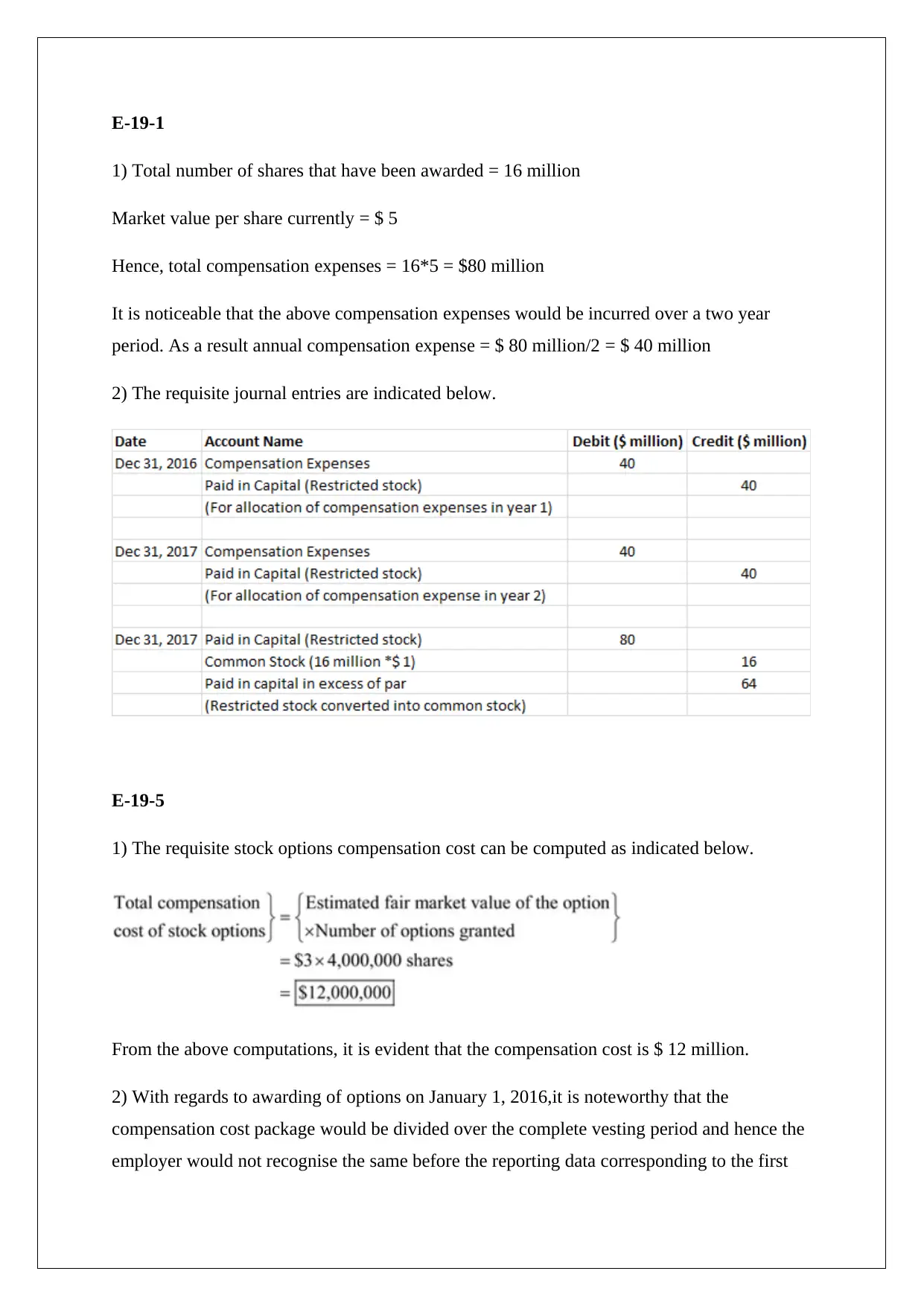
E-19-1
1) Total number of shares that have been awarded = 16 million
Market value per share currently = $ 5
Hence, total compensation expenses = 16*5 = $80 million
It is noticeable that the above compensation expenses would be incurred over a two year
period. As a result annual compensation expense = $ 80 million/2 = $ 40 million
2) The requisite journal entries are indicated below.
E-19-5
1) The requisite stock options compensation cost can be computed as indicated below.
From the above computations, it is evident that the compensation cost is $ 12 million.
2) With regards to awarding of options on January 1, 2016,it is noteworthy that the
compensation cost package would be divided over the complete vesting period and hence the
employer would not recognise the same before the reporting data corresponding to the first
Document Page
completion year. As a result, no journal entry is required to record the transaction as on
January 1, 2016.
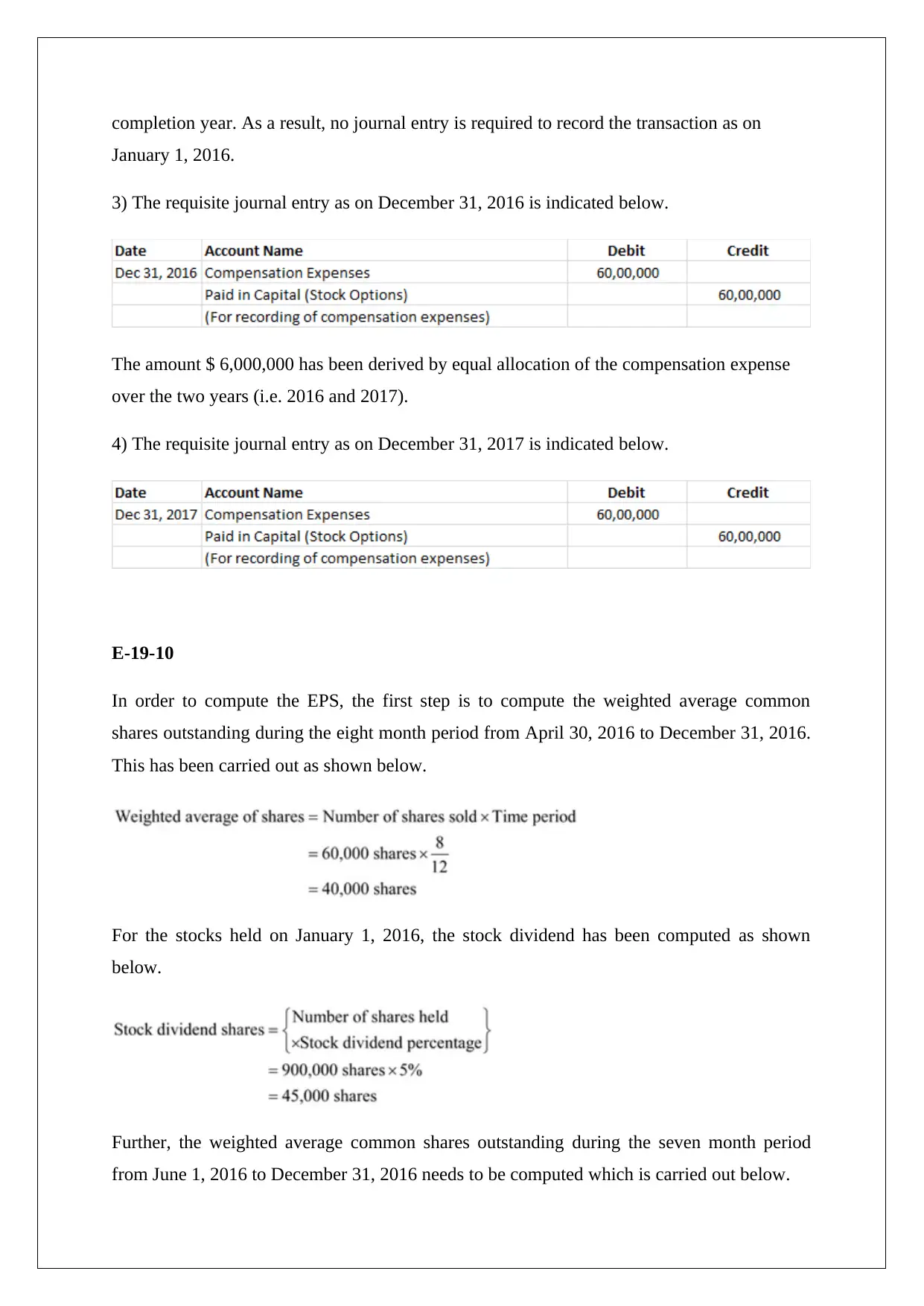
3) The requisite journal entry as on December 31, 2016 is indicated below.
The amount $ 6,000,000 has been derived by equal allocation of the compensation expense
over the two years (i.e. 2016 and 2017).
4) The requisite journal entry as on December 31, 2017 is indicated below.
E-19-10
In order to compute the EPS, the first step is to compute the weighted average common
shares outstanding during the eight month period from April 30, 2016 to December 31, 2016.
This has been carried out as shown below.
For the stocks held on January 1, 2016, the stock dividend has been computed as shown
below.
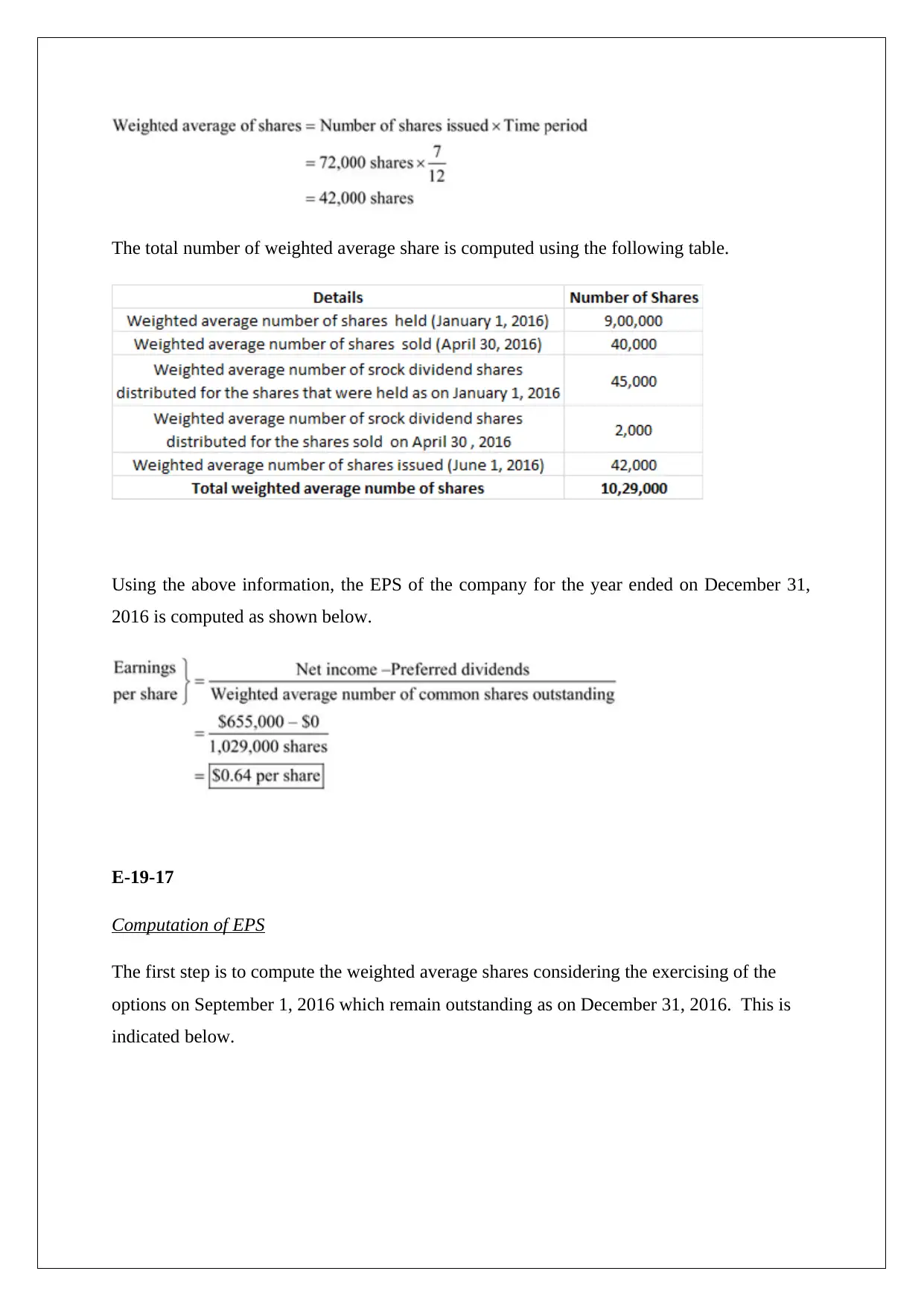
Further, the weighted average common shares outstanding during the seven month period
from June 1, 2016 to December 31, 2016 needs to be computed which is carried out below.
Document Page
The total number of weighted average share is computed using the following table.
Using the above information, the EPS of the company for the year ended on December 31,
2016 is computed as shown below.
E-19-17
Computation of EPS
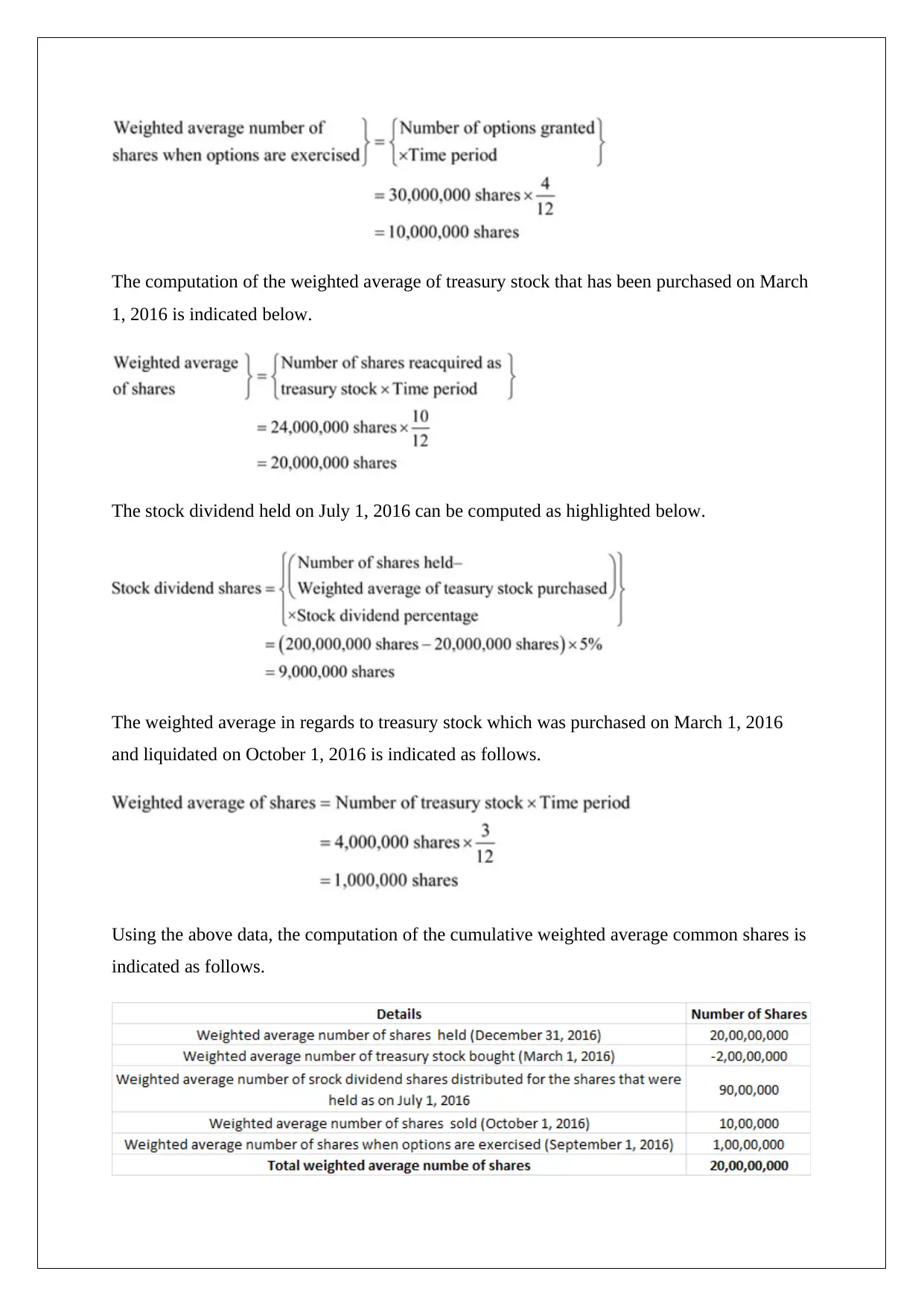
The first step is to compute the weighted average shares considering the exercising of the
options on September 1, 2016 which remain outstanding as on December 31, 2016. This is
indicated below.
tabler-icon-diamond-filled.svg

Paraphrase This Document

Need a fresh take? Get an instant paraphrase of this document with our AI Paraphraser
Document Page
The computation of the weighted average of treasury stock that has been purchased on March
1, 2016 is indicated below.
The stock dividend held on July 1, 2016 can be computed as highlighted below.
The weighted average in regards to treasury stock which was purchased on March 1, 2016
and liquidated on October 1, 2016 is indicated as follows.
Using the above data, the computation of the cumulative weighted average common shares is
indicated as follows.
Document Page
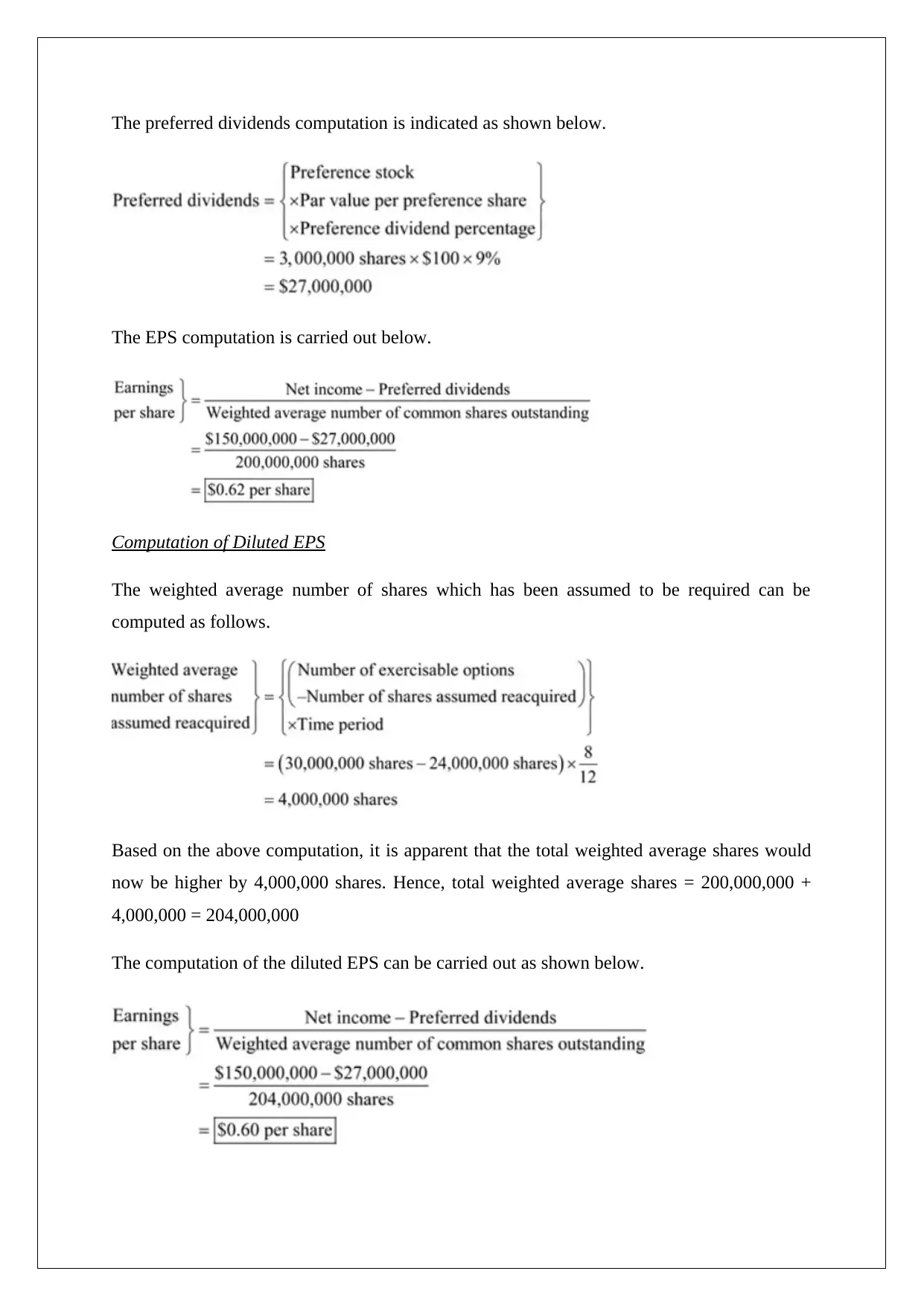
The preferred dividends computation is indicated as shown below.
The EPS computation is carried out below.
Computation of Diluted EPS
The weighted average number of shares which has been assumed to be required can be
computed as follows.
Based on the above computation, it is apparent that the total weighted average shares would
now be higher by 4,000,000 shares. Hence, total weighted average shares = 200,000,000 +
4,000,000 = 204,000,000
The computation of the diluted EPS can be carried out as shown below.
chevron_up_icon
1 out of 6
circle_padding
hide_on_mobile
zoom_out_icon
[object Object]