Report on Costing Techniques: GSK's Financial Analysis
VerifiedAdded on 2022/08/19
|9
|2171
|24
Report
AI Summary
This report provides a detailed analysis of costing techniques, specifically focusing on absorption costing and activity-based costing (ABC), within the context of a business case study involving GSK. The report begins by outlining the nature, source, and purpose of management information, emphasizing its importance in business decision-making. It then delves into the specifics of absorption costing, explaining how overhead costs are allocated based on a single factor, and compares it to ABC, which allocates costs based on activities. The report includes calculations, comparing the costs and selling prices derived from both methods for two GSK products, the multi-vit patch and multi-vit syrup. It interprets the findings, recommending ABC as a more reliable method due to its detailed approach to overhead allocation. The conclusion reinforces the significance of management accounting techniques in business operations and highlights the benefits of ABC for accurate cost determination and informed pricing strategies. The appendix provides detailed calculations for both costing methods.

1
Accounting and finance
Paraphrase This Document
Need a fresh take? Get an instant paraphrase of this document with our AI Paraphraser

2
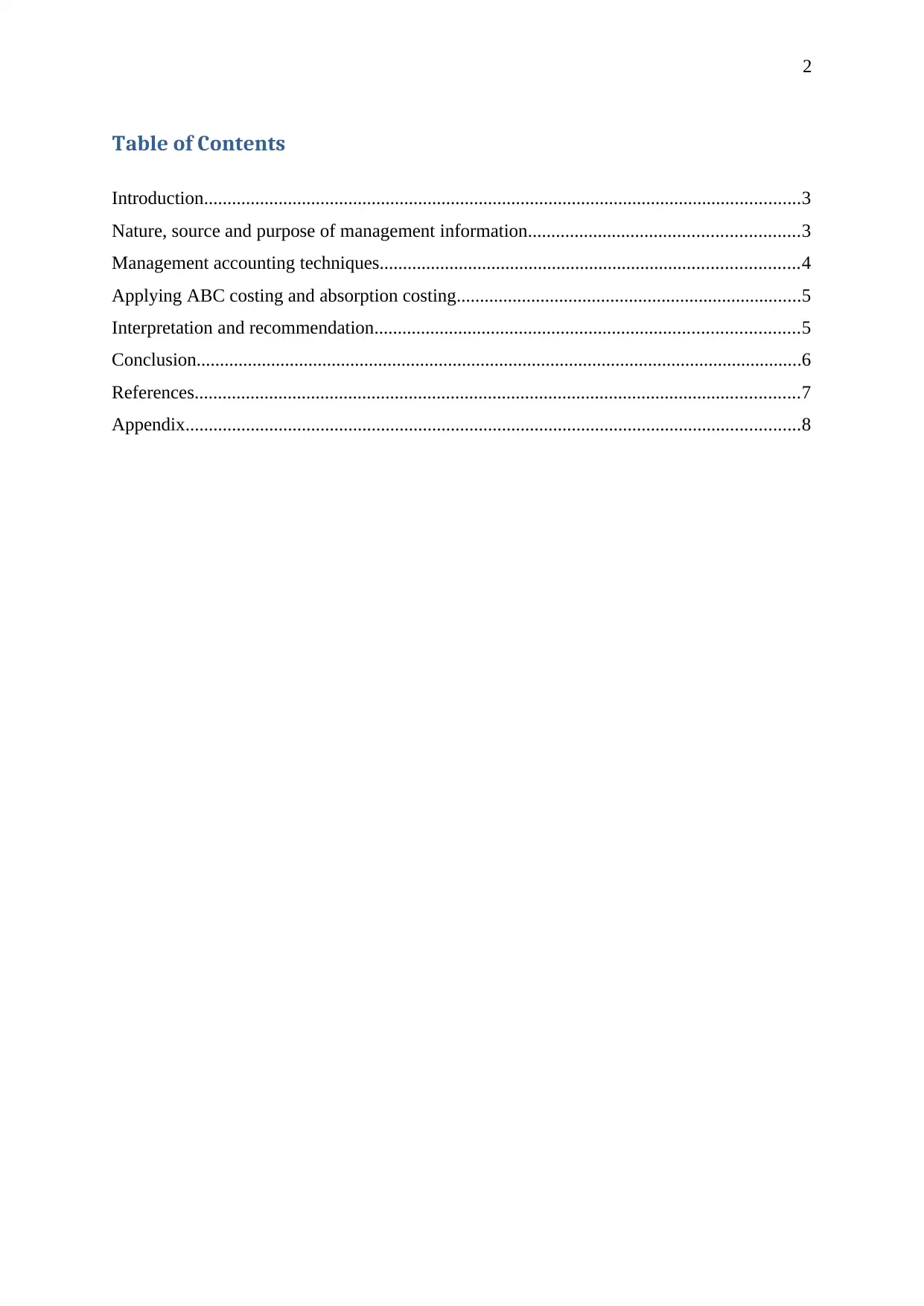
Table of Contents
Introduction................................................................................................................................3
Nature, source and purpose of management information..........................................................3
Management accounting techniques..........................................................................................4
Applying ABC costing and absorption costing..........................................................................5
Interpretation and recommendation...........................................................................................5
Conclusion..................................................................................................................................6
References..................................................................................................................................7
Appendix....................................................................................................................................8
Table of Contents
Introduction................................................................................................................................3
Nature, source and purpose of management information..........................................................3
Management accounting techniques..........................................................................................4
Applying ABC costing and absorption costing..........................................................................5
Interpretation and recommendation...........................................................................................5
Conclusion..................................................................................................................................6
References..................................................................................................................................7
Appendix....................................................................................................................................8

3
Introduction
In the carrying of the business, there are various decisions that are required to be undertaken.
This is done with the help of proper accounting and in that various techniques are available
which will be used. There will be a proper discussion that will be carried in the report
presented below. The costing techniques will be used and in that absorption costing and
activity-based costing will be considered. There will be consideration of the information
provided and with that proper evaluation will be made so that appropriate decision making
can be made possible. The costing strategy will be recommended on the basis of the findings
which will be made in the report.
Nature, source and purpose of management information
In the business, there are various types of information that are involved and they are of great
use in several processes that are carried. In GSK it is required that the management
information is collected from all the activities which are performed. It has been identified that
GSK is incorporating three global businesses in which development, research, and
manufacturing is involved in relation to the pharmaceuticals medicines. In addition to this,
they also deal in the consumer healthcare products and vaccines (Taipaleenmäki and
Ikäheimo, 2013). It is involved in healthcare facilities and all the information which is
collected by management is related to the same. They focus on making such products by
which customer satisfaction will be increased and that will be made possible by making the
required changes.
The information which is required can be collected from various sources and they are
available online. In the given case the information about the GSK can be obtained from the
website of the company or the annual report which is issued by it. All the companies are
required to meet with reporting requirements and in that it is required that annual report shall
be prepared in an effective manner (Quinn, 2014). In that, all the information in relation to
business and its operations is provided. With the help of that data proper evaluation of
performance and position can be made possible.
The main purpose for which the management information is collected is to make the proper
evaluation and analysis. There are various aspects which are involved and it is required that
the best decision in relation to them shall be made. There are various options which are
Introduction
In the carrying of the business, there are various decisions that are required to be undertaken.
This is done with the help of proper accounting and in that various techniques are available
which will be used. There will be a proper discussion that will be carried in the report
presented below. The costing techniques will be used and in that absorption costing and
activity-based costing will be considered. There will be consideration of the information
provided and with that proper evaluation will be made so that appropriate decision making
can be made possible. The costing strategy will be recommended on the basis of the findings
which will be made in the report.
Nature, source and purpose of management information
In the business, there are various types of information that are involved and they are of great
use in several processes that are carried. In GSK it is required that the management
information is collected from all the activities which are performed. It has been identified that
GSK is incorporating three global businesses in which development, research, and
manufacturing is involved in relation to the pharmaceuticals medicines. In addition to this,
they also deal in the consumer healthcare products and vaccines (Taipaleenmäki and
Ikäheimo, 2013). It is involved in healthcare facilities and all the information which is
collected by management is related to the same. They focus on making such products by
which customer satisfaction will be increased and that will be made possible by making the
required changes.
The information which is required can be collected from various sources and they are
available online. In the given case the information about the GSK can be obtained from the
website of the company or the annual report which is issued by it. All the companies are
required to meet with reporting requirements and in that it is required that annual report shall
be prepared in an effective manner (Quinn, 2014). In that, all the information in relation to
business and its operations is provided. With the help of that data proper evaluation of
performance and position can be made possible.
The main purpose for which the management information is collected is to make the proper
evaluation and analysis. There are various aspects which are involved and it is required that
the best decision in relation to them shall be made. There are various options which are
⊘ This is a preview!⊘
Do you want full access?
Subscribe today to unlock all pages.

Trusted by 1+ million students worldwide

4
available and it is required that best among all shall be selected. This will be made possible
when the proper information will be collected and then with the use of management
accounting techniques the complete information is evaluated (Hutaibat, 2012). GSK is
considering the application of management accounting techniques and for that, the analysis
will be made in the report so that the required decision can be made.
Management accounting techniques
Business involves various processes and in that there is a need for various techniques of
management accounting. The GSK is considering the costing approaches and in that, they are
considering major two techniques that involve activity-based costing and absorption costing.
They both are the techniques to calculate cost which will be further used to ascertain the
selling price of the product.
In case of the absorption costing there is the apportionment of the overheads which are
involved on the basis of a single element. In that, a factor will be identified such as the labor
hour or the machine hour and then all the overheads will be allocated on that basis (Bogale,
2013). There will be a calculation of the overhead rate which will be used for the
ascertainment of the total cost that will be incurred in relation to the production of that
product. The rate will be applied to the product with the help of the information that is
provided.
Another approach will be activity-based costing in which there will be a different process that
will be carried. In the process of manufacturing a product, there are various activities that are
performed. All of the activities which are involved will be identified and then all the
overheads will be distributed among them (Aurora, 2013). There will be cost pools which
will be involved in all the activities. There will be the determination of the cost driver
associated with them and then the rate of the driver will be identified which will be used for
further calculation. There will be ascertainment of the total cost by considering all the
activities and the cost that will be associated with it (Geiszler, Baker and Lippitt, 2017). With
this, the allocation of the overhead will be made in a better manner as there will be better cost
calculation which will be made.
They both will be used in GSK and that will be providing it with the relevant cost which will
be used in calculating the selling price of the products.
available and it is required that best among all shall be selected. This will be made possible
when the proper information will be collected and then with the use of management
accounting techniques the complete information is evaluated (Hutaibat, 2012). GSK is
considering the application of management accounting techniques and for that, the analysis
will be made in the report so that the required decision can be made.
Management accounting techniques
Business involves various processes and in that there is a need for various techniques of
management accounting. The GSK is considering the costing approaches and in that, they are
considering major two techniques that involve activity-based costing and absorption costing.
They both are the techniques to calculate cost which will be further used to ascertain the
selling price of the product.
In case of the absorption costing there is the apportionment of the overheads which are
involved on the basis of a single element. In that, a factor will be identified such as the labor
hour or the machine hour and then all the overheads will be allocated on that basis (Bogale,
2013). There will be a calculation of the overhead rate which will be used for the
ascertainment of the total cost that will be incurred in relation to the production of that
product. The rate will be applied to the product with the help of the information that is
provided.
Another approach will be activity-based costing in which there will be a different process that
will be carried. In the process of manufacturing a product, there are various activities that are
performed. All of the activities which are involved will be identified and then all the
overheads will be distributed among them (Aurora, 2013). There will be cost pools which
will be involved in all the activities. There will be the determination of the cost driver
associated with them and then the rate of the driver will be identified which will be used for
further calculation. There will be ascertainment of the total cost by considering all the
activities and the cost that will be associated with it (Geiszler, Baker and Lippitt, 2017). With
this, the allocation of the overhead will be made in a better manner as there will be better cost
calculation which will be made.
They both will be used in GSK and that will be providing it with the relevant cost which will
be used in calculating the selling price of the products.
Paraphrase This Document
Need a fresh take? Get an instant paraphrase of this document with our AI Paraphraser

5
Applying ABC costing and absorption costing
Refer to the Appendix for further calculations.
Interpretation and recommendation
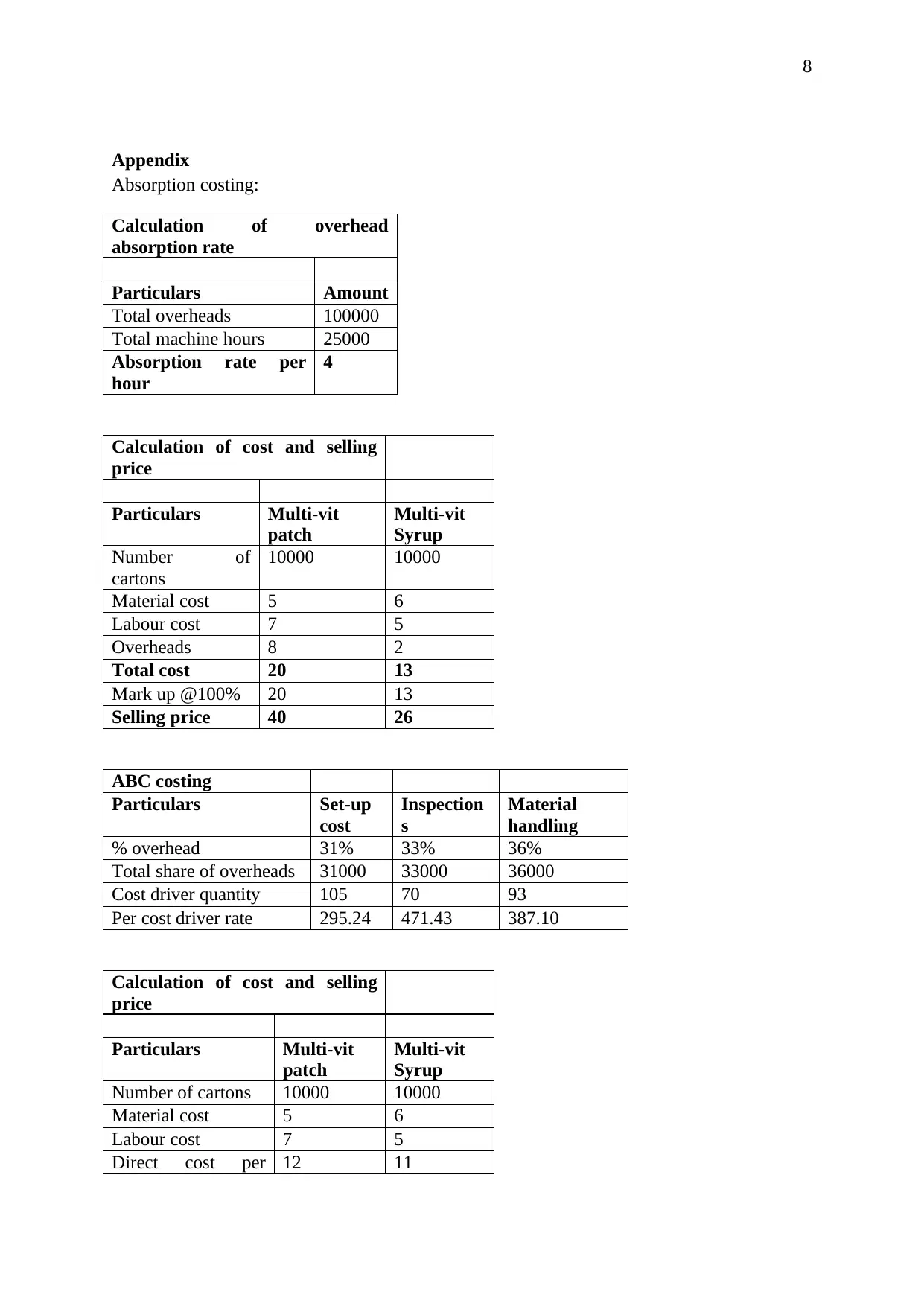
The calculations have been made and in that first, the absorption costing is used. It is
identified that for the allocation purpose the machine hours of the company have been used as
the main medium. There are total overheads of £100000 which is allocated by considering the
machine hours which are 25000 in total. On that basis the overhead allocation rate of
determined to be £4 for each hour. This is considered in calculating the total cost which is
made by adding the cost of material, labour and overheads which are incurred (Nawaz, 2013).
There are two products that are manufactured by GSK and they include the multi-vit patch
and multi-vit syrup. The different levels of machine-hours are required for both and due to
that, the overheads which are incurred for the patch are more than that of the syrup. The final
calculation is made and it is identified that the total cost is £20 and £13 for the patch and
syrup respectively. With the addition of mark-up to this, the selling price is ascertained to be
£40 and £13 respectively for multi-vit patch and multi-vit syrup.
The activity-based costing is also used and in that there are three activities that have been
considered and that involve set-up cost, inspection, and material handling. They are
considered and the allocation is made to them on the basis of provided proportion (Ray,
2012). After this, the cost drivers associated have been identified and their rate is calculated.
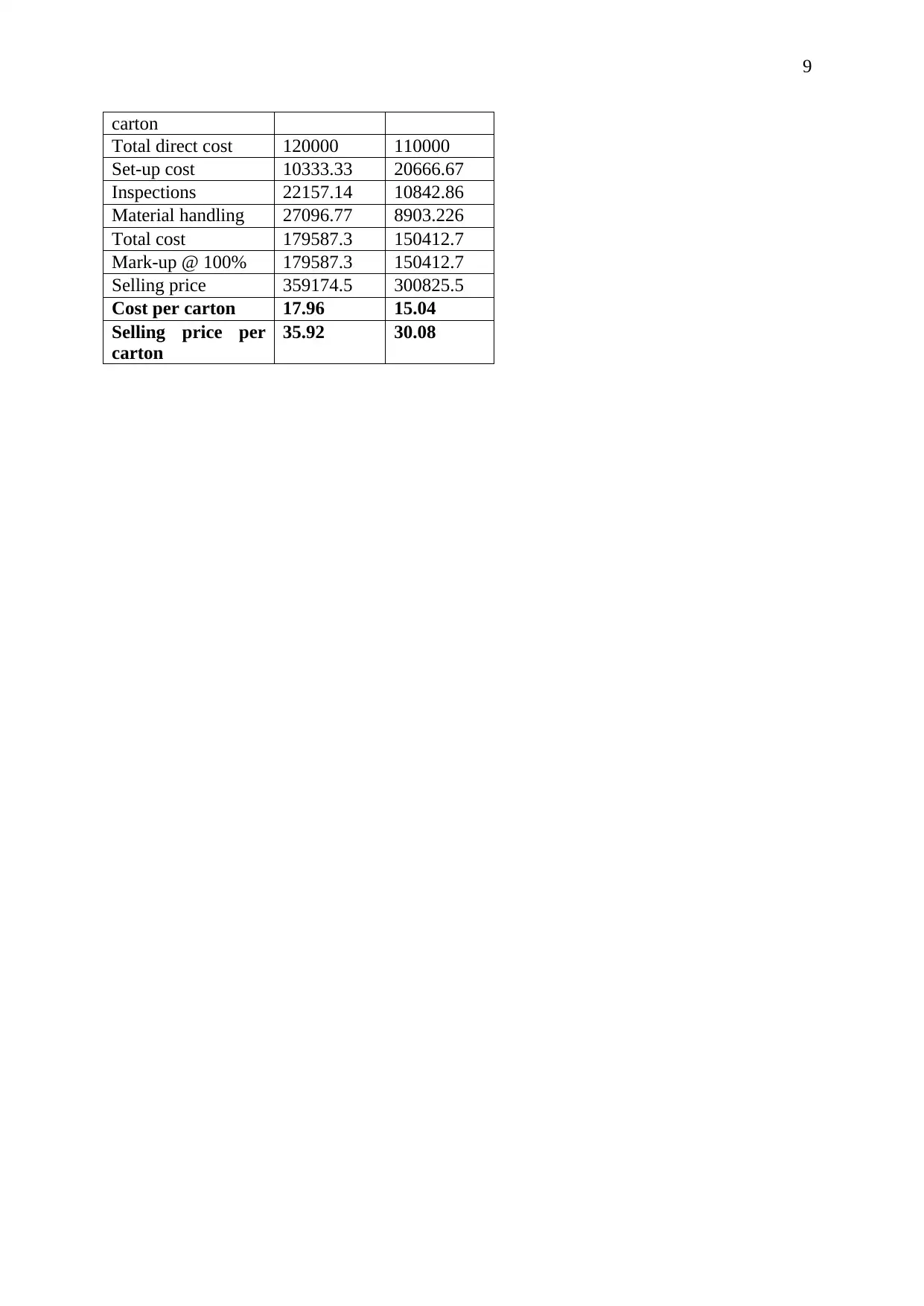
In the calculation of the total cost associated with the product, there is the consideration of all
the activities and the final cost including the direct cost and overheads is ascertained. With
that, the cost of each carton is determined to be £17.96 for the multi-vit patch and £15.04 for
the multi-vit syrup. This is used to calculate the selling price which is derived after adding the
mark-up of 100%.
It can be noted that there is a difference in the cost which is determined under both the
approaches and that is because of the deviation in the manner of overhead allocation. The
director is concerned about the cost and viability of the approach which is used for costing.
On the basis of the finding which is obtained, it can be recommended that activity-based
costing shall be used as it is more reliable and proper (Desti, 2015). In that, all the activities
are considered and with that, the cost which is derived is also appropriate. The total overhead
consists of various tasks and it is required that they shall be properly bifurcated so that proper
Applying ABC costing and absorption costing
Refer to the Appendix for further calculations.
Interpretation and recommendation
The calculations have been made and in that first, the absorption costing is used. It is
identified that for the allocation purpose the machine hours of the company have been used as
the main medium. There are total overheads of £100000 which is allocated by considering the
machine hours which are 25000 in total. On that basis the overhead allocation rate of
determined to be £4 for each hour. This is considered in calculating the total cost which is
made by adding the cost of material, labour and overheads which are incurred (Nawaz, 2013).
There are two products that are manufactured by GSK and they include the multi-vit patch
and multi-vit syrup. The different levels of machine-hours are required for both and due to
that, the overheads which are incurred for the patch are more than that of the syrup. The final
calculation is made and it is identified that the total cost is £20 and £13 for the patch and
syrup respectively. With the addition of mark-up to this, the selling price is ascertained to be
£40 and £13 respectively for multi-vit patch and multi-vit syrup.
The activity-based costing is also used and in that there are three activities that have been
considered and that involve set-up cost, inspection, and material handling. They are
considered and the allocation is made to them on the basis of provided proportion (Ray,
2012). After this, the cost drivers associated have been identified and their rate is calculated.
In the calculation of the total cost associated with the product, there is the consideration of all
the activities and the final cost including the direct cost and overheads is ascertained. With
that, the cost of each carton is determined to be £17.96 for the multi-vit patch and £15.04 for
the multi-vit syrup. This is used to calculate the selling price which is derived after adding the
mark-up of 100%.
It can be noted that there is a difference in the cost which is determined under both the
approaches and that is because of the deviation in the manner of overhead allocation. The
director is concerned about the cost and viability of the approach which is used for costing.
On the basis of the finding which is obtained, it can be recommended that activity-based
costing shall be used as it is more reliable and proper (Desti, 2015). In that, all the activities
are considered and with that, the cost which is derived is also appropriate. The total overhead
consists of various tasks and it is required that they shall be properly bifurcated so that proper

6
allocation is made. By that, the original cost which is incurred is calculated and that helps in
taking the correct decisions in relation to the product. In absorption costing only one factor is
considered and it is not necessary that the amount of time will be consumed in all the
processes. Due to this the cost which is calculated with the help of absorption costing is not
much reliable.
The cost strategy which will be used by GSK in the coming period will be activity-based
costing and with that, there will be a proper cost that will be calculated. The cost will be
viable and this will be appropriate to be used so that other calculations can also be made in
the best possible manner.
Conclusion
The report has been made and in that, all the aspects and concerns which are involved in
relation to the products made by GSK have been considered. There is the determination of the
source, nature, and purpose of the management accounting information which is involved and
made available. The company is required to use various management accounting approaches
and a proper understanding of them is gained. In that explanation of activity-based costing
and absorption costing is provided. The proper understanding of both the techniques has been
gained and the same knowledge is used in calculations that are performed for the company. In
that, all the areas which are involved in the production have been incorporated. The
interpretation of the findings is made by which the recommendation is drawn. The activity-
based costing is chosen as the strategy to be used as that is more viable for the business.
allocation is made. By that, the original cost which is incurred is calculated and that helps in
taking the correct decisions in relation to the product. In absorption costing only one factor is
considered and it is not necessary that the amount of time will be consumed in all the
processes. Due to this the cost which is calculated with the help of absorption costing is not
much reliable.
The cost strategy which will be used by GSK in the coming period will be activity-based
costing and with that, there will be a proper cost that will be calculated. The cost will be
viable and this will be appropriate to be used so that other calculations can also be made in
the best possible manner.
Conclusion
The report has been made and in that, all the aspects and concerns which are involved in
relation to the products made by GSK have been considered. There is the determination of the
source, nature, and purpose of the management accounting information which is involved and
made available. The company is required to use various management accounting approaches
and a proper understanding of them is gained. In that explanation of activity-based costing
and absorption costing is provided. The proper understanding of both the techniques has been
gained and the same knowledge is used in calculations that are performed for the company. In
that, all the areas which are involved in the production have been incorporated. The
interpretation of the findings is made by which the recommendation is drawn. The activity-
based costing is chosen as the strategy to be used as that is more viable for the business.
⊘ This is a preview!⊘
Do you want full access?
Subscribe today to unlock all pages.

Trusted by 1+ million students worldwide

7
References
Aurora, B.B.C. (2013) The Cost of Production Under Direct Costing And Absorption
Costing–A Comparative Approach. Annals-Economy Series, 2, pp.123-129.
Bogale, E. (2013) Advanced management accounting techniques in manufacturing firms in
Ethiopia. Research Journal of Finance and Accounting, 4(16).
Desti, K. (2015) Activity-Based Costing (ABC): is it a tool for a company to achieve
competitive advantage?. International Journal of Economics and Finance, 7, pp.275-281.
Geiszler, M., Baker, K. and Lippitt, J. (2017) Variable Activity‐Based Costing and Decision
Making. Journal of Corporate Accounting & Finance, 28(5), pp.45-52.
Hutaibat, K.A. (2012) Interest in the management accounting profession: accounting students'
perceptions in Jordanian universities. Asian Social Science, 8(3), p.303.
Nawaz, M. (2013) An Insight Into the Two Costing Technique: Absorption Costing and
Marginal Costing. BRAND. Broad Research in Accounting, Negotiation, and
Distribution, 4(1), pp.48-61.
Quinn, M. (2014) Stability and change in management accounting over time—A century or
so of evidence from Guinness. Management Accounting Research, 25(1), pp.76-92.
Ray, S. (2012) Relevance and applicability of activity-based costing: An appraisal. Journal of
Expert Systems (JES), 1(3), p.7.
Taipaleenmäki, J. and Ikäheimo, S. (2013) On the convergence of management accounting
and financial accounting–the role of information technology in accounting
change. International Journal of Accounting Information Systems, 14(4), pp.321-348.
References
Aurora, B.B.C. (2013) The Cost of Production Under Direct Costing And Absorption
Costing–A Comparative Approach. Annals-Economy Series, 2, pp.123-129.
Bogale, E. (2013) Advanced management accounting techniques in manufacturing firms in
Ethiopia. Research Journal of Finance and Accounting, 4(16).
Desti, K. (2015) Activity-Based Costing (ABC): is it a tool for a company to achieve
competitive advantage?. International Journal of Economics and Finance, 7, pp.275-281.
Geiszler, M., Baker, K. and Lippitt, J. (2017) Variable Activity‐Based Costing and Decision
Making. Journal of Corporate Accounting & Finance, 28(5), pp.45-52.
Hutaibat, K.A. (2012) Interest in the management accounting profession: accounting students'
perceptions in Jordanian universities. Asian Social Science, 8(3), p.303.
Nawaz, M. (2013) An Insight Into the Two Costing Technique: Absorption Costing and
Marginal Costing. BRAND. Broad Research in Accounting, Negotiation, and
Distribution, 4(1), pp.48-61.
Quinn, M. (2014) Stability and change in management accounting over time—A century or
so of evidence from Guinness. Management Accounting Research, 25(1), pp.76-92.
Ray, S. (2012) Relevance and applicability of activity-based costing: An appraisal. Journal of
Expert Systems (JES), 1(3), p.7.
Taipaleenmäki, J. and Ikäheimo, S. (2013) On the convergence of management accounting
and financial accounting–the role of information technology in accounting
change. International Journal of Accounting Information Systems, 14(4), pp.321-348.
Paraphrase This Document
Need a fresh take? Get an instant paraphrase of this document with our AI Paraphraser

8
Appendix
Absorption costing:
Calculation of overhead
absorption rate
Particulars Amount
Total overheads 100000
Total machine hours 25000
Absorption rate per
hour
4
Calculation of cost and selling
price
Particulars Multi-vit
patch
Multi-vit
Syrup
Number of
cartons
10000 10000
Material cost 5 6
Labour cost 7 5
Overheads 8 2
Total cost 20 13
Mark up @100% 20 13
Selling price 40 26
ABC costing
Particulars Set-up
cost
Inspection
s
Material
handling
% overhead 31% 33% 36%
Total share of overheads 31000 33000 36000
Cost driver quantity 105 70 93
Per cost driver rate 295.24 471.43 387.10
Calculation of cost and selling
price
Particulars Multi-vit
patch
Multi-vit
Syrup
Number of cartons 10000 10000
Material cost 5 6
Labour cost 7 5
Direct cost per 12 11
Appendix
Absorption costing:
Calculation of overhead
absorption rate
Particulars Amount
Total overheads 100000
Total machine hours 25000
Absorption rate per
hour
4
Calculation of cost and selling
price
Particulars Multi-vit
patch
Multi-vit
Syrup
Number of
cartons
10000 10000
Material cost 5 6
Labour cost 7 5
Overheads 8 2
Total cost 20 13
Mark up @100% 20 13
Selling price 40 26
ABC costing
Particulars Set-up
cost
Inspection
s
Material
handling
% overhead 31% 33% 36%
Total share of overheads 31000 33000 36000
Cost driver quantity 105 70 93
Per cost driver rate 295.24 471.43 387.10
Calculation of cost and selling
price
Particulars Multi-vit
patch
Multi-vit
Syrup
Number of cartons 10000 10000
Material cost 5 6
Labour cost 7 5
Direct cost per 12 11

9
carton
Total direct cost 120000 110000
Set-up cost 10333.33 20666.67
Inspections 22157.14 10842.86
Material handling 27096.77 8903.226
Total cost 179587.3 150412.7
Mark-up @ 100% 179587.3 150412.7
Selling price 359174.5 300825.5
Cost per carton 17.96 15.04
Selling price per
carton
35.92 30.08
carton
Total direct cost 120000 110000
Set-up cost 10333.33 20666.67
Inspections 22157.14 10842.86
Material handling 27096.77 8903.226
Total cost 179587.3 150412.7
Mark-up @ 100% 179587.3 150412.7
Selling price 359174.5 300825.5
Cost per carton 17.96 15.04
Selling price per
carton
35.92 30.08
⊘ This is a preview!⊘
Do you want full access?
Subscribe today to unlock all pages.

Trusted by 1+ million students worldwide
1 out of 9
Related Documents
Your All-in-One AI-Powered Toolkit for Academic Success.
+13062052269
info@desklib.com
Available 24*7 on WhatsApp / Email
Unlock your academic potential
Copyright © 2020–2026 A2Z Services. All Rights Reserved. Developed and managed by ZUCOL.