Financial and Management Accounting Report - Semester 1
VerifiedAdded on 2023/01/05
|18
|3258
|68
Report
AI Summary
This comprehensive accounting report delves into key concepts within financial and management accounting. It begins by explaining the books of prime entry, including sales day books, purchase day books, and the cash book, providing examples to illustrate their usage. The report then discusses essential accounting concepts such as trial balances and financial statements (income statement, balance sheet, and cash flow statement), highlighting the differences between financial and management accounting. It further examines the advantages and disadvantages of various business entities, including partnerships, corporations, sole proprietorships, cooperatives, and limited liability companies. Finally, the report explores the classification of costs and contrasts absorption costing with marginal costing approaches, offering a complete overview of critical accounting principles.

Accounting

Paraphrase This Document
Need a fresh take? Get an instant paraphrase of this document with our AI Paraphraser
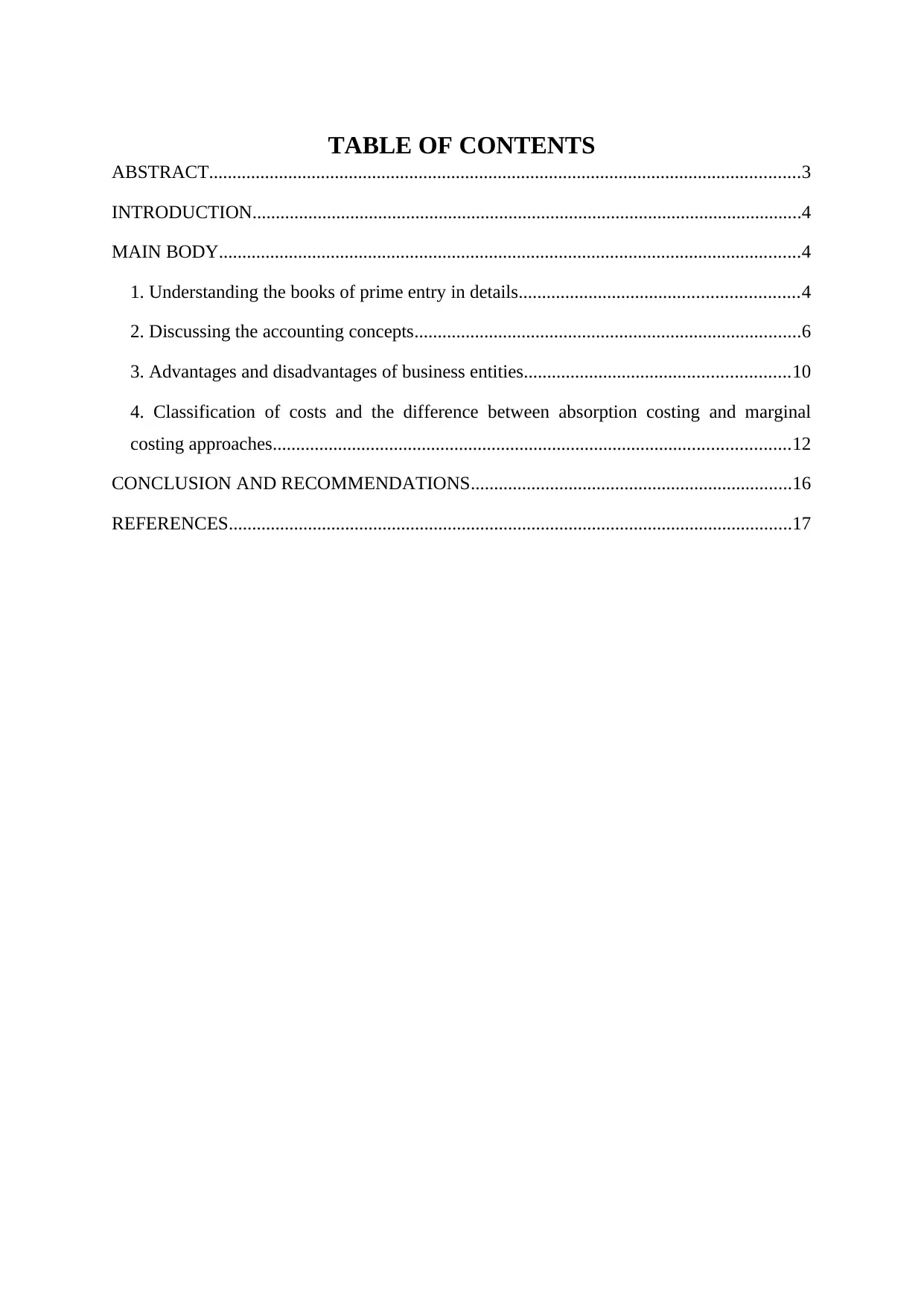
TABLE OF CONTENTS
ABSTRACT...............................................................................................................................3
INTRODUCTION......................................................................................................................4
MAIN BODY.............................................................................................................................4
1. Understanding the books of prime entry in details............................................................4
2. Discussing the accounting concepts...................................................................................6
3. Advantages and disadvantages of business entities.........................................................10
4. Classification of costs and the difference between absorption costing and marginal
costing approaches...............................................................................................................12
CONCLUSION AND RECOMMENDATIONS.....................................................................16
REFERENCES.........................................................................................................................17
ABSTRACT...............................................................................................................................3
INTRODUCTION......................................................................................................................4
MAIN BODY.............................................................................................................................4
1. Understanding the books of prime entry in details............................................................4
2. Discussing the accounting concepts...................................................................................6
3. Advantages and disadvantages of business entities.........................................................10
4. Classification of costs and the difference between absorption costing and marginal
costing approaches...............................................................................................................12
CONCLUSION AND RECOMMENDATIONS.....................................................................16
REFERENCES.........................................................................................................................17

ABSTRACT
This report is based on the accounting field which present about the key concepts in
relation to financial and management accounting. It covers the books of entries, accounting
terms, pros and cons of business entities and the various costing concepts.
This report is based on the accounting field which present about the key concepts in
relation to financial and management accounting. It covers the books of entries, accounting
terms, pros and cons of business entities and the various costing concepts.
⊘ This is a preview!⊘
Do you want full access?
Subscribe today to unlock all pages.

Trusted by 1+ million students worldwide
INTRODUCTION
Accounting is basically referring to the recording of the financial transactions of the
busines in the books of accounts. There are different branches of accounting such as
financial, cost and management accounting. It is considered as the one of the key functions in
all the business organizations which is either handled by the accountant or the bookkeeper in
the small firms while by a separate finance division in large organizations. This report
presents about eth newly established business which requires assistance in understanding the
financial and management accounting processes.
MAIN BODY
1. Understanding the books of prime entry in details
The initial step for recording of the transaction is the prime entry which is used for
preparing the ledger accounts. There are different types of books which are stated below
along with examples.
Sales day book
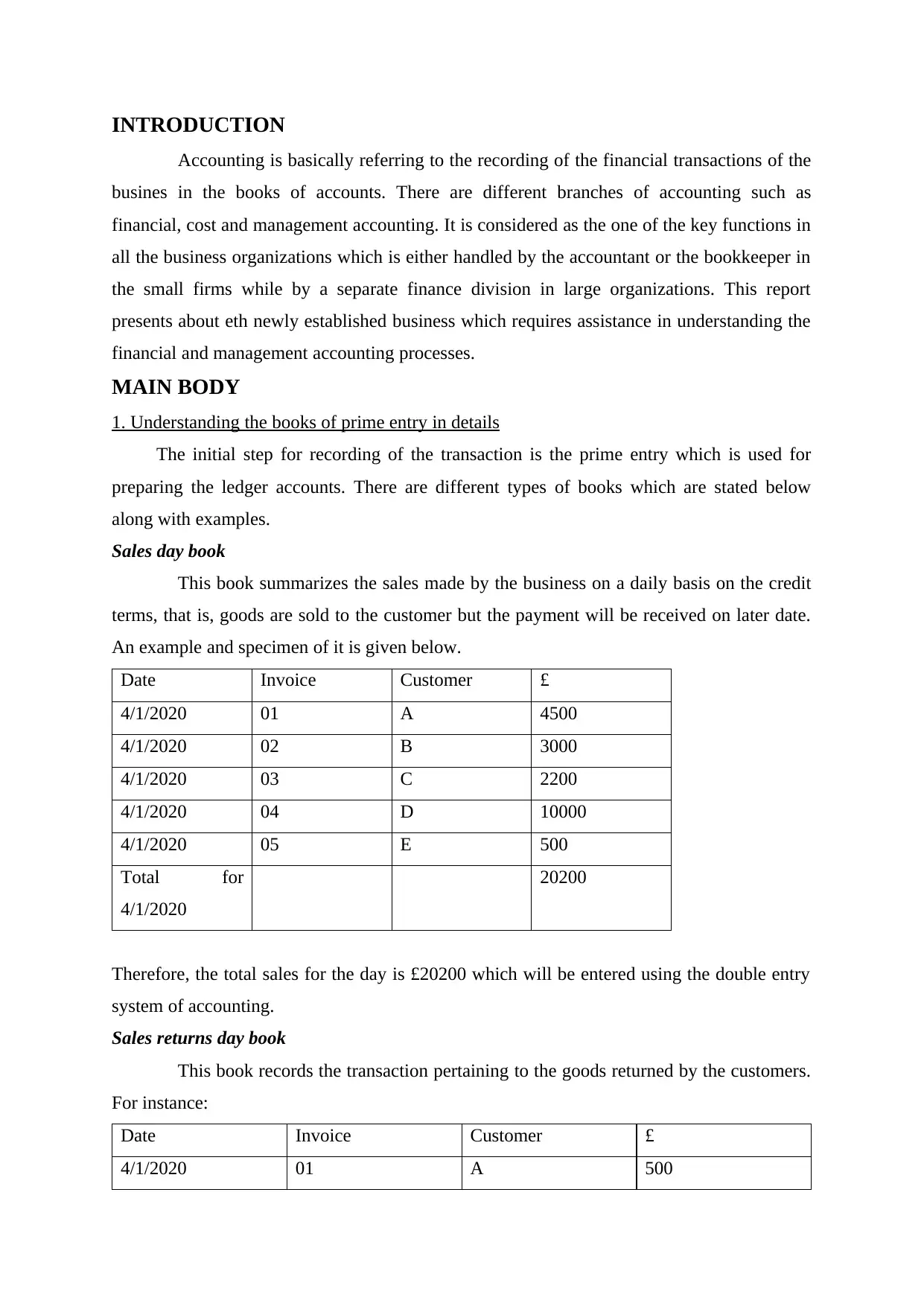
This book summarizes the sales made by the business on a daily basis on the credit
terms, that is, goods are sold to the customer but the payment will be received on later date.
An example and specimen of it is given below.
Date Invoice Customer £
4/1/2020 01 A 4500
4/1/2020 02 B 3000
4/1/2020 03 C 2200
4/1/2020 04 D 10000
4/1/2020 05 E 500
Total for
4/1/2020
20200
Therefore, the total sales for the day is £20200 which will be entered using the double entry
system of accounting.
Sales returns day book
This book records the transaction pertaining to the goods returned by the customers.
For instance:
Date Invoice Customer £
4/1/2020 01 A 500
Accounting is basically referring to the recording of the financial transactions of the
busines in the books of accounts. There are different branches of accounting such as
financial, cost and management accounting. It is considered as the one of the key functions in
all the business organizations which is either handled by the accountant or the bookkeeper in
the small firms while by a separate finance division in large organizations. This report
presents about eth newly established business which requires assistance in understanding the
financial and management accounting processes.
MAIN BODY
1. Understanding the books of prime entry in details
The initial step for recording of the transaction is the prime entry which is used for
preparing the ledger accounts. There are different types of books which are stated below
along with examples.
Sales day book
This book summarizes the sales made by the business on a daily basis on the credit
terms, that is, goods are sold to the customer but the payment will be received on later date.
An example and specimen of it is given below.
Date Invoice Customer £
4/1/2020 01 A 4500
4/1/2020 02 B 3000
4/1/2020 03 C 2200
4/1/2020 04 D 10000
4/1/2020 05 E 500
Total for
4/1/2020
20200
Therefore, the total sales for the day is £20200 which will be entered using the double entry
system of accounting.
Sales returns day book
This book records the transaction pertaining to the goods returned by the customers.
For instance:
Date Invoice Customer £
4/1/2020 01 A 500
Paraphrase This Document
Need a fresh take? Get an instant paraphrase of this document with our AI Paraphraser
4/1/2020 02 B 1000
4/1/2020 03 C 1200
4/1/2020 04 D 6500
4/1/2020 05 E 100
Total for 4/1/2020 9300
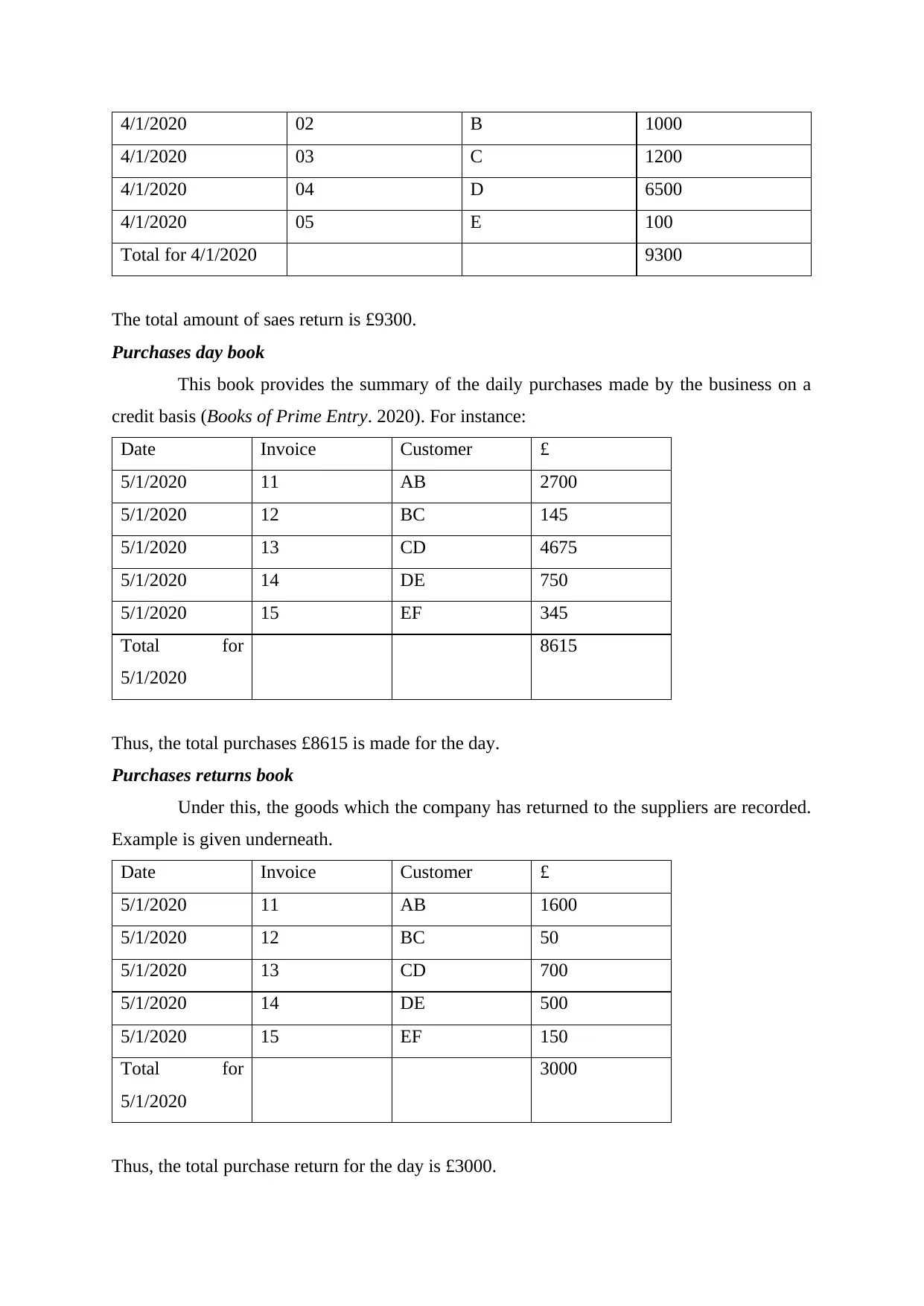
The total amount of saes return is £9300.
Purchases day book
This book provides the summary of the daily purchases made by the business on a
credit basis (Books of Prime Entry. 2020). For instance:
Date Invoice Customer £
5/1/2020 11 AB 2700
5/1/2020 12 BC 145
5/1/2020 13 CD 4675
5/1/2020 14 DE 750
5/1/2020 15 EF 345
Total for
5/1/2020
8615
Thus, the total purchases £8615 is made for the day.
Purchases returns book
Under this, the goods which the company has returned to the suppliers are recorded.
Example is given underneath.
Date Invoice Customer £
5/1/2020 11 AB 1600
5/1/2020 12 BC 50
5/1/2020 13 CD 700
5/1/2020 14 DE 500
5/1/2020 15 EF 150
Total for
5/1/2020
3000
Thus, the total purchase return for the day is £3000.
4/1/2020 03 C 1200
4/1/2020 04 D 6500
4/1/2020 05 E 100
Total for 4/1/2020 9300
The total amount of saes return is £9300.
Purchases day book
This book provides the summary of the daily purchases made by the business on a
credit basis (Books of Prime Entry. 2020). For instance:
Date Invoice Customer £
5/1/2020 11 AB 2700
5/1/2020 12 BC 145
5/1/2020 13 CD 4675
5/1/2020 14 DE 750
5/1/2020 15 EF 345
Total for
5/1/2020
8615
Thus, the total purchases £8615 is made for the day.
Purchases returns book
Under this, the goods which the company has returned to the suppliers are recorded.
Example is given underneath.
Date Invoice Customer £
5/1/2020 11 AB 1600
5/1/2020 12 BC 50
5/1/2020 13 CD 700
5/1/2020 14 DE 500
5/1/2020 15 EF 150
Total for
5/1/2020
3000
Thus, the total purchase return for the day is £3000.
The cash book
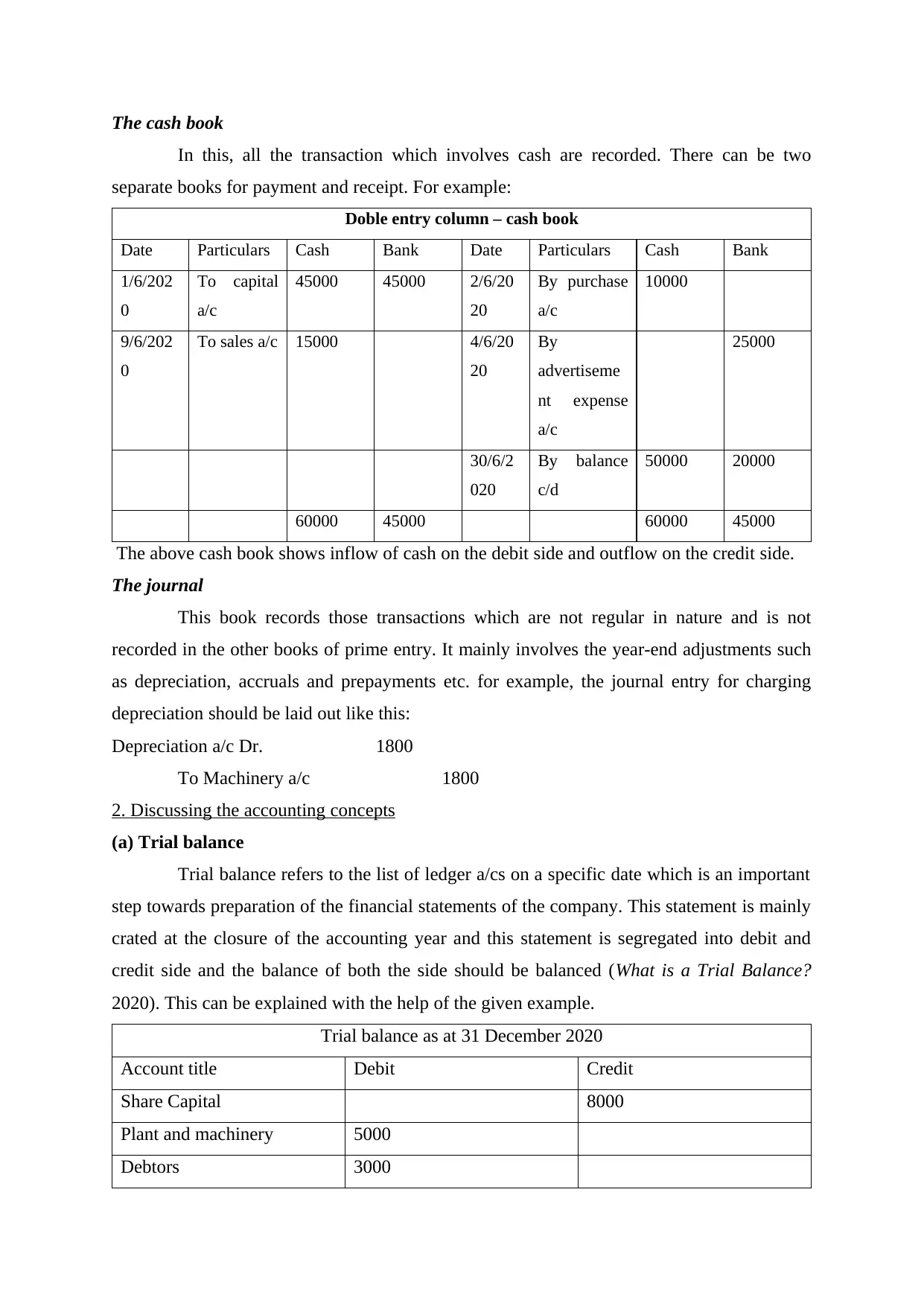
In this, all the transaction which involves cash are recorded. There can be two
separate books for payment and receipt. For example:
Doble entry column – cash book
Date Particulars Cash Bank Date Particulars Cash Bank
1/6/202
0
To capital
a/c
45000 45000 2/6/20
20
By purchase
a/c
10000
9/6/202
0
To sales a/c 15000 4/6/20
20
By
advertiseme
nt expense
a/c
25000
30/6/2
020
By balance
c/d
50000 20000
60000 45000 60000 45000
The above cash book shows inflow of cash on the debit side and outflow on the credit side.
The journal
This book records those transactions which are not regular in nature and is not
recorded in the other books of prime entry. It mainly involves the year-end adjustments such
as depreciation, accruals and prepayments etc. for example, the journal entry for charging
depreciation should be laid out like this:
Depreciation a/c Dr. 1800
To Machinery a/c 1800
2. Discussing the accounting concepts
(a) Trial balance
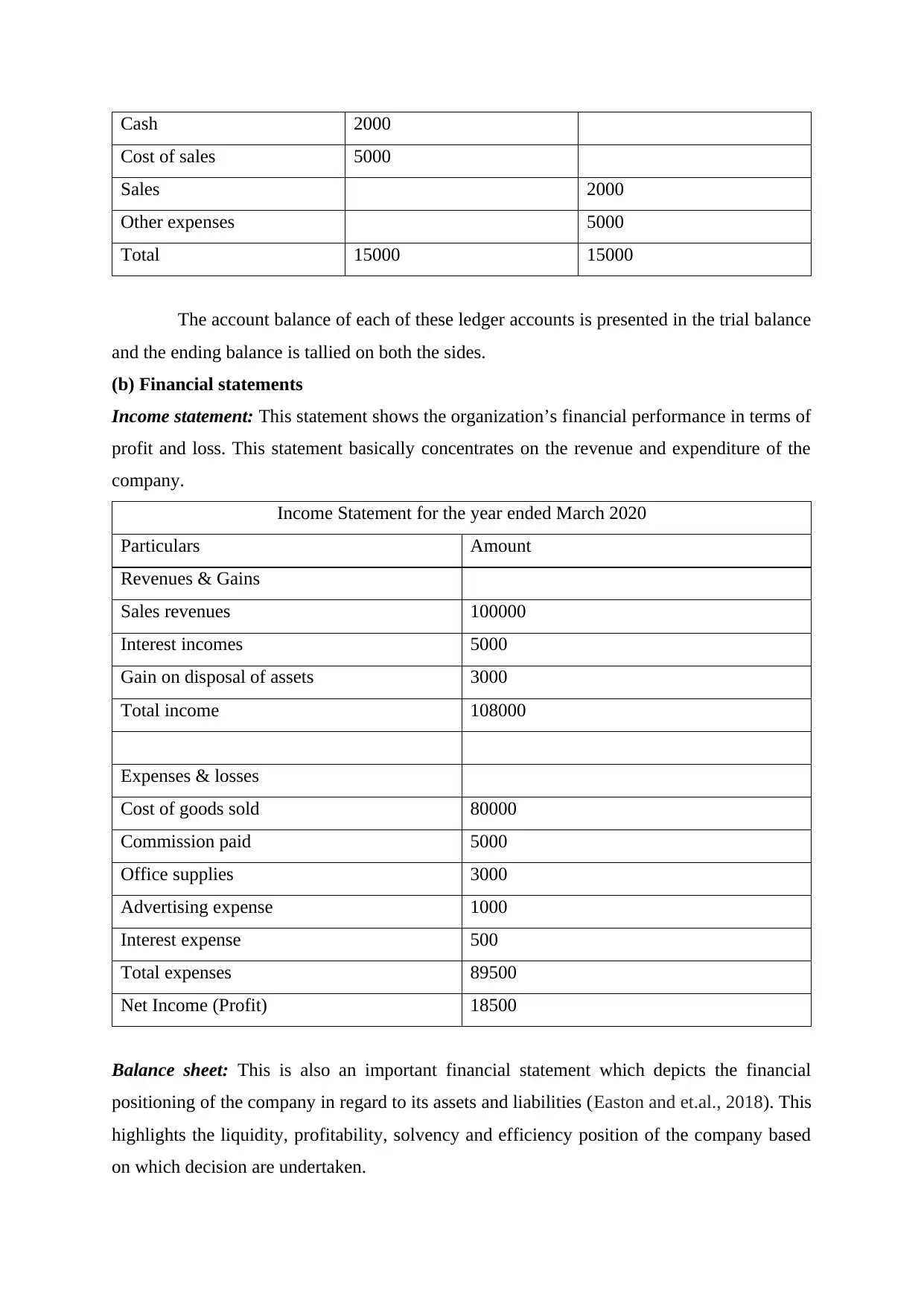
Trial balance refers to the list of ledger a/cs on a specific date which is an important
step towards preparation of the financial statements of the company. This statement is mainly
crated at the closure of the accounting year and this statement is segregated into debit and
credit side and the balance of both the side should be balanced (What is a Trial Balance?
2020). This can be explained with the help of the given example.
Trial balance as at 31 December 2020
Account title Debit Credit
Share Capital 8000
Plant and machinery 5000
Debtors 3000
In this, all the transaction which involves cash are recorded. There can be two
separate books for payment and receipt. For example:
Doble entry column – cash book
Date Particulars Cash Bank Date Particulars Cash Bank
1/6/202
0
To capital
a/c
45000 45000 2/6/20
20
By purchase
a/c
10000
9/6/202
0
To sales a/c 15000 4/6/20
20
By
advertiseme
nt expense
a/c
25000
30/6/2
020
By balance
c/d
50000 20000
60000 45000 60000 45000
The above cash book shows inflow of cash on the debit side and outflow on the credit side.
The journal
This book records those transactions which are not regular in nature and is not
recorded in the other books of prime entry. It mainly involves the year-end adjustments such
as depreciation, accruals and prepayments etc. for example, the journal entry for charging
depreciation should be laid out like this:
Depreciation a/c Dr. 1800
To Machinery a/c 1800
2. Discussing the accounting concepts
(a) Trial balance
Trial balance refers to the list of ledger a/cs on a specific date which is an important
step towards preparation of the financial statements of the company. This statement is mainly
crated at the closure of the accounting year and this statement is segregated into debit and
credit side and the balance of both the side should be balanced (What is a Trial Balance?
2020). This can be explained with the help of the given example.
Trial balance as at 31 December 2020
Account title Debit Credit
Share Capital 8000
Plant and machinery 5000
Debtors 3000
⊘ This is a preview!⊘
Do you want full access?
Subscribe today to unlock all pages.
Trusted by 1+ million students worldwide
Cash 2000
Cost of sales 5000
Sales 2000
Other expenses 5000
Total 15000 15000
The account balance of each of these ledger accounts is presented in the trial balance
and the ending balance is tallied on both the sides.
(b) Financial statements
Income statement: This statement shows the organization’s financial performance in terms of
profit and loss. This statement basically concentrates on the revenue and expenditure of the
company.
Income Statement for the year ended March 2020
Particulars Amount
Revenues & Gains
Sales revenues 100000
Interest incomes 5000
Gain on disposal of assets 3000
Total income 108000
Expenses & losses
Cost of goods sold 80000
Commission paid 5000
Office supplies 3000
Advertising expense 1000
Interest expense 500
Total expenses 89500
Net Income (Profit) 18500
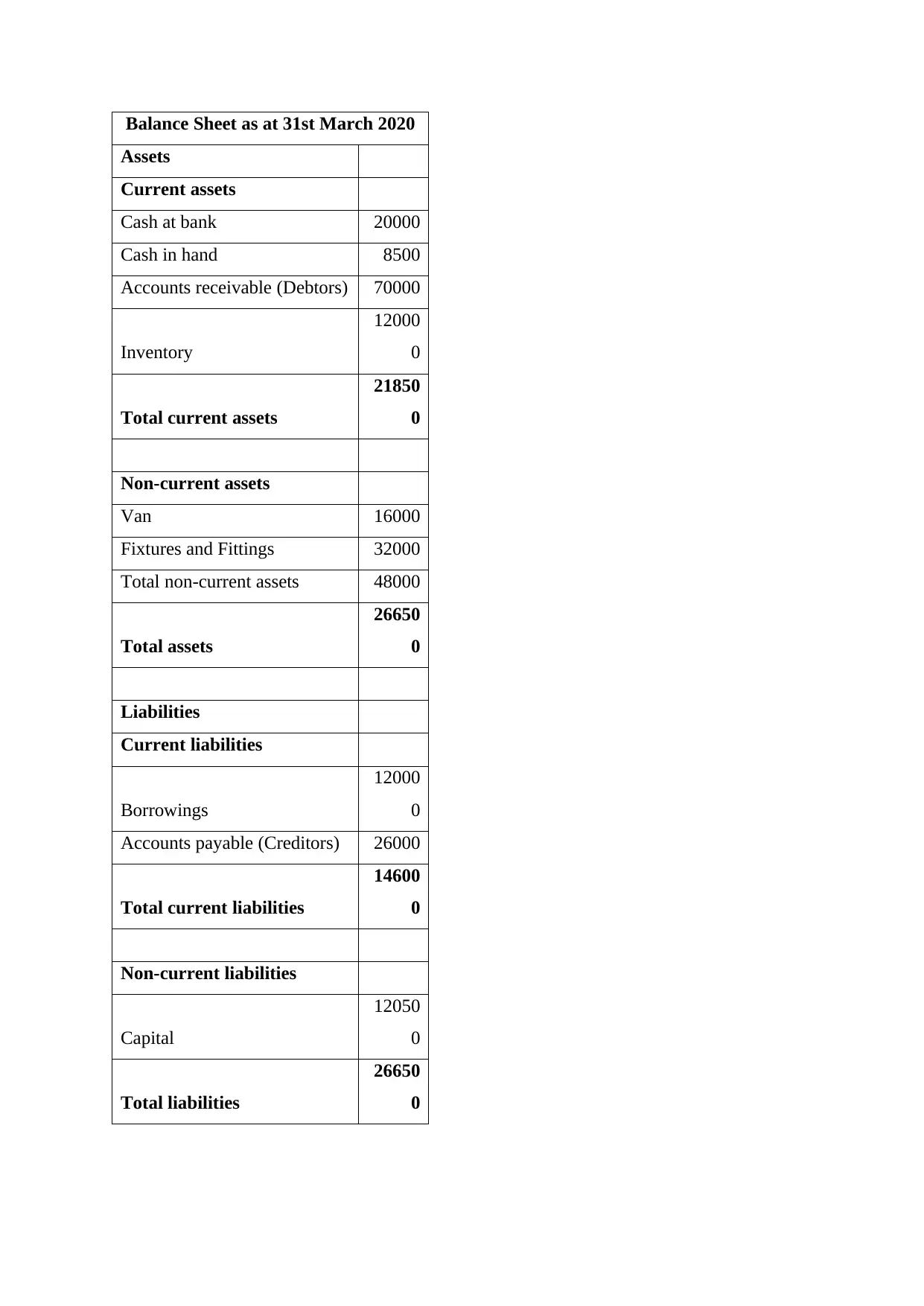
Balance sheet: This is also an important financial statement which depicts the financial
positioning of the company in regard to its assets and liabilities (Easton and et.al., 2018). This
highlights the liquidity, profitability, solvency and efficiency position of the company based
on which decision are undertaken.
Cost of sales 5000
Sales 2000
Other expenses 5000
Total 15000 15000
The account balance of each of these ledger accounts is presented in the trial balance
and the ending balance is tallied on both the sides.
(b) Financial statements
Income statement: This statement shows the organization’s financial performance in terms of
profit and loss. This statement basically concentrates on the revenue and expenditure of the
company.
Income Statement for the year ended March 2020
Particulars Amount
Revenues & Gains
Sales revenues 100000
Interest incomes 5000
Gain on disposal of assets 3000
Total income 108000
Expenses & losses
Cost of goods sold 80000
Commission paid 5000
Office supplies 3000
Advertising expense 1000
Interest expense 500
Total expenses 89500
Net Income (Profit) 18500
Balance sheet: This is also an important financial statement which depicts the financial
positioning of the company in regard to its assets and liabilities (Easton and et.al., 2018). This
highlights the liquidity, profitability, solvency and efficiency position of the company based
on which decision are undertaken.
Paraphrase This Document
Need a fresh take? Get an instant paraphrase of this document with our AI Paraphraser
Balance Sheet as at 31st March 2020
Assets
Current assets
Cash at bank 20000
Cash in hand 8500
Accounts receivable (Debtors) 70000
Inventory
12000
0
Total current assets
21850
0
Non-current assets
Van 16000
Fixtures and Fittings 32000
Total non-current assets 48000
Total assets
26650
0
Liabilities
Current liabilities
Borrowings
12000
0
Accounts payable (Creditors) 26000
Total current liabilities
14600
0
Non-current liabilities
Capital
12050
0
Total liabilities
26650
0
Assets
Current assets
Cash at bank 20000
Cash in hand 8500
Accounts receivable (Debtors) 70000
Inventory
12000
0
Total current assets
21850
0
Non-current assets
Van 16000
Fixtures and Fittings 32000
Total non-current assets 48000
Total assets
26650
0
Liabilities
Current liabilities
Borrowings
12000
0
Accounts payable (Creditors) 26000
Total current liabilities
14600
0
Non-current liabilities
Capital
12050
0
Total liabilities
26650
0
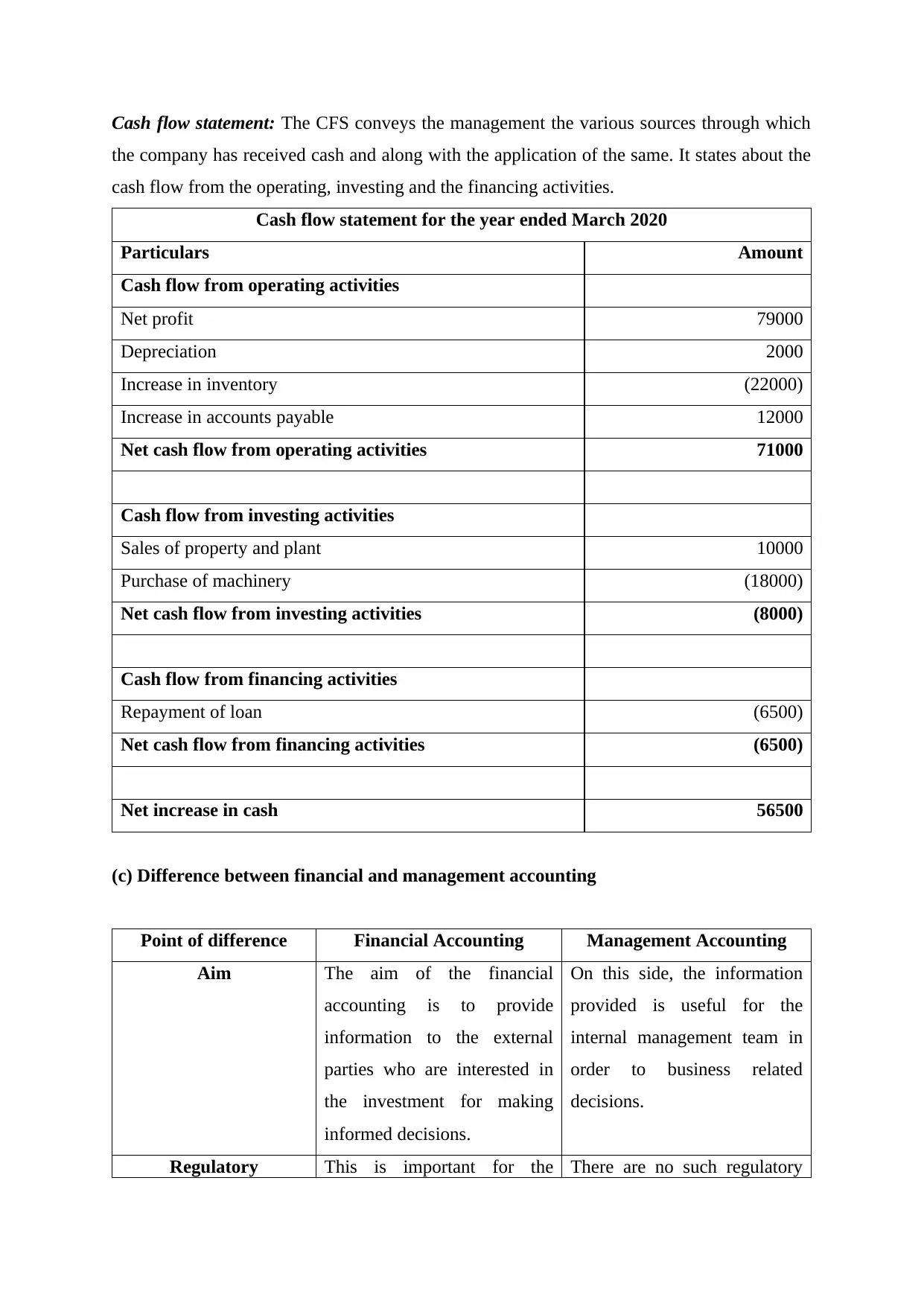
Cash flow statement: The CFS conveys the management the various sources through which
the company has received cash and along with the application of the same. It states about the
cash flow from the operating, investing and the financing activities.
Cash flow statement for the year ended March 2020
Particulars Amount
Cash flow from operating activities
Net profit 79000
Depreciation 2000
Increase in inventory (22000)
Increase in accounts payable 12000
Net cash flow from operating activities 71000
Cash flow from investing activities
Sales of property and plant 10000
Purchase of machinery (18000)
Net cash flow from investing activities (8000)
Cash flow from financing activities
Repayment of loan (6500)
Net cash flow from financing activities (6500)
Net increase in cash 56500
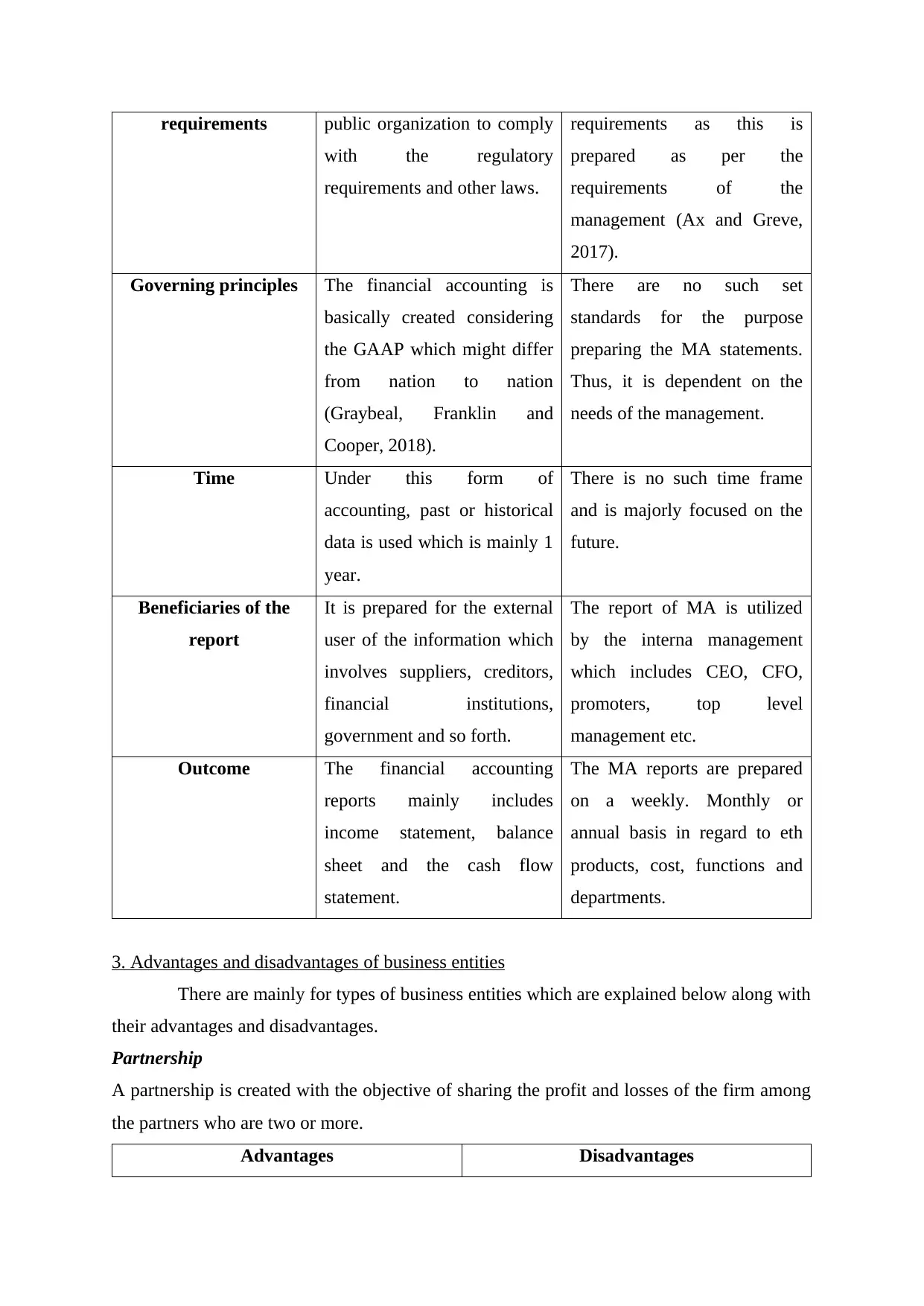
(c) Difference between financial and management accounting
Point of difference Financial Accounting Management Accounting
Aim The aim of the financial
accounting is to provide
information to the external
parties who are interested in
the investment for making
informed decisions.
On this side, the information
provided is useful for the
internal management team in
order to business related
decisions.
Regulatory This is important for the There are no such regulatory
the company has received cash and along with the application of the same. It states about the
cash flow from the operating, investing and the financing activities.
Cash flow statement for the year ended March 2020
Particulars Amount
Cash flow from operating activities
Net profit 79000
Depreciation 2000
Increase in inventory (22000)
Increase in accounts payable 12000
Net cash flow from operating activities 71000
Cash flow from investing activities
Sales of property and plant 10000
Purchase of machinery (18000)
Net cash flow from investing activities (8000)
Cash flow from financing activities
Repayment of loan (6500)
Net cash flow from financing activities (6500)
Net increase in cash 56500
(c) Difference between financial and management accounting
Point of difference Financial Accounting Management Accounting
Aim The aim of the financial
accounting is to provide
information to the external
parties who are interested in
the investment for making
informed decisions.
On this side, the information
provided is useful for the
internal management team in
order to business related
decisions.
Regulatory This is important for the There are no such regulatory
⊘ This is a preview!⊘
Do you want full access?
Subscribe today to unlock all pages.
Trusted by 1+ million students worldwide
requirements public organization to comply
with the regulatory
requirements and other laws.
requirements as this is
prepared as per the
requirements of the
management (Ax and Greve,
2017).
Governing principles The financial accounting is
basically created considering
the GAAP which might differ
from nation to nation
(Graybeal, Franklin and
Cooper, 2018).
There are no such set
standards for the purpose
preparing the MA statements.
Thus, it is dependent on the
needs of the management.
Time Under this form of
accounting, past or historical
data is used which is mainly 1
year.
There is no such time frame
and is majorly focused on the
future.
Beneficiaries of the
report
It is prepared for the external
user of the information which
involves suppliers, creditors,
financial institutions,
government and so forth.
The report of MA is utilized
by the interna management
which includes CEO, CFO,
promoters, top level
management etc.
Outcome The financial accounting
reports mainly includes
income statement, balance
sheet and the cash flow
statement.
The MA reports are prepared
on a weekly. Monthly or
annual basis in regard to eth
products, cost, functions and
departments.
3. Advantages and disadvantages of business entities
There are mainly for types of business entities which are explained below along with
their advantages and disadvantages.
Partnership
A partnership is created with the objective of sharing the profit and losses of the firm among
the partners who are two or more.
Advantages Disadvantages
with the regulatory
requirements and other laws.
requirements as this is
prepared as per the
requirements of the
management (Ax and Greve,
2017).
Governing principles The financial accounting is
basically created considering
the GAAP which might differ
from nation to nation
(Graybeal, Franklin and
Cooper, 2018).
There are no such set
standards for the purpose
preparing the MA statements.
Thus, it is dependent on the
needs of the management.
Time Under this form of
accounting, past or historical
data is used which is mainly 1
year.
There is no such time frame
and is majorly focused on the
future.
Beneficiaries of the
report
It is prepared for the external
user of the information which
involves suppliers, creditors,
financial institutions,
government and so forth.
The report of MA is utilized
by the interna management
which includes CEO, CFO,
promoters, top level
management etc.
Outcome The financial accounting
reports mainly includes
income statement, balance
sheet and the cash flow
statement.
The MA reports are prepared
on a weekly. Monthly or
annual basis in regard to eth
products, cost, functions and
departments.
3. Advantages and disadvantages of business entities
There are mainly for types of business entities which are explained below along with
their advantages and disadvantages.
Partnership
A partnership is created with the objective of sharing the profit and losses of the firm among
the partners who are two or more.
Advantages Disadvantages
Paraphrase This Document
Need a fresh take? Get an instant paraphrase of this document with our AI Paraphraser
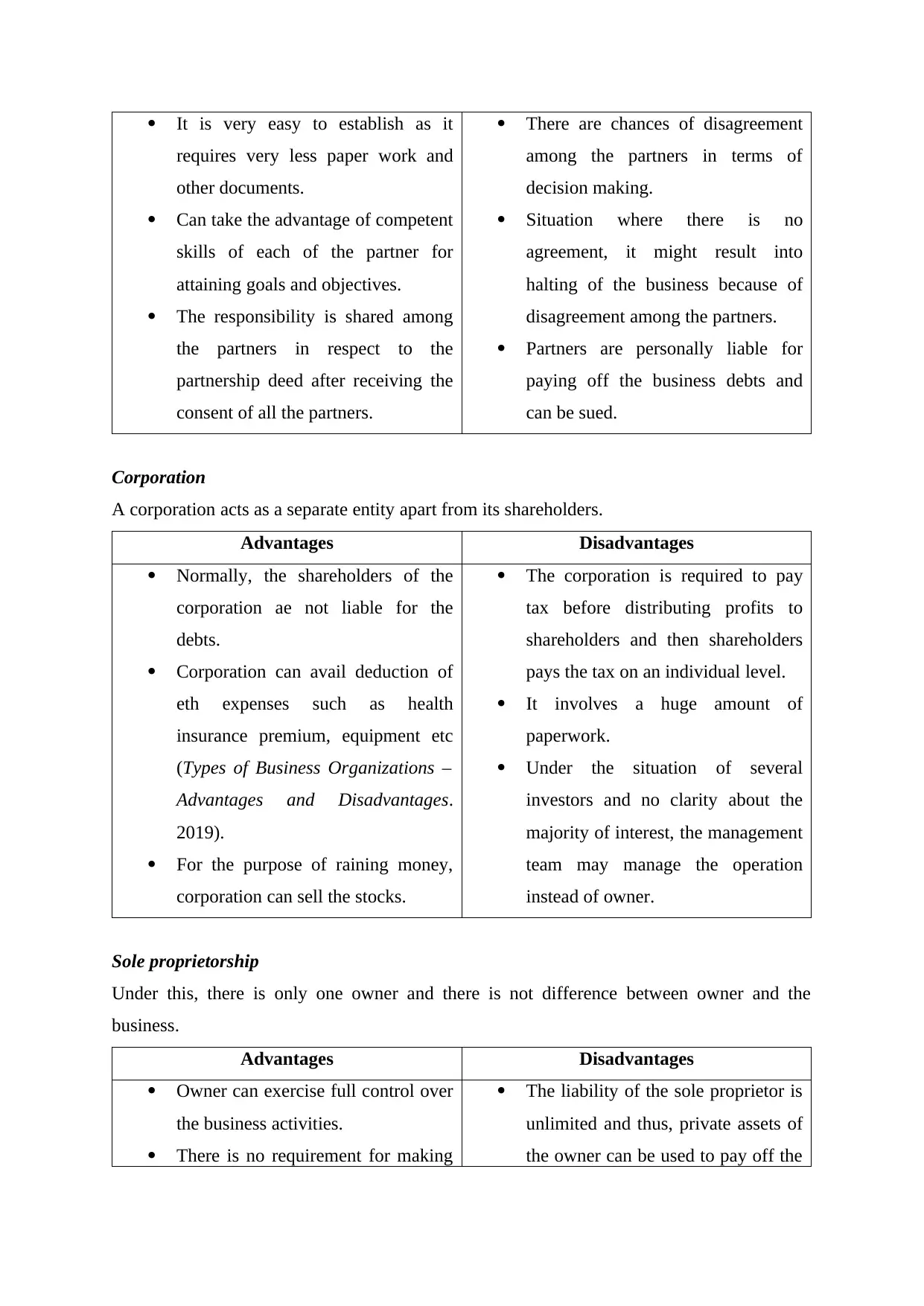
It is very easy to establish as it
requires very less paper work and
other documents.
Can take the advantage of competent
skills of each of the partner for
attaining goals and objectives.
The responsibility is shared among
the partners in respect to the
partnership deed after receiving the
consent of all the partners.
There are chances of disagreement
among the partners in terms of
decision making.
Situation where there is no
agreement, it might result into
halting of the business because of
disagreement among the partners.
Partners are personally liable for
paying off the business debts and
can be sued.
Corporation
A corporation acts as a separate entity apart from its shareholders.
Advantages Disadvantages
Normally, the shareholders of the
corporation ae not liable for the
debts.
Corporation can avail deduction of
eth expenses such as health
insurance premium, equipment etc
(Types of Business Organizations –
Advantages and Disadvantages.
2019).
For the purpose of raining money,
corporation can sell the stocks.
The corporation is required to pay
tax before distributing profits to
shareholders and then shareholders
pays the tax on an individual level.
It involves a huge amount of
paperwork.
Under the situation of several
investors and no clarity about the
majority of interest, the management
team may manage the operation
instead of owner.
Sole proprietorship
Under this, there is only one owner and there is not difference between owner and the
business.
Advantages Disadvantages
Owner can exercise full control over
the business activities.
There is no requirement for making
The liability of the sole proprietor is
unlimited and thus, private assets of
the owner can be used to pay off the
requires very less paper work and
other documents.
Can take the advantage of competent
skills of each of the partner for
attaining goals and objectives.
The responsibility is shared among
the partners in respect to the
partnership deed after receiving the
consent of all the partners.
There are chances of disagreement
among the partners in terms of
decision making.
Situation where there is no
agreement, it might result into
halting of the business because of
disagreement among the partners.
Partners are personally liable for
paying off the business debts and
can be sued.
Corporation
A corporation acts as a separate entity apart from its shareholders.
Advantages Disadvantages
Normally, the shareholders of the
corporation ae not liable for the
debts.
Corporation can avail deduction of
eth expenses such as health
insurance premium, equipment etc
(Types of Business Organizations –
Advantages and Disadvantages.
2019).
For the purpose of raining money,
corporation can sell the stocks.
The corporation is required to pay
tax before distributing profits to
shareholders and then shareholders
pays the tax on an individual level.
It involves a huge amount of
paperwork.
Under the situation of several
investors and no clarity about the
majority of interest, the management
team may manage the operation
instead of owner.
Sole proprietorship
Under this, there is only one owner and there is not difference between owner and the
business.
Advantages Disadvantages
Owner can exercise full control over
the business activities.
There is no requirement for making
The liability of the sole proprietor is
unlimited and thus, private assets of
the owner can be used to pay off the
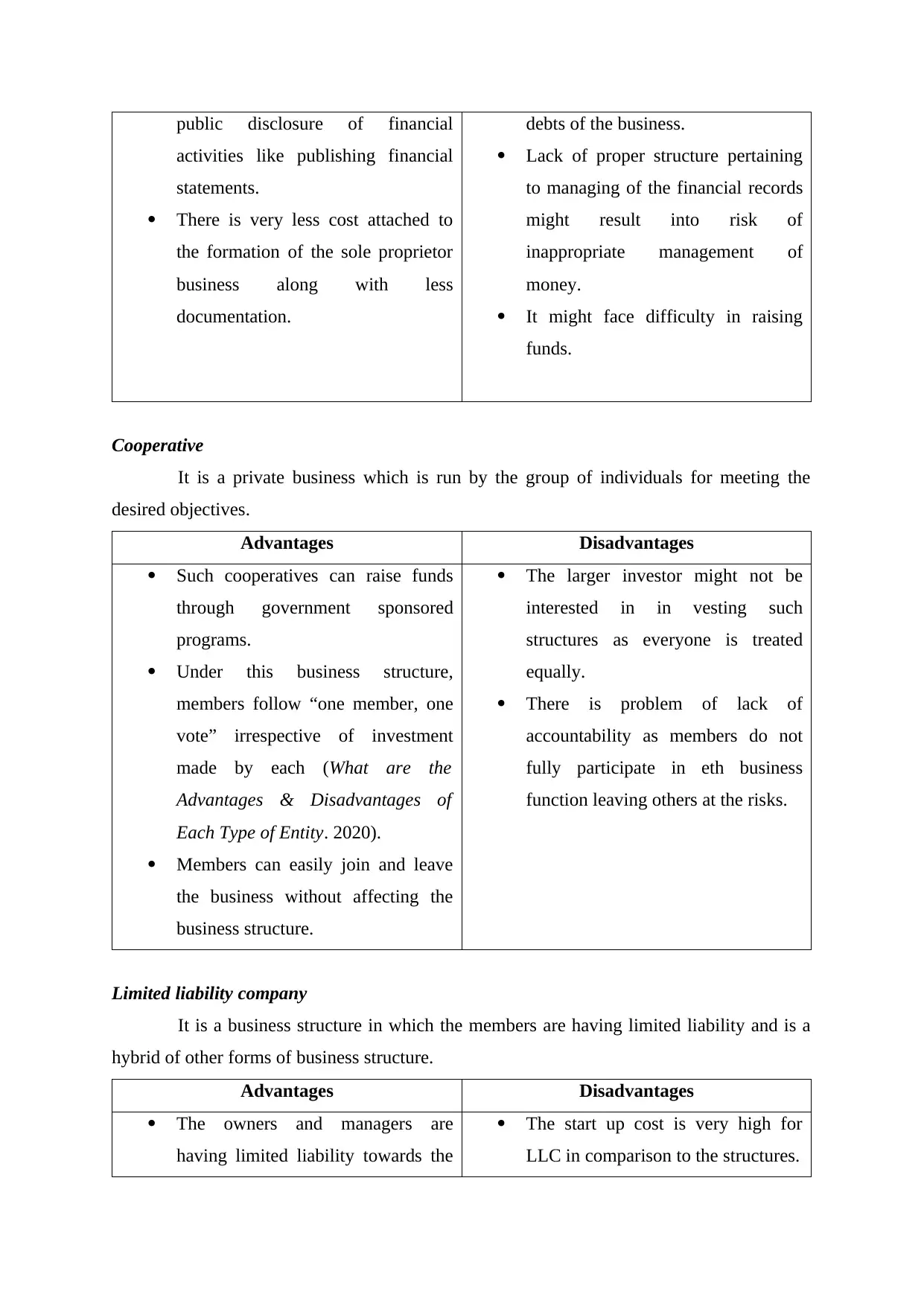
public disclosure of financial
activities like publishing financial
statements.
There is very less cost attached to
the formation of the sole proprietor
business along with less
documentation.
debts of the business.
Lack of proper structure pertaining
to managing of the financial records
might result into risk of
inappropriate management of
money.
It might face difficulty in raising
funds.
Cooperative
It is a private business which is run by the group of individuals for meeting the
desired objectives.
Advantages Disadvantages
Such cooperatives can raise funds
through government sponsored
programs.
Under this business structure,
members follow “one member, one
vote” irrespective of investment
made by each (What are the
Advantages & Disadvantages of
Each Type of Entity. 2020).
Members can easily join and leave
the business without affecting the
business structure.
The larger investor might not be
interested in in vesting such
structures as everyone is treated
equally.
There is problem of lack of
accountability as members do not
fully participate in eth business
function leaving others at the risks.
Limited liability company
It is a business structure in which the members are having limited liability and is a
hybrid of other forms of business structure.
Advantages Disadvantages
The owners and managers are
having limited liability towards the
The start up cost is very high for
LLC in comparison to the structures.
activities like publishing financial
statements.
There is very less cost attached to
the formation of the sole proprietor
business along with less
documentation.
debts of the business.
Lack of proper structure pertaining
to managing of the financial records
might result into risk of
inappropriate management of
money.
It might face difficulty in raising
funds.
Cooperative
It is a private business which is run by the group of individuals for meeting the
desired objectives.
Advantages Disadvantages
Such cooperatives can raise funds
through government sponsored
programs.
Under this business structure,
members follow “one member, one
vote” irrespective of investment
made by each (What are the
Advantages & Disadvantages of
Each Type of Entity. 2020).
Members can easily join and leave
the business without affecting the
business structure.
The larger investor might not be
interested in in vesting such
structures as everyone is treated
equally.
There is problem of lack of
accountability as members do not
fully participate in eth business
function leaving others at the risks.
Limited liability company
It is a business structure in which the members are having limited liability and is a
hybrid of other forms of business structure.
Advantages Disadvantages
The owners and managers are
having limited liability towards the
The start up cost is very high for
LLC in comparison to the structures.
⊘ This is a preview!⊘
Do you want full access?
Subscribe today to unlock all pages.
Trusted by 1+ million students worldwide

1 out of 18


Related Documents


Your All-in-One AI-Powered Toolkit for Academic Success.
+13062052269
info@desklib.com
Available 24*7 on WhatsApp / Email
![[object Object]](/_next/static/media/star-bottom.7253800d.svg)
Unlock your academic potential
Copyright © 2020–2026 A2Z Services. All Rights Reserved. Developed and managed by ZUCOL.