Accounting Theory Report: Research, Analysis, and Recommendations
VerifiedAdded on 2022/11/14
|22
|6115
|138
Report
AI Summary
This report provides a comprehensive overview of accounting theory, beginning with an introduction to the subject and its framework based on the Financial Accounting Standards Board (FASB). It explores the significance of financial reporting for business decision-making and defines accounting theory as a set of frameworks, assumptions, and methodologies used in financial reporting. The report includes a detailed literature review, covering theoretical backgrounds, accounting standards and practices, and corporate financial reporting. It also examines international accounting practices and the significance of accounting principles globally. The research methodology section outlines the aims, objectives, and research approaches used, including traditional and non-theoretical approaches. The findings, implications, and recommendations are presented, followed by a conclusion summarizing the key aspects of accounting theory and its practical applications. The report emphasizes the importance of accounting as a language of business and a tool for measuring a company's financial health, ultimately contributing to informed decision-making.
Running head: ACCOUNTING THEORY
ACCOUNTING THEORY
Name of the student:
Name of the university:
Author Note:
ACCOUNTING THEORY
Name of the student:
Name of the university:
Author Note:

Paraphrase This Document
Need a fresh take? Get an instant paraphrase of this document with our AI Paraphraser
1ACCOUNTING THEORY
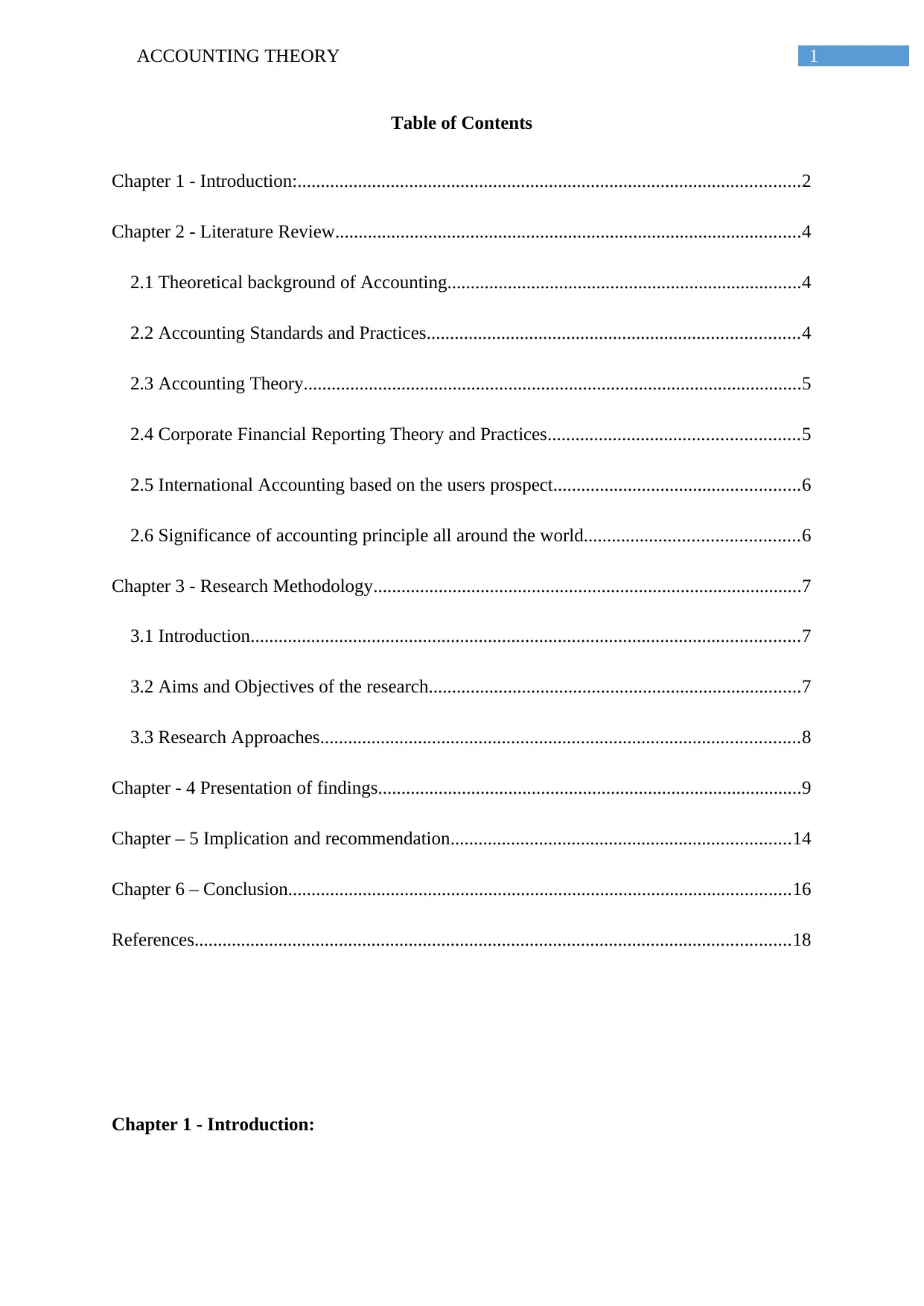
Table of Contents
Chapter 1 - Introduction:............................................................................................................2
Chapter 2 - Literature Review....................................................................................................4
2.1 Theoretical background of Accounting............................................................................4
2.2 Accounting Standards and Practices................................................................................4
2.3 Accounting Theory...........................................................................................................5
2.4 Corporate Financial Reporting Theory and Practices......................................................5
2.5 International Accounting based on the users prospect.....................................................6
2.6 Significance of accounting principle all around the world..............................................6
Chapter 3 - Research Methodology............................................................................................7
3.1 Introduction......................................................................................................................7
3.2 Aims and Objectives of the research................................................................................7
3.3 Research Approaches.......................................................................................................8
Chapter - 4 Presentation of findings...........................................................................................9
Chapter – 5 Implication and recommendation.........................................................................14
Chapter 6 – Conclusion............................................................................................................16
References................................................................................................................................18
Chapter 1 - Introduction:
Table of Contents
Chapter 1 - Introduction:............................................................................................................2
Chapter 2 - Literature Review....................................................................................................4
2.1 Theoretical background of Accounting............................................................................4
2.2 Accounting Standards and Practices................................................................................4
2.3 Accounting Theory...........................................................................................................5
2.4 Corporate Financial Reporting Theory and Practices......................................................5
2.5 International Accounting based on the users prospect.....................................................6
2.6 Significance of accounting principle all around the world..............................................6
Chapter 3 - Research Methodology............................................................................................7
3.1 Introduction......................................................................................................................7
3.2 Aims and Objectives of the research................................................................................7
3.3 Research Approaches.......................................................................................................8
Chapter - 4 Presentation of findings...........................................................................................9
Chapter – 5 Implication and recommendation.........................................................................14
Chapter 6 – Conclusion............................................................................................................16
References................................................................................................................................18
Chapter 1 - Introduction:
2ACCOUNTING THEORY
The aim of the assignment deals with the study of the accounting theory which is
bound by the framework of the Financial accounting standard board (FASB). The various
objectives, significance of the financial reporting the business have been highlighted in the
conducted study. The theory of accounting is basically a part of the logical reasoning which is
evaluated and further guided by the various types of accounting practices. Accounting theory
deals with the regulatory standards further used for developing the new accounting practices
and procedures (Sterling 2014). The financial statements of the company provides significant
information’s which is used by the business for the purpose of decision making (Zeff 2018.).
The term “Accounting Theory” is defined as the set of frameworks, assumptions and
methodologies used for the purpose of identifying and further applying the principles based
on financial reporting (Christensen, Nikolaev and Wittenberg‐Moerman 2016). The
accounting theory is based on the historical foundations of the accounting practices, the
changes in the accounting practices and framework which is governed while preparation of
the financial reporting and statements. In accounting theory, the financial and accounting
professional conducts the financial operations based on several assumptions. The
assumptions are the separate business entity from the owners, business must follow the going
concern concept of accounting, and financial statements are based on the unit of production
and are recorded in dollars. The financial statement of the company is based on the annual,
monthly or quarterly basis which further helps the upper level management of the company to
analyses and make significant decisions for the business (Whittington 2016).
The significant theory of the accounting practices is that it is based on the set of
logical principles in reference to the evaluation and sound business practices. Accounting is
basically a language of business and hence it is significant to understand the importance of it
in order to take the significant decisions for the business (Staubus 2013). The most important
objective of the business is to generate profit and in order to achieve huge profitability in the
The aim of the assignment deals with the study of the accounting theory which is
bound by the framework of the Financial accounting standard board (FASB). The various
objectives, significance of the financial reporting the business have been highlighted in the
conducted study. The theory of accounting is basically a part of the logical reasoning which is
evaluated and further guided by the various types of accounting practices. Accounting theory
deals with the regulatory standards further used for developing the new accounting practices
and procedures (Sterling 2014). The financial statements of the company provides significant
information’s which is used by the business for the purpose of decision making (Zeff 2018.).
The term “Accounting Theory” is defined as the set of frameworks, assumptions and
methodologies used for the purpose of identifying and further applying the principles based
on financial reporting (Christensen, Nikolaev and Wittenberg‐Moerman 2016). The
accounting theory is based on the historical foundations of the accounting practices, the
changes in the accounting practices and framework which is governed while preparation of
the financial reporting and statements. In accounting theory, the financial and accounting
professional conducts the financial operations based on several assumptions. The
assumptions are the separate business entity from the owners, business must follow the going
concern concept of accounting, and financial statements are based on the unit of production
and are recorded in dollars. The financial statement of the company is based on the annual,
monthly or quarterly basis which further helps the upper level management of the company to
analyses and make significant decisions for the business (Whittington 2016).
The significant theory of the accounting practices is that it is based on the set of
logical principles in reference to the evaluation and sound business practices. Accounting is
basically a language of business and hence it is significant to understand the importance of it
in order to take the significant decisions for the business (Staubus 2013). The most important
objective of the business is to generate profit and in order to achieve huge profitability in the
⊘ This is a preview!⊘
Do you want full access?
Subscribe today to unlock all pages.

Trusted by 1+ million students worldwide
3ACCOUNTING THEORY
business it is needed for the business to be convenient with the accounting practices. The
accounting is a significant tool which is used to measure the financial pulse rate of the
company. It is further the continuous evaluation cycle of reporting and results for the purpose
of decisions making. The theory of accounting is realistic in nature as it deals with the real
world transactions of the business (Otley 2016).
The formulation of the accounting theory deals with the various types of approaches
which are the regulatory, traditional and other new approaches. The traditional approaches
are of two types which are the theoretical and non-theoretical. In case of the non-theoretical
approaches consists of the deductive, inductive, ethical, sociological, economic and eclectic.
The other approaches of the accounting theory are the behavioral, events, human information
processing, predictive and positive (Fullerton, Kennedy and Widener 2014). The above
discussed approaches plays significant role in the formulation of the accounting practices
theory.
business it is needed for the business to be convenient with the accounting practices. The
accounting is a significant tool which is used to measure the financial pulse rate of the
company. It is further the continuous evaluation cycle of reporting and results for the purpose
of decisions making. The theory of accounting is realistic in nature as it deals with the real
world transactions of the business (Otley 2016).
The formulation of the accounting theory deals with the various types of approaches
which are the regulatory, traditional and other new approaches. The traditional approaches
are of two types which are the theoretical and non-theoretical. In case of the non-theoretical
approaches consists of the deductive, inductive, ethical, sociological, economic and eclectic.
The other approaches of the accounting theory are the behavioral, events, human information
processing, predictive and positive (Fullerton, Kennedy and Widener 2014). The above
discussed approaches plays significant role in the formulation of the accounting practices
theory.
Paraphrase This Document
Need a fresh take? Get an instant paraphrase of this document with our AI Paraphraser
4ACCOUNTING THEORY
Chapter 2 - Literature Review
The research study actually deals with the problems in the statement related to the
validity and thinking aspects. The study also focuses on the future aspects of the accounting
behaviors and techniques where it is needed to fill the gaps in the accounting research studies
of the firm.
2.1 Theoretical background of Accounting
With the evolution of the human civilization, accounting practices have been
developing in a rapid manner. The evolution of accounts is similar to that of the other
practices in the different fields which are the medicine, law and other human practices in
respect to the economic and social needs of the society. With the change in the time and
nature of the business there actually exists a lot of addition and deduction to the meaningful
accounting practices in various significant manner.
Most of the accounting follows the double entry concepts of bookkeeping in a much
descriptive manner (Bragg 2013). The practice of double entry bookkeeping have been
conducted through many years since 1494. After the preparation of the bookkeeping, the
financial statement of the company is prepared accordingly consisting the income statement,
balance sheet and cash flow statement which is prepared by the company (Scott 2015).
2.2 Accounting Standards and Practices
Accounting practices of the firm actually focuses on the corporate accounting
practices and failures associated with it while preparing the financial reports of the firm.
There are various norms which are associated along with it in order to support the practices of
accounting in that case. The accounting standard followed by the organization are the
International Accounting Standard Board which includes all the set of accounting rules and
principles in that case. Further the globally accepted accounting principle used by the firm is
Chapter 2 - Literature Review
The research study actually deals with the problems in the statement related to the
validity and thinking aspects. The study also focuses on the future aspects of the accounting
behaviors and techniques where it is needed to fill the gaps in the accounting research studies
of the firm.
2.1 Theoretical background of Accounting
With the evolution of the human civilization, accounting practices have been
developing in a rapid manner. The evolution of accounts is similar to that of the other
practices in the different fields which are the medicine, law and other human practices in
respect to the economic and social needs of the society. With the change in the time and
nature of the business there actually exists a lot of addition and deduction to the meaningful
accounting practices in various significant manner.
Most of the accounting follows the double entry concepts of bookkeeping in a much
descriptive manner (Bragg 2013). The practice of double entry bookkeeping have been
conducted through many years since 1494. After the preparation of the bookkeeping, the
financial statement of the company is prepared accordingly consisting the income statement,
balance sheet and cash flow statement which is prepared by the company (Scott 2015).
2.2 Accounting Standards and Practices
Accounting practices of the firm actually focuses on the corporate accounting
practices and failures associated with it while preparing the financial reports of the firm.
There are various norms which are associated along with it in order to support the practices of
accounting in that case. The accounting standard followed by the organization are the
International Accounting Standard Board which includes all the set of accounting rules and
principles in that case. Further the globally accepted accounting principle used by the firm is
5ACCOUNTING THEORY
generally accepted accounting principle or also referred as the GAAP. The laws of the
accounting standards further changes with the accounting standards and practices in that case
(Cazier et al. 2015). The reason behind it is the constant changes in the economic situation or
the business environment.
2.3 Accounting Theory
There are various approaches in the development of the accounting theory which are
the inductive-deductive approaches, capital market theories and individual decision making
process (Pavlatos and Kostakis 2015). There are basically three levels in the accounting
theory which are the structure level consists the relation with the financial reports and
procedural systems, the semantic interpretation levels deals with the evaluation and
description of the real world based phenomenon and the third level is the behavioral level
where all the individual within the organization reacts on the annual reports based on the
accounting information’s (Parker 2015). The basic framework actually deals with the
determination of income, fund flow cash flow and problems related to the evaluation of assets
and classification.
2.4 Corporate Financial Reporting Theory and Practices
There are certain issues which is faced at the time of the financial reporting which
further includes the relationship with the provision of assurance and auditing in order to
report the outside entity. In this case it is needed to put significance in the rules and
regulation in the accounting practices, also the development regarding the same is needed in
order to enhance the overall productivity of the company (Gitman, Juchau and Flanagan
2015). The economic situation must be identified by the upper level management of the
company and based on that the financial reports of the firm must be evaluated on the basis of
which the significant decision of the company are made. The present accounting reports of
generally accepted accounting principle or also referred as the GAAP. The laws of the
accounting standards further changes with the accounting standards and practices in that case
(Cazier et al. 2015). The reason behind it is the constant changes in the economic situation or
the business environment.
2.3 Accounting Theory
There are various approaches in the development of the accounting theory which are
the inductive-deductive approaches, capital market theories and individual decision making
process (Pavlatos and Kostakis 2015). There are basically three levels in the accounting
theory which are the structure level consists the relation with the financial reports and
procedural systems, the semantic interpretation levels deals with the evaluation and
description of the real world based phenomenon and the third level is the behavioral level
where all the individual within the organization reacts on the annual reports based on the
accounting information’s (Parker 2015). The basic framework actually deals with the
determination of income, fund flow cash flow and problems related to the evaluation of assets
and classification.
2.4 Corporate Financial Reporting Theory and Practices
There are certain issues which is faced at the time of the financial reporting which
further includes the relationship with the provision of assurance and auditing in order to
report the outside entity. In this case it is needed to put significance in the rules and
regulation in the accounting practices, also the development regarding the same is needed in
order to enhance the overall productivity of the company (Gitman, Juchau and Flanagan
2015). The economic situation must be identified by the upper level management of the
company and based on that the financial reports of the firm must be evaluated on the basis of
which the significant decision of the company are made. The present accounting reports of
⊘ This is a preview!⊘
Do you want full access?
Subscribe today to unlock all pages.
Trusted by 1+ million students worldwide
6ACCOUNTING THEORY
the company must be analyzed and based on that the significant decision making of the
company must be made or rather the future forecast of the firm.
2.5 International Accounting based on the users prospect
The international accounting practices is dependent on the various different factors
and due to the significant diversity ion the accounting practices (Mook 2013). The barriers in
the flow of working capital of the firm must be identified by the management system of the
company on the basis of the key strategies must be undertaken by the company. The investors
are basically relied upon the financial reports prepared by the firm which is completely based
on the international accounting standards (Masocha 2013). The standards are followed for the
purpose of eliminating the major glitches in the system along with the fraudulent activities
which are conducted within the business. The other significant feature of the study is based
on the presence of the issue related to the global use of the accounting information including
the accounting for the intangible assets such as the goodwill, patent, trademark, the change in
the accounting prices of the commodities must also be highlighted and geographic based
segmentation of the environmental and social disclosure (Arcand, Berkes and Panizza 2015).
2.6 Significance of accounting principle all around the world
The significant studies regarding the cost incurred in the research and development,
inventories, fixed assets, pension, accounting for income tax, translation of the foreign
currency, consolidation, acquisition and mergers play significant role in the preparation of the
financial statements of the firm. The above discussed elements in the financial reports plays
important role in the prospects of each and every business and is the main reason behind the
implementation of the accounting principles (Olesen and Cheng 2017). The accounting
principles are different based on the economic aspects of the firm which varies for different
countries all around the world.
the company must be analyzed and based on that the significant decision making of the
company must be made or rather the future forecast of the firm.
2.5 International Accounting based on the users prospect
The international accounting practices is dependent on the various different factors
and due to the significant diversity ion the accounting practices (Mook 2013). The barriers in
the flow of working capital of the firm must be identified by the management system of the
company on the basis of the key strategies must be undertaken by the company. The investors
are basically relied upon the financial reports prepared by the firm which is completely based
on the international accounting standards (Masocha 2013). The standards are followed for the
purpose of eliminating the major glitches in the system along with the fraudulent activities
which are conducted within the business. The other significant feature of the study is based
on the presence of the issue related to the global use of the accounting information including
the accounting for the intangible assets such as the goodwill, patent, trademark, the change in
the accounting prices of the commodities must also be highlighted and geographic based
segmentation of the environmental and social disclosure (Arcand, Berkes and Panizza 2015).
2.6 Significance of accounting principle all around the world
The significant studies regarding the cost incurred in the research and development,
inventories, fixed assets, pension, accounting for income tax, translation of the foreign
currency, consolidation, acquisition and mergers play significant role in the preparation of the
financial statements of the firm. The above discussed elements in the financial reports plays
important role in the prospects of each and every business and is the main reason behind the
implementation of the accounting principles (Olesen and Cheng 2017). The accounting
principles are different based on the economic aspects of the firm which varies for different
countries all around the world.
Paraphrase This Document
Need a fresh take? Get an instant paraphrase of this document with our AI Paraphraser
7ACCOUNTING THEORY
The studies which are revealed in the literature review of the accounting principles
and practices leading the future development of the firm (Warren Jr, Moffitt and Byrnes
2015). The discipline in the accounting principles actually varies based on the changes in the
environmental aspects and the economic growth of the country. The various rules of
accounting are used in the accounting field of practices and further effects in the system are
actually being addressed and further rectified by the upper level management of the
organization.
Chapter 3 - Research Methodology
3.1 Introduction
The study actually deals with the accounting theory followed by the principles
attached to the concepts of the generally accepted accounting principle. The concepts of
accounting is basically a set of conceptual, hypothetical and pragmatic principles for the
purpose of reference to a particular filed. The principles are associated with the general frame
of references and other evaluation along with the development of the recent accounting
practices (Fouché 2013). The practices of the accounting theory are logical in nature which
further involves the sound accounting practices. There are various frameworks used in the
presentations of the financial statements by the firm. The qualitative research approach are
adopted in this case in order to perform the significant analysis accordingly.
3.2 Aims and Objectives of the research
The research focuses on the various types of approaches which are used in the
accounting theory and practices (Grossi, Biondi and Lapsley 2014). The aim of the study is to
understand the accounting approaches and the reason behind is evaluated accordingly. The
objective of the study deals with the various approach and loopholes of the system are also
discussed in the case study.
The studies which are revealed in the literature review of the accounting principles
and practices leading the future development of the firm (Warren Jr, Moffitt and Byrnes
2015). The discipline in the accounting principles actually varies based on the changes in the
environmental aspects and the economic growth of the country. The various rules of
accounting are used in the accounting field of practices and further effects in the system are
actually being addressed and further rectified by the upper level management of the
organization.
Chapter 3 - Research Methodology
3.1 Introduction
The study actually deals with the accounting theory followed by the principles
attached to the concepts of the generally accepted accounting principle. The concepts of
accounting is basically a set of conceptual, hypothetical and pragmatic principles for the
purpose of reference to a particular filed. The principles are associated with the general frame
of references and other evaluation along with the development of the recent accounting
practices (Fouché 2013). The practices of the accounting theory are logical in nature which
further involves the sound accounting practices. There are various frameworks used in the
presentations of the financial statements by the firm. The qualitative research approach are
adopted in this case in order to perform the significant analysis accordingly.
3.2 Aims and Objectives of the research
The research focuses on the various types of approaches which are used in the
accounting theory and practices (Grossi, Biondi and Lapsley 2014). The aim of the study is to
understand the accounting approaches and the reason behind is evaluated accordingly. The
objective of the study deals with the various approach and loopholes of the system are also
discussed in the case study.
8ACCOUNTING THEORY
3.3 Research Approaches
The various research approaches which are used in this case are the traditional and
non-theoretical approaches. The traditional approaches consists of the theoretical and non-
theoretical concepts of the accounting practices (Kieso, Weygandt and Warfield 2016). The
non-theoretical concepts of the accounting theory deals with the developing of the accounting
principles and techniques which will further be used for the purpose of decision making.
Theoretical approaches is further related to the development of the accounting theory
which includes the various traditional approaches like the deductive, inductive, ethical,
sociological , economic and eclectic. The deductive approaches includes the theory based on
the premises, propositions and assumptions based on the accounting principles which
provides the logical conclusions of the matters (Goddard and Issa Mzenzi 2015). The theories
are related to the historical cost of accounting which is further derived from a deductive
approach. The inductive approach is used by the researches which is further based on the
knowledge, principles and techniques. Moist of the researches uses the inductive and the
deductive approach in the theory.
The other approaches used in the accounting theory of framework are the ethical
approach, sociological approach, economic approaches. The sociological approaches are
related to the set of principles which are evaluated by considering all the effects in the groups
of the society. The economic approaches deals with the development of the principles
associated with the GAAP (Toukabri, Jilani and Jemâa 2014). The standards of the rules
associated with IASB changes with the change in the economic and political environment of
the business. The another approach is the regulatory approach which is used to maintain the
standards set by the boards and further upgrade it on an interval basis. The regulatory
approaches helps to identify the difficult solution by anticipating the key issues associated
with it. The other approaches are related to the events, behavioral, predictive and positive.
3.3 Research Approaches
The various research approaches which are used in this case are the traditional and
non-theoretical approaches. The traditional approaches consists of the theoretical and non-
theoretical concepts of the accounting practices (Kieso, Weygandt and Warfield 2016). The
non-theoretical concepts of the accounting theory deals with the developing of the accounting
principles and techniques which will further be used for the purpose of decision making.
Theoretical approaches is further related to the development of the accounting theory
which includes the various traditional approaches like the deductive, inductive, ethical,
sociological , economic and eclectic. The deductive approaches includes the theory based on
the premises, propositions and assumptions based on the accounting principles which
provides the logical conclusions of the matters (Goddard and Issa Mzenzi 2015). The theories
are related to the historical cost of accounting which is further derived from a deductive
approach. The inductive approach is used by the researches which is further based on the
knowledge, principles and techniques. Moist of the researches uses the inductive and the
deductive approach in the theory.
The other approaches used in the accounting theory of framework are the ethical
approach, sociological approach, economic approaches. The sociological approaches are
related to the set of principles which are evaluated by considering all the effects in the groups
of the society. The economic approaches deals with the development of the principles
associated with the GAAP (Toukabri, Jilani and Jemâa 2014). The standards of the rules
associated with IASB changes with the change in the economic and political environment of
the business. The another approach is the regulatory approach which is used to maintain the
standards set by the boards and further upgrade it on an interval basis. The regulatory
approaches helps to identify the difficult solution by anticipating the key issues associated
with it. The other approaches are related to the events, behavioral, predictive and positive.
⊘ This is a preview!⊘
Do you want full access?
Subscribe today to unlock all pages.
Trusted by 1+ million students worldwide
9ACCOUNTING THEORY
Chapter - 4 Presentation of findings
The findings which is included in this case are the research based learning, exercises
of the accounting theory along with the outcome of the exercise and its implications of the
business.
Learning
The learning based activity is related to the relationship of behavioral science and
accounting. The learning is typically based on the reflective exercises where the learners has
a direct link with the method of thinking and discussion of the potential impact on the
accounting theory (Bebbington, Unerman and O’DWYER 2014). The exercise related to the
going concern concept of accounting which further stands on the concepts, behavioral
theories, ideas and implementation of the financial accounting information’s. The accounting
practices of the firm will further provide the efficiency and effectiveness in terms business
operations which are conducted within the company. The accounting practices actually
provides the learning experiences which is quite meaningful as it follows the nature of
business laws.
Experimental Exercise
Most of the firms actually follows the going concern concept of accounting which means
that the current business of the company will be carried on and further eliminates the risk of
dissolution or winding off the company. The financial statements of the firm are prepared
based on the accounting principles which are laid on the accounting theory. In the accounting
theory the most significant aspect to learn is the behavioral concepts in the financial reporting
(Prakash 2013). Financial statement of the firm must be protected from all sorts of
bankruptcy situation.
Chapter - 4 Presentation of findings
The findings which is included in this case are the research based learning, exercises
of the accounting theory along with the outcome of the exercise and its implications of the
business.
Learning
The learning based activity is related to the relationship of behavioral science and
accounting. The learning is typically based on the reflective exercises where the learners has
a direct link with the method of thinking and discussion of the potential impact on the
accounting theory (Bebbington, Unerman and O’DWYER 2014). The exercise related to the
going concern concept of accounting which further stands on the concepts, behavioral
theories, ideas and implementation of the financial accounting information’s. The accounting
practices of the firm will further provide the efficiency and effectiveness in terms business
operations which are conducted within the company. The accounting practices actually
provides the learning experiences which is quite meaningful as it follows the nature of
business laws.
Experimental Exercise
Most of the firms actually follows the going concern concept of accounting which means
that the current business of the company will be carried on and further eliminates the risk of
dissolution or winding off the company. The financial statements of the firm are prepared
based on the accounting principles which are laid on the accounting theory. In the accounting
theory the most significant aspect to learn is the behavioral concepts in the financial reporting
(Prakash 2013). Financial statement of the firm must be protected from all sorts of
bankruptcy situation.
Paraphrase This Document
Need a fresh take? Get an instant paraphrase of this document with our AI Paraphraser
10ACCOUNTING THEORY
The financial statement of the firm is further based on the certain purposes based on
the detailed research study is to remove the accounting titles which sometimes becomes
difficult to understand and further to aggregate the certain accounts in order to eliminate the
complex issues related to the preparation of the financial statements (Christensen and
Nikolaev 2013). Along with that the information related to the debt and financial aspects of
the firm deals with the significant aspects like the additional funding for the purpose of future
pension schemes. All the business information’s are laid on the financial statements provided
by the company and further exercises are conducted in order to understand the pasts and
current financial performance of the company.
The specialist in each and every departments plays significant role in the collecting
the data and information related to the day to day business operations (Kang and Gray 2013).
There are various tools and exercises in order to understand the financial performance of the
firm and detailed learning in that case is needed in order to implement the same in the entity.
The report which is provided by the middle level management is further reviewed and
collected by the upper level management for the purpose of decision making. The concepts
which are laid on the accounting theory is based on the significant principles which is
implemented at the time of preparation of the reports (Songini, Gnan and Malmi 2013). The
theories of the financial accounting is based on the management based practices and
management accounting plays significant role in this case.
The employees which are hired by the firm sees the required skills of accounting in
order to perform their work smoothly and effectively. The tools and techniques are upgraded
and, in that case, the certain trainings to the employees must be provided in order to make
them efficient (Needles, Powers and Crosson 2013). Training exercises will automatically
enhance the production of the company along with the profitability position which is the main
focus of each and every business as they follows the going concern concept of accounting.
The financial statement of the firm is further based on the certain purposes based on
the detailed research study is to remove the accounting titles which sometimes becomes
difficult to understand and further to aggregate the certain accounts in order to eliminate the
complex issues related to the preparation of the financial statements (Christensen and
Nikolaev 2013). Along with that the information related to the debt and financial aspects of
the firm deals with the significant aspects like the additional funding for the purpose of future
pension schemes. All the business information’s are laid on the financial statements provided
by the company and further exercises are conducted in order to understand the pasts and
current financial performance of the company.
The specialist in each and every departments plays significant role in the collecting
the data and information related to the day to day business operations (Kang and Gray 2013).
There are various tools and exercises in order to understand the financial performance of the
firm and detailed learning in that case is needed in order to implement the same in the entity.
The report which is provided by the middle level management is further reviewed and
collected by the upper level management for the purpose of decision making. The concepts
which are laid on the accounting theory is based on the significant principles which is
implemented at the time of preparation of the reports (Songini, Gnan and Malmi 2013). The
theories of the financial accounting is based on the management based practices and
management accounting plays significant role in this case.
The employees which are hired by the firm sees the required skills of accounting in
order to perform their work smoothly and effectively. The tools and techniques are upgraded
and, in that case, the certain trainings to the employees must be provided in order to make
them efficient (Needles, Powers and Crosson 2013). Training exercises will automatically
enhance the production of the company along with the profitability position which is the main
focus of each and every business as they follows the going concern concept of accounting.
11ACCOUNTING THEORY
The rules and regulations in that case may differ based on the environmental and economic
changes in the society. The changes in the society must be identified by the management
system and forecast regarding the impact on it must be evaluated by the upper level
management of the organization (Edwards 2013). The accounting theory in the management
system basically facilitates two types of accounting which are the cost and financial
accounting concept. It is the duty and responsibility of each and every department to provide
the updates regarding the information’s suppose in case of the cost and financial department.
Similarly the task are allocated based on the profile of the employees and accordingly
the duties are laid upon them so that the significant objectives in that case must be fulfilled.
The key terminologies which are produced in the theory of accounting are the accrual basis of
accounting, cost, expense, revenue, income, loss, capital, fund, gain, investment, liability and
net profit of the business (Larkin and DiTommaso 2018). The main objective of each and
every business is related to maintain the true and fair view of accounting. This further means
that the financial statement of the firm is free from all sorts of material misstatement. The
accounting policies of the firm is based on the convention, rules, regulation and practices of
the accounting theories.
The maintenance of capital and evaluation of the revenue and expense recognition of
the firm must be done based on the significant principle. The financial statement of the firm
is prepared based on the principles of the IASB and an exclusive version of the IAS 1. The
preparation of the financial statement of the firm is based on the conceptual framework. Most
of the organization in that case follows the International Accounting Standards (Kieso,
Weygandt and Warfield 2016). The principles laid down in the generally accepted accounting
of the company are also followed by the company for the purpose of ensuring that the
financial statement of the firm are free from all sorts of material misstatements. If there lies
The rules and regulations in that case may differ based on the environmental and economic
changes in the society. The changes in the society must be identified by the management
system and forecast regarding the impact on it must be evaluated by the upper level
management of the organization (Edwards 2013). The accounting theory in the management
system basically facilitates two types of accounting which are the cost and financial
accounting concept. It is the duty and responsibility of each and every department to provide
the updates regarding the information’s suppose in case of the cost and financial department.
Similarly the task are allocated based on the profile of the employees and accordingly
the duties are laid upon them so that the significant objectives in that case must be fulfilled.
The key terminologies which are produced in the theory of accounting are the accrual basis of
accounting, cost, expense, revenue, income, loss, capital, fund, gain, investment, liability and
net profit of the business (Larkin and DiTommaso 2018). The main objective of each and
every business is related to maintain the true and fair view of accounting. This further means
that the financial statement of the firm is free from all sorts of material misstatement. The
accounting policies of the firm is based on the convention, rules, regulation and practices of
the accounting theories.
The maintenance of capital and evaluation of the revenue and expense recognition of
the firm must be done based on the significant principle. The financial statement of the firm
is prepared based on the principles of the IASB and an exclusive version of the IAS 1. The
preparation of the financial statement of the firm is based on the conceptual framework. Most
of the organization in that case follows the International Accounting Standards (Kieso,
Weygandt and Warfield 2016). The principles laid down in the generally accepted accounting
of the company are also followed by the company for the purpose of ensuring that the
financial statement of the firm are free from all sorts of material misstatements. If there lies
⊘ This is a preview!⊘
Do you want full access?
Subscribe today to unlock all pages.
Trusted by 1+ million students worldwide

1 out of 22


Related Documents


Your All-in-One AI-Powered Toolkit for Academic Success.
+13062052269
info@desklib.com
Available 24*7 on WhatsApp / Email
![[object Object]](/_next/static/media/star-bottom.7253800d.svg)
Unlock your academic potential
Copyright © 2020–2026 A2Z Services. All Rights Reserved. Developed and managed by ZUCOL.