BSB115 Management: Acquatech's Culture of Innovation and Inclusion
VerifiedAdded on 2023/03/21
|10
|2350
|51
Report
AI Summary
This report analyzes the challenges faced by Acquatech, a global organization in the water industry, in maintaining a diverse workforce and fostering a culture of innovation and inclusion. The report identifies that the company, despite its global presence, lacks diversity and inclusion in its workforce, impacting its ability to innovate and understand international markets. The report delves into the need for diversity in mission statements, decentralization and delegation of work, and participative leadership to address the issue. Recommendations include creating an inclusive environment, implementing diversity training programs, and adopting participative leadership styles to encourage employee participation. The goal is to enhance productivity, attract top talent, and drive innovation within the organization. The report emphasizes the importance of retaining diverse talent and ensuring equal opportunities for all employees. The recommendations aim to create a more inclusive and innovative workplace culture at Acquatech.
Acquatech-Water Industry – A culture of innovation and inclusion
Assessment # 3
BSB115 – Management
Student’s Name
Student’s Number
Assessment # 3
BSB115 – Management
Student’s Name
Student’s Number

Paraphrase This Document
Need a fresh take? Get an instant paraphrase of this document with our AI Paraphraser
Executive Summary
Acquatech is facing trouble in maintaining a diverse workforce which is crucial for
sustaining a culture of innovation and increasing productivity. However, just hiring diverse
candidates from across the world will not serve the purpose. The management of Acquatech
has to formulate a plan which will emphasize upon the culture of inclusion and innovation in
its mission and vision statement. Further, the organising function will implement a
participative leadership to encourage and engage the diverse workforce to participate in the
decision making process. The paper will elaborate upon the planning and organising function
of Acquatech and the course of action that the organisation can employ in their organisation.
The organisation would strive to create a more inclusive environment within the organisation.
Further, the management would include the diversity training for the employees and ensure
that more employees from diverse backgrounds and fields of expertise are recruited. The
leaders of the organisation needs to be asked to become more participating in the style of
their leadership and coerce the employees to come out of their shell and participate in the
decision making.
Acquatech is facing trouble in maintaining a diverse workforce which is crucial for
sustaining a culture of innovation and increasing productivity. However, just hiring diverse
candidates from across the world will not serve the purpose. The management of Acquatech
has to formulate a plan which will emphasize upon the culture of inclusion and innovation in
its mission and vision statement. Further, the organising function will implement a
participative leadership to encourage and engage the diverse workforce to participate in the
decision making process. The paper will elaborate upon the planning and organising function
of Acquatech and the course of action that the organisation can employ in their organisation.
The organisation would strive to create a more inclusive environment within the organisation.
Further, the management would include the diversity training for the employees and ensure
that more employees from diverse backgrounds and fields of expertise are recruited. The
leaders of the organisation needs to be asked to become more participating in the style of
their leadership and coerce the employees to come out of their shell and participate in the
decision making.
Acquatech-Water Industry – A culture of innovation and inclusion
1.0 Introduction
Acquatech is a global organisation that emphasizes Research & Development and
Manufacturing. However, the organisation is facing trouble in maintaining a diverse
workforce which is crucial for sustaining a culture of innovation and increasing productivity.
However, just hiring diverse candidates from across the world will not serve the purpose. The
management of Acquatech has to formulate a plan which will emphasize upon the culture of
inclusion and innovation in its mission and vision statement. Acquatech has to maintain an
internal environment wherein the differences in language, culture and beliefs are respected
within the workforce, and employees are sensitive towards their differences. (Kalantzis &
Cope, 2006) The organising function of the organisation has to emphasize upon diverse
employees taking active part in the decision making process. The paper will elaborate upon
the planning and organising function of Acquatech and the course of action that the
organisation can employ in their organisation.
2.0 Defining and framing the issue
In the modern day world, it is important to have an inclusive culture in the workforce
as it will not only lead to more talents in the organisation. Diversity in organisation are
referred to the process of hiring and retaining employees from varied demography in the
category of gender, age, culture, nationality, sexual preferences, faith & values, and
incapacity (Nkomo, & Cox, 1999). C.J Prince has claimed that the current competitive
market is entailed with the threat of recession and robust competition from rivals, which
requires organisation to gain new knowledge and maintain a culture of innovation so as to
gain competitive advantage over its rivals. (Prince, 2005).
1.0 Introduction
Acquatech is a global organisation that emphasizes Research & Development and
Manufacturing. However, the organisation is facing trouble in maintaining a diverse
workforce which is crucial for sustaining a culture of innovation and increasing productivity.
However, just hiring diverse candidates from across the world will not serve the purpose. The
management of Acquatech has to formulate a plan which will emphasize upon the culture of
inclusion and innovation in its mission and vision statement. Acquatech has to maintain an
internal environment wherein the differences in language, culture and beliefs are respected
within the workforce, and employees are sensitive towards their differences. (Kalantzis &
Cope, 2006) The organising function of the organisation has to emphasize upon diverse
employees taking active part in the decision making process. The paper will elaborate upon
the planning and organising function of Acquatech and the course of action that the
organisation can employ in their organisation.
2.0 Defining and framing the issue
In the modern day world, it is important to have an inclusive culture in the workforce
as it will not only lead to more talents in the organisation. Diversity in organisation are
referred to the process of hiring and retaining employees from varied demography in the
category of gender, age, culture, nationality, sexual preferences, faith & values, and
incapacity (Nkomo, & Cox, 1999). C.J Prince has claimed that the current competitive
market is entailed with the threat of recession and robust competition from rivals, which
requires organisation to gain new knowledge and maintain a culture of innovation so as to
gain competitive advantage over its rivals. (Prince, 2005).
⊘ This is a preview!⊘
Do you want full access?
Subscribe today to unlock all pages.

Trusted by 1+ million students worldwide
Acquatech has failed to demonstrate itself as a global company as its workforce
largely comprises of Australians and the management has projected itself as ‘Australian
owned and operated’. The organisation has not included diversity in its mission and vision
statements, which is impacting the Human Resources practices prevalent in the organisation.
Diversity is crucial for a global organisation like Acquatech since the company deals in
international market and employing employees from other countries will provide them with a
better analysis of their domestic market. Further, the organisation is unable to attract new
talents that facilitates a culture of innovation. By fostering a diverse workforce, Acquatech
will be able to motivate its employees to think creatively and generate new ideas for
innovation. ((Shemla, 2018) Thus, it will lead to a culture of innovation and also enhance its
productivity.
However, there are certain challenges while implementing a culture of inclusion. The
differences in ethical and cultural difference between different backgrounds entail that the
organisation prepares its employees for the escalation in conflict between their beliefs.
Different cultures have different beliefs and faith, and it might be a task for the management
to bring a common path for the diverse workforce. They have to take into consideration of the
religious practices and other cross-cultural differences between the employees and the
organisation. (Prasad & Mills, 1997)
3.0 Addressing the issue
The issue of projecting a global company will be possible by fostering a culture of
inclusion by employing diverse workforce, which is lacking at Acquatech. In order to
generate new ideas for innovating products and technology, the organisation needs to include
diversity and a culture of inclusion in its planning function so that the same is reflected in
their business practices. Further, the organising function of the organisation should ensure
largely comprises of Australians and the management has projected itself as ‘Australian
owned and operated’. The organisation has not included diversity in its mission and vision
statements, which is impacting the Human Resources practices prevalent in the organisation.
Diversity is crucial for a global organisation like Acquatech since the company deals in
international market and employing employees from other countries will provide them with a
better analysis of their domestic market. Further, the organisation is unable to attract new
talents that facilitates a culture of innovation. By fostering a diverse workforce, Acquatech
will be able to motivate its employees to think creatively and generate new ideas for
innovation. ((Shemla, 2018) Thus, it will lead to a culture of innovation and also enhance its
productivity.
However, there are certain challenges while implementing a culture of inclusion. The
differences in ethical and cultural difference between different backgrounds entail that the
organisation prepares its employees for the escalation in conflict between their beliefs.
Different cultures have different beliefs and faith, and it might be a task for the management
to bring a common path for the diverse workforce. They have to take into consideration of the
religious practices and other cross-cultural differences between the employees and the
organisation. (Prasad & Mills, 1997)
3.0 Addressing the issue
The issue of projecting a global company will be possible by fostering a culture of
inclusion by employing diverse workforce, which is lacking at Acquatech. In order to
generate new ideas for innovating products and technology, the organisation needs to include
diversity and a culture of inclusion in its planning function so that the same is reflected in
their business practices. Further, the organising function of the organisation should ensure
Paraphrase This Document
Need a fresh take? Get an instant paraphrase of this document with our AI Paraphraser
that the diverse employees are engaged and encouraged in the decision making process
within the various organisational departments.
3.1 Diversity in Mission Statement
The management needs to include the diversity culture as its objectives in its mission
statement so that the same is reflected in the organisation’s vital functions. The mission
statement of an organisation provides the management a path to achieving its objectives
(Juneja, 2019). Diverse culture can aid in competitive advantage which in turn could lead to
innovation. It has been proven in study that innovation facilitates economic development.
Innovative thinking within an organisation leads to the transformation of an idea to a
procedure, good or service which brings competitive advantage to a firm. The study “The
Business Case for Diversity; Good Practices in the Workplace”, conducted by European
Commission in 2005 claimed that the influx of parity and diversity inside the varied sectors
and functions of an organisation can enable the company to make great operating and fiscal
profits. (European Commission, 2005) However, for an innovation to occur within an
organisation, it is important that employees have creative difference amongst themselves.
When people have the same thinking process, then they would be stuck in the process of idea
generation, even if they are highly intelligent and genius. Thus, having a diverse workforce
will mean possessing diverse perspective to a problem and lead to increased creative
solutions. Diverse workforces will have larger knowledge base, talents, outlooks, and
proficiency.
3.2 Decentralization and Delegation
The organisation function of Acquatech will employ decentralised way of working by
practising delegation to its workforce (Juneja, 2019). A workforce which is encouraged to
take decisions pertaining to its sphere of work will not only feel empowered but will also feel
within the various organisational departments.
3.1 Diversity in Mission Statement
The management needs to include the diversity culture as its objectives in its mission
statement so that the same is reflected in the organisation’s vital functions. The mission
statement of an organisation provides the management a path to achieving its objectives
(Juneja, 2019). Diverse culture can aid in competitive advantage which in turn could lead to
innovation. It has been proven in study that innovation facilitates economic development.
Innovative thinking within an organisation leads to the transformation of an idea to a
procedure, good or service which brings competitive advantage to a firm. The study “The
Business Case for Diversity; Good Practices in the Workplace”, conducted by European
Commission in 2005 claimed that the influx of parity and diversity inside the varied sectors
and functions of an organisation can enable the company to make great operating and fiscal
profits. (European Commission, 2005) However, for an innovation to occur within an
organisation, it is important that employees have creative difference amongst themselves.
When people have the same thinking process, then they would be stuck in the process of idea
generation, even if they are highly intelligent and genius. Thus, having a diverse workforce
will mean possessing diverse perspective to a problem and lead to increased creative
solutions. Diverse workforces will have larger knowledge base, talents, outlooks, and
proficiency.
3.2 Decentralization and Delegation
The organisation function of Acquatech will employ decentralised way of working by
practising delegation to its workforce (Juneja, 2019). A workforce which is encouraged to
take decisions pertaining to its sphere of work will not only feel empowered but will also feel
comfortable in the organisation. This is a vital way of implementing a culture of inclusion
which will facilitate in retaining a diverse workforce. The decentralised way of working will
also encourage and engage the diverse workforce to innovate and come up with creative
ideas. Sumita Banerjee, vice president of talent recruitment at L’Oréal USA has said that the
hiring of a diverse workforce for business is significant for its capability to develop the
organisation and give a direction to the future growth (Insights, 2014). By recruiting people
from diverse fields and countries, the organisation can reap benefits from their experience
and perspectives. Thus, the focus of Acquatech company should be to formulate hiring
practice wherein application from all diverse field and region is taken into consideration
whenever recruiting for any position in the organisation.
3.3 Participative Leadership
The leaders in the organisation also need to contribute towards making the diverse
workforce feel important and comfortable. (Ferdman, 2014) For this, the leaders in an
organisation should show faith in employees and sustain an environment of equality. The
participative style of leadership will ensure that employees feel empowered and trust their
leaders (Bhatti et. al, 2019). Further, the leaders should motivate the diverse workforce to
take active part in the decision making, so as to break the ice and bring them out of their
shell. The practices will ensure that the employees are able to brainstorm and generate new
ideas for the organisation which will help them to innovate the existing products and services
and discover new style of working.
Conclusion
Acquatech lacks a diverse workforce, which implies that management fails to
understand the preferences and thought process of other cultures. The planning function of
the organisation needs to take adequate measure to address the concern. The management of
Acquatech has to maintain a culture of inclusion within the organisation, so that employees
which will facilitate in retaining a diverse workforce. The decentralised way of working will
also encourage and engage the diverse workforce to innovate and come up with creative
ideas. Sumita Banerjee, vice president of talent recruitment at L’Oréal USA has said that the
hiring of a diverse workforce for business is significant for its capability to develop the
organisation and give a direction to the future growth (Insights, 2014). By recruiting people
from diverse fields and countries, the organisation can reap benefits from their experience
and perspectives. Thus, the focus of Acquatech company should be to formulate hiring
practice wherein application from all diverse field and region is taken into consideration
whenever recruiting for any position in the organisation.
3.3 Participative Leadership
The leaders in the organisation also need to contribute towards making the diverse
workforce feel important and comfortable. (Ferdman, 2014) For this, the leaders in an
organisation should show faith in employees and sustain an environment of equality. The
participative style of leadership will ensure that employees feel empowered and trust their
leaders (Bhatti et. al, 2019). Further, the leaders should motivate the diverse workforce to
take active part in the decision making, so as to break the ice and bring them out of their
shell. The practices will ensure that the employees are able to brainstorm and generate new
ideas for the organisation which will help them to innovate the existing products and services
and discover new style of working.
Conclusion
Acquatech lacks a diverse workforce, which implies that management fails to
understand the preferences and thought process of other cultures. The planning function of
the organisation needs to take adequate measure to address the concern. The management of
Acquatech has to maintain a culture of inclusion within the organisation, so that employees
⊘ This is a preview!⊘
Do you want full access?
Subscribe today to unlock all pages.
Trusted by 1+ million students worldwide
coming from diverse background feels welcomed and comfortable. An organisation where
tasks are delegated and decentralised working style is implemented will ensure that
employees feel significant and contributory towards the achievement of organisational goals
and objectives.
Recommendations
1. Culture of Inclusion: Acquatech would strive to create a more inclusive environment
within the organisation and emphasize upon hiring employees from diverse backgrounds.
However, just recruiting employees is not enough. If the organisation is not able to retain
the talents, no matter how many diverse talent and employees the company hires, it will
be of no use. In order to survive in the modern competitive world, it is important for
organisation to plan well in advance to hire, improve and preserve diversity in the
workplace. Employees coming from diverse background should be given equal
opportunity and responsibility as the existing employees. Thus, along with diversity,
Acquatech needs to encompass inclusivity within its organisation to foster innovation and
enhance its productivity.
2. Training and workshops: Diversity training must be made an integral part of the
training programme designed for employees of Acquatech. According to McLaughlin and
Clemons, effective diversity training helps develop the employees’ ability to function as a
unit with a clear understanding of how the differences in culture could act as a barrier
between the employees thereby affecting the overall morale as well as productivity
(Mclaughlin & Clemons, 2004). One essential approach to an effective diversity
programme would be the management embracing the concept of diversity with its
commitment of making it an integral part of its organisational culture as well as linking
the diversity goals with the organization’s business objectives.
tasks are delegated and decentralised working style is implemented will ensure that
employees feel significant and contributory towards the achievement of organisational goals
and objectives.
Recommendations
1. Culture of Inclusion: Acquatech would strive to create a more inclusive environment
within the organisation and emphasize upon hiring employees from diverse backgrounds.
However, just recruiting employees is not enough. If the organisation is not able to retain
the talents, no matter how many diverse talent and employees the company hires, it will
be of no use. In order to survive in the modern competitive world, it is important for
organisation to plan well in advance to hire, improve and preserve diversity in the
workplace. Employees coming from diverse background should be given equal
opportunity and responsibility as the existing employees. Thus, along with diversity,
Acquatech needs to encompass inclusivity within its organisation to foster innovation and
enhance its productivity.
2. Training and workshops: Diversity training must be made an integral part of the
training programme designed for employees of Acquatech. According to McLaughlin and
Clemons, effective diversity training helps develop the employees’ ability to function as a
unit with a clear understanding of how the differences in culture could act as a barrier
between the employees thereby affecting the overall morale as well as productivity
(Mclaughlin & Clemons, 2004). One essential approach to an effective diversity
programme would be the management embracing the concept of diversity with its
commitment of making it an integral part of its organisational culture as well as linking
the diversity goals with the organization’s business objectives.
Paraphrase This Document
Need a fresh take? Get an instant paraphrase of this document with our AI Paraphraser
3. Participative Leadership: The leaders of the organisation needs adopt participative
style of leadership, instil trust and faith in the employees, and coerce them to come out of
their shell and participate in the decision making process (Bhatti et. al, 2019). Motivating
the employees will not only make them feel accepted in the organisation but will also
encourage and engage them to reach their maximum potential in their work, thus
increasing the productivity of the organisation. Further, leaders should assign every time
someone else to run a meeting. Thus, every employee will feel significant and contribute
towards the department or organisation’s goal.
style of leadership, instil trust and faith in the employees, and coerce them to come out of
their shell and participate in the decision making process (Bhatti et. al, 2019). Motivating
the employees will not only make them feel accepted in the organisation but will also
encourage and engage them to reach their maximum potential in their work, thus
increasing the productivity of the organisation. Further, leaders should assign every time
someone else to run a meeting. Thus, every employee will feel significant and contribute
towards the department or organisation’s goal.
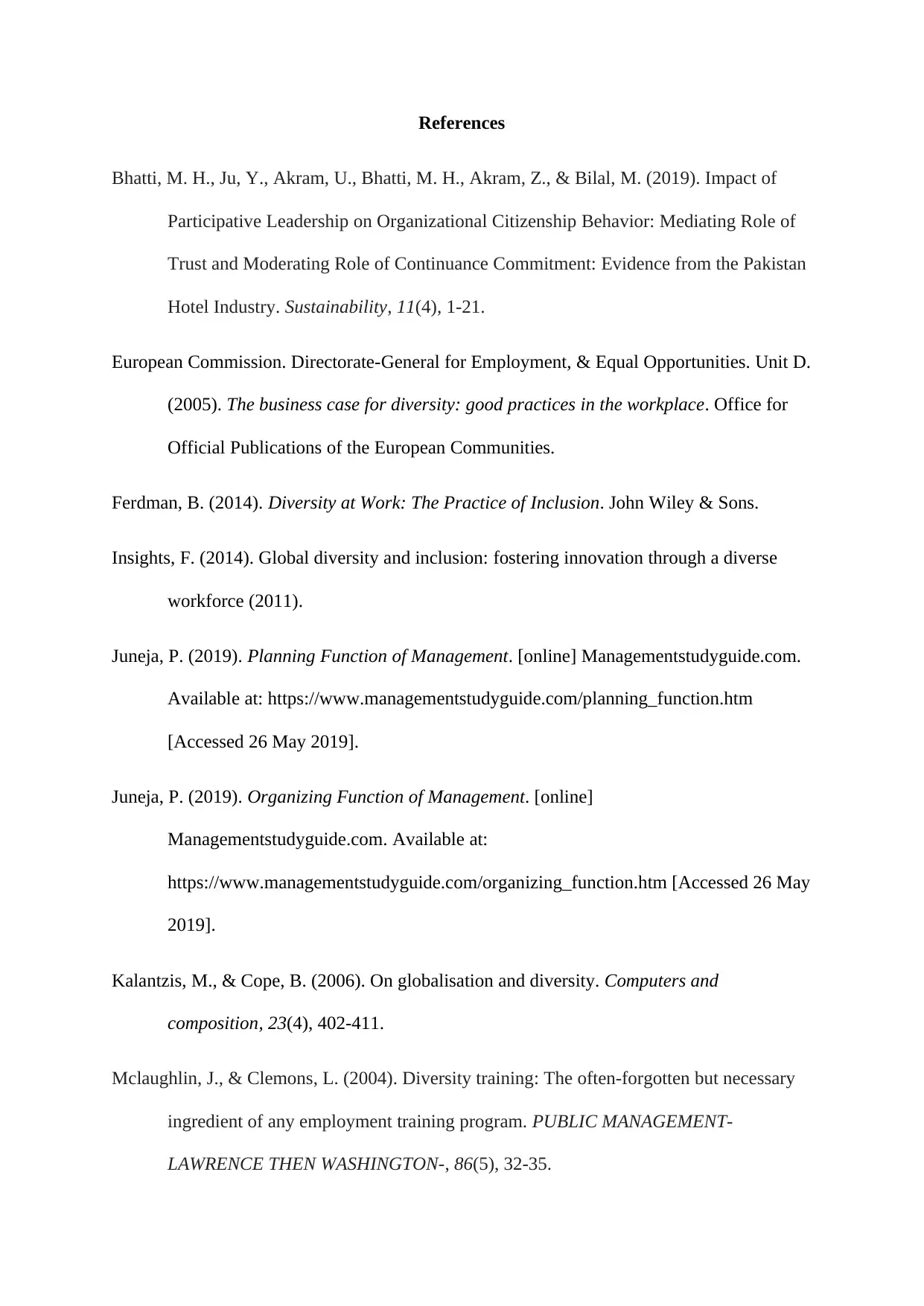
References
Bhatti, M. H., Ju, Y., Akram, U., Bhatti, M. H., Akram, Z., & Bilal, M. (2019). Impact of
Participative Leadership on Organizational Citizenship Behavior: Mediating Role of
Trust and Moderating Role of Continuance Commitment: Evidence from the Pakistan
Hotel Industry. Sustainability, 11(4), 1-21.
European Commission. Directorate-General for Employment, & Equal Opportunities. Unit D.
(2005). The business case for diversity: good practices in the workplace. Office for
Official Publications of the European Communities.
Ferdman, B. (2014). Diversity at Work: The Practice of Inclusion. John Wiley & Sons.
Insights, F. (2014). Global diversity and inclusion: fostering innovation through a diverse
workforce (2011).
Juneja, P. (2019). Planning Function of Management. [online] Managementstudyguide.com.
Available at: https://www.managementstudyguide.com/planning_function.htm
[Accessed 26 May 2019].
Juneja, P. (2019). Organizing Function of Management. [online]
Managementstudyguide.com. Available at:
https://www.managementstudyguide.com/organizing_function.htm [Accessed 26 May
2019].
Kalantzis, M., & Cope, B. (2006). On globalisation and diversity. Computers and
composition, 23(4), 402-411.
Mclaughlin, J., & Clemons, L. (2004). Diversity training: The often-forgotten but necessary
ingredient of any employment training program. PUBLIC MANAGEMENT-
LAWRENCE THEN WASHINGTON-, 86(5), 32-35.
Bhatti, M. H., Ju, Y., Akram, U., Bhatti, M. H., Akram, Z., & Bilal, M. (2019). Impact of
Participative Leadership on Organizational Citizenship Behavior: Mediating Role of
Trust and Moderating Role of Continuance Commitment: Evidence from the Pakistan
Hotel Industry. Sustainability, 11(4), 1-21.
European Commission. Directorate-General for Employment, & Equal Opportunities. Unit D.
(2005). The business case for diversity: good practices in the workplace. Office for
Official Publications of the European Communities.
Ferdman, B. (2014). Diversity at Work: The Practice of Inclusion. John Wiley & Sons.
Insights, F. (2014). Global diversity and inclusion: fostering innovation through a diverse
workforce (2011).
Juneja, P. (2019). Planning Function of Management. [online] Managementstudyguide.com.
Available at: https://www.managementstudyguide.com/planning_function.htm
[Accessed 26 May 2019].
Juneja, P. (2019). Organizing Function of Management. [online]
Managementstudyguide.com. Available at:
https://www.managementstudyguide.com/organizing_function.htm [Accessed 26 May
2019].
Kalantzis, M., & Cope, B. (2006). On globalisation and diversity. Computers and
composition, 23(4), 402-411.
Mclaughlin, J., & Clemons, L. (2004). Diversity training: The often-forgotten but necessary
ingredient of any employment training program. PUBLIC MANAGEMENT-
LAWRENCE THEN WASHINGTON-, 86(5), 32-35.
⊘ This is a preview!⊘
Do you want full access?
Subscribe today to unlock all pages.
Trusted by 1+ million students worldwide
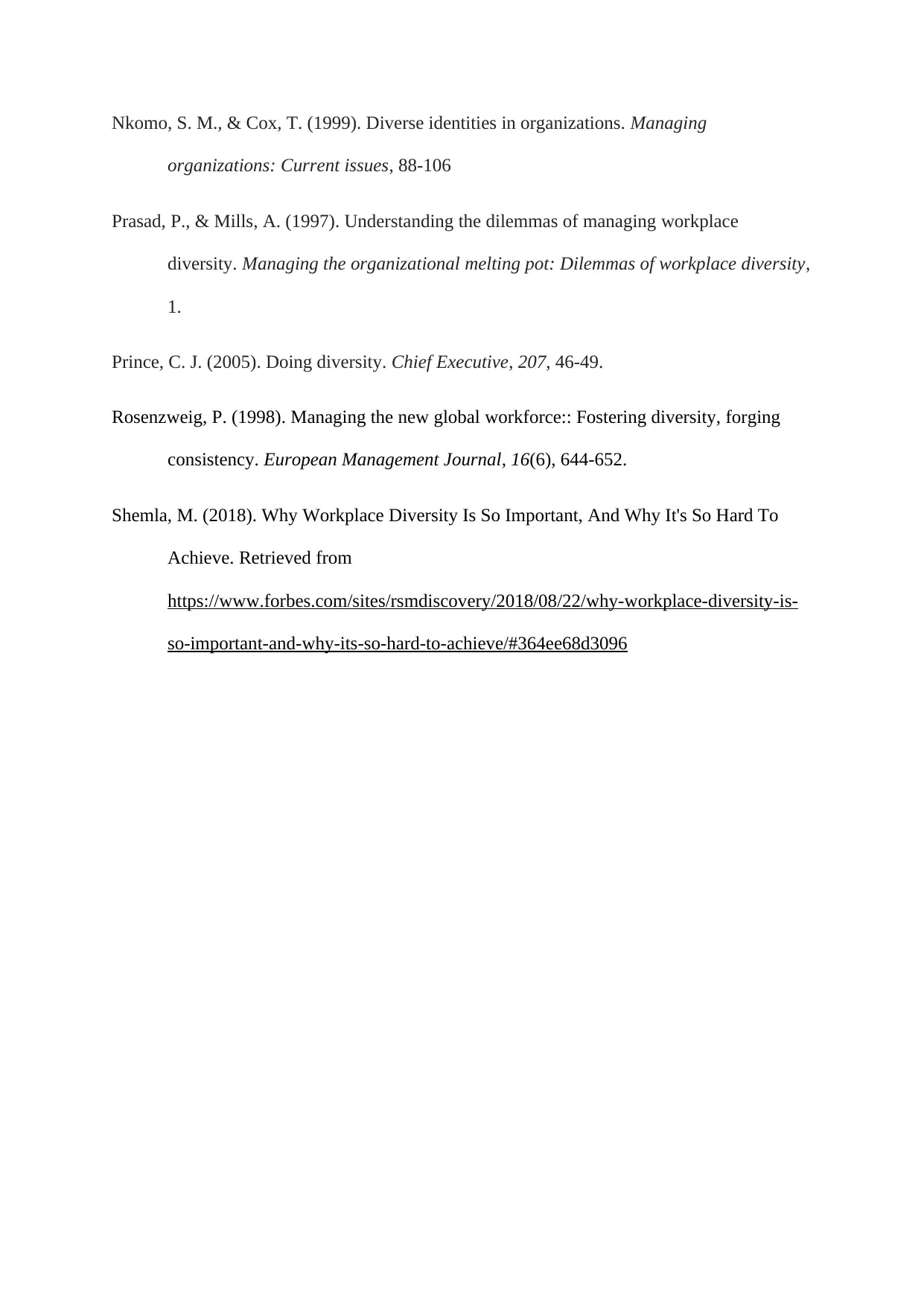
Nkomo, S. M., & Cox, T. (1999). Diverse identities in organizations. Managing
organizations: Current issues, 88-106
Prasad, P., & Mills, A. (1997). Understanding the dilemmas of managing workplace
diversity. Managing the organizational melting pot: Dilemmas of workplace diversity,
1.
Prince, C. J. (2005). Doing diversity. Chief Executive, 207, 46-49.
Rosenzweig, P. (1998). Managing the new global workforce:: Fostering diversity, forging
consistency. European Management Journal, 16(6), 644-652.
Shemla, M. (2018). Why Workplace Diversity Is So Important, And Why It's So Hard To
Achieve. Retrieved from
https://www.forbes.com/sites/rsmdiscovery/2018/08/22/why-workplace-diversity-is-
so-important-and-why-its-so-hard-to-achieve/#364ee68d3096
organizations: Current issues, 88-106
Prasad, P., & Mills, A. (1997). Understanding the dilemmas of managing workplace
diversity. Managing the organizational melting pot: Dilemmas of workplace diversity,
1.
Prince, C. J. (2005). Doing diversity. Chief Executive, 207, 46-49.
Rosenzweig, P. (1998). Managing the new global workforce:: Fostering diversity, forging
consistency. European Management Journal, 16(6), 644-652.
Shemla, M. (2018). Why Workplace Diversity Is So Important, And Why It's So Hard To
Achieve. Retrieved from
https://www.forbes.com/sites/rsmdiscovery/2018/08/22/why-workplace-diversity-is-
so-important-and-why-its-so-hard-to-achieve/#364ee68d3096

1 out of 10


Related Documents


Your All-in-One AI-Powered Toolkit for Academic Success.
+13062052269
info@desklib.com
Available 24*7 on WhatsApp / Email
![[object Object]](/_next/static/media/star-bottom.7253800d.svg)
Unlock your academic potential
Copyright © 2020–2026 A2Z Services. All Rights Reserved. Developed and managed by ZUCOL.