University Essay: Adolescent Brain and Peer Influence Analysis
VerifiedAdded on 2023/06/04
|11
|2534
|475
Essay
AI Summary
This essay delves into the intricate relationship between the adolescent brain and peer influence, exploring how these factors shape behavior and decision-making. It begins by defining adolescence and highlighting the brain's plasticity during this period, emphasizing the 'use it or lose it' principle of synaptic pruning. The essay examines the impact of peer pressure on adolescent behavior, including risky decisions, and how peer groups influence social norms. It then explores brain connectivity and specialization, discussing how these processes contribute to cognitive development. The essay connects these concepts to secondary school teaching, proposing strategies like brain training programs, session groups, and science projects to enhance learning. The author suggests practical applications of the concepts, providing examples of how teachers can leverage peer influence and brain development to create engaging and effective learning environments. Ultimately, the essay underscores the importance of understanding the adolescent brain and peer dynamics to foster positive educational outcomes.
Running head: ADOLESCENT BRAIN AND PEER INFLUENCE
Adolescent Brain and Peer Influence
Name of the student
Name of the University
Author note
Adolescent Brain and Peer Influence
Name of the student
Name of the University
Author note

Paraphrase This Document
Need a fresh take? Get an instant paraphrase of this document with our AI Paraphraser
1ADOLESCENT BRAIN AND PEER INFLUENCE
Table of Contents
Introduction................................................................................................................................2
Principle of Use or Lose it in Adolescence................................................................................2
Peer Influence on Adolescent Behaviour...................................................................................3
Brain connectivity and specialization........................................................................................5
Conclusion..................................................................................................................................6
References..................................................................................................................................8
Table of Contents
Introduction................................................................................................................................2
Principle of Use or Lose it in Adolescence................................................................................2
Peer Influence on Adolescent Behaviour...................................................................................3
Brain connectivity and specialization........................................................................................5
Conclusion..................................................................................................................................6
References..................................................................................................................................8
2ADOLESCENT BRAIN AND PEER INFLUENCE
Introduction
Adolescence refers to phase of the life between childhood and that of adulthood. The
adolescents look for diversion and new experiences that puts their health in grave danger.
High plasticity in relation to adolescent brain enables environmental influence that exerts
strong effect on the cortical circuitry of the adolescents. Physical and emotional maturation
takes place at this stage but it also paves the way for harmful influences (Albert, Chein &
Steinberg, 2013). Adolescence refers to time when teenagers become susceptible to the peer
pressure as the peers have a significant influence on behaviour at the adolescent stage. Peer
pressure can be said to be a hallmark pertaining to adolescent experience. Children who are in
the adolescent stage become aware regarding people around them and they realize the
significance of perception at this stage of life. This essay discusses the concepts of use or lose
it principle and brain connectivity. It talks about the influence that peers have on the
adolescent behaviour and how this can be applied in the context of secondary school
teaching.
Principle of Use or Lose it in Adolescence
The brain of an adolescent has a ‘use it or lose it’ system of pruning that results in
decreased number of the connections. The brain connections are stimulated at the time of
adolescence and they become strengthened owing to repeated use. The connections that are
not used tend to wither away at the adolescent stage. This concept suggests that the
adolescent brain destroys the connections that are weak and it preserves those which
experience has rendered to be useful. This process of synaptic pruning occurs throughout life
but it takes place mostly in late childhood and in the teenage years. Synapses carrying most
messages have the tendency of becoming stronger and the ones that are weak tends to get cut
out. Tis can help in the aspect of refinement along with specialisation (Dunbar, 2014). The
Introduction
Adolescence refers to phase of the life between childhood and that of adulthood. The
adolescents look for diversion and new experiences that puts their health in grave danger.
High plasticity in relation to adolescent brain enables environmental influence that exerts
strong effect on the cortical circuitry of the adolescents. Physical and emotional maturation
takes place at this stage but it also paves the way for harmful influences (Albert, Chein &
Steinberg, 2013). Adolescence refers to time when teenagers become susceptible to the peer
pressure as the peers have a significant influence on behaviour at the adolescent stage. Peer
pressure can be said to be a hallmark pertaining to adolescent experience. Children who are in
the adolescent stage become aware regarding people around them and they realize the
significance of perception at this stage of life. This essay discusses the concepts of use or lose
it principle and brain connectivity. It talks about the influence that peers have on the
adolescent behaviour and how this can be applied in the context of secondary school
teaching.
Principle of Use or Lose it in Adolescence
The brain of an adolescent has a ‘use it or lose it’ system of pruning that results in
decreased number of the connections. The brain connections are stimulated at the time of
adolescence and they become strengthened owing to repeated use. The connections that are
not used tend to wither away at the adolescent stage. This concept suggests that the
adolescent brain destroys the connections that are weak and it preserves those which
experience has rendered to be useful. This process of synaptic pruning occurs throughout life
but it takes place mostly in late childhood and in the teenage years. Synapses carrying most
messages have the tendency of becoming stronger and the ones that are weak tends to get cut
out. Tis can help in the aspect of refinement along with specialisation (Dunbar, 2014). The
⊘ This is a preview!⊘
Do you want full access?
Subscribe today to unlock all pages.

Trusted by 1+ million students worldwide
3ADOLESCENT BRAIN AND PEER INFLUENCE
experiences that are given to the young people is of crucial importance as it goes through
synaptic wiring. It destroys and creates the connections very quickly and what the adolescent
learns gets hardwired in the brain of an individual for the remaining part of his life. The
studies that have been carried out with the non-human animals have brought out the fact that
environmental opportunity have an influence on connections that can be retained at the stage
of pruning. The manner the teenagers spend the time and make use of brain has an influence
on organization along with capacity of brains. The activities that are undertaken by the
adolescents can ensure that circuits underpinning adaptive functioning can grow (Peper &
Dahl, 2013).The teenagers can create their brains and the things that they want to learn are
hardwired in their brains. There are some adolescents who engage in music along with sports
that helps in sustaining synaptic connections within associated areas. The needs of the
students should be recognized and on this basis the intellectual abilities should be developed
in the students.
The concept of “use or lose it” can be applied in the educational setting by the
implementation of a brain training program. I would keep rewards that can help in driving
changes within the brain of the adolescents at the time of secondary school teaching. The
difficulties are different in relation to a task that can help in driving changes with a great
amount of proficiency (Parkinson & Wheatley, 2015). In the classroom, a problem can be
established and the students can be paired. Each pair of the student can be given sufficient
amount of time with the help of which they can arrive at a conclusion. The participants
should be permitted to define conclusion in the personal voice. One student can explain
concept whereas the other student can evaluate the learning. This classroom activity can keep
the students engaged and this can help them in retaining important information in their brain
(Giedd, 2012). This can help in developing the abilities of the secondary school students and
they would stay engaged in the classroom.
experiences that are given to the young people is of crucial importance as it goes through
synaptic wiring. It destroys and creates the connections very quickly and what the adolescent
learns gets hardwired in the brain of an individual for the remaining part of his life. The
studies that have been carried out with the non-human animals have brought out the fact that
environmental opportunity have an influence on connections that can be retained at the stage
of pruning. The manner the teenagers spend the time and make use of brain has an influence
on organization along with capacity of brains. The activities that are undertaken by the
adolescents can ensure that circuits underpinning adaptive functioning can grow (Peper &
Dahl, 2013).The teenagers can create their brains and the things that they want to learn are
hardwired in their brains. There are some adolescents who engage in music along with sports
that helps in sustaining synaptic connections within associated areas. The needs of the
students should be recognized and on this basis the intellectual abilities should be developed
in the students.
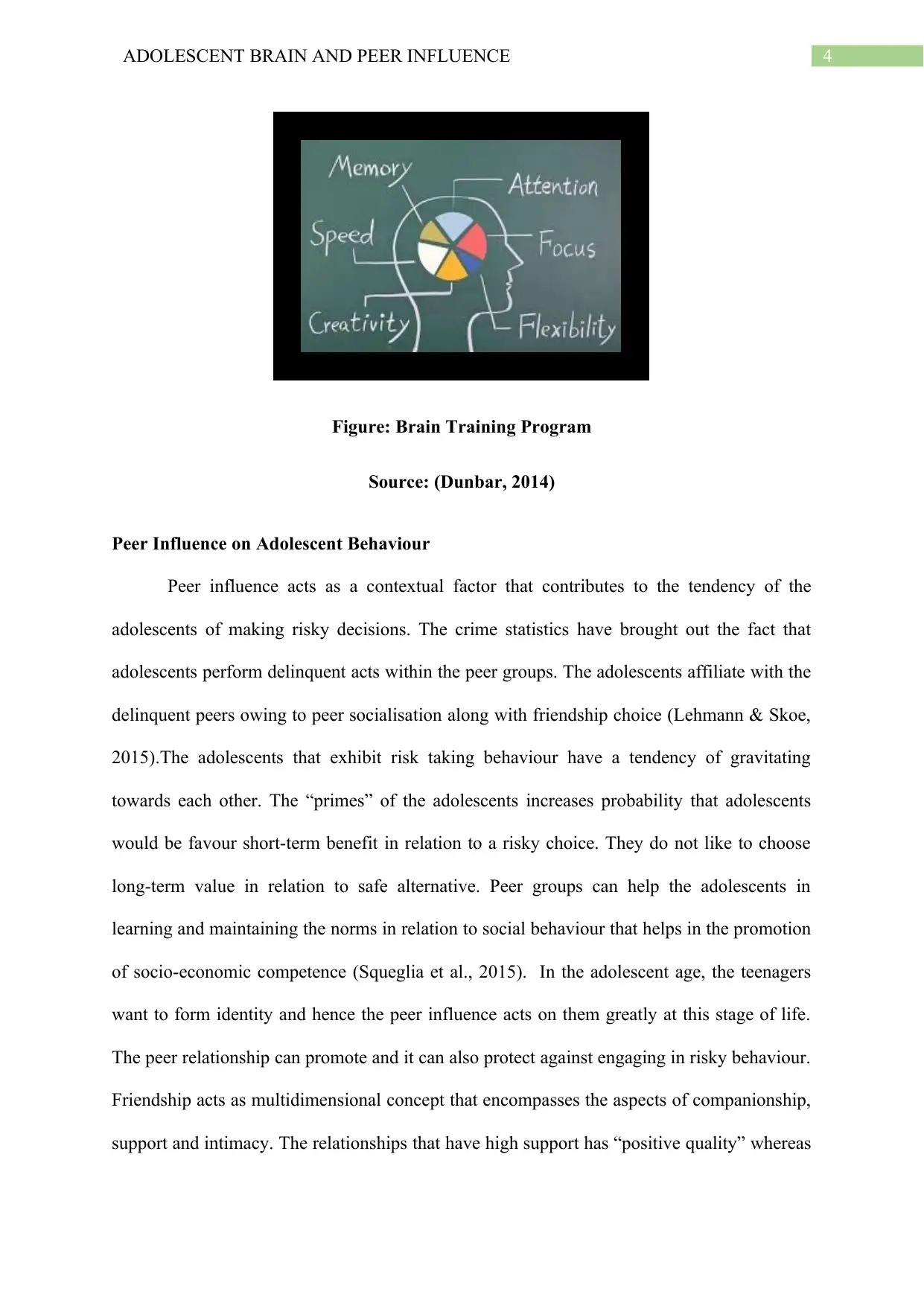
The concept of “use or lose it” can be applied in the educational setting by the
implementation of a brain training program. I would keep rewards that can help in driving
changes within the brain of the adolescents at the time of secondary school teaching. The
difficulties are different in relation to a task that can help in driving changes with a great
amount of proficiency (Parkinson & Wheatley, 2015). In the classroom, a problem can be
established and the students can be paired. Each pair of the student can be given sufficient
amount of time with the help of which they can arrive at a conclusion. The participants
should be permitted to define conclusion in the personal voice. One student can explain
concept whereas the other student can evaluate the learning. This classroom activity can keep
the students engaged and this can help them in retaining important information in their brain
(Giedd, 2012). This can help in developing the abilities of the secondary school students and
they would stay engaged in the classroom.
Paraphrase This Document
Need a fresh take? Get an instant paraphrase of this document with our AI Paraphraser
4ADOLESCENT BRAIN AND PEER INFLUENCE
Figure: Brain Training Program
Source: (Dunbar, 2014)
Peer Influence on Adolescent Behaviour
Peer influence acts as a contextual factor that contributes to the tendency of the
adolescents of making risky decisions. The crime statistics have brought out the fact that
adolescents perform delinquent acts within the peer groups. The adolescents affiliate with the
delinquent peers owing to peer socialisation along with friendship choice (Lehmann & Skoe,
2015).The adolescents that exhibit risk taking behaviour have a tendency of gravitating
towards each other. The “primes” of the adolescents increases probability that adolescents
would be favour short-term benefit in relation to a risky choice. They do not like to choose
long-term value in relation to safe alternative. Peer groups can help the adolescents in
learning and maintaining the norms in relation to social behaviour that helps in the promotion
of socio-economic competence (Squeglia et al., 2015). In the adolescent age, the teenagers
want to form identity and hence the peer influence acts on them greatly at this stage of life.
The peer relationship can promote and it can also protect against engaging in risky behaviour.
Friendship acts as multidimensional concept that encompasses the aspects of companionship,
support and intimacy. The relationships that have high support has “positive quality” whereas
Figure: Brain Training Program
Source: (Dunbar, 2014)
Peer Influence on Adolescent Behaviour
Peer influence acts as a contextual factor that contributes to the tendency of the
adolescents of making risky decisions. The crime statistics have brought out the fact that
adolescents perform delinquent acts within the peer groups. The adolescents affiliate with the
delinquent peers owing to peer socialisation along with friendship choice (Lehmann & Skoe,
2015).The adolescents that exhibit risk taking behaviour have a tendency of gravitating
towards each other. The “primes” of the adolescents increases probability that adolescents
would be favour short-term benefit in relation to a risky choice. They do not like to choose
long-term value in relation to safe alternative. Peer groups can help the adolescents in
learning and maintaining the norms in relation to social behaviour that helps in the promotion
of socio-economic competence (Squeglia et al., 2015). In the adolescent age, the teenagers
want to form identity and hence the peer influence acts on them greatly at this stage of life.
The peer relationship can promote and it can also protect against engaging in risky behaviour.
Friendship acts as multidimensional concept that encompasses the aspects of companionship,
support and intimacy. The relationships that have high support has “positive quality” whereas
5ADOLESCENT BRAIN AND PEER INFLUENCE
those relationships that have high conflict has “negative quality” (Hodel et al., 2015). The
negative quality of the friendships can be said to be associated with the delinquent acts and
these kind of behaviours takes place because they want to lessen negative feelings that rise
owing to high peer conflict.
The adolescents are greatly influenced by the actions and activities of their peers. The
peer influence can be used to create interest towards the subject in the case of secondary
school teaching. The concept of peer influence on the adolescent behaviour can be used by
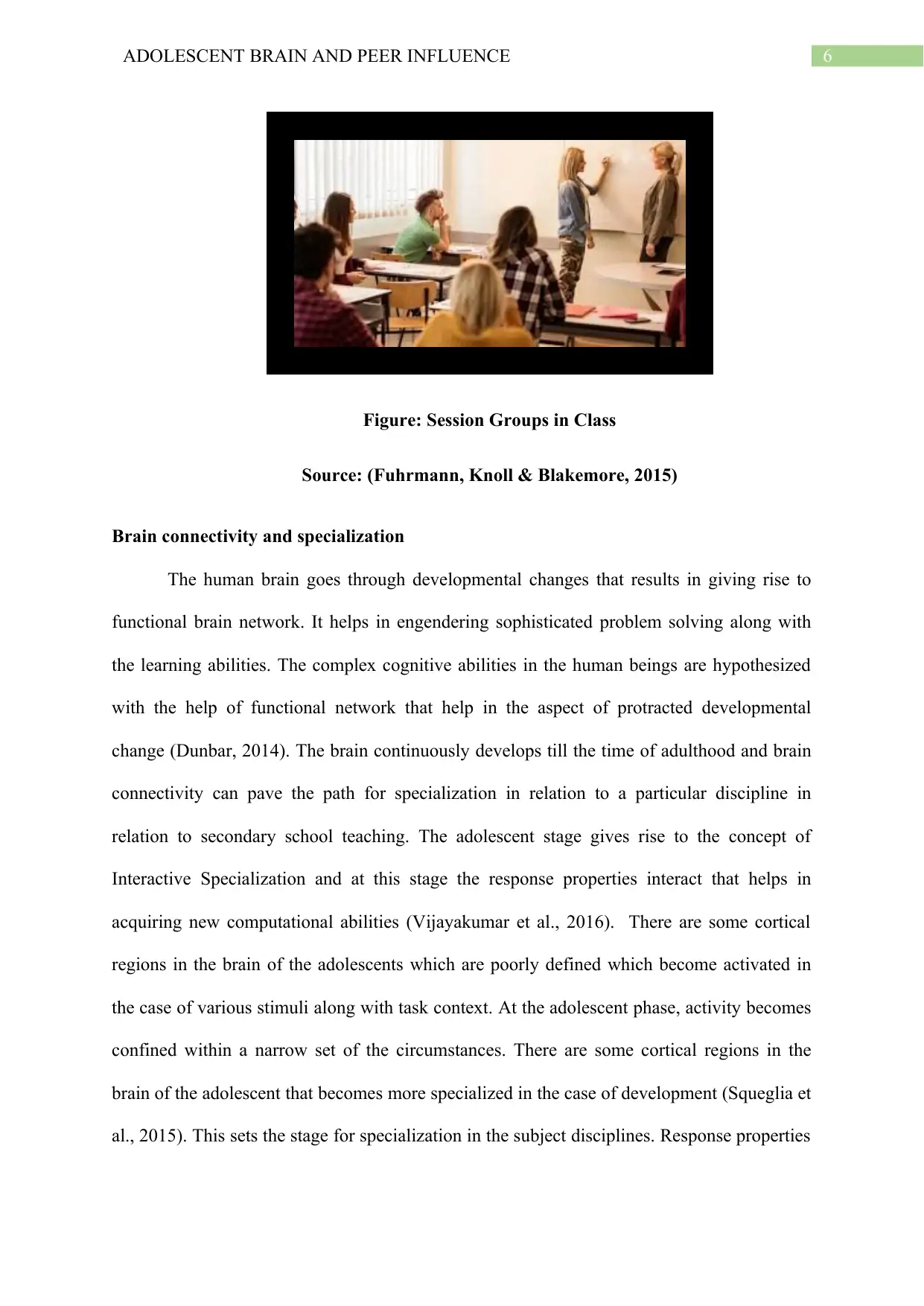
making use of session groups that can be introduced within the classroom by the secondary
school teacher (Fuhrmann, Knoll & Blakemore, 2015).The students can be asked to come
together within session groups focussing on single topic. The session groups can help in
creating interest towards certain subjects in the students. The student can contribute useful
thoughts along with ideas in each group. The secondary school teacher can encourage the
aspect of discussion in the classroom that can stimulate the interest of the students towards
certain subjects. The collaboration in between the students in the classroom can help the
students in learning from each other. The students in the class would like to compete with
each other and they would like to gain more knowledge that can help them in excelling at
their academic performance (Nelson, Jarcho & Guyer, 2016). A person devoting more
amount of time towards study at the home will also influence another individual in devoting a
great deal of time in studies. This can help in bringing about improvements in their academic
results and they would be able to improve in the different domains.
those relationships that have high conflict has “negative quality” (Hodel et al., 2015). The
negative quality of the friendships can be said to be associated with the delinquent acts and
these kind of behaviours takes place because they want to lessen negative feelings that rise
owing to high peer conflict.
The adolescents are greatly influenced by the actions and activities of their peers. The
peer influence can be used to create interest towards the subject in the case of secondary
school teaching. The concept of peer influence on the adolescent behaviour can be used by
making use of session groups that can be introduced within the classroom by the secondary
school teacher (Fuhrmann, Knoll & Blakemore, 2015).The students can be asked to come
together within session groups focussing on single topic. The session groups can help in
creating interest towards certain subjects in the students. The student can contribute useful
thoughts along with ideas in each group. The secondary school teacher can encourage the
aspect of discussion in the classroom that can stimulate the interest of the students towards
certain subjects. The collaboration in between the students in the classroom can help the
students in learning from each other. The students in the class would like to compete with
each other and they would like to gain more knowledge that can help them in excelling at
their academic performance (Nelson, Jarcho & Guyer, 2016). A person devoting more
amount of time towards study at the home will also influence another individual in devoting a
great deal of time in studies. This can help in bringing about improvements in their academic
results and they would be able to improve in the different domains.
⊘ This is a preview!⊘
Do you want full access?
Subscribe today to unlock all pages.
Trusted by 1+ million students worldwide
6ADOLESCENT BRAIN AND PEER INFLUENCE
Figure: Session Groups in Class
Source: (Fuhrmann, Knoll & Blakemore, 2015)
Brain connectivity and specialization
The human brain goes through developmental changes that results in giving rise to
functional brain network. It helps in engendering sophisticated problem solving along with
the learning abilities. The complex cognitive abilities in the human beings are hypothesized
with the help of functional network that help in the aspect of protracted developmental
change (Dunbar, 2014). The brain continuously develops till the time of adulthood and brain
connectivity can pave the path for specialization in relation to a particular discipline in
relation to secondary school teaching. The adolescent stage gives rise to the concept of
Interactive Specialization and at this stage the response properties interact that helps in
acquiring new computational abilities (Vijayakumar et al., 2016). There are some cortical
regions in the brain of the adolescents which are poorly defined which become activated in
the case of various stimuli along with task context. At the adolescent phase, activity becomes
confined within a narrow set of the circumstances. There are some cortical regions in the
brain of the adolescent that becomes more specialized in the case of development (Squeglia et
al., 2015). This sets the stage for specialization in the subject disciplines. Response properties
Figure: Session Groups in Class
Source: (Fuhrmann, Knoll & Blakemore, 2015)
Brain connectivity and specialization
The human brain goes through developmental changes that results in giving rise to
functional brain network. It helps in engendering sophisticated problem solving along with
the learning abilities. The complex cognitive abilities in the human beings are hypothesized
with the help of functional network that help in the aspect of protracted developmental
change (Dunbar, 2014). The brain continuously develops till the time of adulthood and brain
connectivity can pave the path for specialization in relation to a particular discipline in
relation to secondary school teaching. The adolescent stage gives rise to the concept of
Interactive Specialization and at this stage the response properties interact that helps in
acquiring new computational abilities (Vijayakumar et al., 2016). There are some cortical
regions in the brain of the adolescents which are poorly defined which become activated in
the case of various stimuli along with task context. At the adolescent phase, activity becomes
confined within a narrow set of the circumstances. There are some cortical regions in the
brain of the adolescent that becomes more specialized in the case of development (Squeglia et
al., 2015). This sets the stage for specialization in the subject disciplines. Response properties
Paraphrase This Document
Need a fresh take? Get an instant paraphrase of this document with our AI Paraphraser
7ADOLESCENT BRAIN AND PEER INFLUENCE
in relation to cortical regions are determined with the help of pattern of the connectivity to the
other regions.
The concept of brain specialization can be utilized in the classroom with the help of
teaching science that will be able to develop the scientific temper in the students. The
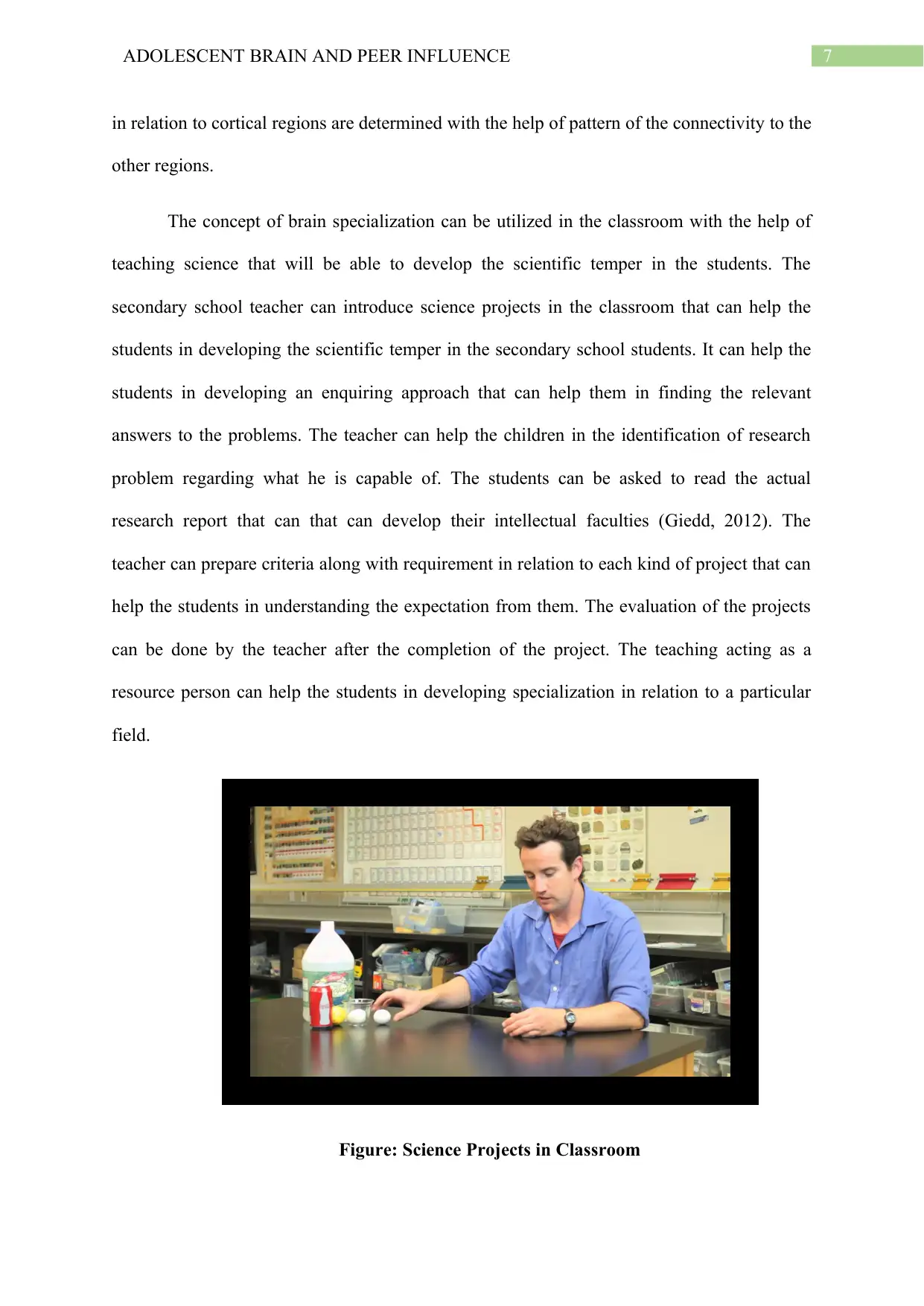
secondary school teacher can introduce science projects in the classroom that can help the
students in developing the scientific temper in the secondary school students. It can help the
students in developing an enquiring approach that can help them in finding the relevant
answers to the problems. The teacher can help the children in the identification of research
problem regarding what he is capable of. The students can be asked to read the actual
research report that can that can develop their intellectual faculties (Giedd, 2012). The
teacher can prepare criteria along with requirement in relation to each kind of project that can
help the students in understanding the expectation from them. The evaluation of the projects
can be done by the teacher after the completion of the project. The teaching acting as a
resource person can help the students in developing specialization in relation to a particular
field.
Figure: Science Projects in Classroom
in relation to cortical regions are determined with the help of pattern of the connectivity to the
other regions.
The concept of brain specialization can be utilized in the classroom with the help of
teaching science that will be able to develop the scientific temper in the students. The
secondary school teacher can introduce science projects in the classroom that can help the
students in developing the scientific temper in the secondary school students. It can help the
students in developing an enquiring approach that can help them in finding the relevant
answers to the problems. The teacher can help the children in the identification of research
problem regarding what he is capable of. The students can be asked to read the actual
research report that can that can develop their intellectual faculties (Giedd, 2012). The
teacher can prepare criteria along with requirement in relation to each kind of project that can
help the students in understanding the expectation from them. The evaluation of the projects
can be done by the teacher after the completion of the project. The teaching acting as a
resource person can help the students in developing specialization in relation to a particular
field.
Figure: Science Projects in Classroom
8ADOLESCENT BRAIN AND PEER INFLUENCE
Source: (Vijayakumar et al., 2016)
Conclusion
Adolescence is the stage of life in between the childhood stage and the adulthood
stage. The adolescents have a tendency of looking for diversion which creates danger for the
health of the adolescents. The brain connections of the adolescents are stimulated and it
becomes strengthened on account of repeated use. The connections which are not made use
of by the adolescent have a tendency of waning away. The principle pertaining to “use or lose
it” can be made use of within the scope of secondary school teaching by taking recourse to
brain training program. Rewards can be provided to the students that can help in bringing
about change in brain of the adolescent during teaching at secondary school stage. Peer
influence compels the adolescent in making risky endeavours that threaten their welfare and
health. There are some adolescents who show risk taking behaviour and they have a tendency
of following each other. Developmental changes take place in human brain which paves the
path for functional brain network. It helps in providing an individual with problem solving
skills. The science projects can be brought into the curriculum of classroom by secondary
school teacher that can inculcate scientific mind set in the students. It develops enquiring
approach in the students that helps the students in searching for answers to problems.
Source: (Vijayakumar et al., 2016)
Conclusion
Adolescence is the stage of life in between the childhood stage and the adulthood
stage. The adolescents have a tendency of looking for diversion which creates danger for the
health of the adolescents. The brain connections of the adolescents are stimulated and it
becomes strengthened on account of repeated use. The connections which are not made use
of by the adolescent have a tendency of waning away. The principle pertaining to “use or lose
it” can be made use of within the scope of secondary school teaching by taking recourse to
brain training program. Rewards can be provided to the students that can help in bringing
about change in brain of the adolescent during teaching at secondary school stage. Peer
influence compels the adolescent in making risky endeavours that threaten their welfare and
health. There are some adolescents who show risk taking behaviour and they have a tendency
of following each other. Developmental changes take place in human brain which paves the
path for functional brain network. It helps in providing an individual with problem solving
skills. The science projects can be brought into the curriculum of classroom by secondary
school teacher that can inculcate scientific mind set in the students. It develops enquiring
approach in the students that helps the students in searching for answers to problems.
⊘ This is a preview!⊘
Do you want full access?
Subscribe today to unlock all pages.
Trusted by 1+ million students worldwide
9ADOLESCENT BRAIN AND PEER INFLUENCE
References
Albert, D., Chein, J., & Steinberg, L. (2013). The teenage brain: Peer influences on
adolescent decision making. Current directions in psychological science, 22(2), 114-
120.
Dunbar, R. I. (2014). The social brain: Psychological underpinnings and implications for the
structure of organizations. Current Directions in Psychological Science, 23(2), 109-
114.
Fuhrmann, D., Knoll, L. J., & Blakemore, S. J. (2015). Adolescence as a sensitive period of
brain development. Trends in cognitive sciences, 19(10), 558-566.
Giedd, J. N. (2012). The digital revolution and adolescent brain evolution. Journal of
Adolescent Health, 51(2), 101-105.
Hodel, A. S., Hunt, R. H., Cowell, R. A., Van Den Heuvel, S. E., Gunnar, M. R., & Thomas,
K. M. (2015). Duration of early adversity and structural brain development in post-
institutionalized adolescents. Neuroimage, 105, 112-119.
Lehmann, A., & Skoe, E. (2015). Robust encoding in the human auditory brainstem: use it or
lose it?. Frontiers in neuroscience, 9, 451.
Nelson, E. E., Jarcho, J. M., & Guyer, A. E. (2016). Social re-orientation and brain
development: An expanded and updated view. Developmental cognitive
neuroscience, 17, 118-127.
Parkinson, C., & Wheatley, T. (2015). The repurposed social brain. Trends in Cognitive
Sciences, 19(3), 133-141.
References
Albert, D., Chein, J., & Steinberg, L. (2013). The teenage brain: Peer influences on
adolescent decision making. Current directions in psychological science, 22(2), 114-
120.
Dunbar, R. I. (2014). The social brain: Psychological underpinnings and implications for the
structure of organizations. Current Directions in Psychological Science, 23(2), 109-
114.
Fuhrmann, D., Knoll, L. J., & Blakemore, S. J. (2015). Adolescence as a sensitive period of
brain development. Trends in cognitive sciences, 19(10), 558-566.
Giedd, J. N. (2012). The digital revolution and adolescent brain evolution. Journal of
Adolescent Health, 51(2), 101-105.
Hodel, A. S., Hunt, R. H., Cowell, R. A., Van Den Heuvel, S. E., Gunnar, M. R., & Thomas,
K. M. (2015). Duration of early adversity and structural brain development in post-
institutionalized adolescents. Neuroimage, 105, 112-119.
Lehmann, A., & Skoe, E. (2015). Robust encoding in the human auditory brainstem: use it or
lose it?. Frontiers in neuroscience, 9, 451.
Nelson, E. E., Jarcho, J. M., & Guyer, A. E. (2016). Social re-orientation and brain
development: An expanded and updated view. Developmental cognitive
neuroscience, 17, 118-127.
Parkinson, C., & Wheatley, T. (2015). The repurposed social brain. Trends in Cognitive
Sciences, 19(3), 133-141.
Paraphrase This Document
Need a fresh take? Get an instant paraphrase of this document with our AI Paraphraser
10ADOLESCENT BRAIN AND PEER INFLUENCE
Peper, J. S., & Dahl, R. E. (2013). The teenage brain: Surging hormones—Brain-behavior
interactions during puberty. Current directions in psychological science, 22(2), 134-
139.
Squeglia, L. M., Tapert, S. F., Sullivan, E. V., Jacobus, J., Meloy, M. J., Rohlfing, T., &
Pfefferbaum, A. (2015). Brain development in heavy-drinking adolescents. American
journal of psychiatry, 172(6), 531-542.
Vijayakumar, N., Allen, N. B., Youssef, G., Dennison, M., Yücel, M., Simmons, J. G., &
Whittle, S. (2016). Brain development during adolescence: A mixed longitudinal‐
investigation of cortical thickness, surface area, and volume. Human brain
mapping, 37(6), 2027-2038.
Peper, J. S., & Dahl, R. E. (2013). The teenage brain: Surging hormones—Brain-behavior
interactions during puberty. Current directions in psychological science, 22(2), 134-
139.
Squeglia, L. M., Tapert, S. F., Sullivan, E. V., Jacobus, J., Meloy, M. J., Rohlfing, T., &
Pfefferbaum, A. (2015). Brain development in heavy-drinking adolescents. American
journal of psychiatry, 172(6), 531-542.
Vijayakumar, N., Allen, N. B., Youssef, G., Dennison, M., Yücel, M., Simmons, J. G., &
Whittle, S. (2016). Brain development during adolescence: A mixed longitudinal‐
investigation of cortical thickness, surface area, and volume. Human brain
mapping, 37(6), 2027-2038.

1 out of 11


Related Documents


Your All-in-One AI-Powered Toolkit for Academic Success.
+13062052269
info@desklib.com
Available 24*7 on WhatsApp / Email
![[object Object]](/_next/static/media/star-bottom.7253800d.svg)
Unlock your academic potential
Copyright © 2020–2026 A2Z Services. All Rights Reserved. Developed and managed by ZUCOL.