Major Assignment 1: Aircraft Boarding Flight Boarding Systems Analysis
VerifiedAdded on 2022/10/06
|11
|1582
|26
Report
AI Summary
This report addresses the inefficiencies of current aircraft boarding methods, specifically focusing on the back-to-front approach. It identifies the problem of increased boarding time and passenger frustration, along with key stakeholders including passengers and flight crew. A comprehensive concept map illustrates the relationships between stakeholders, system elements, and the environment. The report outlines stakeholder requirements, emphasizing the need for improved aircraft services, reduced boarding time, and efficient time management. The proposed architecture suggests the use of a reverse pyramid boarding strategy, where business class passengers board first, followed by a zone-based approach. The proposed design advocates for a reverse pyramid boarding approach as the most effective solution, incorporating a dual-entry system to maximize efficiency. The report references various studies and analyses supporting the proposed design, highlighting the potential to reduce boarding time and improve passenger satisfaction.
Airline Boarding Management

Paraphrase This Document
Need a fresh take? Get an instant paraphrase of this document with our AI Paraphraser
Table of Contents
Identifying Problem...................................................................................................................3
Identifying the main stakeholders encountering problem..........................................................3
Concept map...............................................................................................................................4
Stakeholder’s requirement.........................................................................................................4
Proposed architecture.................................................................................................................6
Proposed Design.........................................................................................................................9
References................................................................................................................................10
Identifying Problem...................................................................................................................3
Identifying the main stakeholders encountering problem..........................................................3
Concept map...............................................................................................................................4
Stakeholder’s requirement.........................................................................................................4
Proposed architecture.................................................................................................................6
Proposed Design.........................................................................................................................9
References................................................................................................................................10
Identifying the Problem
The problem being analysed through this assignment is the increased boarding time
encountered by the passengers of airlines (both domestic and international) due to the
adoption of back-to-front boarding approach. The back to front boarding approach is
considered to be the most inefficient way of filling up a flight cabin yet it is widely utilised
by the modern day airline companies to fill up the flight cabin with passengers. This approach
of passenger embarking takes the maximum amount of time and also results in increased
level of frustration and dissatisfaction among the flight passengers3. The back-to-front
boarding approach is the most time consuming boarding approach which results in greater
waiting time for the passengers and this is one of the most important reasons that eventually
brings down the customer satisfaction levels of the flight passengers. An artificial simulation
of flight boarding technique conducted by Adam and Jamie had found out that back-to-front
boarding approach takes an average time of 24 minutes and 29 seconds which is the
maximum time when considered with the other different passenger boarding techniques5.
This assignment would provide a responsive solution to the present problems faced by the
flight passengers during the process of back-to-front boarding approach by conducting a
thorough and comprehensive evaluation of an effective alternative approach that could be
utilised for the process of flight boarding. This would help in providing greater convenience
and comfort to the flight passengers while at the same time enhancing their flight boarding
experience. .
Identifying the main stakeholders encountering the problem
The stakeholders mainly encountering the problem are the flight passengers of different
airlines who have to wait for a long time to finally get their seats on the flight. The modern
day flight passengers are the main victims of the back-to-front boarding approach that are
mainly being utilised by the modern day airlines companies1. The passengers are the victims
who have to bear the brunt of the back-to-front flight boarding techniques. They have to wait
in queues for long time and a significant amount of time is wasted in this process which could
have been easily saved through the utilisation and adoption of alternative flight boarding
approaches. Additionally, the flight crew members are also an important stakeholder to this
present problem that is being encountered as a result of the back-to-front flight boarding
techniques2. They have to face immense difficulties and challenges in managing the
The problem being analysed through this assignment is the increased boarding time
encountered by the passengers of airlines (both domestic and international) due to the
adoption of back-to-front boarding approach. The back to front boarding approach is
considered to be the most inefficient way of filling up a flight cabin yet it is widely utilised
by the modern day airline companies to fill up the flight cabin with passengers. This approach
of passenger embarking takes the maximum amount of time and also results in increased
level of frustration and dissatisfaction among the flight passengers3. The back-to-front
boarding approach is the most time consuming boarding approach which results in greater
waiting time for the passengers and this is one of the most important reasons that eventually
brings down the customer satisfaction levels of the flight passengers. An artificial simulation
of flight boarding technique conducted by Adam and Jamie had found out that back-to-front
boarding approach takes an average time of 24 minutes and 29 seconds which is the
maximum time when considered with the other different passenger boarding techniques5.
This assignment would provide a responsive solution to the present problems faced by the
flight passengers during the process of back-to-front boarding approach by conducting a
thorough and comprehensive evaluation of an effective alternative approach that could be
utilised for the process of flight boarding. This would help in providing greater convenience
and comfort to the flight passengers while at the same time enhancing their flight boarding
experience. .
Identifying the main stakeholders encountering the problem
The stakeholders mainly encountering the problem are the flight passengers of different
airlines who have to wait for a long time to finally get their seats on the flight. The modern
day flight passengers are the main victims of the back-to-front boarding approach that are
mainly being utilised by the modern day airlines companies1. The passengers are the victims
who have to bear the brunt of the back-to-front flight boarding techniques. They have to wait
in queues for long time and a significant amount of time is wasted in this process which could
have been easily saved through the utilisation and adoption of alternative flight boarding
approaches. Additionally, the flight crew members are also an important stakeholder to this
present problem that is being encountered as a result of the back-to-front flight boarding
techniques2. They have to face immense difficulties and challenges in managing the
⊘ This is a preview!⊘
Do you want full access?
Subscribe today to unlock all pages.

Trusted by 1+ million students worldwide
passengers who at times get irritated owing to the long queues and increased delay in getting
their seats inside the flight. The crew members have to face a lot of problems while trying
their best to address the customer complaints and frustration in an effective manner to the
best of their abilities. By adopting and implementing an effective alternative to the present
back-to-front boarding approach, the inconvenience and difficulties faced by both the
passengers and the flight crew members would be greatly reduced. This would eventually
help in delivering better in-flight experience for the passengers4.
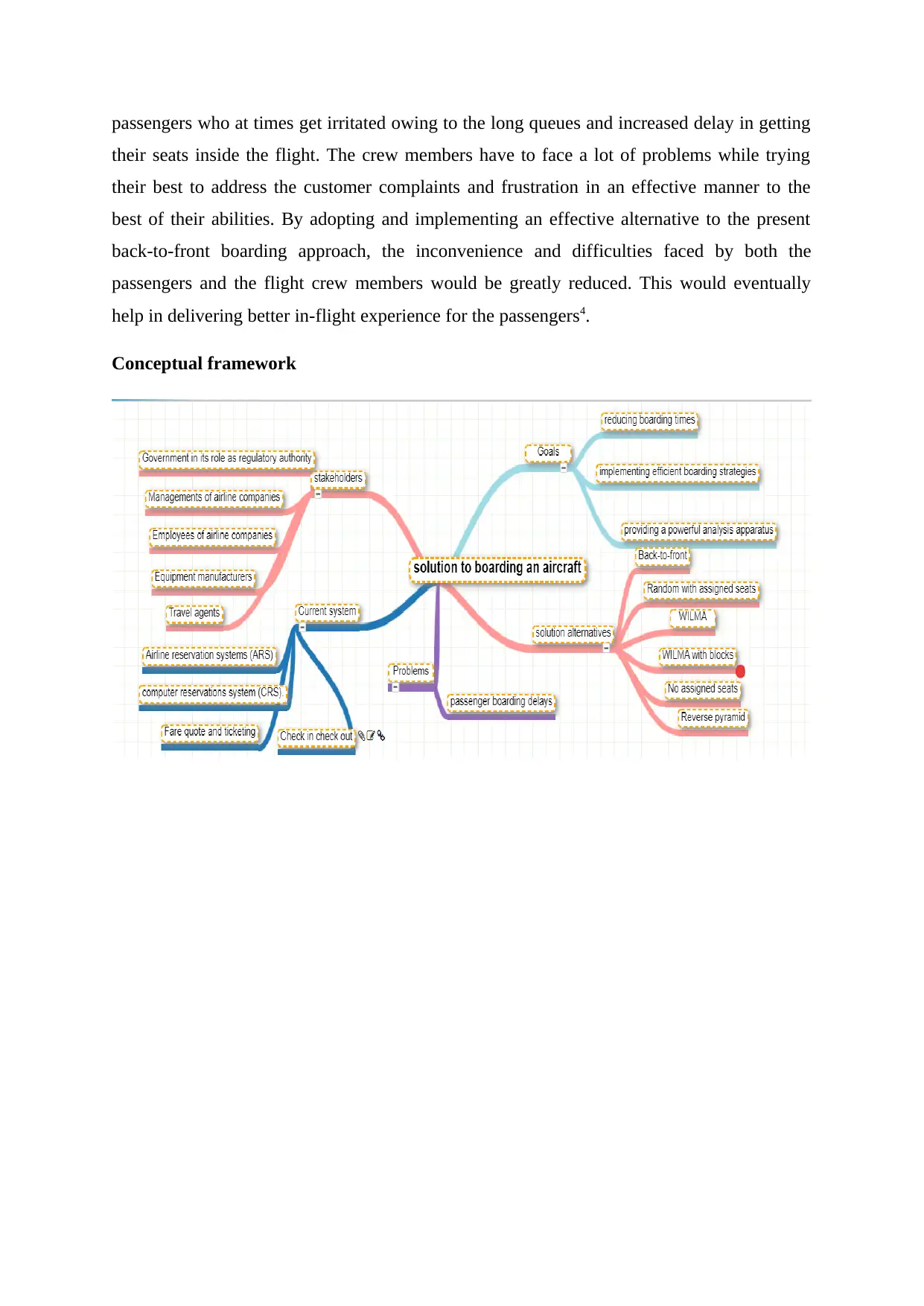
Conceptual framework
their seats inside the flight. The crew members have to face a lot of problems while trying
their best to address the customer complaints and frustration in an effective manner to the
best of their abilities. By adopting and implementing an effective alternative to the present
back-to-front boarding approach, the inconvenience and difficulties faced by both the
passengers and the flight crew members would be greatly reduced. This would eventually
help in delivering better in-flight experience for the passengers4.
Conceptual framework
Paraphrase This Document
Need a fresh take? Get an instant paraphrase of this document with our AI Paraphraser
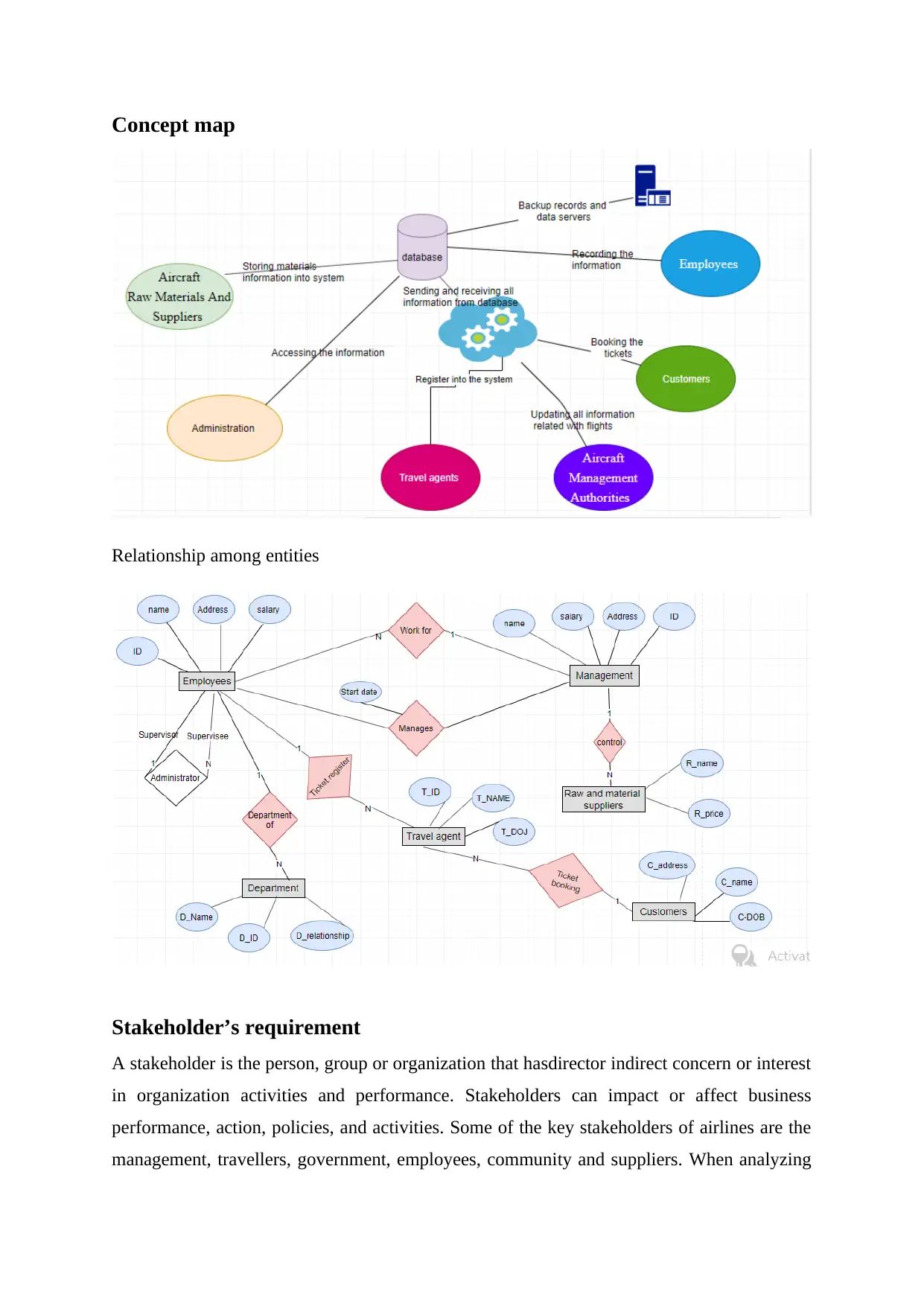
Concept map
Relationship among entities
Stakeholder’s requirement
A stakeholder is the person, group or organization that hasdirector indirect concern or interest
in organization activities and performance. Stakeholders can impact or affect business
performance, action, policies, and activities. Some of the key stakeholders of airlines are the
management, travellers, government, employees, community and suppliers. When analyzing
Relationship among entities
Stakeholder’s requirement
A stakeholder is the person, group or organization that hasdirector indirect concern or interest
in organization activities and performance. Stakeholders can impact or affect business
performance, action, policies, and activities. Some of the key stakeholders of airlines are the
management, travellers, government, employees, community and suppliers. When analyzing
the stakeholders as the passenger and travellers, the requirements of stakeholders as
individuals is to improve aircraft services and reduces the boarding time. Ensuring an
effective time management is considered the vital aspect of accomplishing passenger
satisfaction and meeting traveller requirement8. Aviation manual include flight instruction,
aerial observation, and corporate executive transportation which requirements are to be taken
care by flight crew to deliver a higher quality of services to customer or travellers5. An airport
management requirement is to accomplish and maximize non-aeronautical revenues and sales
performance. The government is also considered as one of the key stakeholders for aviation
industries and it needs to establish all the government rules and regulations.
LISTS OF STAKEHOLDERS REQUIREMENTS EXAMPLE
Workers Or Employees Working condition, wages, and
job security
If employees of the organization
are provided more
responsibilities they will expect
increased payment
Aircraft Management
Authorities
Job security, status If the growth and performance
are going to improve, the
managers of the organization
want to increase bonuses.
Travelers Better services, fair value for
money and reduce boarding
time
If the management accomplish
these goals then performance
will be improved
Aircraft Raw Materials and
suppliers
Paid timely If the decision making is taken
to delay the payment of
suppliers then conflicts occur
between management and
suppliers7
Government Implement the rules and
regulations
Successful implementation of
the regulation will improve the
performance of aircraft
authorities
individuals is to improve aircraft services and reduces the boarding time. Ensuring an
effective time management is considered the vital aspect of accomplishing passenger
satisfaction and meeting traveller requirement8. Aviation manual include flight instruction,
aerial observation, and corporate executive transportation which requirements are to be taken
care by flight crew to deliver a higher quality of services to customer or travellers5. An airport
management requirement is to accomplish and maximize non-aeronautical revenues and sales
performance. The government is also considered as one of the key stakeholders for aviation
industries and it needs to establish all the government rules and regulations.
LISTS OF STAKEHOLDERS REQUIREMENTS EXAMPLE
Workers Or Employees Working condition, wages, and
job security
If employees of the organization
are provided more
responsibilities they will expect
increased payment
Aircraft Management
Authorities
Job security, status If the growth and performance
are going to improve, the
managers of the organization
want to increase bonuses.
Travelers Better services, fair value for
money and reduce boarding
time
If the management accomplish
these goals then performance
will be improved
Aircraft Raw Materials and
suppliers
Paid timely If the decision making is taken
to delay the payment of
suppliers then conflicts occur
between management and
suppliers7
Government Implement the rules and
regulations
Successful implementation of
the regulation will improve the
performance of aircraft
authorities
⊘ This is a preview!⊘
Do you want full access?
Subscribe today to unlock all pages.
Trusted by 1+ million students worldwide
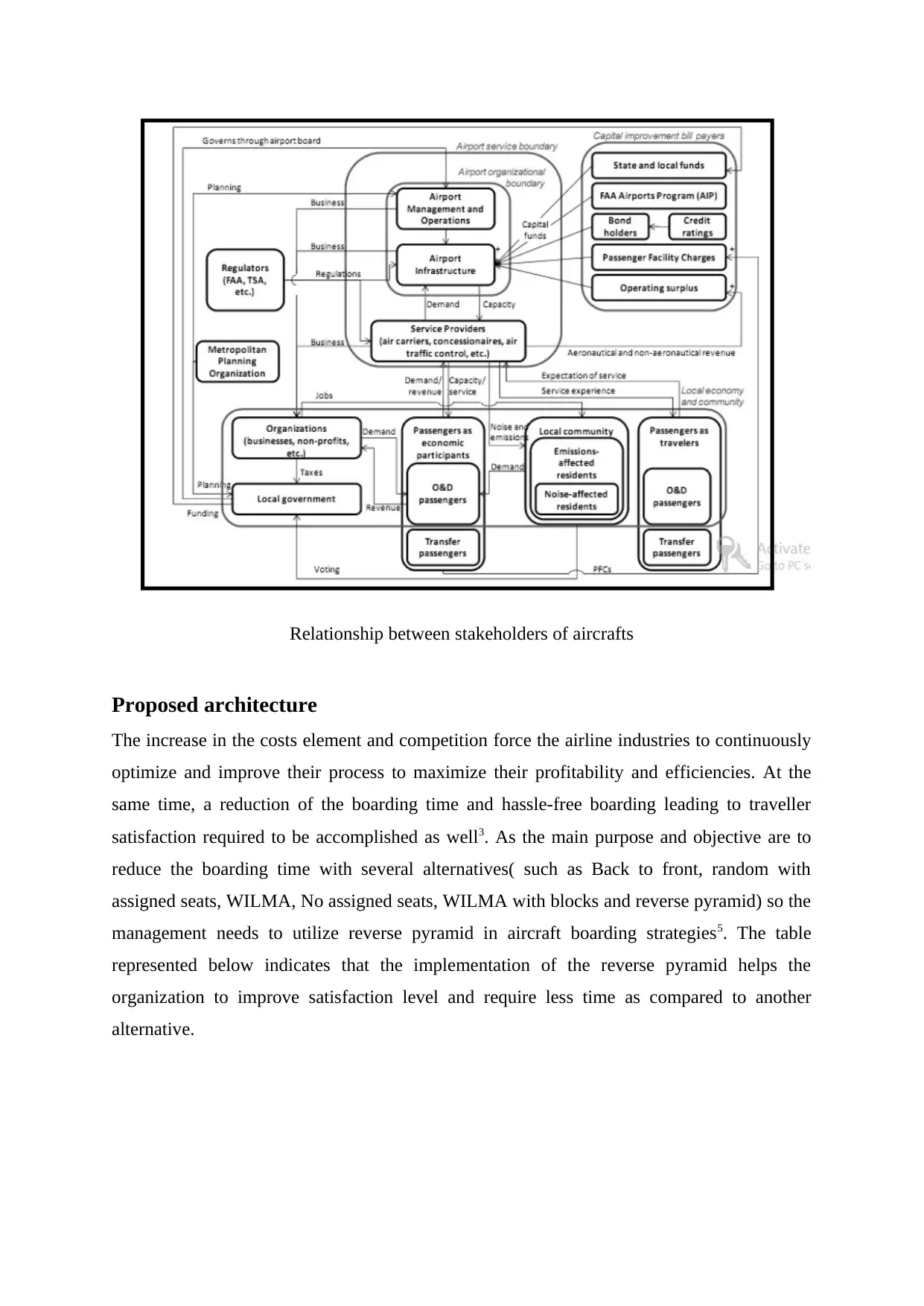
Relationship between stakeholders of aircrafts
Proposed architecture
The increase in the costs element and competition force the airline industries to continuously
optimize and improve their process to maximize their profitability and efficiencies. At the
same time, a reduction of the boarding time and hassle-free boarding leading to traveller
satisfaction required to be accomplished as well3. As the main purpose and objective are to
reduce the boarding time with several alternatives( such as Back to front, random with
assigned seats, WILMA, No assigned seats, WILMA with blocks and reverse pyramid) so the
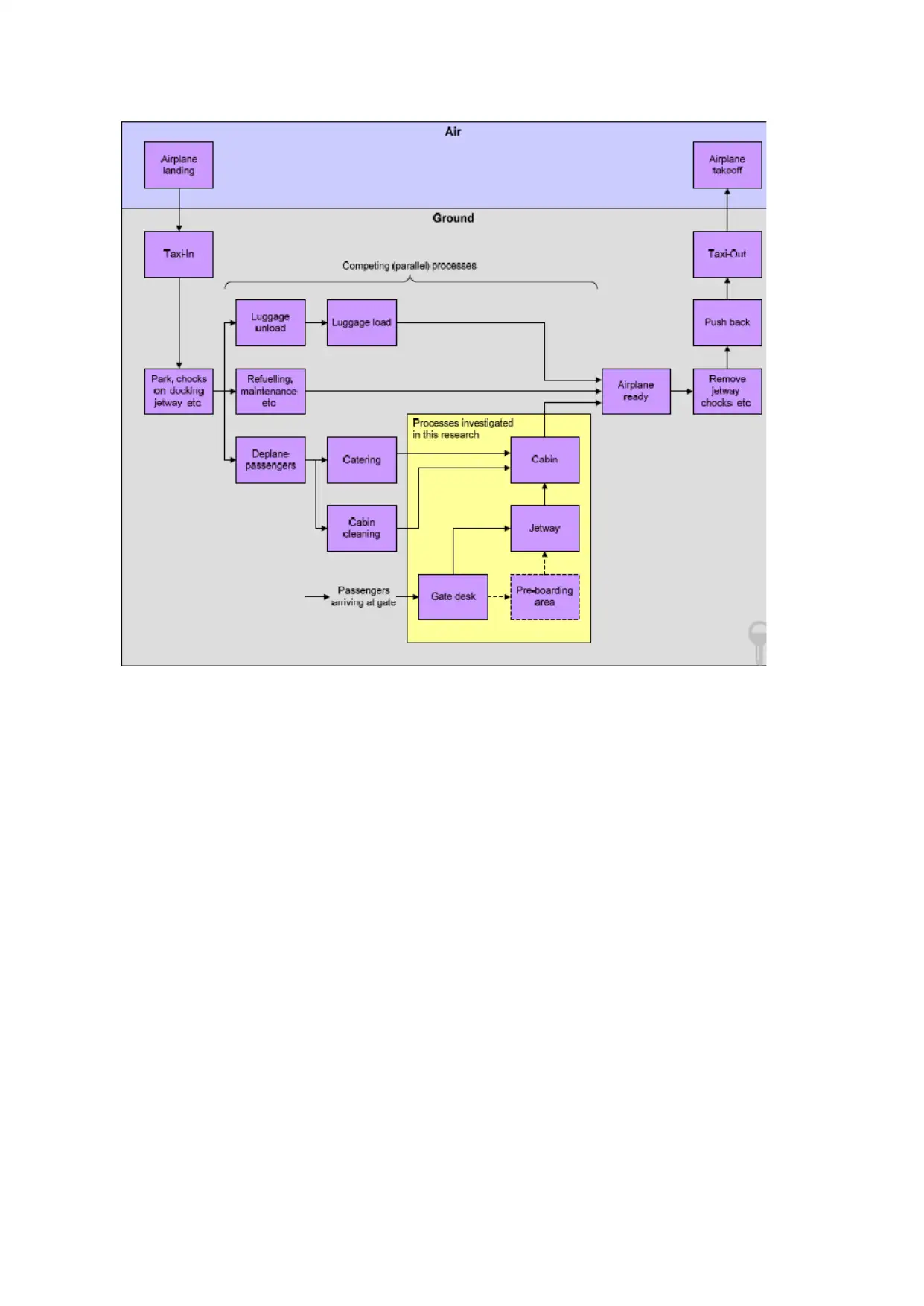
management needs to utilize reverse pyramid in aircraft boarding strategies5. The table
represented below indicates that the implementation of the reverse pyramid helps the
organization to improve satisfaction level and require less time as compared to another
alternative.
Proposed architecture
The increase in the costs element and competition force the airline industries to continuously
optimize and improve their process to maximize their profitability and efficiencies. At the
same time, a reduction of the boarding time and hassle-free boarding leading to traveller
satisfaction required to be accomplished as well3. As the main purpose and objective are to
reduce the boarding time with several alternatives( such as Back to front, random with
assigned seats, WILMA, No assigned seats, WILMA with blocks and reverse pyramid) so the
management needs to utilize reverse pyramid in aircraft boarding strategies5. The table
represented below indicates that the implementation of the reverse pyramid helps the
organization to improve satisfaction level and require less time as compared to another
alternative.
Paraphrase This Document
Need a fresh take? Get an instant paraphrase of this document with our AI Paraphraser
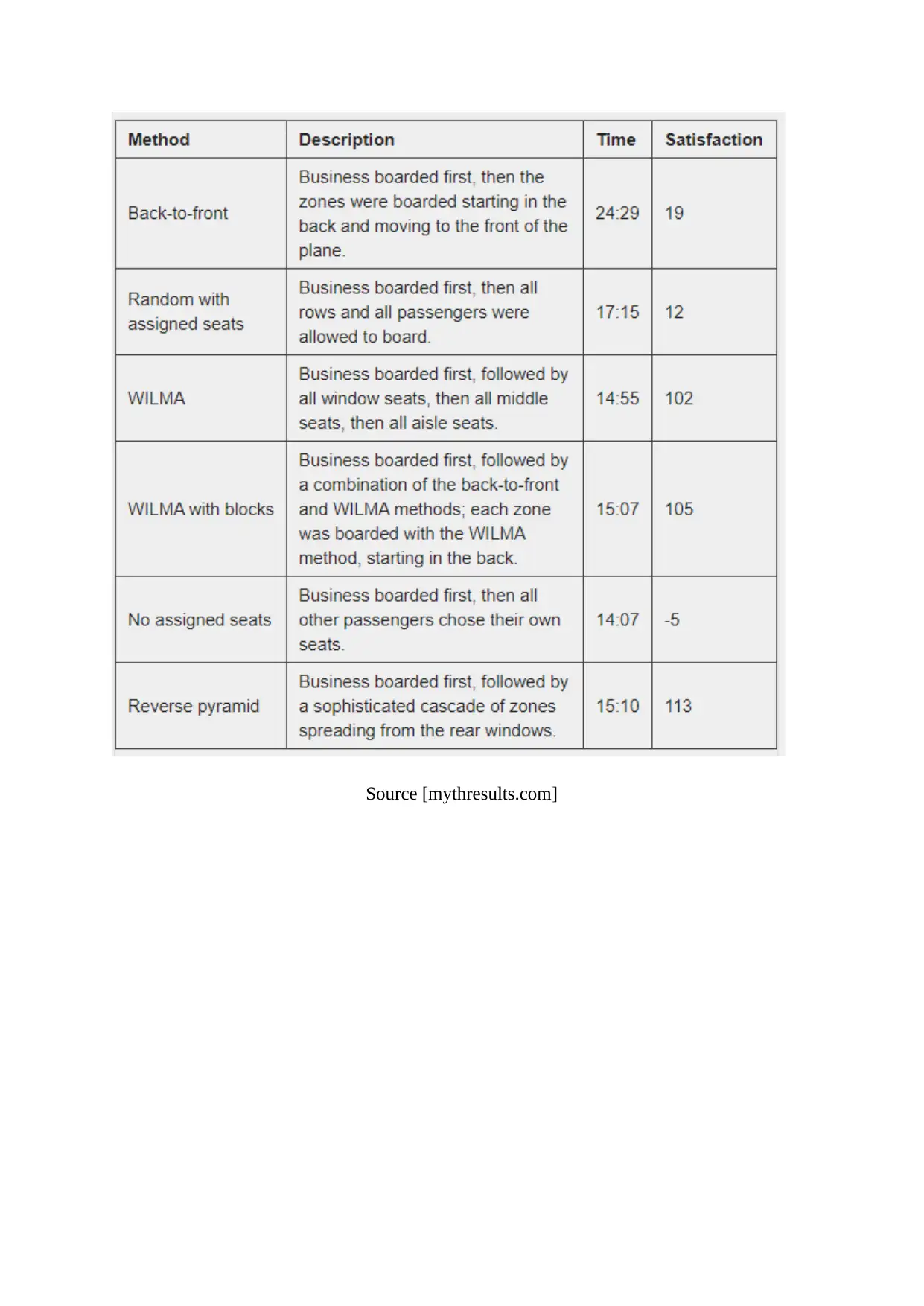
Source [mythresults.com]
⊘ This is a preview!⊘
Do you want full access?
Subscribe today to unlock all pages.
Trusted by 1+ million students worldwide
Proposed Design
The reverse pyramid boarding approach is one of the most effective approaches which could
be utilized for filling up flight passengers. In this boarding approach, the business seats are
allocated on a priority basis and the business class passengers have the privilege of boarding
first and taking the flight seats with the least amount of delay. Once the business passengers
have taken their seats, the flight attendants utilize a sophisticated cascade of different zones
that spreads from the back windows in order to allocate flight seats for the other passengers4.
This helps them to save a lot of time in the boarding process and results in improved in-flight
experience for the customers.
From the six methods available for passenger boarding in the flight namely back to front,
Random with assigned seats, WILMA, No assigned seats, WILMA with blocks and Reverse
Pyramid it is evident from the proposed design that Reverse Pyramid offers the most lucrative
solution. It provides the seating for the business class instantly without delay and then
followed by allocating seats to other passenger both from front and back to reduce the
waiting time and frustration of passenger. The new suggestion therefore is allowing
passenger from both front and back entry to fill the other seats in a fast and organized
manner. It will help the reduction of boarding time from 24.29 in the back to front method to
15.10 in reverse pyramid while allowing both entry of passenger from front and back further
reduce the time improving the efficiency and satisfaction level of flight boarding. However,
this may lead to customer dissatisfaction level to quite an extent. WILMA is best proven
method with higher customer satisfaction as demonstrated in the mock-up drill of the video.
Thus, by implementing this new suggestion, airlines can overcome the present frustration and
improve its boarding of the passengers.
The reverse pyramid boarding approach is one of the most effective approaches which could
be utilized for filling up flight passengers. In this boarding approach, the business seats are
allocated on a priority basis and the business class passengers have the privilege of boarding
first and taking the flight seats with the least amount of delay. Once the business passengers
have taken their seats, the flight attendants utilize a sophisticated cascade of different zones
that spreads from the back windows in order to allocate flight seats for the other passengers4.
This helps them to save a lot of time in the boarding process and results in improved in-flight
experience for the customers.
From the six methods available for passenger boarding in the flight namely back to front,
Random with assigned seats, WILMA, No assigned seats, WILMA with blocks and Reverse
Pyramid it is evident from the proposed design that Reverse Pyramid offers the most lucrative
solution. It provides the seating for the business class instantly without delay and then
followed by allocating seats to other passenger both from front and back to reduce the
waiting time and frustration of passenger. The new suggestion therefore is allowing
passenger from both front and back entry to fill the other seats in a fast and organized
manner. It will help the reduction of boarding time from 24.29 in the back to front method to
15.10 in reverse pyramid while allowing both entry of passenger from front and back further
reduce the time improving the efficiency and satisfaction level of flight boarding. However,
this may lead to customer dissatisfaction level to quite an extent. WILMA is best proven
method with higher customer satisfaction as demonstrated in the mock-up drill of the video.
Thus, by implementing this new suggestion, airlines can overcome the present frustration and
improve its boarding of the passengers.
Paraphrase This Document
Need a fresh take? Get an instant paraphrase of this document with our AI Paraphraser
References
(1) van den Briel, M.; Villalobos, J.; Hogg, G.; Lindemann, T.; Mulé, A. America West
Airlines Develops Efficient Boarding Strategies. Interfaces 2005, 35 (3), 191-201.
(2) Nyquist, D.; McFadden, K. A Study Of The Airline Boarding Problem. Journal of Air
Transport Management 2008, 14 (4), 197-204.
(3) Frette, V.; Hemmer, P. Time Needed To Board An Airplane: A Power Law And The
Structure Behind It. Physical Review E 2012, 85 (1).
(4) Steffen, J. Optimal Boarding Method For Airline Passengers. Journal of Air Transport
Management 2008, 14 (3), 146-150.
(5) MythBusters. MythBusters Episode 222: Airplane Boarding.
https://mythresults.com//airplane-boarding (accessed Sep 30, 2019).
(6)Lander, M.; Kooning, L. Boarding The Aircraft: Trust Development Amongst Negotiators
Of A Complex Merger. Journal of Management Studies 2012, 50 (1), 1-30.
(7) Parnenkov, A. PHASES OF FORECASTING OF AIRCRAFTS SYSTEMS. Radio
industry 2016, No. 2, 47-50.
(8) Schultz, M. Fast Aircraft Turnaround Enabled By Reliable Passenger
Boarding. Aerospace 2018, 5 (1), 8.
(1) van den Briel, M.; Villalobos, J.; Hogg, G.; Lindemann, T.; Mulé, A. America West
Airlines Develops Efficient Boarding Strategies. Interfaces 2005, 35 (3), 191-201.
(2) Nyquist, D.; McFadden, K. A Study Of The Airline Boarding Problem. Journal of Air
Transport Management 2008, 14 (4), 197-204.
(3) Frette, V.; Hemmer, P. Time Needed To Board An Airplane: A Power Law And The
Structure Behind It. Physical Review E 2012, 85 (1).
(4) Steffen, J. Optimal Boarding Method For Airline Passengers. Journal of Air Transport
Management 2008, 14 (3), 146-150.
(5) MythBusters. MythBusters Episode 222: Airplane Boarding.
https://mythresults.com//airplane-boarding (accessed Sep 30, 2019).
(6)Lander, M.; Kooning, L. Boarding The Aircraft: Trust Development Amongst Negotiators
Of A Complex Merger. Journal of Management Studies 2012, 50 (1), 1-30.
(7) Parnenkov, A. PHASES OF FORECASTING OF AIRCRAFTS SYSTEMS. Radio
industry 2016, No. 2, 47-50.
(8) Schultz, M. Fast Aircraft Turnaround Enabled By Reliable Passenger
Boarding. Aerospace 2018, 5 (1), 8.

1 out of 11


Your All-in-One AI-Powered Toolkit for Academic Success.
+13062052269
info@desklib.com
Available 24*7 on WhatsApp / Email
![[object Object]](/_next/static/media/star-bottom.7253800d.svg)
Unlock your academic potential
Copyright © 2020–2026 A2Z Services. All Rights Reserved. Developed and managed by ZUCOL.