Altruism as a Foundation for Sexual Selection: A Study Report
VerifiedAdded on 2019/09/16
|7
|1396
|359
Report
AI Summary
This report investigates the sexual selection hypothesis, originally proposed by Darwin in 1871, which posits that altruism functions as a mating signal. The study explores how attractiveness influences altruistic behavior in both financial and non-financial contexts. Participants were presented with images of varying attractiveness and assessed their responses, revealing a correlation between attractiveness and altruistic tendencies. The methodology involved 2-D facial images and online facial databases, utilizing paired-sample t-tests. The results indicated that participants, particularly males, exhibited more altruistic behavior towards individuals perceived as more attractive, supporting the sexual selection theory and highlighting the influence of dating and sexual intentions. The study's findings suggest that altruism is a key factor in mate selection, with attractiveness playing a significant role in shaping these behaviors.
Altruism the basis of sexual selection
Name-
Submitted to-
Date-
Name-
Submitted to-
Date-
Paraphrase This Document
Need a fresh take? Get an instant paraphrase of this document with our AI Paraphraser

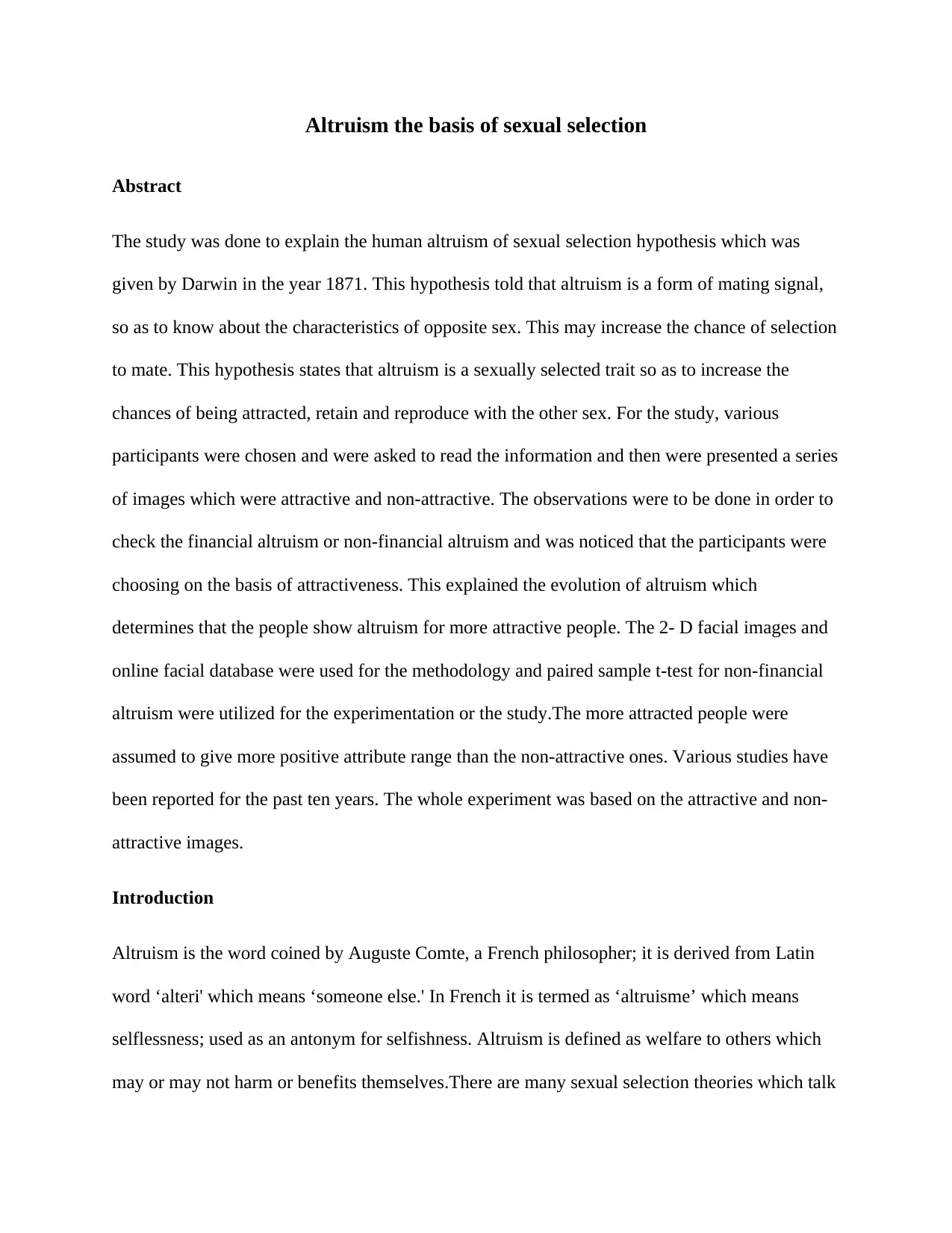
Altruism the basis of sexual selection
Abstract
The study was done to explain the human altruism of sexual selection hypothesis which was
given by Darwin in the year 1871. This hypothesis told that altruism is a form of mating signal,
so as to know about the characteristics of opposite sex. This may increase the chance of selection
to mate. This hypothesis states that altruism is a sexually selected trait so as to increase the
chances of being attracted, retain and reproduce with the other sex. For the study, various
participants were chosen and were asked to read the information and then were presented a series
of images which were attractive and non-attractive. The observations were to be done in order to
check the financial altruism or non-financial altruism and was noticed that the participants were
choosing on the basis of attractiveness. This explained the evolution of altruism which
determines that the people show altruism for more attractive people. The 2- D facial images and
online facial database were used for the methodology and paired sample t-test for non-financial
altruism were utilized for the experimentation or the study.The more attracted people were
assumed to give more positive attribute range than the non-attractive ones. Various studies have
been reported for the past ten years. The whole experiment was based on the attractive and non-
attractive images.
Introduction
Altruism is the word coined by Auguste Comte, a French philosopher; it is derived from Latin
word ‘alteri' which means ‘someone else.' In French it is termed as ‘altruisme’ which means
selflessness; used as an antonym for selfishness. Altruism is defined as welfare to others which
may or may not harm or benefits themselves.There are many sexual selection theories which talk
Abstract
The study was done to explain the human altruism of sexual selection hypothesis which was
given by Darwin in the year 1871. This hypothesis told that altruism is a form of mating signal,
so as to know about the characteristics of opposite sex. This may increase the chance of selection
to mate. This hypothesis states that altruism is a sexually selected trait so as to increase the
chances of being attracted, retain and reproduce with the other sex. For the study, various
participants were chosen and were asked to read the information and then were presented a series
of images which were attractive and non-attractive. The observations were to be done in order to
check the financial altruism or non-financial altruism and was noticed that the participants were
choosing on the basis of attractiveness. This explained the evolution of altruism which
determines that the people show altruism for more attractive people. The 2- D facial images and
online facial database were used for the methodology and paired sample t-test for non-financial
altruism were utilized for the experimentation or the study.The more attracted people were
assumed to give more positive attribute range than the non-attractive ones. Various studies have
been reported for the past ten years. The whole experiment was based on the attractive and non-
attractive images.
Introduction
Altruism is the word coined by Auguste Comte, a French philosopher; it is derived from Latin
word ‘alteri' which means ‘someone else.' In French it is termed as ‘altruisme’ which means
selflessness; used as an antonym for selfishness. Altruism is defined as welfare to others which
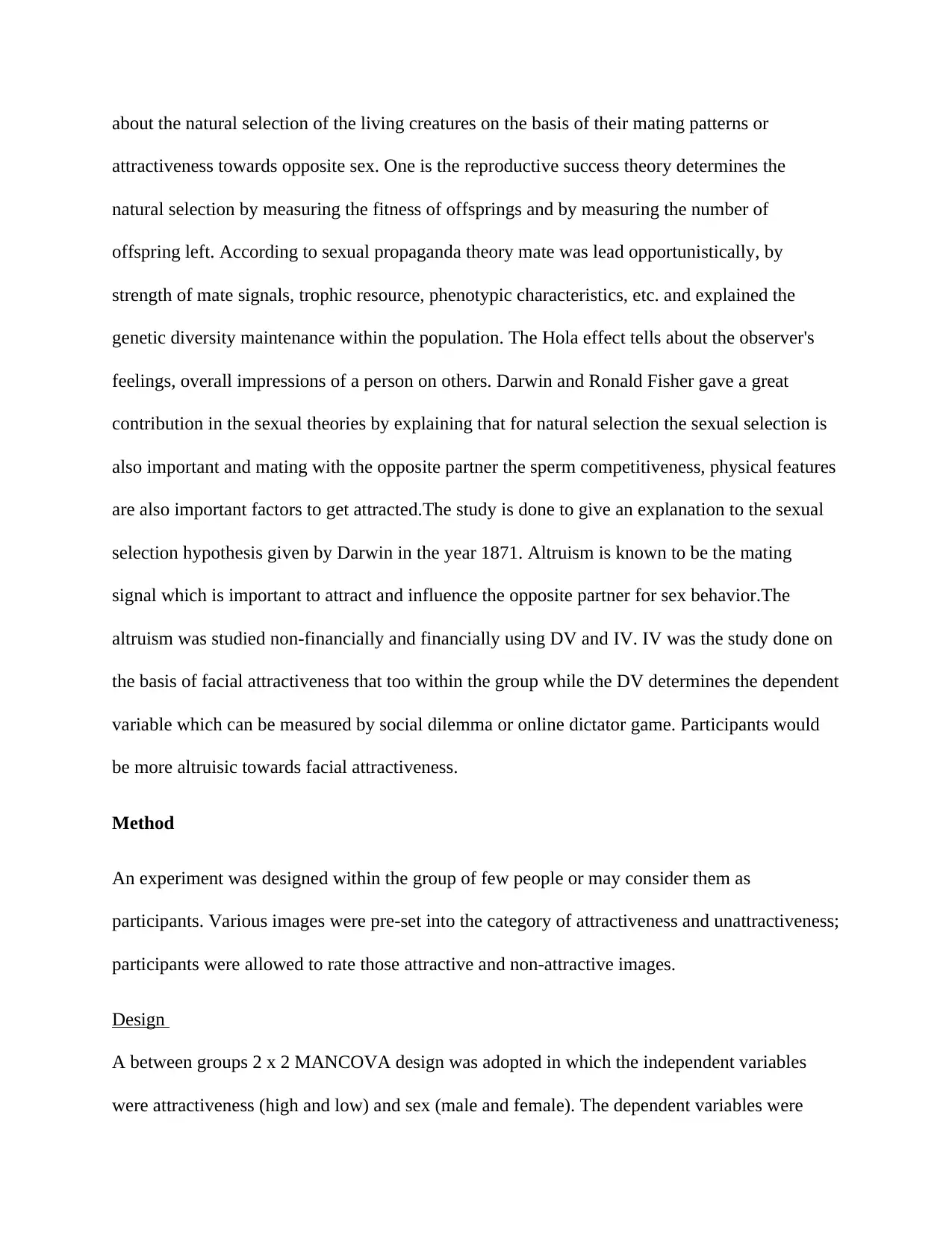
may or may not harm or benefits themselves.There are many sexual selection theories which talk

about the natural selection of the living creatures on the basis of their mating patterns or
attractiveness towards opposite sex. One is the reproductive success theory determines the
natural selection by measuring the fitness of offsprings and by measuring the number of
offspring left. According to sexual propaganda theory mate was lead opportunistically, by
strength of mate signals, trophic resource, phenotypic characteristics, etc. and explained the
genetic diversity maintenance within the population. The Hola effect tells about the observer's
feelings, overall impressions of a person on others. Darwin and Ronald Fisher gave a great
contribution in the sexual theories by explaining that for natural selection the sexual selection is
also important and mating with the opposite partner the sperm competitiveness, physical features
are also important factors to get attracted.The study is done to give an explanation to the sexual
selection hypothesis given by Darwin in the year 1871. Altruism is known to be the mating
signal which is important to attract and influence the opposite partner for sex behavior.The
altruism was studied non-financially and financially using DV and IV. IV was the study done on
the basis of facial attractiveness that too within the group while the DV determines the dependent
variable which can be measured by social dilemma or online dictator game. Participants would
be more altruisic towards facial attractiveness.
Method
An experiment was designed within the group of few people or may consider them as
participants. Various images were pre-set into the category of attractiveness and unattractiveness;
participants were allowed to rate those attractive and non-attractive images.
Design
A between groups 2 x 2 MANCOVA design was adopted in which the independent variables
were attractiveness (high and low) and sex (male and female). The dependent variables were
attractiveness towards opposite sex. One is the reproductive success theory determines the
natural selection by measuring the fitness of offsprings and by measuring the number of
offspring left. According to sexual propaganda theory mate was lead opportunistically, by
strength of mate signals, trophic resource, phenotypic characteristics, etc. and explained the
genetic diversity maintenance within the population. The Hola effect tells about the observer's
feelings, overall impressions of a person on others. Darwin and Ronald Fisher gave a great
contribution in the sexual theories by explaining that for natural selection the sexual selection is
also important and mating with the opposite partner the sperm competitiveness, physical features
are also important factors to get attracted.The study is done to give an explanation to the sexual
selection hypothesis given by Darwin in the year 1871. Altruism is known to be the mating
signal which is important to attract and influence the opposite partner for sex behavior.The
altruism was studied non-financially and financially using DV and IV. IV was the study done on
the basis of facial attractiveness that too within the group while the DV determines the dependent
variable which can be measured by social dilemma or online dictator game. Participants would
be more altruisic towards facial attractiveness.
Method
An experiment was designed within the group of few people or may consider them as
participants. Various images were pre-set into the category of attractiveness and unattractiveness;
participants were allowed to rate those attractive and non-attractive images.
Design
A between groups 2 x 2 MANCOVA design was adopted in which the independent variables
were attractiveness (high and low) and sex (male and female). The dependent variables were
⊘ This is a preview!⊘
Do you want full access?
Subscribe today to unlock all pages.

Trusted by 1+ million students worldwide

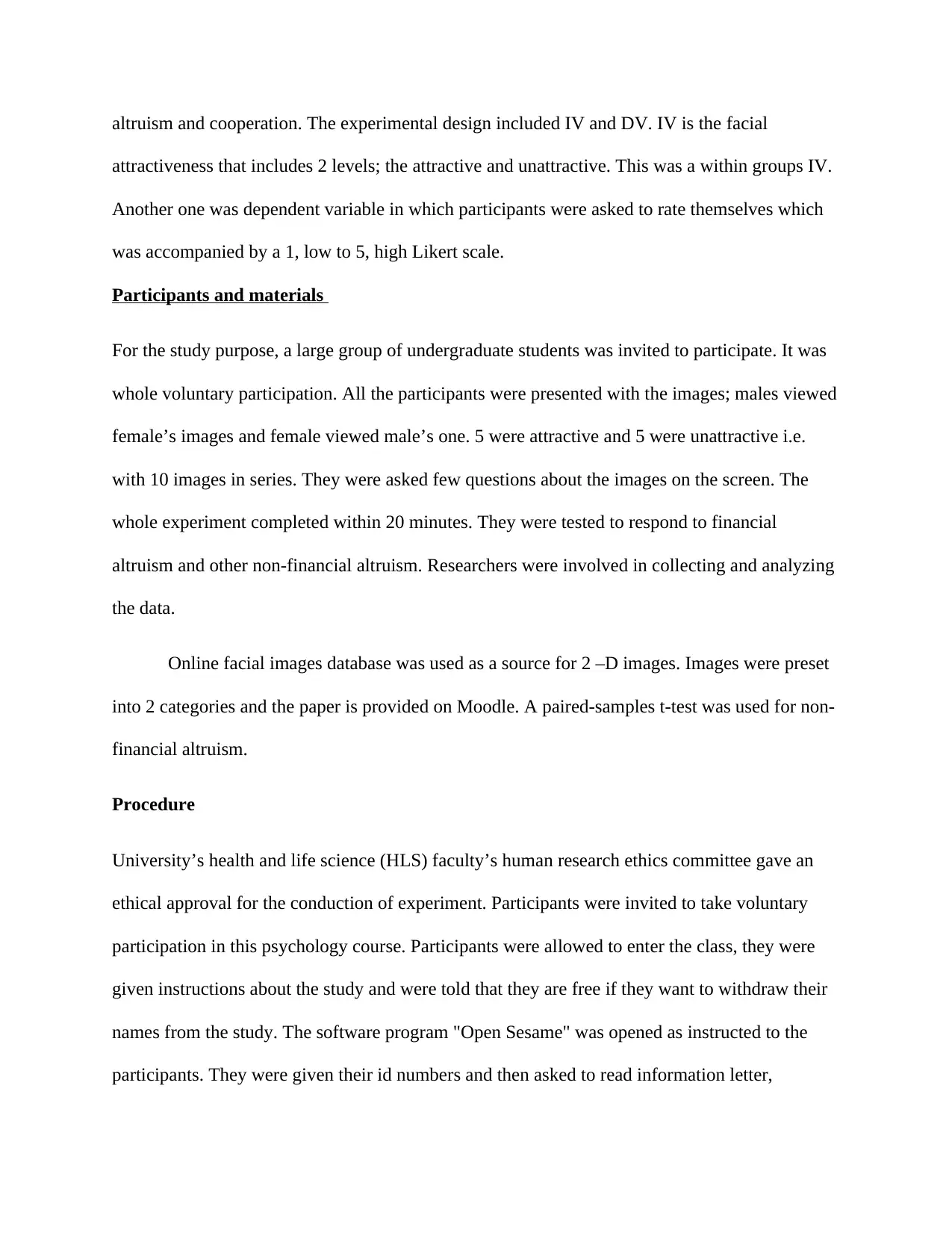
altruism and cooperation. The experimental design included IV and DV. IV is the facial
attractiveness that includes 2 levels; the attractive and unattractive. This was a within groups IV.
Another one was dependent variable in which participants were asked to rate themselves which
was accompanied by a 1, low to 5, high Likert scale.
Participants and materials
For the study purpose, a large group of undergraduate students was invited to participate. It was
whole voluntary participation. All the participants were presented with the images; males viewed
female’s images and female viewed male’s one. 5 were attractive and 5 were unattractive i.e.
with 10 images in series. They were asked few questions about the images on the screen. The
whole experiment completed within 20 minutes. They were tested to respond to financial
altruism and other non-financial altruism. Researchers were involved in collecting and analyzing
the data.
Online facial images database was used as a source for 2 –D images. Images were preset
into 2 categories and the paper is provided on Moodle. A paired-samples t-test was used for non-
financial altruism.
Procedure
University’s health and life science (HLS) faculty’s human research ethics committee gave an
ethical approval for the conduction of experiment. Participants were invited to take voluntary
participation in this psychology course. Participants were allowed to enter the class, they were
given instructions about the study and were told that they are free if they want to withdraw their
names from the study. The software program "Open Sesame" was opened as instructed to the
participants. They were given their id numbers and then asked to read information letter,
attractiveness that includes 2 levels; the attractive and unattractive. This was a within groups IV.
Another one was dependent variable in which participants were asked to rate themselves which
was accompanied by a 1, low to 5, high Likert scale.
Participants and materials
For the study purpose, a large group of undergraduate students was invited to participate. It was
whole voluntary participation. All the participants were presented with the images; males viewed
female’s images and female viewed male’s one. 5 were attractive and 5 were unattractive i.e.
with 10 images in series. They were asked few questions about the images on the screen. The
whole experiment completed within 20 minutes. They were tested to respond to financial
altruism and other non-financial altruism. Researchers were involved in collecting and analyzing
the data.
Online facial images database was used as a source for 2 –D images. Images were preset
into 2 categories and the paper is provided on Moodle. A paired-samples t-test was used for non-
financial altruism.
Procedure
University’s health and life science (HLS) faculty’s human research ethics committee gave an
ethical approval for the conduction of experiment. Participants were invited to take voluntary
participation in this psychology course. Participants were allowed to enter the class, they were
given instructions about the study and were told that they are free if they want to withdraw their
names from the study. The software program "Open Sesame" was opened as instructed to the
participants. They were given their id numbers and then asked to read information letter,
Paraphrase This Document
Need a fresh take? Get an instant paraphrase of this document with our AI Paraphraser

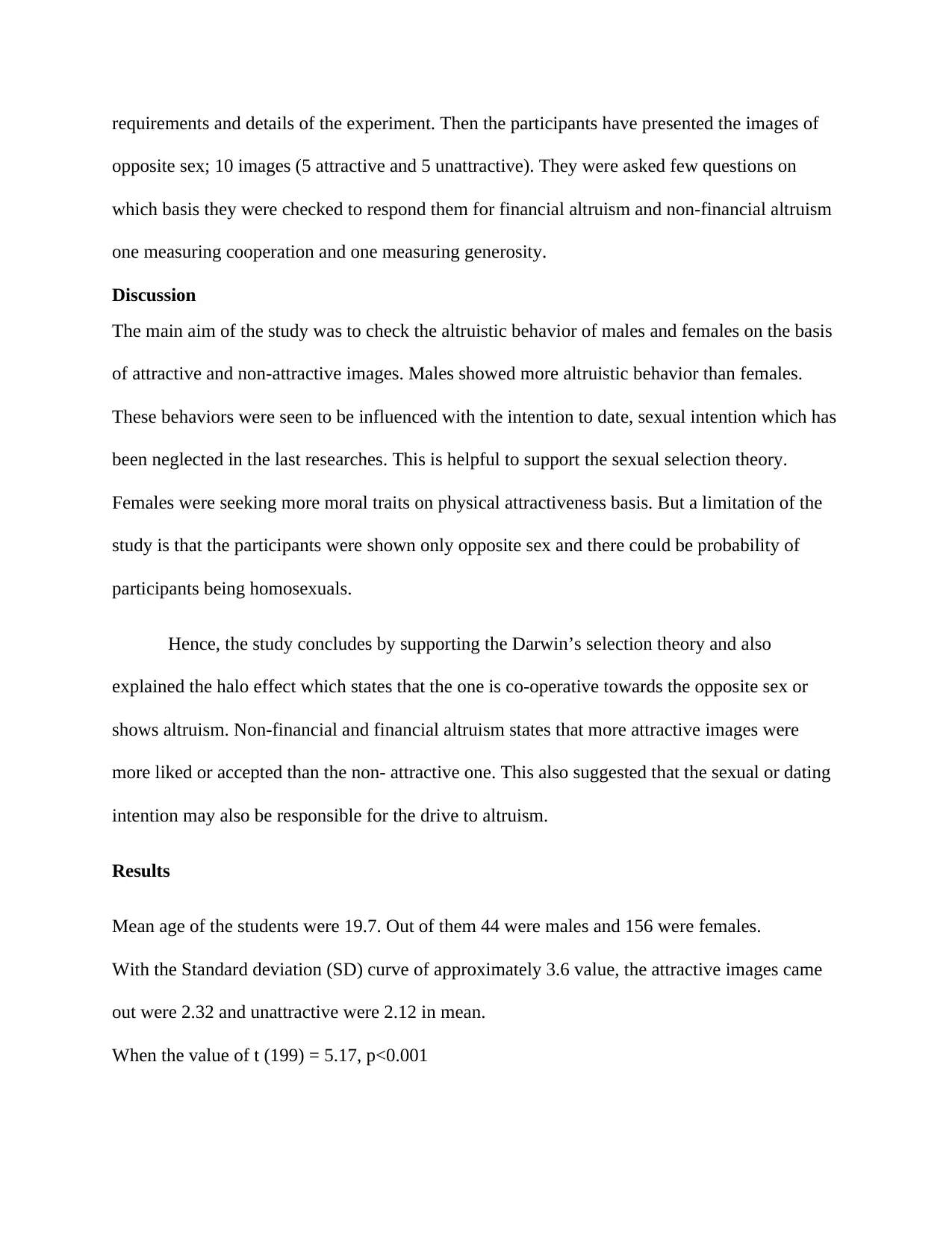
requirements and details of the experiment. Then the participants have presented the images of
opposite sex; 10 images (5 attractive and 5 unattractive). They were asked few questions on
which basis they were checked to respond them for financial altruism and non-financial altruism
one measuring cooperation and one measuring generosity.
Discussion
The main aim of the study was to check the altruistic behavior of males and females on the basis
of attractive and non-attractive images. Males showed more altruistic behavior than females.
These behaviors were seen to be influenced with the intention to date, sexual intention which has
been neglected in the last researches. This is helpful to support the sexual selection theory.
Females were seeking more moral traits on physical attractiveness basis. But a limitation of the
study is that the participants were shown only opposite sex and there could be probability of
participants being homosexuals.
Hence, the study concludes by supporting the Darwin’s selection theory and also
explained the halo effect which states that the one is co-operative towards the opposite sex or
shows altruism. Non-financial and financial altruism states that more attractive images were
more liked or accepted than the non- attractive one. This also suggested that the sexual or dating
intention may also be responsible for the drive to altruism.
Results
Mean age of the students were 19.7. Out of them 44 were males and 156 were females.
With the Standard deviation (SD) curve of approximately 3.6 value, the attractive images came
out were 2.32 and unattractive were 2.12 in mean.
When the value of t (199) = 5.17, p<0.001
opposite sex; 10 images (5 attractive and 5 unattractive). They were asked few questions on
which basis they were checked to respond them for financial altruism and non-financial altruism
one measuring cooperation and one measuring generosity.
Discussion
The main aim of the study was to check the altruistic behavior of males and females on the basis
of attractive and non-attractive images. Males showed more altruistic behavior than females.
These behaviors were seen to be influenced with the intention to date, sexual intention which has
been neglected in the last researches. This is helpful to support the sexual selection theory.
Females were seeking more moral traits on physical attractiveness basis. But a limitation of the
study is that the participants were shown only opposite sex and there could be probability of
participants being homosexuals.
Hence, the study concludes by supporting the Darwin’s selection theory and also
explained the halo effect which states that the one is co-operative towards the opposite sex or
shows altruism. Non-financial and financial altruism states that more attractive images were
more liked or accepted than the non- attractive one. This also suggested that the sexual or dating
intention may also be responsible for the drive to altruism.
Results
Mean age of the students were 19.7. Out of them 44 were males and 156 were females.
With the Standard deviation (SD) curve of approximately 3.6 value, the attractive images came
out were 2.32 and unattractive were 2.12 in mean.
When the value of t (199) = 5.17, p<0.001

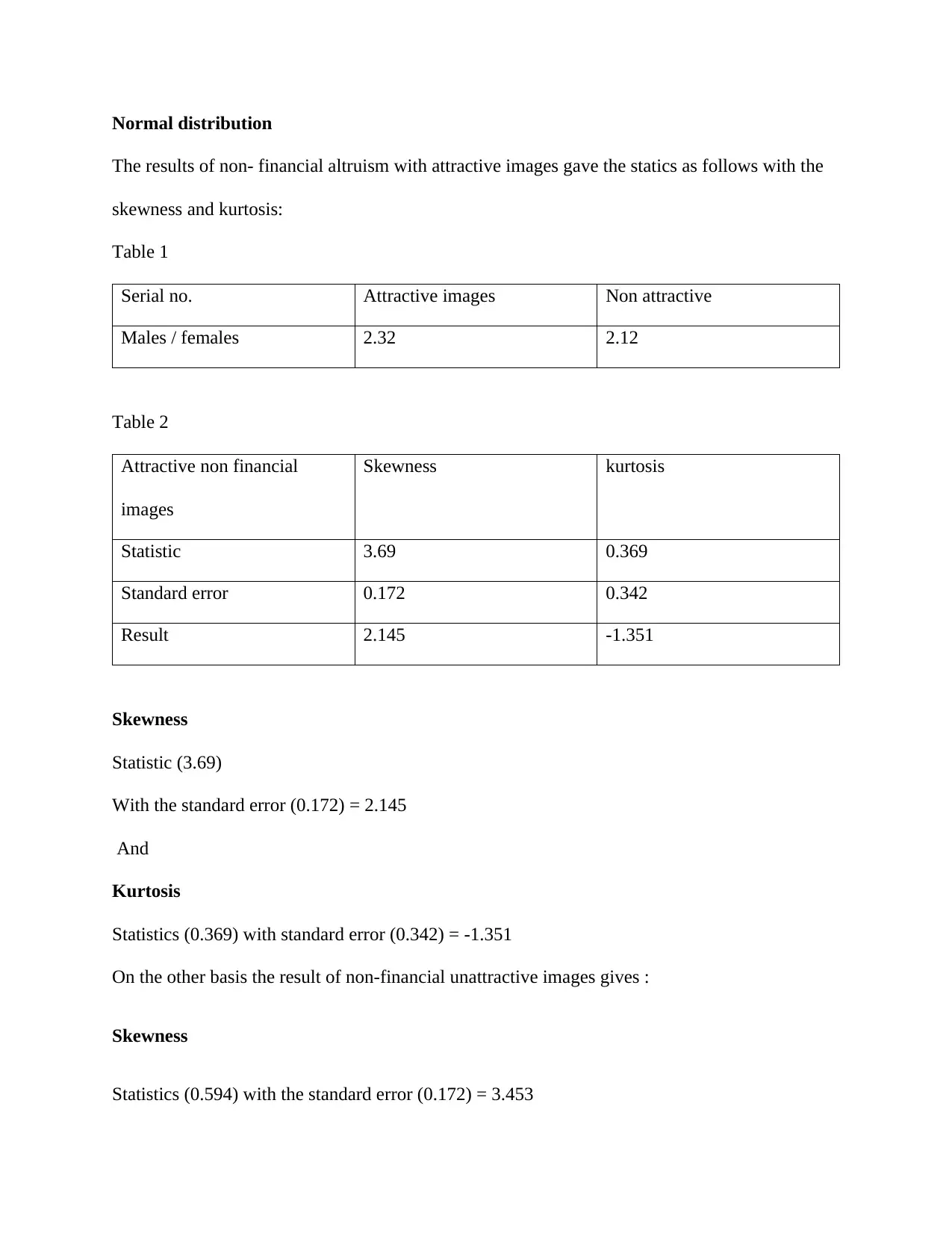
Normal distribution
The results of non- financial altruism with attractive images gave the statics as follows with the
skewness and kurtosis:
Table 1
Serial no. Attractive images Non attractive
Males / females 2.32 2.12
Table 2
Attractive non financial
images
Skewness kurtosis
Statistic 3.69 0.369
Standard error 0.172 0.342
Result 2.145 -1.351
Skewness
Statistic (3.69)
With the standard error (0.172) = 2.145
And
Kurtosis
Statistics (0.369) with standard error (0.342) = -1.351
On the other basis the result of non-financial unattractive images gives :
Skewness
Statistics (0.594) with the standard error (0.172) = 3.453
The results of non- financial altruism with attractive images gave the statics as follows with the
skewness and kurtosis:
Table 1
Serial no. Attractive images Non attractive
Males / females 2.32 2.12
Table 2
Attractive non financial
images
Skewness kurtosis
Statistic 3.69 0.369
Standard error 0.172 0.342
Result 2.145 -1.351
Skewness
Statistic (3.69)
With the standard error (0.172) = 2.145
And
Kurtosis
Statistics (0.369) with standard error (0.342) = -1.351
On the other basis the result of non-financial unattractive images gives :
Skewness
Statistics (0.594) with the standard error (0.172) = 3.453
⊘ This is a preview!⊘
Do you want full access?
Subscribe today to unlock all pages.

Trusted by 1+ million students worldwide

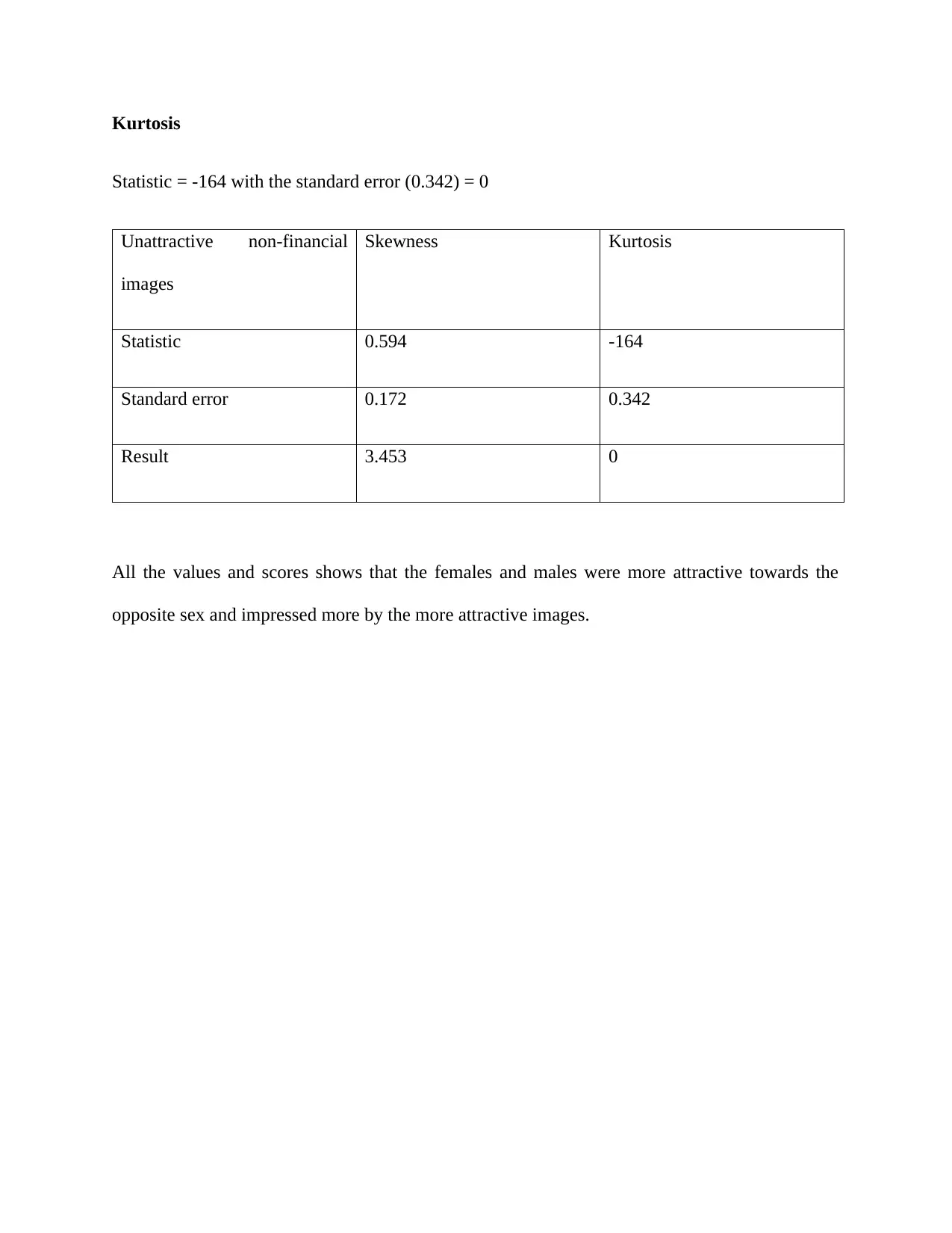
Kurtosis
Statistic = -164 with the standard error (0.342) = 0
Unattractive non-financial
images
Skewness Kurtosis
Statistic 0.594 -164
Standard error 0.172 0.342
Result 3.453 0
All the values and scores shows that the females and males were more attractive towards the
opposite sex and impressed more by the more attractive images.
Statistic = -164 with the standard error (0.342) = 0
Unattractive non-financial
images
Skewness Kurtosis
Statistic 0.594 -164
Standard error 0.172 0.342
Result 3.453 0
All the values and scores shows that the females and males were more attractive towards the
opposite sex and impressed more by the more attractive images.
1 out of 7
Your All-in-One AI-Powered Toolkit for Academic Success.
+13062052269
info@desklib.com
Available 24*7 on WhatsApp / Email
Unlock your academic potential
Copyright © 2020–2025 A2Z Services. All Rights Reserved. Developed and managed by ZUCOL.