An Analysis of American Native Literature: Eastman's Book and Themes

Verified

Added on  2023/06/04

|4
|644
|257
Essay
AI Summary
This essay provides an analysis of American Native Literature, focusing on Charles Eastman's book, "From the Deep Woods to Civilization." The essay explores the key themes presented in the book, including Dakota sovereignty, the concept of home and homeland, and the portrayal of Indian culture and traditions. It discusses the significance of the oral tradition and the author's personal journey and identity. The essay highlights the conflict between cultures and the complexities of the author's family dynamics. The analysis also includes direct quotes from the book to illustrate the values and beliefs of the Native American culture and how it is portrayed in Eastman's autobiography. The paper also references Eastman's previous work, "Indian Boyhood," and discusses the author's aspirations and the challenges he faced.
Document Page
Running head: AMERICAN NATIVE LITERATURE
American Native Literature
Name of the Student
Name of the University
Author Note
tabler-icon-diamond-filled.svg

Paraphrase This Document

Need a fresh take? Get an instant paraphrase of this document with our AI Paraphraser
Document Page
1AMERICAN NATIVE LITERATURE
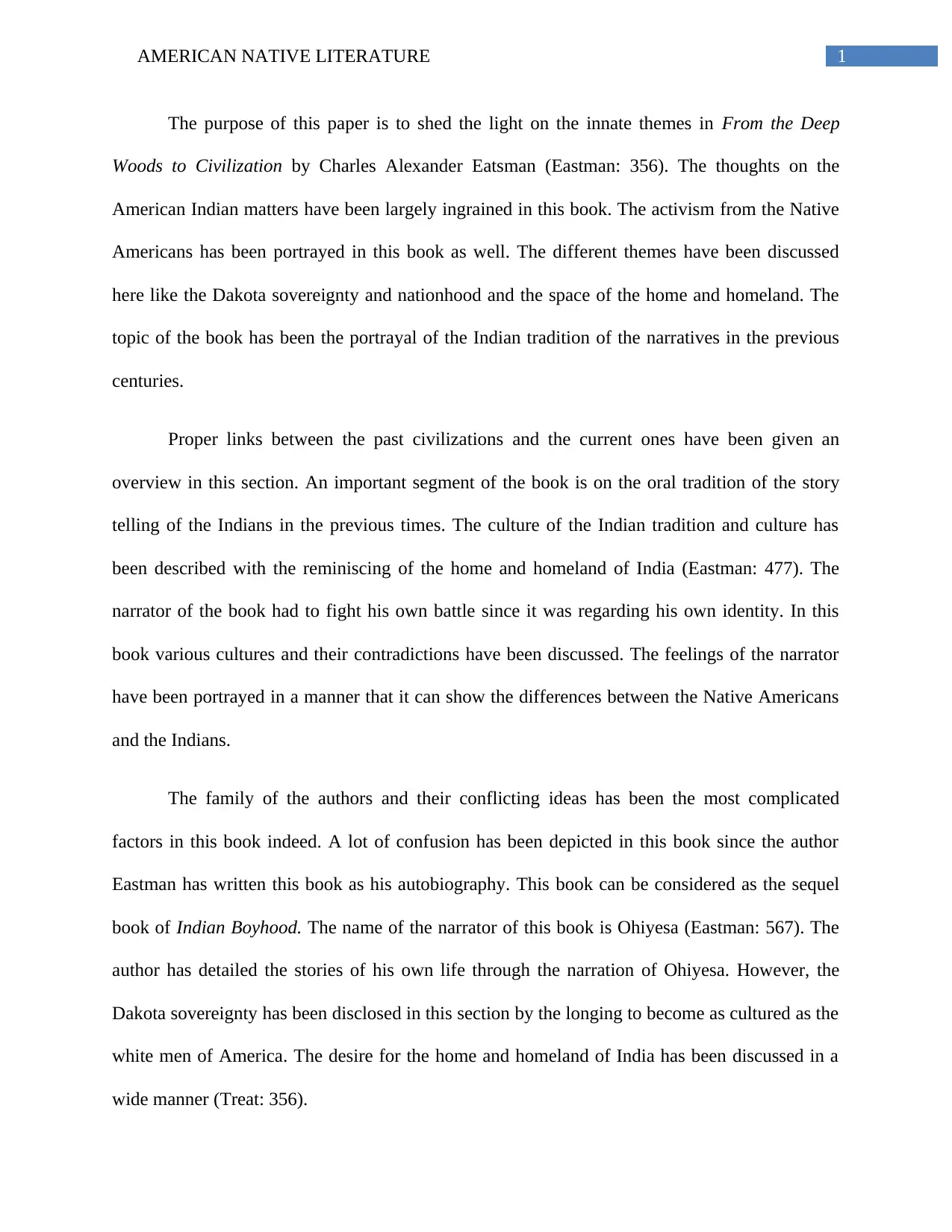
The purpose of this paper is to shed the light on the innate themes in From the Deep
Woods to Civilization by Charles Alexander Eatsman (Eastman: 356). The thoughts on the
American Indian matters have been largely ingrained in this book. The activism from the Native
Americans has been portrayed in this book as well. The different themes have been discussed
here like the Dakota sovereignty and nationhood and the space of the home and homeland. The
topic of the book has been the portrayal of the Indian tradition of the narratives in the previous
centuries.
Proper links between the past civilizations and the current ones have been given an
overview in this section. An important segment of the book is on the oral tradition of the story
telling of the Indians in the previous times. The culture of the Indian tradition and culture has
been described with the reminiscing of the home and homeland of India (Eastman: 477). The
narrator of the book had to fight his own battle since it was regarding his own identity. In this
book various cultures and their contradictions have been discussed. The feelings of the narrator
have been portrayed in a manner that it can show the differences between the Native Americans
and the Indians.
The family of the authors and their conflicting ideas has been the most complicated
factors in this book indeed. A lot of confusion has been depicted in this book since the author
Eastman has written this book as his autobiography. This book can be considered as the sequel
book of Indian Boyhood. The name of the narrator of this book is Ohiyesa (Eastman: 567). The
author has detailed the stories of his own life through the narration of Ohiyesa. However, the
Dakota sovereignty has been disclosed in this section by the longing to become as cultured as the
white men of America. The desire for the home and homeland of India has been discussed in a
wide manner (Treat: 356).
Document Page
2AMERICAN NATIVE LITERATURE
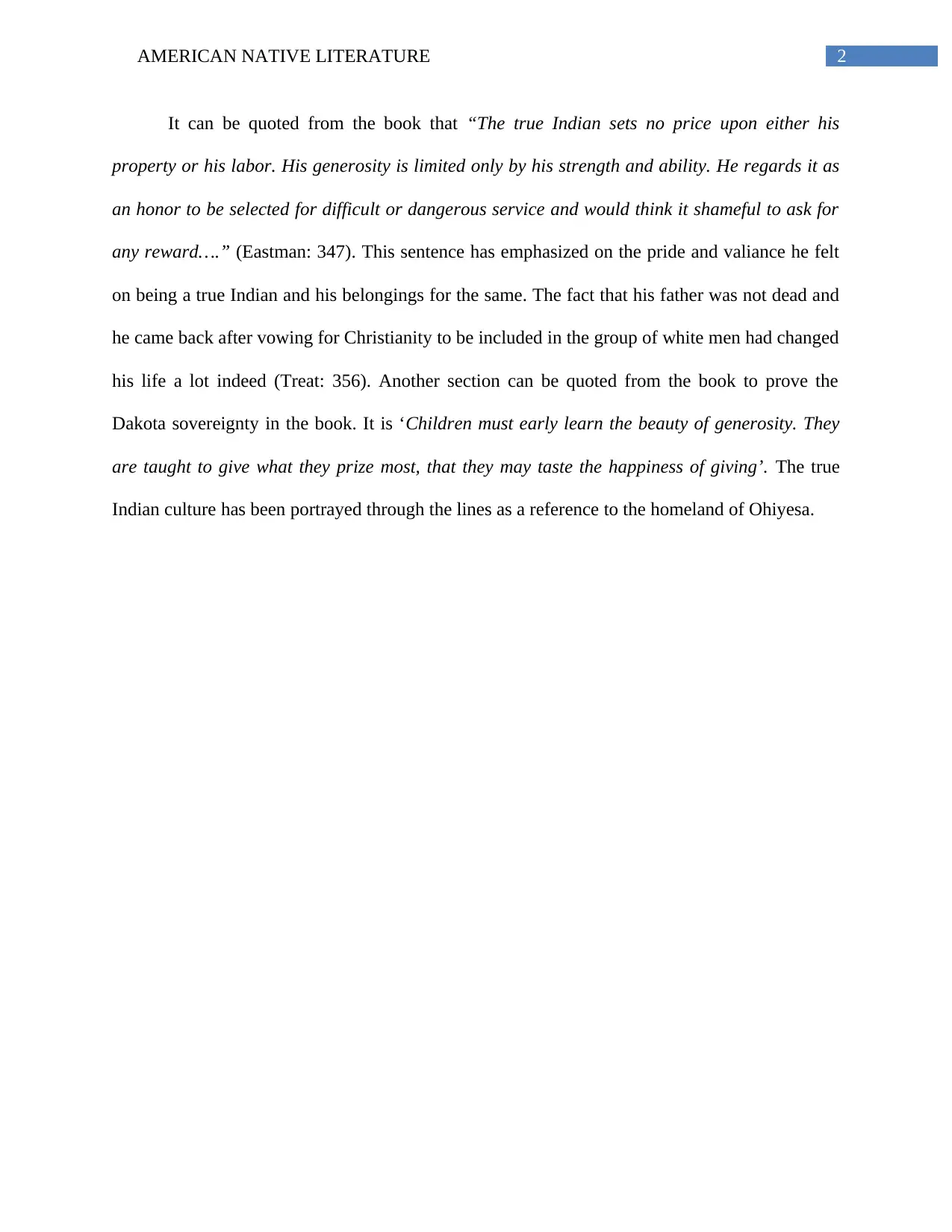
It can be quoted from the book that “The true Indian sets no price upon either his
property or his labor. His generosity is limited only by his strength and ability. He regards it as
an honor to be selected for difficult or dangerous service and would think it shameful to ask for
any reward….” (Eastman: 347). This sentence has emphasized on the pride and valiance he felt
on being a true Indian and his belongings for the same. The fact that his father was not dead and
he came back after vowing for Christianity to be included in the group of white men had changed
his life a lot indeed (Treat: 356). Another section can be quoted from the book to prove the
Dakota sovereignty in the book. It is ‘Children must early learn the beauty of generosity. They
are taught to give what they prize most, that they may taste the happiness of giving’. The true
Indian culture has been portrayed through the lines as a reference to the homeland of Ohiyesa.
Document Page
3AMERICAN NATIVE LITERATURE
References
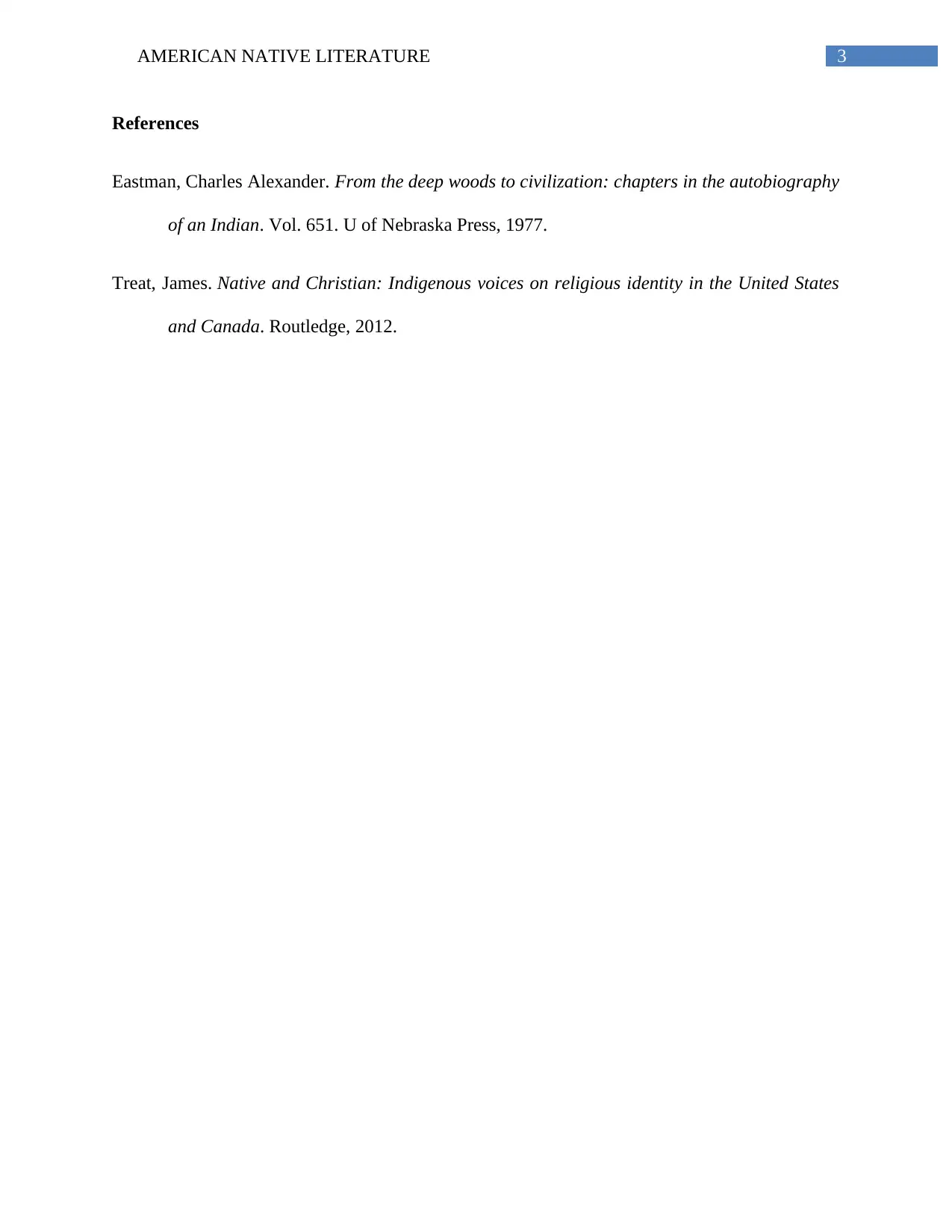
Eastman, Charles Alexander. From the deep woods to civilization: chapters in the autobiography
of an Indian. Vol. 651. U of Nebraska Press, 1977.
Treat, James. Native and Christian: Indigenous voices on religious identity in the United States
and Canada. Routledge, 2012.
chevron_up_icon
1 out of 4
circle_padding
hide_on_mobile
zoom_out_icon
[object Object]