Comprehensive Overview of the Activity Based Costing Model
VerifiedAdded on 2021/06/14
|11
|2397
|27
Report
AI Summary
This report provides a comprehensive overview of the Activity-Based Costing (ABC) model, examining its core features such as cost allocation, product customization, and the identification of over and under costing. It explores the model's impact on cost savings and its role in product cross-subsidization. The report uses the Trilogy International Limited as a case study, detailing the company's missions, vision, and corporate strategies. It also delves into the complications of processes and the benefits of ABC in addressing them. Furthermore, the report offers recommendations for implementing the ABC model, including the use of value chain analysis and the importance of appropriate cost drivers. Finally, it highlights the role of budgetary control as a key management accounting tool and concludes with a summary of the ABC model's potential to improve business performance.

Running Head: AN OVERVIEW OF ABC MODEL 0
An overview of ABC Model
[Pick the date]
HP
An overview of ABC Model
[Pick the date]
HP

Paraphrase This Document
Need a fresh take? Get an instant paraphrase of this document with our AI Paraphraser
AN OVERVIEW OF ABC MODEL 1
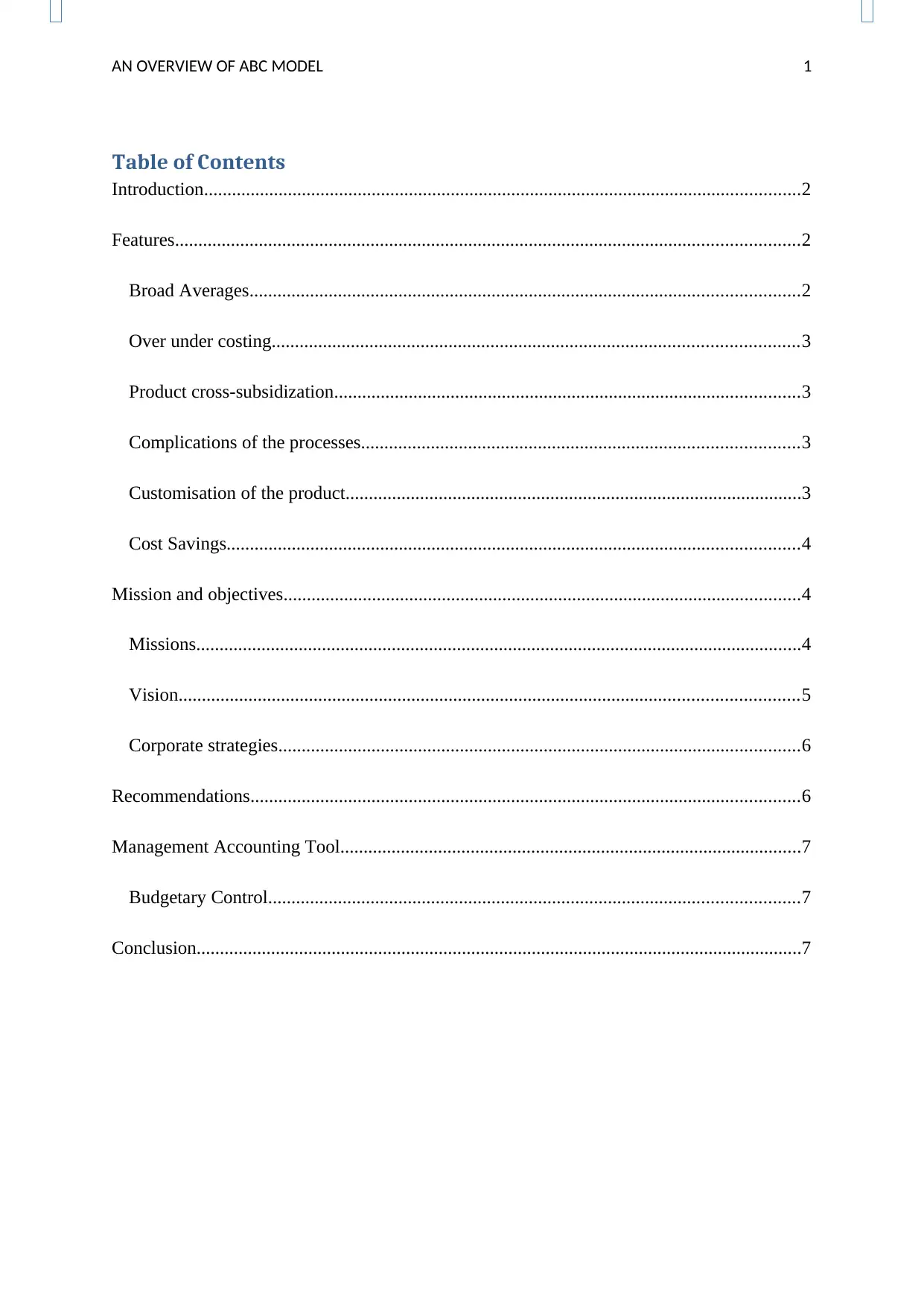
Table of Contents
Introduction................................................................................................................................2
Features......................................................................................................................................2
Broad Averages......................................................................................................................2
Over under costing.................................................................................................................3
Product cross-subsidization....................................................................................................3
Complications of the processes..............................................................................................3
Customisation of the product..................................................................................................3
Cost Savings...........................................................................................................................4
Mission and objectives...............................................................................................................4
Missions..................................................................................................................................4
Vision.....................................................................................................................................5
Corporate strategies................................................................................................................6
Recommendations......................................................................................................................6
Management Accounting Tool...................................................................................................7
Budgetary Control..................................................................................................................7
Conclusion..................................................................................................................................7
Table of Contents
Introduction................................................................................................................................2
Features......................................................................................................................................2
Broad Averages......................................................................................................................2
Over under costing.................................................................................................................3
Product cross-subsidization....................................................................................................3
Complications of the processes..............................................................................................3
Customisation of the product..................................................................................................3
Cost Savings...........................................................................................................................4
Mission and objectives...............................................................................................................4
Missions..................................................................................................................................4
Vision.....................................................................................................................................5
Corporate strategies................................................................................................................6
Recommendations......................................................................................................................6
Management Accounting Tool...................................................................................................7
Budgetary Control..................................................................................................................7
Conclusion..................................................................................................................................7
AN OVERVIEW OF ABC MODEL 2
Introduction
Activity based costing model is a costing methodology whose purpose is to identify the
organisations and assigning the cost of each activity with resources to every kind of product
and services according to their individual level of consumption. In terms of conventional
costing this model assigns more indirect costs into the direct costs (Otley, 2015).
According to the definition of the Chartered Institute of Management Accountants, ABC is an
approach to the costing and monitoring of the activities which involves tracing resource
consumption and for the final outputs the costs are allocated accordingly (Financial Web,
2017).
Features
Firstly the cost is divided into two major categories: that is fixed and variable cost, which is
necessary to provide the quality information
A proper assessment of the costing system can lead to the positive thought process of
becoming more competitive against the existing structure. As a result of this the company can
strive for improvement in the quality of the product and simultaneously focusing on reduction
of cost. This analysis will eventually be helpful in simulating the activity of organising the
process into a proper structure.
Broad Averages
Under the conventional system, the costing exercises have relied on broad averages. That is
where the birth of ABC takes place to refine the existing system of costing from the major
curse of the average as far as possible. Therefore the ABC model helped in removing the
cascading the effect (Howell, S.B. et al 2014).
Introduction
Activity based costing model is a costing methodology whose purpose is to identify the
organisations and assigning the cost of each activity with resources to every kind of product
and services according to their individual level of consumption. In terms of conventional
costing this model assigns more indirect costs into the direct costs (Otley, 2015).
According to the definition of the Chartered Institute of Management Accountants, ABC is an
approach to the costing and monitoring of the activities which involves tracing resource
consumption and for the final outputs the costs are allocated accordingly (Financial Web,
2017).
Features
Firstly the cost is divided into two major categories: that is fixed and variable cost, which is
necessary to provide the quality information
A proper assessment of the costing system can lead to the positive thought process of
becoming more competitive against the existing structure. As a result of this the company can
strive for improvement in the quality of the product and simultaneously focusing on reduction
of cost. This analysis will eventually be helpful in simulating the activity of organising the
process into a proper structure.
Broad Averages
Under the conventional system, the costing exercises have relied on broad averages. That is
where the birth of ABC takes place to refine the existing system of costing from the major
curse of the average as far as possible. Therefore the ABC model helped in removing the
cascading the effect (Howell, S.B. et al 2014).
⊘ This is a preview!⊘
Do you want full access?
Subscribe today to unlock all pages.

Trusted by 1+ million students worldwide
AN OVERVIEW OF ABC MODEL 3
Over under costing
With the introduction of the activity based costing methodology there is a transparency in the
determination of the costs which were defined loosely against the cause and effect
relationship. Therefore, it was necessary to implement the ABC model in Trilogy
International. The costs are having an identification mode which can eventually deliver a
balance between the over costing and the under costing (Vaxevanidis and Petropoulos, 2018).
Product cross-subsidization
When the product subsidisation strategy is inclusive of the pricing policy, a big jump can be
seen in the business. Pricing is one of the primary drivers for the customers of the Trilogy
International. If the quality and the customers both align with the strategy followed by the
Trilogy International the indecisive customers are also ready to buy the relevant product.
Complications of the processes
As the industry and businesses grow in an organisation, the processes become cumbersome
and eventually there are lot of complications which have been increased significantly over a
period of time. An average product of manufacturing normally requires more than 4 to 5
processes. To deal with the complications which have been raised due to these processes,
ABC acts as a blessing in disguise. ABC model helps in determining the process easily and
allocation of costs become easy (Flink, 2017).
Customisation of the product
Earlier the alternative for the product were hardly available but now there are lot of options
available in products due to the packaging, size, colour, design, durability and weight. Again
the ABC model helps in pricing of the products weight wise accordingly. The customisation
is necessary to keep an edge over the competitors. A little customisation can change the
Over under costing
With the introduction of the activity based costing methodology there is a transparency in the
determination of the costs which were defined loosely against the cause and effect
relationship. Therefore, it was necessary to implement the ABC model in Trilogy
International. The costs are having an identification mode which can eventually deliver a
balance between the over costing and the under costing (Vaxevanidis and Petropoulos, 2018).
Product cross-subsidization
When the product subsidisation strategy is inclusive of the pricing policy, a big jump can be
seen in the business. Pricing is one of the primary drivers for the customers of the Trilogy
International. If the quality and the customers both align with the strategy followed by the
Trilogy International the indecisive customers are also ready to buy the relevant product.
Complications of the processes
As the industry and businesses grow in an organisation, the processes become cumbersome
and eventually there are lot of complications which have been increased significantly over a
period of time. An average product of manufacturing normally requires more than 4 to 5
processes. To deal with the complications which have been raised due to these processes,
ABC acts as a blessing in disguise. ABC model helps in determining the process easily and
allocation of costs become easy (Flink, 2017).
Customisation of the product
Earlier the alternative for the product were hardly available but now there are lot of options
available in products due to the packaging, size, colour, design, durability and weight. Again
the ABC model helps in pricing of the products weight wise accordingly. The customisation
is necessary to keep an edge over the competitors. A little customisation can change the
Paraphrase This Document
Need a fresh take? Get an instant paraphrase of this document with our AI Paraphraser
AN OVERVIEW OF ABC MODEL 4
perception of the customer while having the buying alternatives (Angelopoulos and Pollalis,
2017).
Cost Savings
Under this method the cost of the activities gets distributed proportionately. This saves the
cost of the company and the resources of the organisation. A reduction in the cost would not
reduce the sales volume, rather than the sales might increase the number of customers
(Freiesleben, 2014).
Mission and objectives
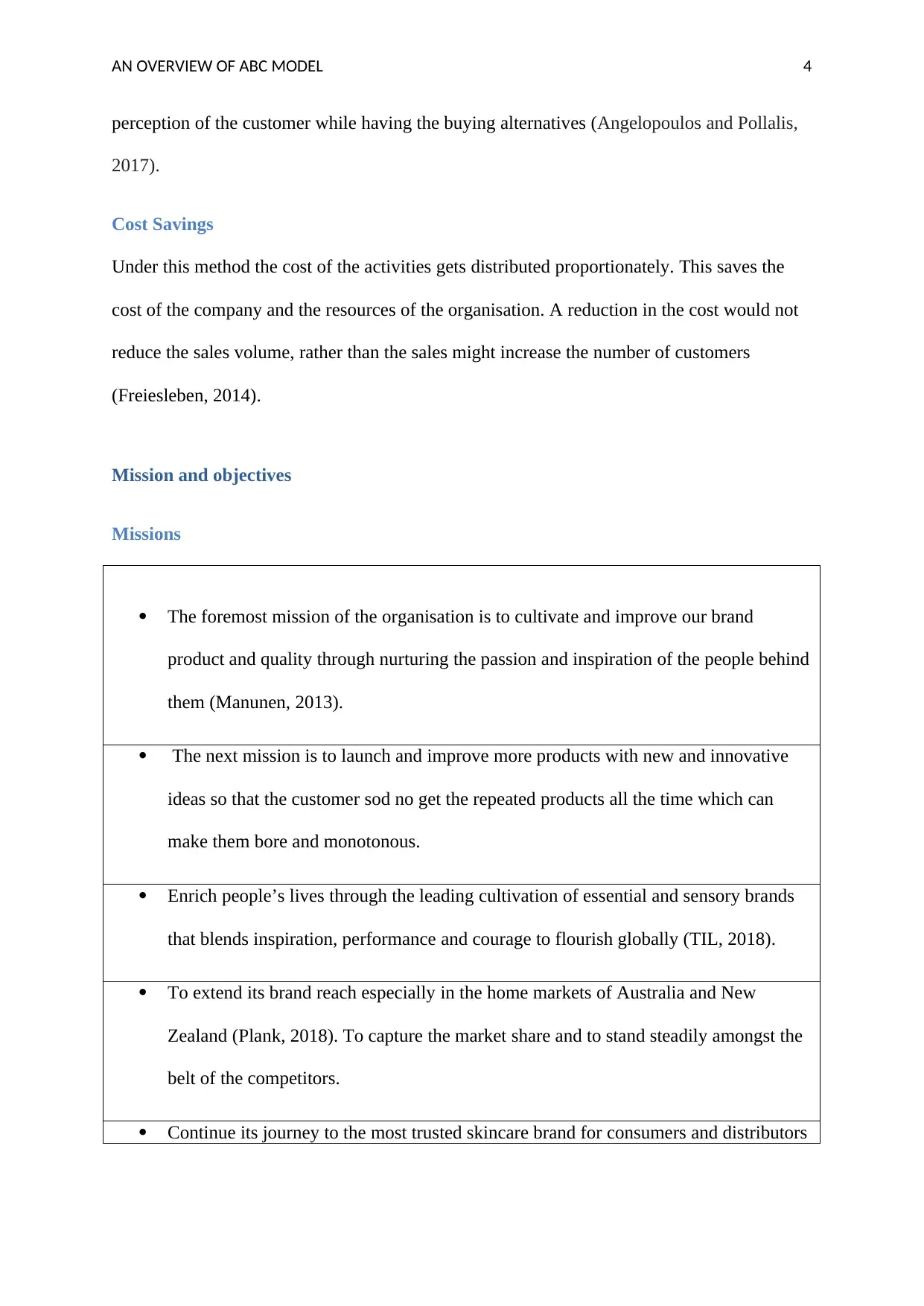
Missions
The foremost mission of the organisation is to cultivate and improve our brand
product and quality through nurturing the passion and inspiration of the people behind
them (Manunen, 2013).
The next mission is to launch and improve more products with new and innovative
ideas so that the customer sod no get the repeated products all the time which can
make them bore and monotonous.
Enrich people’s lives through the leading cultivation of essential and sensory brands
that blends inspiration, performance and courage to flourish globally (TIL, 2018).
To extend its brand reach especially in the home markets of Australia and New
Zealand (Plank, 2018). To capture the market share and to stand steadily amongst the
belt of the competitors.
Continue its journey to the most trusted skincare brand for consumers and distributors
perception of the customer while having the buying alternatives (Angelopoulos and Pollalis,
2017).
Cost Savings
Under this method the cost of the activities gets distributed proportionately. This saves the
cost of the company and the resources of the organisation. A reduction in the cost would not
reduce the sales volume, rather than the sales might increase the number of customers
(Freiesleben, 2014).
Mission and objectives
Missions
The foremost mission of the organisation is to cultivate and improve our brand
product and quality through nurturing the passion and inspiration of the people behind
them (Manunen, 2013).
The next mission is to launch and improve more products with new and innovative
ideas so that the customer sod no get the repeated products all the time which can
make them bore and monotonous.
Enrich people’s lives through the leading cultivation of essential and sensory brands
that blends inspiration, performance and courage to flourish globally (TIL, 2018).
To extend its brand reach especially in the home markets of Australia and New
Zealand (Plank, 2018). To capture the market share and to stand steadily amongst the
belt of the competitors.
Continue its journey to the most trusted skincare brand for consumers and distributors
AN OVERVIEW OF ABC MODEL 5
(Frimpong, Ameyaw and Osei-Bonsu, 2017).
Focus on brands footprints in the new markets. Feedback really plays a vital role for
any organisation. Through the feedback the Trilogy company wants to improve
themselves robustly so they do no lose their count on the existing customers.
The revenue of the Trilogy Limited was $93.4 million as compared to the previous
year in which the revenue was $83.1 million. The growth itself shows the
performance and the financial stability of the company.
The thirst of the company is to build the ethical and socially responsible business. The
mission of the company is also to continue its reputation and brand image in the
markets of Australia and New Zealand.
Vision
To create the value of the shareholder in the international market is also one of the
visions the company has (Fyall, Moore and Gugerty, 2018)
The next vision of the company is to focus on ERP system to create effective
infrastructure. The company is also focusing in streamlining the business in an
effective and efficient manner.
Also to continue to supply the high quality organic rosehip oil for the deeper
understanding of people in its products is the favourable and foremost vision of the
company.
By increasing the door to door marketing of the product, and new fragrances and
organic materials the company wants to extend its market share by 12% as compared
(Frimpong, Ameyaw and Osei-Bonsu, 2017).
Focus on brands footprints in the new markets. Feedback really plays a vital role for
any organisation. Through the feedback the Trilogy company wants to improve
themselves robustly so they do no lose their count on the existing customers.
The revenue of the Trilogy Limited was $93.4 million as compared to the previous
year in which the revenue was $83.1 million. The growth itself shows the
performance and the financial stability of the company.
The thirst of the company is to build the ethical and socially responsible business. The
mission of the company is also to continue its reputation and brand image in the
markets of Australia and New Zealand.
Vision
To create the value of the shareholder in the international market is also one of the
visions the company has (Fyall, Moore and Gugerty, 2018)
The next vision of the company is to focus on ERP system to create effective
infrastructure. The company is also focusing in streamlining the business in an
effective and efficient manner.
Also to continue to supply the high quality organic rosehip oil for the deeper
understanding of people in its products is the favourable and foremost vision of the
company.
By increasing the door to door marketing of the product, and new fragrances and
organic materials the company wants to extend its market share by 12% as compared
⊘ This is a preview!⊘
Do you want full access?
Subscribe today to unlock all pages.
Trusted by 1+ million students worldwide
AN OVERVIEW OF ABC MODEL 6
to the previous year.
To enter into the Chinese markets and various other counties markets through the e-
commerce websites is also one of the visions (TIL, 2018).
The total revenue of the $83.1million has been escalated by 127%, and the EBITDA
of $16.3 million.
The focus is also to broaden the distribution of the goodness brand, particularly in
Australia where the significantly larger population creates the natural opportunity for
the brand.
Corporate strategies
The corporate strategies of the Trilogy International involve in core strategy whose focus has
been similar since past two decades which is to grow the business in the segments of the
beauty, fragrance and salon.
The second strategy under the Trilogy International Limited is to continuously focus on the
development of the distribution network in the New Zealand and to offer the best class
service to existing and new brand principals. Under this strategy a one fit solution in the New
Zealand market has been given to the customers (Weygandt, Kimmel and Kieso, 2015).
The channels to market strategy also include pharmacies, department stores. The corporate
strategies of the company were to complement the existing businesses channels to deliver
more services to the customers with reference to the more satisfaction.
In addition to providing a good premium distribution services the company continued to
focus at the development of the business opportunities by sourcing on trend. The brand which
is under portfolio of the business needs to be considered.
to the previous year.
To enter into the Chinese markets and various other counties markets through the e-
commerce websites is also one of the visions (TIL, 2018).
The total revenue of the $83.1million has been escalated by 127%, and the EBITDA
of $16.3 million.
The focus is also to broaden the distribution of the goodness brand, particularly in
Australia where the significantly larger population creates the natural opportunity for
the brand.
Corporate strategies
The corporate strategies of the Trilogy International involve in core strategy whose focus has
been similar since past two decades which is to grow the business in the segments of the
beauty, fragrance and salon.
The second strategy under the Trilogy International Limited is to continuously focus on the
development of the distribution network in the New Zealand and to offer the best class
service to existing and new brand principals. Under this strategy a one fit solution in the New
Zealand market has been given to the customers (Weygandt, Kimmel and Kieso, 2015).
The channels to market strategy also include pharmacies, department stores. The corporate
strategies of the company were to complement the existing businesses channels to deliver
more services to the customers with reference to the more satisfaction.
In addition to providing a good premium distribution services the company continued to
focus at the development of the business opportunities by sourcing on trend. The brand which
is under portfolio of the business needs to be considered.
Paraphrase This Document
Need a fresh take? Get an instant paraphrase of this document with our AI Paraphraser
AN OVERVIEW OF ABC MODEL 7
Recommendations
Based on the existing ABC model following are the two recommendations which needs to be
implemented so that the business can grow at a faster pace.
To appropriately allocate the scheme of the costs of division, a method is necessary for the
purpose of creation of transparency in all the tasks of the company. The value chain method
can also be included along with the method of the ABC costing to smoothen the functioning
of the organisation. This way the resources will be pooled on the timely basis and the costs of
manufacturing and distributing can be stabilised (Ahn, C.Y, et al 2017). The proper allocation
of resources will remove any chance of confusion and it becomes easy for the managers to
ascertain the individual costs quickly.
At times the choice of both the activities and the drivers of the cost might be inappropriate.
Therefore the company should improve the ABC model to analyse the loopholes and shall
convert the non- potential areas into the potential ones (Saghafifar and Poullikkas, 2017). The
right driver shall be associated with the right activity to ensure the proper segregation and
also to maintain a hierarchy of the categories.
Management Accounting Tool
Budgetary Control
This is the tool of management in which the budget of the organisation needs to be prepared
for planning and control of fund. All the budgets are made with the historical data and
expectations from the future. After this a budgeted data is compared with the actual
accounting data and the performance is calculate don the basis of the variation between the
actual and the expected performance. The budgets are also useful in giving in-depth
understanding of where your money is being spent. It also helps to reduce the troubles of the
Recommendations
Based on the existing ABC model following are the two recommendations which needs to be
implemented so that the business can grow at a faster pace.
To appropriately allocate the scheme of the costs of division, a method is necessary for the
purpose of creation of transparency in all the tasks of the company. The value chain method
can also be included along with the method of the ABC costing to smoothen the functioning
of the organisation. This way the resources will be pooled on the timely basis and the costs of
manufacturing and distributing can be stabilised (Ahn, C.Y, et al 2017). The proper allocation
of resources will remove any chance of confusion and it becomes easy for the managers to
ascertain the individual costs quickly.
At times the choice of both the activities and the drivers of the cost might be inappropriate.
Therefore the company should improve the ABC model to analyse the loopholes and shall
convert the non- potential areas into the potential ones (Saghafifar and Poullikkas, 2017). The
right driver shall be associated with the right activity to ensure the proper segregation and
also to maintain a hierarchy of the categories.
Management Accounting Tool
Budgetary Control
This is the tool of management in which the budget of the organisation needs to be prepared
for planning and control of fund. All the budgets are made with the historical data and
expectations from the future. After this a budgeted data is compared with the actual
accounting data and the performance is calculate don the basis of the variation between the
actual and the expected performance. The budgets are also useful in giving in-depth
understanding of where your money is being spent. It also helps to reduce the troubles of the
AN OVERVIEW OF ABC MODEL 8
debt. If the debts are already to the control it will become cumbersome to implement the
budget. Therefore, a budget is like a blue print of the organisation’s revenue and the
expenditure. This eventually helps in examining the total funds available for the company to
expense on the investments. It shall be used by the Trilogy International Limited since its
business is dealing into different segments like organic products d fresh fragrances. Therefore
a budgetary control will help in determine the utilisation of funds in which market segments.
Conclusion
Therefore from the above analysis it can be concluded that the Trilogy International Limited
shall focus on its existing structure as well take a step to improve the performance with the
use of the managerial tools. The implementation of the ABC model is likely to accelerate the
performance of the business in association with other relevant improvements.
debt. If the debts are already to the control it will become cumbersome to implement the
budget. Therefore, a budget is like a blue print of the organisation’s revenue and the
expenditure. This eventually helps in examining the total funds available for the company to
expense on the investments. It shall be used by the Trilogy International Limited since its
business is dealing into different segments like organic products d fresh fragrances. Therefore
a budgetary control will help in determine the utilisation of funds in which market segments.
Conclusion
Therefore from the above analysis it can be concluded that the Trilogy International Limited
shall focus on its existing structure as well take a step to improve the performance with the
use of the managerial tools. The implementation of the ABC model is likely to accelerate the
performance of the business in association with other relevant improvements.
⊘ This is a preview!⊘
Do you want full access?
Subscribe today to unlock all pages.
Trusted by 1+ million students worldwide
AN OVERVIEW OF ABC MODEL 9
References
Ahn, C.Y. et al (2017) Analysis of Vision Statements in 6th Community Health Plan of Local
Government in Korea. Journal of Agricultural Medicine and Community Health, 42(1), pp.1-
12.
Angelopoulos, M. and Pollalis, Y., (2017) Using ABC costing method with in a KPI-based
framework to a Lean transformation of a Greek Public Company.
Financial Web (2017) [online] Available from
https://www.finweb.com/financial-planning/the-importance-of-budgeting.html [Accessed on
22nd May 2018].
Flink, C.M. (2017) Ordering Chaos: The Performance Consequences of Budgetary
Changes. The American Review of Public Administration,10(2), pp 13-25.
Freiesleben, J. (2014) On the limited value of cost of quality models, Total Quality
Management and Business Excellence, 15(7), 959-969.
Frimpong, E.A., Ameyaw, F. and Osei-Bonsu, E. (2017) Budgeting And Budgetary Control
Practices in Timber industries in Ghana: A Case of Logs and Lumber Limited. International
Journal of Technology and Management Research, 2(2), pp.44-50.
Fyall, R., Moore, M.K. and Gugerty, M.K. (2018) Beyond NTEE Codes: Opportunities to
Understand Nonprofit Activity Through Mission Statement Content Coding. Nonprofit and
Voluntary Sector Quarterly, 12(3), pp 15-32.
Howell, S.B. et al (2014) The K2 mission: characterization and early results. Publications of
the Astronomical Society of the Pacific, 126(938), p.398.
References
Ahn, C.Y. et al (2017) Analysis of Vision Statements in 6th Community Health Plan of Local
Government in Korea. Journal of Agricultural Medicine and Community Health, 42(1), pp.1-
12.
Angelopoulos, M. and Pollalis, Y., (2017) Using ABC costing method with in a KPI-based
framework to a Lean transformation of a Greek Public Company.
Financial Web (2017) [online] Available from
https://www.finweb.com/financial-planning/the-importance-of-budgeting.html [Accessed on
22nd May 2018].
Flink, C.M. (2017) Ordering Chaos: The Performance Consequences of Budgetary
Changes. The American Review of Public Administration,10(2), pp 13-25.
Freiesleben, J. (2014) On the limited value of cost of quality models, Total Quality
Management and Business Excellence, 15(7), 959-969.
Frimpong, E.A., Ameyaw, F. and Osei-Bonsu, E. (2017) Budgeting And Budgetary Control
Practices in Timber industries in Ghana: A Case of Logs and Lumber Limited. International
Journal of Technology and Management Research, 2(2), pp.44-50.
Fyall, R., Moore, M.K. and Gugerty, M.K. (2018) Beyond NTEE Codes: Opportunities to
Understand Nonprofit Activity Through Mission Statement Content Coding. Nonprofit and
Voluntary Sector Quarterly, 12(3), pp 15-32.
Howell, S.B. et al (2014) The K2 mission: characterization and early results. Publications of
the Astronomical Society of the Pacific, 126(938), p.398.
Paraphrase This Document
Need a fresh take? Get an instant paraphrase of this document with our AI Paraphraser
AN OVERVIEW OF ABC MODEL 10
Innes, J. and Mitchell, F., (2015) A survey of activity-based costing in the UK's largest
companies, Management accounting research, 6(2), pp.137-153.
Kirkpatrick, S.A., 2017. Toward a Grounded Theory: A Qualitative Study of Vision
Statement Development. Journal of Management Policy and Practice, 18(1), p.87.
Manunen, O. (2013) An activity-based costing model for logistics operations of
manufacturers and wholesalers, International Journal of Logistics, 3(1), 53-65.
Otley, D. (2015) in Management Control. Critical Perspectives in Management Control,
p.27.
Plank, P. (2018) Introduction. In Price and Product-Mix Decisions Under Different Cost
Systems, New York: Springer
Saghafifar, M. and Poullikkas, A. (2017) Comparative analysis of power augmentation in air
bottoming cycles, International Journal of Sustainable Energy, 36(1), pp.47-60.
TIL(2018) [online] Availbale from https://www.trilogyproducts.com/media/pdf/Trilogy
%20International%20Ltd%20Annual%20Report%202016.pdf [Accessed on 23rd May 2018]
Vaxevanidis, N. M., and Petropoulos, G. (2018) A literature survey of cost of quality
models, Journal of engineering, 6(3), pp. 274-283.
Weygandt, J.J., Kimmel, P.D. and Kieso, D.E. (2015) Managerial accounting.London:
Wiley.
Innes, J. and Mitchell, F., (2015) A survey of activity-based costing in the UK's largest
companies, Management accounting research, 6(2), pp.137-153.
Kirkpatrick, S.A., 2017. Toward a Grounded Theory: A Qualitative Study of Vision
Statement Development. Journal of Management Policy and Practice, 18(1), p.87.
Manunen, O. (2013) An activity-based costing model for logistics operations of
manufacturers and wholesalers, International Journal of Logistics, 3(1), 53-65.
Otley, D. (2015) in Management Control. Critical Perspectives in Management Control,
p.27.
Plank, P. (2018) Introduction. In Price and Product-Mix Decisions Under Different Cost
Systems, New York: Springer
Saghafifar, M. and Poullikkas, A. (2017) Comparative analysis of power augmentation in air
bottoming cycles, International Journal of Sustainable Energy, 36(1), pp.47-60.
TIL(2018) [online] Availbale from https://www.trilogyproducts.com/media/pdf/Trilogy
%20International%20Ltd%20Annual%20Report%202016.pdf [Accessed on 23rd May 2018]
Vaxevanidis, N. M., and Petropoulos, G. (2018) A literature survey of cost of quality
models, Journal of engineering, 6(3), pp. 274-283.
Weygandt, J.J., Kimmel, P.D. and Kieso, D.E. (2015) Managerial accounting.London:
Wiley.

1 out of 11


Related Documents


Your All-in-One AI-Powered Toolkit for Academic Success.
+13062052269
info@desklib.com
Available 24*7 on WhatsApp / Email
![[object Object]](/_next/static/media/star-bottom.7253800d.svg)
Unlock your academic potential
Copyright © 2020–2026 A2Z Services. All Rights Reserved. Developed and managed by ZUCOL.