Business Operations and Management: Detailed Assignment Solution
VerifiedAdded on 2020/07/22
|17
|3897
|56
Homework Assignment
AI Summary
This document provides a comprehensive solution to a business operations and management assignment, covering various units and topics. The assignment delves into key areas such as marketing priorities for B2B companies, effective presentation techniques, and communication strategies. It also explores performance management, budgeting, and office system design. Furthermore, the assignment addresses workplace mail handling, meeting procedures, and health and safety considerations. The solution also includes insights into data entry, Excel techniques, email best practices, and project scope definition. It emphasizes the importance of decision-making, risk assessment, and employee performance strategies within a business context. The document offers a detailed analysis of each topic, providing practical examples and solutions to the given problems.

UNIT 10 ;11; 19; 21; 49; 52; 73

Paraphrase This Document
Need a fresh take? Get an instant paraphrase of this document with our AI Paraphraser
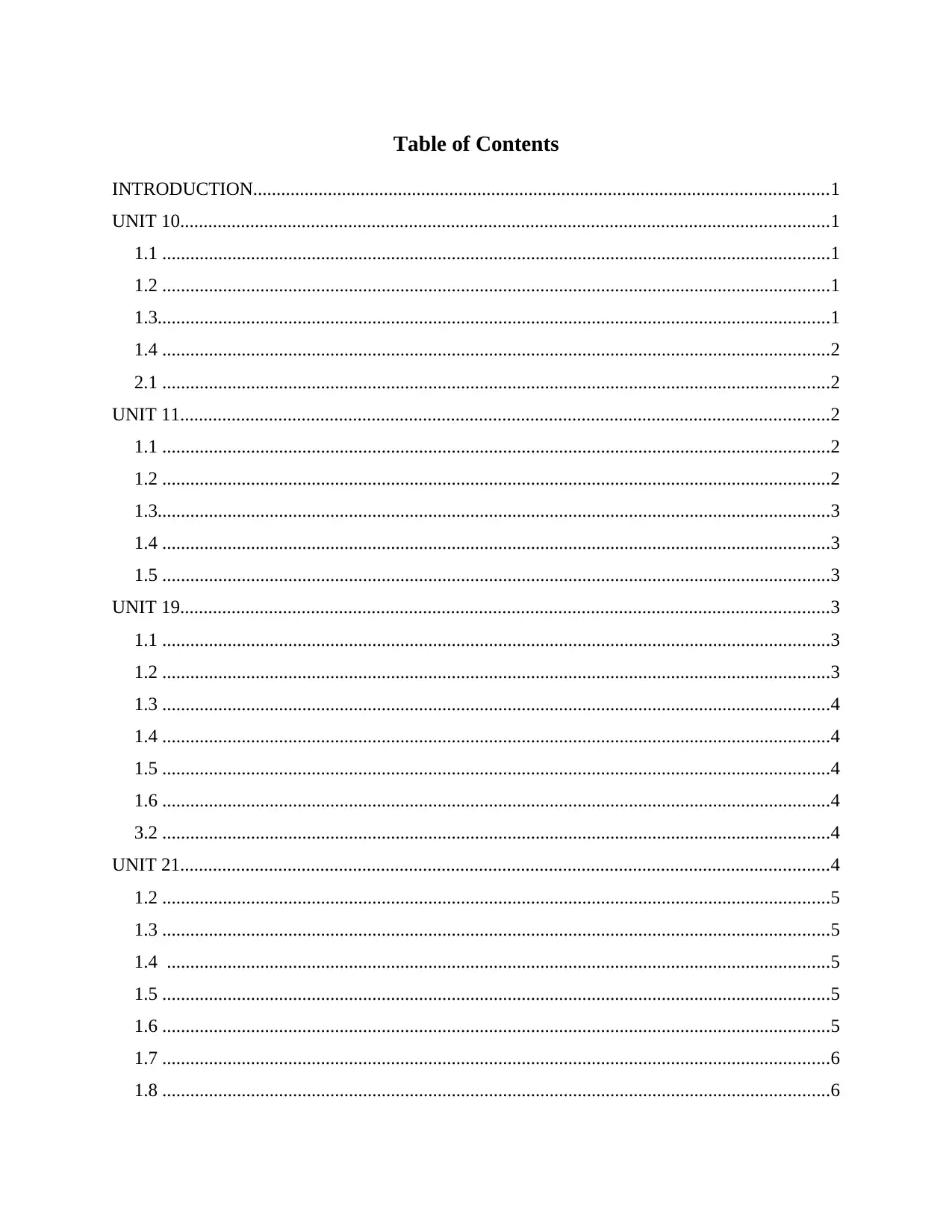
Table of Contents
INTRODUCTION...........................................................................................................................1
UNIT 10...........................................................................................................................................1
1.1 ...............................................................................................................................................1
1.2 ...............................................................................................................................................1
1.3................................................................................................................................................1
1.4 ...............................................................................................................................................2
2.1 ...............................................................................................................................................2
UNIT 11...........................................................................................................................................2
1.1 ...............................................................................................................................................2
1.2 ...............................................................................................................................................2
1.3................................................................................................................................................3
1.4 ...............................................................................................................................................3
1.5 ...............................................................................................................................................3
UNIT 19...........................................................................................................................................3
1.1 ...............................................................................................................................................3
1.2 ...............................................................................................................................................3
1.3 ...............................................................................................................................................4
1.4 ...............................................................................................................................................4
1.5 ...............................................................................................................................................4
1.6 ...............................................................................................................................................4
3.2 ...............................................................................................................................................4
UNIT 21...........................................................................................................................................4
1.2 ...............................................................................................................................................5
1.3 ...............................................................................................................................................5
1.4 ..............................................................................................................................................5
1.5 ...............................................................................................................................................5
1.6 ...............................................................................................................................................5
1.7 ...............................................................................................................................................6
1.8 ...............................................................................................................................................6
INTRODUCTION...........................................................................................................................1
UNIT 10...........................................................................................................................................1
1.1 ...............................................................................................................................................1
1.2 ...............................................................................................................................................1
1.3................................................................................................................................................1
1.4 ...............................................................................................................................................2
2.1 ...............................................................................................................................................2
UNIT 11...........................................................................................................................................2
1.1 ...............................................................................................................................................2
1.2 ...............................................................................................................................................2
1.3................................................................................................................................................3
1.4 ...............................................................................................................................................3
1.5 ...............................................................................................................................................3
UNIT 19...........................................................................................................................................3
1.1 ...............................................................................................................................................3
1.2 ...............................................................................................................................................3
1.3 ...............................................................................................................................................4
1.4 ...............................................................................................................................................4
1.5 ...............................................................................................................................................4
1.6 ...............................................................................................................................................4
3.2 ...............................................................................................................................................4
UNIT 21...........................................................................................................................................4
1.2 ...............................................................................................................................................5
1.3 ...............................................................................................................................................5
1.4 ..............................................................................................................................................5
1.5 ...............................................................................................................................................5
1.6 ...............................................................................................................................................5
1.7 ...............................................................................................................................................6
1.8 ...............................................................................................................................................6
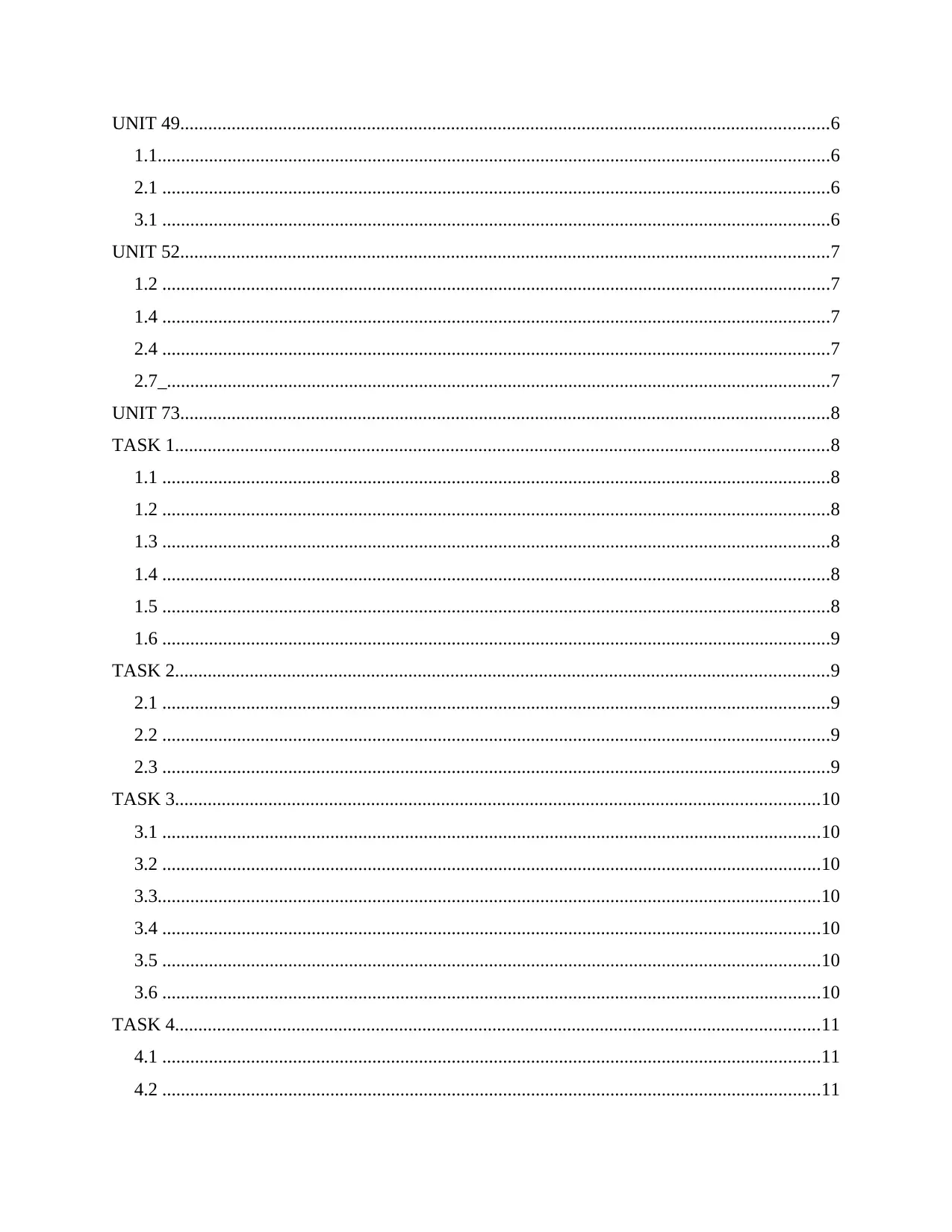
UNIT 49...........................................................................................................................................6
1.1................................................................................................................................................6
2.1 ...............................................................................................................................................6
3.1 ...............................................................................................................................................6
UNIT 52...........................................................................................................................................7
1.2 ...............................................................................................................................................7
1.4 ...............................................................................................................................................7
2.4 ...............................................................................................................................................7
2.7_..............................................................................................................................................7
UNIT 73...........................................................................................................................................8
TASK 1............................................................................................................................................8
1.1 ...............................................................................................................................................8
1.2 ...............................................................................................................................................8
1.3 ...............................................................................................................................................8
1.4 ...............................................................................................................................................8
1.5 ...............................................................................................................................................8
1.6 ...............................................................................................................................................9
TASK 2............................................................................................................................................9
2.1 ...............................................................................................................................................9
2.2 ...............................................................................................................................................9
2.3 ...............................................................................................................................................9
TASK 3..........................................................................................................................................10
3.1 .............................................................................................................................................10
3.2 .............................................................................................................................................10
3.3..............................................................................................................................................10
3.4 .............................................................................................................................................10
3.5 .............................................................................................................................................10
3.6 .............................................................................................................................................10
TASK 4..........................................................................................................................................11
4.1 .............................................................................................................................................11
4.2 .............................................................................................................................................11
1.1................................................................................................................................................6
2.1 ...............................................................................................................................................6
3.1 ...............................................................................................................................................6
UNIT 52...........................................................................................................................................7
1.2 ...............................................................................................................................................7
1.4 ...............................................................................................................................................7
2.4 ...............................................................................................................................................7
2.7_..............................................................................................................................................7
UNIT 73...........................................................................................................................................8
TASK 1............................................................................................................................................8
1.1 ...............................................................................................................................................8
1.2 ...............................................................................................................................................8
1.3 ...............................................................................................................................................8
1.4 ...............................................................................................................................................8
1.5 ...............................................................................................................................................8
1.6 ...............................................................................................................................................9
TASK 2............................................................................................................................................9
2.1 ...............................................................................................................................................9
2.2 ...............................................................................................................................................9
2.3 ...............................................................................................................................................9
TASK 3..........................................................................................................................................10
3.1 .............................................................................................................................................10
3.2 .............................................................................................................................................10
3.3..............................................................................................................................................10
3.4 .............................................................................................................................................10
3.5 .............................................................................................................................................10
3.6 .............................................................................................................................................10
TASK 4..........................................................................................................................................11
4.1 .............................................................................................................................................11
4.2 .............................................................................................................................................11
⊘ This is a preview!⊘
Do you want full access?
Subscribe today to unlock all pages.

Trusted by 1+ million students worldwide

4.3 .............................................................................................................................................11
4.4 .............................................................................................................................................11
4.5 .............................................................................................................................................11
4.6 .............................................................................................................................................12
CONCLUSION..............................................................................................................................12
REFERENCES..............................................................................................................................13
4.4 .............................................................................................................................................11
4.5 .............................................................................................................................................11
4.6 .............................................................................................................................................12
CONCLUSION..............................................................................................................................12
REFERENCES..............................................................................................................................13
Paraphrase This Document
Need a fresh take? Get an instant paraphrase of this document with our AI Paraphraser
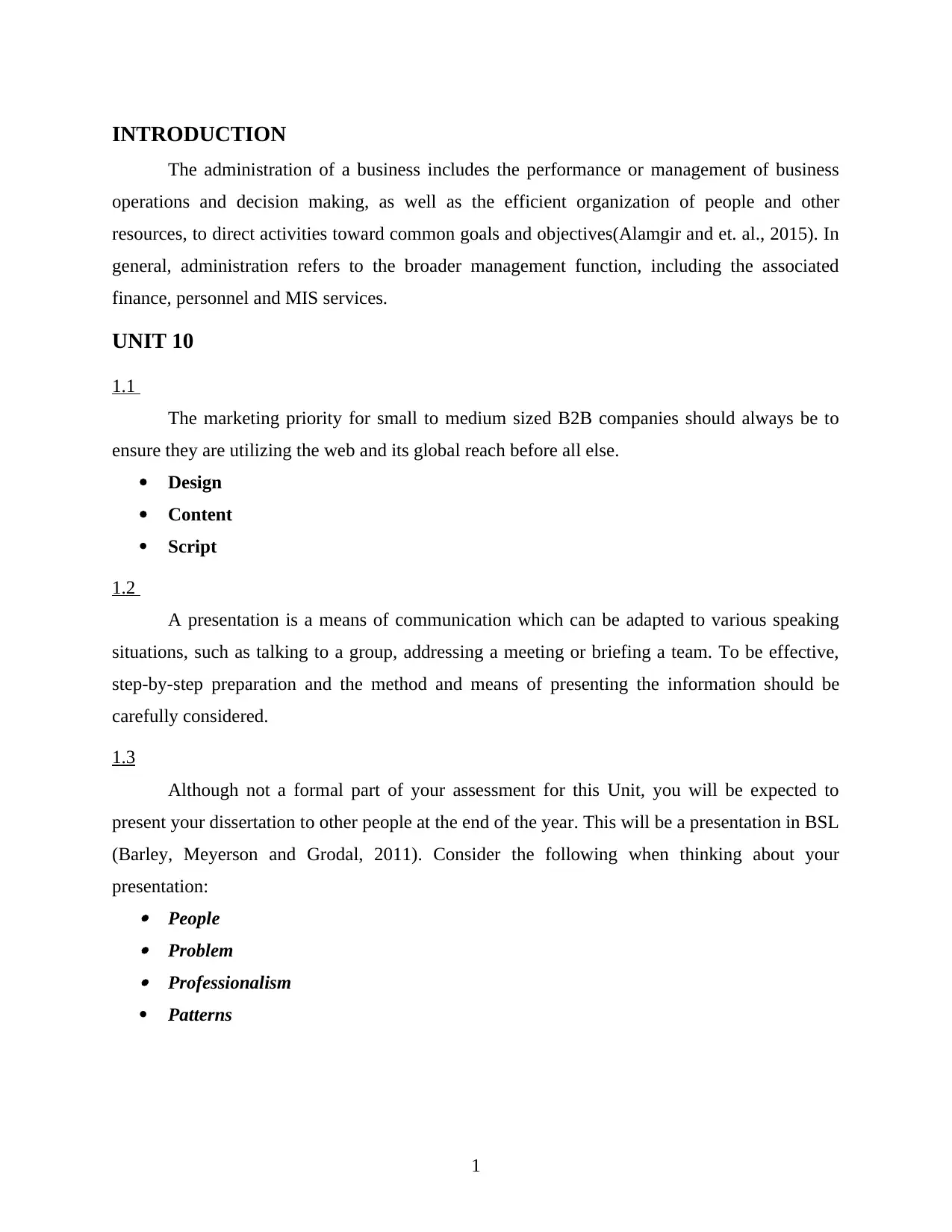
INTRODUCTION
The administration of a business includes the performance or management of business
operations and decision making, as well as the efficient organization of people and other
resources, to direct activities toward common goals and objectives(Alamgir and et. al., 2015). In
general, administration refers to the broader management function, including the associated
finance, personnel and MIS services.
UNIT 10
1.1
The marketing priority for small to medium sized B2B companies should always be to
ensure they are utilizing the web and its global reach before all else.
Design
Content
Script
1.2
A presentation is a means of communication which can be adapted to various speaking
situations, such as talking to a group, addressing a meeting or briefing a team. To be effective,
step-by-step preparation and the method and means of presenting the information should be
carefully considered.
1.3
Although not a formal part of your assessment for this Unit, you will be expected to
present your dissertation to other people at the end of the year. This will be a presentation in BSL
(Barley, Meyerson and Grodal, 2011). Consider the following when thinking about your
presentation: People Problem Professionalism
Patterns
1
The administration of a business includes the performance or management of business
operations and decision making, as well as the efficient organization of people and other
resources, to direct activities toward common goals and objectives(Alamgir and et. al., 2015). In
general, administration refers to the broader management function, including the associated
finance, personnel and MIS services.
UNIT 10
1.1
The marketing priority for small to medium sized B2B companies should always be to
ensure they are utilizing the web and its global reach before all else.
Design
Content
Script
1.2
A presentation is a means of communication which can be adapted to various speaking
situations, such as talking to a group, addressing a meeting or briefing a team. To be effective,
step-by-step preparation and the method and means of presenting the information should be
carefully considered.
1.3
Although not a formal part of your assessment for this Unit, you will be expected to
present your dissertation to other people at the end of the year. This will be a presentation in BSL
(Barley, Meyerson and Grodal, 2011). Consider the following when thinking about your
presentation: People Problem Professionalism
Patterns
1
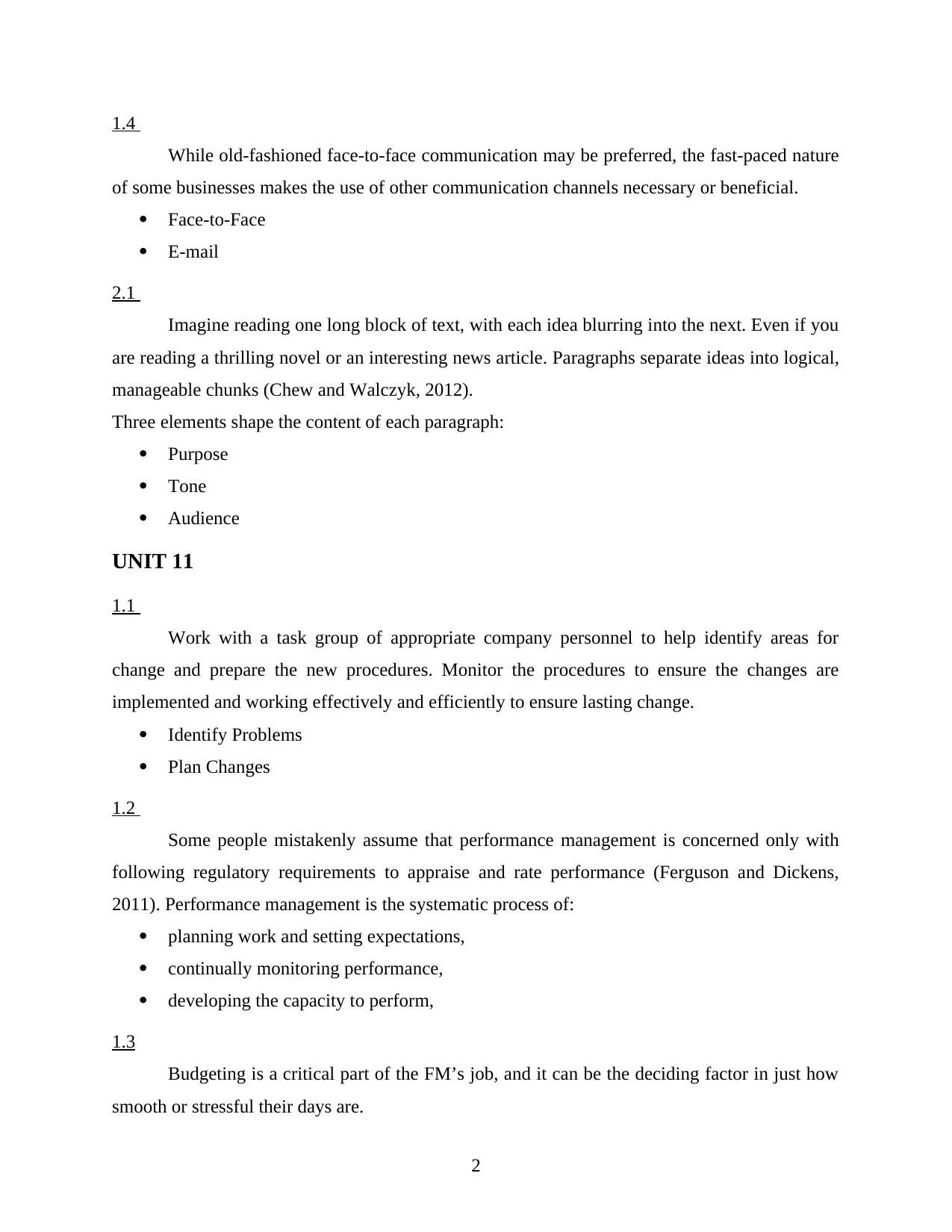
1.4
While old-fashioned face-to-face communication may be preferred, the fast-paced nature
of some businesses makes the use of other communication channels necessary or beneficial.
Face-to-Face
E-mail
2.1
Imagine reading one long block of text, with each idea blurring into the next. Even if you
are reading a thrilling novel or an interesting news article. Paragraphs separate ideas into logical,
manageable chunks (Chew and Walczyk, 2012).
Three elements shape the content of each paragraph:
Purpose
Tone
Audience
UNIT 11
1.1
Work with a task group of appropriate company personnel to help identify areas for
change and prepare the new procedures. Monitor the procedures to ensure the changes are
implemented and working effectively and efficiently to ensure lasting change.
Identify Problems
Plan Changes
1.2
Some people mistakenly assume that performance management is concerned only with
following regulatory requirements to appraise and rate performance (Ferguson and Dickens,
2011). Performance management is the systematic process of:
planning work and setting expectations,
continually monitoring performance,
developing the capacity to perform,
1.3
Budgeting is a critical part of the FM’s job, and it can be the deciding factor in just how
smooth or stressful their days are.
2
While old-fashioned face-to-face communication may be preferred, the fast-paced nature
of some businesses makes the use of other communication channels necessary or beneficial.
Face-to-Face
2.1
Imagine reading one long block of text, with each idea blurring into the next. Even if you
are reading a thrilling novel or an interesting news article. Paragraphs separate ideas into logical,
manageable chunks (Chew and Walczyk, 2012).
Three elements shape the content of each paragraph:
Purpose
Tone
Audience
UNIT 11
1.1
Work with a task group of appropriate company personnel to help identify areas for
change and prepare the new procedures. Monitor the procedures to ensure the changes are
implemented and working effectively and efficiently to ensure lasting change.
Identify Problems
Plan Changes
1.2
Some people mistakenly assume that performance management is concerned only with
following regulatory requirements to appraise and rate performance (Ferguson and Dickens,
2011). Performance management is the systematic process of:
planning work and setting expectations,
continually monitoring performance,
developing the capacity to perform,
1.3
Budgeting is a critical part of the FM’s job, and it can be the deciding factor in just how
smooth or stressful their days are.
2
⊘ This is a preview!⊘
Do you want full access?
Subscribe today to unlock all pages.
Trusted by 1+ million students worldwide
Act Like a Business Owner
Research, research, research
1.4
It is the job of the top management to get themselves involved, and to share the
responsibility, to show an enthusiasm and a zeal for designing an office system. Like any other
activity, a system must be properly planned and carefully designed (Glasserman, 2013).
Organisation Manuals and Charts
Information Flow and System
1.5
As a business owner, you have a lot of concerns to occupy your time. The last thing you
need to worry about is whether or not your employees are doing their jobs.
Hire an Adequate Workforce
Hire the Right Employees for the Job
Set Realistic Expectations
UNIT 19
1.1
In my workplace, we hardly ever get junk mail delivered to us, however if this happens,
the administrator dealing with the post will open the item and use their own discretion to see if it
would be relevant to a member of star, if so the item will be delivered with the rest of the post to
the star pigeon holes However, if it is of no use to the us, for e!ample catalogues that were not
requested, it will be recycled in the designated bin (Hangal, Lam and Heer, 2011).
1.2
The main problems that can occur are delays, missing deliveries, and suspicious mail. To
avoid delays, we have to send the mail at the right time, with the correct postage. To avoid
missing deliveries of an important document, it can be delivered via recorded delivery which lets
one track the delivery.
3
Research, research, research
1.4
It is the job of the top management to get themselves involved, and to share the
responsibility, to show an enthusiasm and a zeal for designing an office system. Like any other
activity, a system must be properly planned and carefully designed (Glasserman, 2013).
Organisation Manuals and Charts
Information Flow and System
1.5
As a business owner, you have a lot of concerns to occupy your time. The last thing you
need to worry about is whether or not your employees are doing their jobs.
Hire an Adequate Workforce
Hire the Right Employees for the Job
Set Realistic Expectations
UNIT 19
1.1
In my workplace, we hardly ever get junk mail delivered to us, however if this happens,
the administrator dealing with the post will open the item and use their own discretion to see if it
would be relevant to a member of star, if so the item will be delivered with the rest of the post to
the star pigeon holes However, if it is of no use to the us, for e!ample catalogues that were not
requested, it will be recycled in the designated bin (Hangal, Lam and Heer, 2011).
1.2
The main problems that can occur are delays, missing deliveries, and suspicious mail. To
avoid delays, we have to send the mail at the right time, with the correct postage. To avoid
missing deliveries of an important document, it can be delivered via recorded delivery which lets
one track the delivery.
3
Paraphrase This Document
Need a fresh take? Get an instant paraphrase of this document with our AI Paraphraser
1.3
You might know that using a franking machine can save you time and money on your
postage costs, but many people are not aware of exactly how a franking machine works,
believing that the whole process is probably confusing and complicated.
Below is a quick overview on how franking machines generally work; Weight Size and service
Business message
1.4
In every office, a large volume of communication like letters, circulars, telegrams are sent
to outsiders or received from them. Inside the organisation also written materials are exchanged
between different departments (Hill, 2013).
1.5
This standard sets out the skills, knowledge and understanding for mail handlers to
handle mail at work, undertaking naturally occurring tasks. This may be collection, processing or
delivery.
1.6
A letter or package is suspicious if one or more of the following are as follows:
Has any powdery substance on the outside
It is unexpected or from someone unfamiliar to you
Has excessive postage
3.2
For small companies and large enterprises alike, mail continues to be an integral part of
the document workflow. In a typical mail center today, 60% to 70% of the labour is spent sorting
incoming and interoffice mail (Kashihara and Hasegawa, 2012). Incoming mail is defined as
those mail pieces that are received by any company, and in addition to the postal address,
subdivision and other specific details.
UNIT 21
1.1
4
You might know that using a franking machine can save you time and money on your
postage costs, but many people are not aware of exactly how a franking machine works,
believing that the whole process is probably confusing and complicated.
Below is a quick overview on how franking machines generally work; Weight Size and service
Business message
1.4
In every office, a large volume of communication like letters, circulars, telegrams are sent
to outsiders or received from them. Inside the organisation also written materials are exchanged
between different departments (Hill, 2013).
1.5
This standard sets out the skills, knowledge and understanding for mail handlers to
handle mail at work, undertaking naturally occurring tasks. This may be collection, processing or
delivery.
1.6
A letter or package is suspicious if one or more of the following are as follows:
Has any powdery substance on the outside
It is unexpected or from someone unfamiliar to you
Has excessive postage
3.2
For small companies and large enterprises alike, mail continues to be an integral part of
the document workflow. In a typical mail center today, 60% to 70% of the labour is spent sorting
incoming and interoffice mail (Kashihara and Hasegawa, 2012). Incoming mail is defined as
those mail pieces that are received by any company, and in addition to the postal address,
subdivision and other specific details.
UNIT 21
1.1
4
A meeting is where a group of people come together to discuss issues, to improve
communication, to promote coordination or to deal with any matters that are put on the agenda
and to help get any jobs done.
1.2
Minimum number of members that must be present at a meeting. A meeting of an
organisation cannot take place unless the required quorum is in attendance. If the Constitution of
the organisation sets out what a quorum is then clearly that will apply (McIntosh and et. al.,
2013).
1.3
Meetings are the lifeblood of the workforce. They enable progress takes place, and work
to move forward. However, more often than not, they can be overly inefficient or unproductive.
Make Reminder Calls
Spread the Word
Promote Online (Company Website, Social Media, & Email)
1.4
Health and safety can sometimes seem like a load of time-consuming red tape – when
you’re busy planning an event, it’s easy to lose sight of the importance of proper health and
safety planning. Who are you responsible for:
People who work for you
Contractors
1.5
In theory, everyone understands that preparation can make or break an important
meeting. The more work you do before you walk into the room, the more productive and
efficient you’ll be (Mockford and et. al., 2011). But who has the time to properly prepare. Our
checklist makes meeting prep quick and easy—be sure to print it out or save it for later.
1.6
The roles of a chairperson are to set the agenda, lead the meeting, maintain order at the
meeting, ensure the conventions of the meeting are being followed, ensure fairness and equality
at the meeting, represent the group to the public and to approve the formal minutes of the
5
communication, to promote coordination or to deal with any matters that are put on the agenda
and to help get any jobs done.
1.2
Minimum number of members that must be present at a meeting. A meeting of an
organisation cannot take place unless the required quorum is in attendance. If the Constitution of
the organisation sets out what a quorum is then clearly that will apply (McIntosh and et. al.,
2013).
1.3
Meetings are the lifeblood of the workforce. They enable progress takes place, and work
to move forward. However, more often than not, they can be overly inefficient or unproductive.
Make Reminder Calls
Spread the Word
Promote Online (Company Website, Social Media, & Email)
1.4
Health and safety can sometimes seem like a load of time-consuming red tape – when
you’re busy planning an event, it’s easy to lose sight of the importance of proper health and
safety planning. Who are you responsible for:
People who work for you
Contractors
1.5
In theory, everyone understands that preparation can make or break an important
meeting. The more work you do before you walk into the room, the more productive and
efficient you’ll be (Mockford and et. al., 2011). But who has the time to properly prepare. Our
checklist makes meeting prep quick and easy—be sure to print it out or save it for later.
1.6
The roles of a chairperson are to set the agenda, lead the meeting, maintain order at the
meeting, ensure the conventions of the meeting are being followed, ensure fairness and equality
at the meeting, represent the group to the public and to approve the formal minutes of the
5
⊘ This is a preview!⊘
Do you want full access?
Subscribe today to unlock all pages.
Trusted by 1+ million students worldwide
meeting after they have been formatted, to confirming that they are a correct and truthfully
representation of the events at the meeting.
1.7
A formal meeting in a business environment is a pre-planned event with a formal notice
that most often is sent via email or an official company memo. An informal meeting can take
place almost anywhere, anytime, and there is seldom the structure and formality that you will see
in a formal meeting (Mockford and et. al., 2011).
1.8
Legal Requirements – These are policies and procedures which are required from some
organisations by law. An agenda, a chairperson and formal minutes of the meeting are legal
requirements in many places, and consider good business practice in others.
UNIT 49
1.1
The range of data entry, manipulation and outputting techniques will be at times non-
routine or unfamiliar. The tools needed to analyse and interpret the data require a basic
knowledge and understanding of mathematical, logical, statistical or financial formulas and
functions.
2.1
Number crunching is Excel's forte, so when you're ready to move beyond the basic
summarizing aggregates, such as SUM() and AVERAGE(), These summarizing tips will help
you put Excel's summarizing features and functions to work for you (Renz and Herman, 2016).
Sort
Selection
Auto Sum
Filter
3.1
Simple techniques in Excel to get your data message across clearly. Here are a few tips to
get you started:
Give your worksheet a good title
6
representation of the events at the meeting.
1.7
A formal meeting in a business environment is a pre-planned event with a formal notice
that most often is sent via email or an official company memo. An informal meeting can take
place almost anywhere, anytime, and there is seldom the structure and formality that you will see
in a formal meeting (Mockford and et. al., 2011).
1.8
Legal Requirements – These are policies and procedures which are required from some
organisations by law. An agenda, a chairperson and formal minutes of the meeting are legal
requirements in many places, and consider good business practice in others.
UNIT 49
1.1
The range of data entry, manipulation and outputting techniques will be at times non-
routine or unfamiliar. The tools needed to analyse and interpret the data require a basic
knowledge and understanding of mathematical, logical, statistical or financial formulas and
functions.
2.1
Number crunching is Excel's forte, so when you're ready to move beyond the basic
summarizing aggregates, such as SUM() and AVERAGE(), These summarizing tips will help
you put Excel's summarizing features and functions to work for you (Renz and Herman, 2016).
Sort
Selection
Auto Sum
Filter
3.1
Simple techniques in Excel to get your data message across clearly. Here are a few tips to
get you started:
Give your worksheet a good title
6
Paraphrase This Document
Need a fresh take? Get an instant paraphrase of this document with our AI Paraphraser
Wake people up with colour
Let the format lead the eye
UNIT 52
1.2
You are judged by the writing style, tone, language, and mistakes in your e-mails every
single day. We're all so optimistic we believe people will overlook our e-mail typos and
mistakes, while at the same time we privately label those who send us sloppy e-mails as careless,
confused, or ineffective.
1.4
Some safety tips when using email are as follows:
Change your password regularly and keep it in a safe place.
Don’t share your password with anyone.
Don’t open attachments from anyone you don’t know.
2.4
An email archiving solution is designed to store emails in their original state for the
purpose of easy retrieval during daily business operations. Additionally, email archives are used
to protect your company in the event of litigation and to keep you in line with industry
compliance standards (van Ginkel and et. al., 2015).
2.7_
There are plenty of ways to mishandle email communications -- and mistakes can range
from embarrassing to inefficient to highly irritating. These tips will help you sidestep potential
email problems.
Address the email only when it is ready to send
Attach any files before composing your note
7
Let the format lead the eye
UNIT 52
1.2
You are judged by the writing style, tone, language, and mistakes in your e-mails every
single day. We're all so optimistic we believe people will overlook our e-mail typos and
mistakes, while at the same time we privately label those who send us sloppy e-mails as careless,
confused, or ineffective.
1.4
Some safety tips when using email are as follows:
Change your password regularly and keep it in a safe place.
Don’t share your password with anyone.
Don’t open attachments from anyone you don’t know.
2.4
An email archiving solution is designed to store emails in their original state for the
purpose of easy retrieval during daily business operations. Additionally, email archives are used
to protect your company in the event of litigation and to keep you in line with industry
compliance standards (van Ginkel and et. al., 2015).
2.7_
There are plenty of ways to mishandle email communications -- and mistakes can range
from embarrassing to inefficient to highly irritating. These tips will help you sidestep potential
email problems.
Address the email only when it is ready to send
Attach any files before composing your note
7
UNIT 73
TASK 1
1.1
Project scope is defined as the specific endpoints or boundaries of the project as well as
the responsibilities of the project manager and team members. A clearly defined project scope
ensures all stakeholders (individuals and organizations that are involved in or that might be
affected by application architect, contracts and legal) share a common view of what is included
as the objectives of the project.
1.2
High risk or high priority objective should have decisions made against them first and
knowing the risks and priorities will allow managers to make a better and more informed
decision. Assess why it was important to analyse the potential impact of your decision making.
1.3
The rapid pace of change, both in society and in business, can be witnessed all around in
technology, new phenomena, but perhaps most strikingly in information management. The data
and information used as a basis for decision-making is in serious danger of becoming outdated
and distorted (Verhoeven and et. al., 2012).
1.4
Company is like many other small and mid-sized businesses, your employees represent
both your organization's biggest line item expense and your most valuable asset. This means
your company's productivity-and ultimately, its profitability-depend on making sure all of your
workers perform up to their full potential.
1.5
The strategies for validating information are:
Create a constructive environment.
Investigate the situation in detail.
Generate good alternatives.
Explore your options.
Select the best solution.
8
TASK 1
1.1
Project scope is defined as the specific endpoints or boundaries of the project as well as
the responsibilities of the project manager and team members. A clearly defined project scope
ensures all stakeholders (individuals and organizations that are involved in or that might be
affected by application architect, contracts and legal) share a common view of what is included
as the objectives of the project.
1.2
High risk or high priority objective should have decisions made against them first and
knowing the risks and priorities will allow managers to make a better and more informed
decision. Assess why it was important to analyse the potential impact of your decision making.
1.3
The rapid pace of change, both in society and in business, can be witnessed all around in
technology, new phenomena, but perhaps most strikingly in information management. The data
and information used as a basis for decision-making is in serious danger of becoming outdated
and distorted (Verhoeven and et. al., 2012).
1.4
Company is like many other small and mid-sized businesses, your employees represent
both your organization's biggest line item expense and your most valuable asset. This means
your company's productivity-and ultimately, its profitability-depend on making sure all of your
workers perform up to their full potential.
1.5
The strategies for validating information are:
Create a constructive environment.
Investigate the situation in detail.
Generate good alternatives.
Explore your options.
Select the best solution.
8
⊘ This is a preview!⊘
Do you want full access?
Subscribe today to unlock all pages.
Trusted by 1+ million students worldwide

1 out of 17


Related Documents


Your All-in-One AI-Powered Toolkit for Academic Success.
+13062052269
info@desklib.com
Available 24*7 on WhatsApp / Email
![[object Object]](/_next/static/media/star-bottom.7253800d.svg)
Unlock your academic potential
Copyright © 2020–2025 A2Z Services. All Rights Reserved. Developed and managed by ZUCOL.