Economics Analysis: Housing Affordability and Supply Side Economics
VerifiedAdded on 2024/05/23
|6
|1151
|500
Essay
AI Summary
This essay examines the issue of housing affordability in Australia, focusing on whether increasing the supply of houses is the answer to driving down prices. The author analyzes the demand and supply dynamics in the Australian housing market, considering factors such as high incomes, government incentives, and limited land resources. The essay argues that simply increasing supply may not be sufficient due to speculative investment and historical supply lags. The author proposes releasing land for massive-scale development to flood the market and shift the supply curve, while also suggesting a shift in government incentives towards infrastructure projects to maintain economic growth. The analysis supports the conclusion that a combination of controlling demand and increasing supply is necessary to address housing affordability issues in Australia. Desklib provides past papers and solved assignments for students.

Analysis of Housing affordability: Is more supply the answer to driving down prices?
Paraphrase This Document
Need a fresh take? Get an instant paraphrase of this document with our AI Paraphraser

Contents
Introduction of the issue and interested parties.......................................................................2
The economic analysis...............................................................................................................2
My Views....................................................................................................................................3
How the above analysis supports my conclusion......................................................................3
References..................................................................................................................................5
Introduction of the issue and interested parties.......................................................................2
The economic analysis...............................................................................................................2
My Views....................................................................................................................................3
How the above analysis supports my conclusion......................................................................3
References..................................................................................................................................5

Here we are going to talk about a news article titled Housing affordability: Is more supply
the answer to driving down prices?
(http://www.abc.net.au/news/2017-04-25/is-supply-the-answer-to-housing-affordability/
8470552)
Introduction of the issue and interested parties
The article that I am talking about deals with the issue of high housing prices in Australia.
The argument presented here deals with the fact that Australia is a high-income country
where people are buying houses as investment which is speculative as they expect the
prices to increase in short run and they can sell at higher price to make quick money. Thus,
author has argued that increase in supply cannot be the answer to this situation as people
will buy more houses for the same purpose there by not allowing market to cool.
Further, the author has argued that there has been historic lag in the supply of the housing.
This historical supply has ensured that construction can’t match the demand hence it the
prices are not coming down. Thus, our economic analysis needs to deal with the fact that
how prices are driven and what can be done to bring prices down.
The article has talked about that the increase in supply is not the answer of the higher
increase in prices. The article has said that there is need to cut down the incentives that
have been offered as these incentives are the prime reason for the prices. Article has also
talked about the fact that there is need to take lands from government and increase the
supply to bring down the prices at massive scale (Colander, 2012).
The economic analysis
Thus, as discussed earlier, we are going to talk about the demand and supply of the housing
in Australia.
the answer to driving down prices?
(http://www.abc.net.au/news/2017-04-25/is-supply-the-answer-to-housing-affordability/
8470552)
Introduction of the issue and interested parties
The article that I am talking about deals with the issue of high housing prices in Australia.
The argument presented here deals with the fact that Australia is a high-income country
where people are buying houses as investment which is speculative as they expect the
prices to increase in short run and they can sell at higher price to make quick money. Thus,
author has argued that increase in supply cannot be the answer to this situation as people
will buy more houses for the same purpose there by not allowing market to cool.
Further, the author has argued that there has been historic lag in the supply of the housing.
This historical supply has ensured that construction can’t match the demand hence it the
prices are not coming down. Thus, our economic analysis needs to deal with the fact that
how prices are driven and what can be done to bring prices down.
The article has talked about that the increase in supply is not the answer of the higher
increase in prices. The article has said that there is need to cut down the incentives that
have been offered as these incentives are the prime reason for the prices. Article has also
talked about the fact that there is need to take lands from government and increase the
supply to bring down the prices at massive scale (Colander, 2012).
The economic analysis
Thus, as discussed earlier, we are going to talk about the demand and supply of the housing
in Australia.
⊘ This is a preview!⊘
Do you want full access?
Subscribe today to unlock all pages.

Trusted by 1+ million students worldwide

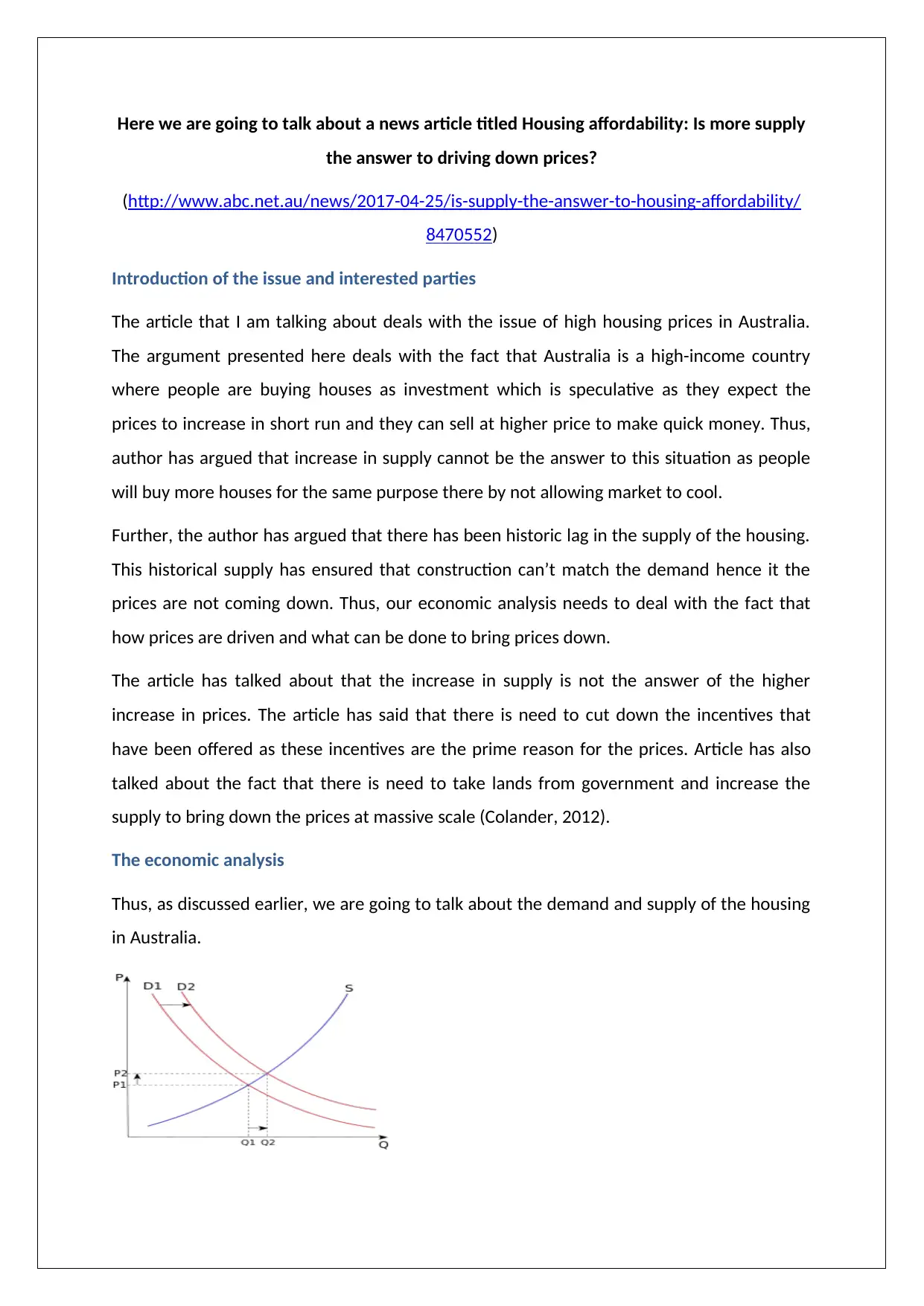
As we know that the prices of goods are factor of demand and supply. The price is nothing
but the equilibrium of the demand and supply. Thus, increase in any of the factor disturbs
the equilibrium and price to move in one of the directions. Thus, as can be seen from the
graph that as demand increases the curve shifts upward hence the price also moves forward
hence the increase in demand drives the prices up. To understand this in real world, we can
take analogy of the fact that if I have 1 resource to sell and there are two people with
unequal income who needs same good. Then the person with the higher income will try to
outbid the other one hence he will drive up the prices (Case, 2015).
This is what is happening in Australia. The housing sector is considered to be the most
important aspect of the economy as this sector drives the demand in many sectors such as
steel and cement and so on. Thus, to boost the overall output of the GDP, the government
of the day starts incentivizing the sector that leads to higher demand. These incentives are
in form of cheaper loans that allows many to have support of cash to boost the prices
(Perloff, 2001).
My Views
In my view, the income of the country is one of the biggest factor which has lead to this
situation. The country has seen rapid increase in the income which is now one of the highest
in world with more than $42K. The higher income coupled with the government incentives
have lead to a situation where more and more people are buying houses in the cities. At the
same time, the cities have limited land resources which is finite and can’t be increased. This
situation is aggravated from the fact that there is plenty of land with army which can’t be
used for the purpose of development.
Thus, my view drives from the fact that these land hoarding should be released and allow
for massive scale development that can suddenly flood the market with supply which can
outpace the demand. This will lead to shift in supply curve and will bring down the prices.
Instead of the incentives in residential projects it can be diverted to some infra projects. This
will not allow the demand to slow down thus GDP growth will not be impacted (Mas-Colell,
2012).
How the above analysis supports my conclusion
but the equilibrium of the demand and supply. Thus, increase in any of the factor disturbs
the equilibrium and price to move in one of the directions. Thus, as can be seen from the
graph that as demand increases the curve shifts upward hence the price also moves forward
hence the increase in demand drives the prices up. To understand this in real world, we can
take analogy of the fact that if I have 1 resource to sell and there are two people with
unequal income who needs same good. Then the person with the higher income will try to
outbid the other one hence he will drive up the prices (Case, 2015).
This is what is happening in Australia. The housing sector is considered to be the most
important aspect of the economy as this sector drives the demand in many sectors such as
steel and cement and so on. Thus, to boost the overall output of the GDP, the government
of the day starts incentivizing the sector that leads to higher demand. These incentives are
in form of cheaper loans that allows many to have support of cash to boost the prices
(Perloff, 2001).
My Views
In my view, the income of the country is one of the biggest factor which has lead to this
situation. The country has seen rapid increase in the income which is now one of the highest
in world with more than $42K. The higher income coupled with the government incentives
have lead to a situation where more and more people are buying houses in the cities. At the
same time, the cities have limited land resources which is finite and can’t be increased. This
situation is aggravated from the fact that there is plenty of land with army which can’t be
used for the purpose of development.
Thus, my view drives from the fact that these land hoarding should be released and allow
for massive scale development that can suddenly flood the market with supply which can
outpace the demand. This will lead to shift in supply curve and will bring down the prices.
Instead of the incentives in residential projects it can be diverted to some infra projects. This
will not allow the demand to slow down thus GDP growth will not be impacted (Mas-Colell,
2012).
How the above analysis supports my conclusion
Paraphrase This Document
Need a fresh take? Get an instant paraphrase of this document with our AI Paraphraser

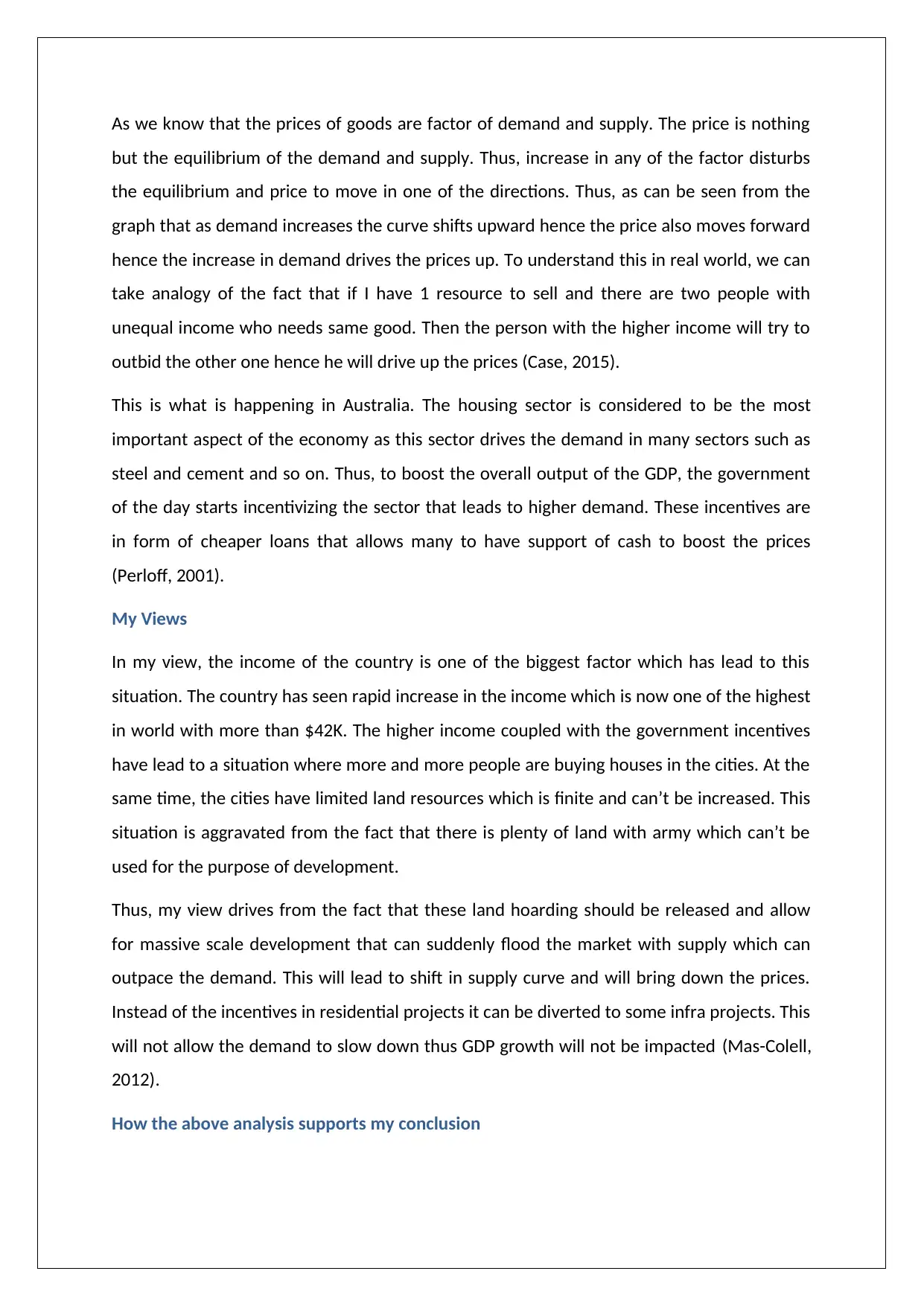
If we look at the statement “these land hoarding should be released and allow for massive
scale development that can suddenly flood the market with supply which can outpace the
demand. This will lead to shift in supply curve and will bring down the prices” that I have
made in the above analysis then this goes hand in hand with the economic theories that we
had presented here.
As I have shown in my analysis that the housing market has seen lack of historical supply at
the same time there have been numerous incentives that have been offered to the sector
that has caused the demand to go up. Thus, the recommendation is as following:
a) There is need to cut down the demand however the same needs to be done in a
manner that the prices are not impacted
b) There is need to increase the supply that will further boost the economy
Thus, for this purpose there is need to shift the incentives to the infra sector where a large
scale infra creation will allow the boom in cement and steel sector at the same time there is
need to allow the consumers to invest in some other options than housing so that housing
can witness decline in speculative demand.
scale development that can suddenly flood the market with supply which can outpace the
demand. This will lead to shift in supply curve and will bring down the prices” that I have
made in the above analysis then this goes hand in hand with the economic theories that we
had presented here.
As I have shown in my analysis that the housing market has seen lack of historical supply at
the same time there have been numerous incentives that have been offered to the sector
that has caused the demand to go up. Thus, the recommendation is as following:
a) There is need to cut down the demand however the same needs to be done in a
manner that the prices are not impacted
b) There is need to increase the supply that will further boost the economy
Thus, for this purpose there is need to shift the incentives to the infra sector where a large
scale infra creation will allow the boom in cement and steel sector at the same time there is
need to allow the consumers to invest in some other options than housing so that housing
can witness decline in speculative demand.

References
Holman J (2017), Housing affordability: Is more supply the answer to driving down prices?,
http://www.abc.net.au/news/2017-04-25/is-supply-the-answer-to-housing-affordability/
8470552, last accessed at August 04, 2017.
Colander, C (2012). Microeconomics 7th ed. Page 90. McGraw-Hill 2008.
Case, K. (2015). 'Demand, Supply, and Market Equilibrium', Principles of Economics, (3)
Prentice Hall Englewood Cliffs, New Jersey
Perloff, L (2014), Microeconomics Theory & Applications with Calculus, Managerial
Economics. Pg No-19.
Mas-Colell, A (2012). Microeconomic Theory. Oxford. p. 878. ISBN 0-19-507340-1.
Holman J (2017), Housing affordability: Is more supply the answer to driving down prices?,
http://www.abc.net.au/news/2017-04-25/is-supply-the-answer-to-housing-affordability/
8470552, last accessed at August 04, 2017.
Colander, C (2012). Microeconomics 7th ed. Page 90. McGraw-Hill 2008.
Case, K. (2015). 'Demand, Supply, and Market Equilibrium', Principles of Economics, (3)
Prentice Hall Englewood Cliffs, New Jersey
Perloff, L (2014), Microeconomics Theory & Applications with Calculus, Managerial
Economics. Pg No-19.
Mas-Colell, A (2012). Microeconomic Theory. Oxford. p. 878. ISBN 0-19-507340-1.
⊘ This is a preview!⊘
Do you want full access?
Subscribe today to unlock all pages.

Trusted by 1+ million students worldwide
1 out of 6
Related Documents
Your All-in-One AI-Powered Toolkit for Academic Success.
+13062052269
info@desklib.com
Available 24*7 on WhatsApp / Email
Unlock your academic potential
Copyright © 2020–2026 A2Z Services. All Rights Reserved. Developed and managed by ZUCOL.