Annotated Bibliography: Fashion, Trends, and Society
VerifiedAdded on  2021/04/21
|6
|1281
|330
Annotated Bibliography
AI Summary
This annotated bibliography examines three key sources related to the fashion industry. The first source, by Bhardwaj and Fairhurst (2010), explores the evolution of fast fashion, the impact of technology, and the shift from forecasting to real-time data-driven approaches in retail. The second source, from the Bureau of Labor Statistics (2016), provides statistical data on the fashion industry's role in employment and wages, offering insights into industry trends and labor laws. The third source, by Venkatasamy (2015), analyzes fashion trends and their impact on society, emphasizing the role of consumer culture, societal values, and generational changes in shaping fashion. The author suggests that fashion is a tool for communication and is influenced by societal expectations, including the growing emphasis on sustainability. Overall, the annotated bibliography provides a comprehensive overview of the fashion industry's dynamic nature, influenced by technological advancements, consumer behavior, and societal values.
Running head: Annotated Bibliography 1
Annotated Bibliography
Student’s Name
University
Annotated Bibliography
Student’s Name
University
Paraphrase This Document
Need a fresh take? Get an instant paraphrase of this document with our AI Paraphraser

Annotated Bibliography 2
Annotated Bibliography
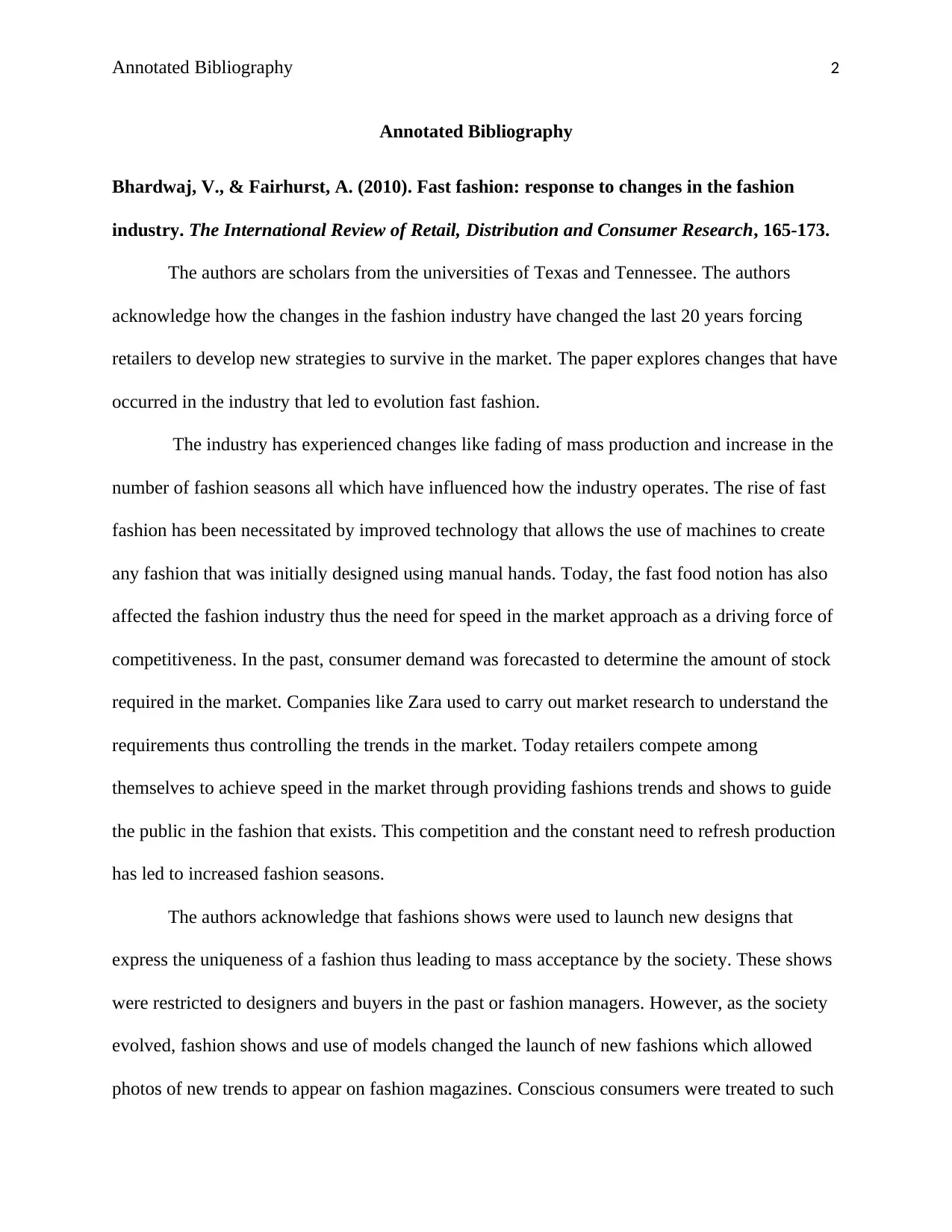
Bhardwaj, V., & Fairhurst, A. (2010). Fast fashion: response to changes in the fashion
industry. The International Review of Retail, Distribution and Consumer Research, 165-173.
The authors are scholars from the universities of Texas and Tennessee. The authors
acknowledge how the changes in the fashion industry have changed the last 20 years forcing
retailers to develop new strategies to survive in the market. The paper explores changes that have
occurred in the industry that led to evolution fast fashion.
The industry has experienced changes like fading of mass production and increase in the
number of fashion seasons all which have influenced how the industry operates. The rise of fast
fashion has been necessitated by improved technology that allows the use of machines to create
any fashion that was initially designed using manual hands. Today, the fast food notion has also
affected the fashion industry thus the need for speed in the market approach as a driving force of
competitiveness. In the past, consumer demand was forecasted to determine the amount of stock
required in the market. Companies like Zara used to carry out market research to understand the
requirements thus controlling the trends in the market. Today retailers compete among
themselves to achieve speed in the market through providing fashions trends and shows to guide
the public in the fashion that exists. This competition and the constant need to refresh production
has led to increased fashion seasons.
The authors acknowledge that fashions shows were used to launch new designs that
express the uniqueness of a fashion thus leading to mass acceptance by the society. These shows
were restricted to designers and buyers in the past or fashion managers. However, as the society
evolved, fashion shows and use of models changed the launch of new fashions which allowed
photos of new trends to appear on fashion magazines. Conscious consumers were treated to such
Annotated Bibliography
Bhardwaj, V., & Fairhurst, A. (2010). Fast fashion: response to changes in the fashion
industry. The International Review of Retail, Distribution and Consumer Research, 165-173.
The authors are scholars from the universities of Texas and Tennessee. The authors
acknowledge how the changes in the fashion industry have changed the last 20 years forcing
retailers to develop new strategies to survive in the market. The paper explores changes that have
occurred in the industry that led to evolution fast fashion.
The industry has experienced changes like fading of mass production and increase in the
number of fashion seasons all which have influenced how the industry operates. The rise of fast
fashion has been necessitated by improved technology that allows the use of machines to create
any fashion that was initially designed using manual hands. Today, the fast food notion has also
affected the fashion industry thus the need for speed in the market approach as a driving force of
competitiveness. In the past, consumer demand was forecasted to determine the amount of stock
required in the market. Companies like Zara used to carry out market research to understand the
requirements thus controlling the trends in the market. Today retailers compete among
themselves to achieve speed in the market through providing fashions trends and shows to guide
the public in the fashion that exists. This competition and the constant need to refresh production
has led to increased fashion seasons.
The authors acknowledge that fashions shows were used to launch new designs that
express the uniqueness of a fashion thus leading to mass acceptance by the society. These shows
were restricted to designers and buyers in the past or fashion managers. However, as the society
evolved, fashion shows and use of models changed the launch of new fashions which allowed
photos of new trends to appear on fashion magazines. Conscious consumers were treated to such

Annotated Bibliography 3
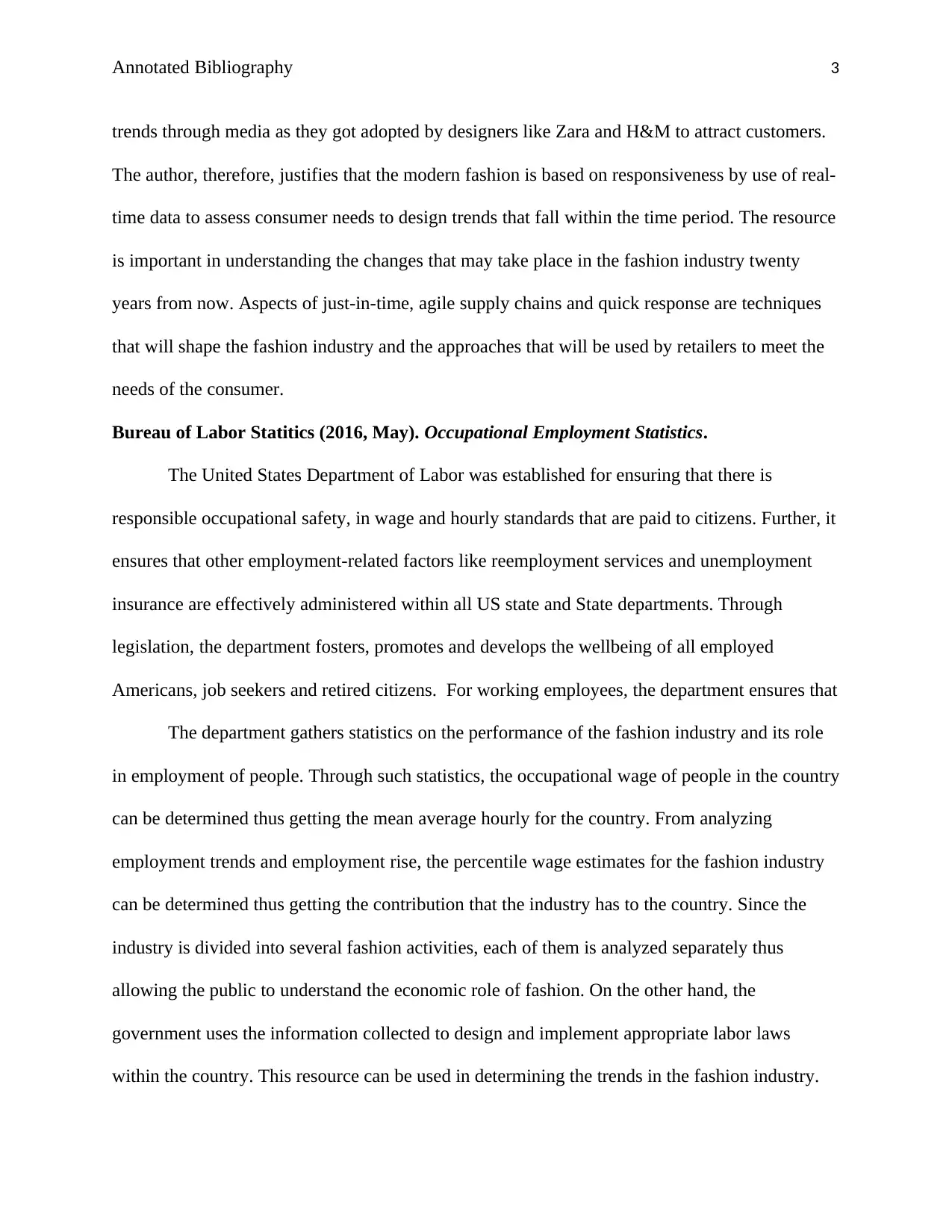
trends through media as they got adopted by designers like Zara and H&M to attract customers.
The author, therefore, justifies that the modern fashion is based on responsiveness by use of real-
time data to assess consumer needs to design trends that fall within the time period. The resource
is important in understanding the changes that may take place in the fashion industry twenty
years from now. Aspects of just-in-time, agile supply chains and quick response are techniques
that will shape the fashion industry and the approaches that will be used by retailers to meet the
needs of the consumer.
Bureau of Labor Statitics (2016, May). Occupational Employment Statistics.
The United States Department of Labor was established for ensuring that there is
responsible occupational safety, in wage and hourly standards that are paid to citizens. Further, it
ensures that other employment-related factors like reemployment services and unemployment
insurance are effectively administered within all US state and State departments. Through
legislation, the department fosters, promotes and develops the wellbeing of all employed
Americans, job seekers and retired citizens. For working employees, the department ensures that
The department gathers statistics on the performance of the fashion industry and its role
in employment of people. Through such statistics, the occupational wage of people in the country
can be determined thus getting the mean average hourly for the country. From analyzing
employment trends and employment rise, the percentile wage estimates for the fashion industry
can be determined thus getting the contribution that the industry has to the country. Since the
industry is divided into several fashion activities, each of them is analyzed separately thus
allowing the public to understand the economic role of fashion. On the other hand, the
government uses the information collected to design and implement appropriate labor laws
within the country. This resource can be used in determining the trends in the fashion industry.
trends through media as they got adopted by designers like Zara and H&M to attract customers.
The author, therefore, justifies that the modern fashion is based on responsiveness by use of real-
time data to assess consumer needs to design trends that fall within the time period. The resource
is important in understanding the changes that may take place in the fashion industry twenty
years from now. Aspects of just-in-time, agile supply chains and quick response are techniques
that will shape the fashion industry and the approaches that will be used by retailers to meet the
needs of the consumer.
Bureau of Labor Statitics (2016, May). Occupational Employment Statistics.
The United States Department of Labor was established for ensuring that there is
responsible occupational safety, in wage and hourly standards that are paid to citizens. Further, it
ensures that other employment-related factors like reemployment services and unemployment
insurance are effectively administered within all US state and State departments. Through
legislation, the department fosters, promotes and develops the wellbeing of all employed
Americans, job seekers and retired citizens. For working employees, the department ensures that
The department gathers statistics on the performance of the fashion industry and its role
in employment of people. Through such statistics, the occupational wage of people in the country
can be determined thus getting the mean average hourly for the country. From analyzing
employment trends and employment rise, the percentile wage estimates for the fashion industry
can be determined thus getting the contribution that the industry has to the country. Since the
industry is divided into several fashion activities, each of them is analyzed separately thus
allowing the public to understand the economic role of fashion. On the other hand, the
government uses the information collected to design and implement appropriate labor laws
within the country. This resource can be used in determining the trends in the fashion industry.
⊘ This is a preview!⊘
Do you want full access?
Subscribe today to unlock all pages.

Trusted by 1+ million students worldwide

Annotated Bibliography 4
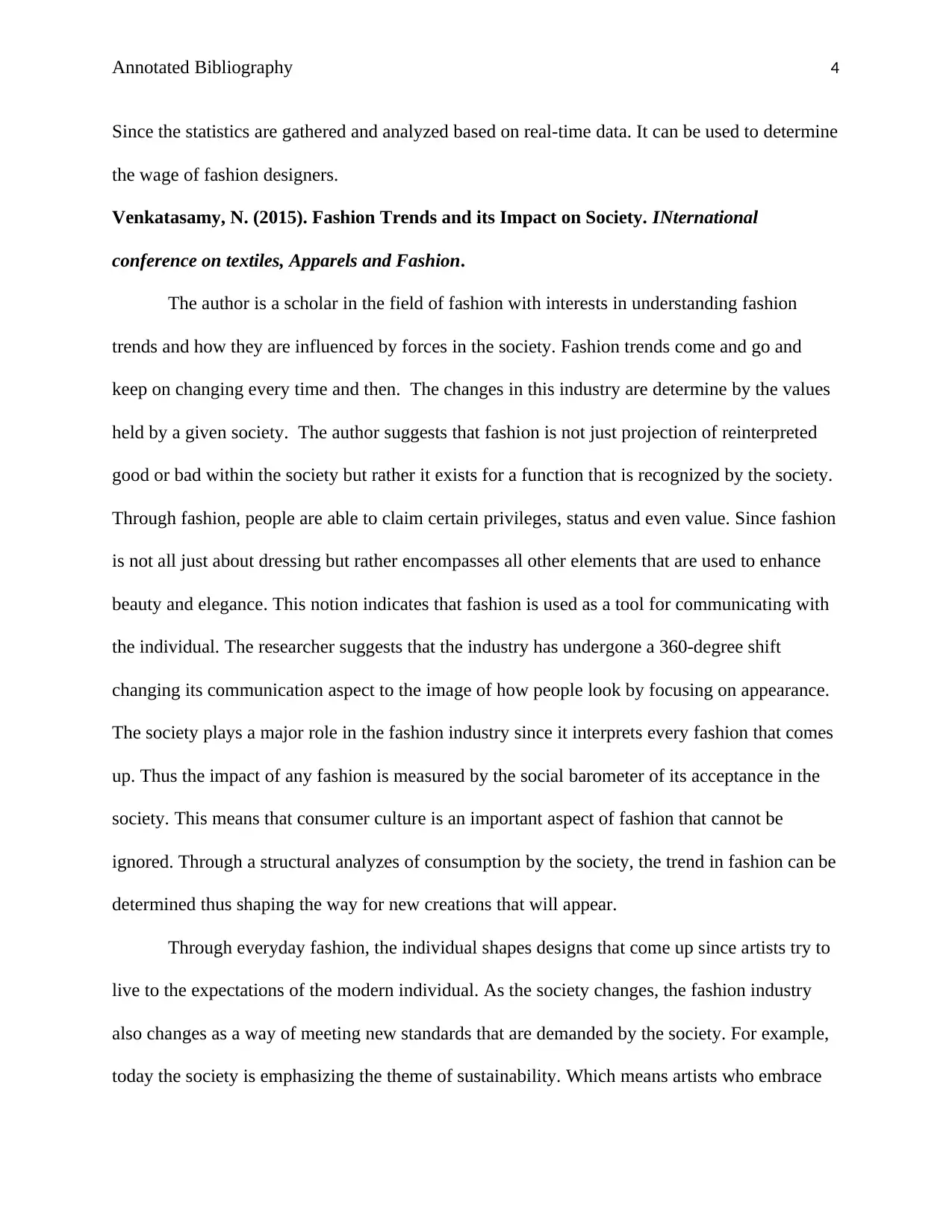
Since the statistics are gathered and analyzed based on real-time data. It can be used to determine
the wage of fashion designers.
Venkatasamy, N. (2015). Fashion Trends and its Impact on Society. INternational
conference on textiles, Apparels and Fashion.
The author is a scholar in the field of fashion with interests in understanding fashion
trends and how they are influenced by forces in the society. Fashion trends come and go and
keep on changing every time and then. The changes in this industry are determine by the values
held by a given society. The author suggests that fashion is not just projection of reinterpreted
good or bad within the society but rather it exists for a function that is recognized by the society.
Through fashion, people are able to claim certain privileges, status and even value. Since fashion
is not all just about dressing but rather encompasses all other elements that are used to enhance
beauty and elegance. This notion indicates that fashion is used as a tool for communicating with
the individual. The researcher suggests that the industry has undergone a 360-degree shift
changing its communication aspect to the image of how people look by focusing on appearance.
The society plays a major role in the fashion industry since it interprets every fashion that comes
up. Thus the impact of any fashion is measured by the social barometer of its acceptance in the
society. This means that consumer culture is an important aspect of fashion that cannot be
ignored. Through a structural analyzes of consumption by the society, the trend in fashion can be
determined thus shaping the way for new creations that will appear.
Through everyday fashion, the individual shapes designs that come up since artists try to
live to the expectations of the modern individual. As the society changes, the fashion industry
also changes as a way of meeting new standards that are demanded by the society. For example,
today the society is emphasizing the theme of sustainability. Which means artists who embrace
Since the statistics are gathered and analyzed based on real-time data. It can be used to determine
the wage of fashion designers.
Venkatasamy, N. (2015). Fashion Trends and its Impact on Society. INternational
conference on textiles, Apparels and Fashion.
The author is a scholar in the field of fashion with interests in understanding fashion
trends and how they are influenced by forces in the society. Fashion trends come and go and
keep on changing every time and then. The changes in this industry are determine by the values
held by a given society. The author suggests that fashion is not just projection of reinterpreted
good or bad within the society but rather it exists for a function that is recognized by the society.
Through fashion, people are able to claim certain privileges, status and even value. Since fashion
is not all just about dressing but rather encompasses all other elements that are used to enhance
beauty and elegance. This notion indicates that fashion is used as a tool for communicating with
the individual. The researcher suggests that the industry has undergone a 360-degree shift
changing its communication aspect to the image of how people look by focusing on appearance.
The society plays a major role in the fashion industry since it interprets every fashion that comes
up. Thus the impact of any fashion is measured by the social barometer of its acceptance in the
society. This means that consumer culture is an important aspect of fashion that cannot be
ignored. Through a structural analyzes of consumption by the society, the trend in fashion can be
determined thus shaping the way for new creations that will appear.
Through everyday fashion, the individual shapes designs that come up since artists try to
live to the expectations of the modern individual. As the society changes, the fashion industry
also changes as a way of meeting new standards that are demanded by the society. For example,
today the society is emphasizing the theme of sustainability. Which means artists who embrace
Paraphrase This Document
Need a fresh take? Get an instant paraphrase of this document with our AI Paraphraser

Annotated Bibliography 5
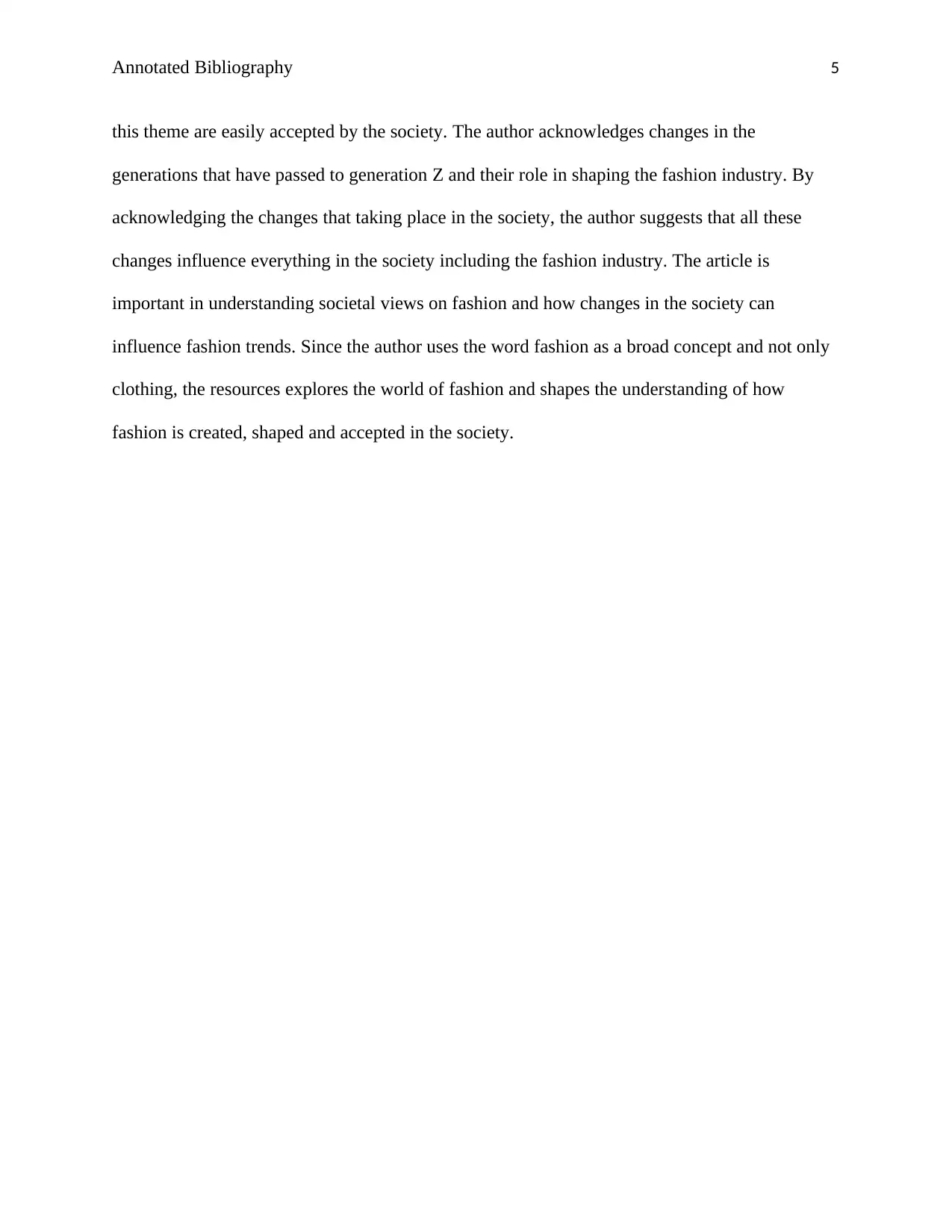
this theme are easily accepted by the society. The author acknowledges changes in the
generations that have passed to generation Z and their role in shaping the fashion industry. By
acknowledging the changes that taking place in the society, the author suggests that all these
changes influence everything in the society including the fashion industry. The article is
important in understanding societal views on fashion and how changes in the society can
influence fashion trends. Since the author uses the word fashion as a broad concept and not only
clothing, the resources explores the world of fashion and shapes the understanding of how
fashion is created, shaped and accepted in the society.
this theme are easily accepted by the society. The author acknowledges changes in the
generations that have passed to generation Z and their role in shaping the fashion industry. By
acknowledging the changes that taking place in the society, the author suggests that all these
changes influence everything in the society including the fashion industry. The article is
important in understanding societal views on fashion and how changes in the society can
influence fashion trends. Since the author uses the word fashion as a broad concept and not only
clothing, the resources explores the world of fashion and shapes the understanding of how
fashion is created, shaped and accepted in the society.

Annotated Bibliography 6
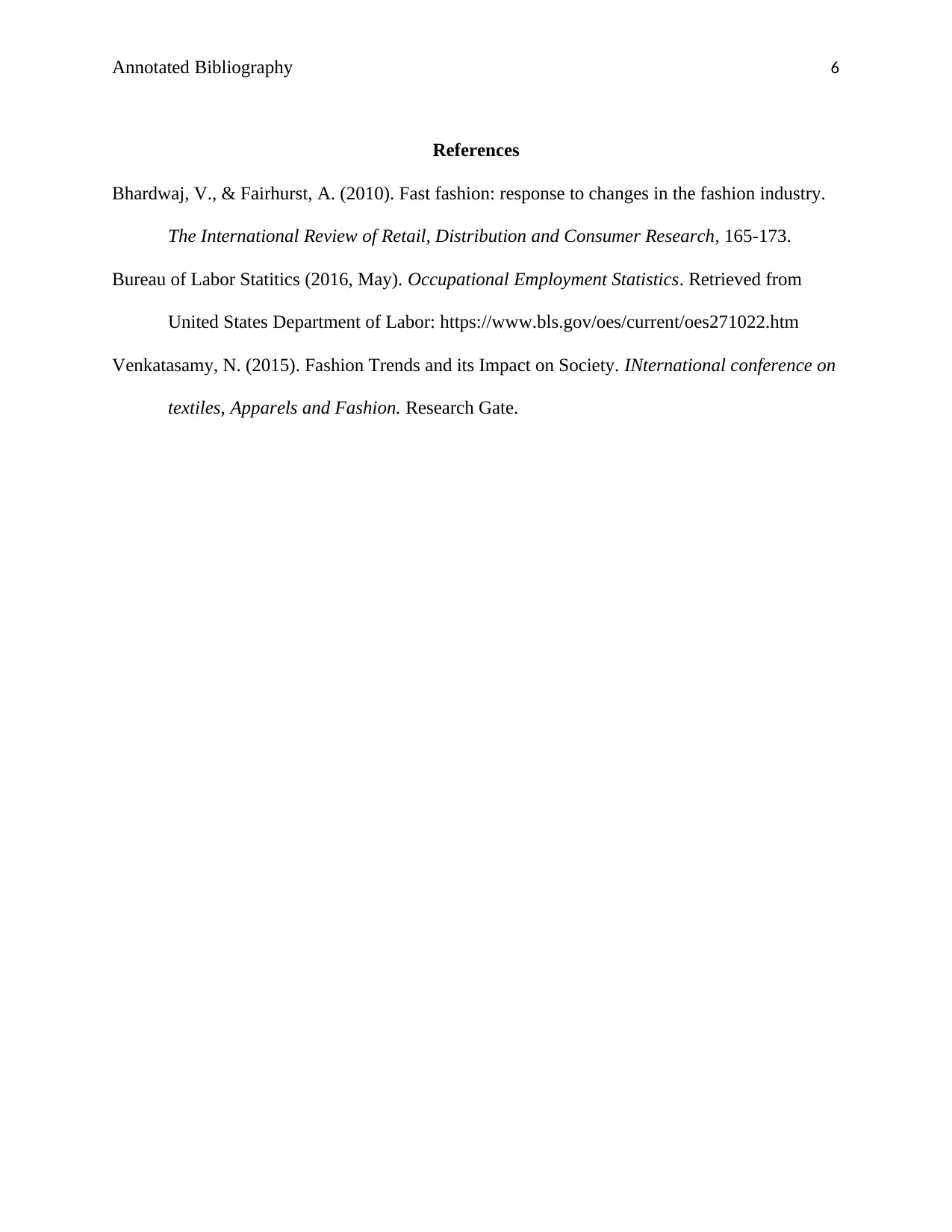
References
Bhardwaj, V., & Fairhurst, A. (2010). Fast fashion: response to changes in the fashion industry.
The International Review of Retail, Distribution and Consumer Research, 165-173.
Bureau of Labor Statitics (2016, May). Occupational Employment Statistics. Retrieved from
United States Department of Labor: https://www.bls.gov/oes/current/oes271022.htm
Venkatasamy, N. (2015). Fashion Trends and its Impact on Society. INternational conference on
textiles, Apparels and Fashion. Research Gate.
References
Bhardwaj, V., & Fairhurst, A. (2010). Fast fashion: response to changes in the fashion industry.
The International Review of Retail, Distribution and Consumer Research, 165-173.
Bureau of Labor Statitics (2016, May). Occupational Employment Statistics. Retrieved from
United States Department of Labor: https://www.bls.gov/oes/current/oes271022.htm
Venkatasamy, N. (2015). Fashion Trends and its Impact on Society. INternational conference on
textiles, Apparels and Fashion. Research Gate.
⊘ This is a preview!⊘
Do you want full access?
Subscribe today to unlock all pages.

Trusted by 1+ million students worldwide
1 out of 6
Related Documents
Your All-in-One AI-Powered Toolkit for Academic Success.
 +13062052269
info@desklib.com
Available 24*7 on WhatsApp / Email
Unlock your academic potential
Copyright © 2020–2026 A2Z Services. All Rights Reserved. Developed and managed by ZUCOL.