Application of Strategies and Teaching Model: Recycling Lesson Plan
VerifiedAdded on 2023/01/06
|6
|1588
|92
Report
AI Summary
This report presents a comprehensive recycling lesson plan designed to teach students about waste management and environmental responsibility. The report begins with an introduction highlighting the importance of teaching recycling and its benefits. It then explores the student-led interaction approach, emphasizing collaborative learning and the role of the teacher in providing resources and fostering discussion. A detailed 80-minute lesson plan is provided, outlining the subject (recycling), the target age group (15-18), objectives, learning outcomes, and a three-stage teaching-learning plan. The lesson plan incorporates group discussions and presentations to encourage student engagement and creative thinking. The conclusion summarizes the key findings, emphasizing the importance of student-led interaction and the development of creative instincts through effective teaching strategies. The report also includes references to relevant academic sources.
APPLICATION OF STRATEGIES
AND TEACHING MODEL
AND TEACHING MODEL
Paraphrase This Document
Need a fresh take? Get an instant paraphrase of this document with our AI Paraphraser

Table of Contents
INTRODUCTION...........................................................................................................................3
MAIN BODY...................................................................................................................................3
Approach used for teaching....................................................................................................3
Lesson plan.............................................................................................................................4
CONCLUSION................................................................................................................................5
REFERENCES................................................................................................................................6
INTRODUCTION...........................................................................................................................3
MAIN BODY...................................................................................................................................3
Approach used for teaching....................................................................................................3
Lesson plan.............................................................................................................................4
CONCLUSION................................................................................................................................5
REFERENCES................................................................................................................................6

INTRODUCTION
Teaching is to cause the students to learn and also acquire certain desired skills, knowledge
and ways to live in society. There are a number of factors included in this which include a
learner, a teacher and curriculum with various variables which are organised in a systematic
manner in order to attain some predetermined goals (Tawafak and et. al., 2020). The following
report consist of a recycling lesson plan in which students are taught various ways in which
micro compost are bottles can be recycled. The major aim of lesson plan is to develop
understanding in students about recycling and helping the community to develop a pollution free
environment. Following report consist of the reason and rationale for choosing the topic along
with various roles of students and teacher in this course. Along with this a lesson plan is also
generated which describes various topics such as subject, level of study, objective of lesson as
well as learning outcomes from the lesson.
MAIN BODY
Approach used for teaching
The teaching method which will be used in order to make students learn about recycling
plastic will be student lead interaction. Student let interaction is a great way to teach students
when they are working in groups. It will provide students with motivation to come with different
ideas and interact how their ideas might affect the learning aspect. It is a interaction that leads to
greater learning and also provides high court satisfaction to students. Students are often
motivated when they are learning in groups and also they do not feel isolated. Getting feedbacks
from fellow group members might also benefit students in their learning. Student collaboration
and information sharing is important for this method. It helps in building a sense of community
when more students are interested in the course. It is necessary that rather than judging the
students the teacher is encouraging them to share their insights with the rest of the group. Due to
increasing pollution which is caused by plastic bottles it is necessary for students to learn this
recycling program.
The role of teacher in this new concept of learning will be providing students with enough
material and articles in order to teach them about recycling (Cao, Shang and Meng, 2020). It is
the duty of teacher to make sure that students are encouraged and they are actively participating
in the lesson plan. Teacher has to provide feedback and also communicate with focused
Teaching is to cause the students to learn and also acquire certain desired skills, knowledge
and ways to live in society. There are a number of factors included in this which include a
learner, a teacher and curriculum with various variables which are organised in a systematic
manner in order to attain some predetermined goals (Tawafak and et. al., 2020). The following
report consist of a recycling lesson plan in which students are taught various ways in which
micro compost are bottles can be recycled. The major aim of lesson plan is to develop
understanding in students about recycling and helping the community to develop a pollution free
environment. Following report consist of the reason and rationale for choosing the topic along
with various roles of students and teacher in this course. Along with this a lesson plan is also
generated which describes various topics such as subject, level of study, objective of lesson as
well as learning outcomes from the lesson.
MAIN BODY
Approach used for teaching
The teaching method which will be used in order to make students learn about recycling
plastic will be student lead interaction. Student let interaction is a great way to teach students
when they are working in groups. It will provide students with motivation to come with different
ideas and interact how their ideas might affect the learning aspect. It is a interaction that leads to
greater learning and also provides high court satisfaction to students. Students are often
motivated when they are learning in groups and also they do not feel isolated. Getting feedbacks
from fellow group members might also benefit students in their learning. Student collaboration
and information sharing is important for this method. It helps in building a sense of community
when more students are interested in the course. It is necessary that rather than judging the
students the teacher is encouraging them to share their insights with the rest of the group. Due to
increasing pollution which is caused by plastic bottles it is necessary for students to learn this
recycling program.
The role of teacher in this new concept of learning will be providing students with enough
material and articles in order to teach them about recycling (Cao, Shang and Meng, 2020). It is
the duty of teacher to make sure that students are encouraged and they are actively participating
in the lesson plan. Teacher has to provide feedback and also communicate with focused
⊘ This is a preview!⊘
Do you want full access?
Subscribe today to unlock all pages.

Trusted by 1+ million students worldwide

messages which will also foster relationship between student and teacher.The role of teacher to
encourage students and also provide them with different platforms where they can come together
and discuss about their interest and different topics related to the course.
The role of student in this concept of learning will be coming up with new ideas which can
enhance recycling and also provide creative ideas to others. Students in team are required to
provide feedback to each other as well. Students are required to interact with each other and start
discussion boards through various tools such as telecommunication, emails and chat rooms.
Teacher can provide them with a student’s only form where they can discuss their interest and
also schedule different sessions to discuss specific topics related to the course.
Lesson plan
The subject of the following lesson plan is recycling. Recycling refers to a process in
which energy is saved through converting waste into a reusable material. Cycling is an important
method which has a number of benefits for environment. It helps in conserving natural resources
such as recycling paper, wood, plastic, metal and glass are methods which are usually used for
recycling. It is an effective method to protect ecosystem as well as wildlife (Lyon, Hogan and
Kearns, 2020). It generally reduces the need to grow and harvest or extract various raw materials
from the earth which helps in saving the planet from harmful destruction as well as damage. It
also reduces demand for raw material and saves energy. This lesson will help students to develop
their own ideas about recycling and also provide benefit to environment.
The level of study for this lesson plan will be for the students who are of age 15 to 18.
They are the middle school students who can generate various ideas for recycling and or old
enough to understand the benefits of recycling. It is necessary for them to understand the
importance of recycling so that they can bring benefits for environment and save various
resources which are scarce in nature. The class will consist of 35 students who will be divided
into three groups of 12 and 11 and conduct group discussions. Each group is to come up with
Idea for recycling. The ability of students required for this lesson plan is presence of mind and
creativity. Rather than any other academic skills students are required to have creativity skills
which will help them to bring in innovations.
Objective of Lesson
The basic objective of lesson is to make student understand the importance of nature and
how can they save nature with help of recycling process. It is necessary for them to understand
encourage students and also provide them with different platforms where they can come together
and discuss about their interest and different topics related to the course.
The role of student in this concept of learning will be coming up with new ideas which can
enhance recycling and also provide creative ideas to others. Students in team are required to
provide feedback to each other as well. Students are required to interact with each other and start
discussion boards through various tools such as telecommunication, emails and chat rooms.
Teacher can provide them with a student’s only form where they can discuss their interest and
also schedule different sessions to discuss specific topics related to the course.
Lesson plan
The subject of the following lesson plan is recycling. Recycling refers to a process in
which energy is saved through converting waste into a reusable material. Cycling is an important
method which has a number of benefits for environment. It helps in conserving natural resources
such as recycling paper, wood, plastic, metal and glass are methods which are usually used for
recycling. It is an effective method to protect ecosystem as well as wildlife (Lyon, Hogan and
Kearns, 2020). It generally reduces the need to grow and harvest or extract various raw materials
from the earth which helps in saving the planet from harmful destruction as well as damage. It
also reduces demand for raw material and saves energy. This lesson will help students to develop
their own ideas about recycling and also provide benefit to environment.
The level of study for this lesson plan will be for the students who are of age 15 to 18.
They are the middle school students who can generate various ideas for recycling and or old
enough to understand the benefits of recycling. It is necessary for them to understand the
importance of recycling so that they can bring benefits for environment and save various
resources which are scarce in nature. The class will consist of 35 students who will be divided
into three groups of 12 and 11 and conduct group discussions. Each group is to come up with
Idea for recycling. The ability of students required for this lesson plan is presence of mind and
creativity. Rather than any other academic skills students are required to have creativity skills
which will help them to bring in innovations.
Objective of Lesson
The basic objective of lesson is to make student understand the importance of nature and
how can they save nature with help of recycling process. It is necessary for them to understand
Paraphrase This Document
Need a fresh take? Get an instant paraphrase of this document with our AI Paraphraser

that recycling process will help in saving various resources in the environment and also reduce
pollution which is the major reason why our environment is depleting.
Learning Outcomes
The learning outcomes from the lesson are that each team of student will come up with a
different idea of recycling (Richards and Shiver, 2020). If their idea of recycling is good enough
and practically possible it can be promoted to bring benefits to environment. It will also help in
making students creative and provide them with various creative instincts.
Teaching –learning plan
Teaching plan will consist of three stages. The first stage will include the introduction of
recycling process and various examples of recycling which are used in today’s world. The
second stage is when teacher will provide students with various materials which will help them
to learn more about recycling. The students will also be provided with time to discuss various
ideas they are developing within their own teams and learn about benefits and drawbacks from
each of those ideas. The third and last stage is when students from all the three teams will come
up with their ideas. They are required to present the idea for recycling which they have
developed in front of the class. In this stage the teacher will judge the learning of students and
the feasibility of the idea for recycling which they have developed (Cárdenas-Robledo and Peña-
Ayala, 2019). The teacher will then provide students with three marks and feedback about their
idea and ways in which they can enhance it. It is a great way to promote learning which will
bring benefits for environment.
CONCLUSION
With the help of above report it can be clearly concluded that importance of students to learn
new subjects including the ones which are benefiting environment is important. There are a
number of teaching styles which can be used by teachers differently to teach students. However
student led interaction will help to encourage student and effectively develop interaction between
them self. Students can effectively provide feedback to each other in groups and work in groups
to come up with one idea of their own. The lesson plan is also effectively developing creative
instincts in students which will help them to come up with innovative ideas in future. The
feedback from teachers and students will encourage them and also help them improve for better
results next time. The major outcome of the lesson plan will be successfully achieved when all
the roles of students and teachers are fulfilled successfully by both of them.
pollution which is the major reason why our environment is depleting.
Learning Outcomes
The learning outcomes from the lesson are that each team of student will come up with a
different idea of recycling (Richards and Shiver, 2020). If their idea of recycling is good enough
and practically possible it can be promoted to bring benefits to environment. It will also help in
making students creative and provide them with various creative instincts.
Teaching –learning plan
Teaching plan will consist of three stages. The first stage will include the introduction of
recycling process and various examples of recycling which are used in today’s world. The
second stage is when teacher will provide students with various materials which will help them
to learn more about recycling. The students will also be provided with time to discuss various
ideas they are developing within their own teams and learn about benefits and drawbacks from
each of those ideas. The third and last stage is when students from all the three teams will come
up with their ideas. They are required to present the idea for recycling which they have
developed in front of the class. In this stage the teacher will judge the learning of students and
the feasibility of the idea for recycling which they have developed (Cárdenas-Robledo and Peña-
Ayala, 2019). The teacher will then provide students with three marks and feedback about their
idea and ways in which they can enhance it. It is a great way to promote learning which will
bring benefits for environment.
CONCLUSION
With the help of above report it can be clearly concluded that importance of students to learn
new subjects including the ones which are benefiting environment is important. There are a
number of teaching styles which can be used by teachers differently to teach students. However
student led interaction will help to encourage student and effectively develop interaction between
them self. Students can effectively provide feedback to each other in groups and work in groups
to come up with one idea of their own. The lesson plan is also effectively developing creative
instincts in students which will help them to come up with innovative ideas in future. The
feedback from teachers and students will encourage them and also help them improve for better
results next time. The major outcome of the lesson plan will be successfully achieved when all
the roles of students and teachers are fulfilled successfully by both of them.

REFERENCES
Books and Journals
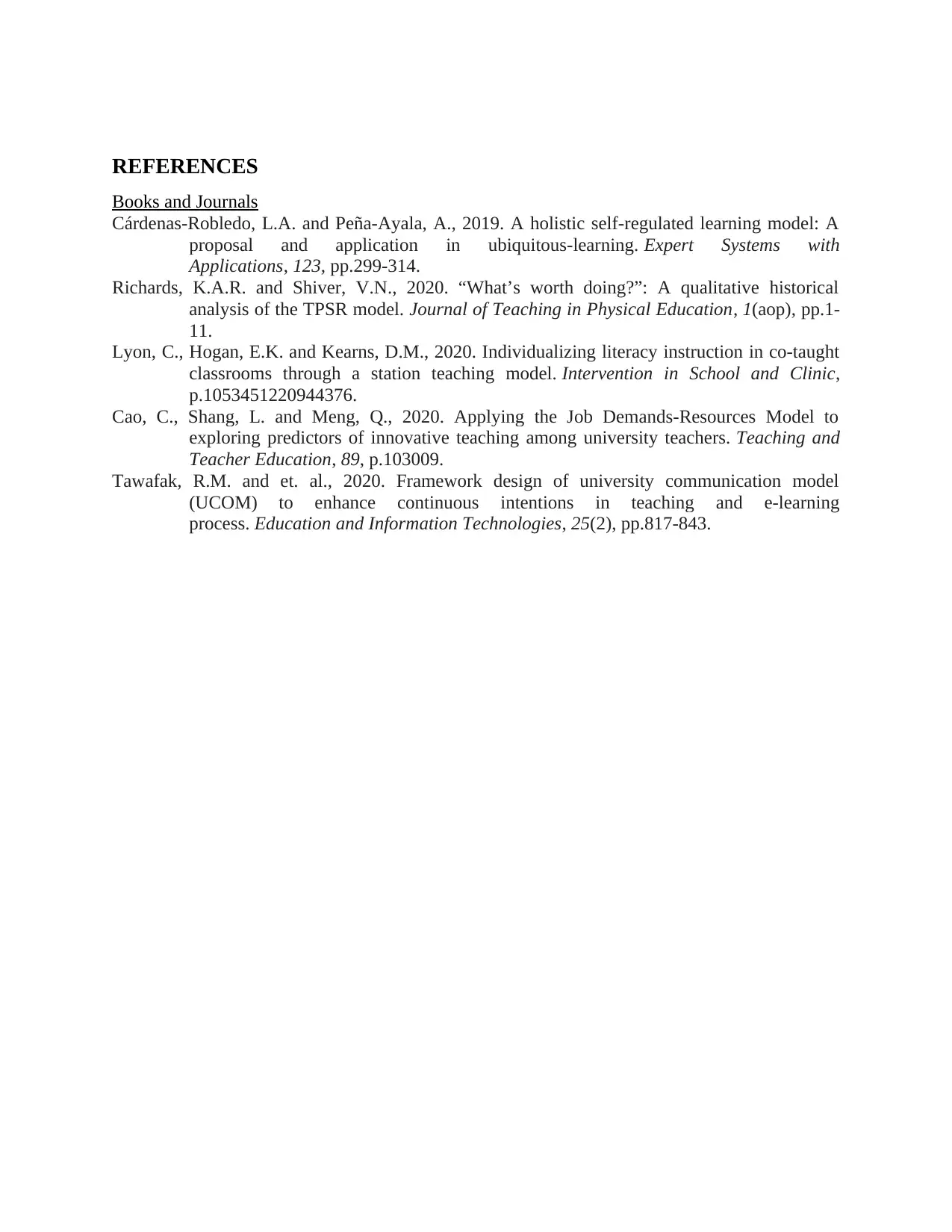
Cárdenas-Robledo, L.A. and Peña-Ayala, A., 2019. A holistic self-regulated learning model: A
proposal and application in ubiquitous-learning. Expert Systems with
Applications, 123, pp.299-314.
Richards, K.A.R. and Shiver, V.N., 2020. “What’s worth doing?”: A qualitative historical
analysis of the TPSR model. Journal of Teaching in Physical Education, 1(aop), pp.1-
11.
Lyon, C., Hogan, E.K. and Kearns, D.M., 2020. Individualizing literacy instruction in co-taught
classrooms through a station teaching model. Intervention in School and Clinic,
p.1053451220944376.
Cao, C., Shang, L. and Meng, Q., 2020. Applying the Job Demands-Resources Model to
exploring predictors of innovative teaching among university teachers. Teaching and
Teacher Education, 89, p.103009.
Tawafak, R.M. and et. al., 2020. Framework design of university communication model
(UCOM) to enhance continuous intentions in teaching and e-learning
process. Education and Information Technologies, 25(2), pp.817-843.
Books and Journals
Cárdenas-Robledo, L.A. and Peña-Ayala, A., 2019. A holistic self-regulated learning model: A
proposal and application in ubiquitous-learning. Expert Systems with
Applications, 123, pp.299-314.
Richards, K.A.R. and Shiver, V.N., 2020. “What’s worth doing?”: A qualitative historical
analysis of the TPSR model. Journal of Teaching in Physical Education, 1(aop), pp.1-
11.
Lyon, C., Hogan, E.K. and Kearns, D.M., 2020. Individualizing literacy instruction in co-taught
classrooms through a station teaching model. Intervention in School and Clinic,
p.1053451220944376.
Cao, C., Shang, L. and Meng, Q., 2020. Applying the Job Demands-Resources Model to
exploring predictors of innovative teaching among university teachers. Teaching and
Teacher Education, 89, p.103009.
Tawafak, R.M. and et. al., 2020. Framework design of university communication model
(UCOM) to enhance continuous intentions in teaching and e-learning
process. Education and Information Technologies, 25(2), pp.817-843.
⊘ This is a preview!⊘
Do you want full access?
Subscribe today to unlock all pages.

Trusted by 1+ million students worldwide
1 out of 6
Related Documents
Your All-in-One AI-Powered Toolkit for Academic Success.
+13062052269
info@desklib.com
Available 24*7 on WhatsApp / Email
Unlock your academic potential
Copyright © 2020–2026 A2Z Services. All Rights Reserved. Developed and managed by ZUCOL.