Riemann Sums vs. Integration: Finding Area Under the Curve Analysis

Verified

Added on  2023/05/30

|6
|1013
|319
Homework Assignment
AI Summary
This assignment focuses on calculating the area under the curve of the function y=2x√(x^2+1) using two different methods: Riemann sums and integration. The Riemann sum method is applied with n=12 and n=4 rectangular strips to approximate the area. The right Riemann sum is used, and the areas are calculated by summing the areas of the rectangles. The results are compared to the exact area calculated through integration using substitution. The assignment highlights that increasing the number of subdivisions (rectangles) in the Riemann sum method improves the accuracy of the approximation, bringing it closer to the exact value obtained through integration. The approximate areas calculated with n=4 and n=12 are 208.4 and 168 square units respectively, while the integrated area is 149.4 square units, demonstrating the increased accuracy with a higher number of rectangles.
Document Page
Area Under the Curve 1
AREA UNDER THE CURVE
Name
Course
Professor
University
City/state
Date
tabler-icon-diamond-filled.svg

Paraphrase This Document

Need a fresh take? Get an instant paraphrase of this document with our AI Paraphraser
Document Page
Area Under the Curve 2
Area under the Curve
Approximate area when n1 = 12
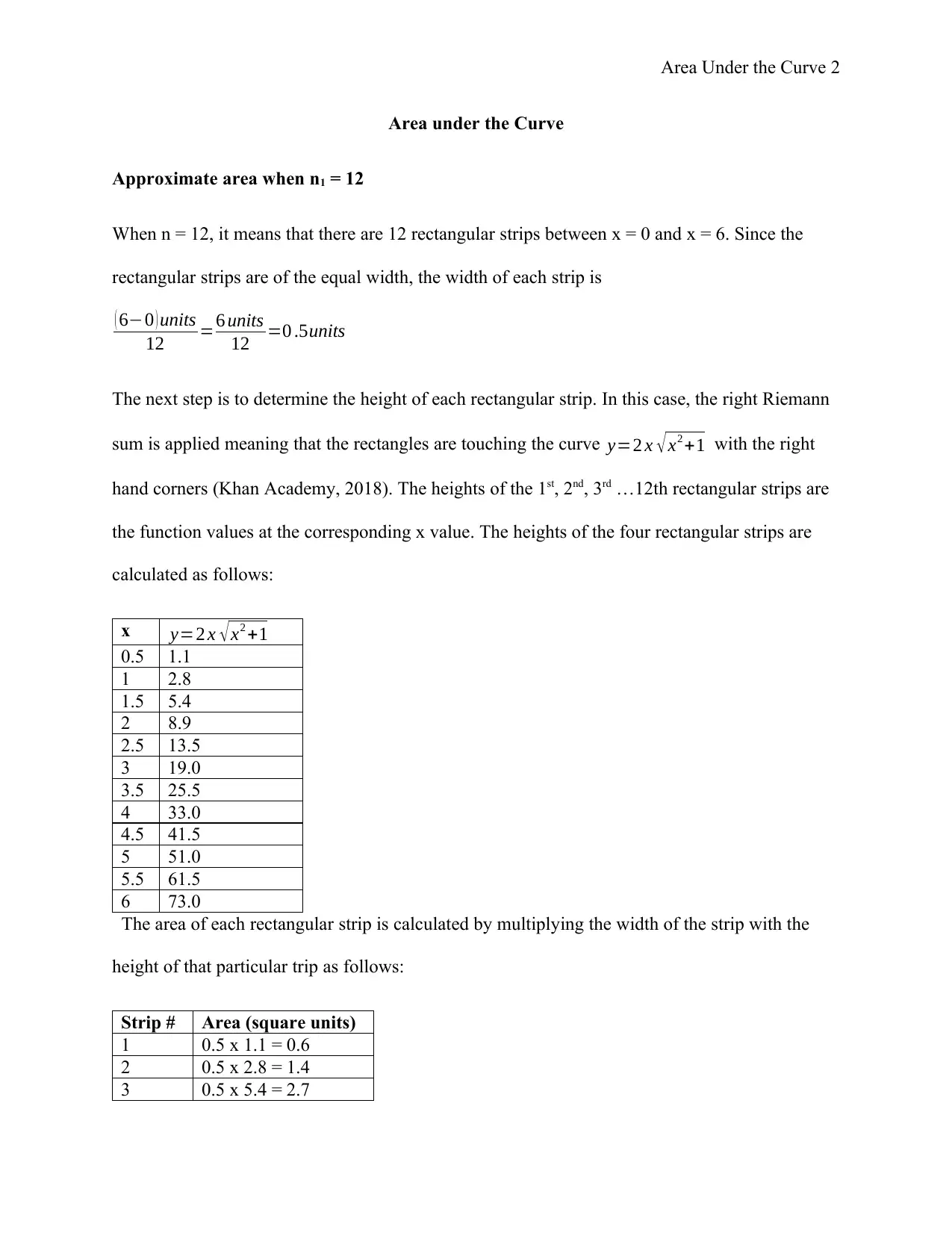
When n = 12, it means that there are 12 rectangular strips between x = 0 and x = 6. Since the
rectangular strips are of the equal width, the width of each strip is
( 60 ) units
12 =6 units
12 =0 .5units
The next step is to determine the height of each rectangular strip. In this case, the right Riemann
sum is applied meaning that the rectangles are touching the curve y=2 x x2 +1 with the right
hand corners (Khan Academy, 2018). The heights of the 1st, 2nd, 3rd …12th rectangular strips are
the function values at the corresponding x value. The heights of the four rectangular strips are
calculated as follows:
x y=2 x x2 +1
0.5 1.1
1 2.8
1.5 5.4
2 8.9
2.5 13.5
3 19.0
3.5 25.5
4 33.0
4.5 41.5
5 51.0
5.5 61.5
6 73.0
The area of each rectangular strip is calculated by multiplying the width of the strip with the
height of that particular trip as follows:
Strip # Area (square units)
1 0.5 x 1.1 = 0.6
2 0.5 x 2.8 = 1.4
3 0.5 x 5.4 = 2.7
Document Page
Area Under the Curve 3
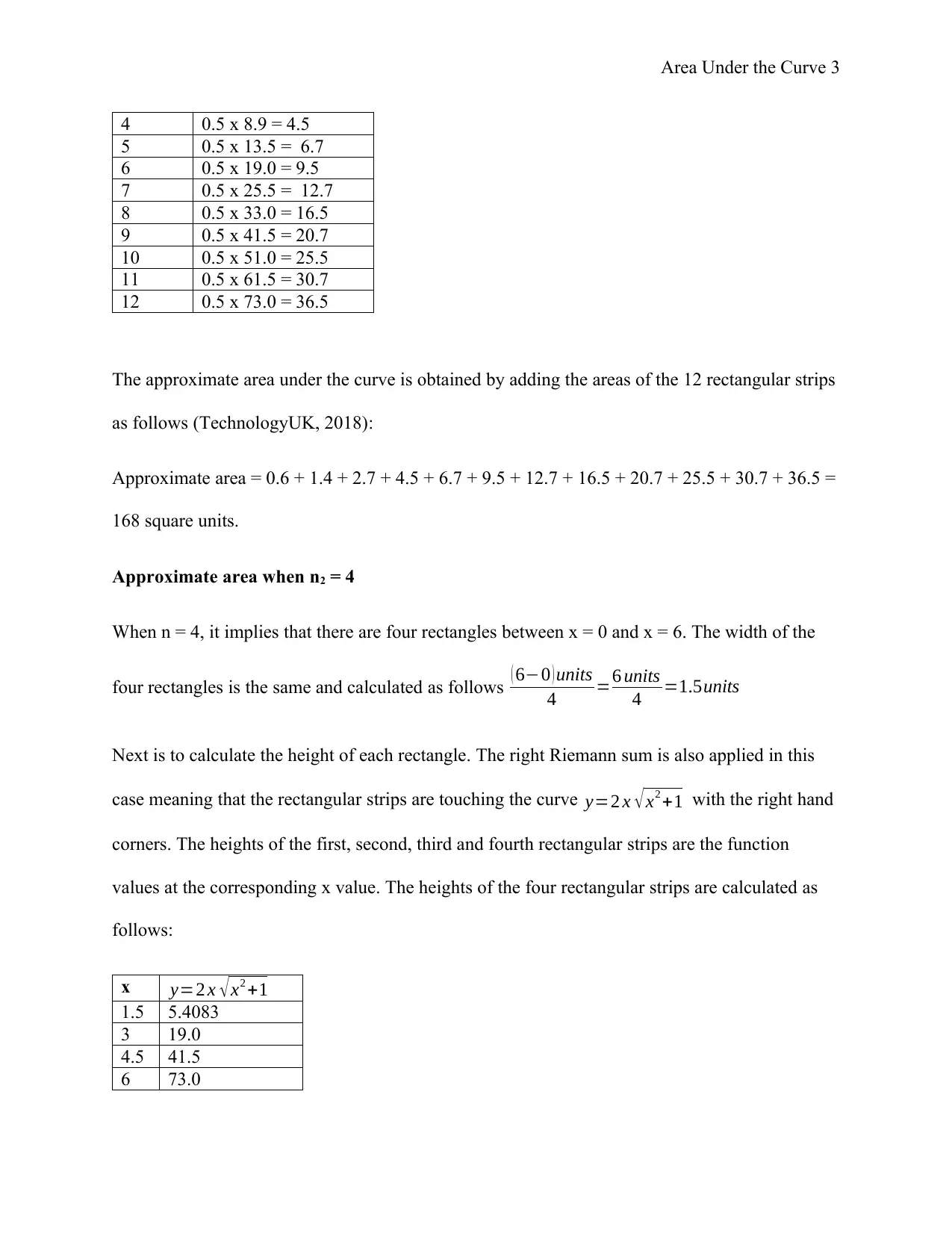
4 0.5 x 8.9 = 4.5
5 0.5 x 13.5 = 6.7
6 0.5 x 19.0 = 9.5
7 0.5 x 25.5 = 12.7
8 0.5 x 33.0 = 16.5
9 0.5 x 41.5 = 20.7
10 0.5 x 51.0 = 25.5
11 0.5 x 61.5 = 30.7
12 0.5 x 73.0 = 36.5
The approximate area under the curve is obtained by adding the areas of the 12 rectangular strips
as follows (TechnologyUK, 2018):
Approximate area = 0.6 + 1.4 + 2.7 + 4.5 + 6.7 + 9.5 + 12.7 + 16.5 + 20.7 + 25.5 + 30.7 + 36.5 =
168 square units.
Approximate area when n2 = 4
When n = 4, it implies that there are four rectangles between x = 0 and x = 6. The width of the
four rectangles is the same and calculated as follows ( 60 ) units
4 =6 units
4 =1.5units
Next is to calculate the height of each rectangle. The right Riemann sum is also applied in this
case meaning that the rectangular strips are touching the curve y=2 x x2 +1 with the right hand
corners. The heights of the first, second, third and fourth rectangular strips are the function
values at the corresponding x value. The heights of the four rectangular strips are calculated as
follows:
x y=2 x x2 +1
1.5 5.4083
3 19.0
4.5 41.5
6 73.0
Document Page
Area Under the Curve 4
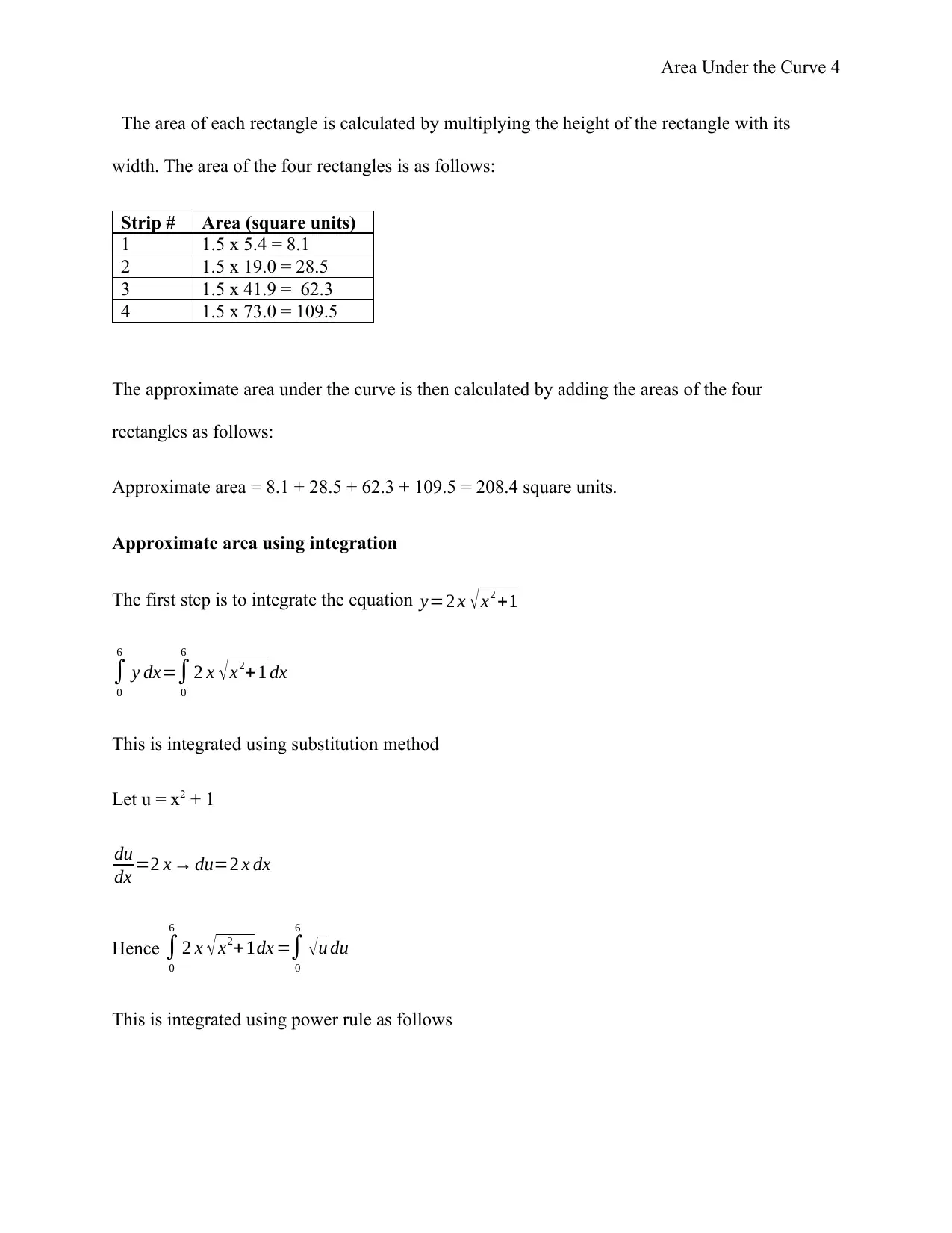
The area of each rectangle is calculated by multiplying the height of the rectangle with its
width. The area of the four rectangles is as follows:
Strip # Area (square units)
1 1.5 x 5.4 = 8.1
2 1.5 x 19.0 = 28.5
3 1.5 x 41.9 = 62.3
4 1.5 x 73.0 = 109.5
The approximate area under the curve is then calculated by adding the areas of the four
rectangles as follows:
Approximate area = 8.1 + 28.5 + 62.3 + 109.5 = 208.4 square units.
Approximate area using integration
The first step is to integrate the equation y=2 x x2 +1

0
6
y dx=
0
6
2 x x2+ 1 dx
This is integrated using substitution method
Let u = x2 + 1
du
dx =2 x du=2 x dx
Hence
0
6
2 x x2+1dx =
0
6
u du
This is integrated using power rule as follows
tabler-icon-diamond-filled.svg

Paraphrase This Document

Need a fresh take? Get an instant paraphrase of this document with our AI Paraphraser
Document Page
Area Under the Curve 5
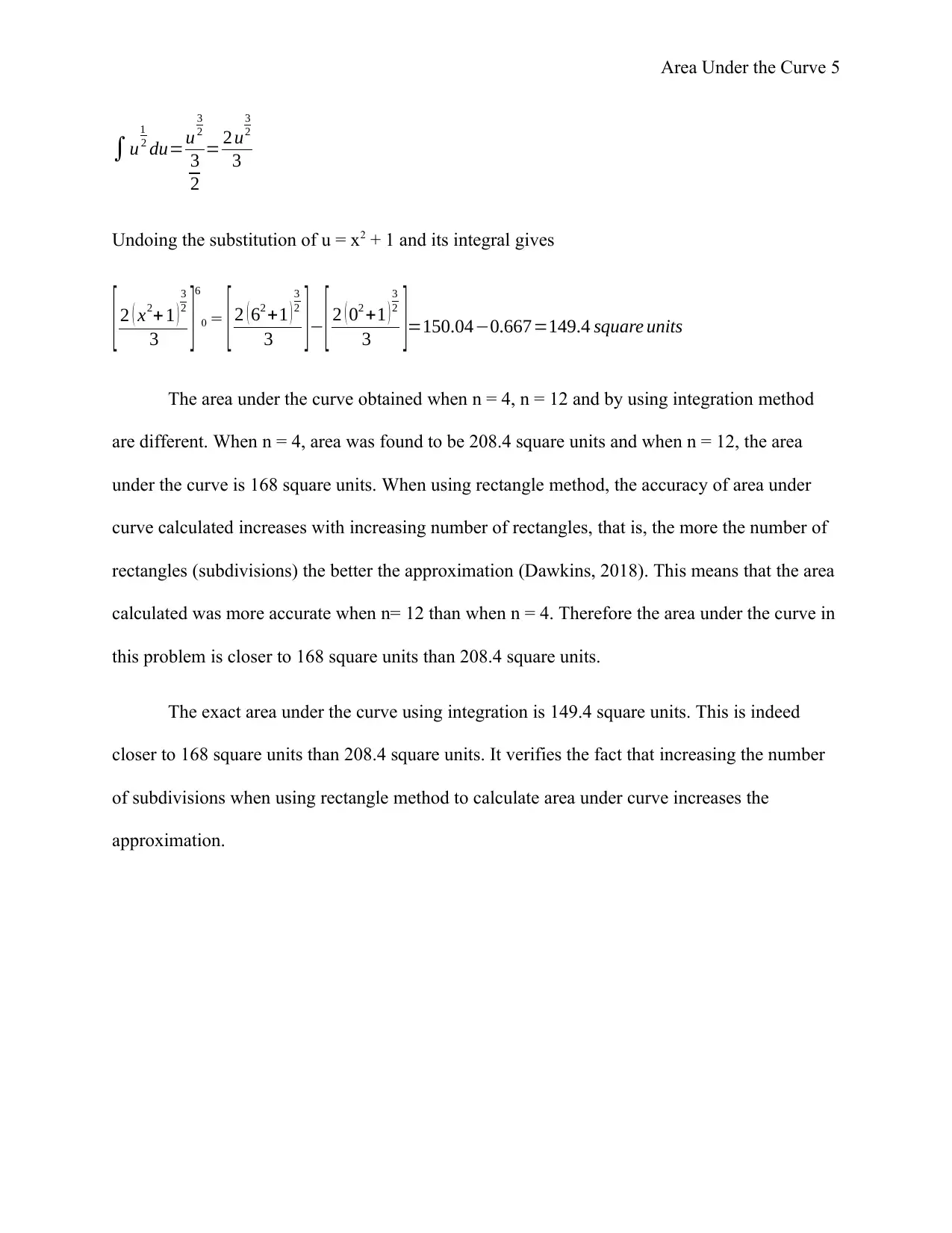
u
1
2 du=u
3
2
3
2
= 2 u
3
2
3
Undoing the substitution of u = x2 + 1 and its integral gives
[ 2 ( x2+ 1 )
3
2
3 ]6
0 = [ 2 ( 62 +1 )
3
2
3 ] [ 2 ( 02 +1 )
3
2
3 ]=150.040.667=149.4 square units
The area under the curve obtained when n = 4, n = 12 and by using integration method
are different. When n = 4, area was found to be 208.4 square units and when n = 12, the area
under the curve is 168 square units. When using rectangle method, the accuracy of area under
curve calculated increases with increasing number of rectangles, that is, the more the number of
rectangles (subdivisions) the better the approximation (Dawkins, 2018). This means that the area
calculated was more accurate when n= 12 than when n = 4. Therefore the area under the curve in
this problem is closer to 168 square units than 208.4 square units.
The exact area under the curve using integration is 149.4 square units. This is indeed
closer to 168 square units than 208.4 square units. It verifies the fact that increasing the number
of subdivisions when using rectangle method to calculate area under curve increases the
approximation.
Document Page
Area Under the Curve 6
References
Dawkins, P., 2018.
Area Problem. [Online]
Available at: http://tutorial.math.lamar.edu/Classes/CalcI/AreaProblem.aspx
[Accessed 29 November 2018].
Khan Academy, 2018.
Left & right Riemann sums. [Online]
Available at: https://www.khanacademy.org/math/ap-calculus-ab/ab-integration-new/ab-6-2/a/left-
and-right-riemann-sums
[Accessed 29 November 2018].
TechnologyUK, 2018.
The Area under a Curve. [Online]
Available at: http://www.technologyuk.net/mathematics/integral-calculus/area-under-curve.shtml
[Accessed 29 November 2018].
chevron_up_icon
1 out of 6
circle_padding
hide_on_mobile
zoom_out_icon
[object Object]