MGT502 Business Communication: Income Inequality Essay Analysis

Verified

Added on  2022/11/15

|3
|574
|496
Essay
AI Summary
This argumentative essay explores the detrimental effects of income inequality within business organizations and on a global scale. It argues that uneven income distribution negatively impacts employees' mental health, stakeholder power, and the wage gap, particularly affecting female workers. The essay references studies showing that economic growth does not always correlate with societal happiness due to income disparities. While acknowledging the argument that income reflects individual skill and effort, the study concludes that increasing income inequality in business organizations has adverse consequences for both individual workers and the overall global economy. The essay utilizes references from various academic sources to support its claims.
Document Page
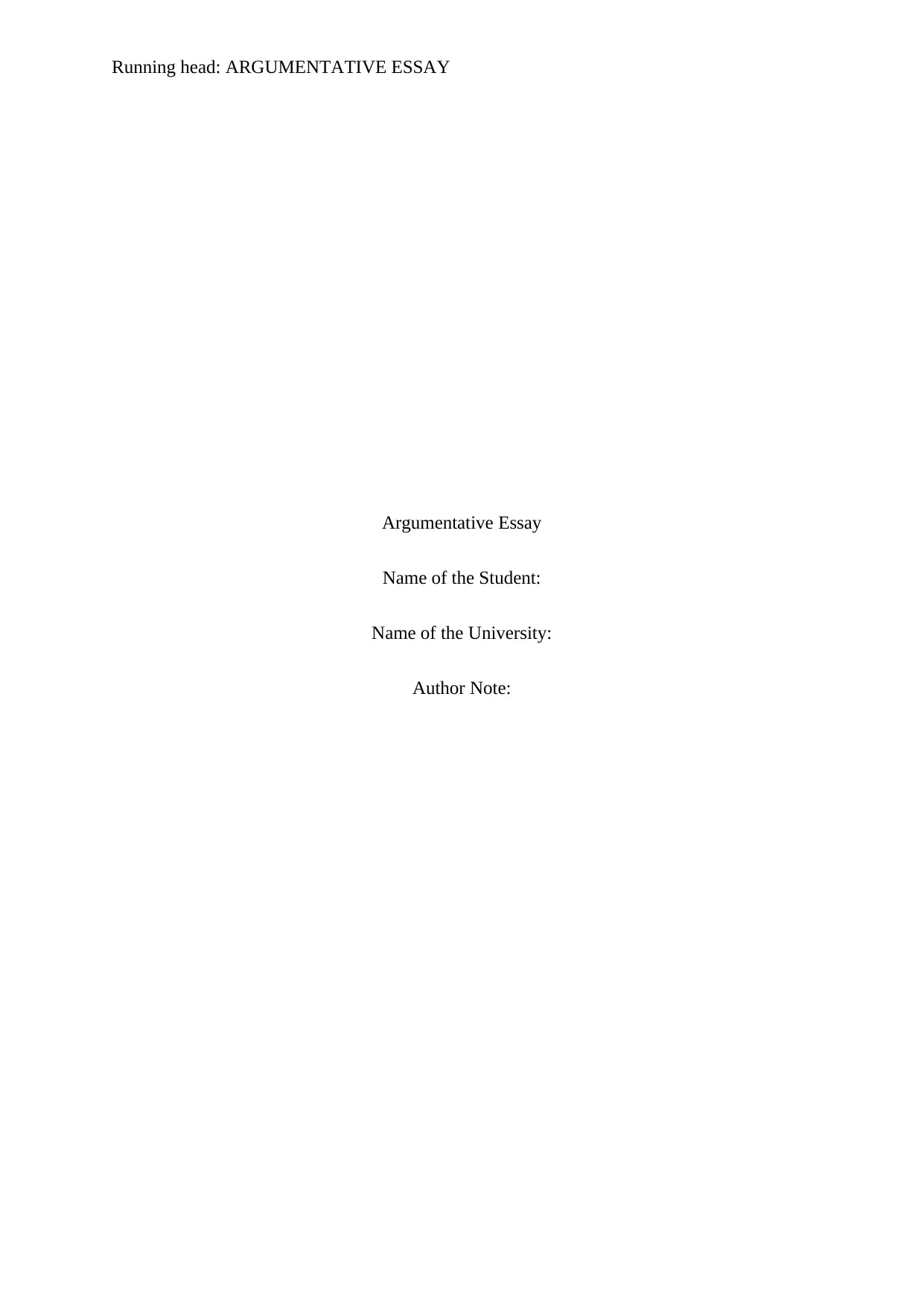
Running head: ARGUMENTATIVE ESSAY
Argumentative Essay
Name of the Student:
Name of the University:
Author Note:
tabler-icon-diamond-filled.svg

Paraphrase This Document

Need a fresh take? Get an instant paraphrase of this document with our AI Paraphraser
Document Page
1ARGUMENTATIVE ESSAY
Income inequality is a context that describes the discrimination in the factor of the
income distribution. Specifically, the income which is unevenly distributed within the
population of any business organisation. In this connection, the given paper is focused on
arguing with the fact that income inequality has created an adverse effect on the employees
working in an organisational structure as well as the global perspective as a whole.
As opined by Pickett & Wilkinson (2015), the inequality in the income distribution
significantly affects the health of the people because of the mental instability they face. As
also critically stated by Adam Cobb (2016), income inequality affects the power of the
stakeholder and the rewards that are given to the employees as well as their recruitment
process. It was also implied by Mihaila (2016), the wage gap affects the female workers and
the labour market participation of the same as the female workers work as equally as the male
workers but are not paid equally. As stated by Oishi & Kesebir (2015), economic growth is
not always related to the happiness of the overall society because of the system of equal
income distribution. This is because the income inequality keeps the rich happy, but the poor
disturbed. However, in lieu of this, as stated by Cooter (2016), income is the labour that one
input in work and gets paid according to the same. Thus, thus in equal distribution of income
is the result of the skill and talent of an individual and the same is justifiable.
Hence, based on the above shreds of evidence, the study tends to conclude that the
increase in income inequality in business organisations is affecting the whole society at a
global perspective. This is because the same affects not only the life of the working
individuals but also the GDP of the entire economy of the globe.
Document Page
2ARGUMENTATIVE ESSAY
References
Adam Cobb, J. (2016). How firms shape income inequality: Stakeholder power, executive
decision making, and the structuring of employment relationships. Academy of
Management Review, 41(2), 324-348. Retrieved from DOI: 10.5465/amr.2013.0451.
Cooter, R., & Ulen, T. (2016). Law and economics. Addison-Wesley. Retrieved from:
https://scholarship.law.berkeley.edu/books/2/
Mihăilă, R. (2016). Is the Decrease in the Gender Wage Gap the Principal Driver of the
Sustained Rise in Female Labor Market Participation? Journal of Research in Gender
Studies, 6(2), 146-172. Retrieved from: https://www.ceeol.com/search/article-detail?
id=470847
Oishi, S., & Kesebir, S. (2015). Income inequality explains why economic growth does not
always translate to an increase in happiness. Psychological science, 26(10), 1630-
1638. Retrieved from DOI: 10.1177/0956797615596713
Pickett, K. E., & Wilkinson, R. G. (2015). Income inequality and health: a causal
review. Social science & medicine, 128, 316-326. Retrieved from DOI:
10.1016/j.socscimed.2014.12.031
chevron_up_icon
1 out of 3
circle_padding
hide_on_mobile
zoom_out_icon
[object Object]