EXSC 550 Article Review: Tennis Power Serve and Performance Levels

Verified

Added on  2022/12/14

|4
|860
|418
Report
AI Summary
This article review analyzes a research article that investigated lower-limb activity during the tennis power serve across different performance levels. The study involved 32 participants, categorized as beginner, intermediate, and elite tennis players. Researchers measured leg power, leg stiffness, ball velocity, and impact height using various methods including countermovement jumps, force platforms, radar, and video analysis. The results indicated similarities in leg power among the groups, but differences in the timing of serve phases and ball velocity. The elite group demonstrated longer preparation phases, shorter concentric phases, and higher ball velocities. The author concludes that the effectiveness of the tennis serve is reliant on elastic energy and muscle preload in the leg extensors. The reviewer raises questions about the data collection methods, the influence of serve efficiency on upper-limb activity, and the interpretation of different Pmax values among the groups. The review highlights the significance of biomechanical analysis in understanding and improving tennis performance.
Document Page
Running head: ARTICLE REVIEW
ARTICLE REVIEW
Name of the Student:
Name of the University:
Author note:
tabler-icon-diamond-filled.svg

Paraphrase This Document

Need a fresh take? Get an instant paraphrase of this document with our AI Paraphraser
Document Page
1ARTICLE REVIEW
Girard, O., Micallef, J. P., & Millet, G. P. (2005). Lower-limb activity during the power serve
in tennis: effects of performance level. Medicine & Science in Sports &
Exercise, 37(6), 1021-1029. DOI: 10.1249/01.mss.0000171619.99391.bb
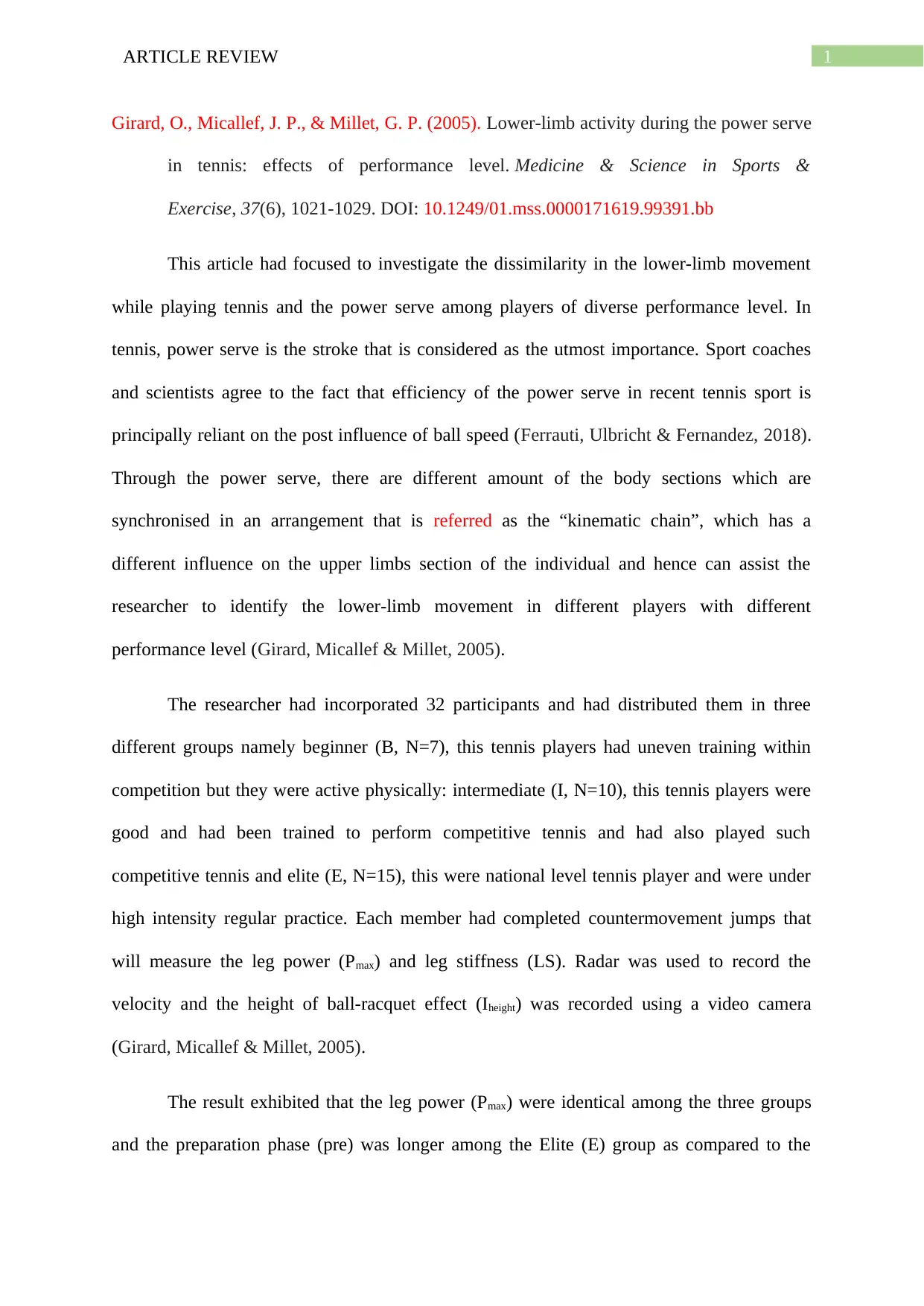
This article had focused to investigate the dissimilarity in the lower-limb movement
while playing tennis and the power serve among players of diverse performance level. In
tennis, power serve is the stroke that is considered as the utmost importance. Sport coaches
and scientists agree to the fact that efficiency of the power serve in recent tennis sport is
principally reliant on the post influence of ball speed (Ferrauti, Ulbricht & Fernandez, 2018).
Through the power serve, there are different amount of the body sections which are
synchronised in an arrangement that is referred as the “kinematic chain”, which has a
different influence on the upper limbs section of the individual and hence can assist the
researcher to identify the lower-limb movement in different players with different
performance level (Girard, Micallef & Millet, 2005).
The researcher had incorporated 32 participants and had distributed them in three
different groups namely beginner (B, N=7), this tennis players had uneven training within
competition but they were active physically: intermediate (I, N=10), this tennis players were
good and had been trained to perform competitive tennis and had also played such
competitive tennis and elite (E, N=15), this were national level tennis player and were under
high intensity regular practice. Each member had completed countermovement jumps that
will measure the leg power (Pmax) and leg stiffness (LS). Radar was used to record the
velocity and the height of ball-racquet effect (Iheight) was recorded using a video camera
(Girard, Micallef & Millet, 2005).
The result exhibited that the leg power (Pmax) were identical among the three groups
and the preparation phase (pre) was longer among the Elite (E) group as compared to the
Document Page
2ARTICLE REVIEW
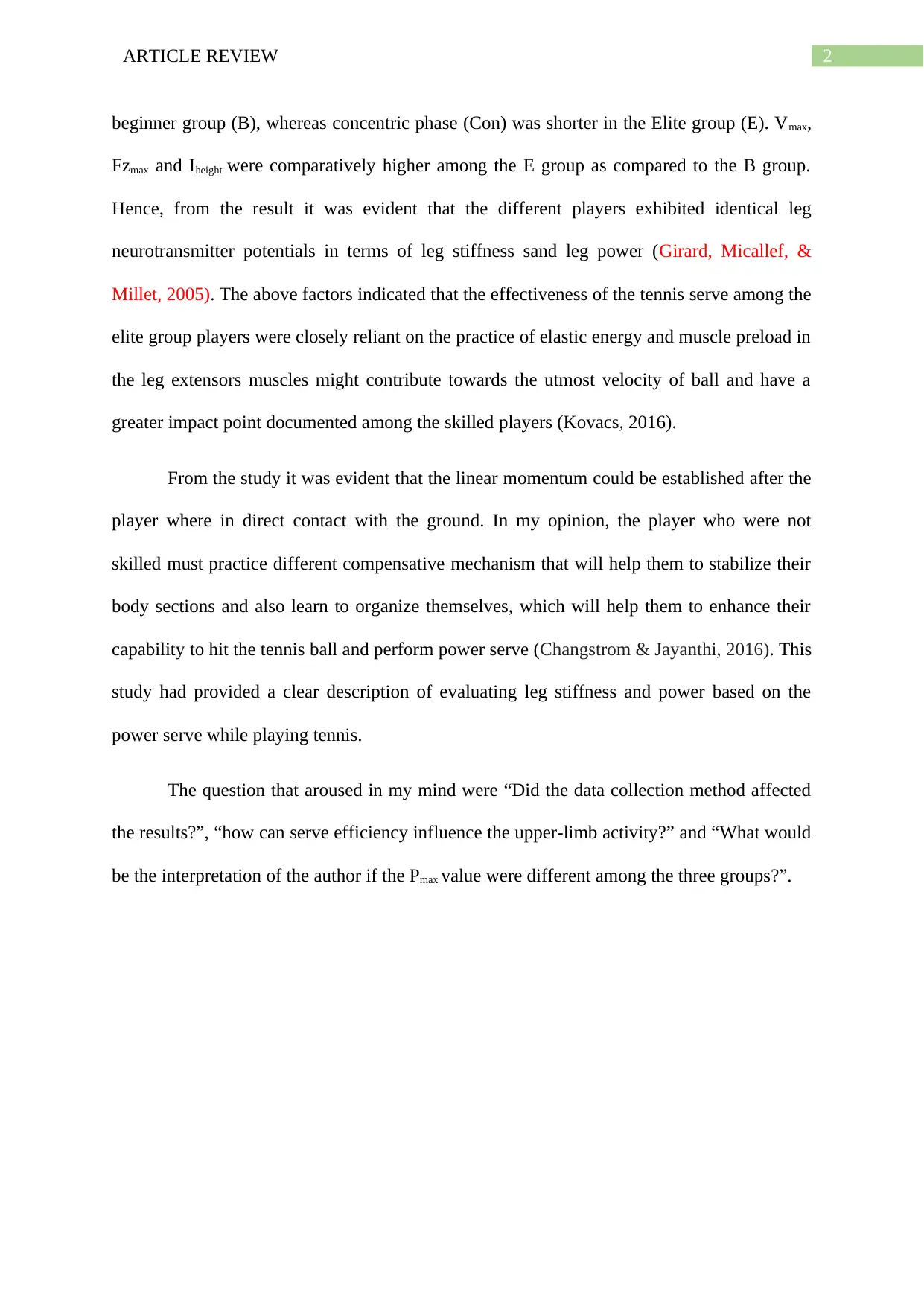
beginner group (B), whereas concentric phase (Con) was shorter in the Elite group (E). Vmax,
Fzmax and Iheight were comparatively higher among the E group as compared to the B group.
Hence, from the result it was evident that the different players exhibited identical leg
neurotransmitter potentials in terms of leg stiffness sand leg power (Girard, Micallef, &
Millet, 2005). The above factors indicated that the effectiveness of the tennis serve among the
elite group players were closely reliant on the practice of elastic energy and muscle preload in
the leg extensors muscles might contribute towards the utmost velocity of ball and have a
greater impact point documented among the skilled players (Kovacs, 2016).
From the study it was evident that the linear momentum could be established after the
player where in direct contact with the ground. In my opinion, the player who were not
skilled must practice different compensative mechanism that will help them to stabilize their
body sections and also learn to organize themselves, which will help them to enhance their
capability to hit the tennis ball and perform power serve (Changstrom & Jayanthi, 2016). This
study had provided a clear description of evaluating leg stiffness and power based on the
power serve while playing tennis.
The question that aroused in my mind were “Did the data collection method affected
the results?”, “how can serve efficiency influence the upper-limb activity?” and “What would
be the interpretation of the author if the Pmax value were different among the three groups?”.
Document Page
3ARTICLE REVIEW
References
Changstrom, B., & Jayanthi, N. (2016). Clinical evaluation of the adult recreational tennis
player. Current sports medicine reports, 15(6), 437-445.
10.1249/JSR.0000000000000315
Ferrauti, A., Ulbricht, A., & Fernandez-Fernandez, J. (2018). Assessment of Physical
Performance for Individualized Training Prescription in Tennis. In Tennis
Medicine (pp. 167-188). Springer, Cham. https://doi.org/10.1007/978-3-319-71498-
1_12
Girard, O., Micallef, J. P., & Millet, G. P. (2005). Lower-limb activity during the power serve
in tennis: effects of performance level. Medicine & Science in Sports &
Exercise, 37(6), 1021-1029. DOI: 10.1249/01.mss.0000171619.99391.bb
Kovacs, M. S. (2016). Strength and Conditioning for the Young Tennis Player. In The Young
Tennis Player (pp. 55-86). Springer, Cham. https://doi.org/10.1007/978-3-319-
27559-8_4
chevron_up_icon
1 out of 4
circle_padding
hide_on_mobile
zoom_out_icon
[object Object]