Assessment 2: Community Profile Report for Local Health Promotion
VerifiedAdded on 2023/01/06
|12
|4213
|76
Report
AI Summary
This Community Profile Report, completed as part of a NURBN2009 nursing assessment, investigates the health needs of a local community. The report, based on a desktop audit due to COVID-19 restrictions, analyzes various elements impacting community health, including demographics, culture, and the physical environment. The student identifies key health issues like diabetes and early marriage within the Aboriginal and Torres Strait Islander community, focusing on the impact of historical events and cultural factors on their health. The report includes demographic data, cultural insights, and references relevant sources like ABS.gov.au and local government reports to support the findings. The goal is to identify at least three health issues that a $100,000 grant could address, supporting the development of a targeted health promotion program for the community in 2021.
Assessment 2
Community Profile Report
This task is due on the following dates:
Progress Report and Peer review:
o Full 10% awarded for a 50% completed report and Peer review report being submitted,
0% awarded for less than 50% completed or incomplete peer review report.
o Uploaded into the submission folder
Final Community Profile Report
o Uploaded into ... in the submission folder
Weighting: 70%
Word count: 10 pages only (not including peer report), single spaced using current headings
provided (do not remove), Calibri font 11 point, no fewer than 12 references (APA 7th).
The Assessment task:
You have recently started a new nursing role at a community health centre in your local suburb,
town or city (where you currently live as a student). The community health centre has recently
received a grant of $100,000 to provide a health promotion program that addresses the local health
needs of the community at the commencement of 2021.
Part of your nursing role will be to provide this health promotion activity to your local community;
however, you do not yet know the current health needs in your community. To identify the specific
health issues in your community for next year’s health promotion program (NURBN2009), your
manager (the lecturer), has asked you to undertake a review of the local suburb, town or city in
order to understand the complex elements that contribute to the health status within the area, and
then develop a report of what you have found. There may not be a lot of information available about
your community, so you may also need to examine your Local Government Area (LGA).
Under normal circumstances, your manager would ask you to visit the suburb, town or city in order
to conduct a field study of the various elements that impact health; however, this can take a lot of
time and resources. Further, given the current COVID-19 situation, the manager has asked you to
perform a “Desktop Audit” and then develop a Community Profile Report. This approach is not ideal;
however, it is sometimes necessary when resources and time are limited or there is a risk to your
own health or the health of others.
The manager has given you a report form to complete in three (3) months’ time. You will investigate
your community via your computer and report on the twelve (12) elements (which are in 4 groups)
outlined in the report template (below). In addition, you must identify at least three (3) health issues
from your findings, which the financial grant could be used to address. Instructions and prompts
have been provided in each section to help you – these are in RED. Read them carefully.
The final Community Profile Report must be no more than 10 pages in length (Front Cover, 12
elements, a discussion of the 3 health issues). This report will support the development of your
health promotion program in 2021.
1
Community Profile Report
This task is due on the following dates:
Progress Report and Peer review:
o Full 10% awarded for a 50% completed report and Peer review report being submitted,
0% awarded for less than 50% completed or incomplete peer review report.
o Uploaded into the submission folder
Final Community Profile Report
o Uploaded into ... in the submission folder
Weighting: 70%
Word count: 10 pages only (not including peer report), single spaced using current headings
provided (do not remove), Calibri font 11 point, no fewer than 12 references (APA 7th).
The Assessment task:
You have recently started a new nursing role at a community health centre in your local suburb,
town or city (where you currently live as a student). The community health centre has recently
received a grant of $100,000 to provide a health promotion program that addresses the local health
needs of the community at the commencement of 2021.
Part of your nursing role will be to provide this health promotion activity to your local community;
however, you do not yet know the current health needs in your community. To identify the specific
health issues in your community for next year’s health promotion program (NURBN2009), your
manager (the lecturer), has asked you to undertake a review of the local suburb, town or city in
order to understand the complex elements that contribute to the health status within the area, and
then develop a report of what you have found. There may not be a lot of information available about
your community, so you may also need to examine your Local Government Area (LGA).
Under normal circumstances, your manager would ask you to visit the suburb, town or city in order
to conduct a field study of the various elements that impact health; however, this can take a lot of
time and resources. Further, given the current COVID-19 situation, the manager has asked you to
perform a “Desktop Audit” and then develop a Community Profile Report. This approach is not ideal;
however, it is sometimes necessary when resources and time are limited or there is a risk to your
own health or the health of others.
The manager has given you a report form to complete in three (3) months’ time. You will investigate
your community via your computer and report on the twelve (12) elements (which are in 4 groups)
outlined in the report template (below). In addition, you must identify at least three (3) health issues
from your findings, which the financial grant could be used to address. Instructions and prompts
have been provided in each section to help you – these are in RED. Read them carefully.
The final Community Profile Report must be no more than 10 pages in length (Front Cover, 12
elements, a discussion of the 3 health issues). This report will support the development of your
health promotion program in 2021.
1

Paraphrase This Document
Need a fresh take? Get an instant paraphrase of this document with our AI Paraphraser
The full report is due at the end of October. You must also provide a progress report on the 18th
September @5pm. The progress report must include 1) a copy of your report with no less than six
(6) of the twelve (12) elements completed AND 2) a separate page containing a signed peer review
report for the manager to review.
Peer Review report
The peer review must be completed by up to two (2) other nursing students who are also in the
NURBN1004 course. The peer review of your work is important to make sure you are on the right
track. Also, by peer reviewing the work of others, you can identify areas you need to improve in your
own work. It is expected that peer reviewers show each other courtesy and respect. You are
expected to review at least one (1) other student’s work. You should not review more than two (2).
You will need to use telephone, Moodle forum, or other communication methods to find another
student to peer review your work – this is YOUR responsibility, not your manager’s.
The peer review process is a great time to reach out to others in the course to support them and
have them support you, as you would hope to see in a nursing setting. The peer review form is
located with the Community Profile Report template in the Assessment section in Moodle and does
not count towards the final page count in the Community Profile Report. The peer review form must
be uploaded as a separate document by the Week 8 deadline and must be physically signed by the
peer who reviewed your work.
Please note: if you successfully upload the Community Profile Report (50% or more complete) AND
your peer’s review of your work separately, you will automatically receive 10% of the overall grade.
However, if the report is less than 50% complete and/or you do not supply your peer review signed
report, then the 10% cannot be awarded.
Lastly, we are using the ... similarity checker at the end of the semester to detect any copying of
others’ work. If a student copies another student’s work, it will be picked up by ... and may lead to
automatic loss of marks and/or failure of the course.
Useful links to help you undertake your desktop audit – you will need to search for more
www.abs.gov.au
https://quickstats.censusdata.abs.gov.au/census_services/getproduct/census/2016/communityprofile/2?opendocument
https://www.education.vic.gov.au/Documents/about/research/aeditop20data.pdf
https://www2.health.vic.gov.au/about/reporting-planning-data/gis-and-planning-products/geographical-profiles
https://www.vichealth.vic.gov.au/media-and-resources/publications/vichealth-indicators-lga-profiles-2015
https://discover.data.vic.gov.au/group/health
https://www.bettersafercare.vic.gov.au/our-work/health-status-of-victorians
https://www.vic.gov.au/local-government-areas-report-population-diversity
[All of the above section must be deleted prior to submission]
2
September @5pm. The progress report must include 1) a copy of your report with no less than six
(6) of the twelve (12) elements completed AND 2) a separate page containing a signed peer review
report for the manager to review.
Peer Review report
The peer review must be completed by up to two (2) other nursing students who are also in the
NURBN1004 course. The peer review of your work is important to make sure you are on the right
track. Also, by peer reviewing the work of others, you can identify areas you need to improve in your
own work. It is expected that peer reviewers show each other courtesy and respect. You are
expected to review at least one (1) other student’s work. You should not review more than two (2).
You will need to use telephone, Moodle forum, or other communication methods to find another
student to peer review your work – this is YOUR responsibility, not your manager’s.
The peer review process is a great time to reach out to others in the course to support them and
have them support you, as you would hope to see in a nursing setting. The peer review form is
located with the Community Profile Report template in the Assessment section in Moodle and does
not count towards the final page count in the Community Profile Report. The peer review form must
be uploaded as a separate document by the Week 8 deadline and must be physically signed by the
peer who reviewed your work.
Please note: if you successfully upload the Community Profile Report (50% or more complete) AND
your peer’s review of your work separately, you will automatically receive 10% of the overall grade.
However, if the report is less than 50% complete and/or you do not supply your peer review signed
report, then the 10% cannot be awarded.
Lastly, we are using the ... similarity checker at the end of the semester to detect any copying of
others’ work. If a student copies another student’s work, it will be picked up by ... and may lead to
automatic loss of marks and/or failure of the course.
Useful links to help you undertake your desktop audit – you will need to search for more
www.abs.gov.au
https://quickstats.censusdata.abs.gov.au/census_services/getproduct/census/2016/communityprofile/2?opendocument
https://www.education.vic.gov.au/Documents/about/research/aeditop20data.pdf
https://www2.health.vic.gov.au/about/reporting-planning-data/gis-and-planning-products/geographical-profiles
https://www.vichealth.vic.gov.au/media-and-resources/publications/vichealth-indicators-lga-profiles-2015
https://discover.data.vic.gov.au/group/health
https://www.bettersafercare.vic.gov.au/our-work/health-status-of-victorians
https://www.vic.gov.au/local-government-areas-report-population-diversity
[All of the above section must be deleted prior to submission]
2
Community Profile Report
Please include an image that represents your community (Delete ALL RED wording once you have
finished completing this section)
[Enter community name here]
Student Name: Enter name here
Student Number: Enter number here
Submission date: Enter date here
3
Please include an image that represents your community (Delete ALL RED wording once you have
finished completing this section)
[Enter community name here]
Student Name: Enter name here
Student Number: Enter number here
Submission date: Enter date here
3
⊘ This is a preview!⊘
Do you want full access?
Subscribe today to unlock all pages.

Trusted by 1+ million students worldwide
1. People and culture
1.1. History
Background
Aboriginal and Torres Strait Islander people are individuals who lived in Australia before
British colonization. They are specific group of people who are also represented as first nations of
Australia or first Australians. They have inhabited Australia since millennia. Their culture and law to
the Australian land is quite enduring and strong. They have their own law and customs that further
helps in determining membership of their group. There are two different theories of origin of
Aboriginal and Torres Strait Islander people. First is the basic theory in which human are though to
have migrated rom Asia to north Australia using primitive boats. Whereas, current theory says that
early migrants of Australia came from Africa approximately 70,000 years ago. This theory helps in
explaining that Aboriginal and Torres Strait people are the oldest population of human being
outside Africa who cane and stated living in Australia. Cultural disconnection of these people from
community can impact both physical and mental health condition of people. but majorly their living
life style and lack of education increased health issues like diabetes among such people.
The main significant event that that impacted development of this community was when
Europeans arrived approximately 230 years ago. This European settlement in Australia affected living
lifestyle of Aboriginal and Torres Strait Islander people in many ways. these people were majorly
impacted in terms of health after European settlement. European settlement not only impacted
overall health of these people but they also brought changes within their living lifestyle as well. their
land and water resources were also reduced, some of them were acquired by Europeans.
Impact on health
The history of Aboriginal and Torres Strait Islander people tells that European settlement in
Australia brought various kinds of changes within their life style, living standards. But most
importantly it impacted their health in a drastic manner. European settlement brought some serious
diseases because of which number of deaths of aboriginal people. this incident brought three major
types of diseases with them. This started with three years epidemic spread of small pox. This disease
only started spreading after European settlement. This disease was one of the major reasons of
death of aboriginal people. Other health diseases that started spreading among these people were
measles and tuberculosis.
Other than living European colonization, living life style and lack of education of these
people also impacted their overall health. Due to their lifestyle and lack of education every 1 out of 5
Aboriginal and Torres Strait Islander people had type two diabetes and disconnection from their
culture impacted mental health of these people. it can be said that history of these people and
European settlement indirectly impacted their health
Resources and references
History of Australia's Aboriginal and Torres Strait Islander Peoples, 2020
4
1.1. History
Background
Aboriginal and Torres Strait Islander people are individuals who lived in Australia before
British colonization. They are specific group of people who are also represented as first nations of
Australia or first Australians. They have inhabited Australia since millennia. Their culture and law to
the Australian land is quite enduring and strong. They have their own law and customs that further
helps in determining membership of their group. There are two different theories of origin of
Aboriginal and Torres Strait Islander people. First is the basic theory in which human are though to
have migrated rom Asia to north Australia using primitive boats. Whereas, current theory says that
early migrants of Australia came from Africa approximately 70,000 years ago. This theory helps in
explaining that Aboriginal and Torres Strait people are the oldest population of human being
outside Africa who cane and stated living in Australia. Cultural disconnection of these people from
community can impact both physical and mental health condition of people. but majorly their living
life style and lack of education increased health issues like diabetes among such people.
The main significant event that that impacted development of this community was when
Europeans arrived approximately 230 years ago. This European settlement in Australia affected living
lifestyle of Aboriginal and Torres Strait Islander people in many ways. these people were majorly
impacted in terms of health after European settlement. European settlement not only impacted
overall health of these people but they also brought changes within their living lifestyle as well. their
land and water resources were also reduced, some of them were acquired by Europeans.
Impact on health
The history of Aboriginal and Torres Strait Islander people tells that European settlement in
Australia brought various kinds of changes within their life style, living standards. But most
importantly it impacted their health in a drastic manner. European settlement brought some serious
diseases because of which number of deaths of aboriginal people. this incident brought three major
types of diseases with them. This started with three years epidemic spread of small pox. This disease
only started spreading after European settlement. This disease was one of the major reasons of
death of aboriginal people. Other health diseases that started spreading among these people were
measles and tuberculosis.
Other than living European colonization, living life style and lack of education of these
people also impacted their overall health. Due to their lifestyle and lack of education every 1 out of 5
Aboriginal and Torres Strait Islander people had type two diabetes and disconnection from their
culture impacted mental health of these people. it can be said that history of these people and
European settlement indirectly impacted their health
Resources and references
History of Australia's Aboriginal and Torres Strait Islander Peoples, 2020
4
Paraphrase This Document
Need a fresh take? Get an instant paraphrase of this document with our AI Paraphraser
http://www.shareourpride.org.au/sections/our-shared-history/#:~:text=Australia's%20history
%20extends%20beyond%201788,land%20is%20strong%20and%20enduring.
1.2. Demographics
Background
Population of Aboriginal and Torres Strait Islander people in Australia have been increasing
continuously. Victorian region also has Aboriginal and/or Torres Strait Islander population.
According to local government area report demographic o these people can be explained on the
basis of age group, gender and material status.
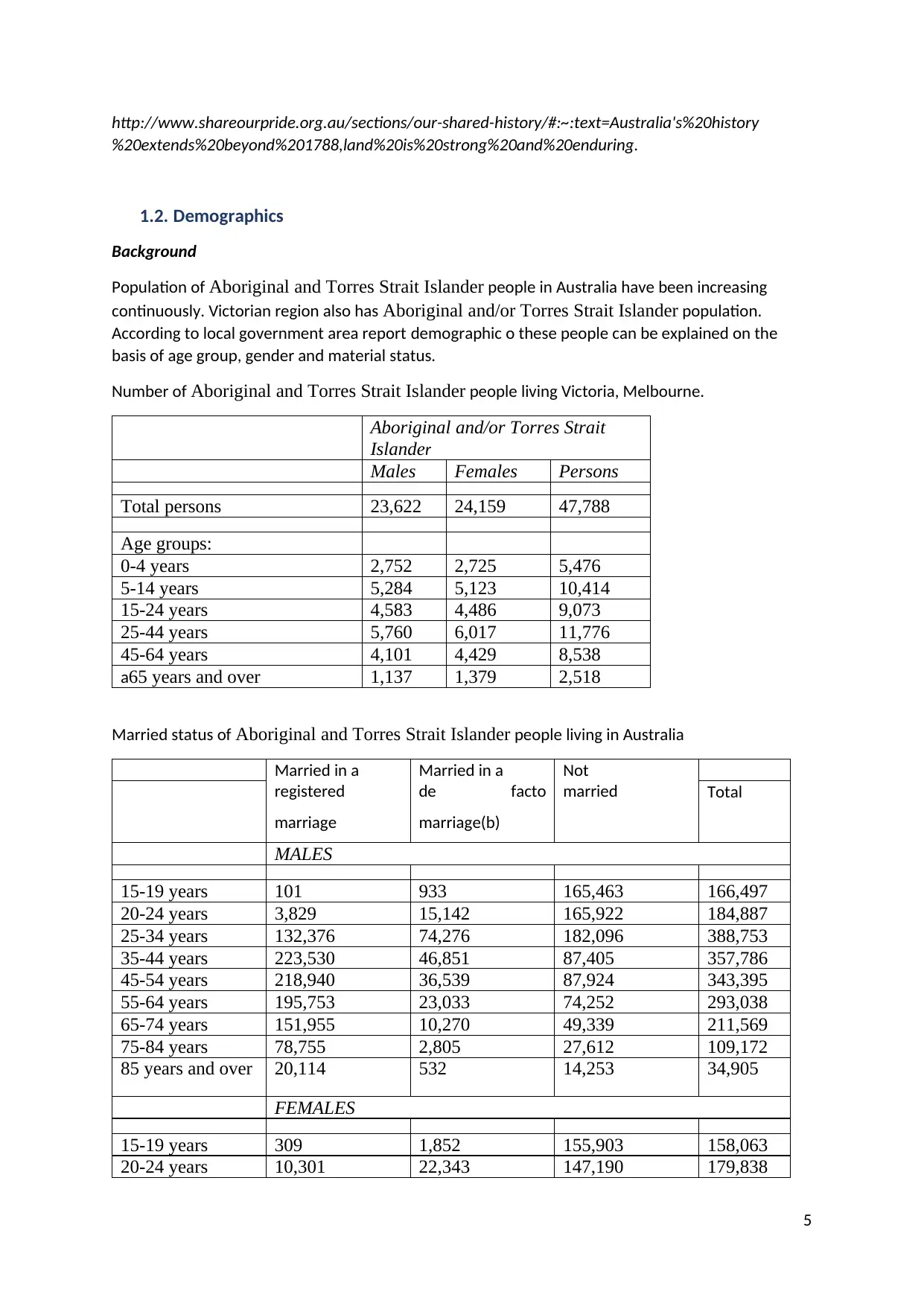
Number of Aboriginal and Torres Strait Islander people living Victoria, Melbourne.
Aboriginal and/or Torres Strait
Islander
Males Females Persons
Total persons 23,622 24,159 47,788
Age groups:
0-4 years 2,752 2,725 5,476
5-14 years 5,284 5,123 10,414
15-24 years 4,583 4,486 9,073
25-44 years 5,760 6,017 11,776
45-64 years 4,101 4,429 8,538
a65 years and over 1,137 1,379 2,518
Married status of Aboriginal and Torres Strait Islander people living in Australia
Married in a
registered
marriage
Married in a
de facto
marriage(b)
Not
married Total
MALES
15-19 years 101 933 165,463 166,497
20-24 years 3,829 15,142 165,922 184,887
25-34 years 132,376 74,276 182,096 388,753
35-44 years 223,530 46,851 87,405 357,786
45-54 years 218,940 36,539 87,924 343,395
55-64 years 195,753 23,033 74,252 293,038
65-74 years 151,955 10,270 49,339 211,569
75-84 years 78,755 2,805 27,612 109,172
85 years and over 20,114 532 14,253 34,905
FEMALES
15-19 years 309 1,852 155,903 158,063
20-24 years 10,301 22,343 147,190 179,838
5
%20extends%20beyond%201788,land%20is%20strong%20and%20enduring.
1.2. Demographics
Background
Population of Aboriginal and Torres Strait Islander people in Australia have been increasing
continuously. Victorian region also has Aboriginal and/or Torres Strait Islander population.
According to local government area report demographic o these people can be explained on the
basis of age group, gender and material status.
Number of Aboriginal and Torres Strait Islander people living Victoria, Melbourne.
Aboriginal and/or Torres Strait
Islander
Males Females Persons
Total persons 23,622 24,159 47,788
Age groups:
0-4 years 2,752 2,725 5,476
5-14 years 5,284 5,123 10,414
15-24 years 4,583 4,486 9,073
25-44 years 5,760 6,017 11,776
45-64 years 4,101 4,429 8,538
a65 years and over 1,137 1,379 2,518
Married status of Aboriginal and Torres Strait Islander people living in Australia
Married in a
registered
marriage
Married in a
de facto
marriage(b)
Not
married Total
MALES
15-19 years 101 933 165,463 166,497
20-24 years 3,829 15,142 165,922 184,887
25-34 years 132,376 74,276 182,096 388,753
35-44 years 223,530 46,851 87,405 357,786
45-54 years 218,940 36,539 87,924 343,395
55-64 years 195,753 23,033 74,252 293,038
65-74 years 151,955 10,270 49,339 211,569
75-84 years 78,755 2,805 27,612 109,172
85 years and over 20,114 532 14,253 34,905
FEMALES
15-19 years 309 1,852 155,903 158,063
20-24 years 10,301 22,343 147,190 179,838
5
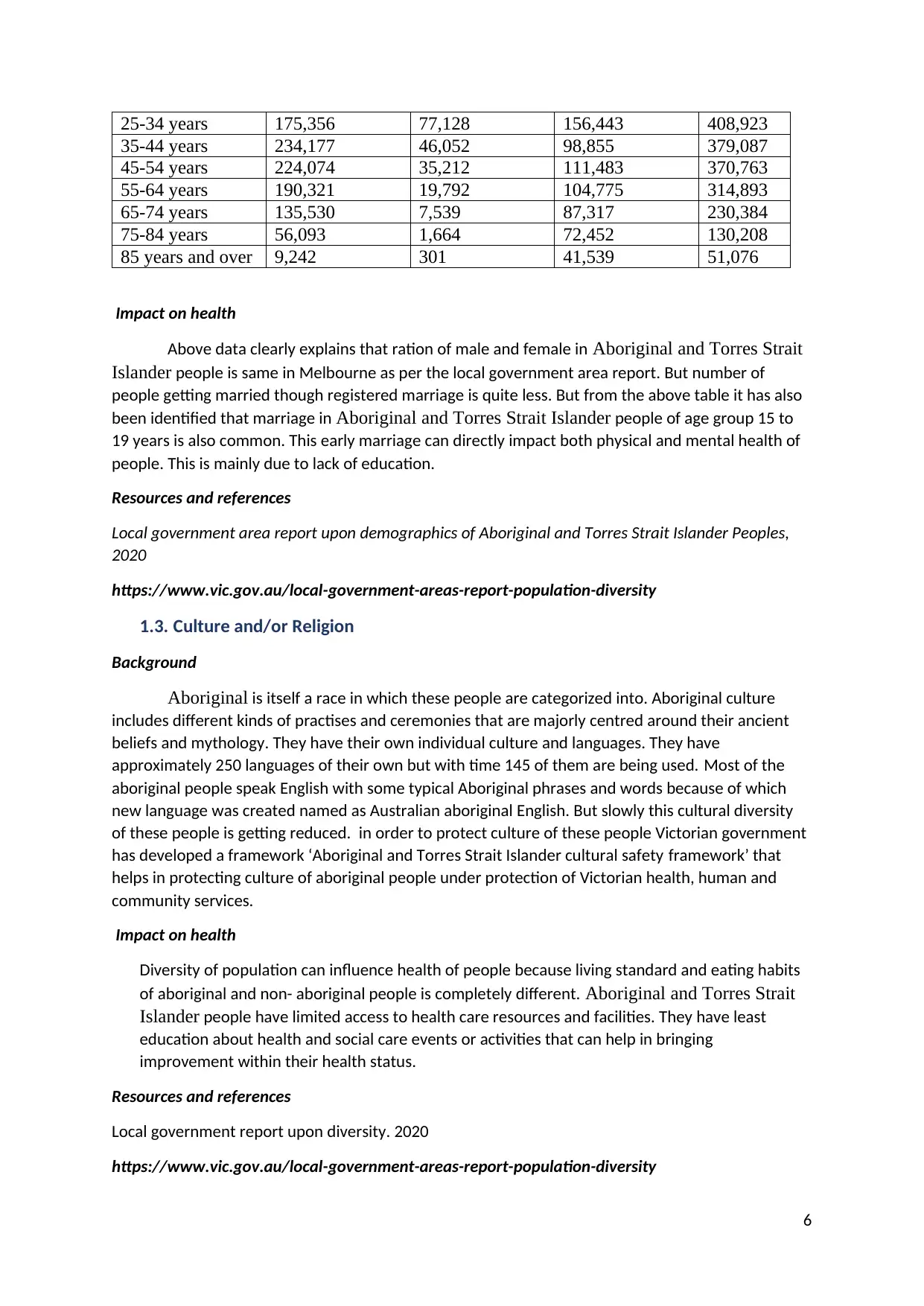
25-34 years 175,356 77,128 156,443 408,923
35-44 years 234,177 46,052 98,855 379,087
45-54 years 224,074 35,212 111,483 370,763
55-64 years 190,321 19,792 104,775 314,893
65-74 years 135,530 7,539 87,317 230,384
75-84 years 56,093 1,664 72,452 130,208
85 years and over 9,242 301 41,539 51,076
Impact on health
Above data clearly explains that ration of male and female in Aboriginal and Torres Strait
Islander people is same in Melbourne as per the local government area report. But number of
people getting married though registered marriage is quite less. But from the above table it has also
been identified that marriage in Aboriginal and Torres Strait Islander people of age group 15 to
19 years is also common. This early marriage can directly impact both physical and mental health of
people. This is mainly due to lack of education.
Resources and references
Local government area report upon demographics of Aboriginal and Torres Strait Islander Peoples,
2020
https://www.vic.gov.au/local-government-areas-report-population-diversity
1.3. Culture and/or Religion
Background
Aboriginal is itself a race in which these people are categorized into. Aboriginal culture
includes different kinds of practises and ceremonies that are majorly centred around their ancient
beliefs and mythology. They have their own individual culture and languages. They have
approximately 250 languages of their own but with time 145 of them are being used. Most of the
aboriginal people speak English with some typical Aboriginal phrases and words because of which
new language was created named as Australian aboriginal English. But slowly this cultural diversity
of these people is getting reduced. in order to protect culture of these people Victorian government
has developed a framework ‘Aboriginal and Torres Strait Islander cultural safety framework’ that
helps in protecting culture of aboriginal people under protection of Victorian health, human and
community services.
Impact on health
Diversity of population can influence health of people because living standard and eating habits
of aboriginal and non- aboriginal people is completely different. Aboriginal and Torres Strait
Islander people have limited access to health care resources and facilities. They have least
education about health and social care events or activities that can help in bringing
improvement within their health status.
Resources and references
Local government report upon diversity. 2020
https://www.vic.gov.au/local-government-areas-report-population-diversity
6
35-44 years 234,177 46,052 98,855 379,087
45-54 years 224,074 35,212 111,483 370,763
55-64 years 190,321 19,792 104,775 314,893
65-74 years 135,530 7,539 87,317 230,384
75-84 years 56,093 1,664 72,452 130,208
85 years and over 9,242 301 41,539 51,076
Impact on health
Above data clearly explains that ration of male and female in Aboriginal and Torres Strait
Islander people is same in Melbourne as per the local government area report. But number of
people getting married though registered marriage is quite less. But from the above table it has also
been identified that marriage in Aboriginal and Torres Strait Islander people of age group 15 to
19 years is also common. This early marriage can directly impact both physical and mental health of
people. This is mainly due to lack of education.
Resources and references
Local government area report upon demographics of Aboriginal and Torres Strait Islander Peoples,
2020
https://www.vic.gov.au/local-government-areas-report-population-diversity
1.3. Culture and/or Religion
Background
Aboriginal is itself a race in which these people are categorized into. Aboriginal culture
includes different kinds of practises and ceremonies that are majorly centred around their ancient
beliefs and mythology. They have their own individual culture and languages. They have
approximately 250 languages of their own but with time 145 of them are being used. Most of the
aboriginal people speak English with some typical Aboriginal phrases and words because of which
new language was created named as Australian aboriginal English. But slowly this cultural diversity
of these people is getting reduced. in order to protect culture of these people Victorian government
has developed a framework ‘Aboriginal and Torres Strait Islander cultural safety framework’ that
helps in protecting culture of aboriginal people under protection of Victorian health, human and
community services.
Impact on health
Diversity of population can influence health of people because living standard and eating habits
of aboriginal and non- aboriginal people is completely different. Aboriginal and Torres Strait
Islander people have limited access to health care resources and facilities. They have least
education about health and social care events or activities that can help in bringing
improvement within their health status.
Resources and references
Local government report upon diversity. 2020
https://www.vic.gov.au/local-government-areas-report-population-diversity
6
⊘ This is a preview!⊘
Do you want full access?
Subscribe today to unlock all pages.
Trusted by 1+ million students worldwide
2. Environment and Accessibility
2.1. Physical environment
Background
Physical environment of Aboriginal and Torres Strait Islander people has changed over
time. Their life style, access of different types of transportation has also increased with time. Have
also increased. According to LGA data of Victoria Aboriginal people are present at approximately all
the areas of Melbourne. But still as per the reports these people live separately from urban and city
life.
Impact on health
Place where people live can impact their health in many different ways as aboriginal people
live separately and far from city life. So, it becomes difficult or them to access health care facilities or
attend health camps. So it can impact their health status in many ways.
Resources and references
Aboriginal and Torres Strait Islander physical environment, 2020
https://www.health.qld.gov.au/__data/assets/pdf_file/0024/830445/atsi-environmental-health-
plan-2019-2022.pdf
2.2. Recreation
Background
More than 80 percent of people living in this community have access to physical activities. 95
percent of people have access to at least one sports facilities.
Impact on health
As per the LGA report data most of the aboriginal people have access to physical activities, sports
facilities so this recreation factors does not majorly impact health of these people.
Resources and references
Access to sports facilities. 220
https://www.abs.gov.au/ausstats/abs@.nsf/Latestproducts/
0397FA84D13C7C3BCA2576570015F79A?opendocument
2.3. Mobility and Transportation
Background
7
2.1. Physical environment
Background
Physical environment of Aboriginal and Torres Strait Islander people has changed over
time. Their life style, access of different types of transportation has also increased with time. Have
also increased. According to LGA data of Victoria Aboriginal people are present at approximately all
the areas of Melbourne. But still as per the reports these people live separately from urban and city
life.
Impact on health
Place where people live can impact their health in many different ways as aboriginal people
live separately and far from city life. So, it becomes difficult or them to access health care facilities or
attend health camps. So it can impact their health status in many ways.
Resources and references
Aboriginal and Torres Strait Islander physical environment, 2020
https://www.health.qld.gov.au/__data/assets/pdf_file/0024/830445/atsi-environmental-health-
plan-2019-2022.pdf
2.2. Recreation
Background
More than 80 percent of people living in this community have access to physical activities. 95
percent of people have access to at least one sports facilities.
Impact on health
As per the LGA report data most of the aboriginal people have access to physical activities, sports
facilities so this recreation factors does not majorly impact health of these people.
Resources and references
Access to sports facilities. 220
https://www.abs.gov.au/ausstats/abs@.nsf/Latestproducts/
0397FA84D13C7C3BCA2576570015F79A?opendocument
2.3. Mobility and Transportation
Background
7
Paraphrase This Document
Need a fresh take? Get an instant paraphrase of this document with our AI Paraphraser
Slowly, access to transportation facilities for aboriginal people have increased. But still for families
with low income or large family members families still face difficulties in terms of access to
transportation facilities. As a result, they prefer walking as a mode of transport.
Impact on health
Mobility and transport impact health of aboriginal people because low income large family
member families face difficulty in accessing transport for healthcare facilities. Due to this
difficulty many times these people do not prefer using health care resources and facilities
available for them as a result it either degrade their health status or increases mortality rate.
Resources and references
Access to transportation facilities, 22
https://aifs.gov.au/cfca/publications/relationship-between-transport-and-disadvantage-austr
3. Socioeconomic status and connection
3.1. Economy
Background
The financial and employment security have the defining of overall assistance of various source
sources of income in order to support the financial security, employment, and economic
empowerment. the Melbourne city in Victoria is offering the unique level of support to the
Aboriginal and Torres Strait Islander people into careers, and walks along with them during their
employment journey to provide advice, mentoring and other specialist supports. Engaging the
unique level of skills and knowledge so that’s the people have the positive impacts all organization.
There have been the keep role on assisting the organization for developing t mutual beneficials and
indigoids employment strategy. The government have announced the a $55.7 million Closing the
Gap - Employment Services package in the 2017-18 Budget. As part of this package, job active is
being boosted to deliver upfront intensive employment services to Indigenous job seekers.
Impact on health
The social economy status is influencing the heath rates quality of life. the most of the people are
unemployed. In these people the rate of smoking is higher. They are identified not to be capable to
make the adjustments for the necessary requirement of the healthcare.
Resources and references
The Health and Welfare of Australia's Aboriginal and Torres Strait Islander Peoples, Oct 2010
https://www.abs.gov.au/AUSSTATS/abs@.nsf/lookup/4704.0Chapter750Oct+2010
3.2. Education
Background
8
with low income or large family members families still face difficulties in terms of access to
transportation facilities. As a result, they prefer walking as a mode of transport.
Impact on health
Mobility and transport impact health of aboriginal people because low income large family
member families face difficulty in accessing transport for healthcare facilities. Due to this
difficulty many times these people do not prefer using health care resources and facilities
available for them as a result it either degrade their health status or increases mortality rate.
Resources and references
Access to transportation facilities, 22
https://aifs.gov.au/cfca/publications/relationship-between-transport-and-disadvantage-austr
3. Socioeconomic status and connection
3.1. Economy
Background
The financial and employment security have the defining of overall assistance of various source
sources of income in order to support the financial security, employment, and economic
empowerment. the Melbourne city in Victoria is offering the unique level of support to the
Aboriginal and Torres Strait Islander people into careers, and walks along with them during their
employment journey to provide advice, mentoring and other specialist supports. Engaging the
unique level of skills and knowledge so that’s the people have the positive impacts all organization.
There have been the keep role on assisting the organization for developing t mutual beneficials and
indigoids employment strategy. The government have announced the a $55.7 million Closing the
Gap - Employment Services package in the 2017-18 Budget. As part of this package, job active is
being boosted to deliver upfront intensive employment services to Indigenous job seekers.
Impact on health
The social economy status is influencing the heath rates quality of life. the most of the people are
unemployed. In these people the rate of smoking is higher. They are identified not to be capable to
make the adjustments for the necessary requirement of the healthcare.
Resources and references
The Health and Welfare of Australia's Aboriginal and Torres Strait Islander Peoples, Oct 2010
https://www.abs.gov.au/AUSSTATS/abs@.nsf/lookup/4704.0Chapter750Oct+2010
3.2. Education
Background
8
The Victorian state Melbourne’s is committed to have he closing of gaps by targeting there such as
increasing the participative in early childhood education along with impeding regular attends
The net is improvement in reading, writing and numeracy along with encouraging student to have
educational achievement of the aboriginal community.
So, the set target is Ensure that 95% of all Indigenous 4-year-olds are enrolled in early childhood
education by 2025.
Close the gap between Indigenous and non-Indigenous school attendance within 5 years by 2018.
Halve the gap for Indigenous children in reading and numeracy within a decade by 2018.
Halve the gap for Indigenous Australians aged 20–24 in Year 12 attainment or equivalent attainment
rates by 2020
Impact on health
Education is properly inked to the health outcomes of the children. There is major improvement
in having aboriginal teachers to develop the wide range perspective which is helpful in improving
literati, employment, social status and productivity. the propel will be mor aware regarding the
health facilities advisable to them and helpful in generating ore level of awareness the
population’s
Resources and references
Indigenous education and skills
https://www.aihw.gov.au/reports/australias-welfare/indigenous-education-and-skills
3.3. Interaction/Isolation
This element explores the way people communicate and interact with each other in this community.
Please include the following information using the headings provided:
Background
As in current scenario the western culture has benne prevailing at the rapid space in the
Melbourne city. it is important to note that’s Aboriginal people continue to be a marginalised and
socially disadvantaged minority group. there is the difference in their existing level of cultural
believe and world view with is influencing the thinking behaviour and interaction with others. it is
important to be reflected without having any respective judgments during and after interacting with
people whose beliefs, values, world-views and experiences are different
How does this community compare with other LGAs or with Victoria overall?
As in the area of the Melbourne, the demonstration is making the major level of concern as these
communities are a priority in the Australian Government’s response to COVID-19, being led by the
Department of Health. Aboriginal people in central Australia experienced rates five times higher than
the nonindigenous population. ion the city of the Melbourne there have been much greater level of
mortality and burden of the chronic diseases as compare the non-indigenous Australia’s.
Impact on health
9
increasing the participative in early childhood education along with impeding regular attends
The net is improvement in reading, writing and numeracy along with encouraging student to have
educational achievement of the aboriginal community.
So, the set target is Ensure that 95% of all Indigenous 4-year-olds are enrolled in early childhood
education by 2025.
Close the gap between Indigenous and non-Indigenous school attendance within 5 years by 2018.
Halve the gap for Indigenous children in reading and numeracy within a decade by 2018.
Halve the gap for Indigenous Australians aged 20–24 in Year 12 attainment or equivalent attainment
rates by 2020
Impact on health
Education is properly inked to the health outcomes of the children. There is major improvement
in having aboriginal teachers to develop the wide range perspective which is helpful in improving
literati, employment, social status and productivity. the propel will be mor aware regarding the
health facilities advisable to them and helpful in generating ore level of awareness the
population’s
Resources and references
Indigenous education and skills
https://www.aihw.gov.au/reports/australias-welfare/indigenous-education-and-skills
3.3. Interaction/Isolation
This element explores the way people communicate and interact with each other in this community.
Please include the following information using the headings provided:
Background
As in current scenario the western culture has benne prevailing at the rapid space in the
Melbourne city. it is important to note that’s Aboriginal people continue to be a marginalised and
socially disadvantaged minority group. there is the difference in their existing level of cultural
believe and world view with is influencing the thinking behaviour and interaction with others. it is
important to be reflected without having any respective judgments during and after interacting with
people whose beliefs, values, world-views and experiences are different
How does this community compare with other LGAs or with Victoria overall?
As in the area of the Melbourne, the demonstration is making the major level of concern as these
communities are a priority in the Australian Government’s response to COVID-19, being led by the
Department of Health. Aboriginal people in central Australia experienced rates five times higher than
the nonindigenous population. ion the city of the Melbourne there have been much greater level of
mortality and burden of the chronic diseases as compare the non-indigenous Australia’s.
Impact on health
9
⊘ This is a preview!⊘
Do you want full access?
Subscribe today to unlock all pages.
Trusted by 1+ million students worldwide
As per the various article, it have ben noted that the have ben increase of the fear and entity of the
pandemic have resulted the spike in aboriginal suicides in remote communities.
Resources and references
Resources and references for this section
4. Services and Resources
4.1. Health and Social Services:
Background
More than 200 private and public hospitals are located across Melbourne and regional Victoria for
in-patient hospital care and follow-up outpatient services. There is the large level of emergency, crisis
and support services are available aa around the cloak. in addition to that’s the city has there Call
000 in an emergency for fire, ambulance and police services.
Australia ve be world renowned for the health care systems having wide range professionals and
health care service variable. in the different LGA, no support aver ben available for the family a
maternal child health service in compared to Melbourne. in addition to that child health services to
early parenting centres, family intervention centres and community-based organisations.
Impact on health
Many Indigenous Australians experience poorer health than other Australians, often dying at much
younger ages. Improving the health of Aboriginal peoples is a priority of Australia. Closing the Gap is
a commitment by all Australian governments to improve the lives of Aboriginal. there is major level
of with chronic conditions. Hence, there’s need for the program to reduce the high rate of smoking
among Indigenous people.
Resources and references
Indigenous health
https://www.healthdirect.gov.au/indigenous-health
4.2. Safety
Background
The crime in the Australia Melbourne have been identified to low as compare to the other loyal
government are in the Victoria. as per the data is considered Melbourne's CBD having the state's
highest crime rate (15,949.9) the city is considered one of the safest in the world, with Melbourne
being ranked the 5th safest city globally. As per the statics is concerned Burglary: 651.9, Homicide:
3.3, Rape: 219.4 and Robbery: 48.
Impact on health
There is more level of trauma are experienced such as the lack of services, communities, lack of
medicals and services along with lack in the medical and disability services. The community have
observed themselves as the victim in medical care.
10
pandemic have resulted the spike in aboriginal suicides in remote communities.
Resources and references
Resources and references for this section
4. Services and Resources
4.1. Health and Social Services:
Background
More than 200 private and public hospitals are located across Melbourne and regional Victoria for
in-patient hospital care and follow-up outpatient services. There is the large level of emergency, crisis
and support services are available aa around the cloak. in addition to that’s the city has there Call
000 in an emergency for fire, ambulance and police services.
Australia ve be world renowned for the health care systems having wide range professionals and
health care service variable. in the different LGA, no support aver ben available for the family a
maternal child health service in compared to Melbourne. in addition to that child health services to
early parenting centres, family intervention centres and community-based organisations.
Impact on health
Many Indigenous Australians experience poorer health than other Australians, often dying at much
younger ages. Improving the health of Aboriginal peoples is a priority of Australia. Closing the Gap is
a commitment by all Australian governments to improve the lives of Aboriginal. there is major level
of with chronic conditions. Hence, there’s need for the program to reduce the high rate of smoking
among Indigenous people.
Resources and references
Indigenous health
https://www.healthdirect.gov.au/indigenous-health
4.2. Safety
Background
The crime in the Australia Melbourne have been identified to low as compare to the other loyal
government are in the Victoria. as per the data is considered Melbourne's CBD having the state's
highest crime rate (15,949.9) the city is considered one of the safest in the world, with Melbourne
being ranked the 5th safest city globally. As per the statics is concerned Burglary: 651.9, Homicide:
3.3, Rape: 219.4 and Robbery: 48.
Impact on health
There is more level of trauma are experienced such as the lack of services, communities, lack of
medicals and services along with lack in the medical and disability services. The community have
observed themselves as the victim in medical care.
10
Paraphrase This Document
Need a fresh take? Get an instant paraphrase of this document with our AI Paraphraser
Resources and references
Resources and references for this section
Source: Mental health and Aboriginal people - Creative Spirits, retrieved from
https://www.creativespirits.info/aboriginalculture/health/mental-health-and-aboriginal-people
4.3. Government and Politics
Background
legal statement known as the Mabo Decision. Today, in Melbourne the part of victories indigenous
land use agreement has been granted to the Aboriginal communities. they are using the land for a
variety of cultural, social and economic activities. Tribal boundaries are recognised as basis of native
title claims under the Commonwealth Government's Native Title Act. For their meeting, Milbourn
have been always ben inedited as the important place of meeting in term of events of social,
educational, sporting and cultural significance.
Impact on health
The government is taking the major level of intuitive for the better level of access for the
aboriginals people healthcare services which are considered to be essential in improving the
health and life expectancy along with reducing the child moratilty. the indigenous sustainable
health programmes have providing of the primary healthcare’s child and maternal health,
support for people with chronic diseases and other targeted health activities.
Resources and references
Resources and references for this section
5. Recommendation for the 2021 Health Promotion Program
5.1. Health issue 1 – Mental health
As per the report, the aboriginal’s communities have the increase in the rates other of youth
suicide, anxiety and depression, as well as cognitive disability and mental health among offenders,
and perinatal mental health. in addition to which the anxiety has been the set common or
behavioural condition. In the year 2018-19 s the 31% of the aboriginal people have reported the
high level of psychological distress. 68% had experienced at least one stressful event in the past
year, and, alarmingly, so did almost the same proportion of children. Aboriginal people in central
Australia experienced rates five times higher than the nonindigenous population. ion the city of the
Melbourne there have been much greater level of mortality and burden of the chronic diseases as
compare the non-indigenous Australia’s.
5.2. Health issue 2 – Diabetes
11
Resources and references for this section
Source: Mental health and Aboriginal people - Creative Spirits, retrieved from
https://www.creativespirits.info/aboriginalculture/health/mental-health-and-aboriginal-people
4.3. Government and Politics
Background
legal statement known as the Mabo Decision. Today, in Melbourne the part of victories indigenous
land use agreement has been granted to the Aboriginal communities. they are using the land for a
variety of cultural, social and economic activities. Tribal boundaries are recognised as basis of native
title claims under the Commonwealth Government's Native Title Act. For their meeting, Milbourn
have been always ben inedited as the important place of meeting in term of events of social,
educational, sporting and cultural significance.
Impact on health
The government is taking the major level of intuitive for the better level of access for the
aboriginals people healthcare services which are considered to be essential in improving the
health and life expectancy along with reducing the child moratilty. the indigenous sustainable
health programmes have providing of the primary healthcare’s child and maternal health,
support for people with chronic diseases and other targeted health activities.
Resources and references
Resources and references for this section
5. Recommendation for the 2021 Health Promotion Program
5.1. Health issue 1 – Mental health
As per the report, the aboriginal’s communities have the increase in the rates other of youth
suicide, anxiety and depression, as well as cognitive disability and mental health among offenders,
and perinatal mental health. in addition to which the anxiety has been the set common or
behavioural condition. In the year 2018-19 s the 31% of the aboriginal people have reported the
high level of psychological distress. 68% had experienced at least one stressful event in the past
year, and, alarmingly, so did almost the same proportion of children. Aboriginal people in central
Australia experienced rates five times higher than the nonindigenous population. ion the city of the
Melbourne there have been much greater level of mortality and burden of the chronic diseases as
compare the non-indigenous Australia’s.
5.2. Health issue 2 – Diabetes
11
As per the reports, type two diabetes is quite common among aboriginal community people due to
their eating habits and living life style. Type 2 diabetes is one of the most common health issues
which is found within these people. one out of 4 people in aboriginal community have type two
diabetes. Not only this every year approximately 15 percent of aboriginal people die because of type
two diabetes
5.3. Health issue 3 – Tuberculosis
Tuberculosis is another health issue which is found within aboriginal people. this health issue started
increasing among these people after European settlement. Every year one out of ten aboriginal
people suffer from tuberculosis. With those people approximately 12 percent of people die because
of this disease due to lack of access to health care resources.
12
their eating habits and living life style. Type 2 diabetes is one of the most common health issues
which is found within these people. one out of 4 people in aboriginal community have type two
diabetes. Not only this every year approximately 15 percent of aboriginal people die because of type
two diabetes
5.3. Health issue 3 – Tuberculosis
Tuberculosis is another health issue which is found within aboriginal people. this health issue started
increasing among these people after European settlement. Every year one out of ten aboriginal
people suffer from tuberculosis. With those people approximately 12 percent of people die because
of this disease due to lack of access to health care resources.
12
⊘ This is a preview!⊘
Do you want full access?
Subscribe today to unlock all pages.
Trusted by 1+ million students worldwide

1 out of 12


Your All-in-One AI-Powered Toolkit for Academic Success.
+13062052269
info@desklib.com
Available 24*7 on WhatsApp / Email
![[object Object]](/_next/static/media/star-bottom.7253800d.svg)
Unlock your academic potential
Copyright © 2020–2026 A2Z Services. All Rights Reserved. Developed and managed by ZUCOL.