Assessment, Moderation and Reporting: Diana's Mathematics Paper

Verified

Added on  2023/06/07

|12
|2752
|410
Report
AI Summary
This report provides a comprehensive analysis of assessment, moderation, and reporting within an educational context, using a case study of a 9-year-old girl named Diana and her mathematics paper. The report begins by establishing the assessment context, focusing on Diana's performance and the need for educators to be well-equipped in child development. It then examines the standards of achievement, specifically the Australian government's curriculum and its A-E judgment-making system, highlighting how it aids in tracking a child's growth. The analysis identifies Diana's strengths, such as her ability to differentiate between odd and even numbers and her capacity to rearrange numbers, while also pointing out areas needing remediation, including difficulties with fractions and interpreting certain word problems. The report also discusses the curriculum expectations for a third and fourth-year student. Recommendations are made for Diana's teacher, suggesting strategies to improve her understanding of challenging concepts. Part B of the report emphasizes the importance of strategic teaching activities, including incorporating Diana's interests and creating a conducive learning environment. It explores the use of formative and summative assessments, suggesting authentic tasks, conferences, and checklists as effective strategies. The report concludes by emphasizing the validity and reliability of these assessment methods, advocating for their implementation to improve student learning outcomes.
Document Page
1
Running head: Assessment, moderation and reporting
Assessment, Moderation and Reporting
Name of the student
Institution
tabler-icon-diamond-filled.svg

Paraphrase This Document

Need a fresh take? Get an instant paraphrase of this document with our AI Paraphraser
Document Page
2
Assessment, moderation and reporting
Assessment Context
As the child advances in years, he starts to show some interesting improvements in the
way they conduct their education. This can only be dismissed only at the ignorance of the highest
order since the results are as explicit as possible. This now brings the need for people who spend
the most time with these children to be well equipped in the area of a child development process
(Klenowski, & Wyatt-Smith, 2010). In this study, Diana will be the center of discussion. She is a
9 years girl who has a great interest in learning. She seems to have a great motivation in this as
her teachers have observed. A testimony from her parent’s states that she is not pushed to go to
school but she is always excited when this subject is mentioned. We will be mainly be focusing
on one of her mathematics paper that was provided to us as a sample. This sample is very rich
with information that will help us conduct an assessment of Diana’s learning process with great
ease. The sample has primary data that will help us in making a sober and updated conclusion.
We will be majorly focusing on the abilities that this child depicts in this sample paper. We will
also seek to find the areas that improvement is needed.
Standard of achievement
With the new curriculum that was introduced by the Australian government, standards of
achievement came handy and have been seen to take effect as some of the best tools of
assessment. Despite the challenges they came with during their implementation, they have now
been appreciated as the best tools that aid an instructor or a teacher to track the growth of the
child (Cumming, & Maxwell, 2004). These standard uses the A-E judgment making and is a
great aid in reporting on a child’s progress. Earlier, teachers could report at different times of the
year but this had to change as this standard required them to make this at the end of each year.
Document Page
3
Assessment, moderation and reporting
They viewed them to be ineffective back then. In the case of Diana, our focus will be on
mathematics and this will make us use the F-6 sequence of achievement. This achievement looks
the ability of a student to apply the different mathematics skill. The achievement standard is
divided in accordance to years since at each level the abilities vary. This standard will help us in
determining the strengths and weaknesses of this child.
Areas of strength
Diana depicts some strength especially when we relate her paper with the achievements
that are expected at the end of the fourth year. Her performance, in addition, is excellent as she
rarely struggles. She is also can comfortably differentiate between odd numbers and even
numbers. This is evident when we see her being able to solve not only even numbers sums but
also them involving odd numbers. He can also differentiate numbers according to their greatness.
This is one of the achievement that should be acquired at this level and mostly it’s emphasized
by ensuring the child has the ability to recite 1 to 10000. In the 16th question, Diana can with
ease rearrange the numbers from the greatest to the smallest. Another greatest achievement is the
ability to interpolate written statements and understand what they are asking. Apart from a few,
he has shown the ability to know what is required of her in this statements. He also has some few
skills in using decimals and fractions. This is however not with efficiency.
Areas of remediation
The achievement standards help us in pointing out the areas of improvement. There are
expectations in each level of the curriculum should be met by each and every child (Klenowski,
2011). According to the 4th level, there are still areas that Diana is lagging behind. Despite her
Document Page
4
Assessment, moderation and reporting
being able to interpret some statements that are written in a statement format, there are still some
that seems hard for her to understand such as question 12 and 19. More emphasis, therefore,
needs to be put by her teachers in this area. She is also not good in the division and some of the
multiplication. She also needs special support in working with fractions. This includes
simplifying of the fraction which is an action that integrates division with the fractions. This is
evident in the fifth sum where she is unable to simplify the given fraction. In the same area, she
also depicts deficiency generally in activities involving fraction such as multiplication and
addition.
Curriculum
The curriculum clearly states that by the end of the 3rd year, the child should be in a
position to know the difference between addition and subtraction and also be in a position of
solving the related question with efficiency (Maxwell, 2002). The child should also be in a
position of applying the relevant strategies of multiplication with ease. He/she should also be in a
position of representing unit fractions and also represent money values in diverse ways without
difficulty. They should see the symmetry of object and also be in a position of interpreting data
on maps and also compare and interpret it in the best way possible (Brindley, 1998). As also
stated earlier, the child should be in a position of counting from 1 to 10000 without help. This is
a sign of a strong memory that can hold data. It is also worth noting that it is in this stage the
child is expected to pose the ability to use metrics in his/ her learning.
Recommendations
As mentioned in the remediation section, Diana still needs more support so as to improve
on the areas mentioned therein. Her teacher can try to put simple questions that are she can easily
tabler-icon-diamond-filled.svg

Paraphrase This Document

Need a fresh take? Get an instant paraphrase of this document with our AI Paraphraser
Document Page
5
Assessment, moderation and reporting
solve in statement form. This will be one of the ways to help solve the complex questions that
come in statement form requiring her interpretation. In this statements, there should be objects
that will attract her attention. This is a challenge for the teacher to know her interests. She also
needs more practice in fractions, addition, and subtractions. This will improve her in a short
period.
Part B
The teaching activity ought to be very strategical as it entails much despite it being
viewed to be just simple activity. It calls a teacher to move out of his/her comfort zone all the
way to the reach of the children. Here he seeks to know the needs, interests, and preference of
the child. Some people may be surprised why all this while all that is needed is to know the need
of the child. With the new curriculum, the learning process of a child ought to be carried out in a
strategical manner (Rowe, & Hill, 1996). This is only possible by seeking to know the interest of
the child and therefore using it as a bridge in the teaching process. For Diana’s case, the fraction,
division, multiplication and interpretation of mathematical statement should be brought in a way
Document Page
6
Assessment, moderation and reporting
that marries her interests. Here is a good example, Diana has a special liking to fruits. This is a
very key point that can be used by her teacher to teach one of the concepts. That teacher may use
oranges to help Diana understand the whole issue of a fraction. This will not only quicken the
whole teaching process but also make it a permanent. Research shows that when children’s
interest is captured in a teaching, the lesson learned lasts for a long period of time. The other
strategy which also revolves around the previous one is about creating a conducive environment
in the classroom. This makes learning an exciting process. As the child enjoys learning, it
becomes easier for her to absorb concepts (Lindberg, Hyde, Petersen, & Linn, 2010). Another
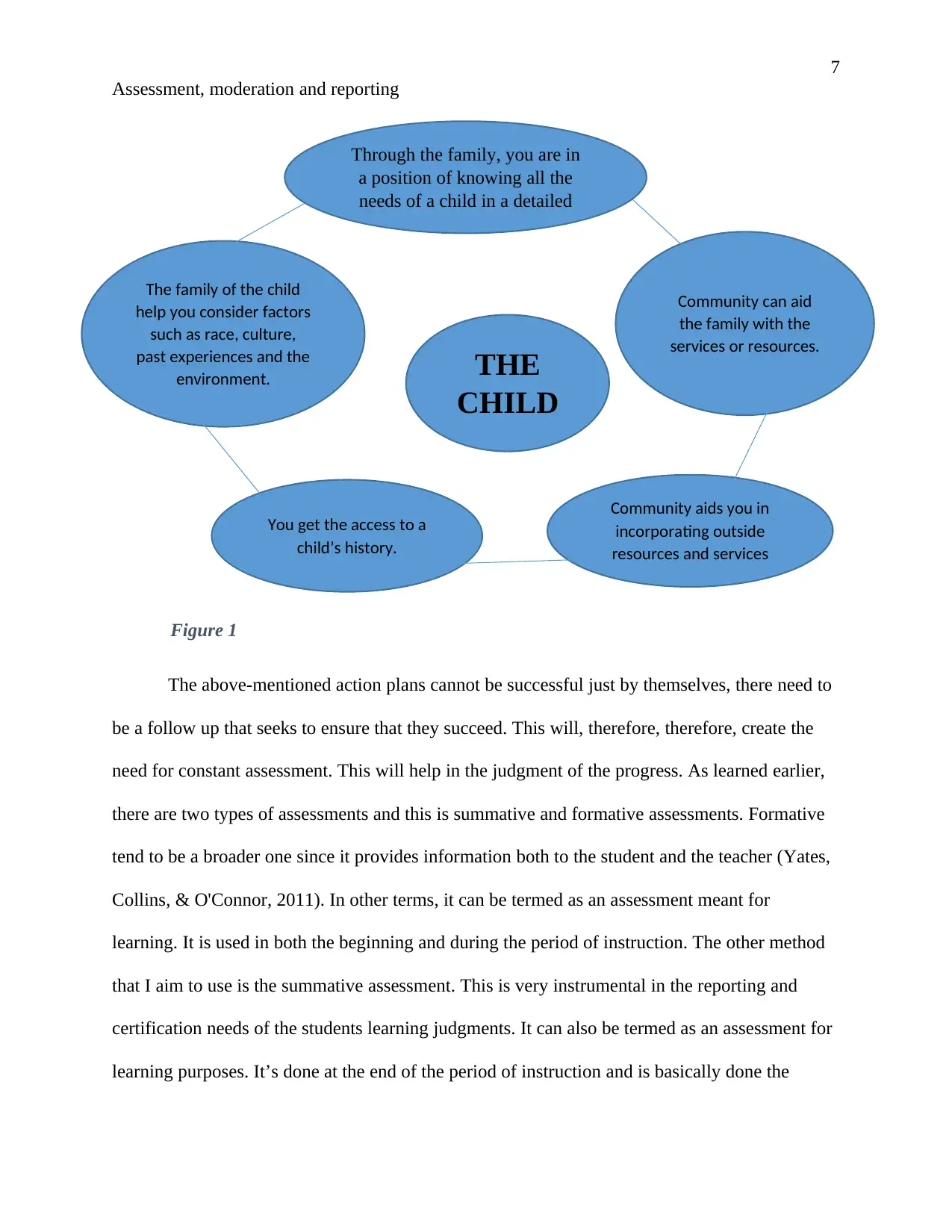
secret will be using of her parents in the learning process. They help a lot as they act as a catalyst
in the process. The diagram below explains it all.
Document Page
7
Assessment, moderation and reporting
The above-mentioned action plans cannot be successful just by themselves, there need to
be a follow up that seeks to ensure that they succeed. This will, therefore, therefore, create the
need for constant assessment. This will help in the judgment of the progress. As learned earlier,
there are two types of assessments and this is summative and formative assessments. Formative
tend to be a broader one since it provides information both to the student and the teacher (Yates,
Collins, & O'Connor, 2011). In other terms, it can be termed as an assessment meant for
learning. It is used in both the beginning and during the period of instruction. The other method
that I aim to use is the summative assessment. This is very instrumental in the reporting and
certification needs of the students learning judgments. It can also be termed as an assessment for
learning purposes. It’s done at the end of the period of instruction and is basically done the
THE
CHILD
The family of the child
help you consider factors
such as race, culture,
past experiences and the
environment.
Community can aid
the family with the
services or resources.
You get the access to a
child’s history.
Community aids you in
incorporating outside
resources and services
Figure 1
Through the family, you are in
a position of knowing all the
needs of a child in a detailed
manner
tabler-icon-diamond-filled.svg

Paraphrase This Document

Need a fresh take? Get an instant paraphrase of this document with our AI Paraphraser
Document Page
8
Assessment, moderation and reporting
teacher collecting the cumulative achievements of the child. These assessments, however, need
to be applied with aid of some special strategies to ensure they bare some fruits. In the area of the
formative assessment, some of the strategies that will be appropriate will be an authentic task.
This is activities that are both genuine and very purposeful. This may include involving the child
in shopping to see that he gains the ability to calculate using money values. The other strategy
will be the use of conferences where both the parent and the child are involved in assessing the
child’s progress. In the summative assessment, the best strategy will be to come up with
checklists or even uses the one provided by the curriculum to assess the student’s achievement.
The above-mentioned assessments and strategies are very useful in the assessment and
reporting and moderation of a given school. There has been a problem of schools having an
unreliable and invalid strategy that leaves them in a worse position than they were in previously.
This brings the need of ensuring that any of the strategies meet these requirements before they
are implemented (Watt, 2005). To start with, the formative assessment, I have assigned it the
most appropriate strategies that can be done with ease and without any hindrance. In other
words, the strategies are very actionable. The first one is the use of an authentic task. As it is
known, children do not spend all their entire time in the classroom and therefore there is a need
for utilizing the time they use in other activities as well. This strategy makes it possible even for
parents to be part of the assessment. The other strategy of the same assessment is the use of
conferences with both the parents and the students. As mentioned earlier, parents are very key to
the learning process of the child and therefore their inclusion would mean a simplified process
(Papic, Mulligan, & Mitchelmore, 2011). The other assessment will be the use of summative
and it comes handy with the strategy of using a checklist that takes into consideration the
students need. This is one of the most reliable and valid strategies as the checklist is made in
Document Page
9
Assessment, moderation and reporting
consideration of the student level and capability. All said and done, these strategies are valid and
reliable to be used in a school set up during the assessment, reporting and moderation activity.
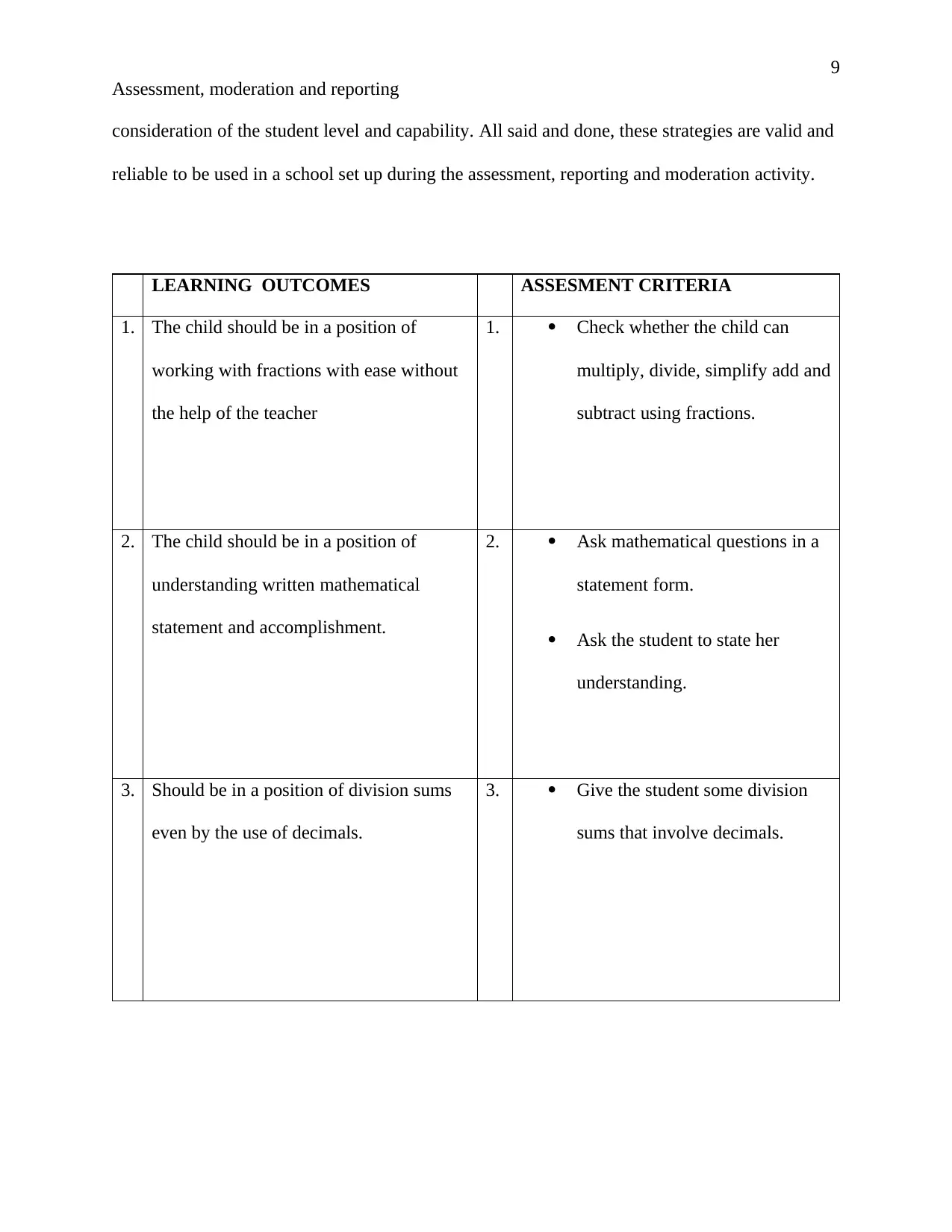
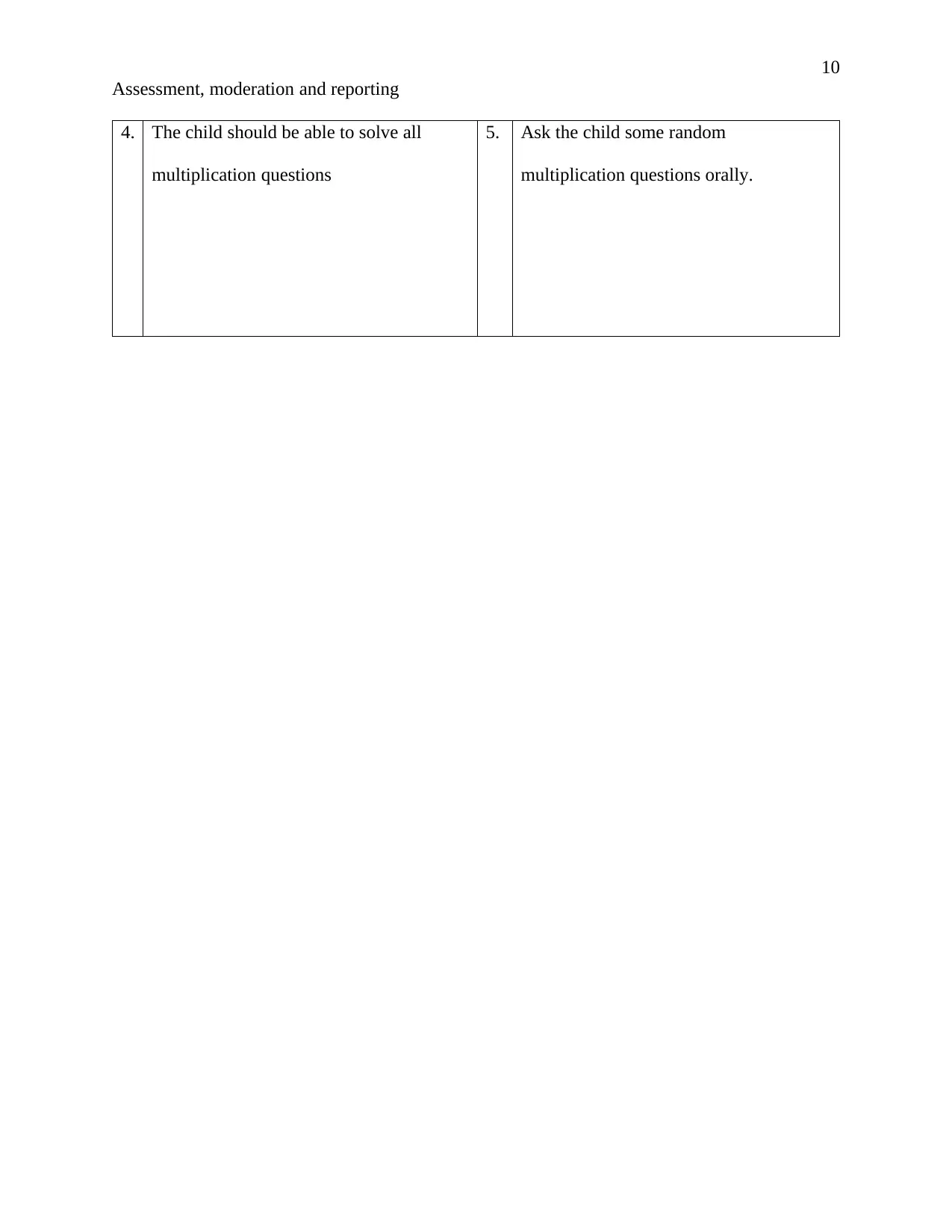
LEARNING OUTCOMES ASSESMENT CRITERIA
1. The child should be in a position of
working with fractions with ease without
the help of the teacher
1. Check whether the child can
multiply, divide, simplify add and
subtract using fractions.
2. The child should be in a position of
understanding written mathematical
statement and accomplishment.
2. Ask mathematical questions in a
statement form.
Ask the student to state her
understanding.
3. Should be in a position of division sums
even by the use of decimals.
3. Give the student some division
sums that involve decimals.
Document Page
10
Assessment, moderation and reporting
4. The child should be able to solve all
multiplication questions
5. Ask the child some random
multiplication questions orally.
tabler-icon-diamond-filled.svg

Paraphrase This Document

Need a fresh take? Get an instant paraphrase of this document with our AI Paraphraser
Document Page
11
Assessment, moderation and reporting
References
Brindley, G. (1998). Outcomes-based assessment and reporting in language learning
programmes: A review of the issues. Language Testing, 15(1), 45-85.
Cumming, J. J., & Maxwell, G. S. (2004). Assessment in Australian schools: Current practice
and trends. Assessment in Educa
Klenowski, V. (2011). Assessment for learning in the accountability era: Queensland, Australia.
Studies in Educational Evaluation, 37(1), 78-83.
Klenowski, V., & Wyatt-Smith, C. (2010). Standards, teacher judgement, and moderation in
contexts of the national curriculum and assessment reform. Assessment Matters, 2, 107-
131.
Lindberg, S. M., Hyde, J. S., Petersen, J. L., & Linn, M. C. (2010). New trends in gender and
mathematics performance: a meta-analysis. Psychological Bulletin, 136(6), 1123.
Maxwell, G. S. (2002). Moderation of teacher judgments in student assessment.
Papic, M. M., Mulligan, J. T., & Mitchelmore, M. C. (2011). Assessing the development of
preschoolers' mathematical patterning. Journal for Research in Mathematics Education,
42(3), 237-269.
Rowe, K. J., & Hill, P. W. (1996). Assessing, recording and reporting on students’ educational
progress: The case for ‘Subject Profiles’. Assessment in Education: Principles, Policy &
Practice, 3(3), 309-352.
Document Page
12
Assessment, moderation and reporting
Watt, H. M. (2005). Attitudes to the use of alternative assessment methods in mathematics: A
study with secondary mathematics teachers in Sydney, Australia. Educational studies in
mathematics, 58(1), 21-44.
Yates, L., Collins, C. W., & O'Connor, K. (2011). Australia's curriculum dilemmas: State
cultures and the big issues. Carlton: Melbourne University Publishing.
chevron_up_icon
1 out of 12
circle_padding
hide_on_mobile
zoom_out_icon
[object Object]