Procurement Management Report: Networking and Relationship Analysis
VerifiedAdded on 2022/10/04
|15
|3039
|18
Report
AI Summary
This report provides a comprehensive analysis of procurement management, focusing on the construction industry. It explores the significance of networking and relationships between organizations involved in projects, particularly in the context of engineering asset construction like bridges. The report delves into the four phases of project procurement contracts: initiation, planning, execution, and closure. It highlights the potential for conflicts arising from differing interests among project partners and emphasizes the importance of constant communication for fostering healthy networking relationships. The analysis draws on the theory of networks and inter-organizational relationships, examining the procurement and contract management processes, including feasibility studies, project governance, and supply chain management. The report evaluates the behavioral aspects of project partners, such as the motivation for quality asset creation and profit-making motives, which can lead to conflicts. It concludes by emphasizing the validity of the findings and the importance of efficient project governance and communication in mitigating conflicts and ensuring successful project outcomes.
Running head: PROCUREMENT MANAGEMENT
Procurement Management
Name of the Student:
Name of the University:
Author Note:
Procurement Management
Name of the Student:
Name of the University:
Author Note:

Paraphrase This Document
Need a fresh take? Get an instant paraphrase of this document with our AI Paraphraser
1
PROCUREMENT MANAGEMENT
Executive Summary:
The report revolves around the concepts of networking and relationships which organisations
involved in projects hold among themselves. The report below shows that the construction of
engineering assets like bridges calls for project partnerships between the project owners which
includes government bodies and project management companies. The second salient aspect
which the reports reveals that the project procurement contracts in general consists of four phases
namely, project initiation, project planning, project execution and project closure. The second
salient fact uncovered in the report is that parties to the PPs often enter into conflicts due to clash
of interests. The final finding is that the parties to the projects should maintain constant
communication among themselves in order to ensure healthy networking relationship.
PROCUREMENT MANAGEMENT
Executive Summary:
The report revolves around the concepts of networking and relationships which organisations
involved in projects hold among themselves. The report below shows that the construction of
engineering assets like bridges calls for project partnerships between the project owners which
includes government bodies and project management companies. The second salient aspect
which the reports reveals that the project procurement contracts in general consists of four phases
namely, project initiation, project planning, project execution and project closure. The second
salient fact uncovered in the report is that parties to the PPs often enter into conflicts due to clash
of interests. The final finding is that the parties to the projects should maintain constant
communication among themselves in order to ensure healthy networking relationship.
2
PROCUREMENT MANAGEMENT
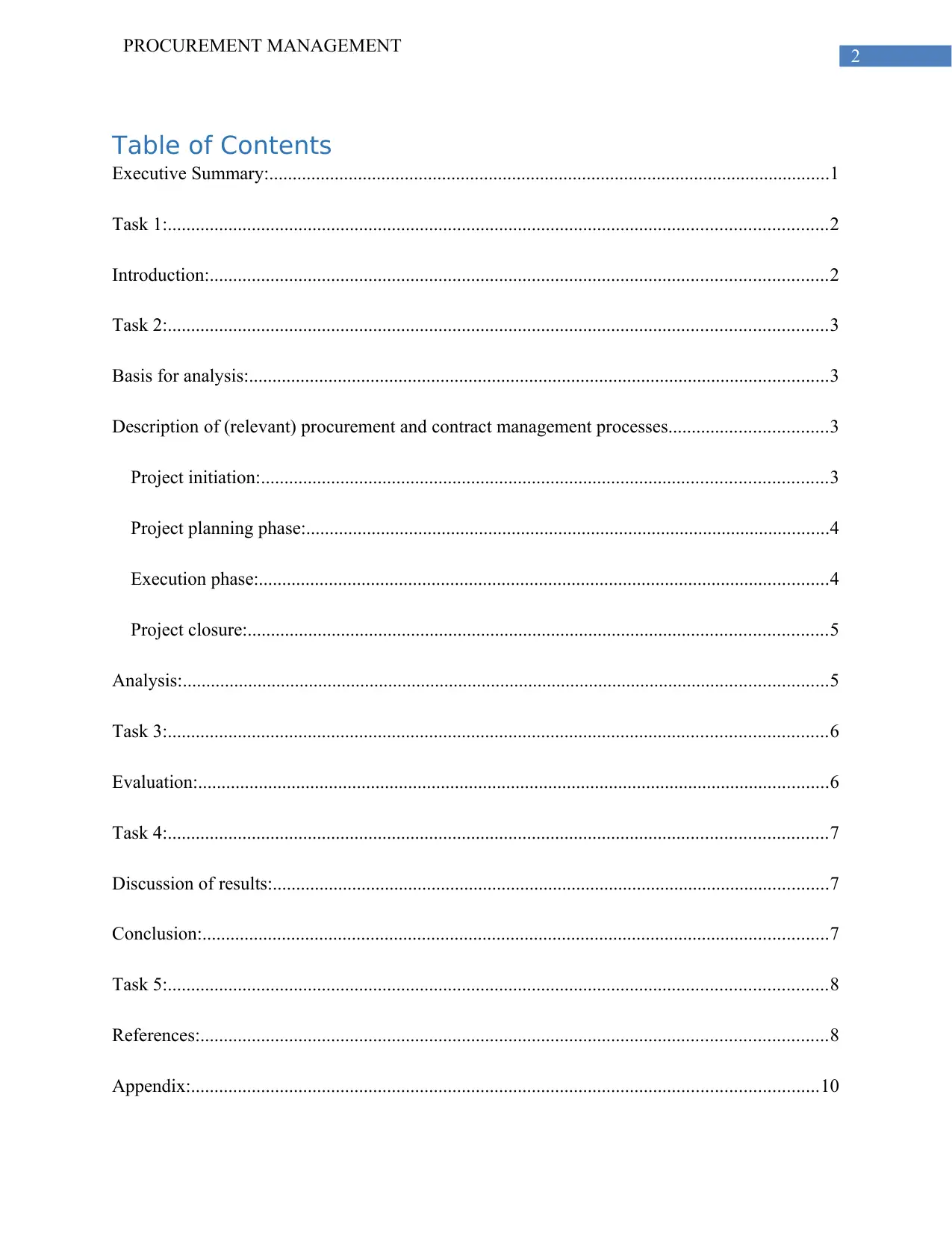
Table of Contents
Executive Summary:........................................................................................................................1
Task 1:.............................................................................................................................................2
Introduction:....................................................................................................................................2
Task 2:.............................................................................................................................................3
Basis for analysis:............................................................................................................................3
Description of (relevant) procurement and contract management processes..................................3
Project initiation:.........................................................................................................................3
Project planning phase:................................................................................................................4
Execution phase:..........................................................................................................................4
Project closure:............................................................................................................................5
Analysis:..........................................................................................................................................5
Task 3:.............................................................................................................................................6
Evaluation:.......................................................................................................................................6
Task 4:.............................................................................................................................................7
Discussion of results:.......................................................................................................................7
Conclusion:......................................................................................................................................7
Task 5:.............................................................................................................................................8
References:......................................................................................................................................8
Appendix:......................................................................................................................................10
PROCUREMENT MANAGEMENT
Table of Contents
Executive Summary:........................................................................................................................1
Task 1:.............................................................................................................................................2
Introduction:....................................................................................................................................2
Task 2:.............................................................................................................................................3
Basis for analysis:............................................................................................................................3
Description of (relevant) procurement and contract management processes..................................3
Project initiation:.........................................................................................................................3
Project planning phase:................................................................................................................4
Execution phase:..........................................................................................................................4
Project closure:............................................................................................................................5
Analysis:..........................................................................................................................................5
Task 3:.............................................................................................................................................6
Evaluation:.......................................................................................................................................6
Task 4:.............................................................................................................................................7
Discussion of results:.......................................................................................................................7
Conclusion:......................................................................................................................................7
Task 5:.............................................................................................................................................8
References:......................................................................................................................................8
Appendix:......................................................................................................................................10
⊘ This is a preview!⊘
Do you want full access?
Subscribe today to unlock all pages.

Trusted by 1+ million students worldwide
3
PROCUREMENT MANAGEMENT
Task 1:
Introduction:
Business organisations in order to execute projects, especially complex projects depend
on their respective business networks and enter into relationship with other organisations.
Havenvid, Håkansson and Linné (2016) mentions that companies often renew and expand their
business network in order to carry out projects. The article also mentions that the companies
enter into PP with organisations based on contracts The relationship between these companies
are based on procurement contracts which dictate the terms and conditions regarding the project
execution. Cicmil and Marshall (2005) enrich the discussion by pointing out large scale projects
like construction projects require complex project execution processes. These networking and
relationship building with companies several advantages like innovation, pooling of resources
and diversification of risks involved in the project execution. Ey, Zuo and Han (2014) though do
not contradict the advantages which the project partnership ushers, point out that successful
project partnership execution fails due to dispute among the partners involved. Cheung and
Rowlinson (2011) put forth the point that project partners can counteract the challenges to
efficient partnerships by maintaining transparent communication among themselves. In other
words, the article hints at the broader context of stakeholder management in order to ensure
success of PPs. The essence of the PPs in ensuring successful project procurement and the
impending challenges have motivated to carry on the research. The research would aim to
achieve two main objectives. The first objective would be exploring the procurement and
contract management process. The second objective would be analysing the factors which go
into make procurement and contract management functions. The main theory on which the
PROCUREMENT MANAGEMENT
Task 1:
Introduction:
Business organisations in order to execute projects, especially complex projects depend
on their respective business networks and enter into relationship with other organisations.
Havenvid, Håkansson and Linné (2016) mentions that companies often renew and expand their
business network in order to carry out projects. The article also mentions that the companies
enter into PP with organisations based on contracts The relationship between these companies
are based on procurement contracts which dictate the terms and conditions regarding the project
execution. Cicmil and Marshall (2005) enrich the discussion by pointing out large scale projects
like construction projects require complex project execution processes. These networking and
relationship building with companies several advantages like innovation, pooling of resources
and diversification of risks involved in the project execution. Ey, Zuo and Han (2014) though do
not contradict the advantages which the project partnership ushers, point out that successful
project partnership execution fails due to dispute among the partners involved. Cheung and
Rowlinson (2011) put forth the point that project partners can counteract the challenges to
efficient partnerships by maintaining transparent communication among themselves. In other
words, the article hints at the broader context of stakeholder management in order to ensure
success of PPs. The essence of the PPs in ensuring successful project procurement and the
impending challenges have motivated to carry on the research. The research would aim to
achieve two main objectives. The first objective would be exploring the procurement and
contract management process. The second objective would be analysing the factors which go
into make procurement and contract management functions. The main theory on which the
Paraphrase This Document
Need a fresh take? Get an instant paraphrase of this document with our AI Paraphraser
4
PROCUREMENT MANAGEMENT
entire work would be based would be networks and inter-organisational relationships
theory. The research would concentrate on procurement and contract management
functions prevailing in the construction industry in order to make the research more
specific. This funnelling down the research would lead to a uncovering more specific findings.
The structure of the research would be bifurcated into two sections namely, analysis of the PPs
projects and the evaluation of the outcomes which are likely to be achieved. These would be
followed by establishment of the validity of the results and concluding the research. The relevant
area of procurement and contract management would refer to the process
Task 2:
Basis for analysis:
Description of (relevant) procurement and contract management processes.
The following are the steps which form the procurement and contract management
process in the construction projects:
Plan procurement:
The procurement firm should conduct the procurement activities prior to starting projects
undertaken. The project procurement process starts with feasibility analyses of the project in
terms of finance, technology, technology and environmental conditions. The project management
companies or the agents conduct financial feasibility analyses of the projects based on the project
documents issued by the owners of the projects concerned. Børve et al. (2017) can be iterated in
this respect mention that project management companies identify the risks which they may face
while commencing the projects. For example, the sites of construction of bridges over rivers
being close to the rivers are prone to flooding. Similarly, the construction sites if located in areas
PROCUREMENT MANAGEMENT
entire work would be based would be networks and inter-organisational relationships
theory. The research would concentrate on procurement and contract management
functions prevailing in the construction industry in order to make the research more
specific. This funnelling down the research would lead to a uncovering more specific findings.
The structure of the research would be bifurcated into two sections namely, analysis of the PPs
projects and the evaluation of the outcomes which are likely to be achieved. These would be
followed by establishment of the validity of the results and concluding the research. The relevant
area of procurement and contract management would refer to the process
Task 2:
Basis for analysis:
Description of (relevant) procurement and contract management processes.
The following are the steps which form the procurement and contract management
process in the construction projects:
Plan procurement:
The procurement firm should conduct the procurement activities prior to starting projects
undertaken. The project procurement process starts with feasibility analyses of the project in
terms of finance, technology, technology and environmental conditions. The project management
companies or the agents conduct financial feasibility analyses of the projects based on the project
documents issued by the owners of the projects concerned. Børve et al. (2017) can be iterated in
this respect mention that project management companies identify the risks which they may face
while commencing the projects. For example, the sites of construction of bridges over rivers
being close to the rivers are prone to flooding. Similarly, the construction sites if located in areas
5
PROCUREMENT MANAGEMENT
without sufficiently broad roads would pose impediments in mobilisation of materials, personnel
and plant and machinery. The project procurement companies have to make important decisions
like whether the materials have to procured or purchased from the suppliers. Cheung and
Rowlinson (2011) point out that project management companies consider these supply chain
related aspects while conducting feasibility analyses of the projects prior taking them up.
Similarly, the companies consider the technological feasibility of the projects like availability of
internet connections and online payment gateways to make spot payments to suppliers. The
project management companies on establishment of the positive feasibility, embark on
submitting the project initiation document or PID. The project initiation document mentions that
project plans and the ways in which the projects concerned would be executed in collaboration of
the project partners. Manu et al. (2015) mention in this respect that, ‘Trust is crucial for
achieving optimum benefits from supply chain integration and collaboration in the construction
sector.’ The authors in supports Cheung and Rowlinson (2011). It can be established upon
analysis of the two articles that PID plays the significant role in establishment of continuous
communication between the parties to the concerned PP.
Conduct procurement:
The project procurement companies have to conduct procurement activities. Bekker
(2014) sheds light on the importance of project governance in order to minimise the conflicts of
interests between the parties to the project procurement. The project planning phase breaks down
the entire plan into different parts namely, milestones and breakups of the milestones. The
project management companies have to consider their existing network of suppliers and the
prevailing level of relationship with them like whether these companies would collaborate
readily or an already in conflict with them. They have to decide on important aspects regarding
PROCUREMENT MANAGEMENT
without sufficiently broad roads would pose impediments in mobilisation of materials, personnel
and plant and machinery. The project procurement companies have to make important decisions
like whether the materials have to procured or purchased from the suppliers. Cheung and
Rowlinson (2011) point out that project management companies consider these supply chain
related aspects while conducting feasibility analyses of the projects prior taking them up.
Similarly, the companies consider the technological feasibility of the projects like availability of
internet connections and online payment gateways to make spot payments to suppliers. The
project management companies on establishment of the positive feasibility, embark on
submitting the project initiation document or PID. The project initiation document mentions that
project plans and the ways in which the projects concerned would be executed in collaboration of
the project partners. Manu et al. (2015) mention in this respect that, ‘Trust is crucial for
achieving optimum benefits from supply chain integration and collaboration in the construction
sector.’ The authors in supports Cheung and Rowlinson (2011). It can be established upon
analysis of the two articles that PID plays the significant role in establishment of continuous
communication between the parties to the concerned PP.
Conduct procurement:
The project procurement companies have to conduct procurement activities. Bekker
(2014) sheds light on the importance of project governance in order to minimise the conflicts of
interests between the parties to the project procurement. The project planning phase breaks down
the entire plan into different parts namely, milestones and breakups of the milestones. The
project management companies have to consider their existing network of suppliers and the
prevailing level of relationship with them like whether these companies would collaborate
readily or an already in conflict with them. They have to decide on important aspects regarding
⊘ This is a preview!⊘
Do you want full access?
Subscribe today to unlock all pages.
Trusted by 1+ million students worldwide
6
PROCUREMENT MANAGEMENT
the project execution. For example, they have to make decisions regarding whether to centralise
or decentralise their procurement processes. The project managers assign costs and time to each
breakup which ultimately tantamount to the execution of the concerned milestone. Pala et al.
(2014) point that project managers while planning for the project undertaken have to consider the
partners concerned, the markets (local and foreign markets) and supply chain aspects (Ey, Zuo
and Han 2014). The project plans are monitored and controlled using tools like Microsoft project
and Gantt chart. Kraljic portfolio purchasing matrix is also used by the project managers to plan
procurement especially in case of multi-layered projects. The procurement function can take
either leverage approach in which the procurement is decentralised or strategic approach
according to which procurement is largely de-centralised. The procurement managers have to
ensure that the the procurement activities commence as per the contracts. They have to ensure
that products (raw materials) are delivered as per requirement of the project. They should
maintain continuous communication between the vendor and the purchaser of the projects or the
project owner. The contract administration should commence as per the spirit and sections of the
project.
PROCUREMENT MANAGEMENT
the project execution. For example, they have to make decisions regarding whether to centralise
or decentralise their procurement processes. The project managers assign costs and time to each
breakup which ultimately tantamount to the execution of the concerned milestone. Pala et al.
(2014) point that project managers while planning for the project undertaken have to consider the
partners concerned, the markets (local and foreign markets) and supply chain aspects (Ey, Zuo
and Han 2014). The project plans are monitored and controlled using tools like Microsoft project
and Gantt chart. Kraljic portfolio purchasing matrix is also used by the project managers to plan
procurement especially in case of multi-layered projects. The procurement function can take
either leverage approach in which the procurement is decentralised or strategic approach
according to which procurement is largely de-centralised. The procurement managers have to
ensure that the the procurement activities commence as per the contracts. They have to ensure
that products (raw materials) are delivered as per requirement of the project. They should
maintain continuous communication between the vendor and the purchaser of the projects or the
project owner. The contract administration should commence as per the spirit and sections of the
project.
Paraphrase This Document
Need a fresh take? Get an instant paraphrase of this document with our AI Paraphraser
7
PROCUREMENT MANAGEMENT
Figure 1. Kraljic portfolio purchasing matrix
(Source: Kraljic, P. 1983)
Control procurement:
The procurement companies have to control procurement in order to ensure successful
execution of the project. Tennant and Fernie (2012) point out that the construction projects
require mobilisation of immense amount material resources, labour, advanced plants and
machinery, all of which attract immense cost. The construction projects today work in extremely
volatile environmental conditions. Walker, Hampson and Peters (2002) further deepen the
PROCUREMENT MANAGEMENT
Figure 1. Kraljic portfolio purchasing matrix
(Source: Kraljic, P. 1983)
Control procurement:
The procurement companies have to control procurement in order to ensure successful
execution of the project. Tennant and Fernie (2012) point out that the construction projects
require mobilisation of immense amount material resources, labour, advanced plants and
machinery, all of which attract immense cost. The construction projects today work in extremely
volatile environmental conditions. Walker, Hampson and Peters (2002) further deepen the
8
PROCUREMENT MANAGEMENT
research to point out that volatility in the construction projects also account due to
macroeconomic conditions in which the projects take place. The authors substantiate their claim
by drawing example from the American economy which in general provides favourable market
conditions to project management companies. An analyses of the two articles point out that the
procurement project managers have to control two areas in order to ensure efficient execution
as per the PP procurement contract namely, execution and project monitoring. Bekker (2014) can
be iterated here to point out that efficient project execution and monitoring results in efficient
project governance. This in turn reduces the scopes of conflicts of interests among the partners
(Ey, Zuo and Han 2014). This stage also includes appropriate management of the risks so as to
minimise their impact on the projects under commencement. The procurement managers should
seek improvement in the procurement function at all the stages in order to enhance the efficiency
of the project as a whole. The entire procurement process should be assessed on continual basis.
The managers should manage the changes in efficient manners which may surface owing to
changes in the activities, requirements and raw materials available.
Close procurement:
This stage consists of the closing of the project procured by delivering the projects to the
owner of the respective projects. They recognise the part(s) of the projects which are unfinished
or unachieved. The project managers then submit the final report to the principles or the project
owners concerned. They also present the financial claims due along with the supporting
documents to support their claims (Ey, Zuo and Han 2014) (Appendix).
Analysis:
The analysis of the procurement and contract management steps on the basis of the
articles mentioned above uncover several findings. First of all, the construction projects
PROCUREMENT MANAGEMENT
research to point out that volatility in the construction projects also account due to
macroeconomic conditions in which the projects take place. The authors substantiate their claim
by drawing example from the American economy which in general provides favourable market
conditions to project management companies. An analyses of the two articles point out that the
procurement project managers have to control two areas in order to ensure efficient execution
as per the PP procurement contract namely, execution and project monitoring. Bekker (2014) can
be iterated here to point out that efficient project execution and monitoring results in efficient
project governance. This in turn reduces the scopes of conflicts of interests among the partners
(Ey, Zuo and Han 2014). This stage also includes appropriate management of the risks so as to
minimise their impact on the projects under commencement. The procurement managers should
seek improvement in the procurement function at all the stages in order to enhance the efficiency
of the project as a whole. The entire procurement process should be assessed on continual basis.
The managers should manage the changes in efficient manners which may surface owing to
changes in the activities, requirements and raw materials available.
Close procurement:
This stage consists of the closing of the project procured by delivering the projects to the
owner of the respective projects. They recognise the part(s) of the projects which are unfinished
or unachieved. The project managers then submit the final report to the principles or the project
owners concerned. They also present the financial claims due along with the supporting
documents to support their claims (Ey, Zuo and Han 2014) (Appendix).
Analysis:
The analysis of the procurement and contract management steps on the basis of the
articles mentioned above uncover several findings. First of all, the construction projects
⊘ This is a preview!⊘
Do you want full access?
Subscribe today to unlock all pages.
Trusted by 1+ million students worldwide
9
PROCUREMENT MANAGEMENT
commence under extremely volatile market conditions. Secondly, the procurement companies
concerned have to conduct feasibility tests to ensure that the projects under study are feasible in
the given conditions. Thirdly, the parties involved in project partnerships are often engaged in
conflicts due to clash of interests. Fourthly, efficient project governance and continuous
communication between the parties can contribute towards minimising the scope of conflict
among the parties to a great extent. An analysis of the articles taken into consideration to conduct
the research throw light upon several crucial aspects like the very theory of the PPs, conflicts of
interests among the parties, project governance and supply chain management. However, the
articles do not shed light on several significant concepts which could have enriched the research
like corporate social responsibility and stakeholder management. It can be also be pointed out
that the managers can use appropriate methods to resolve the issues pointed out. For example,
regular meetings between the project owners and suppliers can improve understanding between
the two parties and reduce conflicts.
Task 3:
Evaluation:
It can be evaluated from the outcome of the above analysis that several factors are
responsible for the behaviour of the parties to procurement construction projects. The first
behavioural aspect which comes to the forefront is the need among the principles to procure
projects is to gain high quality creation of assets like bridges and roads. Erdogan, Šaparauskas
and Turskis (2017) evaluates this behavioural aspect by pointing out that the project owners
usually governments are motivated to float the engineering asset creation projects to bring about
economic development in the countries under their domination. The second behavioural aspect
which surfaces upon analysis is profit making motives among both the parties. For example, the
PROCUREMENT MANAGEMENT
commence under extremely volatile market conditions. Secondly, the procurement companies
concerned have to conduct feasibility tests to ensure that the projects under study are feasible in
the given conditions. Thirdly, the parties involved in project partnerships are often engaged in
conflicts due to clash of interests. Fourthly, efficient project governance and continuous
communication between the parties can contribute towards minimising the scope of conflict
among the parties to a great extent. An analysis of the articles taken into consideration to conduct
the research throw light upon several crucial aspects like the very theory of the PPs, conflicts of
interests among the parties, project governance and supply chain management. However, the
articles do not shed light on several significant concepts which could have enriched the research
like corporate social responsibility and stakeholder management. It can be also be pointed out
that the managers can use appropriate methods to resolve the issues pointed out. For example,
regular meetings between the project owners and suppliers can improve understanding between
the two parties and reduce conflicts.
Task 3:
Evaluation:
It can be evaluated from the outcome of the above analysis that several factors are
responsible for the behaviour of the parties to procurement construction projects. The first
behavioural aspect which comes to the forefront is the need among the principles to procure
projects is to gain high quality creation of assets like bridges and roads. Erdogan, Šaparauskas
and Turskis (2017) evaluates this behavioural aspect by pointing out that the project owners
usually governments are motivated to float the engineering asset creation projects to bring about
economic development in the countries under their domination. The second behavioural aspect
which surfaces upon analysis is profit making motives among both the parties. For example, the
Paraphrase This Document
Need a fresh take? Get an instant paraphrase of this document with our AI Paraphraser
10
PROCUREMENT MANAGEMENT
project owners aim to show that the project management companies have breached the
predetermined construction processes, time, laws or all of them to impose penal charges on them.
The project management companies aim to counteract the claims of the project owners to ensure
generation of maximum revenue. These scenarios of clashes of interests between the parties
based on financial outcomes lead to conflicts of interests among them.
Task 4:
Discussion of results:
The results or findings from the research are important and valid because they throw light
on the several aspects of networking and relationship between organisations involved in projects
in the construction industry. The issue which would limit the acceptability of the research is that
articles taken into consideration to conduct the research did not consider the key theories like
CSR theory and stakeholder theory. The issues which remained unresolved at the end of the
research are appropriate methods which could be used to resolve conflicts among the parties and
manage risks which construction projects face.
Conclusion:
The detailed discussions carried on above lead to uncovering of several key findings
pertaining to the networking and relationship between bodies involved in procurement and
contract management processes and phases. The first finding is that several business
organisations and government bodies collaborate to execute high level engineering asset creation
projects which require them to share strong relationships among themselves. The second finding
is that the parties to the PP projects often enter into conflicts due to clash of interests. The fourth
PROCUREMENT MANAGEMENT
project owners aim to show that the project management companies have breached the
predetermined construction processes, time, laws or all of them to impose penal charges on them.
The project management companies aim to counteract the claims of the project owners to ensure
generation of maximum revenue. These scenarios of clashes of interests between the parties
based on financial outcomes lead to conflicts of interests among them.
Task 4:
Discussion of results:
The results or findings from the research are important and valid because they throw light
on the several aspects of networking and relationship between organisations involved in projects
in the construction industry. The issue which would limit the acceptability of the research is that
articles taken into consideration to conduct the research did not consider the key theories like
CSR theory and stakeholder theory. The issues which remained unresolved at the end of the
research are appropriate methods which could be used to resolve conflicts among the parties and
manage risks which construction projects face.
Conclusion:
The detailed discussions carried on above lead to uncovering of several key findings
pertaining to the networking and relationship between bodies involved in procurement and
contract management processes and phases. The first finding is that several business
organisations and government bodies collaborate to execute high level engineering asset creation
projects which require them to share strong relationships among themselves. The second finding
is that the parties to the PP projects often enter into conflicts due to clash of interests. The fourth
11
PROCUREMENT MANAGEMENT
finding is that smooth communication and project governance can enable the parties to minimise
the conflicts of interests to a great extent.
PROCUREMENT MANAGEMENT
finding is that smooth communication and project governance can enable the parties to minimise
the conflicts of interests to a great extent.
⊘ This is a preview!⊘
Do you want full access?
Subscribe today to unlock all pages.
Trusted by 1+ million students worldwide

1 out of 15


Related Documents


Your All-in-One AI-Powered Toolkit for Academic Success.
+13062052269
info@desklib.com
Available 24*7 on WhatsApp / Email
![[object Object]](/_next/static/media/star-bottom.7253800d.svg)
Unlock your academic potential
Copyright © 2020–2026 A2Z Services. All Rights Reserved. Developed and managed by ZUCOL.