Accounting Assignment: Financial Accounting and Management Accounting
VerifiedAdded on 2022/10/11
|16
|2802
|40
Homework Assignment
AI Summary
This accounting assignment solution covers key concepts in financial and management accounting. It begins with an overview of accounting principles, scope, and the preparation of financial statements like income statements and balance sheets. The solution then delves into management accounting tools, including breakeven analysis, variance analysis, and budgeting techniques. The assignment further explores cost accounting principles, cost classification, and the relationship between accounting and finance. The solution provides detailed explanations, calculations, and examples to illustrate these concepts, offering a thorough understanding of accounting fundamentals and their practical applications. References are included for each concept covered, and a detailed analysis of each question is provided.
Running head: ACCOUNTING
Accounting
Name of the Student:
Name of the University:
Author’s Note:
Accounting
Name of the Student:
Name of the University:
Author’s Note:

Paraphrase This Document
Need a fresh take? Get an instant paraphrase of this document with our AI Paraphraser
1ACCOUNTING
Table of Contents
Answer to question 1:......................................................................................................................3
Part a:...........................................................................................................................................3
Part b:...........................................................................................................................................4
Answer to question 2:......................................................................................................................6
Part a:...........................................................................................................................................6
Subpart i:..................................................................................................................................6
Subpart ii:.................................................................................................................................7
Part b:...........................................................................................................................................7
Answer to question 3:......................................................................................................................8
Part a:...........................................................................................................................................9
Part b:...........................................................................................................................................9
Part c:.........................................................................................................................................10
Answer to question 4:....................................................................................................................10
Part a:.........................................................................................................................................10
Part b:.........................................................................................................................................11
Answer to question 5:....................................................................................................................12
Answer to question 6:....................................................................................................................13
Part a:.........................................................................................................................................13
Part b:.........................................................................................................................................13
Table of Contents
Answer to question 1:......................................................................................................................3
Part a:...........................................................................................................................................3
Part b:...........................................................................................................................................4
Answer to question 2:......................................................................................................................6
Part a:...........................................................................................................................................6
Subpart i:..................................................................................................................................6
Subpart ii:.................................................................................................................................7
Part b:...........................................................................................................................................7
Answer to question 3:......................................................................................................................8
Part a:...........................................................................................................................................9
Part b:...........................................................................................................................................9
Part c:.........................................................................................................................................10
Answer to question 4:....................................................................................................................10
Part a:.........................................................................................................................................10
Part b:.........................................................................................................................................11
Answer to question 5:....................................................................................................................12
Answer to question 6:....................................................................................................................13
Part a:.........................................................................................................................................13
Part b:.........................................................................................................................................13

2ACCOUNTING
References and bibliography:........................................................................................................14
References and bibliography:........................................................................................................14
⊘ This is a preview!⊘
Do you want full access?
Subscribe today to unlock all pages.

Trusted by 1+ million students worldwide
3ACCOUNTING
Answer to question 1:
The first question focuses on the conceptual aspects of the financial accounting.
Accounting is an integrated and systematic process of recording transactions in the books of
accounts, classifying them, summarizing them based on relevancy and reporting transactions for
the financial information users. In the first part of this question, the concepts of accounting, its
scope and importance have been asked to describe. The second part of this question is aimed at
application of the knowledge of accounting and the knowledge of finalizing accounts and
preparing financial statements (Biereret al. 2015).
Part a:
Accounting can be defined as a continuous and systematic process of recording
transactions classifying them in according to their nature, summarizing them and preparing some
meaningful reports. Money is the common means of exchange, hence it can be converted into
anything. Therefore, there must be a track of cash inflows and outflows. Therefore, accounting is
the process, which keeps a track of all such inflows and outflows of money. It is also aimed at
comparing the inflows and outflows of money and money values and to ascertain the net result.
Accounting is not specifically meant for the business organization. Every such institutions or
happenings, where certain amount of money or money value is involved, the accounting process
can be applied to keep a proper track of all the inflow and outflow of money. Hence, the scope of
accounting is not a narrower one, rather it can be applied in each such contexts where some
monetary transactions are involved (Bobryshevet al. 2015).
In a business organization also in each segment of the business the accounting process
can be implemented as each process of a business organization involves certain monetary
Answer to question 1:
The first question focuses on the conceptual aspects of the financial accounting.
Accounting is an integrated and systematic process of recording transactions in the books of
accounts, classifying them, summarizing them based on relevancy and reporting transactions for
the financial information users. In the first part of this question, the concepts of accounting, its
scope and importance have been asked to describe. The second part of this question is aimed at
application of the knowledge of accounting and the knowledge of finalizing accounts and
preparing financial statements (Biereret al. 2015).
Part a:
Accounting can be defined as a continuous and systematic process of recording
transactions classifying them in according to their nature, summarizing them and preparing some
meaningful reports. Money is the common means of exchange, hence it can be converted into
anything. Therefore, there must be a track of cash inflows and outflows. Therefore, accounting is
the process, which keeps a track of all such inflows and outflows of money. It is also aimed at
comparing the inflows and outflows of money and money values and to ascertain the net result.
Accounting is not specifically meant for the business organization. Every such institutions or
happenings, where certain amount of money or money value is involved, the accounting process
can be applied to keep a proper track of all the inflow and outflow of money. Hence, the scope of
accounting is not a narrower one, rather it can be applied in each such contexts where some
monetary transactions are involved (Bobryshevet al. 2015).
In a business organization also in each segment of the business the accounting process
can be implemented as each process of a business organization involves certain monetary
Paraphrase This Document
Need a fresh take? Get an instant paraphrase of this document with our AI Paraphraser
4ACCOUNTING
transactions. Based on the department or the segment where the techniques of accounting is
implemented and applied it can be classified as financial accounting, management accounting,
cost accounting and corporate accounting (Brewer,Garrisonand Noreen2015).
Part b:
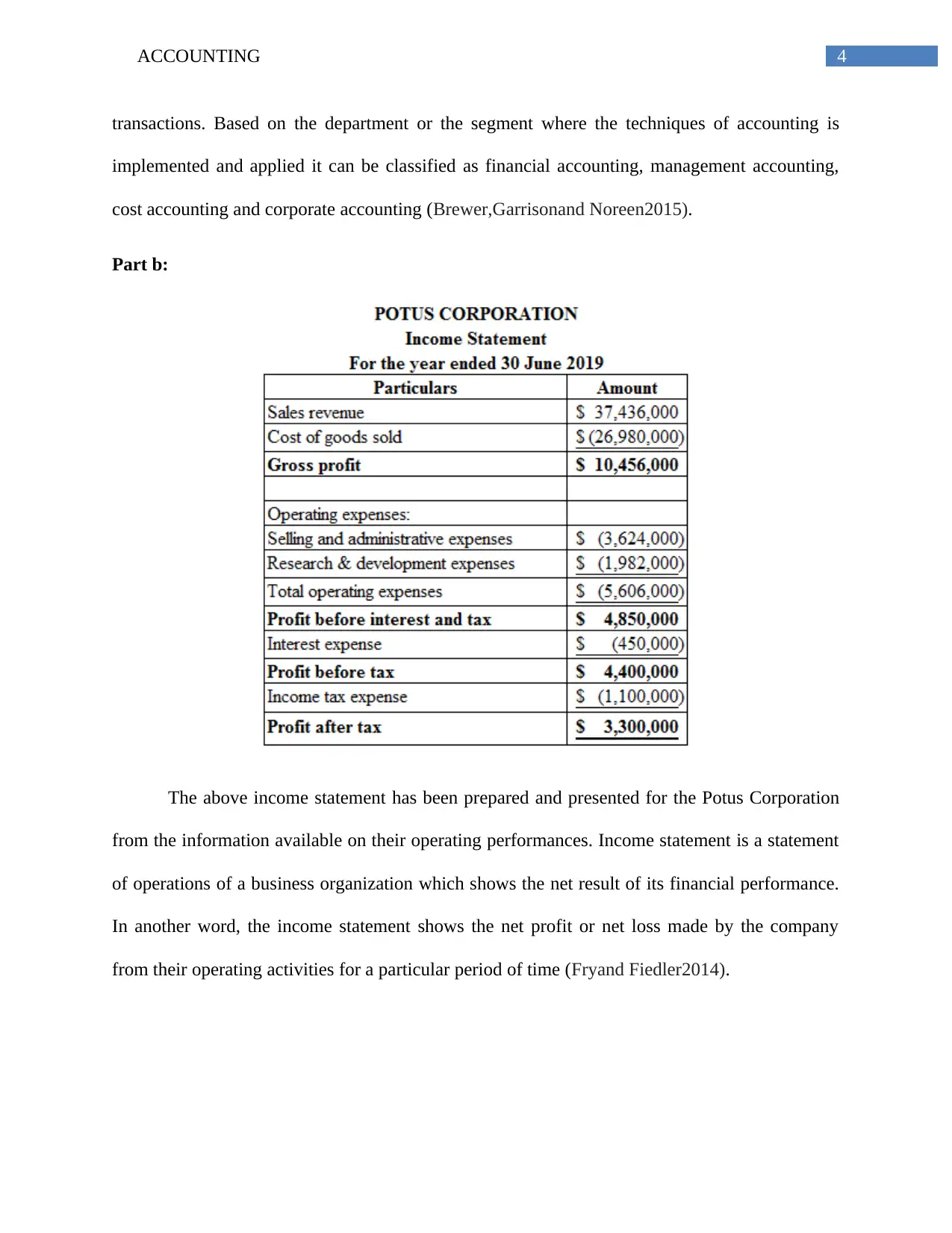
The above income statement has been prepared and presented for the Potus Corporation
from the information available on their operating performances. Income statement is a statement
of operations of a business organization which shows the net result of its financial performance.
In another word, the income statement shows the net profit or net loss made by the company
from their operating activities for a particular period of time (Fryand Fiedler2014).
transactions. Based on the department or the segment where the techniques of accounting is
implemented and applied it can be classified as financial accounting, management accounting,
cost accounting and corporate accounting (Brewer,Garrisonand Noreen2015).
Part b:
The above income statement has been prepared and presented for the Potus Corporation
from the information available on their operating performances. Income statement is a statement
of operations of a business organization which shows the net result of its financial performance.
In another word, the income statement shows the net profit or net loss made by the company
from their operating activities for a particular period of time (Fryand Fiedler2014).
5ACCOUNTING
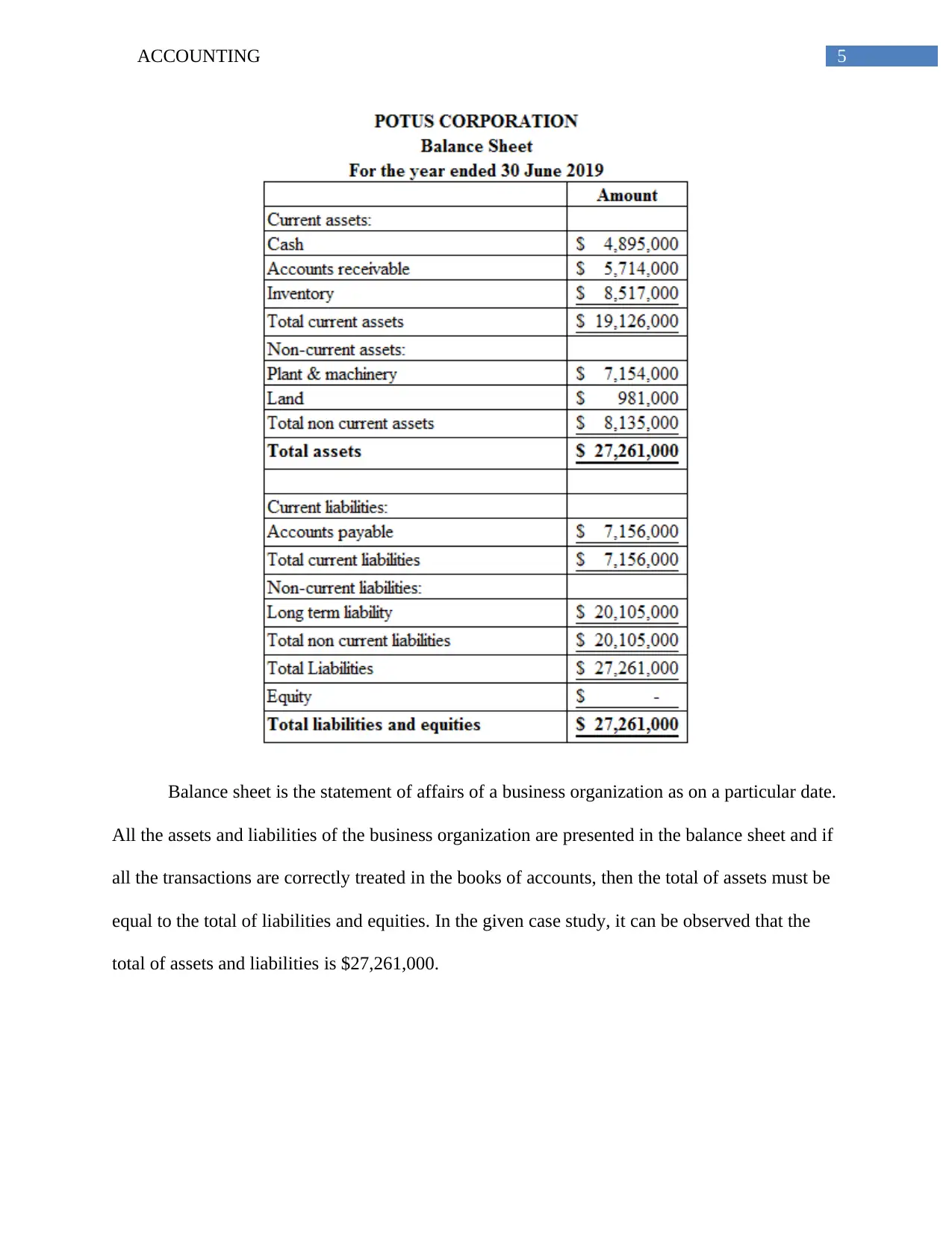
Balance sheet is the statement of affairs of a business organization as on a particular date.
All the assets and liabilities of the business organization are presented in the balance sheet and if
all the transactions are correctly treated in the books of accounts, then the total of assets must be
equal to the total of liabilities and equities. In the given case study, it can be observed that the
total of assets and liabilities is $27,261,000.
Balance sheet is the statement of affairs of a business organization as on a particular date.
All the assets and liabilities of the business organization are presented in the balance sheet and if
all the transactions are correctly treated in the books of accounts, then the total of assets must be
equal to the total of liabilities and equities. In the given case study, it can be observed that the
total of assets and liabilities is $27,261,000.
⊘ This is a preview!⊘
Do you want full access?
Subscribe today to unlock all pages.
Trusted by 1+ million students worldwide
6ACCOUNTING
Answer to question 2:
In this part knowledge of management accounting have been applied, and some of the
management accounting tools have been applied which help in analyzing and interpreting the
current operational performance of a business organization and to make necessary corrective
measures for improvement in the operational performance of the business (Glover2014).
Part a:
Breakeven point is nothing but that level of output at which the firm earns no profit and
incurs no loss. It is a situation when the firm is able to extract the total costs, and nothing more or
less than the costs. The breakeven point analysis can be applied in various decision making such
as make or buy, outsourcing decision and so on (Hendersonet al. 2015).
Subpart i:
Breakeven analysis is the method of computation of minimum number of output that will
make the total cost equal to the total revenue there by leaving no profit and no loss. A firm must
produce the breakeven number of units to avoid any losses, otherwise there will be a capital
erosion. If the business is going to take up a new project, and if its costs are known then the
breakeven analysis can help to understand whether the expected demand for the output of the
proposed project is going to make profit for the company or loss. It can be applied for analysis of
the feasibility of the proposed project. Hence, in making various important business decisions
and management decisions, the breakeven point analysis is most important and helpful too
(Hoyle,Schaeferand Doupnik2015).
Answer to question 2:
In this part knowledge of management accounting have been applied, and some of the
management accounting tools have been applied which help in analyzing and interpreting the
current operational performance of a business organization and to make necessary corrective
measures for improvement in the operational performance of the business (Glover2014).
Part a:
Breakeven point is nothing but that level of output at which the firm earns no profit and
incurs no loss. It is a situation when the firm is able to extract the total costs, and nothing more or
less than the costs. The breakeven point analysis can be applied in various decision making such
as make or buy, outsourcing decision and so on (Hendersonet al. 2015).
Subpart i:
Breakeven analysis is the method of computation of minimum number of output that will
make the total cost equal to the total revenue there by leaving no profit and no loss. A firm must
produce the breakeven number of units to avoid any losses, otherwise there will be a capital
erosion. If the business is going to take up a new project, and if its costs are known then the
breakeven analysis can help to understand whether the expected demand for the output of the
proposed project is going to make profit for the company or loss. It can be applied for analysis of
the feasibility of the proposed project. Hence, in making various important business decisions
and management decisions, the breakeven point analysis is most important and helpful too
(Hoyle,Schaeferand Doupnik2015).
Paraphrase This Document
Need a fresh take? Get an instant paraphrase of this document with our AI Paraphraser
7ACCOUNTING
Subpart ii:
Breakeven point analysis helps in ascertaining the minimum number of out that is
required to recover the fixed as well as the variable costs. Therefore, its importance and
advantages can be well observed in decision making situations.
On the other hand, when the organization is a service providing organization and the
output are not identical and varied in nature, then it is quite difficult to apply the breakeven point
analysis technique to make an optimal decision. Breakeven analysis, is based on the preset
scenario and present price and costs of the output, if for any reason the price and costs for the
products varies then the whole analysis becomes immaterial. These can be considered as the
disadvantage of the breakeven point analysis (Kozarkiewiczand Lada2014).
Part b:
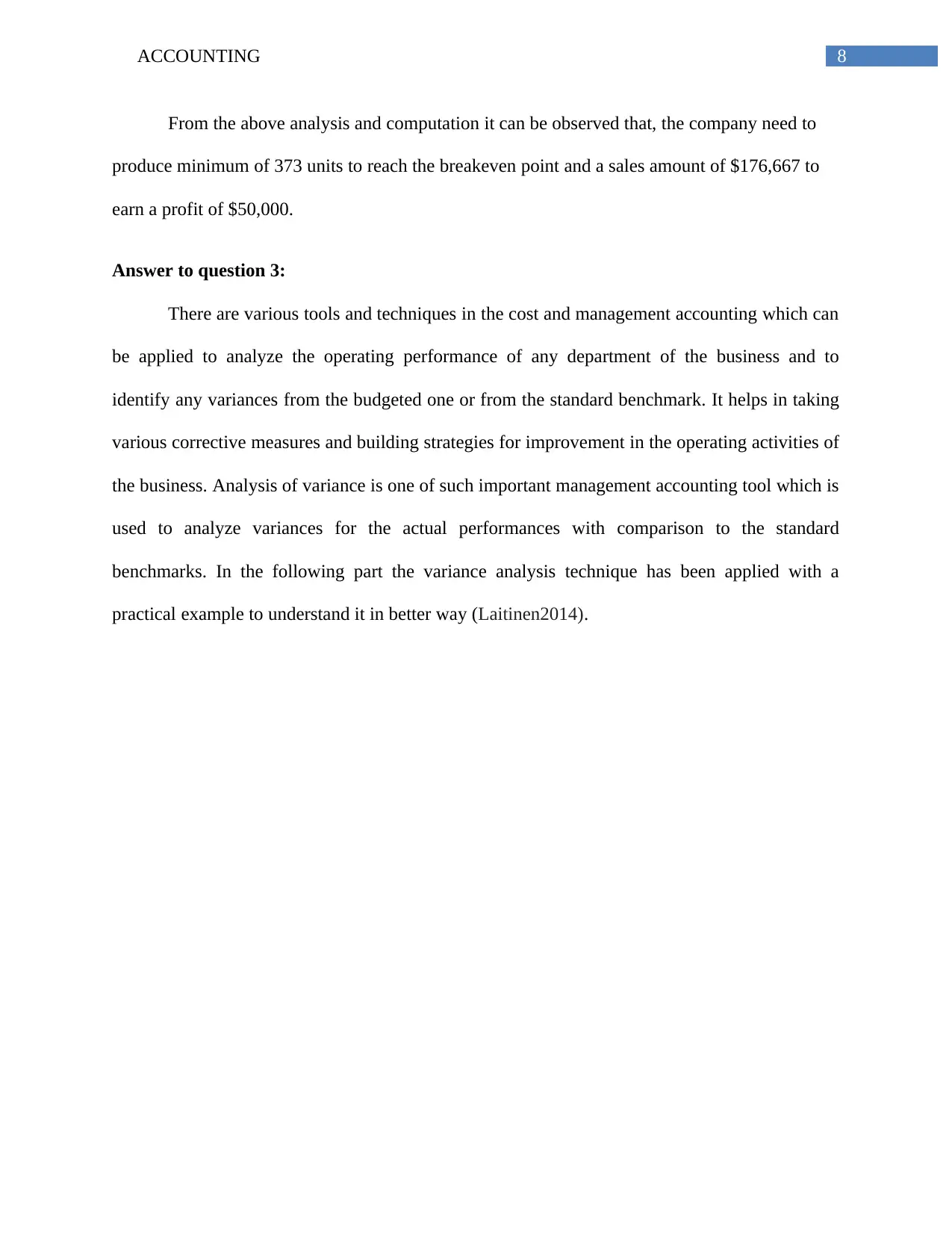
From the given information of the Robert Industries, following breakeven point analysis
figures can be computed.
Subpart ii:
Breakeven point analysis helps in ascertaining the minimum number of out that is
required to recover the fixed as well as the variable costs. Therefore, its importance and
advantages can be well observed in decision making situations.
On the other hand, when the organization is a service providing organization and the
output are not identical and varied in nature, then it is quite difficult to apply the breakeven point
analysis technique to make an optimal decision. Breakeven analysis, is based on the preset
scenario and present price and costs of the output, if for any reason the price and costs for the
products varies then the whole analysis becomes immaterial. These can be considered as the
disadvantage of the breakeven point analysis (Kozarkiewiczand Lada2014).
Part b:
From the given information of the Robert Industries, following breakeven point analysis
figures can be computed.
8ACCOUNTING
From the above analysis and computation it can be observed that, the company need to
produce minimum of 373 units to reach the breakeven point and a sales amount of $176,667 to
earn a profit of $50,000.
Answer to question 3:
There are various tools and techniques in the cost and management accounting which can
be applied to analyze the operating performance of any department of the business and to
identify any variances from the budgeted one or from the standard benchmark. It helps in taking
various corrective measures and building strategies for improvement in the operating activities of
the business. Analysis of variance is one of such important management accounting tool which is
used to analyze variances for the actual performances with comparison to the standard
benchmarks. In the following part the variance analysis technique has been applied with a
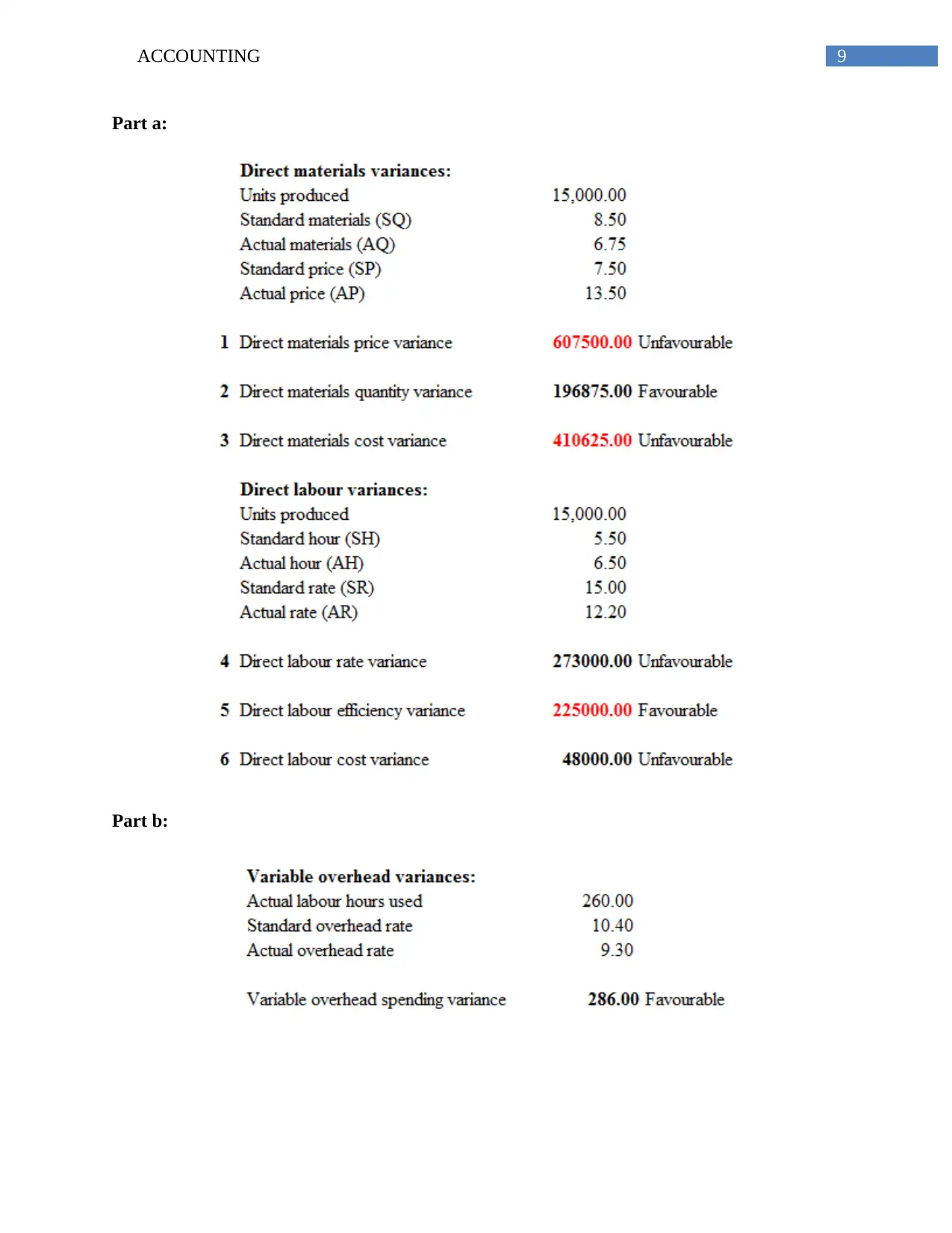
practical example to understand it in better way (Laitinen2014).
From the above analysis and computation it can be observed that, the company need to
produce minimum of 373 units to reach the breakeven point and a sales amount of $176,667 to
earn a profit of $50,000.
Answer to question 3:
There are various tools and techniques in the cost and management accounting which can
be applied to analyze the operating performance of any department of the business and to
identify any variances from the budgeted one or from the standard benchmark. It helps in taking
various corrective measures and building strategies for improvement in the operating activities of
the business. Analysis of variance is one of such important management accounting tool which is
used to analyze variances for the actual performances with comparison to the standard
benchmarks. In the following part the variance analysis technique has been applied with a
practical example to understand it in better way (Laitinen2014).
⊘ This is a preview!⊘
Do you want full access?
Subscribe today to unlock all pages.
Trusted by 1+ million students worldwide
9ACCOUNTING
Part a:
Part b:
Part a:
Part b:
Paraphrase This Document
Need a fresh take? Get an instant paraphrase of this document with our AI Paraphraser
10ACCOUNTING
Part c:
Variance analysis is a cost and management accounting tool which is applied to ascertain
the difference between the budgeted or standards costs and the actual costs for the actual
production. Variance analysis not only means comparison and analysis of costs, it also applies
for the revenues. Therefore, comparison of the actual performance with the budgeted or
standards one and ascertainment of the differences between these two is known as the variance
analysis (Macve2015).
The most important advantage of the variance analysis is that, it helps in identifying the
cause behind the poor performance of any particular segment of the business and helps in taking
corrective measures. If the production process is unique in nature, where each of the production
requires different types of materials and process times the standards cannot be fixed before and
hence, the variance analysis cannot be applied. Hence, it is not applicable for tailor made works
which can be considered as the disadvantage of the variance analysis technique (Morden2016).
Answer to question 4:
Budget is another important tool of cost and management accounting. Budget is the
estimation of expenses of incomes for some future operating activities. Budget and forecasting is
different completely. Budget is the estimation of incomes and expenses based on the forecasted
demands for the products or services. Budget helps in planning activities and allocation of funds
for certain operational activities of the business (Nelsonand Miller2014).
Part a:
When preparing a budget, the main objective of the budget to ascertain the expected cash
inflows and the expected allocation of funds in expenses payments. Therefore, the main
Part c:
Variance analysis is a cost and management accounting tool which is applied to ascertain
the difference between the budgeted or standards costs and the actual costs for the actual
production. Variance analysis not only means comparison and analysis of costs, it also applies
for the revenues. Therefore, comparison of the actual performance with the budgeted or
standards one and ascertainment of the differences between these two is known as the variance
analysis (Macve2015).
The most important advantage of the variance analysis is that, it helps in identifying the
cause behind the poor performance of any particular segment of the business and helps in taking
corrective measures. If the production process is unique in nature, where each of the production
requires different types of materials and process times the standards cannot be fixed before and
hence, the variance analysis cannot be applied. Hence, it is not applicable for tailor made works
which can be considered as the disadvantage of the variance analysis technique (Morden2016).
Answer to question 4:
Budget is another important tool of cost and management accounting. Budget is the
estimation of expenses of incomes for some future operating activities. Budget and forecasting is
different completely. Budget is the estimation of incomes and expenses based on the forecasted
demands for the products or services. Budget helps in planning activities and allocation of funds
for certain operational activities of the business (Nelsonand Miller2014).
Part a:
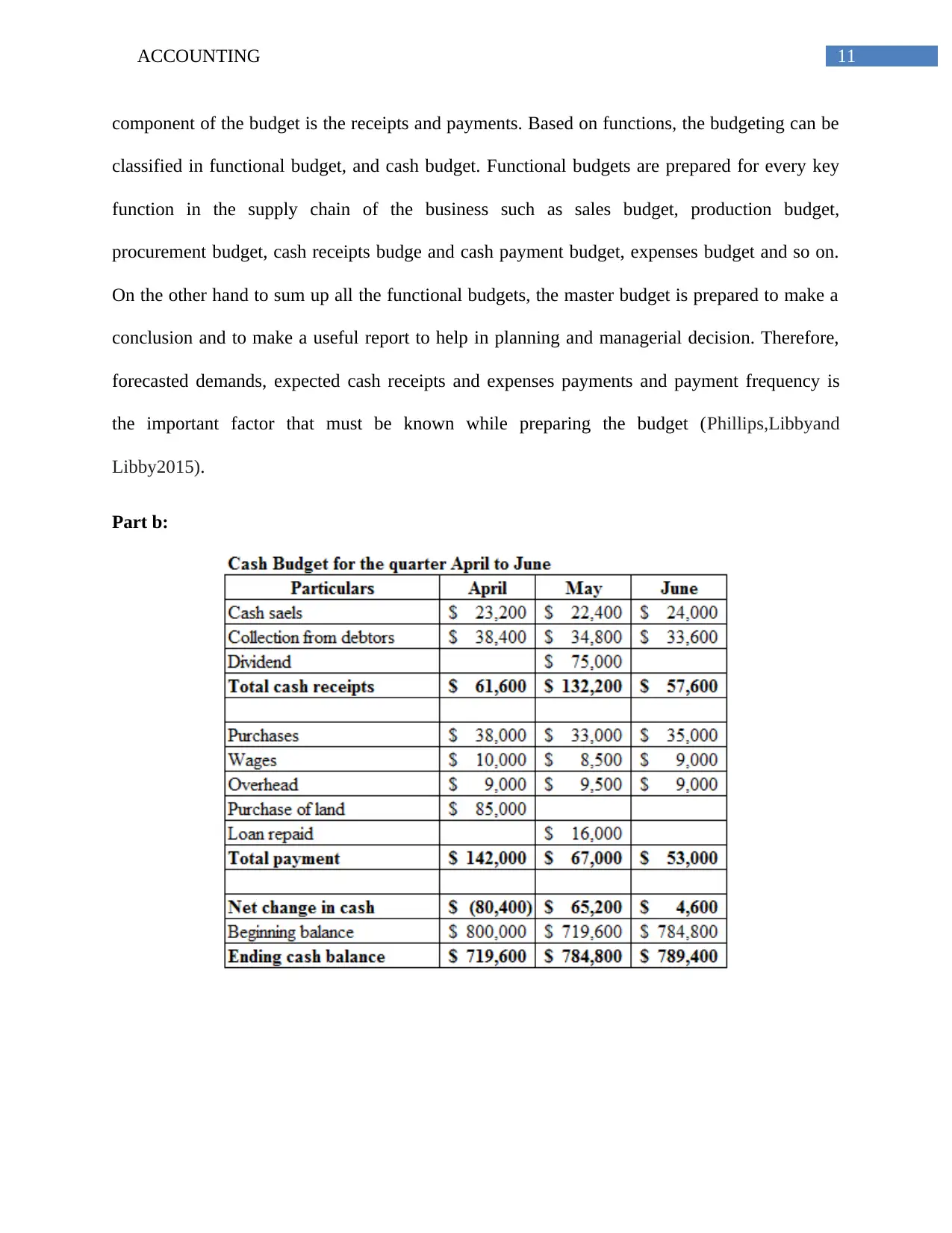
When preparing a budget, the main objective of the budget to ascertain the expected cash
inflows and the expected allocation of funds in expenses payments. Therefore, the main
11ACCOUNTING
component of the budget is the receipts and payments. Based on functions, the budgeting can be
classified in functional budget, and cash budget. Functional budgets are prepared for every key
function in the supply chain of the business such as sales budget, production budget,
procurement budget, cash receipts budge and cash payment budget, expenses budget and so on.
On the other hand to sum up all the functional budgets, the master budget is prepared to make a
conclusion and to make a useful report to help in planning and managerial decision. Therefore,
forecasted demands, expected cash receipts and expenses payments and payment frequency is
the important factor that must be known while preparing the budget (Phillips,Libbyand
Libby2015).
Part b:
component of the budget is the receipts and payments. Based on functions, the budgeting can be
classified in functional budget, and cash budget. Functional budgets are prepared for every key
function in the supply chain of the business such as sales budget, production budget,
procurement budget, cash receipts budge and cash payment budget, expenses budget and so on.
On the other hand to sum up all the functional budgets, the master budget is prepared to make a
conclusion and to make a useful report to help in planning and managerial decision. Therefore,
forecasted demands, expected cash receipts and expenses payments and payment frequency is
the important factor that must be known while preparing the budget (Phillips,Libbyand
Libby2015).
Part b:
⊘ This is a preview!⊘
Do you want full access?
Subscribe today to unlock all pages.
Trusted by 1+ million students worldwide

1 out of 16


Related Documents


Your All-in-One AI-Powered Toolkit for Academic Success.
+13062052269
info@desklib.com
Available 24*7 on WhatsApp / Email
![[object Object]](/_next/static/media/star-bottom.7253800d.svg)
Unlock your academic potential
Copyright © 2020–2026 A2Z Services. All Rights Reserved. Developed and managed by ZUCOL.