Child Development: Activities for Emotional and Social Development
VerifiedAdded on 2020/05/04
|5
|1359
|68
Homework Assignment
AI Summary
This assignment examines the crucial role of play in facilitating both emotional and cognitive development in children. It emphasizes the significance of designing group activities to elicit a range of emotions, such as joy, cooperation, jealousy, and competitiveness, using examples like the Balloon Race. The assignment also highlights the importance of developing social competence in children and proposes the 'Name Game' as an effective activity to foster social skills, confidence, and interaction among children of diverse backgrounds. The solutions provided includes detailed explanations of the activities and their benefits, along with a reference list supporting the arguments made.
Running head: CHILD DEVELOPMENT
Child Development
Name of the Student:
Name of the University:
Author note:
Child Development
Name of the Student:
Name of the University:
Author note:
Paraphrase This Document
Need a fresh take? Get an instant paraphrase of this document with our AI Paraphraser

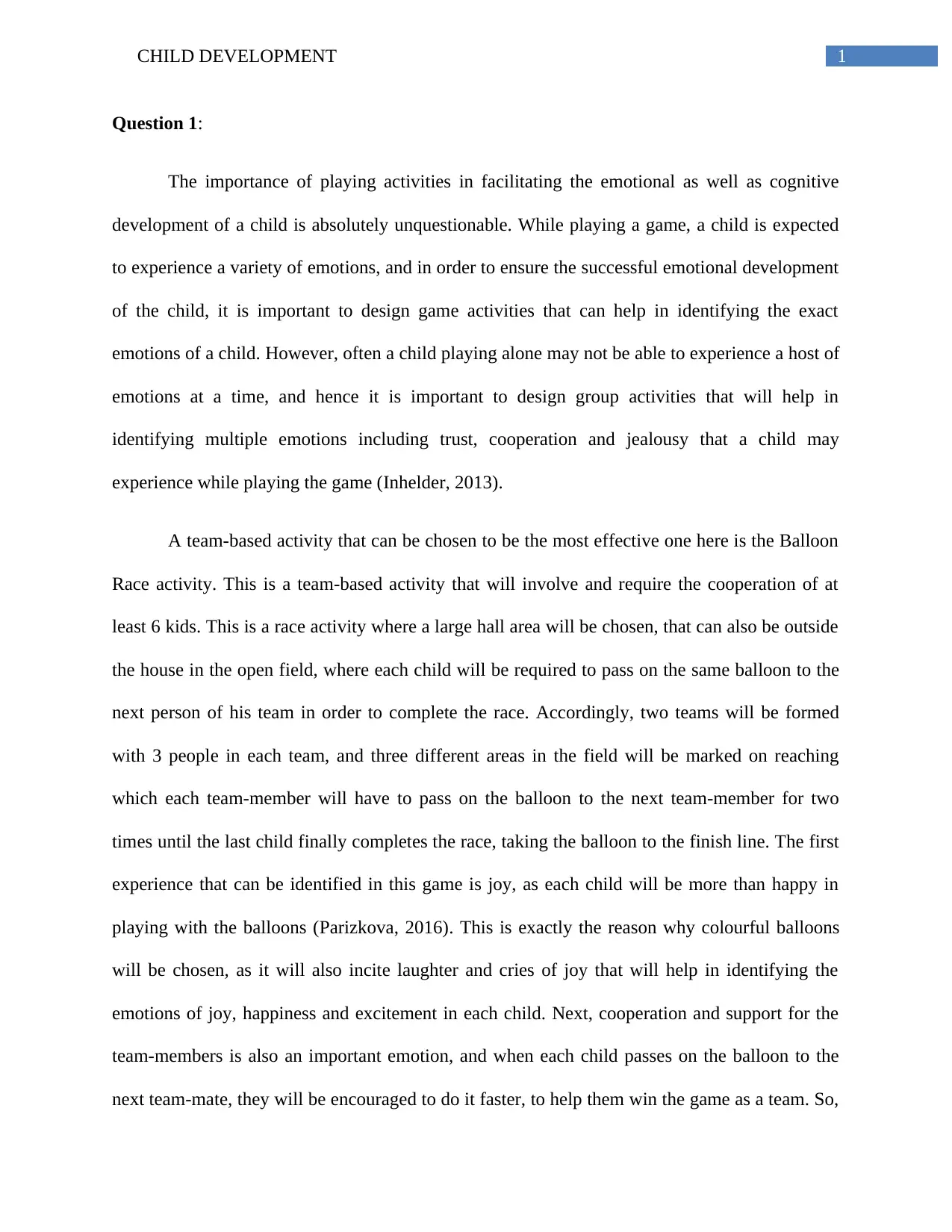
1CHILD DEVELOPMENT
Question 1:
The importance of playing activities in facilitating the emotional as well as cognitive
development of a child is absolutely unquestionable. While playing a game, a child is expected
to experience a variety of emotions, and in order to ensure the successful emotional development
of the child, it is important to design game activities that can help in identifying the exact
emotions of a child. However, often a child playing alone may not be able to experience a host of
emotions at a time, and hence it is important to design group activities that will help in
identifying multiple emotions including trust, cooperation and jealousy that a child may
experience while playing the game (Inhelder, 2013).
A team-based activity that can be chosen to be the most effective one here is the Balloon
Race activity. This is a team-based activity that will involve and require the cooperation of at
least 6 kids. This is a race activity where a large hall area will be chosen, that can also be outside
the house in the open field, where each child will be required to pass on the same balloon to the
next person of his team in order to complete the race. Accordingly, two teams will be formed
with 3 people in each team, and three different areas in the field will be marked on reaching
which each team-member will have to pass on the balloon to the next team-member for two
times until the last child finally completes the race, taking the balloon to the finish line. The first
experience that can be identified in this game is joy, as each child will be more than happy in
playing with the balloons (Parizkova, 2016). This is exactly the reason why colourful balloons
will be chosen, as it will also incite laughter and cries of joy that will help in identifying the
emotions of joy, happiness and excitement in each child. Next, cooperation and support for the
team-members is also an important emotion, and when each child passes on the balloon to the
next team-mate, they will be encouraged to do it faster, to help them win the game as a team. So,
Question 1:
The importance of playing activities in facilitating the emotional as well as cognitive
development of a child is absolutely unquestionable. While playing a game, a child is expected
to experience a variety of emotions, and in order to ensure the successful emotional development
of the child, it is important to design game activities that can help in identifying the exact
emotions of a child. However, often a child playing alone may not be able to experience a host of
emotions at a time, and hence it is important to design group activities that will help in
identifying multiple emotions including trust, cooperation and jealousy that a child may
experience while playing the game (Inhelder, 2013).
A team-based activity that can be chosen to be the most effective one here is the Balloon
Race activity. This is a team-based activity that will involve and require the cooperation of at
least 6 kids. This is a race activity where a large hall area will be chosen, that can also be outside
the house in the open field, where each child will be required to pass on the same balloon to the
next person of his team in order to complete the race. Accordingly, two teams will be formed
with 3 people in each team, and three different areas in the field will be marked on reaching
which each team-member will have to pass on the balloon to the next team-member for two
times until the last child finally completes the race, taking the balloon to the finish line. The first
experience that can be identified in this game is joy, as each child will be more than happy in
playing with the balloons (Parizkova, 2016). This is exactly the reason why colourful balloons
will be chosen, as it will also incite laughter and cries of joy that will help in identifying the
emotions of joy, happiness and excitement in each child. Next, cooperation and support for the
team-members is also an important emotion, and when each child passes on the balloon to the
next team-mate, they will be encouraged to do it faster, to help them win the game as a team. So,

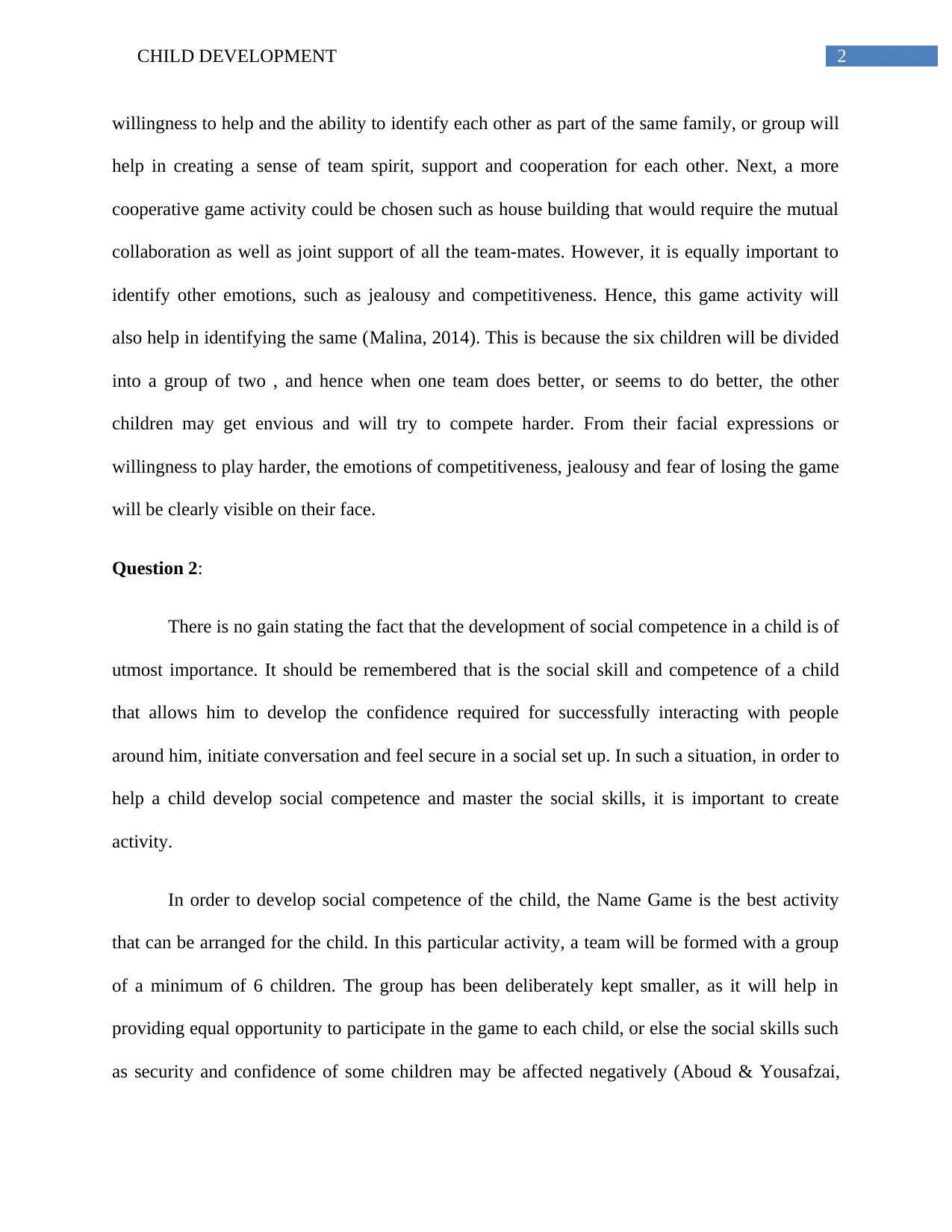
2CHILD DEVELOPMENT
willingness to help and the ability to identify each other as part of the same family, or group will
help in creating a sense of team spirit, support and cooperation for each other. Next, a more
cooperative game activity could be chosen such as house building that would require the mutual
collaboration as well as joint support of all the team-mates. However, it is equally important to
identify other emotions, such as jealousy and competitiveness. Hence, this game activity will
also help in identifying the same (Malina, 2014). This is because the six children will be divided
into a group of two , and hence when one team does better, or seems to do better, the other
children may get envious and will try to compete harder. From their facial expressions or
willingness to play harder, the emotions of competitiveness, jealousy and fear of losing the game
will be clearly visible on their face.
Question 2:
There is no gain stating the fact that the development of social competence in a child is of
utmost importance. It should be remembered that is the social skill and competence of a child
that allows him to develop the confidence required for successfully interacting with people
around him, initiate conversation and feel secure in a social set up. In such a situation, in order to
help a child develop social competence and master the social skills, it is important to create
activity.
In order to develop social competence of the child, the Name Game is the best activity
that can be arranged for the child. In this particular activity, a team will be formed with a group
of a minimum of 6 children. The group has been deliberately kept smaller, as it will help in
providing equal opportunity to participate in the game to each child, or else the social skills such
as security and confidence of some children may be affected negatively (Aboud & Yousafzai,
willingness to help and the ability to identify each other as part of the same family, or group will
help in creating a sense of team spirit, support and cooperation for each other. Next, a more
cooperative game activity could be chosen such as house building that would require the mutual
collaboration as well as joint support of all the team-mates. However, it is equally important to
identify other emotions, such as jealousy and competitiveness. Hence, this game activity will
also help in identifying the same (Malina, 2014). This is because the six children will be divided
into a group of two , and hence when one team does better, or seems to do better, the other
children may get envious and will try to compete harder. From their facial expressions or
willingness to play harder, the emotions of competitiveness, jealousy and fear of losing the game
will be clearly visible on their face.
Question 2:
There is no gain stating the fact that the development of social competence in a child is of
utmost importance. It should be remembered that is the social skill and competence of a child
that allows him to develop the confidence required for successfully interacting with people
around him, initiate conversation and feel secure in a social set up. In such a situation, in order to
help a child develop social competence and master the social skills, it is important to create
activity.
In order to develop social competence of the child, the Name Game is the best activity
that can be arranged for the child. In this particular activity, a team will be formed with a group
of a minimum of 6 children. The group has been deliberately kept smaller, as it will help in
providing equal opportunity to participate in the game to each child, or else the social skills such
as security and confidence of some children may be affected negatively (Aboud & Yousafzai,
⊘ This is a preview!⊘
Do you want full access?
Subscribe today to unlock all pages.

Trusted by 1+ million students worldwide

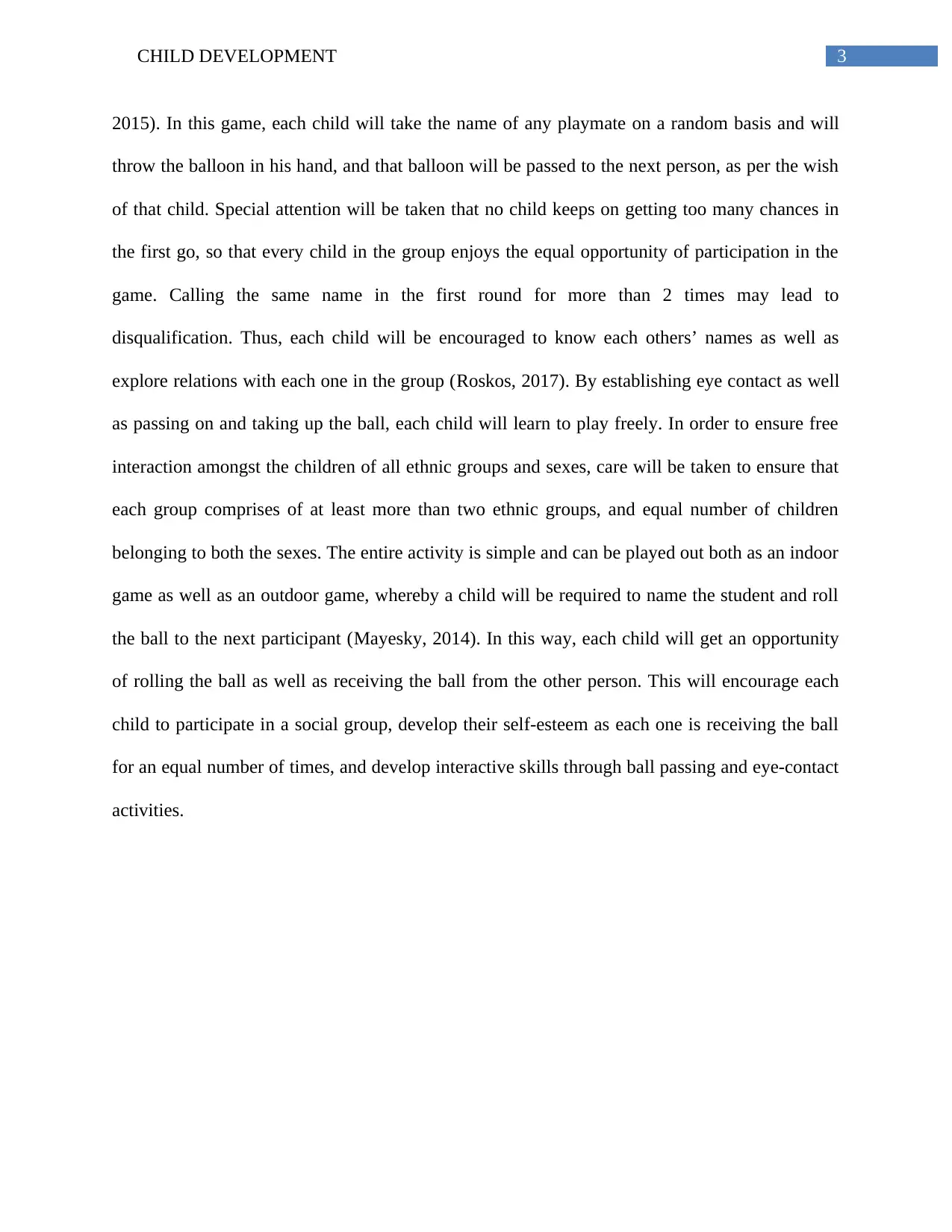
3CHILD DEVELOPMENT
2015). In this game, each child will take the name of any playmate on a random basis and will
throw the balloon in his hand, and that balloon will be passed to the next person, as per the wish
of that child. Special attention will be taken that no child keeps on getting too many chances in
the first go, so that every child in the group enjoys the equal opportunity of participation in the
game. Calling the same name in the first round for more than 2 times may lead to
disqualification. Thus, each child will be encouraged to know each others’ names as well as
explore relations with each one in the group (Roskos, 2017). By establishing eye contact as well
as passing on and taking up the ball, each child will learn to play freely. In order to ensure free
interaction amongst the children of all ethnic groups and sexes, care will be taken to ensure that
each group comprises of at least more than two ethnic groups, and equal number of children
belonging to both the sexes. The entire activity is simple and can be played out both as an indoor
game as well as an outdoor game, whereby a child will be required to name the student and roll
the ball to the next participant (Mayesky, 2014). In this way, each child will get an opportunity
of rolling the ball as well as receiving the ball from the other person. This will encourage each
child to participate in a social group, develop their self-esteem as each one is receiving the ball
for an equal number of times, and develop interactive skills through ball passing and eye-contact
activities.
2015). In this game, each child will take the name of any playmate on a random basis and will
throw the balloon in his hand, and that balloon will be passed to the next person, as per the wish
of that child. Special attention will be taken that no child keeps on getting too many chances in
the first go, so that every child in the group enjoys the equal opportunity of participation in the
game. Calling the same name in the first round for more than 2 times may lead to
disqualification. Thus, each child will be encouraged to know each others’ names as well as
explore relations with each one in the group (Roskos, 2017). By establishing eye contact as well
as passing on and taking up the ball, each child will learn to play freely. In order to ensure free
interaction amongst the children of all ethnic groups and sexes, care will be taken to ensure that
each group comprises of at least more than two ethnic groups, and equal number of children
belonging to both the sexes. The entire activity is simple and can be played out both as an indoor
game as well as an outdoor game, whereby a child will be required to name the student and roll
the ball to the next participant (Mayesky, 2014). In this way, each child will get an opportunity
of rolling the ball as well as receiving the ball from the other person. This will encourage each
child to participate in a social group, develop their self-esteem as each one is receiving the ball
for an equal number of times, and develop interactive skills through ball passing and eye-contact
activities.
Paraphrase This Document
Need a fresh take? Get an instant paraphrase of this document with our AI Paraphraser

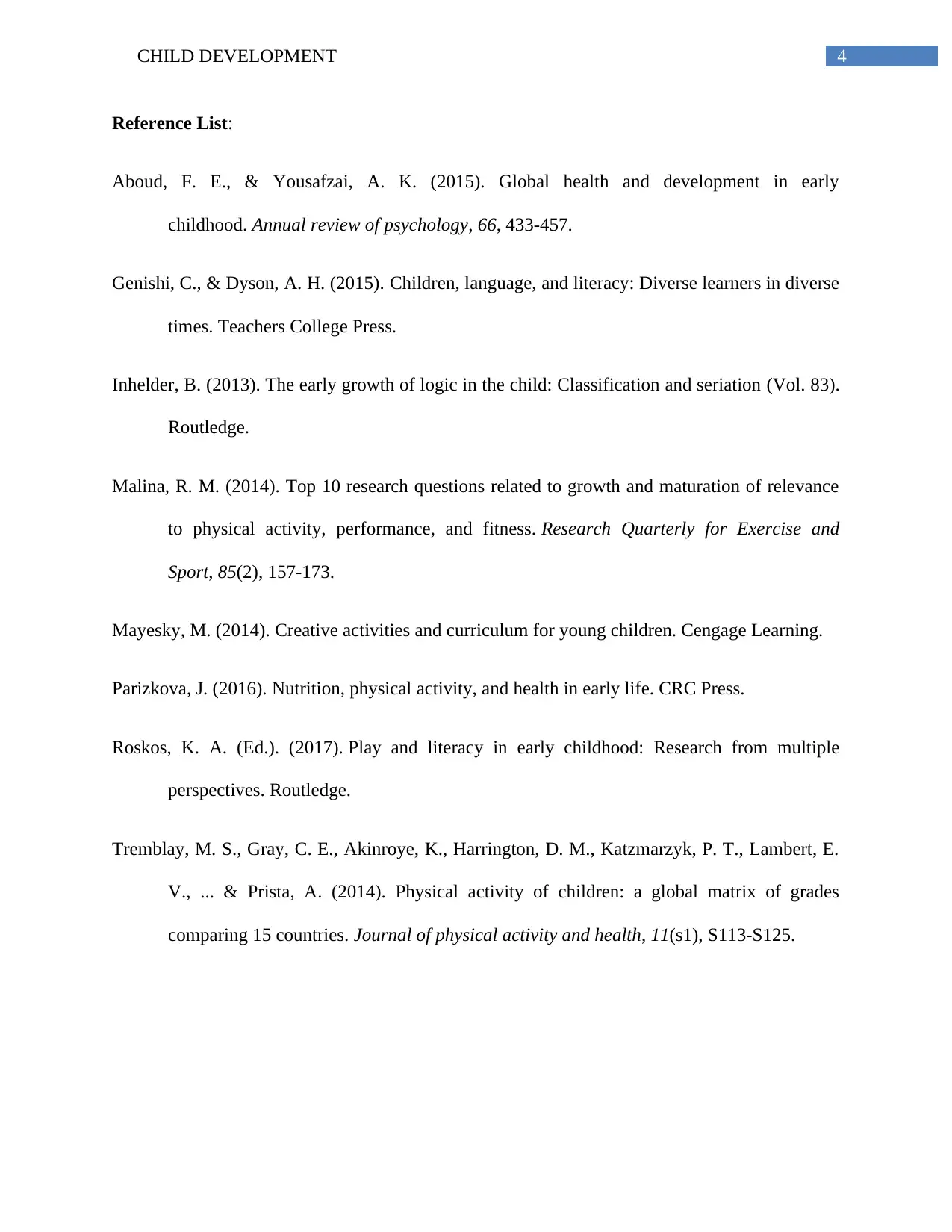
4CHILD DEVELOPMENT
Reference List:
Aboud, F. E., & Yousafzai, A. K. (2015). Global health and development in early
childhood. Annual review of psychology, 66, 433-457.
Genishi, C., & Dyson, A. H. (2015). Children, language, and literacy: Diverse learners in diverse
times. Teachers College Press.
Inhelder, B. (2013). The early growth of logic in the child: Classification and seriation (Vol. 83).
Routledge.
Malina, R. M. (2014). Top 10 research questions related to growth and maturation of relevance
to physical activity, performance, and fitness. Research Quarterly for Exercise and
Sport, 85(2), 157-173.
Mayesky, M. (2014). Creative activities and curriculum for young children. Cengage Learning.
Parizkova, J. (2016). Nutrition, physical activity, and health in early life. CRC Press.
Roskos, K. A. (Ed.). (2017). Play and literacy in early childhood: Research from multiple
perspectives. Routledge.
Tremblay, M. S., Gray, C. E., Akinroye, K., Harrington, D. M., Katzmarzyk, P. T., Lambert, E.
V., ... & Prista, A. (2014). Physical activity of children: a global matrix of grades
comparing 15 countries. Journal of physical activity and health, 11(s1), S113-S125.
Reference List:
Aboud, F. E., & Yousafzai, A. K. (2015). Global health and development in early
childhood. Annual review of psychology, 66, 433-457.
Genishi, C., & Dyson, A. H. (2015). Children, language, and literacy: Diverse learners in diverse
times. Teachers College Press.
Inhelder, B. (2013). The early growth of logic in the child: Classification and seriation (Vol. 83).
Routledge.
Malina, R. M. (2014). Top 10 research questions related to growth and maturation of relevance
to physical activity, performance, and fitness. Research Quarterly for Exercise and
Sport, 85(2), 157-173.
Mayesky, M. (2014). Creative activities and curriculum for young children. Cengage Learning.
Parizkova, J. (2016). Nutrition, physical activity, and health in early life. CRC Press.
Roskos, K. A. (Ed.). (2017). Play and literacy in early childhood: Research from multiple
perspectives. Routledge.
Tremblay, M. S., Gray, C. E., Akinroye, K., Harrington, D. M., Katzmarzyk, P. T., Lambert, E.
V., ... & Prista, A. (2014). Physical activity of children: a global matrix of grades
comparing 15 countries. Journal of physical activity and health, 11(s1), S113-S125.
1 out of 5
Related Documents
Your All-in-One AI-Powered Toolkit for Academic Success.
+13062052269
info@desklib.com
Available 24*7 on WhatsApp / Email
Unlock your academic potential
Copyright © 2020–2026 A2Z Services. All Rights Reserved. Developed and managed by ZUCOL.