University Finance Management Assignment: Cash Flow Analysis
VerifiedAdded on 2020/02/24
|9
|1335
|35
Homework Assignment
AI Summary
This finance assignment solution, completed in 2017, addresses key concepts in financial management. Part A focuses on incremental cash flow, explaining its calculation and significance in project evaluation. Part B delves into JIT (Just-In-Time) inventory management, highlighting its benefits in cost reduction and efficiency, along with strategies for its implementation. Part C applies capital budgeting techniques to a case study, outlining six steps to determine project profitability, including inflation adjustments and present value calculations. The solution integrates academic references and provides a comprehensive analysis of financial decision-making processes, emphasizing the importance of cash flow analysis and inventory management in achieving financial goals. The assignment is a comprehensive guide for understanding financial concepts.

Finance
Management
Management
Paraphrase This Document
Need a fresh take? Get an instant paraphrase of this document with our AI Paraphraser

1
By student name
Professor
University
Date: 07 October , 2017.
1 | P a g e
By student name
Professor
University
Date: 07 October , 2017.
1 | P a g e

2
Contents
Part 1…..………….…………………………………………………………..3
Part 2…..…………………………………………………..…………………..4
Part 3…..………………………..……………………………………………..5
References.....………………………………………………………………...7
2 | P a g e
Contents
Part 1…..………….…………………………………………………………..3
Part 2…..…………………………………………………..…………………..4
Part 3…..………………………..……………………………………………..5
References.....………………………………………………………………...7
2 | P a g e
⊘ This is a preview!⊘
Do you want full access?
Subscribe today to unlock all pages.

Trusted by 1+ million students worldwide

3
Part A
1. a) Incremental cash flow is the additional cash flow that an organization earns whenever they
undertake a new project. If the incremental cash flow is positive it means that the company will earn
more cash with the acceptance of the new project. Incremental cash flow can be calculated by
deducting the net income from the net expenses and on the basis of that the cash flow can be decided.
The cash will flow will be calculated over a specific period of time and it also helps in making comparison
between two projects.
b) Three concepts that help in understanding how to calculate the incremental cash flow for a project
are- Discounting models of capital budgeting like net present value and internal rate of return that helps
in comparing the initial investment of the project with the incremental cash flow or terminal cash flow
to judge whether or not to accept the project. Other concepts include non discounting models such as
pay back periods where the face value of the incremental cash flow and initial investment are compared
with each other. Capital Budgeting is based on the concept of incremental cash flow and all the solutions
are based on the same.
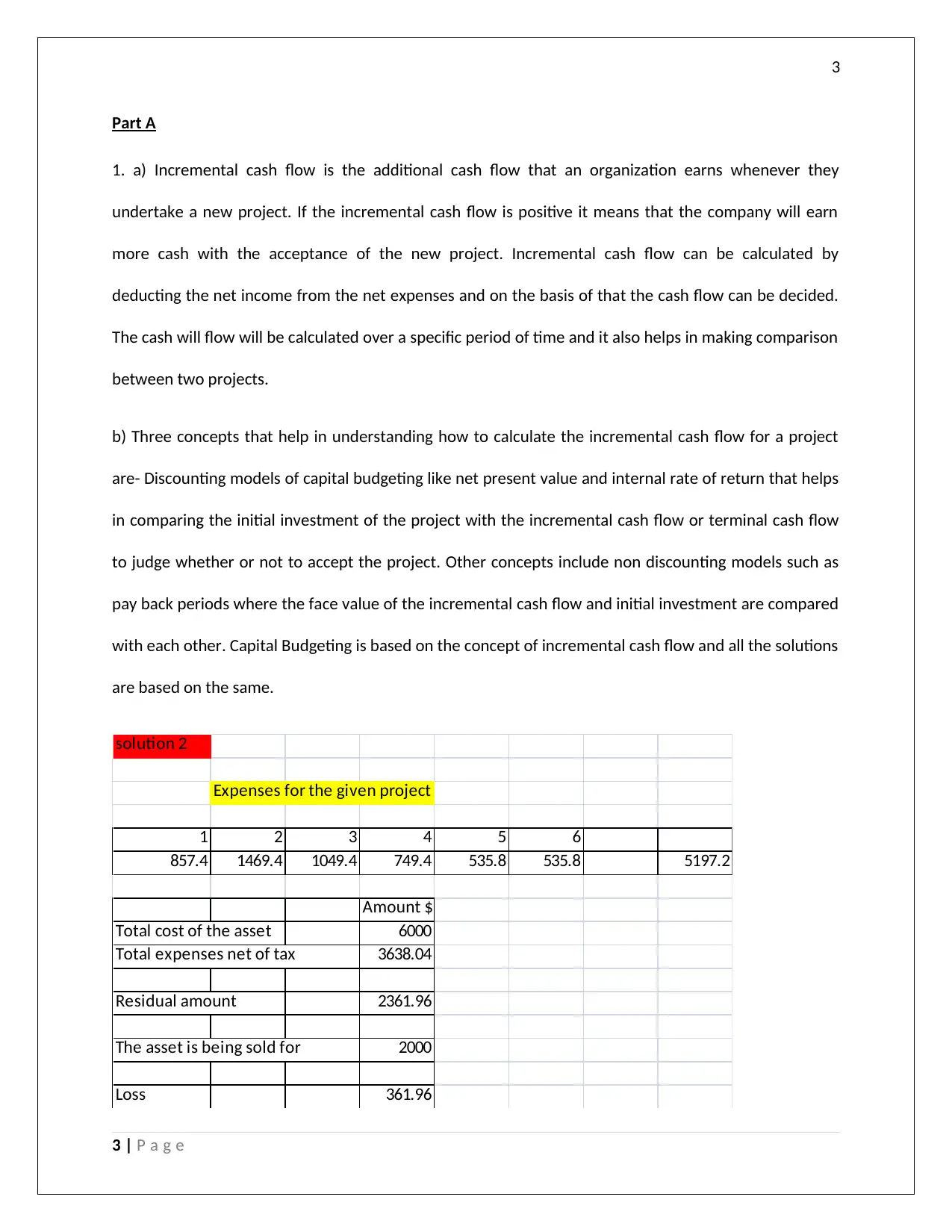
solution 2
Expenses for the given project
1 2 3 4 5 6
857.4 1469.4 1049.4 749.4 535.8 535.8 5197.2
Amount $
Total cost of the asset 6000
Total expenses net of tax 3638.04
Residual amount 2361.96
The asset is being sold for 2000
Loss 361.96
3 | P a g e
Part A
1. a) Incremental cash flow is the additional cash flow that an organization earns whenever they
undertake a new project. If the incremental cash flow is positive it means that the company will earn
more cash with the acceptance of the new project. Incremental cash flow can be calculated by
deducting the net income from the net expenses and on the basis of that the cash flow can be decided.
The cash will flow will be calculated over a specific period of time and it also helps in making comparison
between two projects.
b) Three concepts that help in understanding how to calculate the incremental cash flow for a project
are- Discounting models of capital budgeting like net present value and internal rate of return that helps
in comparing the initial investment of the project with the incremental cash flow or terminal cash flow
to judge whether or not to accept the project. Other concepts include non discounting models such as
pay back periods where the face value of the incremental cash flow and initial investment are compared
with each other. Capital Budgeting is based on the concept of incremental cash flow and all the solutions
are based on the same.
solution 2
Expenses for the given project
1 2 3 4 5 6
857.4 1469.4 1049.4 749.4 535.8 535.8 5197.2
Amount $
Total cost of the asset 6000
Total expenses net of tax 3638.04
Residual amount 2361.96
The asset is being sold for 2000
Loss 361.96
3 | P a g e
Paraphrase This Document
Need a fresh take? Get an instant paraphrase of this document with our AI Paraphraser

4
Part B
1)JIT inventory management is a strategy by which the companies try to reduce the wastage and
increase the efficiency by receiving goods only when they are needed in the production process. It helps
in reducing the overall cost that the company incurs in the inventory process (Crosby & Henneberry,
2016). It also requires forecasting the overall demand of the company accurately. It is highly scalable
and has a lot of advantages in comparison with the traditional inventory management.
2)One type of cost that can be minimized with the help of this type of system is the total
inventory cost that the company incurs and total wastage that occurs in the production. It reduces the
overall cost of the warehouse storage, as the companies can easily shift from one method of production
to another and also it can be seen that when goods arrive as and when they are needed, the need of
storage also reduces (Burke & Clark, 2016). This is one of the major advantage that the company is
having over the traditional method of inventory management.
3)In order to use JIT it is important to have high ordering cost so that there is no disruption in
the overall supply chain and the production team gets the product as and when needed. The company
must make an accurate assumption on how much product they might need and should place order for
the same only, this will reduce unnecessary wastage (Birt, Muthusamy, & Bir, 2017). In case there is any
disruption in the supply management the overall process of production gets delayed that might cause
much loss. In case there is a sudden order of goods which is more then what the company has expected
in those cases also high ordering cost will help in ensuring that the company will get the products on
time. This will help in reducing unnecessary wastage on part of the company (Chiapello, 2017).
4 | P a g e
Part B
1)JIT inventory management is a strategy by which the companies try to reduce the wastage and
increase the efficiency by receiving goods only when they are needed in the production process. It helps
in reducing the overall cost that the company incurs in the inventory process (Crosby & Henneberry,
2016). It also requires forecasting the overall demand of the company accurately. It is highly scalable
and has a lot of advantages in comparison with the traditional inventory management.
2)One type of cost that can be minimized with the help of this type of system is the total
inventory cost that the company incurs and total wastage that occurs in the production. It reduces the
overall cost of the warehouse storage, as the companies can easily shift from one method of production
to another and also it can be seen that when goods arrive as and when they are needed, the need of
storage also reduces (Burke & Clark, 2016). This is one of the major advantage that the company is
having over the traditional method of inventory management.
3)In order to use JIT it is important to have high ordering cost so that there is no disruption in
the overall supply chain and the production team gets the product as and when needed. The company
must make an accurate assumption on how much product they might need and should place order for
the same only, this will reduce unnecessary wastage (Birt, Muthusamy, & Bir, 2017). In case there is any
disruption in the supply management the overall process of production gets delayed that might cause
much loss. In case there is a sudden order of goods which is more then what the company has expected
in those cases also high ordering cost will help in ensuring that the company will get the products on
time. This will help in reducing unnecessary wastage on part of the company (Chiapello, 2017).
4 | P a g e

5
PART C
In the given case the concept of capital budgeting will be employed to understand whether or not the
company is making any profit from the project and in what ways will it be beneficial for the company to
accept the project. Six effective steps that will help the company in reaching to a conclusion are-
• Applying rate of inflation to the present exchange value to know the exchange value for the
given currencies after a period of three years. In the given case the annual inflation is given to be 5% in
the United States and 4% in Mexico. Since the home company is US company, peso will be converted
into US dollars.
• Calculation of incoming cash flow from the project after three years in terms of U.S dollar. It is
said that the company is earning a cash flow of 100,000,000 pesos. In terms of dollar the amount will be
calculated after applying the exchange rate that is calculated in the first step. This is what the company
will earn in three years in terms of U.S dollar (Given, 2016).
• Applying the discounted rate of interested to know the present value of the project. The
incoming cash flow after three years will be discounted with the rate given to ascertain the present
value of the same.
• All expenditure that the company is doing, will be deducted from the present cash flow to
calculate the incremental cash flow of the project. In the given case the cost of the project is given to be
$5,500,000. This will be deducted from the net income of the project and on the basis of the same the
overall incremental cash flow will be calculated for the given project.
5 | P a g e
PART C
In the given case the concept of capital budgeting will be employed to understand whether or not the
company is making any profit from the project and in what ways will it be beneficial for the company to
accept the project. Six effective steps that will help the company in reaching to a conclusion are-
• Applying rate of inflation to the present exchange value to know the exchange value for the
given currencies after a period of three years. In the given case the annual inflation is given to be 5% in
the United States and 4% in Mexico. Since the home company is US company, peso will be converted
into US dollars.
• Calculation of incoming cash flow from the project after three years in terms of U.S dollar. It is
said that the company is earning a cash flow of 100,000,000 pesos. In terms of dollar the amount will be
calculated after applying the exchange rate that is calculated in the first step. This is what the company
will earn in three years in terms of U.S dollar (Given, 2016).
• Applying the discounted rate of interested to know the present value of the project. The
incoming cash flow after three years will be discounted with the rate given to ascertain the present
value of the same.
• All expenditure that the company is doing, will be deducted from the present cash flow to
calculate the incremental cash flow of the project. In the given case the cost of the project is given to be
$5,500,000. This will be deducted from the net income of the project and on the basis of the same the
overall incremental cash flow will be calculated for the given project.
5 | P a g e
⊘ This is a preview!⊘
Do you want full access?
Subscribe today to unlock all pages.

Trusted by 1+ million students worldwide

6
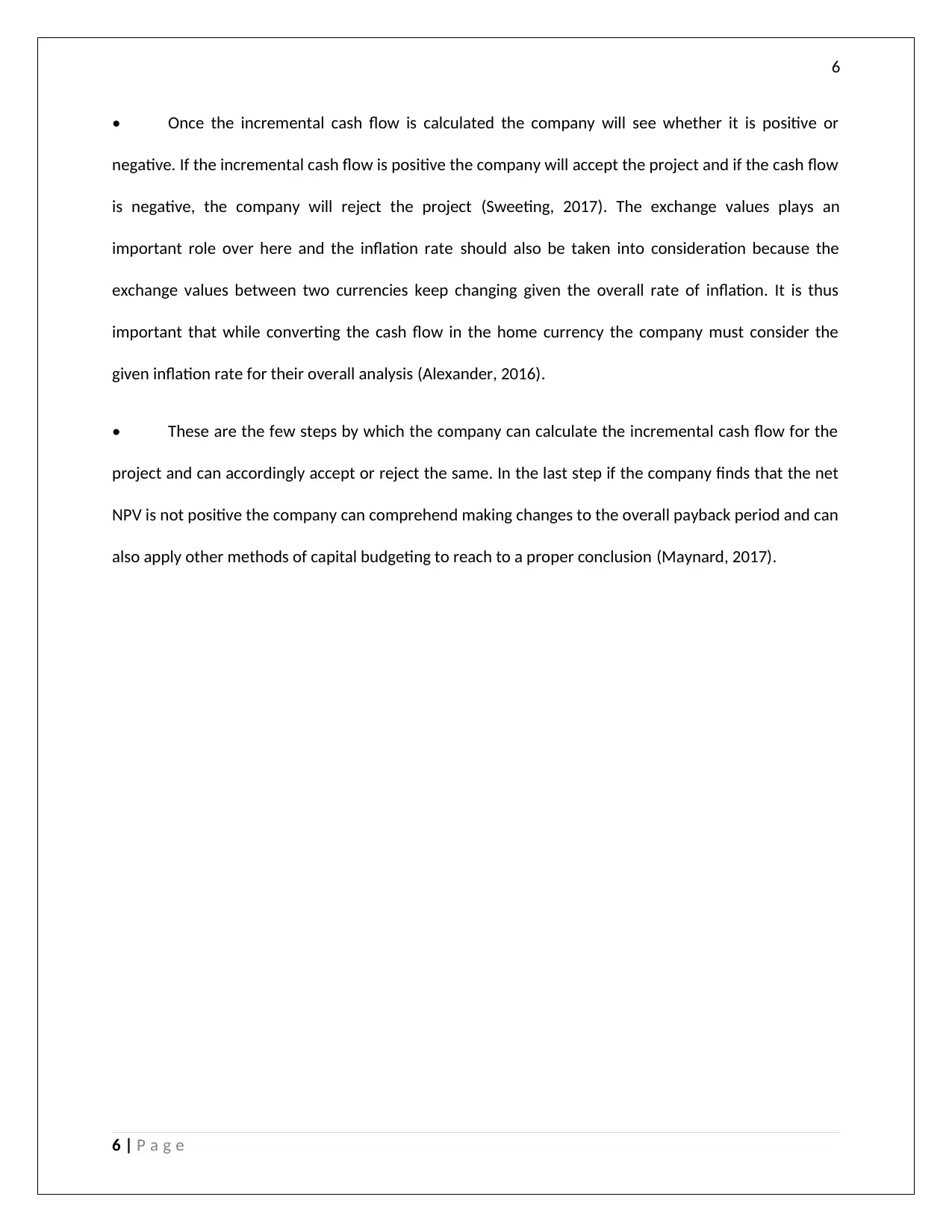
• Once the incremental cash flow is calculated the company will see whether it is positive or
negative. If the incremental cash flow is positive the company will accept the project and if the cash flow
is negative, the company will reject the project (Sweeting, 2017). The exchange values plays an
important role over here and the inflation rate should also be taken into consideration because the
exchange values between two currencies keep changing given the overall rate of inflation. It is thus
important that while converting the cash flow in the home currency the company must consider the
given inflation rate for their overall analysis (Alexander, 2016).
• These are the few steps by which the company can calculate the incremental cash flow for the
project and can accordingly accept or reject the same. In the last step if the company finds that the net
NPV is not positive the company can comprehend making changes to the overall payback period and can
also apply other methods of capital budgeting to reach to a proper conclusion (Maynard, 2017).
6 | P a g e
• Once the incremental cash flow is calculated the company will see whether it is positive or
negative. If the incremental cash flow is positive the company will accept the project and if the cash flow
is negative, the company will reject the project (Sweeting, 2017). The exchange values plays an
important role over here and the inflation rate should also be taken into consideration because the
exchange values between two currencies keep changing given the overall rate of inflation. It is thus
important that while converting the cash flow in the home currency the company must consider the
given inflation rate for their overall analysis (Alexander, 2016).
• These are the few steps by which the company can calculate the incremental cash flow for the
project and can accordingly accept or reject the same. In the last step if the company finds that the net
NPV is not positive the company can comprehend making changes to the overall payback period and can
also apply other methods of capital budgeting to reach to a proper conclusion (Maynard, 2017).
6 | P a g e
Paraphrase This Document
Need a fresh take? Get an instant paraphrase of this document with our AI Paraphraser

7
Reference
Alexander, F. (2016). The Changing Face of Accountability. The Journal of Higher Education, 71(4), 411-
431.
Birt, J., Muthusamy, K., & Bir, P. (2017). "XBRL and the qualitative characteristics of useful financial
information". Accounting Research Journal, 30(1), 107-126.
Burke, J., & Clark, C. (2016). The business case for integrated reporting: Insights from leading
practitioners, regulators, and academics. Business Horizons, 59(3), 273-283.
Chiapello, E. (2017). Critical accounting research and neoliberalism. Critical Perspectives on Accounting,
43, 47-64.
Crosby, N., & Henneberry, J. (2016). Financialisation, the valuation of investment property and the urban
built environment in the UK. Urban Studies, 53(7).
Given, L. (2016). 100 questions (and answers) about qualitative research. Sage.
Maynard, J. (2017). Financial accounting reporting and analysis (second ed.). United Kingdom: Oxford
University Press.
Sweeting, P. (2017). Financial Enterprise Risk Management (Second ed.). UK: Cambridge University
Press.
7 | P a g e
Reference
Alexander, F. (2016). The Changing Face of Accountability. The Journal of Higher Education, 71(4), 411-
431.
Birt, J., Muthusamy, K., & Bir, P. (2017). "XBRL and the qualitative characteristics of useful financial
information". Accounting Research Journal, 30(1), 107-126.
Burke, J., & Clark, C. (2016). The business case for integrated reporting: Insights from leading
practitioners, regulators, and academics. Business Horizons, 59(3), 273-283.
Chiapello, E. (2017). Critical accounting research and neoliberalism. Critical Perspectives on Accounting,
43, 47-64.
Crosby, N., & Henneberry, J. (2016). Financialisation, the valuation of investment property and the urban
built environment in the UK. Urban Studies, 53(7).
Given, L. (2016). 100 questions (and answers) about qualitative research. Sage.
Maynard, J. (2017). Financial accounting reporting and analysis (second ed.). United Kingdom: Oxford
University Press.
Sweeting, P. (2017). Financial Enterprise Risk Management (Second ed.). UK: Cambridge University
Press.
7 | P a g e

8
8 | P a g e
8 | P a g e
⊘ This is a preview!⊘
Do you want full access?
Subscribe today to unlock all pages.

Trusted by 1+ million students worldwide
1 out of 9
Related Documents
Your All-in-One AI-Powered Toolkit for Academic Success.
+13062052269
info@desklib.com
Available 24*7 on WhatsApp / Email
Unlock your academic potential
Copyright © 2020–2026 A2Z Services. All Rights Reserved. Developed and managed by ZUCOL.